Quartiles, Deciles,
Percentiles
(Grouped data)
Objective: I can calculate a specified measure of position.
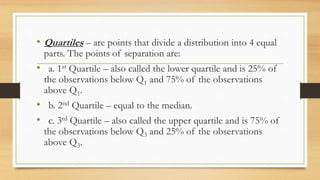
• Quartiles – are points that divide a distribution into 4 equal
parts. The points of separation are:
• a. 1st Quartile – also called the lower quartile and is 25% of
the observations below Q1 and 75% of the observations
above Q1.
• b. 2nd Quartile – equal to the median.
• c. 3rd Quartile – also called the upper quartile and is 75% of
the observations below Q3 and 25% of the observations
above Q3.
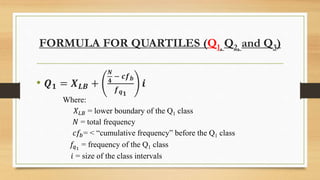
FORMULA FOR QUARTILES (Q1, Q2, and Q3)
• 𝑸 𝟏 = 𝑿 𝑳𝑩 +
𝑵
𝟒
− 𝒄𝒇 𝒃
𝒇 𝒒 𝟏
𝒊
Where:
𝑋 𝐿𝐵 = lower boundary of the Q1 class
𝑁 = total frequency
𝑐𝑓𝑏= < “cumulative frequency” before the Q1 class
𝑓𝑞1
= frequency of the Q1 class
𝑖 = size of the class intervals
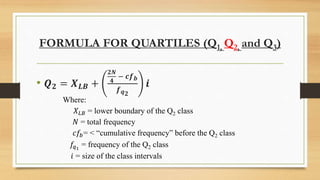
FORMULA FOR QUARTILES (Q1, Q2, and Q3)
• 𝑸 𝟐 = 𝑿 𝑳𝑩 +
𝟐𝑵
𝟒
− 𝒄𝒇 𝒃
𝒇 𝒒 𝟐
𝒊
Where:
𝑋 𝐿𝐵 = lower boundary of the Q2 class
𝑁 = total frequency
𝑐𝑓𝑏= < “cumulative frequency” before the Q2 class
𝑓𝑞1
= frequency of the Q2 class
𝑖 = size of the class intervals
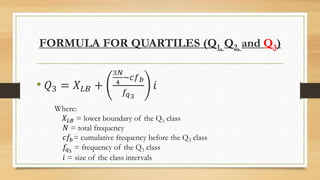
FORMULA FOR QUARTILES (Q1, Q2, and Q3)
• 𝑄3 = 𝑋 𝐿𝐵 +
3𝑁
4
−𝑐𝑓 𝑏
𝑓𝑞3
𝑖
Where:
𝑋 𝐿𝐵 = lower boundary of the Q3 class
𝑁 = total frequency
𝑐𝑓𝑏= cumulative frequency before the Q3 class
𝑓𝑞3
= frequency of the Q3 class
𝑖 = size of the class intervals
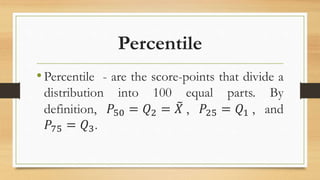
Percentile
•Percentile - are the score-points that divide a
distribution into 100 equal parts. By
definition, 𝑃50 = 𝑄2 = 𝑋 , 𝑃25 = 𝑄1 , and
𝑃75 = 𝑄3.
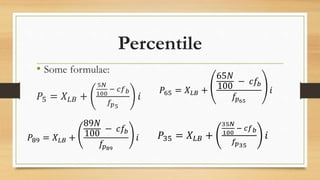
Percentile
• Some formulae:
𝑃5 = 𝑋 𝐿𝐵 +
5𝑁
100
− 𝑐𝑓 𝑏
𝑓𝑝5
𝑖
𝑃65 = 𝑋 𝐿𝐵 +
65𝑁
100
− 𝑐𝑓𝑏
𝑓𝑝65
𝑖
𝑃35 = 𝑋 𝐿𝐵 +
35𝑁
100
− 𝑐𝑓 𝑏
𝑓𝑝35
𝑖𝑃89 = 𝑋 𝐿𝐵 +
89𝑁
100
− 𝑐𝑓𝑏
𝑓𝑝89
𝑖
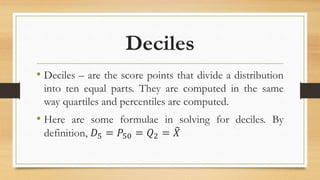
Deciles
• Deciles – are the score points that divide a distribution
into ten equal parts. They are computed in the same
way quartiles and percentiles are computed.
• Here are some formulae in solving for deciles. By
definition, 𝐷5 = 𝑃50 = 𝑄2 = 𝑋
Deciles
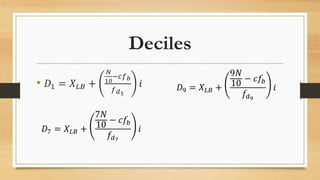
• 𝐷1 = 𝑋 𝐿𝐵 +
𝑁
10
−𝑐𝑓 𝑏
𝑓 𝑑1
𝑖 𝐷9 = 𝑋 𝐿𝐵 +
9𝑁
10
− 𝑐𝑓𝑏
𝑓𝑑9
𝑖
𝐷7 = 𝑋 𝐿𝐵 +
7𝑁
10
− 𝑐𝑓𝑏
𝑓𝑑7
𝑖
Solve for the 3rd quartile,
32nd percentile and 7th
decile.
Class
Interval
f <“cf
”
134-139 10 50
128-133 9 40
122-127 8 31
116-121 1 23
110-115 5 22
104-109 2 17
98-103 9 15
92-97 5 6
86-91 1 1
N=50
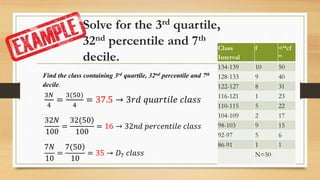
Find the class containing 3rd quartile, 32nd percentile and 7th
decile.
3𝑁
4
=
3(50)
4
= 37.5 → 3𝑟𝑑 𝑞𝑢𝑎𝑟𝑡𝑖𝑙𝑒 𝑐𝑙𝑎𝑠𝑠
32𝑁
100
=
)32(50
100
= 16 → 32𝑛𝑑 𝑝𝑒𝑟𝑐𝑒𝑛𝑡𝑖𝑙𝑒 𝑐𝑙𝑎𝑠𝑠
7𝑁
10
=
)7(50
10
= 35 → 𝐷7 𝑐𝑙𝑎𝑠𝑠
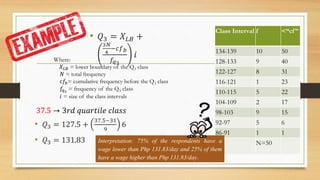
• 𝑄3 = 127.5 +
37.5−31
9
6
• 𝑄3 = 131.83
Class Interval f <“cf”
134-139 10 50
128-133 9 40
122-127 8 31
116-121 1 23
110-115 5 22
104-109 2 17
98-103 9 15
92-97 5 6
86-91 1 1
N=50
• 𝑄3 = 𝑋 𝐿𝐵 +
3𝑁
4
−𝑐𝑓 𝑏
𝑓𝑞3
𝑖Where:
𝑋 𝐿𝐵 = lower boundary of the Q3 class
𝑁 = total frequency
𝑐𝑓𝑏= cumulative frequency before the Q3 class
𝑓𝑞3
= frequency of the Q3 class
𝑖 = size of the class intervals
37.5 → 3𝑟𝑑 𝑞𝑢𝑎𝑟𝑡𝑖𝑙𝑒 𝑐𝑙𝑎𝑠𝑠
Interpretation: 75% of the respondents have a
wage lower than Php 131.83/day and 25% of them
have a wage higher than Php 131.83/day.
𝑃32 = 𝑋 𝐿𝐵 +
32𝑁
100
− 𝑐𝑓𝑏
𝑓𝑝32
𝑖
Class Interval f <“cf”
134-139 10 50
128-133 9 40
122-127 8 31
116-121 1 23
110-115 5 22
104-109 2 17
98-103 9 15
92-97 5 6
86-91 1 1
N=50
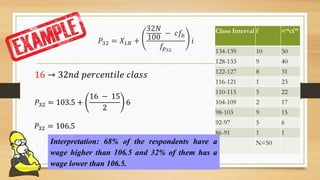
16 → 32𝑛𝑑 𝑝𝑒𝑟𝑐𝑒𝑛𝑡𝑖𝑙𝑒 𝑐𝑙𝑎𝑠𝑠
𝑃32 = 103.5 +
16 − 15
2
6
𝑃32 = 106.5
Interpretation: 68% of the respondents have a
wage higher than 106.5 and 32% of them has a
wage lower than 106.5.
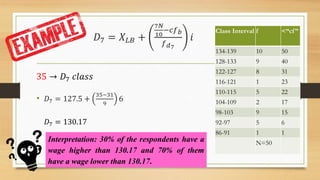
𝐷7 = 𝑋 𝐿𝐵 +
7𝑁
10
−𝑐𝑓 𝑏
𝑓 𝑑7
𝑖
• 𝐷7 = 127.5 +
35−31
9
6
Class Interval f <“cf”
134-139 10 50
128-133 9 40
122-127 8 31
116-121 1 23
110-115 5 22
104-109 2 17
98-103 9 15
92-97 5 6
86-91 1 1
N=50
𝐷7 = 130.17
35 → 𝐷7 𝑐𝑙𝑎𝑠𝑠
Interpretation: 30% of the respondents have a
wage higher than 130.17 and 70% of them
have a wage lower than 130.17.
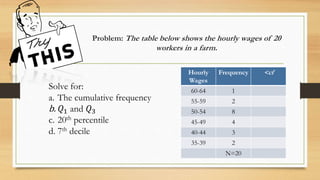
Problem: The table below shows the hourly wages of 20
workers in a farm.
Hourly
Wages
Frequency <cf
60-64 1
55-59 2
50-54 8
45-49 4
40-44 3
35-39 2
N=20
Solve for:
a. The cumulative frequency
b. 𝑄1 and 𝑄3
c. 20th percentile
d. 7th decile

Measures of position. gouped data

  • 1.
    Quartiles, Deciles, Percentiles (Grouped data) Objective:I can calculate a specified measure of position.
  • 2.
    • Quartiles –are points that divide a distribution into 4 equal parts. The points of separation are: • a. 1st Quartile – also called the lower quartile and is 25% of the observations below Q1 and 75% of the observations above Q1. • b. 2nd Quartile – equal to the median. • c. 3rd Quartile – also called the upper quartile and is 75% of the observations below Q3 and 25% of the observations above Q3.
  • 3.
    FORMULA FOR QUARTILES(Q1, Q2, and Q3) • 𝑸 𝟏 = 𝑿 𝑳𝑩 + 𝑵 𝟒 − 𝒄𝒇 𝒃 𝒇 𝒒 𝟏 𝒊 Where: 𝑋 𝐿𝐵 = lower boundary of the Q1 class 𝑁 = total frequency 𝑐𝑓𝑏= < “cumulative frequency” before the Q1 class 𝑓𝑞1 = frequency of the Q1 class 𝑖 = size of the class intervals
  • 4.
    FORMULA FOR QUARTILES(Q1, Q2, and Q3) • 𝑸 𝟐 = 𝑿 𝑳𝑩 + 𝟐𝑵 𝟒 − 𝒄𝒇 𝒃 𝒇 𝒒 𝟐 𝒊 Where: 𝑋 𝐿𝐵 = lower boundary of the Q2 class 𝑁 = total frequency 𝑐𝑓𝑏= < “cumulative frequency” before the Q2 class 𝑓𝑞1 = frequency of the Q2 class 𝑖 = size of the class intervals
  • 5.
    FORMULA FOR QUARTILES(Q1, Q2, and Q3) • 𝑄3 = 𝑋 𝐿𝐵 + 3𝑁 4 −𝑐𝑓 𝑏 𝑓𝑞3 𝑖 Where: 𝑋 𝐿𝐵 = lower boundary of the Q3 class 𝑁 = total frequency 𝑐𝑓𝑏= cumulative frequency before the Q3 class 𝑓𝑞3 = frequency of the Q3 class 𝑖 = size of the class intervals
  • 6.
    Percentile •Percentile - arethe score-points that divide a distribution into 100 equal parts. By definition, 𝑃50 = 𝑄2 = 𝑋 , 𝑃25 = 𝑄1 , and 𝑃75 = 𝑄3.
  • 7.
    Percentile • Some formulae: 𝑃5= 𝑋 𝐿𝐵 + 5𝑁 100 − 𝑐𝑓 𝑏 𝑓𝑝5 𝑖 𝑃65 = 𝑋 𝐿𝐵 + 65𝑁 100 − 𝑐𝑓𝑏 𝑓𝑝65 𝑖 𝑃35 = 𝑋 𝐿𝐵 + 35𝑁 100 − 𝑐𝑓 𝑏 𝑓𝑝35 𝑖𝑃89 = 𝑋 𝐿𝐵 + 89𝑁 100 − 𝑐𝑓𝑏 𝑓𝑝89 𝑖
  • 8.
    Deciles • Deciles –are the score points that divide a distribution into ten equal parts. They are computed in the same way quartiles and percentiles are computed. • Here are some formulae in solving for deciles. By definition, 𝐷5 = 𝑃50 = 𝑄2 = 𝑋
  • 9.
    Deciles • 𝐷1 =𝑋 𝐿𝐵 + 𝑁 10 −𝑐𝑓 𝑏 𝑓 𝑑1 𝑖 𝐷9 = 𝑋 𝐿𝐵 + 9𝑁 10 − 𝑐𝑓𝑏 𝑓𝑑9 𝑖 𝐷7 = 𝑋 𝐿𝐵 + 7𝑁 10 − 𝑐𝑓𝑏 𝑓𝑑7 𝑖
  • 10.
    Solve for the3rd quartile, 32nd percentile and 7th decile. Class Interval f <“cf ” 134-139 10 50 128-133 9 40 122-127 8 31 116-121 1 23 110-115 5 22 104-109 2 17 98-103 9 15 92-97 5 6 86-91 1 1 N=50 Find the class containing 3rd quartile, 32nd percentile and 7th decile. 3𝑁 4 = 3(50) 4 = 37.5 → 3𝑟𝑑 𝑞𝑢𝑎𝑟𝑡𝑖𝑙𝑒 𝑐𝑙𝑎𝑠𝑠 32𝑁 100 = )32(50 100 = 16 → 32𝑛𝑑 𝑝𝑒𝑟𝑐𝑒𝑛𝑡𝑖𝑙𝑒 𝑐𝑙𝑎𝑠𝑠 7𝑁 10 = )7(50 10 = 35 → 𝐷7 𝑐𝑙𝑎𝑠𝑠
  • 11.
    • 𝑄3 =127.5 + 37.5−31 9 6 • 𝑄3 = 131.83 Class Interval f <“cf” 134-139 10 50 128-133 9 40 122-127 8 31 116-121 1 23 110-115 5 22 104-109 2 17 98-103 9 15 92-97 5 6 86-91 1 1 N=50 • 𝑄3 = 𝑋 𝐿𝐵 + 3𝑁 4 −𝑐𝑓 𝑏 𝑓𝑞3 𝑖Where: 𝑋 𝐿𝐵 = lower boundary of the Q3 class 𝑁 = total frequency 𝑐𝑓𝑏= cumulative frequency before the Q3 class 𝑓𝑞3 = frequency of the Q3 class 𝑖 = size of the class intervals 37.5 → 3𝑟𝑑 𝑞𝑢𝑎𝑟𝑡𝑖𝑙𝑒 𝑐𝑙𝑎𝑠𝑠 Interpretation: 75% of the respondents have a wage lower than Php 131.83/day and 25% of them have a wage higher than Php 131.83/day.
  • 12.
    𝑃32 = 𝑋𝐿𝐵 + 32𝑁 100 − 𝑐𝑓𝑏 𝑓𝑝32 𝑖 Class Interval f <“cf” 134-139 10 50 128-133 9 40 122-127 8 31 116-121 1 23 110-115 5 22 104-109 2 17 98-103 9 15 92-97 5 6 86-91 1 1 N=50 16 → 32𝑛𝑑 𝑝𝑒𝑟𝑐𝑒𝑛𝑡𝑖𝑙𝑒 𝑐𝑙𝑎𝑠𝑠 𝑃32 = 103.5 + 16 − 15 2 6 𝑃32 = 106.5 Interpretation: 68% of the respondents have a wage higher than 106.5 and 32% of them has a wage lower than 106.5.
  • 13.
    𝐷7 = 𝑋𝐿𝐵 + 7𝑁 10 −𝑐𝑓 𝑏 𝑓 𝑑7 𝑖 • 𝐷7 = 127.5 + 35−31 9 6 Class Interval f <“cf” 134-139 10 50 128-133 9 40 122-127 8 31 116-121 1 23 110-115 5 22 104-109 2 17 98-103 9 15 92-97 5 6 86-91 1 1 N=50 𝐷7 = 130.17 35 → 𝐷7 𝑐𝑙𝑎𝑠𝑠 Interpretation: 30% of the respondents have a wage higher than 130.17 and 70% of them have a wage lower than 130.17.
  • 14.
    Problem: The tablebelow shows the hourly wages of 20 workers in a farm. Hourly Wages Frequency <cf 60-64 1 55-59 2 50-54 8 45-49 4 40-44 3 35-39 2 N=20 Solve for: a. The cumulative frequency b. 𝑄1 and 𝑄3 c. 20th percentile d. 7th decile