


5/2/2020 Janak Singh Saud 1
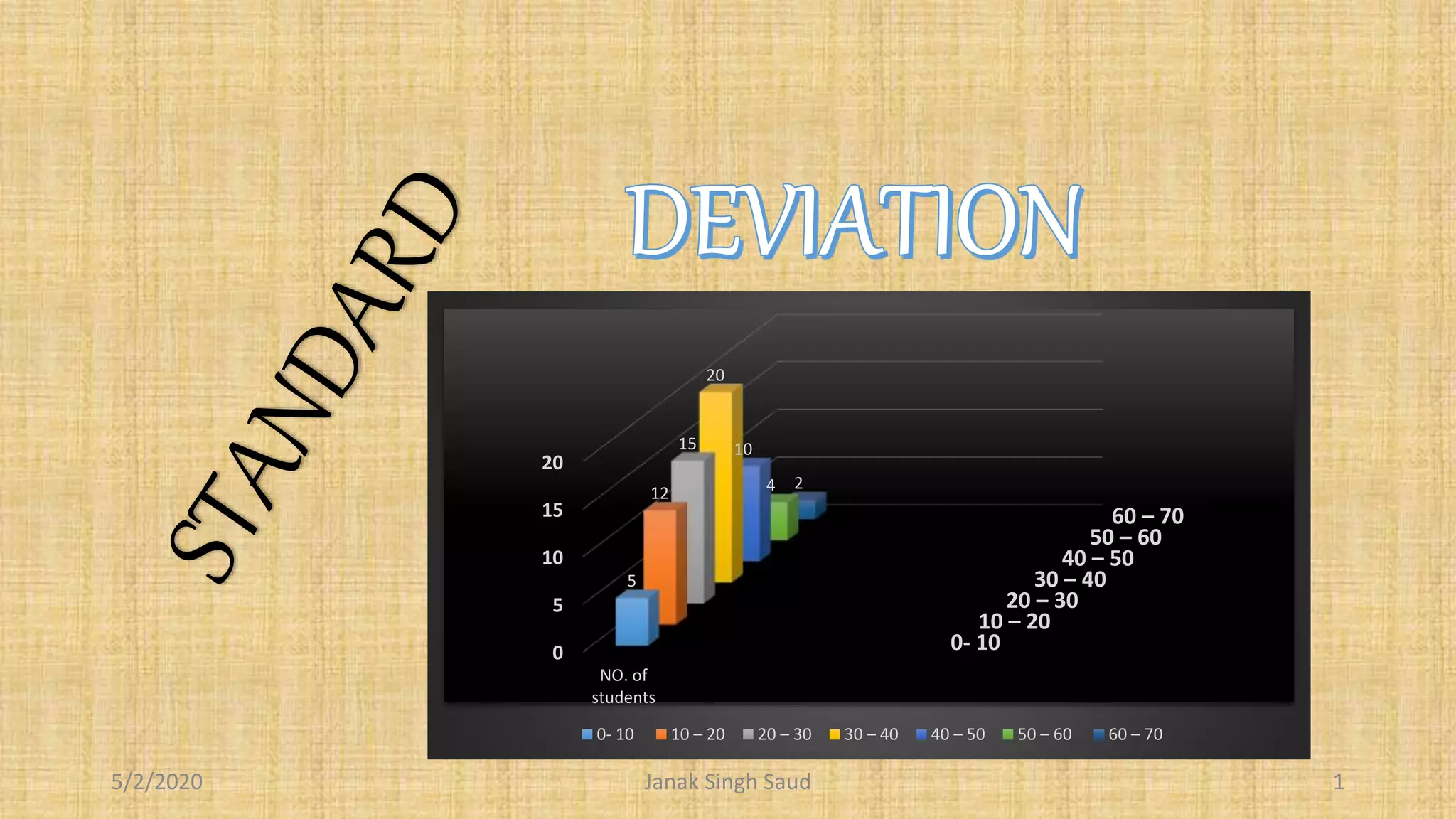
0- 10
10 – 20
20 – 30
30 – 40
40 – 50
50 – 60
60 – 70
0
5
10
15
20
NO. of
students
5
12
15
20
10
4 2
0- 10 10 – 20 20 – 30 30 – 40 40 – 50 50 – 60 60 – 70
OBJECTIVES
5/2/2020 Janak Singh Saud 2
The learners are expected to
• Calculate the Standard Deviation of a given set of
grouped data.
• Compare the consistency and variability of two given
set of data by Coefficient of variance.
STANDARD DEVIATION
5/2/2020 Janak Singh Saud 3
 It is considered as the most reliable
measure of variability because
Its value is based on all the observations
Deviation of each item is taken from the central
value
All algebraic sign are also considered
5/2/2020 Janak Singh Saud 4
STANDARD DEVIATION
S.D is a special form of average deviation from the
mean
S.D is affected by the individual values or items in
the distribution
•The concept of standard deviation was first introduced
by Karl pearson in 1893
•The standard deviation is the most useful and the most
popular measure of dispersion.
•It is always calculated from the arithmetic mean;
median and mode is not considered.
5/2/2020 Janak Singh Saud 5
Standard
Definition:
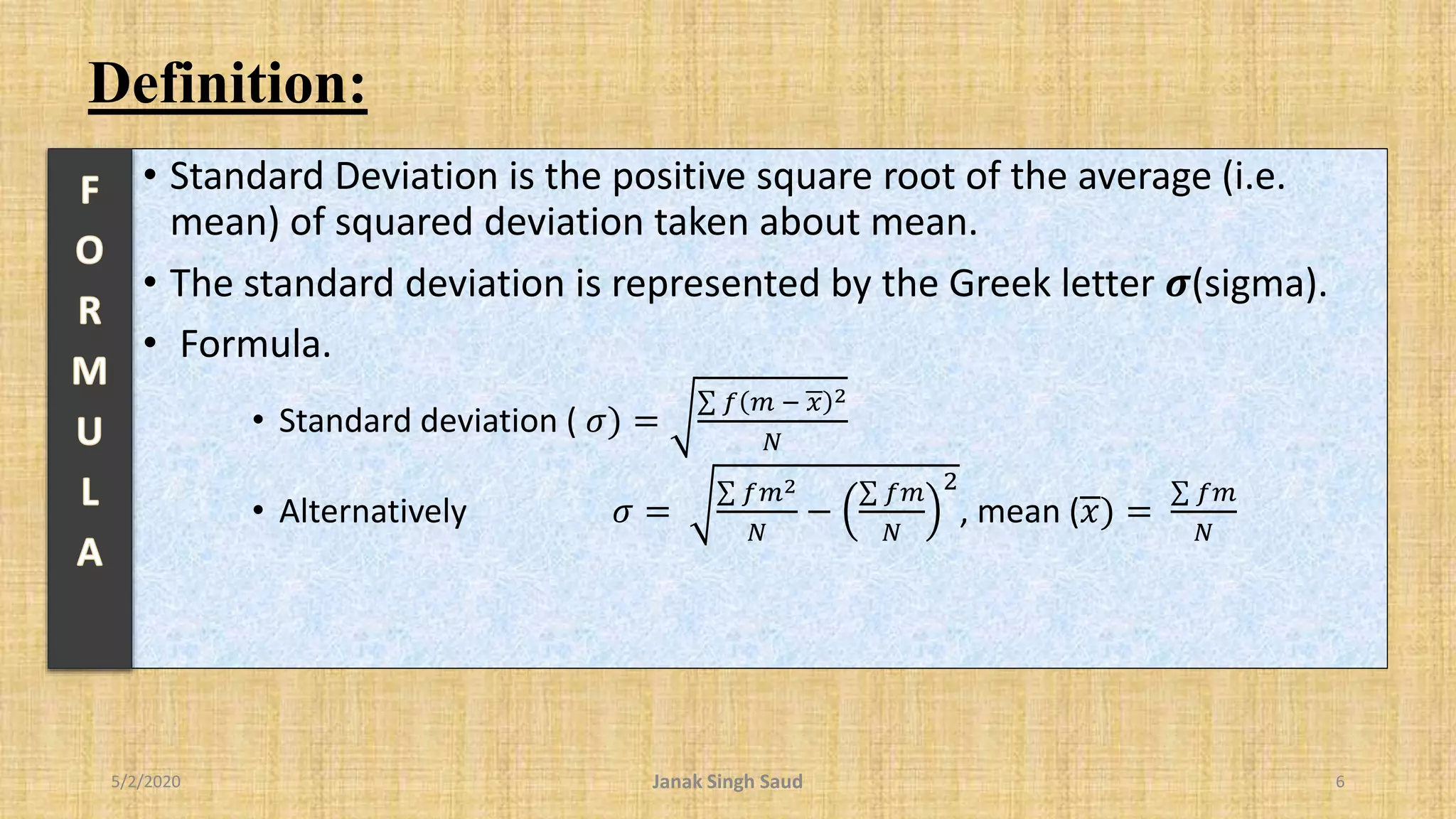
• Standard Deviation is the positive square root of the average (i.e.
mean) of squared deviation taken about mean.
• The standard deviation is represented by the Greek letter 𝝈(sigma).
• Formula.
• Standard deviation ( 𝜎) =
𝑓 𝑚 − 𝑥 2
𝑁
• Alternatively 𝜎 =
𝑓𝑚2
𝑁
−
𝑓𝑚
𝑁
2
, mean (𝑥) =
𝑓𝑚
𝑁
5/2/2020 Janak Singh Saud 6
5/2/2020 Janak Singh Saud 7
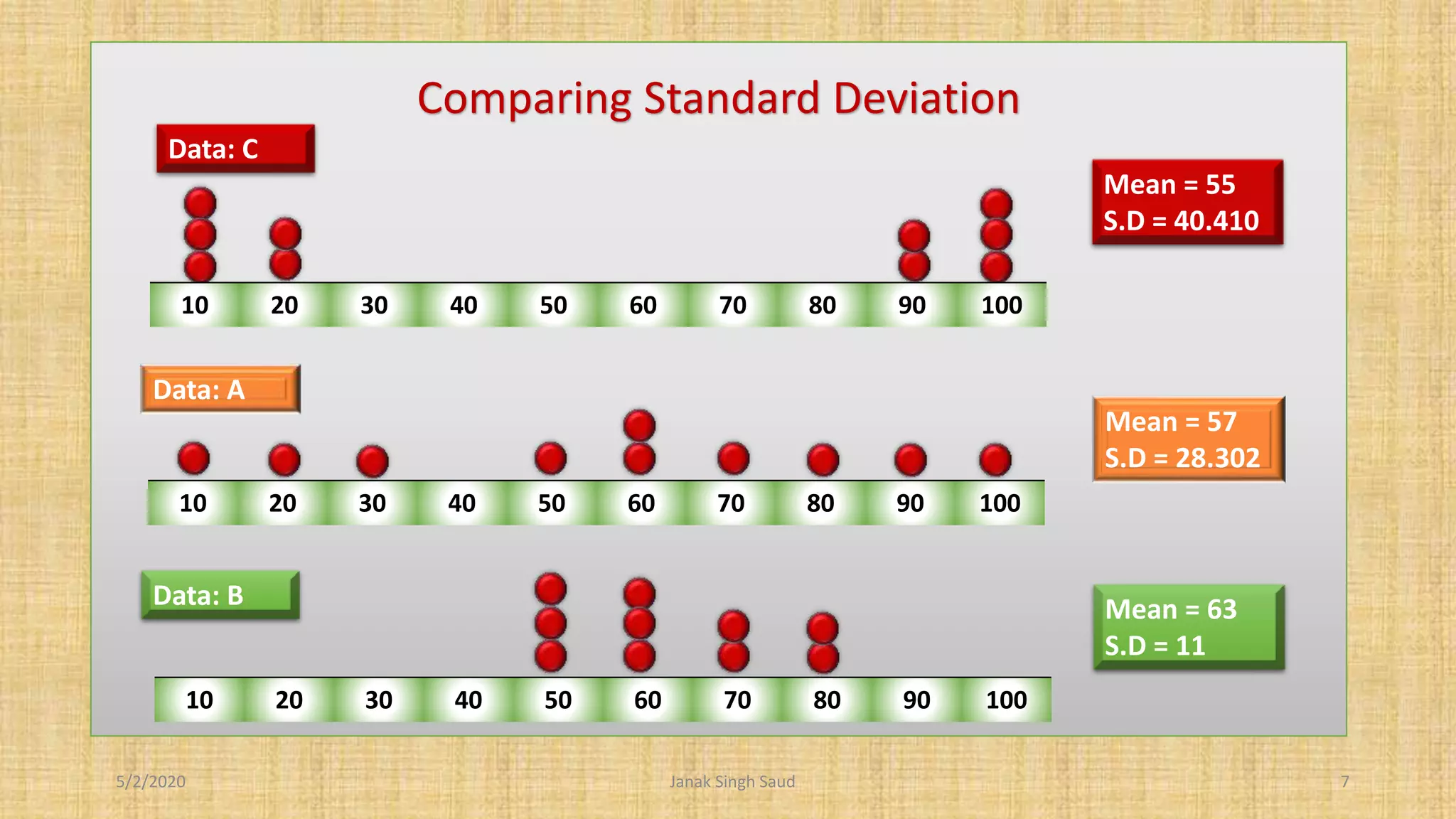
Comparing Standard Deviation
10 20 30 40 50 60 70 80 90 100
Data: A
Mean = 57
S.D = 28.302
Data: B Mean = 63
S.D = 11
10 20 30 40 50 60 70 80 90 100
Data: C
Mean = 55
S.D = 40.410
10 20 30 40 50 60 70 80 90 100
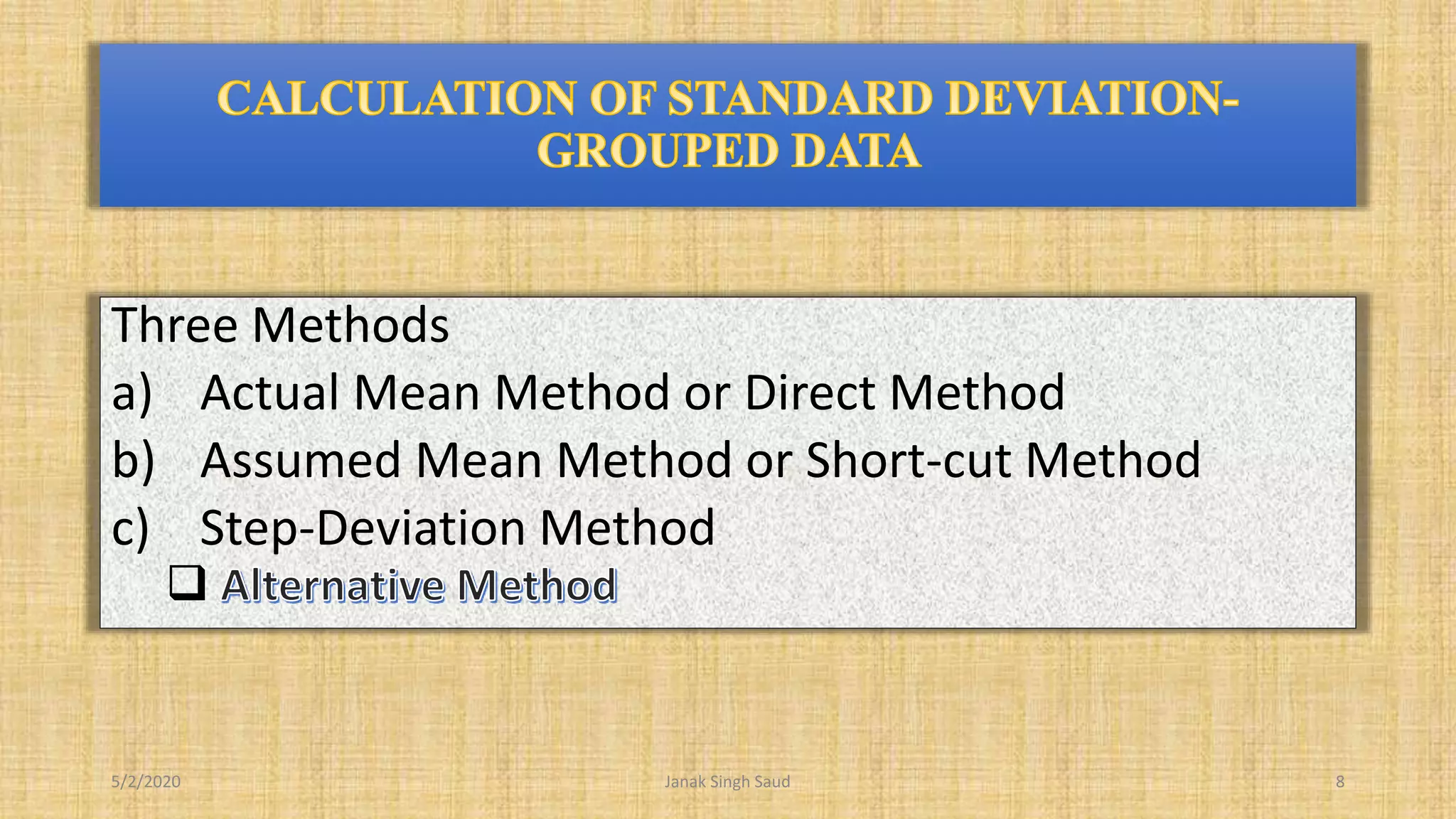
Three Methods
a) Actual Mean Method or Direct Method
b) Assumed Mean Method or Short-cut Method
c) Step-Deviation Method

5/2/2020 Janak Singh Saud 8
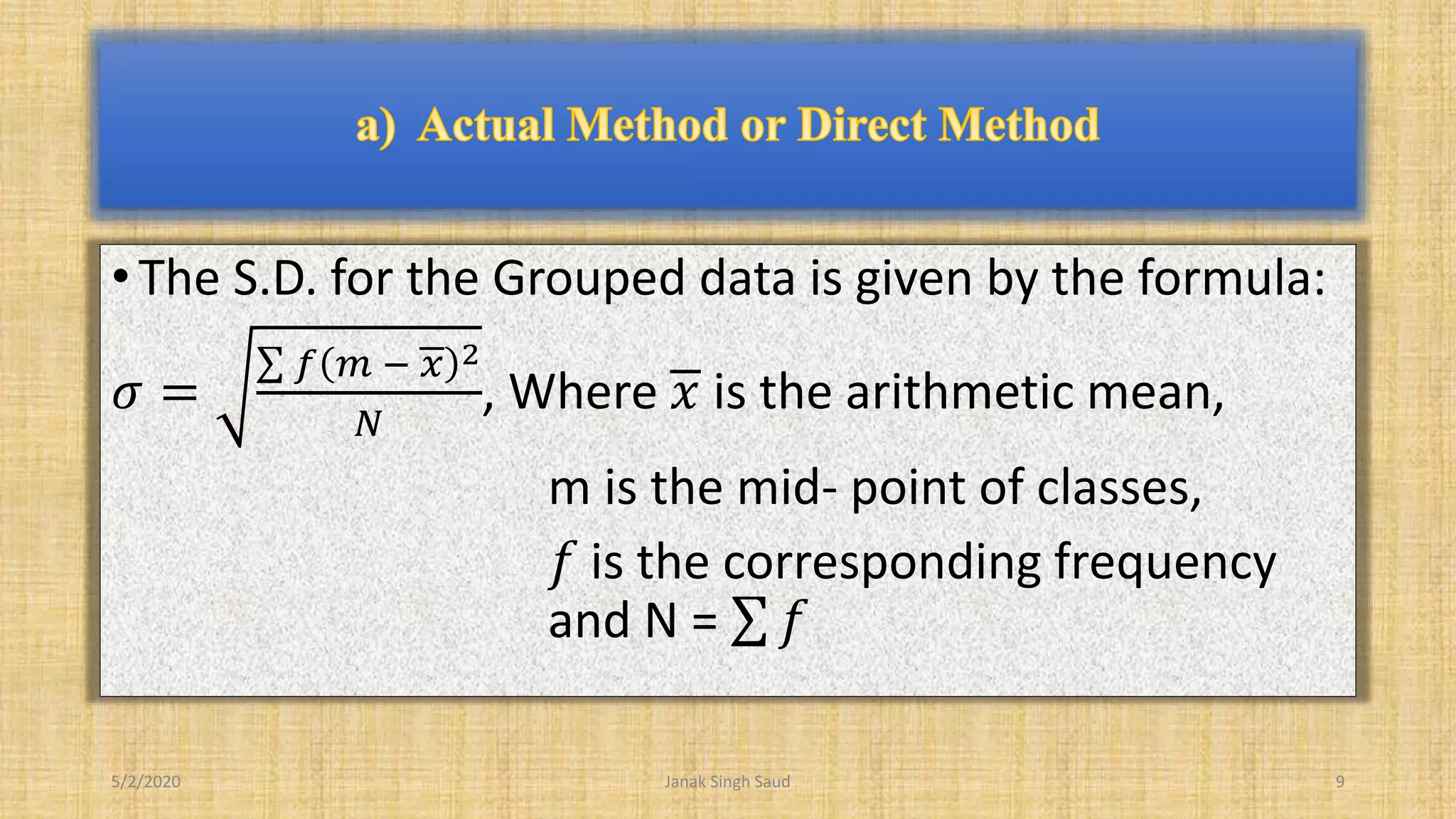
• The S.D. for the Grouped data is given by the formula:
𝜎 =
𝑓 𝑚 − 𝑥 2
𝑁
, Where 𝑥 is the arithmetic mean,
m is the mid- point of classes,
𝑓 is the corresponding frequency
and N = 𝑓
5/2/2020 Janak Singh Saud 9
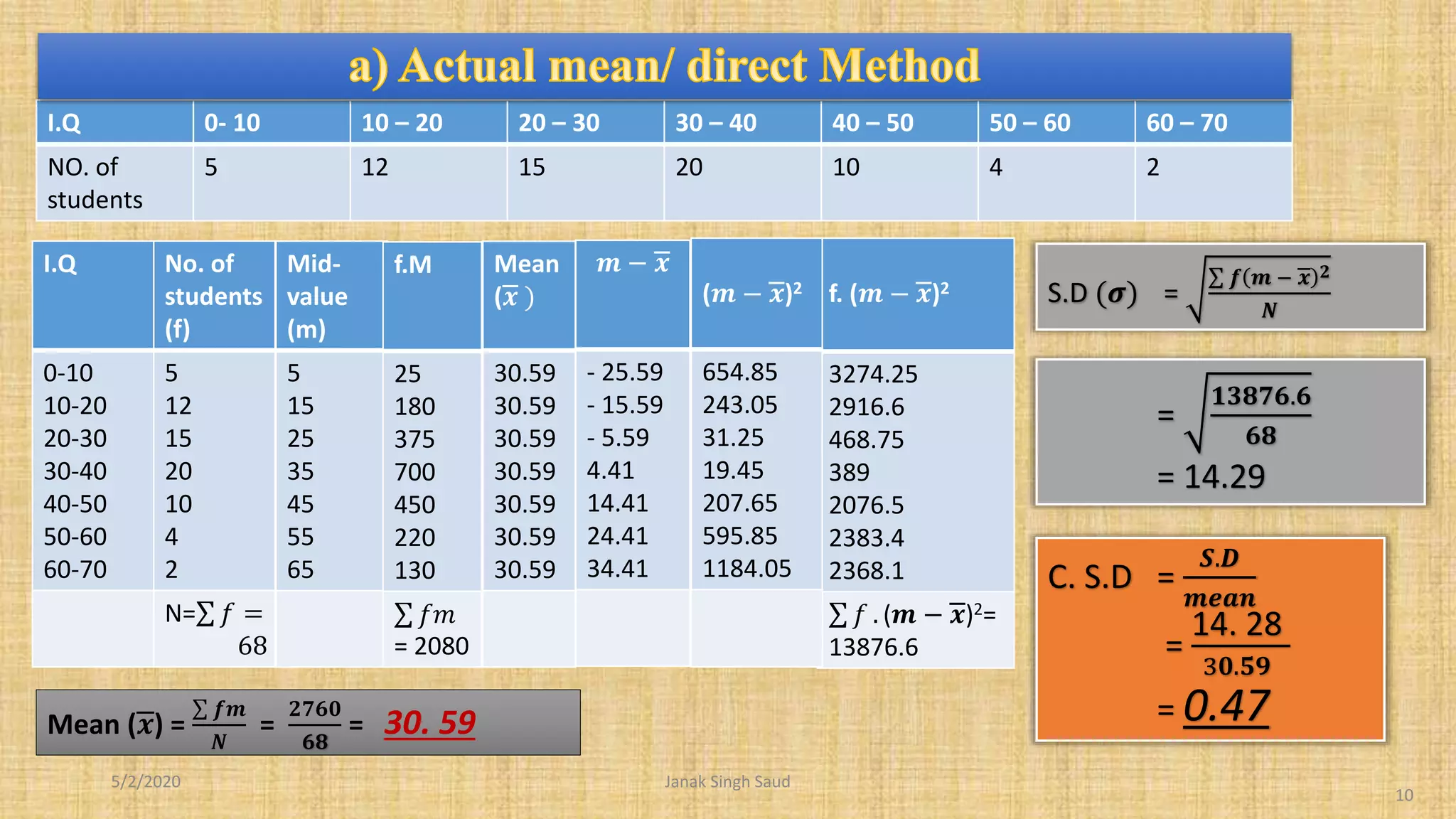
Mean
(𝒙 )
30.59
30.59
30.59
30.59
30.59
30.59
30.59
I.Q 0- 10 10 – 20 20 – 30 30 – 40 40 – 50 50 – 60 60 – 70
NO. of
students
5 12 15 20 10 4 2
f. (𝒎 − 𝒙)2
3274.25
2916.6
468.75
389
2076.5
2383.4
2368.1
𝑓 . (𝒎 − 𝒙)2=
13876.6
Mean (𝒙) =
𝒇𝒎
𝑵
=
𝟐𝟕𝟔𝟎
𝟔𝟖
= 30. 59
S.D (𝝈) =
𝒇 𝒎 − 𝒙 𝟐
𝑵
=
𝟏𝟑𝟖𝟕𝟔.𝟔
𝟔𝟖
= 14.29
C. S.D =
𝑺.𝑫
𝒎𝒆𝒂𝒏
=
14. 28
3𝟎.𝟓𝟗
= 0.47
I.Q No. of
students
(f)
0-10
10-20
20-30
30-40
40-50
50-60
60-70
5
12
15
20
10
4
2
N= 𝑓 =
68
Mid-
value
(m)
5
15
25
35
45
55
65
f.M
25
180
375
700
450
220
130
𝑓𝑚
= 2080
𝒎 − 𝒙
- 25.59
- 15.59
- 5.59
4.41
14.41
24.41
34.41
(𝒎 − 𝒙)2
654.85
243.05
31.25
19.45
207.65
595.85
1184.05
5/2/2020 Janak Singh Saud
10
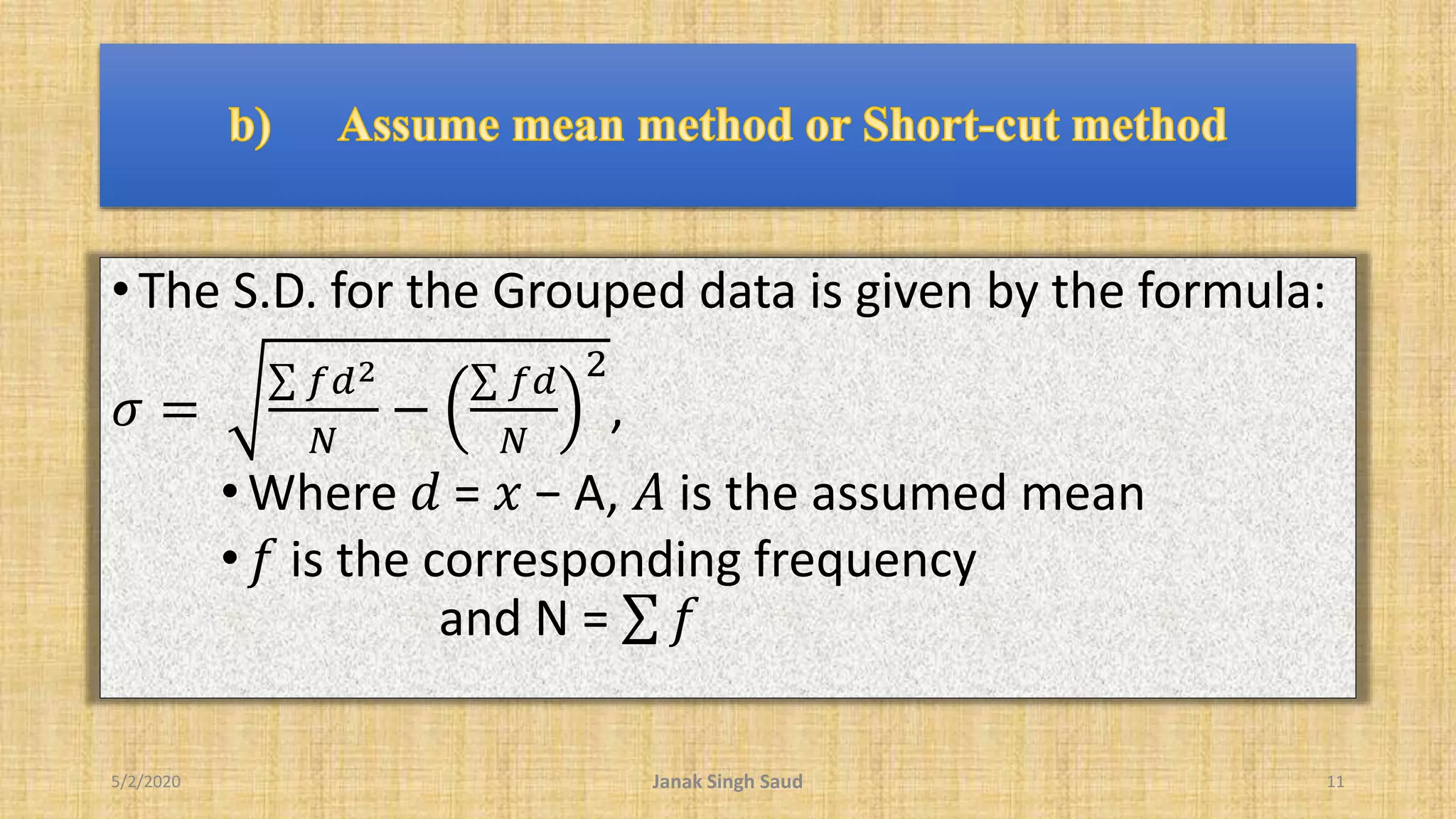
• The S.D. for the Grouped data is given by the formula:
𝜎 =
𝑓𝑑2
𝑁
−
𝑓𝑑
𝑁
2
,
•Where 𝑑 = 𝑥 − A, 𝐴 is the assumed mean
• 𝑓 is the corresponding frequency
and N = 𝑓
5/2/2020 Janak Singh Saud 11
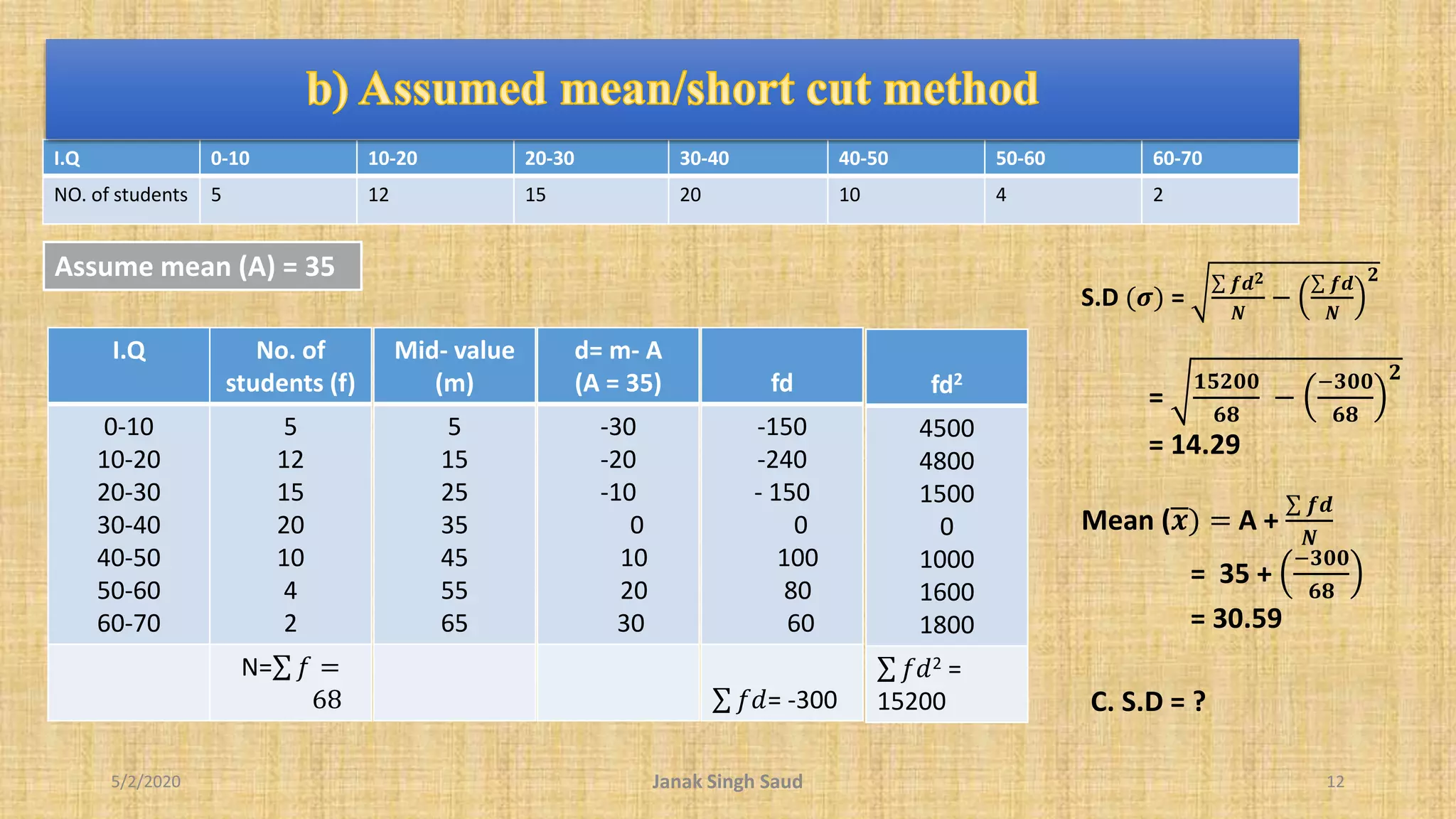
I.Q 0-10 10-20 20-30 30-40 40-50 50-60 60-70
NO. of students 5 12 15 20 10 4 2
fd2
4500
4800
1500
0
1000
1600
1800
𝑓𝑑2 =
15200
Assume mean (A) = 35
S.D (𝝈) =
𝒇𝒅 𝟐
𝑵
−
𝒇𝒅
𝑵
𝟐
=
𝟏𝟓𝟐𝟎𝟎
𝟔𝟖
−
−𝟑𝟎𝟎
𝟔𝟖
𝟐
= 14.29
Mean (𝒙) = A +
𝒇𝒅
𝑵
= 35 +
−𝟑𝟎𝟎
𝟔𝟖
= 30.59
I.Q No. of
students (f)
0-10
10-20
20-30
30-40
40-50
50-60
60-70
5
12
15
20
10
4
2
N= 𝑓 =
68
Mid- value
(m)
5
15
25
35
45
55
65
d= m- A
(A = 35)
-30
-20
-10
0
10
20
30
fd
-150
-240
- 150
0
100
80
60
𝑓𝑑= -300
5/2/2020 Janak Singh Saud 12
C. S.D = ?
5/2/2020 Janak Singh Saud 13
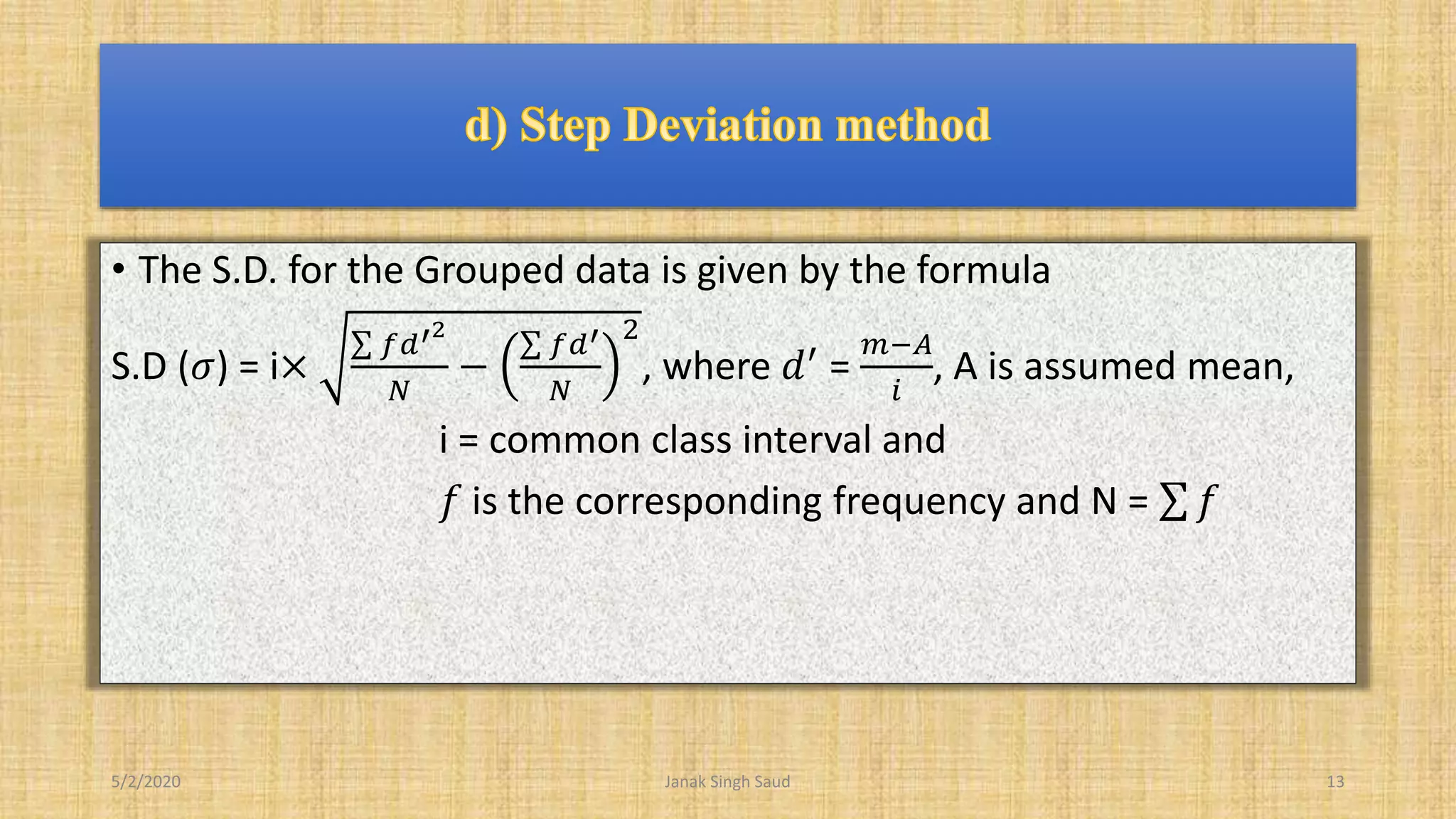
• The S.D. for the Grouped data is given by the formula
S.D (𝜎) = i×
𝑓𝑑′2
𝑁
−
𝑓𝑑′
𝑁
2
, where 𝑑′ =
𝑚−𝐴
𝑖
, A is assumed mean,
i = common class interval and
𝑓 is the corresponding frequency and N = 𝑓
5/2/2020 Janak Singh Saud 14
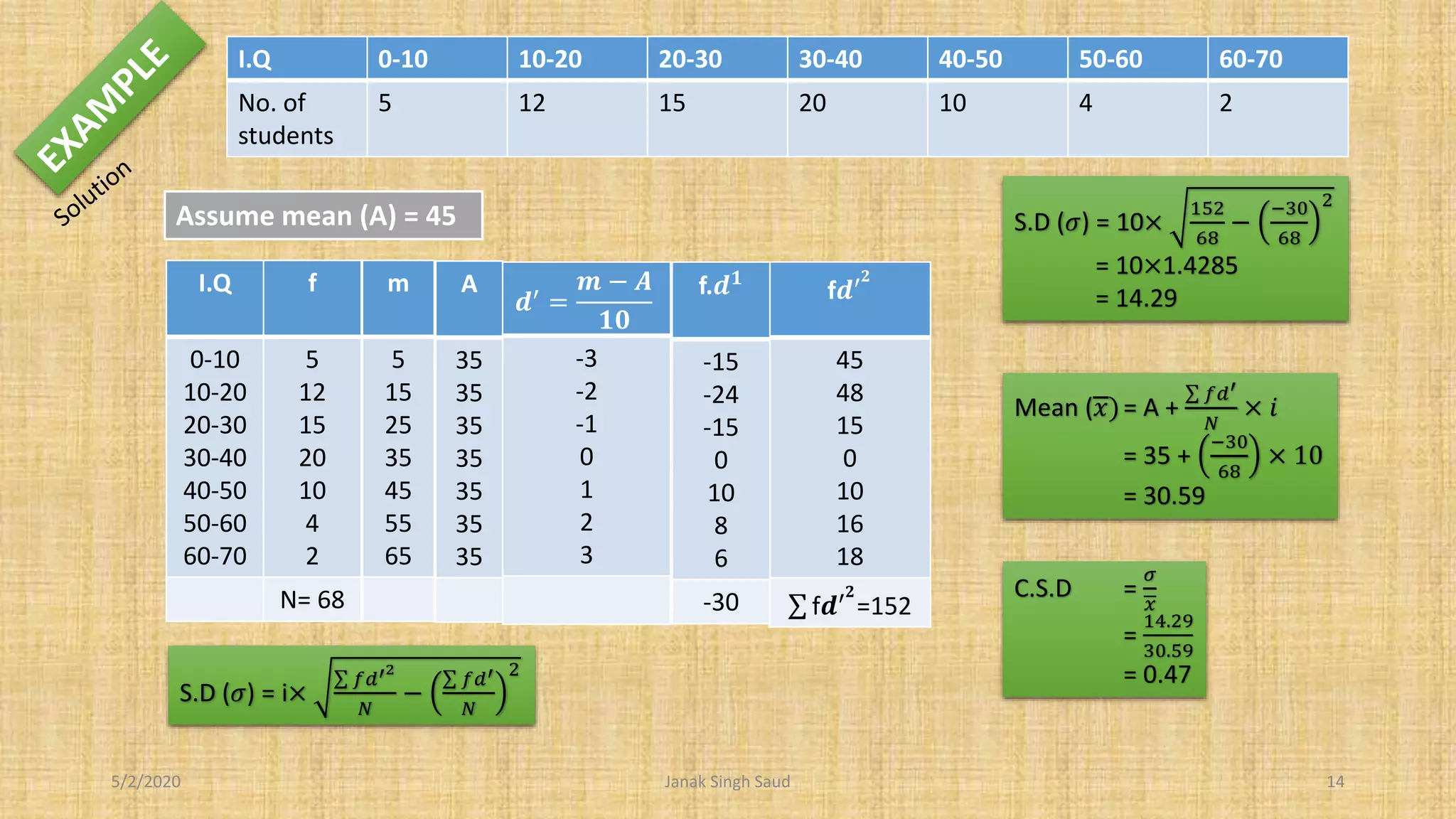
I.Q 0-10 10-20 20-30 30-40 40-50 50-60 60-70
No. of
students
5 12 15 20 10 4 2
Assume mean (A) = 45
f𝒅′ 𝟐
45
48
15
0
10
16
18
f𝒅′ 𝟐
=152
I.Q f
0-10
10-20
20-30
30-40
40-50
50-60
60-70
5
12
15
20
10
4
2
N= 68
m
5
15
25
35
45
55
65
A
35
35
35
35
35
35
35
𝒅′
=
𝒎 − 𝑨
𝟏𝟎
-3
-2
-1
0
1
2
3
f.𝒅 𝟏
-15
-24
-15
0
10
8
6
-30
S.D (𝜎) = i×
𝑓𝑑′2
𝑁
−
𝑓𝑑′
𝑁
2
S.D (𝜎) = 10×
152
68
−
−30
68
2
= 10×1.4285
= 14.29
Mean (𝑥)= A +
𝑓𝑑′
𝑁
× 𝑖
= 35 +
−30
68
× 10
= 30.59
C.S.D =
𝜎
𝑥
=
14.29
30.59
= 0.47
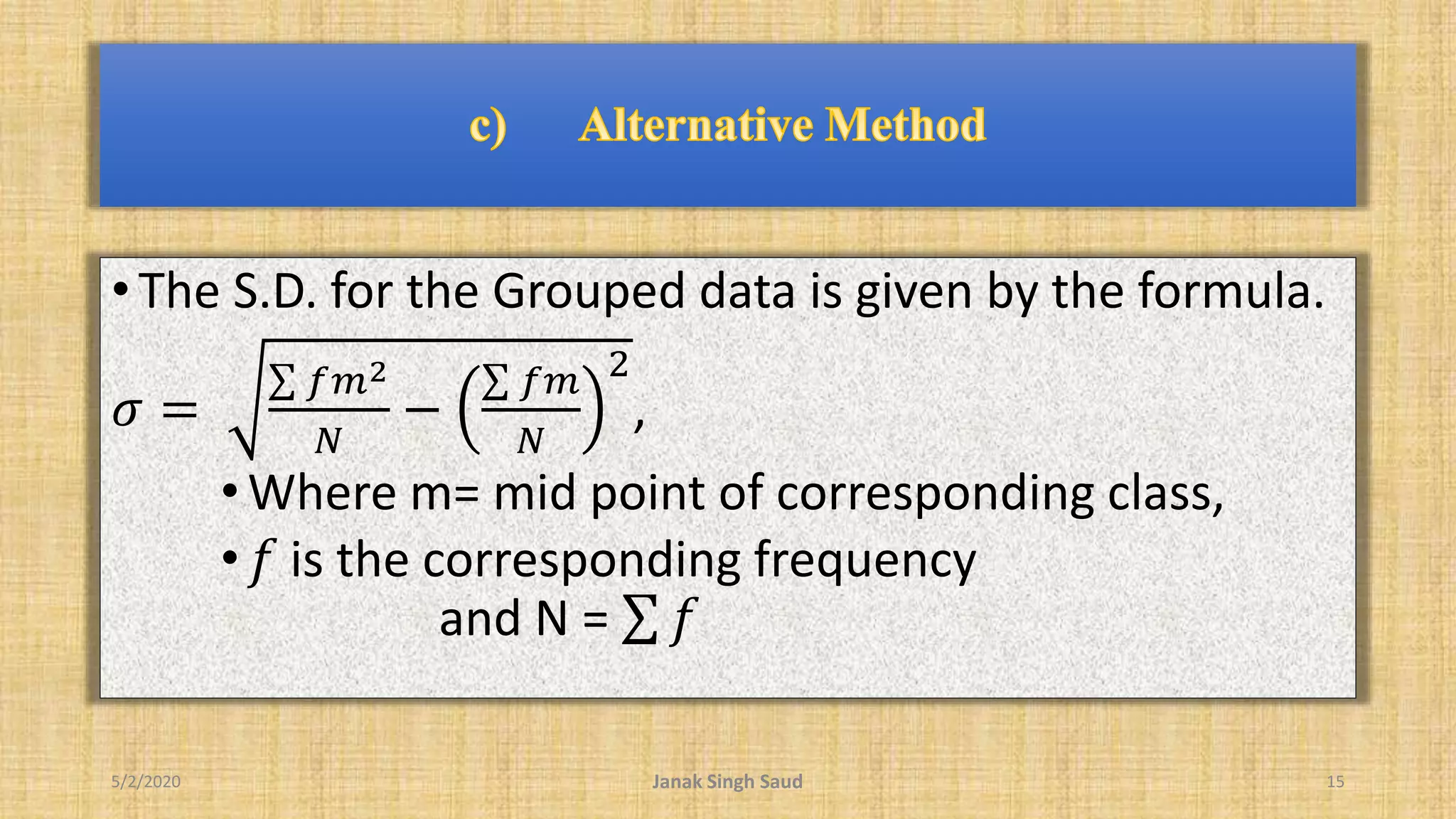
• The S.D. for the Grouped data is given by the formula.
𝜎 =
𝑓𝑚2
𝑁
−
𝑓𝑚
𝑁
2
,
•Where m= mid point of corresponding class,
• 𝑓 is the corresponding frequency
and N = 𝑓
5/2/2020 Janak Singh Saud 15
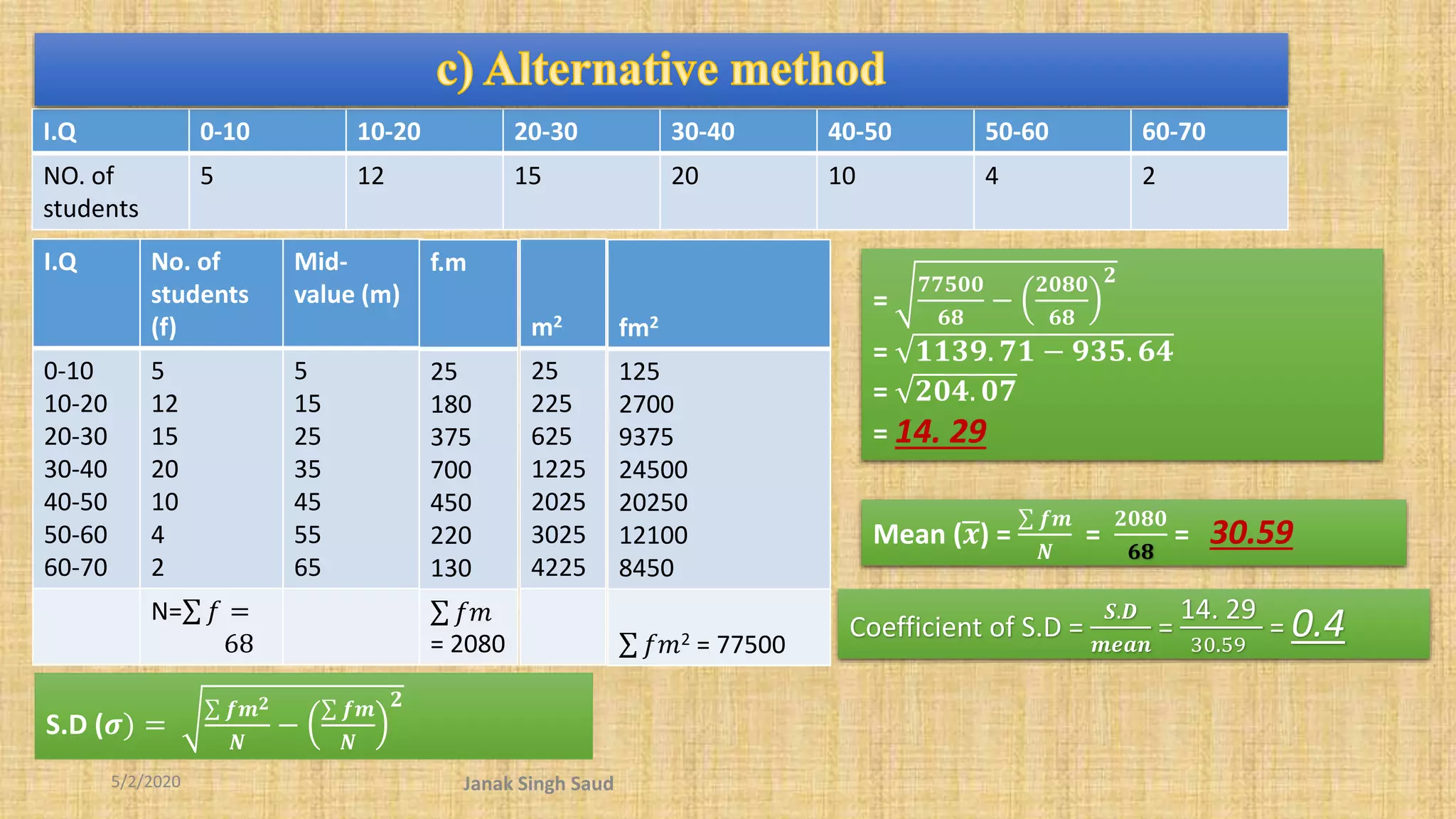
I.Q 0-10 10-20 20-30 30-40 40-50 50-60 60-70
NO. of
students
5 12 15 20 10 4 2
fm2
125
2700
9375
24500
20250
12100
8450
𝑓𝑚2 = 77500
S.D (𝝈) =
𝒇𝒎 𝟐
𝑵
−
𝒇𝒎
𝑵
𝟐
Mean (𝒙) =
𝒇𝒎
𝑵
=
𝟐𝟎𝟖𝟎
𝟔𝟖
= 30.59
Coefficient of S.D =
𝑺.𝑫
𝒎𝒆𝒂𝒏
=
14. 29
30.59
= 0.4
=
𝟕𝟕𝟓𝟎𝟎
𝟔𝟖
−
𝟐𝟎𝟖𝟎
𝟔𝟖
𝟐
= 𝟏𝟏𝟑𝟗. 𝟕𝟏 − 𝟗𝟑𝟓. 𝟔𝟒
= 𝟐𝟎𝟒. 𝟎𝟕
= 14. 29
I.Q No. of
students
(f)
Mid-
value (m)
0-10
10-20
20-30
30-40
40-50
50-60
60-70
5
12
15
20
10
4
2
5
15
25
35
45
55
65
N= 𝑓 =
68
f.m
25
180
375
700
450
220
130
𝑓𝑚
= 2080
m2
25
225
625
1225
2025
3025
4225
5/2/2020 Janak Singh Saud
5/2/2020 Janak Singh Saud 17
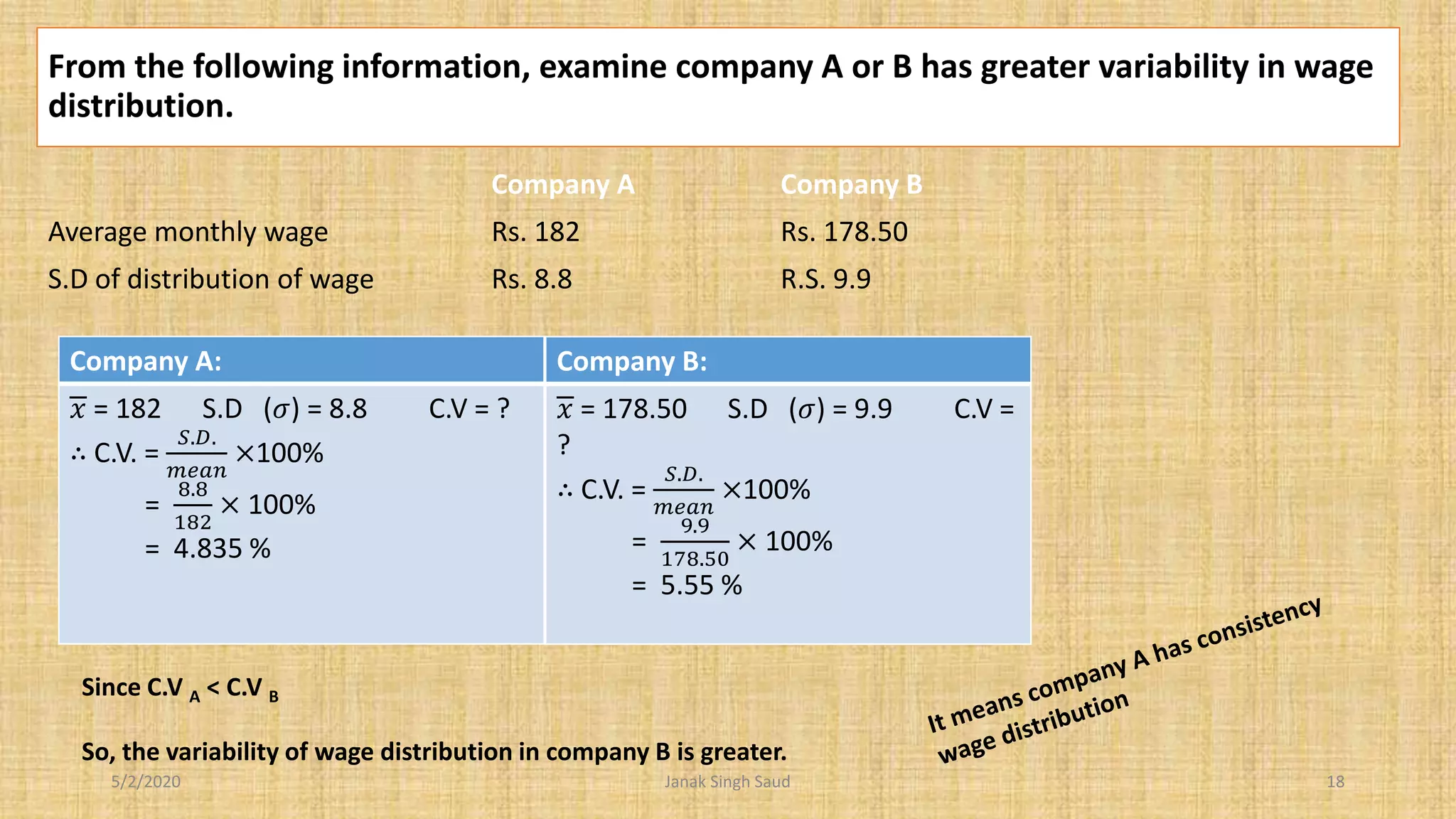
From the following information, examine company A or B has greater variability in wage
distribution.
Company A Company B
Average monthly wage Rs. 182 Rs. 178.50
S.D of distribution of wage Rs. 8.8 R.S. 9.9
Company B:
𝑥 = 178.50 S.D (𝜎) = 9.9 C.V =
?
∴ C.V. =
𝑆.𝐷.
𝑚𝑒𝑎𝑛
×100%
=
9.9
178.50
× 100%
= 5.55 %
Since C.V A < C.V B
So, the variability of wage distribution in company B is greater.
Company A:
𝑥 = 182 S.D (𝜎) = 8.8 C.V = ?
∴ C.V. =
𝑆.𝐷.
𝑚𝑒𝑎𝑛
×100%
=
8.8
182
× 100%
= 4.835 %
5/2/2020 Janak Singh Saud 18
Email: saudjanaksingh@gmail.com
Youtube Channel:
https://www.youtube.com/channel/UCGxSYD_UZLzXfmAzxaRyYhw?vie
w_as=subscriber
https://www.blogger.com/blogger.g?blogID=5544241353531082206#al
lposts
https://www.facebook.com/janaksinghsaud
https://www.slideshare.net/janaksinghsaud
5/2/2020 Janak Singh Saud 19
THANK YOU
5/2/2020 Janak Singh Saud 20

Standard deviation :grouped data/Continuous data

  • 1.
    5/2/2020 Janak SinghSaud 1 0- 10 10 – 20 20 – 30 30 – 40 40 – 50 50 – 60 60 – 70 0 5 10 15 20 NO. of students 5 12 15 20 10 4 2 0- 10 10 – 20 20 – 30 30 – 40 40 – 50 50 – 60 60 – 70
  • 2.
    OBJECTIVES 5/2/2020 Janak SinghSaud 2 The learners are expected to • Calculate the Standard Deviation of a given set of grouped data. • Compare the consistency and variability of two given set of data by Coefficient of variance.
  • 3.
    STANDARD DEVIATION 5/2/2020 JanakSingh Saud 3  It is considered as the most reliable measure of variability because Its value is based on all the observations Deviation of each item is taken from the central value All algebraic sign are also considered
  • 4.
    5/2/2020 Janak SinghSaud 4 STANDARD DEVIATION S.D is a special form of average deviation from the mean S.D is affected by the individual values or items in the distribution
  • 5.
    •The concept ofstandard deviation was first introduced by Karl pearson in 1893 •The standard deviation is the most useful and the most popular measure of dispersion. •It is always calculated from the arithmetic mean; median and mode is not considered. 5/2/2020 Janak Singh Saud 5 Standard
  • 6.
    Definition: • Standard Deviationis the positive square root of the average (i.e. mean) of squared deviation taken about mean. • The standard deviation is represented by the Greek letter 𝝈(sigma). • Formula. • Standard deviation ( 𝜎) = 𝑓 𝑚 − 𝑥 2 𝑁 • Alternatively 𝜎 = 𝑓𝑚2 𝑁 − 𝑓𝑚 𝑁 2 , mean (𝑥) = 𝑓𝑚 𝑁 5/2/2020 Janak Singh Saud 6
  • 7.
    5/2/2020 Janak SinghSaud 7 Comparing Standard Deviation 10 20 30 40 50 60 70 80 90 100 Data: A Mean = 57 S.D = 28.302 Data: B Mean = 63 S.D = 11 10 20 30 40 50 60 70 80 90 100 Data: C Mean = 55 S.D = 40.410 10 20 30 40 50 60 70 80 90 100
  • 8.
    Three Methods a) ActualMean Method or Direct Method b) Assumed Mean Method or Short-cut Method c) Step-Deviation Method  5/2/2020 Janak Singh Saud 8
  • 9.
    • The S.D.for the Grouped data is given by the formula: 𝜎 = 𝑓 𝑚 − 𝑥 2 𝑁 , Where 𝑥 is the arithmetic mean, m is the mid- point of classes, 𝑓 is the corresponding frequency and N = 𝑓 5/2/2020 Janak Singh Saud 9
  • 10.
    Mean (𝒙 ) 30.59 30.59 30.59 30.59 30.59 30.59 30.59 I.Q 0-10 10 – 20 20 – 30 30 – 40 40 – 50 50 – 60 60 – 70 NO. of students 5 12 15 20 10 4 2 f. (𝒎 − 𝒙)2 3274.25 2916.6 468.75 389 2076.5 2383.4 2368.1 𝑓 . (𝒎 − 𝒙)2= 13876.6 Mean (𝒙) = 𝒇𝒎 𝑵 = 𝟐𝟕𝟔𝟎 𝟔𝟖 = 30. 59 S.D (𝝈) = 𝒇 𝒎 − 𝒙 𝟐 𝑵 = 𝟏𝟑𝟖𝟕𝟔.𝟔 𝟔𝟖 = 14.29 C. S.D = 𝑺.𝑫 𝒎𝒆𝒂𝒏 = 14. 28 3𝟎.𝟓𝟗 = 0.47 I.Q No. of students (f) 0-10 10-20 20-30 30-40 40-50 50-60 60-70 5 12 15 20 10 4 2 N= 𝑓 = 68 Mid- value (m) 5 15 25 35 45 55 65 f.M 25 180 375 700 450 220 130 𝑓𝑚 = 2080 𝒎 − 𝒙 - 25.59 - 15.59 - 5.59 4.41 14.41 24.41 34.41 (𝒎 − 𝒙)2 654.85 243.05 31.25 19.45 207.65 595.85 1184.05 5/2/2020 Janak Singh Saud 10
  • 11.
    • The S.D.for the Grouped data is given by the formula: 𝜎 = 𝑓𝑑2 𝑁 − 𝑓𝑑 𝑁 2 , •Where 𝑑 = 𝑥 − A, 𝐴 is the assumed mean • 𝑓 is the corresponding frequency and N = 𝑓 5/2/2020 Janak Singh Saud 11
  • 12.
    I.Q 0-10 10-2020-30 30-40 40-50 50-60 60-70 NO. of students 5 12 15 20 10 4 2 fd2 4500 4800 1500 0 1000 1600 1800 𝑓𝑑2 = 15200 Assume mean (A) = 35 S.D (𝝈) = 𝒇𝒅 𝟐 𝑵 − 𝒇𝒅 𝑵 𝟐 = 𝟏𝟓𝟐𝟎𝟎 𝟔𝟖 − −𝟑𝟎𝟎 𝟔𝟖 𝟐 = 14.29 Mean (𝒙) = A + 𝒇𝒅 𝑵 = 35 + −𝟑𝟎𝟎 𝟔𝟖 = 30.59 I.Q No. of students (f) 0-10 10-20 20-30 30-40 40-50 50-60 60-70 5 12 15 20 10 4 2 N= 𝑓 = 68 Mid- value (m) 5 15 25 35 45 55 65 d= m- A (A = 35) -30 -20 -10 0 10 20 30 fd -150 -240 - 150 0 100 80 60 𝑓𝑑= -300 5/2/2020 Janak Singh Saud 12 C. S.D = ?
  • 13.
    5/2/2020 Janak SinghSaud 13 • The S.D. for the Grouped data is given by the formula S.D (𝜎) = i× 𝑓𝑑′2 𝑁 − 𝑓𝑑′ 𝑁 2 , where 𝑑′ = 𝑚−𝐴 𝑖 , A is assumed mean, i = common class interval and 𝑓 is the corresponding frequency and N = 𝑓
  • 14.
    5/2/2020 Janak SinghSaud 14 I.Q 0-10 10-20 20-30 30-40 40-50 50-60 60-70 No. of students 5 12 15 20 10 4 2 Assume mean (A) = 45 f𝒅′ 𝟐 45 48 15 0 10 16 18 f𝒅′ 𝟐 =152 I.Q f 0-10 10-20 20-30 30-40 40-50 50-60 60-70 5 12 15 20 10 4 2 N= 68 m 5 15 25 35 45 55 65 A 35 35 35 35 35 35 35 𝒅′ = 𝒎 − 𝑨 𝟏𝟎 -3 -2 -1 0 1 2 3 f.𝒅 𝟏 -15 -24 -15 0 10 8 6 -30 S.D (𝜎) = i× 𝑓𝑑′2 𝑁 − 𝑓𝑑′ 𝑁 2 S.D (𝜎) = 10× 152 68 − −30 68 2 = 10×1.4285 = 14.29 Mean (𝑥)= A + 𝑓𝑑′ 𝑁 × 𝑖 = 35 + −30 68 × 10 = 30.59 C.S.D = 𝜎 𝑥 = 14.29 30.59 = 0.47
  • 15.
    • The S.D.for the Grouped data is given by the formula. 𝜎 = 𝑓𝑚2 𝑁 − 𝑓𝑚 𝑁 2 , •Where m= mid point of corresponding class, • 𝑓 is the corresponding frequency and N = 𝑓 5/2/2020 Janak Singh Saud 15
  • 16.
    I.Q 0-10 10-2020-30 30-40 40-50 50-60 60-70 NO. of students 5 12 15 20 10 4 2 fm2 125 2700 9375 24500 20250 12100 8450 𝑓𝑚2 = 77500 S.D (𝝈) = 𝒇𝒎 𝟐 𝑵 − 𝒇𝒎 𝑵 𝟐 Mean (𝒙) = 𝒇𝒎 𝑵 = 𝟐𝟎𝟖𝟎 𝟔𝟖 = 30.59 Coefficient of S.D = 𝑺.𝑫 𝒎𝒆𝒂𝒏 = 14. 29 30.59 = 0.4 = 𝟕𝟕𝟓𝟎𝟎 𝟔𝟖 − 𝟐𝟎𝟖𝟎 𝟔𝟖 𝟐 = 𝟏𝟏𝟑𝟗. 𝟕𝟏 − 𝟗𝟑𝟓. 𝟔𝟒 = 𝟐𝟎𝟒. 𝟎𝟕 = 14. 29 I.Q No. of students (f) Mid- value (m) 0-10 10-20 20-30 30-40 40-50 50-60 60-70 5 12 15 20 10 4 2 5 15 25 35 45 55 65 N= 𝑓 = 68 f.m 25 180 375 700 450 220 130 𝑓𝑚 = 2080 m2 25 225 625 1225 2025 3025 4225 5/2/2020 Janak Singh Saud
  • 17.
  • 18.
    From the followinginformation, examine company A or B has greater variability in wage distribution. Company A Company B Average monthly wage Rs. 182 Rs. 178.50 S.D of distribution of wage Rs. 8.8 R.S. 9.9 Company B: 𝑥 = 178.50 S.D (𝜎) = 9.9 C.V = ? ∴ C.V. = 𝑆.𝐷. 𝑚𝑒𝑎𝑛 ×100% = 9.9 178.50 × 100% = 5.55 % Since C.V A < C.V B So, the variability of wage distribution in company B is greater. Company A: 𝑥 = 182 S.D (𝜎) = 8.8 C.V = ? ∴ C.V. = 𝑆.𝐷. 𝑚𝑒𝑎𝑛 ×100% = 8.8 182 × 100% = 4.835 % 5/2/2020 Janak Singh Saud 18
  • 19.
  • 20.