Project
Stakeholder Management
Maqsood Alam | 53472 Sultan Memhood |55857
Arshad Ali Anjum | 56622 Umair Zaman |50744
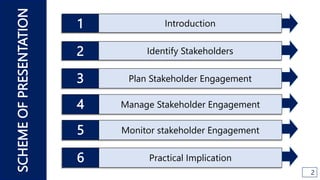
SCHEME
OF
PRESENTATION 1 Introduction
2 Identify Stakeholders
3 Plan Stakeholder Engagement
2
4 Manage Stakeholder Engagement
5 Monitor stakeholder Engagement
6 Practical Implication
3
INTRODUCTION/ OVERVIEW
INTRODUCTION
Project
Stakeholders
Management
The process to identify the people, groups, or organizations that
could impact or be impacted by the project, to analyze stakeholder
expectations and their impact on the project, and to develop
appropriate management strategies for effectively engaging
stakeholders in project decisions and execution.
By PMBOK
INTRODUCTION
Project
Stakeholders
Management
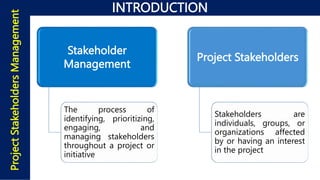
Stakeholder
Management
The process of
identifying, prioritizing,
engaging, and
managing stakeholders
throughout a project or
initiative
Project Stakeholders
Stakeholders are
individuals, groups, or
organizations affected
by or having an interest
in the project
Project
Stakeholders
Management
IMPORTANCE
Improved
Communication
Effective stakeholder
engagement fosters open
communication and prevents
misunderstandings.
Reduced Risks
Understanding stakeholder
expectations helps identify
and mitigate potential risks.
Enhanced Decision-making
Active stakeholder involvement provides valuable insights and
perspectives for better decision-making.
KEY CONCEPTS
Project
Stakeholders
Management
Stakeholder Management Vital for Project
Success
 Early, structured approach crucial.
 Academic research highlights its impact.
Continuous Communication Key
 Open communication with all stakeholders.
 Identifying and managing issues promptly.
Iterative Process
 Review and update during key milestones.
 Ensures alignment with stakeholder
expectations.
Trends in Stakeholder Engagement
Broader stakeholder definitions
emerging.
Comprehensive identification and co-
creation practices.
Tailoring and Agile Considerations
Tailor processes to project uniqueness.
Agile emphasizes direct stakeholder
engagement and transparency.
PROCESS GROUP
Project
Stakeholders
Management
Identify
Stakeholders
Plan Stakeholder
Engagement
Manage
Stakeholder
Engagement
Monitor
Stakeholder
Engagement
OVERVIEW
Project
Stakeholders
Management
TOOLS AND TECHNIQUES
Project
Stakeholders
Management
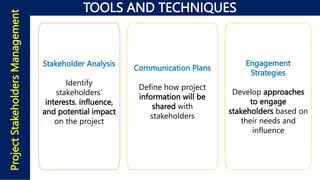
Stakeholder Analysis
Identify
stakeholders'
interests, influence,
and potential impact
on the project
Communication Plans
Define how project
information will be
shared with
stakeholders
Engagement
Strategies
Develop approaches
to engage
stakeholders based on
their needs and
influence
11
IDENTIFY STAKEHOLDERS
Project
Stakeholders
Management
Process of identifying project stakeholders regularly, analyzing and
documenting relevant information regarding their interests, involvement,
interdependencies, influence, and potential impact on project success
Primary
Stakeholders • High Influence, High Interest
Secondary
Stakeholders • Low Influence, Moderate Interest
IDENTIFY STAKEHOLDERS
Project
Stakeholders
Management
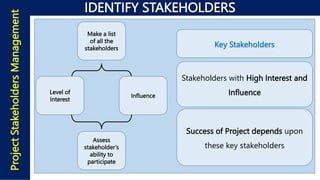
Make a list
of all the
stakeholders
Influence
Level of
Interest
Assess
stakeholder’s
ability to
participate
Stakeholders with High Interest and
Influence
Key Stakeholders
Success of Project depends upon
these key stakeholders
Project
Stakeholders
Management
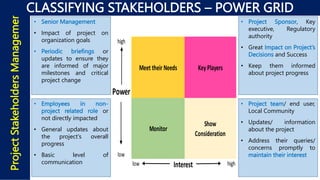
CLASSIFYING STAKEHOLDERS – POWER GRID
high
Meet their Needs Key Players
low
Monitor
Show
Consideration
low high
Power
Interest
• Project Sponsor, Key
executive, Regulatory
authority
• Great Impact on Project’s
Decisions and Success
• Keep them informed
about project progress
• Senior Management
• Impact of project on
organization goals
• Periodic briefings or
updates to ensure they
are informed of major
milestones and critical
project change
• Project team/ end user,
Local Community
• Updates/ information
about the project
• Address their queries/
concerns promptly to
maintain their interest
• Employees in non-
project related role or
not directly impacted
• General updates about
the project's overall
progress
• Basic level of
communication
STAKEHOLDERS REGSITER
Project
Stakeholders
Management Stakeho
lder
Role/ Title Organizatio
n
Contact
Information
Interest/ Expectations Influence/
Impact
Engagement Plan
Sajid
Khan
Primary
Sponsor/
XEN
Pakistan
Public Works
Department
sajid@gmail.
com
 Funding
 compliance with
Pak PWD
standards
 Timely project
completion
 Adherence to
regulations
 High
 Decision
Making
 Budget
 Regular meetings
 Detailed project updates
 Approval for key project phases
 Budget reviews
 compliance reports
 Address concerns promptly
Umair Project Mngt/
Project
Manager
NESPAK umair@gmai
l.com
 Project execution
 Adherence to
schedule
 Budget control
 Quality assurance
 Safety protocols
 High
 Day-to-Day
Operations
 Daily/ weekly progress meetings
 Detailed reports
 Issue escalation
 Risk assessment and mitigation
plans
Gohar Regulatory
Body/
Planning
Officer
Planning
Commission
of Pakistan
gohar@gmai
l.com
 Compliance with
national
development
policies
 Environmental
standards
 Adherence to
regulations
 High
 Regulatory
Compliance
 Timely submission of required
documents
 Adherence to regulations
 Conduct environmental impact
assessments
 Address concerns raised by the
commission
16
PLAN STAKEHOLDER ENGAGEMENT
Project
Stakeholders
Management
 Process of developing approaches to involve project stakeholders based on
their needs, expectations, interests, and potential impact on the project
 The key benefit is that it provides an actionable plan to interact effectively
with stakeholders. This process is performed periodically throughout the
project as needed
Project
Stakeholders
Management
TOOLS AND TECHNIQUES
Expert Judgment
Expertise should be
considered from
individuals or groups
with specialized
knowledge or
training in various
topics related to
stakeholder
engagement.
Data Gathering
Benchmarking is a
valuable data-gathering
technique that can be
used for stakeholder
engagement to
compare information
from other
organizations or
projects.
Data Analysis
Techniques like
assumption and
constraint analysis,
and root cause
analysis are essential
for tailoring
appropriate
engagement
strategies.
Project
Stakeholders
Management
TOOLS AND TECHNIQUES
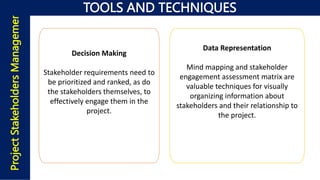
Decision Making
Stakeholder requirements need to
be prioritized and ranked, as do
the stakeholders themselves, to
effectively engage them in the
project.
Data Representation
Mind mapping and stakeholder
engagement assessment matrix are
valuable techniques for visually
organizing information about
stakeholders and their relationship to
the project.
OUTPUTS OF STAKEHOLDER ENGAGEMENT
Project
Stakeholders
Management
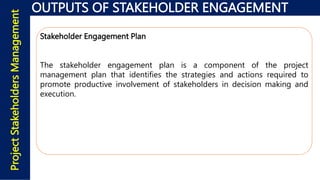
Stakeholder Engagement Plan
The stakeholder engagement plan is a component of the project
management plan that identifies the strategies and actions required to
promote productive involvement of stakeholders in decision making and
execution.
21
MANAGE STAKEHOLDER ENGAGEMENT
Project
Stakeholders
Management
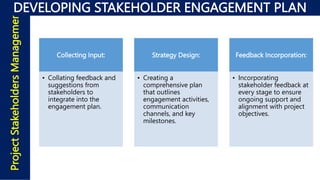
DEVELOPING STAKEHOLDER ENGAGEMENT PLAN
Collecting Input:
• Collating feedback and
suggestions from
stakeholders to
integrate into the
engagement plan.
Strategy Design:
• Creating a
comprehensive plan
that outlines
engagement activities,
communication
channels, and key
milestones.
Feedback Incorporation:
• Incorporating
stakeholder feedback at
every stage to ensure
ongoing support and
alignment with project
objectives.
STAKEHOLDER ENGAGEMENT STRATEGY
Project
Stakeholders
Management
1 Evaluate Stakeholder Needs
Understand the concerns and
requirements of key
stakeholders to align the
strategy with their
expectations.
2
Develop Engagement Plan
Create a comprehensive
plan outlining the approach
to engage and
communicate with
stakeholders effectively.
3 Implement Strategy
Put the engagement strategy
into action, ensuring
consistent and meaningful
interactions with stakeholders.
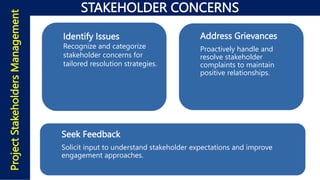
STAKEHOLDER CONCERNS
Project
Stakeholders
Management
Identify Issues
Recognize and categorize
stakeholder concerns for
tailored resolution strategies.
Address Grievances
Proactively handle and
resolve stakeholder
complaints to maintain
positive relationships.
Seek Feedback
Solicit input to understand stakeholder expectations and improve
engagement approaches.
Project
Stakeholders
Management
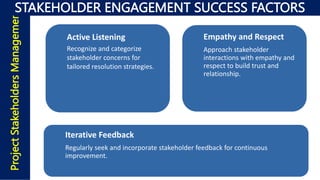
STAKEHOLDER ENGAGEMENT SUCCESS FACTORS
Active Listening
Recognize and categorize
stakeholder concerns for
tailored resolution strategies.
Empathy and Respect
Approach stakeholder
interactions with empathy and
respect to build trust and
relationship.
Iterative Feedback
Regularly seek and incorporate stakeholder feedback for continuous
improvement.
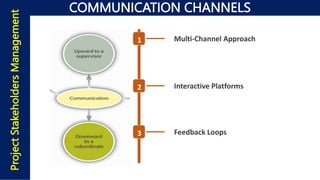
COMMUNICATION CHANNELS
Project
Stakeholders
Management
1 Multi-Channel Approach
2 Interactive Platforms
3 Feedback Loops
Effective expectation
management is crucial in any
project, as it plays a pivotal
role in ensuring successful
outcomes and maintaining
positive stakeholder
relationships throughout the
project lifecycle.
EXPECTATION MANAGEMENT
Project
Stakeholders
Management
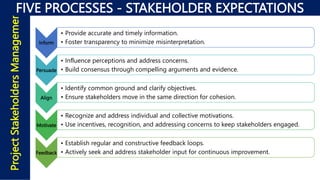
Inform
• Provide accurate and timely information.
• Foster transparency to minimize misinterpretation.
Persuade
• Influence perceptions and address concerns.
• Build consensus through compelling arguments and evidence.
Align
• Identify common ground and clarify objectives.
• Ensure stakeholders move in the same direction for cohesion.
Motivate
• Recognize and address individual and collective motivations.
• Use incentives, recognition, and addressing concerns to keep stakeholders engaged.
Feedback
• Establish regular and constructive feedback loops.
• Actively seek and address stakeholder input for continuous improvement.
EXPECTATION MANAGEMENT
Project
Stakeholders
Management
FIVE PROCESSES - STAKEHOLDER EXPECTATIONS
29
MONITOR STAKEHOLDER ENGAGEMENT
• Process of monitoring project stakeholder relationships and
tailoring strategies for engaging stakeholders through modification
of engagement strategies and plans.
• The key benefit of this process is that it maintains or increases the
efficiency and effectiveness of stakeholder engagement activities as
the project evolves and its environment changes. This process is
performed periodically throughout the project as needed.
MONITOR STAKEHOLDER ENGAGEMENT
Project
Stakeholders
Management
Continuous Monitoring
Implement continuous
monitoring techniques
to oversee stakeholder
relationships
consistently.
Data Analysis
Analyze stakeholder data
to identify potential areas
for improvement in
engagement strategies.
Feedback Loops
Create feedback loops
for stakeholders to
provide valuable
insights for engagement
enhancement.
MONITOR STAKEHOLDER ENGAGEMENT
Project
Stakeholders
Management
MONITORING STRATEGIES
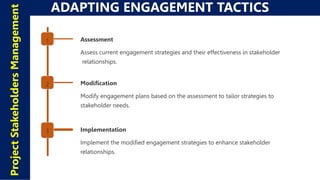
1 Assessment
Assess current engagement strategies and their effectiveness in stakeholder
relationships.
2 Modification
Modify engagement plans based on the assessment to tailor strategies to
stakeholder needs.
3 Implementation
Implement the modified engagement strategies to enhance stakeholder
relationships.
ADAPTING ENGAGEMENT TACTICS
Project
Stakeholders
Management
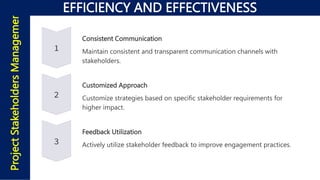
Consistent Communication
Maintain consistent and transparent communication channels with
stakeholders.
Customized Approach
Customize strategies based on specific stakeholder requirements for
higher impact.
Feedback Utilization
Actively utilize stakeholder feedback to improve engagement practices.
Project
Stakeholders
Management
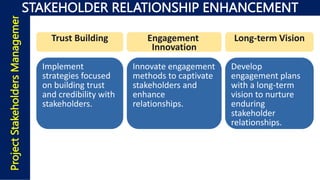
EFFICIENCY AND EFFECTIVENESS
Trust Building
Implement
strategies focused
on building trust
and credibility with
stakeholders.
Engagement
Innovation
Innovate engagement
methods to captivate
stakeholders and
enhance
relationships.
Long-term Vision
Develop
engagement plans
with a long-term
vision to nurture
enduring
stakeholder
relationships.
Project
Stakeholders
Management
STAKEHOLDER RELATIONSHIP ENHANCEMENT
35
PRACTICAL IMPLICATION
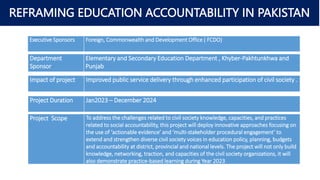
REFRAMING EDUCATION ACCOUNTABILITY IN PAKISTAN
• Girls Transition Rate Grades 5 to 6
• Summer Zone District
• Road works under KP-RAP
• Multi dimensional Poverty - Incidence
Executive Sponsors Foreign, Commonwealth and Development Office ( FCDO)
Department
Sponsor
Elementary and Secondary Education Department , Khyber-Pakhtunkhwa and
Punjab
Impact of project Improved public service delivery through enhanced participation of civil society .
Project Duration Jan2023 – December 2024
Project Scope To address the challenges related to civil society knowledge, capacities, and practices
related to social accountability, this project will deploy innovative approaches focusing on
the use of ‘actionable evidence’ and ‘multi-stakeholder procedural engagement’ to
extend and strengthen diverse civil society voices in education policy, planning, budgets
and accountability at district, provincial and national levels. The project will not only build
knowledge, networking, traction, and capacities of the civil society organizations, it will
also demonstrate practice-based learning during Year 2023
PROJECT TEAM
Project Director
Field
coordinator
Field teams
Manager MEL
Manager
Finance
Manager
Communication
Project Manager
• Absence of local, relatable data (Availability and Access)
• Nature & Scope of CSO Engagement
o Cross-sectoral focus; limited specialized area(s)
o Aiding in Service Delivery; participation and accountability is absent
o Absence of Networks and Alliances
o Lack of understanding of existing systemic entry points for
procedural engagement
o Capacity constraints
CONTEXT OF PROJECT
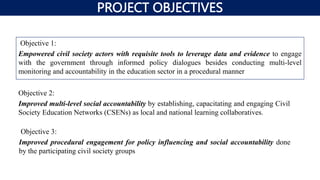
PROJECT OBJECTIVES
Objective 1:
Empowered civil society actors with requisite tools to leverage data and evidence to engage
with the government through informed policy dialogues besides conducting multi-level
monitoring and accountability in the education sector in a procedural manner
Objective 2:
Improved multi-level social accountability by establishing, capacitating and engaging Civil
Society Education Networks (CSENs) as local and national learning collaboratives.
Objective 3:
Improved procedural engagement for policy influencing and social accountability done
by the participating civil society groups
Objective 1:
Empowered civil society actors with requisite tools to leverage data and evidence to engage with the government
through informed policy dialogues besides conducting multi-level monitoring and accountability in the education
sector in a procedural manner
Output(s) Indicator(s)
Output 1.1.1 Generated data and evidence for tracking government’s education
policies, plans, commitments, and financing at provincial, district, and local levels
Number of citizen scorecards
developed
Number of budget trackers
developed
Output 1.1.2 Created online citizen portal for disseminating data and information on
education outcomes, facilities besides highlighting challenges from citizens’
perspectives and priorities
A functional online citizen
portal on education
outcomes
Output 1.1.3 Developed citizen monitoring reports and futuristic agenda Output 1.1.3 Developed
citizen monitoring reports
and futuristic agenda
MONITORING INDICATORS
Objective 2:
Improved multi-level social accountability by establishing, capacitating and engaging Civil Society Education
Networks (CSENs) as local and national learning collaboratives.
Output(s) Indicator(s)
Outcome 2.1 Civil society networks established for collective engagement and social
accountability
Number of CSENs and CEFs
established
Output 2.1.1 Established CSENs through stakeholder forums and orientation sessions Number stakeholder forums and
orientation sessions conducted
Outcomes 2.2 Civil society capacitated in evidence-based policy influencing and multi-
level accountability in the education sector
Number of training modules
developed
Number of training sessions
conducted
Output 2.2.1 Civil society organizations trained in data analysis, actionable evidence
generation, procedural accountability, policy influencing strategies, financial
transparency, and accountability
Number of civil society members
trained
Number of government officials
trained
MONITORING INDICATORS
Objective 3:
Improved procedural engagement for policy influencing and social accountability done by the participating
civil society groups
Output(s) Indicator(s)
Outcome 3.1 Civil society practices and engages in social accountability of education sector
policies, plans and services
Number of requests sent to the
government by civil society networks
Output 3.1.1 Government and civil society networks engaged in joint dialogues and meetings Number of dialogues and sessions held
Output 3.1.2 Civil society engaged with public representatives to share their findings and
recommendations
Number of sessions held
Output 3.1.3 Citizen network sessions held for participatory budgeting and reporting
recommendations to the government
Number of sessions held
Output 3.1.4 Citizen sessions organized to educate and mobilize larger community on key
educational challenges and context-specific solutions
Number of sessions held
Output 3.1.5 Success stories of localized collective actions documented and disseminated Number of success stories developed
and disseminated
MONITORING INDICATORS
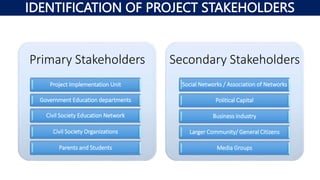
IDENTIFICATION OF PROJECT STAKEHOLDERS
Primary Stakeholders
Project Implementation Unit
Government Education departments
Civil Society Education Network
Civil Society Organizations
Parents and Students
Secondary Stakeholders
Social Networks / Association of Networks
Political Capital
Business industry
Larger Community/ General Citizens
Media Groups
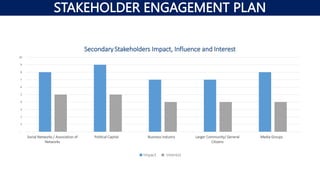
STAKEHOLDER ENGAGEMENT PLAN
-
1
2
3
4
5
6
7
8
9
Government Education
departments
Project Implementation Unit Civil Society Education Network Civil Society Organizations Parents and Students
Primary Stakeholders Impact, Influence and Interest
Impact Interest
STAKEHOLDER ENGAGEMENT PLAN
-
1
2
3
4
5
6
7
8
9
10
Social Networks / Association of
Networks
Political Capital Business industry Larger Community/ General
Citizens
Media Groups
SecondaryStakeholders Impact, Influence and Interest
Impact Interest
ENGAGING STAKEHOLDERS FOR IMPACTFUL
RESULTS
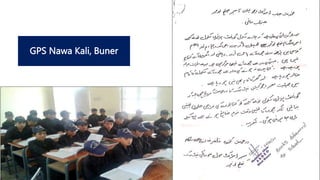
SUCCESS STORIES
Vacant Posts for
Teachers - Mansehra
GPS Faqir Kari &
GPS Zangi Khel
Lakki Marwat
Missing Facilities
Lakki Marwat
GPS Nawa Kali, Buner
GGPS Dhun, Gujrat
- Boundary Wall
- Gate and Windows
Thank You

Stakeholder Managment - Presentation.pptx

  • 1.
    Project Stakeholder Management Maqsood Alam| 53472 Sultan Memhood |55857 Arshad Ali Anjum | 56622 Umair Zaman |50744
  • 2.
    SCHEME OF PRESENTATION 1 Introduction 2Identify Stakeholders 3 Plan Stakeholder Engagement 2 4 Manage Stakeholder Engagement 5 Monitor stakeholder Engagement 6 Practical Implication
  • 3.
  • 4.
    INTRODUCTION Project Stakeholders Management The process toidentify the people, groups, or organizations that could impact or be impacted by the project, to analyze stakeholder expectations and their impact on the project, and to develop appropriate management strategies for effectively engaging stakeholders in project decisions and execution. By PMBOK
  • 5.
    INTRODUCTION Project Stakeholders Management Stakeholder Management The process of identifying,prioritizing, engaging, and managing stakeholders throughout a project or initiative Project Stakeholders Stakeholders are individuals, groups, or organizations affected by or having an interest in the project
  • 6.
    Project Stakeholders Management IMPORTANCE Improved Communication Effective stakeholder engagement fostersopen communication and prevents misunderstandings. Reduced Risks Understanding stakeholder expectations helps identify and mitigate potential risks. Enhanced Decision-making Active stakeholder involvement provides valuable insights and perspectives for better decision-making.
  • 7.
    KEY CONCEPTS Project Stakeholders Management Stakeholder ManagementVital for Project Success  Early, structured approach crucial.  Academic research highlights its impact. Continuous Communication Key  Open communication with all stakeholders.  Identifying and managing issues promptly. Iterative Process  Review and update during key milestones.  Ensures alignment with stakeholder expectations. Trends in Stakeholder Engagement Broader stakeholder definitions emerging. Comprehensive identification and co- creation practices. Tailoring and Agile Considerations Tailor processes to project uniqueness. Agile emphasizes direct stakeholder engagement and transparency.
  • 8.
  • 9.
  • 10.
    TOOLS AND TECHNIQUES Project Stakeholders Management StakeholderAnalysis Identify stakeholders' interests, influence, and potential impact on the project Communication Plans Define how project information will be shared with stakeholders Engagement Strategies Develop approaches to engage stakeholders based on their needs and influence
  • 11.
  • 12.
    IDENTIFY STAKEHOLDERS Project Stakeholders Management Process ofidentifying project stakeholders regularly, analyzing and documenting relevant information regarding their interests, involvement, interdependencies, influence, and potential impact on project success Primary Stakeholders • High Influence, High Interest Secondary Stakeholders • Low Influence, Moderate Interest
  • 13.
    IDENTIFY STAKEHOLDERS Project Stakeholders Management Make alist of all the stakeholders Influence Level of Interest Assess stakeholder’s ability to participate Stakeholders with High Interest and Influence Key Stakeholders Success of Project depends upon these key stakeholders
  • 14.
    Project Stakeholders Management CLASSIFYING STAKEHOLDERS –POWER GRID high Meet their Needs Key Players low Monitor Show Consideration low high Power Interest • Project Sponsor, Key executive, Regulatory authority • Great Impact on Project’s Decisions and Success • Keep them informed about project progress • Senior Management • Impact of project on organization goals • Periodic briefings or updates to ensure they are informed of major milestones and critical project change • Project team/ end user, Local Community • Updates/ information about the project • Address their queries/ concerns promptly to maintain their interest • Employees in non- project related role or not directly impacted • General updates about the project's overall progress • Basic level of communication
  • 15.
    STAKEHOLDERS REGSITER Project Stakeholders Management Stakeho lder Role/Title Organizatio n Contact Information Interest/ Expectations Influence/ Impact Engagement Plan Sajid Khan Primary Sponsor/ XEN Pakistan Public Works Department sajid@gmail. com  Funding  compliance with Pak PWD standards  Timely project completion  Adherence to regulations  High  Decision Making  Budget  Regular meetings  Detailed project updates  Approval for key project phases  Budget reviews  compliance reports  Address concerns promptly Umair Project Mngt/ Project Manager NESPAK umair@gmai l.com  Project execution  Adherence to schedule  Budget control  Quality assurance  Safety protocols  High  Day-to-Day Operations  Daily/ weekly progress meetings  Detailed reports  Issue escalation  Risk assessment and mitigation plans Gohar Regulatory Body/ Planning Officer Planning Commission of Pakistan gohar@gmai l.com  Compliance with national development policies  Environmental standards  Adherence to regulations  High  Regulatory Compliance  Timely submission of required documents  Adherence to regulations  Conduct environmental impact assessments  Address concerns raised by the commission
  • 16.
  • 17.
    PLAN STAKEHOLDER ENGAGEMENT Project Stakeholders Management Process of developing approaches to involve project stakeholders based on their needs, expectations, interests, and potential impact on the project  The key benefit is that it provides an actionable plan to interact effectively with stakeholders. This process is performed periodically throughout the project as needed
  • 18.
    Project Stakeholders Management TOOLS AND TECHNIQUES ExpertJudgment Expertise should be considered from individuals or groups with specialized knowledge or training in various topics related to stakeholder engagement. Data Gathering Benchmarking is a valuable data-gathering technique that can be used for stakeholder engagement to compare information from other organizations or projects. Data Analysis Techniques like assumption and constraint analysis, and root cause analysis are essential for tailoring appropriate engagement strategies.
  • 19.
    Project Stakeholders Management TOOLS AND TECHNIQUES DecisionMaking Stakeholder requirements need to be prioritized and ranked, as do the stakeholders themselves, to effectively engage them in the project. Data Representation Mind mapping and stakeholder engagement assessment matrix are valuable techniques for visually organizing information about stakeholders and their relationship to the project.
  • 20.
    OUTPUTS OF STAKEHOLDERENGAGEMENT Project Stakeholders Management Stakeholder Engagement Plan The stakeholder engagement plan is a component of the project management plan that identifies the strategies and actions required to promote productive involvement of stakeholders in decision making and execution.
  • 21.
  • 22.
    Project Stakeholders Management DEVELOPING STAKEHOLDER ENGAGEMENTPLAN Collecting Input: • Collating feedback and suggestions from stakeholders to integrate into the engagement plan. Strategy Design: • Creating a comprehensive plan that outlines engagement activities, communication channels, and key milestones. Feedback Incorporation: • Incorporating stakeholder feedback at every stage to ensure ongoing support and alignment with project objectives.
  • 23.
    STAKEHOLDER ENGAGEMENT STRATEGY Project Stakeholders Management 1Evaluate Stakeholder Needs Understand the concerns and requirements of key stakeholders to align the strategy with their expectations. 2 Develop Engagement Plan Create a comprehensive plan outlining the approach to engage and communicate with stakeholders effectively. 3 Implement Strategy Put the engagement strategy into action, ensuring consistent and meaningful interactions with stakeholders.
  • 24.
    STAKEHOLDER CONCERNS Project Stakeholders Management Identify Issues Recognizeand categorize stakeholder concerns for tailored resolution strategies. Address Grievances Proactively handle and resolve stakeholder complaints to maintain positive relationships. Seek Feedback Solicit input to understand stakeholder expectations and improve engagement approaches.
  • 25.
    Project Stakeholders Management STAKEHOLDER ENGAGEMENT SUCCESSFACTORS Active Listening Recognize and categorize stakeholder concerns for tailored resolution strategies. Empathy and Respect Approach stakeholder interactions with empathy and respect to build trust and relationship. Iterative Feedback Regularly seek and incorporate stakeholder feedback for continuous improvement.
  • 26.
    COMMUNICATION CHANNELS Project Stakeholders Management 1 Multi-ChannelApproach 2 Interactive Platforms 3 Feedback Loops
  • 27.
    Effective expectation management iscrucial in any project, as it plays a pivotal role in ensuring successful outcomes and maintaining positive stakeholder relationships throughout the project lifecycle. EXPECTATION MANAGEMENT Project Stakeholders Management
  • 28.
    Inform • Provide accurateand timely information. • Foster transparency to minimize misinterpretation. Persuade • Influence perceptions and address concerns. • Build consensus through compelling arguments and evidence. Align • Identify common ground and clarify objectives. • Ensure stakeholders move in the same direction for cohesion. Motivate • Recognize and address individual and collective motivations. • Use incentives, recognition, and addressing concerns to keep stakeholders engaged. Feedback • Establish regular and constructive feedback loops. • Actively seek and address stakeholder input for continuous improvement. EXPECTATION MANAGEMENT Project Stakeholders Management FIVE PROCESSES - STAKEHOLDER EXPECTATIONS
  • 29.
  • 30.
    • Process ofmonitoring project stakeholder relationships and tailoring strategies for engaging stakeholders through modification of engagement strategies and plans. • The key benefit of this process is that it maintains or increases the efficiency and effectiveness of stakeholder engagement activities as the project evolves and its environment changes. This process is performed periodically throughout the project as needed. MONITOR STAKEHOLDER ENGAGEMENT Project Stakeholders Management
  • 31.
    Continuous Monitoring Implement continuous monitoringtechniques to oversee stakeholder relationships consistently. Data Analysis Analyze stakeholder data to identify potential areas for improvement in engagement strategies. Feedback Loops Create feedback loops for stakeholders to provide valuable insights for engagement enhancement. MONITOR STAKEHOLDER ENGAGEMENT Project Stakeholders Management MONITORING STRATEGIES
  • 32.
    1 Assessment Assess currentengagement strategies and their effectiveness in stakeholder relationships. 2 Modification Modify engagement plans based on the assessment to tailor strategies to stakeholder needs. 3 Implementation Implement the modified engagement strategies to enhance stakeholder relationships. ADAPTING ENGAGEMENT TACTICS Project Stakeholders Management
  • 33.
    Consistent Communication Maintain consistentand transparent communication channels with stakeholders. Customized Approach Customize strategies based on specific stakeholder requirements for higher impact. Feedback Utilization Actively utilize stakeholder feedback to improve engagement practices. Project Stakeholders Management EFFICIENCY AND EFFECTIVENESS
  • 34.
    Trust Building Implement strategies focused onbuilding trust and credibility with stakeholders. Engagement Innovation Innovate engagement methods to captivate stakeholders and enhance relationships. Long-term Vision Develop engagement plans with a long-term vision to nurture enduring stakeholder relationships. Project Stakeholders Management STAKEHOLDER RELATIONSHIP ENHANCEMENT
  • 35.
  • 36.
    REFRAMING EDUCATION ACCOUNTABILITYIN PAKISTAN • Girls Transition Rate Grades 5 to 6 • Summer Zone District • Road works under KP-RAP • Multi dimensional Poverty - Incidence Executive Sponsors Foreign, Commonwealth and Development Office ( FCDO) Department Sponsor Elementary and Secondary Education Department , Khyber-Pakhtunkhwa and Punjab Impact of project Improved public service delivery through enhanced participation of civil society . Project Duration Jan2023 – December 2024 Project Scope To address the challenges related to civil society knowledge, capacities, and practices related to social accountability, this project will deploy innovative approaches focusing on the use of ‘actionable evidence’ and ‘multi-stakeholder procedural engagement’ to extend and strengthen diverse civil society voices in education policy, planning, budgets and accountability at district, provincial and national levels. The project will not only build knowledge, networking, traction, and capacities of the civil society organizations, it will also demonstrate practice-based learning during Year 2023
  • 37.
    PROJECT TEAM Project Director Field coordinator Fieldteams Manager MEL Manager Finance Manager Communication Project Manager
  • 38.
    • Absence oflocal, relatable data (Availability and Access) • Nature & Scope of CSO Engagement o Cross-sectoral focus; limited specialized area(s) o Aiding in Service Delivery; participation and accountability is absent o Absence of Networks and Alliances o Lack of understanding of existing systemic entry points for procedural engagement o Capacity constraints CONTEXT OF PROJECT
  • 39.
    PROJECT OBJECTIVES Objective 1: Empoweredcivil society actors with requisite tools to leverage data and evidence to engage with the government through informed policy dialogues besides conducting multi-level monitoring and accountability in the education sector in a procedural manner Objective 2: Improved multi-level social accountability by establishing, capacitating and engaging Civil Society Education Networks (CSENs) as local and national learning collaboratives. Objective 3: Improved procedural engagement for policy influencing and social accountability done by the participating civil society groups
  • 40.
    Objective 1: Empowered civilsociety actors with requisite tools to leverage data and evidence to engage with the government through informed policy dialogues besides conducting multi-level monitoring and accountability in the education sector in a procedural manner Output(s) Indicator(s) Output 1.1.1 Generated data and evidence for tracking government’s education policies, plans, commitments, and financing at provincial, district, and local levels Number of citizen scorecards developed Number of budget trackers developed Output 1.1.2 Created online citizen portal for disseminating data and information on education outcomes, facilities besides highlighting challenges from citizens’ perspectives and priorities A functional online citizen portal on education outcomes Output 1.1.3 Developed citizen monitoring reports and futuristic agenda Output 1.1.3 Developed citizen monitoring reports and futuristic agenda MONITORING INDICATORS
  • 41.
    Objective 2: Improved multi-levelsocial accountability by establishing, capacitating and engaging Civil Society Education Networks (CSENs) as local and national learning collaboratives. Output(s) Indicator(s) Outcome 2.1 Civil society networks established for collective engagement and social accountability Number of CSENs and CEFs established Output 2.1.1 Established CSENs through stakeholder forums and orientation sessions Number stakeholder forums and orientation sessions conducted Outcomes 2.2 Civil society capacitated in evidence-based policy influencing and multi- level accountability in the education sector Number of training modules developed Number of training sessions conducted Output 2.2.1 Civil society organizations trained in data analysis, actionable evidence generation, procedural accountability, policy influencing strategies, financial transparency, and accountability Number of civil society members trained Number of government officials trained MONITORING INDICATORS
  • 42.
    Objective 3: Improved proceduralengagement for policy influencing and social accountability done by the participating civil society groups Output(s) Indicator(s) Outcome 3.1 Civil society practices and engages in social accountability of education sector policies, plans and services Number of requests sent to the government by civil society networks Output 3.1.1 Government and civil society networks engaged in joint dialogues and meetings Number of dialogues and sessions held Output 3.1.2 Civil society engaged with public representatives to share their findings and recommendations Number of sessions held Output 3.1.3 Citizen network sessions held for participatory budgeting and reporting recommendations to the government Number of sessions held Output 3.1.4 Citizen sessions organized to educate and mobilize larger community on key educational challenges and context-specific solutions Number of sessions held Output 3.1.5 Success stories of localized collective actions documented and disseminated Number of success stories developed and disseminated MONITORING INDICATORS
  • 43.
    IDENTIFICATION OF PROJECTSTAKEHOLDERS Primary Stakeholders Project Implementation Unit Government Education departments Civil Society Education Network Civil Society Organizations Parents and Students Secondary Stakeholders Social Networks / Association of Networks Political Capital Business industry Larger Community/ General Citizens Media Groups
  • 44.
    STAKEHOLDER ENGAGEMENT PLAN - 1 2 3 4 5 6 7 8 9 GovernmentEducation departments Project Implementation Unit Civil Society Education Network Civil Society Organizations Parents and Students Primary Stakeholders Impact, Influence and Interest Impact Interest
  • 45.
    STAKEHOLDER ENGAGEMENT PLAN - 1 2 3 4 5 6 7 8 9 10 SocialNetworks / Association of Networks Political Capital Business industry Larger Community/ General Citizens Media Groups SecondaryStakeholders Impact, Influence and Interest Impact Interest
  • 46.
    ENGAGING STAKEHOLDERS FORIMPACTFUL RESULTS SUCCESS STORIES
  • 47.
  • 48.
    GPS Faqir Kari& GPS Zangi Khel Lakki Marwat
  • 49.
  • 50.
  • 51.
    GGPS Dhun, Gujrat -Boundary Wall - Gate and Windows
  • 52.