2.2 STAKEHOLDER ANALYSIS:
(ANALYSIS FOR PROJECT
IDENTIFICATION & SELECTION)
1. SH ANALSYSI
ANALYSIS PHASE/COMPONENET OF LFA
– ANALYSIS PHASE/COMPONENET OF LFA
• STAKEHOLDER ANALYSIS
• PROBLEM ANALYSIS & THE PROBLEM TREE
• ANALYSIS OF OBJECTIVES & THE OBJECTIVE TREE
• ANALYSIS OF ALTERNATIVE STRATEGIES
2. SITUATION ANALYSIS
– Assess & analyze an environmental situation needs
– Include analyses of needs, interests, strengths &
weaknesses of key stakeholders & beneficiaries
(stakeholder analysis)
– Explores likely causes & linkages between existing
problems & the needed actions (Problem & objective
analyses)
– Generates key actions & strategies to be applied
2. SITUATION ANALYSIS (1): STAKEHOLDER
ANALYSIS
“A person or group of people who have a vested
interest in the success of an organization &
the environment in which the organization
operates”
STAKEHOLDERS
– are individuals/groups/institutions who may
• directly or indirectly
• positively or negatively affect or be affected
• by the activities &/or outcomes of projects.
• Stakeholders are likely to out number project users/beneficiaries.
How do we Determine Relevant Stakeholders Depends on the
• situation &
• type of project to be carried.
• Community is usually a key stakeholder for local based dev’t
initiatives
• SH can be categorized as:
– Primary SHs - direct targeted participants & institutions
– Secondary SHs - the intermediary participants
– External SHs - not formally involved but who may impact or be impacted by the
development program/project.
2.SITUATION ANALYSIS (1): STAKEHOLDER
ANALYSIS
2. Identifying stakeholders
Core issue
6
2. Stakeholder Analysis
Stakeholders: - are people affected by the impact of an
activity & people who can influence the impact of an
activity
• Stakeholders are:
individuals or groups with a direct, significant &
specific stake or interest in a given territory or set of
natural resources &, thus, in a proposed project.
People affected by the project
People who can influence the impact of an activity
• Participation or stakeholder analysis seeks to identify the
major interest groups involved (all those affected by or
involved) in the project.
7
7
2. KEY PLAYERS
• The project manager
– Is responsible for achieving project objectives.
– Manages the project:
• Planning, organizing, leading, controlling (monitoring progress)
• Communicating, balancing conflicting requirements, managing stakeholders, building &
inspiring the team
• Sharing success, accepts all blame!
• Sponsor– the person or group that provides the financial resources, in cash or kind,
for the project
– Project Initiator
– Ensures project relevance
– Helps in objectives setting
• Customer/user/client– the person or organization that will use the project/s
product.
• Performing organization—the enterprise whose employees are most directly
involved in doing the work of the project.
• Project team members– the group that is performing the work of the project
• Project management team– the members of the project team who are directly
involved in project management activities
• Potential opponents: Groups which may oppose or obstruct a project.
• Supplier-- Provides resources
8
2. SITUATION ANALYSIS (1):
STAKEHOLDER ANALYSIS
1. Identify the principal stakeholders at various levels – local,
national, regional & international
2. Investigate their roles, interests, & relative powers &
capacities to participate
3. Identify the extent of cooperation or conflict in the
relationships among stakeholders
4. Interpret the findings of the analysis & define how they
should be incorporated into project design
2. STAKEHOLDER ENGAGEMENT PROCESS
• Identify Stakeholders
• Assess needs
• Define actions
• Establish communication channels
• Gather feedback
• Monitor & review
2. Stakeholder Participation
• Active participation is likely to have many benefits, although it is not a guarantee
of project success
• Achieving full participation is not easy. It can also take a lot of time, & conflicting
interests are likely to come to the surface
Coercion
Co-operation/
Partnership
Control,
collective action or
Co-learning
Informing
Consultation
Decided by ourselves
Decided by others
Levels of participation
Being manipulated;
No real power
Being informed,
others set the agenda
Being consulted,
Others analyze &
Decide course action
Work with
others
Little input
by others
11
2. STAKEHOLDER ANALYSIS MATRIX
• How affected by the problem(s)
• Expected impacts of proposed intervention/solution
•
•
Stakeholder How affected
by the
problem
Capacity to
participate in
addressing
the pb
R/ship with
other SH (
partnership or
conflict)
Stakehol
der
Stakeholder’s
Main
objectives
Positive
impacts/
benefits
Negative
impacts/co
sts
Net impact
2. Why stakeholder analysis:
– To identify stakeholders’ interests in, importance to, &
influence over the intervention
– To identify local institutions & processes upon which to
build
– To provide a foundation & strategy for participation
– To develop a strategic view of the human & institutional
situation, & the relationship between the different
stakeholders & the objectives identified.
– provides a useful starting point for problem analysis.
– It involves the identification of all stakeholder groups
likely to be affected (either positively or negatively)
13
2. QUESTIONS TO BE RAISED TO IDENTIFY
STAKEHOLDERS ARE;
• Who are likely to be affected?
• Who is responsible for what is intended to be done?
• Who is likely to mobilize for or against what is intended?
• Who can make what is intended more effective through their
participation or less effective by their non-participation or outright
opposition?
• Who can contribute financial & technical resources?
• Whose behavior has to change for the effort to succeed?
Projects if planned & implemented in participatory
way, they are a means of empowering people.
Because participation gives;
–access to relevant information
–opportunity to influence decision making
–chance to learn & appreciate.
2. PARTICIPATION ANALYSIS
• Identify all groups involved & categorise as:
– actors
– beneficiaries
– those affected (both supporters & opponents)
• Identify situation for each group
(characteristics, motivation, potential) &
determine possible implications for planning
2.HOW DO WE BEGIN PARTICIPATION?
There is no perfect formula for designing community participation in
development. Below is a simple guide.
1) Be clear with what you want to know & can offer.
2) Try to be non-intrusive. Go slow.
– Be open to all points of view
– Respect local customs, ways of communicating, time frames, & other
demands on people’s time
– Be flexible
– Be prepared to withdraw if appropriate
cont’d
3) Select field workers who are culturally acceptable & well trained with tools &
techniques of participation
4) Use a mixture of technical & cultural expertise & sound community participation
techniques.
5) Find ways of listening to more marginalized/less vocal members of the
community.
6) Don’t focus only on needs. In every situation there are resources which can be
tapped & built upon. Hence try to know:
– What resources (materials & skills) does the community have
– Who owns them?
– Who are the power brokers/decision makers in the community?
– What is their relationship with other members of the community?
– What social, economic, & political organizations are there in the community?
– What resources/decision making process do they control?
– What do they represent?
2. HOW DO WE BEGIN PARTICIPATION?
2. WHO SHOULD PARTICIPATE?
• Different groups of the community (youths, women, young female,
elders, etc.) Why?
a lot of different needs which the community wants to address
different priorities that will be suggested
then
trying to bring the ideas of the different group (most difficult &
challenging work of the development planners/workers)
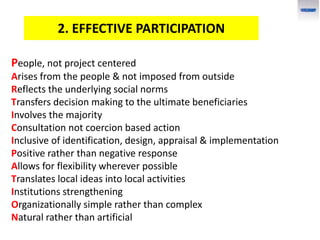
2. EFFECTIVE PARTICIPATION
People, not project centered
Arises from the people & not imposed from outside
Reflects the underlying social norms
Transfers decision making to the ultimate beneficiaries
Involves the majority
Consultation not coercion based action
Inclusive of identification, design, appraisal & implementation
Positive rather than negative response
Allows for flexibility wherever possible
Translates local ideas into local activities
Institutions strengthening
Organizationally simple rather than complex
Natural rather than artificial
Group discussion
• Think of a project in group & answer the following
questions:
a) Identify possible stakeholders
b) Perform stakeholder analysis
c) Design stakeholder engagement strategy
21

2.2 skill sh analysis

  • 1.
    2.2 STAKEHOLDER ANALYSIS: (ANALYSISFOR PROJECT IDENTIFICATION & SELECTION)
  • 2.
    1. SH ANALSYSI ANALYSISPHASE/COMPONENET OF LFA – ANALYSIS PHASE/COMPONENET OF LFA • STAKEHOLDER ANALYSIS • PROBLEM ANALYSIS & THE PROBLEM TREE • ANALYSIS OF OBJECTIVES & THE OBJECTIVE TREE • ANALYSIS OF ALTERNATIVE STRATEGIES
  • 3.
    2. SITUATION ANALYSIS –Assess & analyze an environmental situation needs – Include analyses of needs, interests, strengths & weaknesses of key stakeholders & beneficiaries (stakeholder analysis) – Explores likely causes & linkages between existing problems & the needed actions (Problem & objective analyses) – Generates key actions & strategies to be applied
  • 4.
    2. SITUATION ANALYSIS(1): STAKEHOLDER ANALYSIS “A person or group of people who have a vested interest in the success of an organization & the environment in which the organization operates”
  • 5.
    STAKEHOLDERS – are individuals/groups/institutionswho may • directly or indirectly • positively or negatively affect or be affected • by the activities &/or outcomes of projects. • Stakeholders are likely to out number project users/beneficiaries. How do we Determine Relevant Stakeholders Depends on the • situation & • type of project to be carried. • Community is usually a key stakeholder for local based dev’t initiatives • SH can be categorized as: – Primary SHs - direct targeted participants & institutions – Secondary SHs - the intermediary participants – External SHs - not formally involved but who may impact or be impacted by the development program/project. 2.SITUATION ANALYSIS (1): STAKEHOLDER ANALYSIS
  • 6.
  • 7.
    2. Stakeholder Analysis Stakeholders:- are people affected by the impact of an activity & people who can influence the impact of an activity • Stakeholders are: individuals or groups with a direct, significant & specific stake or interest in a given territory or set of natural resources &, thus, in a proposed project. People affected by the project People who can influence the impact of an activity • Participation or stakeholder analysis seeks to identify the major interest groups involved (all those affected by or involved) in the project. 7 7
  • 8.
    2. KEY PLAYERS •The project manager – Is responsible for achieving project objectives. – Manages the project: • Planning, organizing, leading, controlling (monitoring progress) • Communicating, balancing conflicting requirements, managing stakeholders, building & inspiring the team • Sharing success, accepts all blame! • Sponsor– the person or group that provides the financial resources, in cash or kind, for the project – Project Initiator – Ensures project relevance – Helps in objectives setting • Customer/user/client– the person or organization that will use the project/s product. • Performing organization—the enterprise whose employees are most directly involved in doing the work of the project. • Project team members– the group that is performing the work of the project • Project management team– the members of the project team who are directly involved in project management activities • Potential opponents: Groups which may oppose or obstruct a project. • Supplier-- Provides resources 8
  • 9.
    2. SITUATION ANALYSIS(1): STAKEHOLDER ANALYSIS 1. Identify the principal stakeholders at various levels – local, national, regional & international 2. Investigate their roles, interests, & relative powers & capacities to participate 3. Identify the extent of cooperation or conflict in the relationships among stakeholders 4. Interpret the findings of the analysis & define how they should be incorporated into project design
  • 10.
    2. STAKEHOLDER ENGAGEMENTPROCESS • Identify Stakeholders • Assess needs • Define actions • Establish communication channels • Gather feedback • Monitor & review
  • 11.
    2. Stakeholder Participation •Active participation is likely to have many benefits, although it is not a guarantee of project success • Achieving full participation is not easy. It can also take a lot of time, & conflicting interests are likely to come to the surface Coercion Co-operation/ Partnership Control, collective action or Co-learning Informing Consultation Decided by ourselves Decided by others Levels of participation Being manipulated; No real power Being informed, others set the agenda Being consulted, Others analyze & Decide course action Work with others Little input by others 11
  • 12.
    2. STAKEHOLDER ANALYSISMATRIX • How affected by the problem(s) • Expected impacts of proposed intervention/solution • • Stakeholder How affected by the problem Capacity to participate in addressing the pb R/ship with other SH ( partnership or conflict) Stakehol der Stakeholder’s Main objectives Positive impacts/ benefits Negative impacts/co sts Net impact
  • 13.
    2. Why stakeholderanalysis: – To identify stakeholders’ interests in, importance to, & influence over the intervention – To identify local institutions & processes upon which to build – To provide a foundation & strategy for participation – To develop a strategic view of the human & institutional situation, & the relationship between the different stakeholders & the objectives identified. – provides a useful starting point for problem analysis. – It involves the identification of all stakeholder groups likely to be affected (either positively or negatively) 13
  • 14.
    2. QUESTIONS TOBE RAISED TO IDENTIFY STAKEHOLDERS ARE; • Who are likely to be affected? • Who is responsible for what is intended to be done? • Who is likely to mobilize for or against what is intended? • Who can make what is intended more effective through their participation or less effective by their non-participation or outright opposition? • Who can contribute financial & technical resources? • Whose behavior has to change for the effort to succeed?
  • 15.
    Projects if planned& implemented in participatory way, they are a means of empowering people. Because participation gives; –access to relevant information –opportunity to influence decision making –chance to learn & appreciate.
  • 16.
    2. PARTICIPATION ANALYSIS •Identify all groups involved & categorise as: – actors – beneficiaries – those affected (both supporters & opponents) • Identify situation for each group (characteristics, motivation, potential) & determine possible implications for planning
  • 17.
    2.HOW DO WEBEGIN PARTICIPATION? There is no perfect formula for designing community participation in development. Below is a simple guide. 1) Be clear with what you want to know & can offer. 2) Try to be non-intrusive. Go slow. – Be open to all points of view – Respect local customs, ways of communicating, time frames, & other demands on people’s time – Be flexible – Be prepared to withdraw if appropriate
  • 18.
    cont’d 3) Select fieldworkers who are culturally acceptable & well trained with tools & techniques of participation 4) Use a mixture of technical & cultural expertise & sound community participation techniques. 5) Find ways of listening to more marginalized/less vocal members of the community. 6) Don’t focus only on needs. In every situation there are resources which can be tapped & built upon. Hence try to know: – What resources (materials & skills) does the community have – Who owns them? – Who are the power brokers/decision makers in the community? – What is their relationship with other members of the community? – What social, economic, & political organizations are there in the community? – What resources/decision making process do they control? – What do they represent? 2. HOW DO WE BEGIN PARTICIPATION?
  • 19.
    2. WHO SHOULDPARTICIPATE? • Different groups of the community (youths, women, young female, elders, etc.) Why? a lot of different needs which the community wants to address different priorities that will be suggested then trying to bring the ideas of the different group (most difficult & challenging work of the development planners/workers)
  • 20.
    2. EFFECTIVE PARTICIPATION People,not project centered Arises from the people & not imposed from outside Reflects the underlying social norms Transfers decision making to the ultimate beneficiaries Involves the majority Consultation not coercion based action Inclusive of identification, design, appraisal & implementation Positive rather than negative response Allows for flexibility wherever possible Translates local ideas into local activities Institutions strengthening Organizationally simple rather than complex Natural rather than artificial
  • 21.
    Group discussion • Thinkof a project in group & answer the following questions: a) Identify possible stakeholders b) Perform stakeholder analysis c) Design stakeholder engagement strategy 21