Prepared by:
Group 5: Anis, Fatin, Aimi
Stages of Teachers
Development
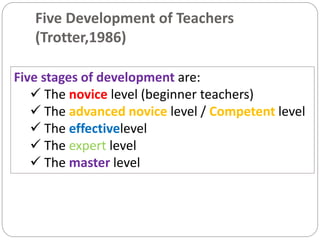
Five Development of Teachers
(Trotter,1986)
Five stages of development are:
 The novice level (beginner teachers)
 The advanced novice level / Competent level
 The effectivelevel
 The expert level
 The master level
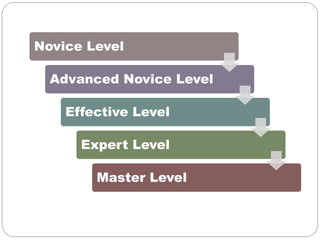
Novice Level
Advanced Novice Level
Effective Level
Expert Level
Master Level
Pre-service teachers in Teaching degree program may
be moved from the novice to the advanced novice and
start heading to the efficient level when they become
teachers in school.
Trotter (1986) argues that teachers need many years of
experience and shift to the skilled and only a handful of
them will achieve progress at the expert level.
 The novices learn the specific facts objectively and
master the basic concepts and principles in action.
 They began to acquire some basic skills, master the
terminology related to his profession and gather
initial ideas about teaching duties.
When does this stage begin?
This stage begins when you are registered as a
student teacher education (teacher education
students) in Teaching degree program.
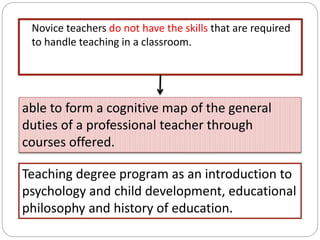
Novice teachers do not have the skills that are required
to handle teaching in a classroom.
able to form a cognitive map of the general
duties of a professional teacher through
courses offered.
Teaching degree program as an introduction to
psychology and child development, educational
philosophy and history of education.
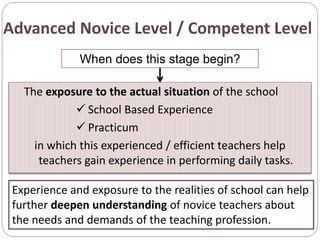
Advanced Novice Level / Competent Level
When does this stage begin?
Experience and exposure to the realities of school can help
further deepen understanding of novice teachers about
the needs and demands of the teaching profession.
The exposure to the actual situation of the school
 School Based Experience
 Practicum
in which this experienced / efficient teachers help
teachers gain experience in performing daily tasks.
Effective(competent) Level
 The third stage :The teacher achieved the skills in their
respective fields.
 The teacher had a certificate or a degree in teaching to
meet the eligibility requirement.
 Efficiency (competence) actually is a minimum for a
function as a qualified educator.
When does this competent stage begin?
Begins when you accept an offer of
appointment as a teacher.
Teachers require between two and five years of
teaching experience and at the same time being
open to new learning or ready to receive
additional training in service.
If they leave the teaching profession before the
five years of service, chances are they did not
even reach the level of competence.
Competent Level
Teachers begin to recognize more and more the
principles and concepts out of context and elements
with respect to specific situations.
Teachers begin to have the ability to solve T & L
problems they face.
Competent teacher can investigate their own practice
through reflection that may sound, "I have tried this, but
the result is not what I want. What should I do now?
THE EXPERT LEVEL (Proficient)
 Only a small percentage of professional educators ever
reach this stage.
 These are the teachers one normally thinks about when
we remember the teachers who had the most influence
on us.
Characteristics:
 Expert teacher can easily identify the key elements in a
task.
 Expert teachers have high cognitive ability to analyze and
digest the learning environment in a creative and
distinctive ways.
 Can identify the important elements of the task very
quickly, very easily.
They have a smooth style that allows them to
implement decisions based on intuitive
understandings--understandings that come out of
their experiences.
These understandings are so internalized that
sometimes they can not even state why it is that
they are thinking that way.
Teachers have the ability to guide and mentor novice
teachers.
They can share ideas, experiences and skills through
forums, in-service training courses, seminars, research,
intellectual discussion and so on.
THE MASTER LEVEL
The individual is operating in an experienced-based similar
to that achieved at the proficient stage, but in a more
holistic manner.
This means that they are not focusing on simply
one or two elements, but are able to
comprehend and work with a variety of
patterns.
Characteristics:
 People who are operating at the stage of expertise
can handle a large quantity of information and give a
very smooth, natural performance.
 Individuals in the stage of proficient still make
mistakes; those in expertise provide almost perfect
performance.
 We may only interact with a handful in our entire
education experience.
 These educators are widely recognized as superior.
 They are also likely to be mentors for educators who
desire to become like them.
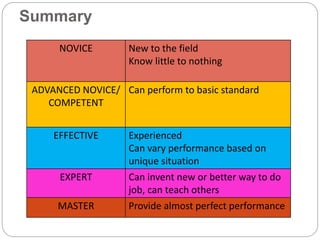
Summary
NOVICE New to the field
Know little to nothing
ADVANCED NOVICE/
COMPETENT
Can perform to basic standard
EFFECTIVE Experienced
Can vary performance based on
unique situation
EXPERT Can invent new or better way to do
job, can teach others
MASTER Provide almost perfect performance
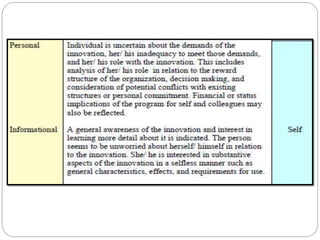
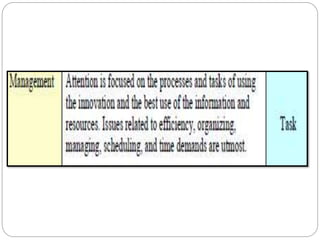
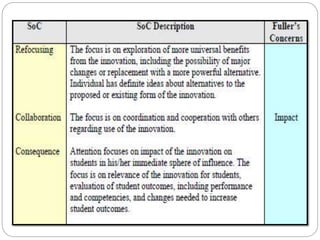
FULLER’S THREE LEVELS OF
CONCERNS
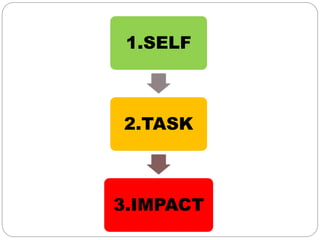
1.SELF
2.TASK
3.IMPACT
Reference
 Huitt, W. (2006, September). Stages of mastery.
Educational Psychology Interactive. Valdosta,
GA: Valdosta State University. Retrieved from
http://www.edpsycinteractive.org/edpsyc/stgmstry.
html

Stages of Teachers Development

  • 1.
    Prepared by: Group 5:Anis, Fatin, Aimi Stages of Teachers Development
  • 2.
    Five Development ofTeachers (Trotter,1986) Five stages of development are:  The novice level (beginner teachers)  The advanced novice level / Competent level  The effectivelevel  The expert level  The master level
  • 3.
    Novice Level Advanced NoviceLevel Effective Level Expert Level Master Level
  • 4.
    Pre-service teachers inTeaching degree program may be moved from the novice to the advanced novice and start heading to the efficient level when they become teachers in school. Trotter (1986) argues that teachers need many years of experience and shift to the skilled and only a handful of them will achieve progress at the expert level.
  • 5.
     The noviceslearn the specific facts objectively and master the basic concepts and principles in action.  They began to acquire some basic skills, master the terminology related to his profession and gather initial ideas about teaching duties. When does this stage begin? This stage begins when you are registered as a student teacher education (teacher education students) in Teaching degree program.
  • 6.
    Novice teachers donot have the skills that are required to handle teaching in a classroom. able to form a cognitive map of the general duties of a professional teacher through courses offered. Teaching degree program as an introduction to psychology and child development, educational philosophy and history of education.
  • 7.
    Advanced Novice Level/ Competent Level When does this stage begin? Experience and exposure to the realities of school can help further deepen understanding of novice teachers about the needs and demands of the teaching profession. The exposure to the actual situation of the school  School Based Experience  Practicum in which this experienced / efficient teachers help teachers gain experience in performing daily tasks.
  • 8.
    Effective(competent) Level  Thethird stage :The teacher achieved the skills in their respective fields.  The teacher had a certificate or a degree in teaching to meet the eligibility requirement.  Efficiency (competence) actually is a minimum for a function as a qualified educator.
  • 9.
    When does thiscompetent stage begin? Begins when you accept an offer of appointment as a teacher. Teachers require between two and five years of teaching experience and at the same time being open to new learning or ready to receive additional training in service. If they leave the teaching profession before the five years of service, chances are they did not even reach the level of competence.
  • 10.
    Competent Level Teachers beginto recognize more and more the principles and concepts out of context and elements with respect to specific situations. Teachers begin to have the ability to solve T & L problems they face. Competent teacher can investigate their own practice through reflection that may sound, "I have tried this, but the result is not what I want. What should I do now?
  • 11.
    THE EXPERT LEVEL(Proficient)  Only a small percentage of professional educators ever reach this stage.  These are the teachers one normally thinks about when we remember the teachers who had the most influence on us.
  • 12.
    Characteristics:  Expert teachercan easily identify the key elements in a task.  Expert teachers have high cognitive ability to analyze and digest the learning environment in a creative and distinctive ways.  Can identify the important elements of the task very quickly, very easily.
  • 13.
    They have asmooth style that allows them to implement decisions based on intuitive understandings--understandings that come out of their experiences. These understandings are so internalized that sometimes they can not even state why it is that they are thinking that way. Teachers have the ability to guide and mentor novice teachers. They can share ideas, experiences and skills through forums, in-service training courses, seminars, research, intellectual discussion and so on.
  • 14.
    THE MASTER LEVEL Theindividual is operating in an experienced-based similar to that achieved at the proficient stage, but in a more holistic manner. This means that they are not focusing on simply one or two elements, but are able to comprehend and work with a variety of patterns.
  • 15.
    Characteristics:  People whoare operating at the stage of expertise can handle a large quantity of information and give a very smooth, natural performance.  Individuals in the stage of proficient still make mistakes; those in expertise provide almost perfect performance.
  • 16.
     We mayonly interact with a handful in our entire education experience.  These educators are widely recognized as superior.  They are also likely to be mentors for educators who desire to become like them.
  • 17.
    Summary NOVICE New tothe field Know little to nothing ADVANCED NOVICE/ COMPETENT Can perform to basic standard EFFECTIVE Experienced Can vary performance based on unique situation EXPERT Can invent new or better way to do job, can teach others MASTER Provide almost perfect performance
  • 18.
  • 19.
  • 23.
    Reference  Huitt, W.(2006, September). Stages of mastery. Educational Psychology Interactive. Valdosta, GA: Valdosta State University. Retrieved from http://www.edpsycinteractive.org/edpsyc/stgmstry. html