CONSIDERATIONS
IN DESIGNING CURRICULUM
L E C T U R E R : Y E E B E E
C H O O
I P G K T H O
Topic 4 TSL 3143
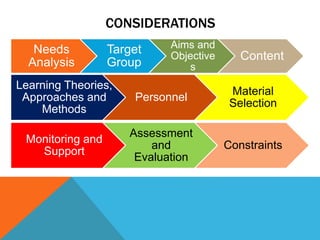
Needs
Analysis
Target
Group
Aims and
Objective
s
Content
Learning Theories,
Approaches and
Methods
Personnel
Material
Selection
Monitoring and
Support
Assessment
and
Evaluation
Constraints
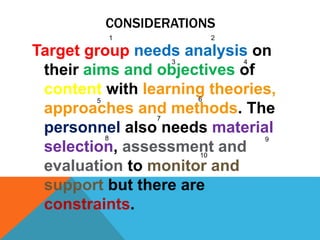
CONSIDERATIONS
Target group needs analysis on
their aims and objectives of
content with learning theories,
approaches and methods. The
personnel also needs material
selection, assessment and
evaluation to monitor and
support but there are
constraints.
8
3 4
21
7
65
10
9
CONSIDERATIONS
CONSIDERATIONS
• A curriculum is more than putting
together a set of academically required
subjects.
• Several things must be considered,
such as the learning needs of students;
the consensus of teachers and
administrators; the expectations of the
community; and current breakthroughs
in academic fields.
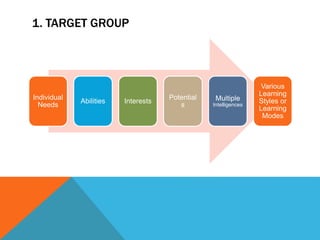
1. TARGET GROUP
Individual
Needs
Abilities Interests
Potential
s
Multiple
Intelligences
Various
Learning
Styles or
Learning
Modes
2. NEEDS ANALYSIS
• According to Iwai et al. (1999), the term needs analysis
generally refers to the activities that are involved in
collecting information that will serve as the basis for
developing a curriculum that will meet the needs of a
particular group of students.
• The curriculum designers must be aware of the learners’
strengths and weaknesses.
• It examines what learners already know and what they
need to know (Nation & Macalister, 2010).
• Many scholars indicate that knowing about learners’
needs such as “their learning objectives, language
attitudes, expectations from the course” are necessary in
order to design an efficient curriculum (Brindley, 1984;
Nunan, 1988, Xenodohids, 2002, et Kayi, 2008).
2. NEEDS ANALYSIS
Steps of a needs analysis plan include:
1. Write objectives: What is it that you want to learn from
the needs analysis?
2. Select audience: Who is the target audience? Whose
needs are you measuring, and to whom will you give the
required information?
3. Collect data: How will you collect data that will tell you
what you need to know? Will you collect data directly
from the target audience or indirectly?
4. Select audience sample: How will you select a sample of
respondents who represent the target audience?
2. NEEDS ANALYSIS
Steps of a needs analysis plan include:
5. Choose an instrument: What instrument and techniques
will you
use to collect data?
6. Analyse data: How will you do with information that you
gain?
7. Follow up: What will you do with information that you
gain?
8. Make decision: What kind of decision is to be made from
the
information gained?
2. NEEDS ANALYSIS
Needs analysis is important to the development of a new
programme:
• The outcome of a needs analysis should be a list of goals
and objectives which is important to determine the
direction and target of the programme. For example,
before setting up a remedial programme in school, the
teacher should analyse the results from the summative
evaluation of students’ performance.
• The findings of the needs analysis will serve as the basis
for developing tests, materials, teaching activities,
evaluation strategies. For example, students are weak in
grammar, so the teacher needs to prepare more materials
and suitable tasks to address the problem identified.
2. NEEDS ANALYSIS
Needs analysis is important to the development of a new
programme:
• Re-evaluating the precision accuracy of the original
needs analysis is important because the feedback helps
to realign or improve existing practice in developing
curriculum. For example, before starting on a new
programme, the teacher should reflect on the
shortcomings of past practices so that those
shortcomings can be overcome.
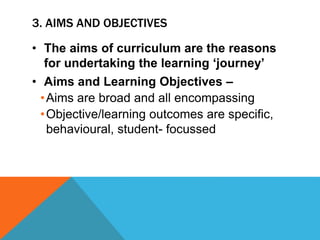
3. AIMS AND OBJECTIVES
• The aims of curriculum are the reasons
for undertaking the learning ‘journey’
• Aims and Learning Objectives –
•Aims are broad and all encompassing
•Objective/learning outcomes are specific,
behavioural, student- focussed
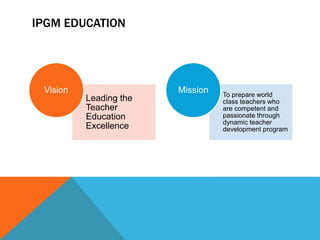
IPGM EDUCATION
Leading the
Teacher
Education
Excellence
Vision To prepare world
class teachers who
are competent and
passionate through
dynamic teacher
development program
Mission
(Ministry of Education, p.131, 2012)
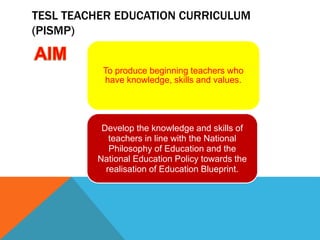
TESL TEACHER EDUCATION CURRICULUM
(PISMP)
To produce beginning teachers who
have knowledge, skills and values.
Develop the knowledge and skills of
teachers in line with the National
Philosophy of Education and the
National Education Policy towards the
realisation of Education Blueprint.
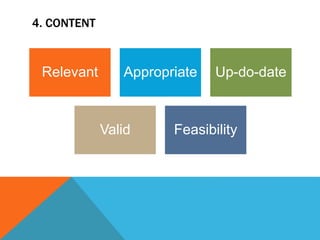
4. CONTENT
Relevant Appropriate Up-do-date
Valid Feasibility
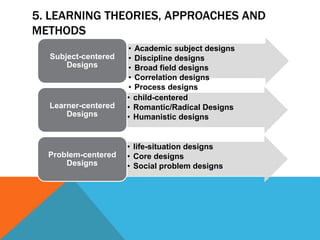
5. LEARNING THEORIES, APPROACHES AND
METHODS
• Academic subject designs
• Discipline designs
• Broad field designs
• Correlation designs
• Process designs
Subject-centered
Designs
• child-centered
• Romantic/Radical Designs
• Humanistic designs
Learner-centered
Designs
• life-situation designs
• Core designs
• Social problem designs
Problem-centered
Designs
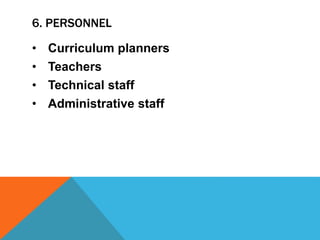
6. PERSONNEL
• Curriculum planners
• Teachers
• Technical staff
• Administrative staff
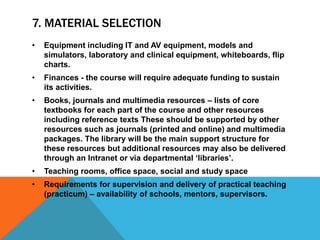
7. MATERIAL SELECTION
• Equipment including IT and AV equipment, models and
simulators, laboratory and clinical equipment, whiteboards, flip
charts.
• Finances - the course will require adequate funding to sustain
its activities.
• Books, journals and multimedia resources – lists of core
textbooks for each part of the course and other resources
including reference texts These should be supported by other
resources such as journals (printed and online) and multimedia
packages. The library will be the main support structure for
these resources but additional resources may also be delivered
through an Intranet or via departmental ‘libraries’.
• Teaching rooms, office space, social and study space
• Requirements for supervision and delivery of practical teaching
(practicum) – availability of schools, mentors, supervisors.
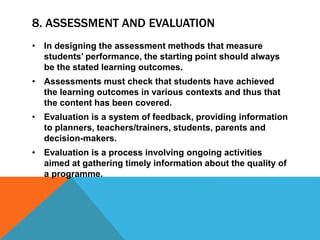
8. ASSESSMENT AND EVALUATION
• In designing the assessment methods that measure
students’ performance, the starting point should always
be the stated learning outcomes.
• Assessments must check that students have achieved
the learning outcomes in various contexts and thus that
the content has been covered.
• Evaluation is a system of feedback, providing information
to planners, teachers/trainers, students, parents and
decision-makers.
• Evaluation is a process involving ongoing activities
aimed at gathering timely information about the quality of
a programme.
9. MONITORING AND SUPPORT
• Student recruitment and selection processes.
• Teaching staff
• Training needs for teachers
• The teaching and learning process
• Assessment
• Regulations and procedures
• Availability of recommended books and journals and
other teaching materials
• Access to the library and other resources
• Performance standards
10. CONSTRAINTS
• Technological: ICT, lab, LCD, etc.
• Timing: Implementation, Readiness
• Duration: Length – lectures,
• Co-curriculum, practicum, internship,
etc
CONCLUSION
• Designing a curriculum involves the
interaction of several participants,
reaching beyond the academic wall to
impact the entire community.
• Without an effective curriculum,
students would not be able to
understand or meet the challenges of
society.
• A curriculum prepares an individual with
the knowledge to be successful,
confident and responsible citizen.
TUTORIAL 4
Task 1
• Conduct a background research on the
current Malaysian curriculum and
English Language syllabus.
• Based on your research, discuss the
influencing factors that shaped the
curriculum.
Task 2
• Read the following chapters from
Ornstein and Hunkins (2014):
Chapter 7 Curriculum Development (pg 181
– 220)
• Based on your readings, find the answers
for the focusing questions in the
beginning of the chapter. Present your
answers in class.
TUTORIAL 4

TSL3143 Topic 4 Considerations in Curriculum Studies

  • 1.
    CONSIDERATIONS IN DESIGNING CURRICULUM LE C T U R E R : Y E E B E E C H O O I P G K T H O Topic 4 TSL 3143
  • 2.
    Needs Analysis Target Group Aims and Objective s Content Learning Theories, Approachesand Methods Personnel Material Selection Monitoring and Support Assessment and Evaluation Constraints CONSIDERATIONS
  • 3.
    Target group needsanalysis on their aims and objectives of content with learning theories, approaches and methods. The personnel also needs material selection, assessment and evaluation to monitor and support but there are constraints. 8 3 4 21 7 65 10 9 CONSIDERATIONS
  • 4.
    CONSIDERATIONS • A curriculumis more than putting together a set of academically required subjects. • Several things must be considered, such as the learning needs of students; the consensus of teachers and administrators; the expectations of the community; and current breakthroughs in academic fields.
  • 5.
    1. TARGET GROUP Individual Needs AbilitiesInterests Potential s Multiple Intelligences Various Learning Styles or Learning Modes
  • 6.
    2. NEEDS ANALYSIS •According to Iwai et al. (1999), the term needs analysis generally refers to the activities that are involved in collecting information that will serve as the basis for developing a curriculum that will meet the needs of a particular group of students. • The curriculum designers must be aware of the learners’ strengths and weaknesses. • It examines what learners already know and what they need to know (Nation & Macalister, 2010). • Many scholars indicate that knowing about learners’ needs such as “their learning objectives, language attitudes, expectations from the course” are necessary in order to design an efficient curriculum (Brindley, 1984; Nunan, 1988, Xenodohids, 2002, et Kayi, 2008).
  • 7.
    2. NEEDS ANALYSIS Stepsof a needs analysis plan include: 1. Write objectives: What is it that you want to learn from the needs analysis? 2. Select audience: Who is the target audience? Whose needs are you measuring, and to whom will you give the required information? 3. Collect data: How will you collect data that will tell you what you need to know? Will you collect data directly from the target audience or indirectly? 4. Select audience sample: How will you select a sample of respondents who represent the target audience?
  • 8.
    2. NEEDS ANALYSIS Stepsof a needs analysis plan include: 5. Choose an instrument: What instrument and techniques will you use to collect data? 6. Analyse data: How will you do with information that you gain? 7. Follow up: What will you do with information that you gain? 8. Make decision: What kind of decision is to be made from the information gained?
  • 9.
    2. NEEDS ANALYSIS Needsanalysis is important to the development of a new programme: • The outcome of a needs analysis should be a list of goals and objectives which is important to determine the direction and target of the programme. For example, before setting up a remedial programme in school, the teacher should analyse the results from the summative evaluation of students’ performance. • The findings of the needs analysis will serve as the basis for developing tests, materials, teaching activities, evaluation strategies. For example, students are weak in grammar, so the teacher needs to prepare more materials and suitable tasks to address the problem identified.
  • 10.
    2. NEEDS ANALYSIS Needsanalysis is important to the development of a new programme: • Re-evaluating the precision accuracy of the original needs analysis is important because the feedback helps to realign or improve existing practice in developing curriculum. For example, before starting on a new programme, the teacher should reflect on the shortcomings of past practices so that those shortcomings can be overcome.
  • 11.
    3. AIMS ANDOBJECTIVES • The aims of curriculum are the reasons for undertaking the learning ‘journey’ • Aims and Learning Objectives – •Aims are broad and all encompassing •Objective/learning outcomes are specific, behavioural, student- focussed
  • 12.
    IPGM EDUCATION Leading the Teacher Education Excellence VisionTo prepare world class teachers who are competent and passionate through dynamic teacher development program Mission
  • 13.
  • 14.
    TESL TEACHER EDUCATIONCURRICULUM (PISMP) To produce beginning teachers who have knowledge, skills and values. Develop the knowledge and skills of teachers in line with the National Philosophy of Education and the National Education Policy towards the realisation of Education Blueprint.
  • 15.
    4. CONTENT Relevant AppropriateUp-do-date Valid Feasibility
  • 16.
    5. LEARNING THEORIES,APPROACHES AND METHODS • Academic subject designs • Discipline designs • Broad field designs • Correlation designs • Process designs Subject-centered Designs • child-centered • Romantic/Radical Designs • Humanistic designs Learner-centered Designs • life-situation designs • Core designs • Social problem designs Problem-centered Designs
  • 17.
    6. PERSONNEL • Curriculumplanners • Teachers • Technical staff • Administrative staff
  • 18.
    7. MATERIAL SELECTION •Equipment including IT and AV equipment, models and simulators, laboratory and clinical equipment, whiteboards, flip charts. • Finances - the course will require adequate funding to sustain its activities. • Books, journals and multimedia resources – lists of core textbooks for each part of the course and other resources including reference texts These should be supported by other resources such as journals (printed and online) and multimedia packages. The library will be the main support structure for these resources but additional resources may also be delivered through an Intranet or via departmental ‘libraries’. • Teaching rooms, office space, social and study space • Requirements for supervision and delivery of practical teaching (practicum) – availability of schools, mentors, supervisors.
  • 19.
    8. ASSESSMENT ANDEVALUATION • In designing the assessment methods that measure students’ performance, the starting point should always be the stated learning outcomes. • Assessments must check that students have achieved the learning outcomes in various contexts and thus that the content has been covered. • Evaluation is a system of feedback, providing information to planners, teachers/trainers, students, parents and decision-makers. • Evaluation is a process involving ongoing activities aimed at gathering timely information about the quality of a programme.
  • 20.
    9. MONITORING ANDSUPPORT • Student recruitment and selection processes. • Teaching staff • Training needs for teachers • The teaching and learning process • Assessment • Regulations and procedures • Availability of recommended books and journals and other teaching materials • Access to the library and other resources • Performance standards
  • 21.
    10. CONSTRAINTS • Technological:ICT, lab, LCD, etc. • Timing: Implementation, Readiness • Duration: Length – lectures, • Co-curriculum, practicum, internship, etc
  • 22.
    CONCLUSION • Designing acurriculum involves the interaction of several participants, reaching beyond the academic wall to impact the entire community. • Without an effective curriculum, students would not be able to understand or meet the challenges of society. • A curriculum prepares an individual with the knowledge to be successful, confident and responsible citizen.
  • 23.
    TUTORIAL 4 Task 1 •Conduct a background research on the current Malaysian curriculum and English Language syllabus. • Based on your research, discuss the influencing factors that shaped the curriculum.
  • 24.
    Task 2 • Readthe following chapters from Ornstein and Hunkins (2014): Chapter 7 Curriculum Development (pg 181 – 220) • Based on your readings, find the answers for the focusing questions in the beginning of the chapter. Present your answers in class. TUTORIAL 4