by Conway & Clark


Leonardo Langaro | PD MAE DIT | 2010
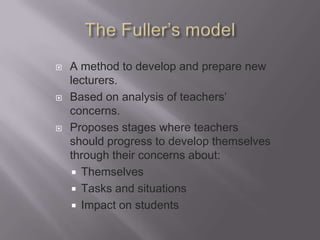
   A method to develop and prepare new
    lecturers.
   Based on analysis of teachers’
    concerns.
   Proposes stages where teachers
    should progress to develop themselves
    through their concerns about:
     Themselves
     Tasks and situations
     Impact on students
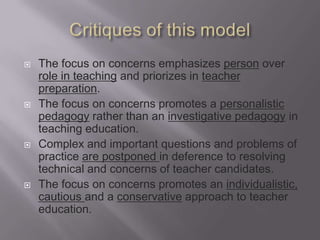
   The focus on concerns emphasizes person over
    role in teaching and priorizes in teacher
    preparation.
   The focus on concerns promotes a personalistic
    pedagogy rather than an investigative pedagogy in
    teaching education.
   Complex and important questions and problems of
    practice are postponed in deference to resolving
    technical and concerns of teacher candidates.
   The focus on concerns promotes an individualistic,
    cautious and a conservative approach to teacher
    education.
   Attention to both hopes and fears together
    provides a more balanced and expansive view
    of their actual experience and their
    expectations about learning to teach.
   Hopes and fears can be the basis for both an
    encouraging and challenging conversation with
    teachers candidates about their beliefs and
    motives about classrooms, schools, students,
    learning and teaching, and relationships.
   The pattern of concerns moves outward, but also
    inward with intense reflexivity and self-control.
   Teachers’ candidates develop focused concerns
    as they move through early field experiences.
   The initial inward focus among teachers’
    candidates is necessary, valuable, and reflects a
    move toward reflective as the professional self is
    constructed over time.
   Models of teachers’ development do not provide
    direct prescriptions for teacher education
    programs, however they enrich our understanding
    of how teachers’ candidates can think and change.
   The Conway's article about the Fuller's concern model
    give me a feeling that to be a teacher by full is
    necessary have a deep understanding about myself
    including personality, hopes and fears, and my
    strenghts and weakness.
   I understand that in the process of teaching and
    learning should have a feeling relationship between the
    learner and the teacher.
   Even in a virtual class where you never see or hear
    your teacher, the motivation and wish to learn are
    essential feelings to reach the objectives.
   The focus on concerns will help you to deal with the
    daily problems in a clearly and consistent manner.
   Conway, P., & Clark, C. (2003). The journey
    inward and outward: a re-examination of Fuller’s
    concerned-based model of teacher development.
    Teaching and Teacher Education, (19), 465–482.


                                 © 2010 Leonardo Langaro

The Fuller's Model

  • 1.
    by Conway &Clark Leonardo Langaro | PD MAE DIT | 2010
  • 2.
    A method to develop and prepare new lecturers.  Based on analysis of teachers’ concerns.  Proposes stages where teachers should progress to develop themselves through their concerns about:  Themselves  Tasks and situations  Impact on students
  • 3.
    The focus on concerns emphasizes person over role in teaching and priorizes in teacher preparation.  The focus on concerns promotes a personalistic pedagogy rather than an investigative pedagogy in teaching education.  Complex and important questions and problems of practice are postponed in deference to resolving technical and concerns of teacher candidates.  The focus on concerns promotes an individualistic, cautious and a conservative approach to teacher education.
  • 4.
    Attention to both hopes and fears together provides a more balanced and expansive view of their actual experience and their expectations about learning to teach.  Hopes and fears can be the basis for both an encouraging and challenging conversation with teachers candidates about their beliefs and motives about classrooms, schools, students, learning and teaching, and relationships.
  • 5.
    The pattern of concerns moves outward, but also inward with intense reflexivity and self-control.  Teachers’ candidates develop focused concerns as they move through early field experiences.  The initial inward focus among teachers’ candidates is necessary, valuable, and reflects a move toward reflective as the professional self is constructed over time.  Models of teachers’ development do not provide direct prescriptions for teacher education programs, however they enrich our understanding of how teachers’ candidates can think and change.
  • 6.
    The Conway's article about the Fuller's concern model give me a feeling that to be a teacher by full is necessary have a deep understanding about myself including personality, hopes and fears, and my strenghts and weakness.  I understand that in the process of teaching and learning should have a feeling relationship between the learner and the teacher.  Even in a virtual class where you never see or hear your teacher, the motivation and wish to learn are essential feelings to reach the objectives.  The focus on concerns will help you to deal with the daily problems in a clearly and consistent manner.
  • 7.
    Conway, P., & Clark, C. (2003). The journey inward and outward: a re-examination of Fuller’s concerned-based model of teacher development. Teaching and Teacher Education, (19), 465–482. © 2010 Leonardo Langaro