APrIR – SBS 2011 Prof. Carla Raguseo
Agenda:  Open Professional Development Building a PLN  (Personal Learning Network) Social Networking  Unconferences : bottom-up learning ---------  Coffee Break  ---------- Research 2.0  Digital Teaching Portfolios
by reflecting on your practice by attending talks, workshops and seminars by reading academic journals or professional literature by attending in-service training sessions and staff meetings by …
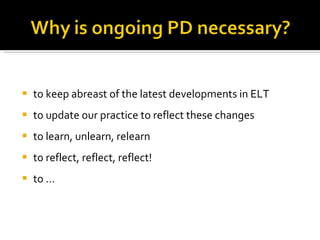
to keep abreast of the latest developments in ELT to update our practice to reflect these changes to learn, unlearn, relearn to reflect, reflect, reflect! to …
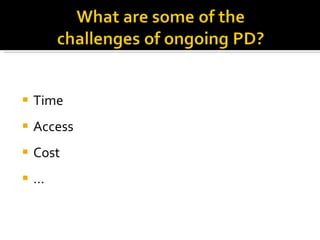
Time Access Cost …
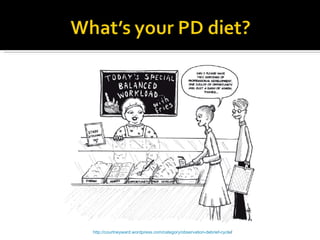
http://courtneyward.wordpress.com/category/observation-debrief-cycle /
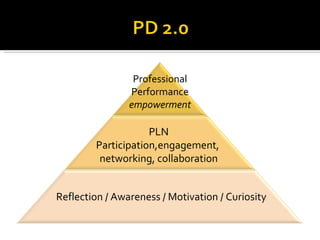
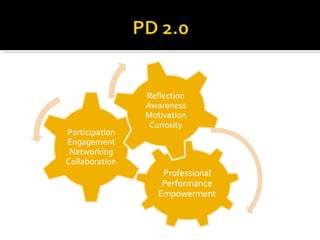
Reflection / Awareness / Motivation / Curiosity PLN Participation,engagement,  networking, collaboration Professional Performance empowerment
 
Open participatory architecture Two-way communication User-generated content
http://www.go2web20.net/   +3,000 services
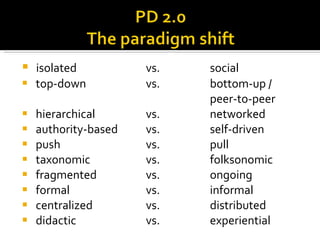
isolated  vs.  social  top-down  vs.  bottom-up / peer-to-peer hierarchical vs. networked authority-based  vs.  self-driven push  vs.  pull taxonomic vs.  folksonomic fragmented  vs.  ongoing formal  vs.  informal centralized  vs.  distributed didactic  vs.  experiential
 
“ In this new interactive Web world, I have become a nomadic learner; I graze on knowledge. I find what I need when I need it.” Will Richardson 2006 http://www.edutopia.org/new-face-learning/
“ We know we can publish information, now we need to focus on how we connect to each other, how we build learning contexts”  P. Mancini 2007
“ Know-how and know-what is being supplemented with know-where (the understanding of where to find knowledge needed).” “ The pipe is more important than the content within the pipe. Our ability to learn what we need for tomorrow is more important than what we know today.”  G. Siemens 2004 http://www.elearnspace.org/Articles/connectivism.htm
 
 
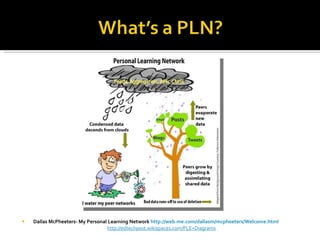
Dallas McPheeters- My Personal Learning Network  http://web.me.com/dallasm/mcpheeters/Welcome.html http://edtechpost.wikispaces.com/PLE+Diagrams
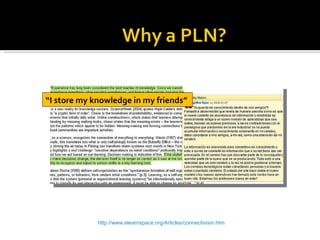
“ I store my knowledge in my friends” http://www.elearnspace.org/Articles/connectivism.htm
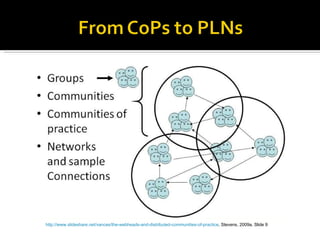
http://www.slideshare.net/vances/the-webheads-and-distributed-communities-of-practice , Stevens, 2009a, Slide 9
All work and no play ? Work and play? “ As people become more fulfilled and do work  that they enjoy it becomes less work and more play. In some way, we are seeing in the web the evidence of the marriage between work and play, which is really what life should be about.”  Kevin Kelly – Digitalismo 2007  http://digitalistas.blogspot.com/2007/11/entrevista-kevin-kelly.html   5:04 http://mateyedublogs.pbworks.com/w/page/20514031/TercerLugar https://docs.google.com/Doc?docid=0AWybQ2ooynY5ZGNncTdkdzNfMThjNHB6Nzhmag&hl=en http://ticsylenguas.edublogs.org/2008/09/17/desde-el-tercer-lugar/
 
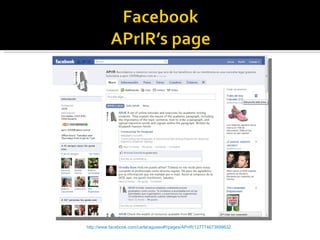
http://www.facebook.com/carlaraguseo#!/pages/APrIR/127774673899632
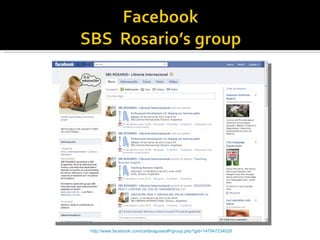
http://www.facebook.com/carlaraguseo#!/group.php?gid=147947234026
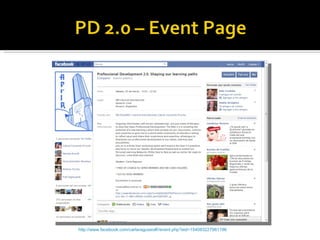
http://www.facebook.com/carlaraguseo#!/event.php?eid=154083227981196


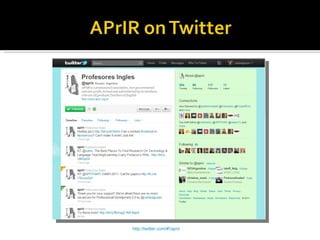
http://twitter.com/#!/aprir
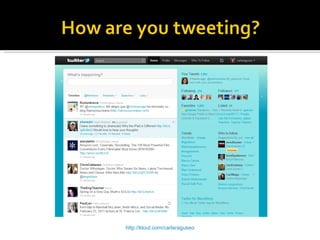
http://klout.com/carlaraguseo
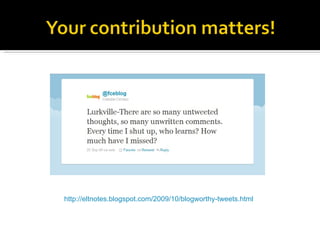
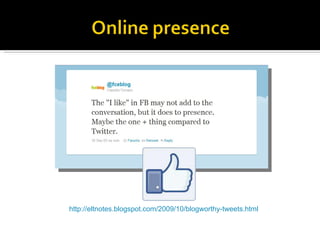
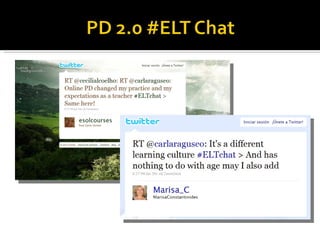
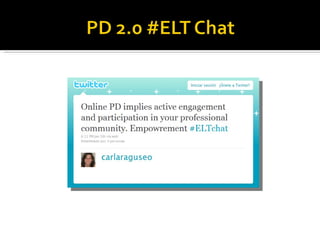
http://eltnotes.blogspot.com/2009/10/blogworthy-tweets.html
Individual Knowledge vs. Mutual Knowledge : Collective power to bring about change Explicit language is an excellent way of creating mutual knowledge  By putting it “out there” we are changing the state of knowledge. 			http://www.youtube.com/watch?v=3-son3EJTrU&feature=relmfu   Language as a Window into Social Relations  by Steven Pinker
http://eltnotes.blogspot.com/2009/10/blogworthy-tweets.html
 
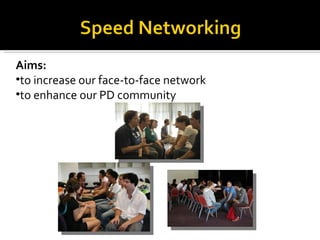
Aims:  to increase our face-to-face network to enhance our PD community
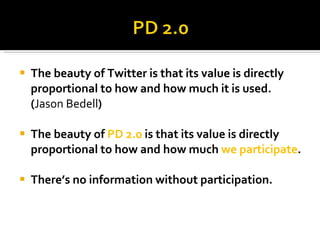
The beauty of Twitter is that its value is directly proportional to how and how much it is used. ( Jason Bedell ) The beauty of  PD 2.0  is that its value is directly proportional to how and how much  we participate . There’s no information without participation.


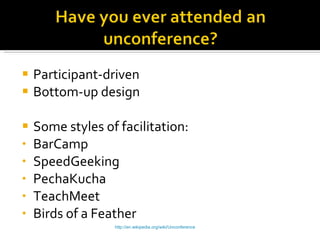
Participant-driven Bottom-up design Some styles of facilitation: BarCamp SpeedGeeking PechaKucha TeachMeet Birds of a Feather http://en.wikipedia.org/wiki/Unconference
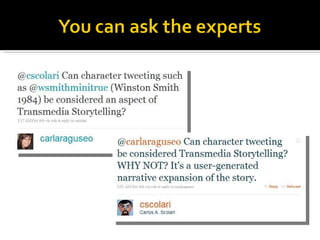
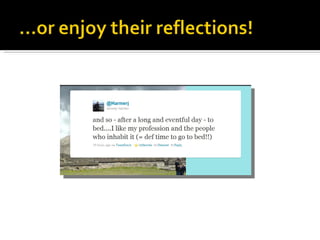


An interview with … http://wetoku.com/carlaraguseo/3Pv
Divide yourselves into groups according to a special ELT interest. Go over the Web 2.0 tools list (handout). How would you use them in your particular field of interest?
Time to keep learning! Talk to a colleague you’ve never met before. Leave a message on APrIR or SBS’s “wall”. “ Like” somebody else’s message. Explore the environment.
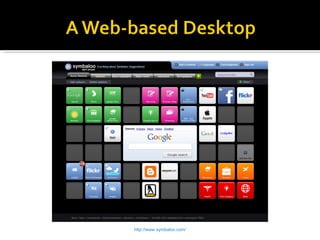
http://www.symbaloo.com/
 
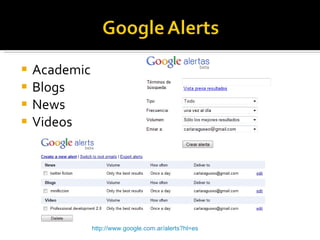
Google Search Google Alerts
Search terms Search Syntax Advanced Search Options Try searching for content through images!
Academic Blogs News Videos http://www.google.com.ar/alerts?hl=es
 
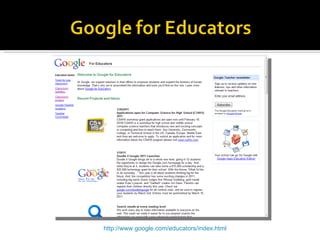
http://www.google.com/educators/index.html
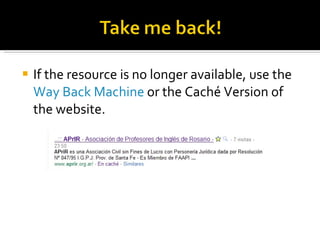
If the resource is no longer available, use the  Way Back Machine  or the Caché Version of the website.
Spezify – Inspired search http://www.spezify.com/ Qwiki  -  The information experience http://www.qwiki.com/
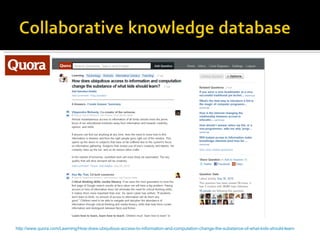
http://www.quora.com/Learning/How-does-ubiquitous-access-to-information-and-computation-change-the-substance-of-what-kids-should-learn
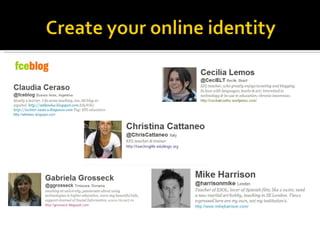
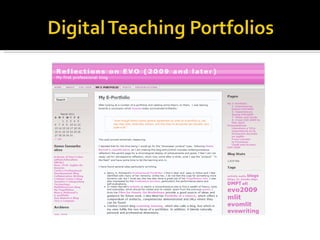
Blogs  Personal Website Online CV Reflective reading and writing Sandbox Silvia Tolisano  http://www.langwitches.org/portfolio/ Claudia Ceraso  http://eltnotes.blogspot.com/ Gabriela Sellart:  http://revealties.wordpress.com/ Jennifer Verschoor:  http://jenverschoor.wordpress.com/ Mariel Amez  http://mamez.wordpress.com/ Carla Raguseo  http://carlaraguseo.wordpress.com/
 
Wikis Collection of resources, presentations, projects…. http://claudiaceraso.pbworks.com/w/page/15996447/FrontPage
TEFLpedia  http://teflpedia.com/Main_Page Wikis in EFL  http://wikisinefl.wikispaces.com/ Simple English Wikipedia  http://simple.wikipedia.org/
http://voicethread.com/?#u1642534.b1734523
You cannot give away what you do not own. (Sheryl  Nussbaum-Beach ) We can’t teach 2.0 if we don’t learn 2.0  To teach is to learn twice.  ~Joseph Joubert, 1842
“ They may forget what you said, but they will never forget how you made them feel.” Carl W. Buechner quote
Facebook Group: Professional Development 2.0
http://21stcenturylearning.typepad.com/blog/2007/07/when-preparing-.html http://www.tesl-ej.org/wordpress/issues/volume13/ej51/ej51int/ http://www.infed.org/biblio/learning-social.htm http://jasontbedell.com/professional-development-2-0-the-ebook Images http://www.flickr.com/photos/halans/2388757936 http://www.flickr.com/photos/halans/2388758982/ http://www.flickr.com/photos/uwa_studentservices/5176661175/ Special thanks to my PLN!

Professional development 2

Editor's Notes

  • #7 Cognitive Diet (Piscitelli): How we design our own curriculum, how we organize and reflect on emerging learning experinces.
  • #8 Problem solving and learning from experience become central processes
  • #9 Mechanism
  • #12 la definición de nativos/inmigrantes como clases cognitivas diferenciadas. La brecha tecnológica que es fundamentalmente cultural (Piscitelli)
  • #15 Design spaces for learning to emerge / content to be built through meaningful interactions. Not downloading content to students.
  • #19 API : Application Programming Interface An API allows computer programmers to access the functionality of pre-built software modules. http://apiwiki.twitter.com/w/page/22554648/FrontPage
  • #21 Various perspectives of how knowledge is propagated through networks have addressed the problem of information overload. Information is essentially raw data and is disconnected and of itself of little use beyond the scope of factoid. Communities and networks help us to aggregate, filter, and assimilate this information into some kind of knowledge structure and then disseminate it throughout the community or network. Nik Peachey (2009) addressed exactly this concept in his presentation recorded at the recent AVEALMEC/ARCALL online conference on Social Networking. Downes (2005) has written and presented much on the concept of diffusion of knowledge within distributed learning networks, as has Siemens (2006). Siemens has long espoused the notion of connectivism, famously summarized as “The pipe is more important than the content within the pipe.” (Siemens, 2004, n.p.). Here, Siemens means that it is more important to nurture a system of connections between knowledgeable people (the pipe) than to be concerned with what these knowledgeable people know (the content within the pipe) since this content can be directed as needed to anyone with appropriate connections within the pipe.
  • #22 We enjoy learning – W share our work – We get together voluntarily. It’s not an obligation.