PROFESSIONAL DEVELOPMENT INFORMATION EVENING FOR FIRST YEAR TEACHERSWHAT IT TAKES TO BE A PROFESSIONAL AND EFFECTIVE TEACHER
Thank you all for coming tonight, I am Professor Gilmour from Curtin University and it is a privilege to be your guest speaker for this evening. It is great to be here and we are fortunate to have a fantastic turnout from teachers all around the city and I hope this evening provides you with some extra knowledge as well as some handy tips and pointers to take home with you and apply in your classrooms.
TOPICS COVEREDProfessionalism
Characteristics of a Professional
Commitment to Students
Knowledge
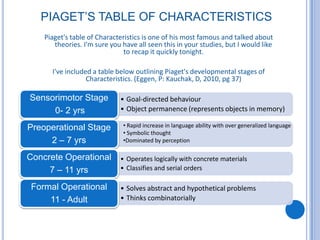
Piaget’s Theory of Intellectual Development & Characteristics
Decision Making
Reflective Practices
SummaryWHAT IS PROFESSIONALISM?Professionalism:the standing, practice, or methods of a professional, as distinguished from an amateur. – Dictionary Reference (2010)There are many different definitions for the word professionalism. An individual must possess a number of different types of qualities and characteristics to be labeled as a professional. It is important for teachers to be viewed as a 'professional' from all different angels; their colleagues, students and students parents.
CHARACTERISTICS OF A PROFESSIONAL TEACHER: Commitment to his/her studentsSpecialized Knowledge of content and Pedagogical contentCompetent Classroom Management & quick Decision Making SkillsReflective practices such as self assessment We will expand on these in more depth throughout the evening.
“A good teacher is like a candle - it consumes itself to light the way for others.”  ~Author Unknown Think about how you would like your students to perceive you and the impact you will have on your students lives.
1. COMMITMENT TO STUDENTS"A professional doesn't view his or her profession as just a job, but rather sees it as a calling that is all about caring for children"  (Kramer 2003, pg 23)   As teachers you must have Genuine Care for students not only in their studies and learning abilities but also relating and supporting them socially and emotionally - students will look up to teachers as role models.
 A committed teacher will always aim to Motivate their Students – studies have found that motivated students have positive attitudes and a higher success rate in learning abilities.
  A committed teacher will always Voice and Act on concerns they have for students - by taking a little extra time to help a student who doesn't understand equations and/or speaking to a student's parent if concerned about their child’s behavior or skills.
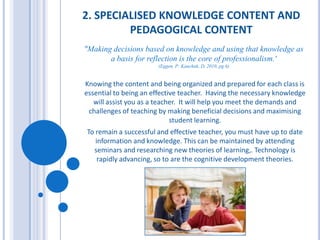
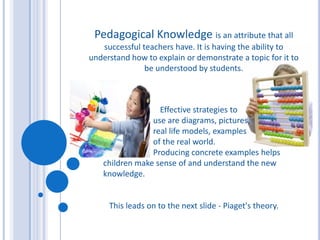
Eliminate any distractions for students - try to make the class an equal learning opportunity for all students. If there is someone misbehaving intervene immediately to avoid further disruptions.2. SPECIALISED KNOWLEDGE CONTENT AND PEDAGOGICAL CONTENT"Making decisions based on knowledge and using that knowledge as a basis for reflection is the core of professionalism.' (Eggen, P: Kauchak, D, 2010, pg 6)Knowing the content and being organized and prepared for each class is essential to being an effective teacher. Having the necessary knowledge will assist you as a teacher.  It will help you meet the demands and challenges of teaching by making beneficial decisions and maximising student learning. To remain a successful and effective teacher, you must have up to date informationand knowledge. This can be maintained by attending seminars and researching new theories of learning,. Technology is rapidly advancing, so to are the cognitive development theories.  

F:\Uni 2009\Group Assignment Slide Show

  • 1.
    PROFESSIONAL DEVELOPMENT INFORMATIONEVENING FOR FIRST YEAR TEACHERSWHAT IT TAKES TO BE A PROFESSIONAL AND EFFECTIVE TEACHER
  • 2.
    Thank you allfor coming tonight, I am Professor Gilmour from Curtin University and it is a privilege to be your guest speaker for this evening. It is great to be here and we are fortunate to have a fantastic turnout from teachers all around the city and I hope this evening provides you with some extra knowledge as well as some handy tips and pointers to take home with you and apply in your classrooms.
  • 3.
  • 4.
  • 5.
  • 6.
  • 7.
    Piaget’s Theory ofIntellectual Development & Characteristics
  • 8.
  • 9.
  • 10.
    SummaryWHAT IS PROFESSIONALISM?Professionalism:thestanding, practice, or methods of a professional, as distinguished from an amateur. – Dictionary Reference (2010)There are many different definitions for the word professionalism. An individual must possess a number of different types of qualities and characteristics to be labeled as a professional. It is important for teachers to be viewed as a 'professional' from all different angels; their colleagues, students and students parents.
  • 11.
    CHARACTERISTICS OF APROFESSIONAL TEACHER: Commitment to his/her studentsSpecialized Knowledge of content and Pedagogical contentCompetent Classroom Management & quick Decision Making SkillsReflective practices such as self assessment We will expand on these in more depth throughout the evening.
  • 12.
    “A good teacheris like a candle - it consumes itself to light the way for others.”  ~Author Unknown Think about how you would like your students to perceive you and the impact you will have on your students lives.
  • 13.
    1. COMMITMENT TOSTUDENTS"A professional doesn't view his or her profession as just a job, but rather sees it as a calling that is all about caring for children" (Kramer 2003, pg 23)  As teachers you must have Genuine Care for students not only in their studies and learning abilities but also relating and supporting them socially and emotionally - students will look up to teachers as role models.
  • 14.
    A committedteacher will always aim to Motivate their Students – studies have found that motivated students have positive attitudes and a higher success rate in learning abilities.
  • 15.
    Acommitted teacher will always Voice and Act on concerns they have for students - by taking a little extra time to help a student who doesn't understand equations and/or speaking to a student's parent if concerned about their child’s behavior or skills.
  • 16.
    Eliminate any distractionsfor students - try to make the class an equal learning opportunity for all students. If there is someone misbehaving intervene immediately to avoid further disruptions.2. SPECIALISED KNOWLEDGE CONTENT AND PEDAGOGICAL CONTENT"Making decisions based on knowledge and using that knowledge as a basis for reflection is the core of professionalism.' (Eggen, P: Kauchak, D, 2010, pg 6)Knowing the content and being organized and prepared for each class is essential to being an effective teacher. Having the necessary knowledge will assist you as a teacher. It will help you meet the demands and challenges of teaching by making beneficial decisions and maximising student learning. To remain a successful and effective teacher, you must have up to date informationand knowledge. This can be maintained by attending seminars and researching new theories of learning,. Technology is rapidly advancing, so to are the cognitive development theories.