Training &Training &
DevelopmentDevelopment
Towards Building a LearningTowards Building a Learning
ORGORG..
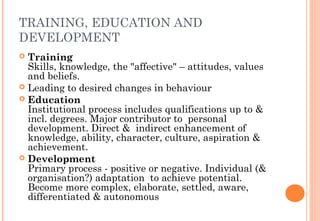
TRAINING, EDUCATION AND
DEVELOPMENT
 Training
Skills, knowledge, the "affective" – attitudes, values
and beliefs.
 Leading to desired changes in behaviour
 Education
Institutional process includes qualifications up to &
incl. degrees. Major contributor to personal
development. Direct & indirect enhancement of
knowledge, ability, character, culture, aspiration &
achievement.
 Development
Primary process - positive or negative. Individual (&
organisation?) adaptation to achieve potential.
Become more complex, elaborate, settled, aware,
differentiated & autonomous
LEARNING?
 Learning is a major process of human adaptation
 It is a continuous process, occurring as we make sense of
changes in environment
 A great deal of our learning is driven by social activity
 Learning is affected by person’s characteristics (culture,
creativity, ability, EQ, confidence
WHY LEARNING MATTERS
 Learning enhances the adaptive capacity of an
organization – its ability to respond quickly and
flexibility to changes in its operating environment
 A poor fir between an organization’s strategy and
culture causes the benefits of learning to be diffused
 A powerful way to promote and establish a positive
culture in which employees are engaged and
committed to making the organization successful
 Creating a positive learning culture supervisors,
managers and HRD practitoners can deliver
considerable strategic value to their organization
CONDITIONS FOR LEARNING
ORGANIZATION
Freedom to
learn
Supportiv
e
Environm
ent
Sense
of
purpose
DEVELOPING A LEARNING
ORGANIZATION
 DEVELOP the vision (one that is believed by all
employees)
 SHARE the vision (Conviction & consistency,
integrated binds team)
 EMPOWER employees (facilitative style of
management, coaching culture)
 LEAD by Example (culture experienced through the
behaviour of front line managers)
 ENCOURAGE Networks (facilitate flow of info across
org. Boundaries such that ideas, expertise and
resources are pooled rather than duplicated or
ignored)
 ALIGN policies and systems (to match culture)
MORE HRM AND INGREDIENTS OF A
“LEARNING ORGANISATION”
• Adopt a Learning Approach to Strategy
• Internal Exchange (Client-Server
relationships)
• Reward Flexibility
• Roles and flexible, matrix structures
• Boundary workers as intelligence
agents
• Company-to-company learning
• Self-development opportunities for all
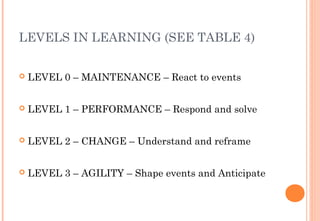
LEVELS IN LEARNING (SEE TABLE 4)
 LEVEL 0 – MAINTENANCE – React to events
 LEVEL 1 – PERFORMANCE – Respond and solve
 LEVEL 2 – CHANGE – Understand and reframe
 LEVEL 3 – AGILITY – Shape events and Anticipate
LEARNING
INTERVENTIONS (SEE TABLE 5)
 SELF DIRECTED
 COACH
 MENTOR
 COUNSELLOR
 FACILITATOR
 CHANGE AGENT
 MIRROR
 KNOWLEDGE BROKER
 CHANGE ARCHITECT
 CULTURE ANALYST
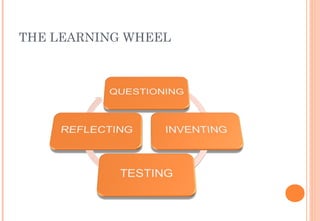
THE LEARNING WHEEL
FEATURES IN LEARNING & TRAINING
 See table 3
TRADITIONAL TRAINING TECHNIQUES
 FORMAL CLASSROOM
 COMPUTER BASED
 E-LEARNING
 SHADOWING
 JOB ROTATION, SECONDMENT,
 ACTION LEARNING/EXPERIENTIAL
 CONFERENCES/SEMINARS/EVENTS &
WORKSHOPS
 ON THE JOB (observation)
WHEN DOES TRAINING FIT IN?
 CRITICAL INFORMATION MUST BE IMPARTED
 CHALLENGES ARE SO COMPLEX EMPLOYEES
ARE UNLIKELY TO MASTER ON THEIR OWN
 STAFF INDUCTION
 DEVELOPING ESSENTIAL IT SKILLS
 DEVELOPING ESSENTIAL ENGINEERING
SKILLS
 PRESENTATION
 AND LEADERSHIP SKILLS
General Model for Training Interventions
Learning
needs &
outcomes
- individual
& group
Training
Content
Methods
of delivery,
learning opps
& materials
Programme
and
implementation
Learners
on
completion
Assessment & test criteria - validity, reliability & utility
Organisational & trainee feedback
Environment of change
Learning for knowledge,
competence & creativity
•Return to job
•Transfer of learning
to performance
•Has training solved the problem?
Symptoms
Learning Contract
COMPETENCE, EXPERIENCE &
THE JOB
 a composite of knowledge & behaviour/skill
comprising ability to do something to a defined
level in a performance situation
 Existing staff may be competent or less than
competent.
 Perceived gaps in mastery of performance.
 The organisation may urge enhanced
competence.
 Can the organisation reward enhanced
competence?
ORGANISATIONAL EXPECTATIONS
 Preparation to enable new technology & empower
 adapt & learn new skills, continuous occupational
development
 Learning for TQM, flexibility, multi-skilling &
shifts in management style, Project focused
 Empowerment
 Flatter project/team structures.
 less supervision, set own objectives, self monitoring and
corrective action
 Manage interfaces & delight customers - external &
internal
DISAPPOINTMENT WITH “TRAINING
SERVICES AND SCHEMES”
 Much talk, expenditure & effort in training
 Many initiatives and events
 Evidence of outcomes and value for money: from
training events, coaching, secondments, learning
from experience (success & failure) & role models.
Yet, T&D strategies often disappoint. Why?
 What determines & influences training effectiveness?
 How do training needs become apparent?
 What factors hinder/help investment in T&D?
 Training as a strategic issue?
 Industry or corporation awareness
 Leadership skills
 Interpersonal-relationship skills
 Technological literacy
 Problem-solving skills
 Confrontational
 Guardian of Values, Fairness and Equity
Training Manager - Service provider or change agent?
TRAINING MANAGER
 Adopt a Performance Consulting Strategy
 Measure Results to See Impact
 Training Delivery Systems Are in Transformation
 Your Customer Is the Individual Employee
 Training is Delivered Just-in-time, as Needed
TRAINING POLICY & PROGRAMMES
 recruitment,
 redundancies
 redeploymen
t
Mission
Staffing plan
Skills audit
Performance review
Development action
Demand for skills
Data for audit
Data to integrate
individual &
organisational needs
Know-how for
competitive advantage &
performance
Skill gaps
Development
needs
Current
performance
Improved capability,
competence + motivation
Training, seminars, delegation,
coaching, private study, day
release, learning company, IIP
Business Strategy & Training
ANALYSING TRAINING
NEEDS?
 Blanket/Comprehensive or Selective
 Who does it? HRD, SUPERVISOR? MANAGER?
 Define needs, objectives, frequency, difficulty, performance standards & measurements
 Brief/train all according to level.
 Job curriculums - ALL or SOME job facets: skills, knowledge & attitudes for tasks/situations
 New legislation - OSHA, strategy/policy drive.
 Identify
 key tasks and problems/difficulties
 competencies to handle it.
 learner involvement + individual & group needs
 best learning approach, training media & methods
 Is a training solution vital for performance?
 Self-organised learning: opportunity or cop-out?
KIRKPATRICK’S POST TRAINING
KIRKPATRICK’S FOUR LEVELS
HOW DO WE MEASURE LEARNING -
DEGREE OF BEHAVIOUR CHANGE?
 Compare - performance & progress between
individuals
 Against established norms or standard levels of
performance/progress for specific applications
 Assess/test- individual progress & performance
GENERIC, CORE/KEY SKILLS (OPEN
CAPACITIES )
 TRANSFERABLE across jobs/or tasks
 awareness, investigation, observation/reflection, analysis &
learning
 decision-making/problem-solving, creativity & evaluation
 communication & social skills, interacting/working with others,
influencing
 numerical & information oriented skills plus IT abilities
 CRITICAL SUCCESS FACTOR COMPETENCES
 OCCUPATIONAL COMPETENCIES (CVQ)
 BOYATZIS : THRESHOLD COMPETENCIES &
CLUSTERS FOR MANAGEMENT
BOYATSIS - SEVEN THRESHOLD
COMPETENCIES
 Use of unilateral power - forms of influence to
gain compliance
 Accurate self-assessment - realistic/grounded
view of self, strengths & weaknesses/limitations
 Positive regard - basic belief/optimistic in others
 Spontaneity - free/easy self-expression.
 Logical thought - orderly, sequential, systematic
 Specialised knowledge - usable facts, frameworks,
models
 Developing others - helping, coach, feedback skills,
facilitating, supporting
(1982, The Competent Manager, Wiley)
BOYATZIS - CLUSTERS OF MGT
COMPETENCE
 Goal & action management cluster
concern with impact, diagnostic use of concepts,
efficiency orientation, proactivity
 Leadership
conceptualisation, self-confidence, oral presentation
 HRM
use of socialised power, managing group processes
 Focus on other clusters
perceptual objectivity, self control, stamina & adaptability
 Directing subordinates
Threshold competencies - developing others, spontaneity,
use of unilateral power
NATIONAL VOCATIONAL
QUALIFICATIONS
 UK 1986: desire for a skilled, flexible workforce ›› ›› NCVQ + NVQs +
TTNVQ = CVQ based on
 National Occupational Standards = performance standards developed
by employer-led NTA
 what competent people in the occupation are expected to be able to do
 main aspects of an occupation
 best practice & ability to adapt
 knowledge-base underpinning competent performance.
 CVQ in schools (but A Level "gold standard")
 qualifications.
UNDERPINNING
PRINCIPLES – CVQ
APPROACH
 Open access. No artificial barriers to training
 Focus on what people CAN DO > learning for
qualifications (process & time) + APL
 uniform standards (devised by industry lead bodies) - no
rival qualifications.
 flexibility & modularisation + a learning contract
 assessment principles - portfolio & work-based (demos at
work or simulations).
 Time to complete. Criteria = “currency”.
 assessment by qualified (CVQ’d) assessor
DIFFERING VIEWS
ON NVQS
“Enormous potential for the health of the
nation & the creation of a learning society”.
Sue Slipman, a lead body representative, 1995
“A disaster of epic proportion”
Prof. Ian Smithers,
Brunel University,
Channel 4 documentary, 1993
Winning
Organisations
must move
from being just
Learning
Organisation
to being a
Teaching
Organisation….
TRENDS IN TRAINING
 ROTI
 PLAR
 Certification as a job requirement.
 Selling job competence. Strong CV. Career progression, job
change, employee independence & life long learning
 CPD stress - compulsory, evidence-based continuous
“professional” up-dating (ACCA, PMP, SPHR)
 Cross Training 
 "Multiskilling"
 NLP

Strategic Training and Development

  • 1.
    Training &Training & DevelopmentDevelopment TowardsBuilding a LearningTowards Building a Learning ORGORG..
  • 2.
    TRAINING, EDUCATION AND DEVELOPMENT Training Skills, knowledge, the "affective" – attitudes, values and beliefs.  Leading to desired changes in behaviour  Education Institutional process includes qualifications up to & incl. degrees. Major contributor to personal development. Direct & indirect enhancement of knowledge, ability, character, culture, aspiration & achievement.  Development Primary process - positive or negative. Individual (& organisation?) adaptation to achieve potential. Become more complex, elaborate, settled, aware, differentiated & autonomous
  • 3.
    LEARNING?  Learning isa major process of human adaptation  It is a continuous process, occurring as we make sense of changes in environment  A great deal of our learning is driven by social activity  Learning is affected by person’s characteristics (culture, creativity, ability, EQ, confidence
  • 4.
    WHY LEARNING MATTERS Learning enhances the adaptive capacity of an organization – its ability to respond quickly and flexibility to changes in its operating environment  A poor fir between an organization’s strategy and culture causes the benefits of learning to be diffused  A powerful way to promote and establish a positive culture in which employees are engaged and committed to making the organization successful  Creating a positive learning culture supervisors, managers and HRD practitoners can deliver considerable strategic value to their organization
  • 5.
    CONDITIONS FOR LEARNING ORGANIZATION Freedomto learn Supportiv e Environm ent Sense of purpose
  • 6.
    DEVELOPING A LEARNING ORGANIZATION DEVELOP the vision (one that is believed by all employees)  SHARE the vision (Conviction & consistency, integrated binds team)  EMPOWER employees (facilitative style of management, coaching culture)  LEAD by Example (culture experienced through the behaviour of front line managers)  ENCOURAGE Networks (facilitate flow of info across org. Boundaries such that ideas, expertise and resources are pooled rather than duplicated or ignored)  ALIGN policies and systems (to match culture)
  • 7.
    MORE HRM ANDINGREDIENTS OF A “LEARNING ORGANISATION” • Adopt a Learning Approach to Strategy • Internal Exchange (Client-Server relationships) • Reward Flexibility • Roles and flexible, matrix structures • Boundary workers as intelligence agents • Company-to-company learning • Self-development opportunities for all
  • 8.
    LEVELS IN LEARNING(SEE TABLE 4)  LEVEL 0 – MAINTENANCE – React to events  LEVEL 1 – PERFORMANCE – Respond and solve  LEVEL 2 – CHANGE – Understand and reframe  LEVEL 3 – AGILITY – Shape events and Anticipate
  • 9.
    LEARNING INTERVENTIONS (SEE TABLE5)  SELF DIRECTED  COACH  MENTOR  COUNSELLOR  FACILITATOR  CHANGE AGENT  MIRROR  KNOWLEDGE BROKER  CHANGE ARCHITECT  CULTURE ANALYST
  • 10.
  • 11.
    FEATURES IN LEARNING& TRAINING  See table 3
  • 12.
    TRADITIONAL TRAINING TECHNIQUES FORMAL CLASSROOM  COMPUTER BASED  E-LEARNING  SHADOWING  JOB ROTATION, SECONDMENT,  ACTION LEARNING/EXPERIENTIAL  CONFERENCES/SEMINARS/EVENTS & WORKSHOPS  ON THE JOB (observation)
  • 13.
    WHEN DOES TRAININGFIT IN?  CRITICAL INFORMATION MUST BE IMPARTED  CHALLENGES ARE SO COMPLEX EMPLOYEES ARE UNLIKELY TO MASTER ON THEIR OWN  STAFF INDUCTION  DEVELOPING ESSENTIAL IT SKILLS  DEVELOPING ESSENTIAL ENGINEERING SKILLS  PRESENTATION  AND LEADERSHIP SKILLS
  • 14.
    General Model forTraining Interventions Learning needs & outcomes - individual & group Training Content Methods of delivery, learning opps & materials Programme and implementation Learners on completion Assessment & test criteria - validity, reliability & utility Organisational & trainee feedback Environment of change Learning for knowledge, competence & creativity •Return to job •Transfer of learning to performance •Has training solved the problem? Symptoms Learning Contract
  • 15.
    COMPETENCE, EXPERIENCE & THEJOB  a composite of knowledge & behaviour/skill comprising ability to do something to a defined level in a performance situation  Existing staff may be competent or less than competent.  Perceived gaps in mastery of performance.  The organisation may urge enhanced competence.  Can the organisation reward enhanced competence?
  • 16.
    ORGANISATIONAL EXPECTATIONS  Preparationto enable new technology & empower  adapt & learn new skills, continuous occupational development  Learning for TQM, flexibility, multi-skilling & shifts in management style, Project focused  Empowerment  Flatter project/team structures.  less supervision, set own objectives, self monitoring and corrective action  Manage interfaces & delight customers - external & internal
  • 17.
    DISAPPOINTMENT WITH “TRAINING SERVICESAND SCHEMES”  Much talk, expenditure & effort in training  Many initiatives and events  Evidence of outcomes and value for money: from training events, coaching, secondments, learning from experience (success & failure) & role models. Yet, T&D strategies often disappoint. Why?  What determines & influences training effectiveness?  How do training needs become apparent?  What factors hinder/help investment in T&D?  Training as a strategic issue?
  • 18.
     Industry orcorporation awareness  Leadership skills  Interpersonal-relationship skills  Technological literacy  Problem-solving skills  Confrontational  Guardian of Values, Fairness and Equity Training Manager - Service provider or change agent?
  • 19.
    TRAINING MANAGER  Adopta Performance Consulting Strategy  Measure Results to See Impact  Training Delivery Systems Are in Transformation  Your Customer Is the Individual Employee  Training is Delivered Just-in-time, as Needed
  • 20.
    TRAINING POLICY &PROGRAMMES  recruitment,  redundancies  redeploymen t Mission Staffing plan Skills audit Performance review Development action Demand for skills Data for audit Data to integrate individual & organisational needs Know-how for competitive advantage & performance Skill gaps Development needs Current performance Improved capability, competence + motivation Training, seminars, delegation, coaching, private study, day release, learning company, IIP Business Strategy & Training
  • 21.
    ANALYSING TRAINING NEEDS?  Blanket/Comprehensiveor Selective  Who does it? HRD, SUPERVISOR? MANAGER?  Define needs, objectives, frequency, difficulty, performance standards & measurements  Brief/train all according to level.  Job curriculums - ALL or SOME job facets: skills, knowledge & attitudes for tasks/situations  New legislation - OSHA, strategy/policy drive.  Identify  key tasks and problems/difficulties  competencies to handle it.  learner involvement + individual & group needs  best learning approach, training media & methods  Is a training solution vital for performance?  Self-organised learning: opportunity or cop-out?
  • 22.
  • 23.
  • 24.
    HOW DO WEMEASURE LEARNING - DEGREE OF BEHAVIOUR CHANGE?  Compare - performance & progress between individuals  Against established norms or standard levels of performance/progress for specific applications  Assess/test- individual progress & performance
  • 25.
    GENERIC, CORE/KEY SKILLS(OPEN CAPACITIES )  TRANSFERABLE across jobs/or tasks  awareness, investigation, observation/reflection, analysis & learning  decision-making/problem-solving, creativity & evaluation  communication & social skills, interacting/working with others, influencing  numerical & information oriented skills plus IT abilities  CRITICAL SUCCESS FACTOR COMPETENCES  OCCUPATIONAL COMPETENCIES (CVQ)  BOYATZIS : THRESHOLD COMPETENCIES & CLUSTERS FOR MANAGEMENT
  • 26.
    BOYATSIS - SEVENTHRESHOLD COMPETENCIES  Use of unilateral power - forms of influence to gain compliance  Accurate self-assessment - realistic/grounded view of self, strengths & weaknesses/limitations  Positive regard - basic belief/optimistic in others  Spontaneity - free/easy self-expression.  Logical thought - orderly, sequential, systematic  Specialised knowledge - usable facts, frameworks, models  Developing others - helping, coach, feedback skills, facilitating, supporting (1982, The Competent Manager, Wiley)
  • 27.
    BOYATZIS - CLUSTERSOF MGT COMPETENCE  Goal & action management cluster concern with impact, diagnostic use of concepts, efficiency orientation, proactivity  Leadership conceptualisation, self-confidence, oral presentation  HRM use of socialised power, managing group processes  Focus on other clusters perceptual objectivity, self control, stamina & adaptability  Directing subordinates Threshold competencies - developing others, spontaneity, use of unilateral power
  • 28.
    NATIONAL VOCATIONAL QUALIFICATIONS  UK1986: desire for a skilled, flexible workforce ›› ›› NCVQ + NVQs + TTNVQ = CVQ based on  National Occupational Standards = performance standards developed by employer-led NTA  what competent people in the occupation are expected to be able to do  main aspects of an occupation  best practice & ability to adapt  knowledge-base underpinning competent performance.  CVQ in schools (but A Level "gold standard")  qualifications.
  • 29.
    UNDERPINNING PRINCIPLES – CVQ APPROACH Open access. No artificial barriers to training  Focus on what people CAN DO > learning for qualifications (process & time) + APL  uniform standards (devised by industry lead bodies) - no rival qualifications.  flexibility & modularisation + a learning contract  assessment principles - portfolio & work-based (demos at work or simulations).  Time to complete. Criteria = “currency”.  assessment by qualified (CVQ’d) assessor
  • 30.
    DIFFERING VIEWS ON NVQS “Enormouspotential for the health of the nation & the creation of a learning society”. Sue Slipman, a lead body representative, 1995 “A disaster of epic proportion” Prof. Ian Smithers, Brunel University, Channel 4 documentary, 1993
  • 31.
    Winning Organisations must move from beingjust Learning Organisation to being a Teaching Organisation….
  • 32.
    TRENDS IN TRAINING ROTI  PLAR  Certification as a job requirement.  Selling job competence. Strong CV. Career progression, job change, employee independence & life long learning  CPD stress - compulsory, evidence-based continuous “professional” up-dating (ACCA, PMP, SPHR)  Cross Training   "Multiskilling"  NLP

Editor's Notes

  • #4 The message for organizations is simple: cultivate learning everywhere, at all times, not only on training courses and not only in response to perceived gaps in capabilityL