T r a i n i n g a n d
D e v e l o p m e n t
07 Andi M Rizqi A A
1924090228
Group 7
02 Tiara Sabilla S
1924090167
03 M Daffa Burhanudin
1924090168
04
Nabila Zahida P
1924090195
05 Shindy Nur Fadhila P
1924090203
06 Nur Fauziah Dwiputri W
1924090209
08 Eva Maria
1924090238
09 Rayhan Aaron Regulus H
1924090240
10 Yusran Kamil
1924090249
11 Aminah Maisarah K
1924090260
12 Kezia Sara Engel
1924090263
13 Ahmad Ramadhoni
1924090264
01 Andreas Niko
1924090151
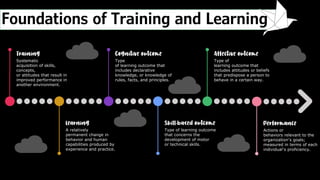
Systematic
acquisition of skills,
concepts,
or attitudes that result in
improved performance in
another environment.
Type
of learning outcome that
includes declarative
knowledge, or knowledge of
rules, facts, and principles.
Type of
learning outcome that
includes attitudes or beliefs
that predispose a person to
behave in a certain way.
A relatively
permanent change in
behavior and human
capabilities produced by
experience and practice.
Type of learning outcome
that concerns the
development of motor
or technical skills.
‐
Actions or
behaviors relevant to the
organization’s goals;
measured in terms of each
individual’s proficiency.
Foundations of Training and Learning
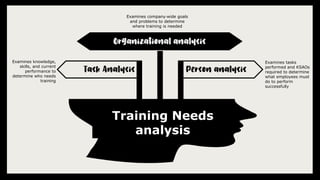
Training Needs
analysis
Examines company‐wide goals
and problems to determine
where training is needed
Examines tasks
performed and KSAOs
required to determine
what employees must
do to perform
successfully
Examines knowledge,
skills, and current
performance to
determine who needs
training
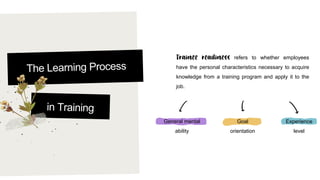
refers to whether employees
have the personal characteristics necessary to acquire
knowledge from a training program and apply it to the
job.
General mental
ability
Goal
orientation
Experience
level
1
2
3
Assessing cognitive ability before training can be useful in grouping individuals based in their
readiness to learn the material.
• Performance orientation Orientation in which individuals are concerned about doing well in
training and being evaluated positively.
• Mastery orientation Orientation in which individuals are concerned with increasing their
competence for the task at hand; they view errors and mistakes as part of the learning process.
• Inexperienced trainees with lower ability generally benefit more from longer and more structured
training program.
• Experienced trainees with high ability thrive in shorter, less structured training program. Even prior
negatives experiences and failures can be useful in heightening motivation to learn before training
begins.
Extent to which trainees are interested in attending
training, learning from training, and transferring the
skills and knowledge acquired in training back to the
job.
Approach in which employees expectations about
the relationship between how much effort they
expend and how well they perform are important to
their motivation and learning.
Learning and Motivational Theories
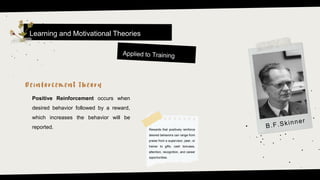
Positive Reinforcement occurs when
desired behavior followed by a reward,
which increases the behavior will be
reported. Rewards that positively reinforce
desired behaviors can range from
praise from a supervisor, peer, or
trainer to gifts, cash bonuses,
attention, recognition, and career
opportunities.
1
Cognitive theory that proposes that there are
many ways to learn, including observational
learning, which occur when people watch
someone perform a task and then rehearse
those activities mentally until they have an
opportunities to try them out.
2
Learning approach that consist of observing
actual job incumbents (or videos of job
incumbents) who demonstrate positive
modeling behaviors, rehearsing the behavior
using a role-playing technique, receiving
feedback on the rehearsal, and trying out the
behavior on the job.
Cognitive theories focus on how individuals process and
interpret information, while acknowledging that humans do
not always learn by performing a task themselves and
receiving direct reinforcement. Instead, human can use
memory, judgment, and reasoning to make connection
between what they observe and how they should behave or
perform in work and non-work situations.
Belief in one’s capability to
perform a specific task or
reach a specific goal.
Approach in which specific,
difficult goals direct attention
and improve performance in
training and on the job
Knowledge of the results of
one’s actions; enhances
learning and performance in
training and on the job.
MDM Company
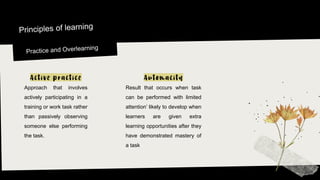
Approach that involves
actively participating in a
training or work task rather
than passively observing
someone else performing
the task.
Result that occurs when task
can be performed with limited
attention’ likely to develop when
learners are given extra
learning opportunities after they
have demonstrated mastery of
a task
Extent to which the task
trained is similar to the
task requried on the job.
Extent to which the
training task mirrors the
physical features of the
task performed on the job.
Extent to which the
training task helps
trainees to develop the
knowledge, skills, abilities,
and other characteristics
necessary to perform the
job.
Training approach in
which the entire task is
practiced at once.
Training approach in
which subtask are
practiced separately and
later combined.
Condition in which individuals
practice a task continuously and
without rest.
Condition that provides individuals
with rest intervals between practice
sessions, which are spaced over a
longer period of time.
(Confessore & Kops, 1998; London & Mone, 1999)
LEARNING
ORGANIZATION
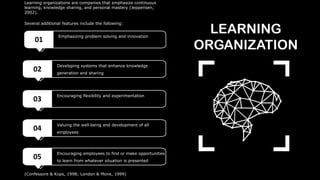
01
Emphasizing problem solving and innovation
02
Developing systems that enhance knowledge
generation and sharing
03
Encouraging flexibility and experimentation
04
Valuing the well‐being and development of all
employees
05
Encouraging employees to find or make opportunities
to learn from whatever situation is presented
Learning organizations are companies that emphasize continuous
learning, knowledge sharing, and personal mastery (Jeppensen,
2002).
Several additional features include the following:
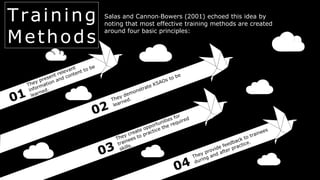
Training
Methods
Salas and Cannon‐Bowers (2001) echoed this idea by
noting that most effective training methods are created
around four basic principles:
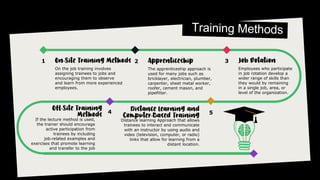
1 ‐
On the job training involves
assigning trainees to jobs and
encouraging them to observe
and learn from more experienced
employees.
2
The apprenticeship approach is
used for many jobs such as
bricklayer, electrician, plumber,
carpenter, sheet metal worker,
roofer, cement mason, and
pipefitter.
3
Employees who participate
in job rotation develop a
wider range of skills than
they would by remaining
in a single job, area, or
level of the organization.
4
‐
If the lecture method is used,
the trainer should encourage
active participation from
trainees by including
job‐related examples and
exercises that promote learning
and transfer to the job
5
‐
Distance learning Approach that allows
trainees to interact and communicate
with an instructor by using audio and
video (television, computer, or radio)
links that allow for learning from a
distant location.
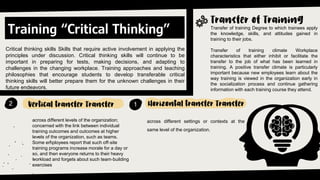
2
across different levels of the organization;
concerned with the link between individual
training outcomes and outcomes at higher
levels of the organization, such as teams.
Some employees report that such off‐site
training programs increase morale for a day or
so, and then everyone returns to their heavy
workload and forgets about such team‐building
exercises
.
Critical thinking skills Skills that require active involvement in applying the
principles under discussion. Critical thinking skills will continue to be
important in preparing for tests, making decisions, and adapting to
challenges in the changing workplace. Training approaches and teaching
philosophies that encourage students to develop transferable critical
thinking skills will better prepare them for the unknown challenges in their
future endeavors.
Training “Critical Thinking”
1
across different settings or contexts at the
same level of the organization.
Transfer of training Degree to which trainees apply
the knowledge, skills, and attitudes gained in
training to their jobs.
Transfer of training climate Workplace
characteristics that either inhibit or facilitate the
transfer to the job of what has been learned in
training. A positive transfer climate is particularly
important because new employees learn about the
way training is viewed in the organization early in
the socialization process and continue gathering
information with each training course they attend.
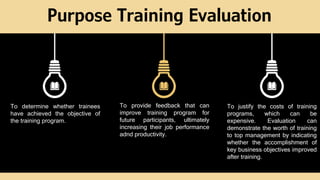
Purpose Training Evaluation
To determine whether trainees
have achieved the objective of
the training program.
To provide feedback that can
improve training program for
future participants, ultimately
increasing their job performance
adnd productivity.
To justify the costs of training
programs, which can be
expensive. Evaluation can
demonstrate the worth of training
to top management by indicating
whether the accomplishment of
key business objectives improved
after training.
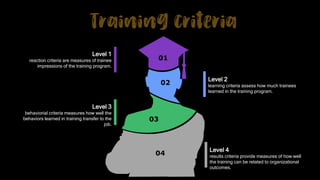
01
02
03
04
Level 1
reaction criteria are measures of trainee
impressions of the training program.
Level 2
learning criteria assess how much trainees
learned in the training program.
Level 3
behaviorial criteria measures how well the
behaviors learned in training transfer to the
job.
Level 4
results criteria provide measures of how well
the training can be related to organizational
outcomes.
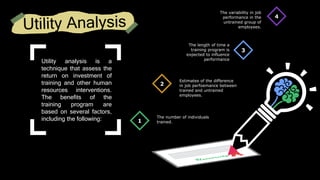
The number of individuals
trained.1
Estimates of the difference
in job perfoemance between
trained and untrained
employees.
2
The variability in job
performance in the
untrained group of
employees.
4
The length of time a
training program is
expected to influence
performance
3
Utility analysis is a
technique that assess the
return on investment of
training and other human
resources interventions.
The benefits of the
training program are
based on several factors,
including the following:
is to produce a systematic change in
knowledge, skills, and attitude. The evaluation design is used to
determine what the training objectives are has been fulfilled and
whether the increase in knowledge, skills, and attitudes after training is
the result of training. Developing a good evaluation design can help
reduce concern about these factors, which is called a threat to validity.
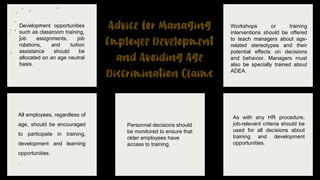
Development opportunities
such as classroom training,
job assignments, job
rotations, and tuition
assistance should be
allocated on an age neutral
basis.
Workshops or training
interventions should be offered
to teach managers about age-
related stereotypes and their
potential effects on decisions
and behavior. Managers must
also be specially trained about
ADEA.
All employees, regardless of
age, should be encouraged
to participate in training,
development and learning
opportunities.
.
Personnel decisions should
be monitored to ensure that
older employees have
access to training.
As with any HR procedure,
job-relevant criteria should be
used for all decisions about
training and development
opportunities.
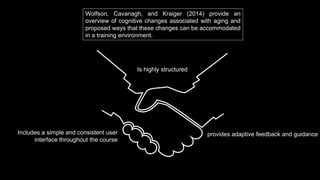
Wolfson, Cavanagh, and Kraiger (2014) provide an
overview of cognitive changes associated with aging and
proposed ways that these changes can be accommodated
in a training environment.
Is highly structured
provides adaptive feedback and guidanceIncludes a simple and consistent user
interface throughout the course
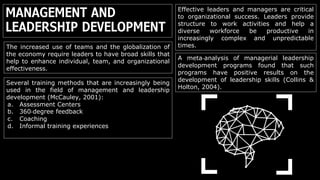
MANAGEMENT AND
LEADERSHIP DEVELOPMENT
Effective leaders and managers are critical
to organizational success. Leaders provide
structure to work activities and help a
diverse workforce be productive in
increasingly complex and unpredictable
times.The increased use of teams and the globalization of
the economy require leaders to have broad skills that
help to enhance individual, team, and organizational
effectiveness.
A meta‐analysis of managerial leadership
development programs found that such
programs have positive results on the
development of leadership skills (Collins &
Holton, 2004).
Several training methods that are increasingly being
used in the field of management and leadership
development (McCauley, 2001):
a. Assessment Centers
b. 360‐degree feedback
c. Coaching
d. Informal training experiences
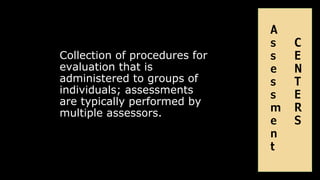
Collection of procedures for
evaluation that is
administered to groups of
individuals; assessments
are typically performed by
multiple assessors.
A
s C
s E
e N
s T
s E
m R
e S
n
t
Process of collecting and
providing a manager or
executive with feedback
from many sources,
including supervisors,
peers, subordinates,
customers, and suppliers.
360
F
D E
E E
G D
R B
E A
E C
K
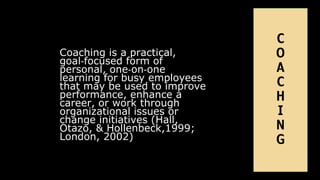
Coaching is a practical,
goal‐focused form of
personal, one‐on‐one
learning for busy employees
that may be used to improve
performance, enhance a
career, or work through
organizational issues or
change initiatives (Hall,
Otazo, & Hollenbeck,1999;
London, 2002)
C
O
A
C
H
I
N
G
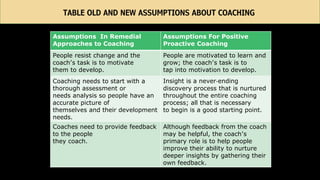
Assumptions In Remedial
Approaches to Coaching
Assumptions For Positive
Proactive Coaching
People resist change and the
coach’s task is to motivate
them to develop.
People are motivated to learn and
grow; the coach’s task is to
tap into motivation to develop.
Coaching needs to start with a
thorough assessment or
needs analysis so people have an
accurate picture of
themselves and their development
needs.
Insight is a never‐ending
discovery process that is nurtured
throughout the entire coaching
process; all that is necessary
to begin is a good starting point.
Coaches need to provide feedback
to the people
they coach.
Although feedback from the coach
may be helpful, the coach’s
primary role is to help people
improve their ability to nurture
deeper insights by gathering their
own feedback.
TABLE OLD AND NEW ASSUMPTIONS ABOUT COACHING
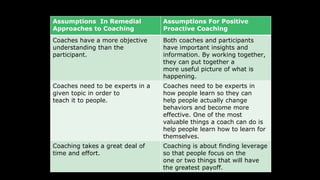
Assumptions In Remedial
Approaches to Coaching
Assumptions For Positive
Proactive Coaching
Coaches have a more objective
understanding than the
participant.
Both coaches and participants
have important insights and
information. By working together,
they can put together a
more useful picture of what is
happening.
Coaches need to be experts in a
given topic in order to
teach it to people.
Coaches need to be experts in
how people learn so they can
help people actually change
behaviors and become more
effective. One of the most
valuable things a coach can do is
help people learn how to learn for
themselves.
Coaching takes a great deal of
time and effort.
Coaching is about finding leverage
so that people focus on the
one or two things that will have
the greatest payoff.
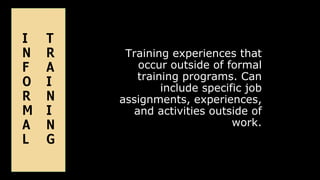
Training experiences that
occur outside of formal
training programs. Can
include specific job
assignments, experiences,
and activities outside of
work.
I T
N R
F A
O I
R N
M I
A N
L G
Unwelcome sexual advances,
requests for sexual favors, and
other conduct of a sexual nature
constitute sexual harassment
when submission to or rejection
of this conduct explicitly or
implicitly affects an individual’s
employment, unreasonably
interferes with an individual’s
work performance, or creates a
hostile work environment.
H
A
S R
E A
X S
U S
A M
L E
N
T
Ethics Training
An increasingly important consideration for
educators and training specialists is whether
training can reduce unethical behavior in
organizations (Treviño, den Nieuwenboer,
&Kish‐Gephart, 2014).
Lefkowitz (2003) published a comprehensive book
addressing ethics and values in I‐O psychology. He
has also contributed to a regular column called
“The I‐O Ethicist” in The Industrial‐Organizational
Psychologist that provides advice and ethical
perspectives on various I‐O topics and practices
(e.g., Lefkowitz, 2004). In addition, an edited
book by Darley,
Messick, and Tyler (2014) addresses the
social influences on ethical behavior in
organizations). Welsh and colleagues (2015)
proposed and found support for a process in
which individuals engage in a slippery slope
of increasingly unethical behavior.
This finding suggests that organizations
might manage employ-ees’ ethical
perceptions and work attitudes with
complementary policies (Valentine
&Fleischman, 2008). A survey from the
Ethics Resource Center (2005) indicated that
an increasing number of organizations has
formal ethics and compliance training.

Lefkowitz (2006) noted that in addition to
ethics training, moral and ethical leadership
from senior executives is critical in creating
strong ethical climates and cultures. In
Chapter 12, we will address ethical
leadership and in Chapter 14 we will cover
climate and culture in detail.
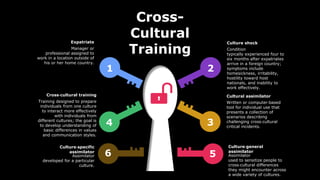
1 2
34
Cross-
Cultural
Training Condition
typically experienced four to
six months after expatriates
arrive in a foreign country;
symptoms include
homesickness, irritability,
hostility toward host
nationals, and inability to
work effectively.
Culture shock
Written or computer‐based
tool for individual use that
presents a collection of
scenarios describing
challenging cross‐cultural
critical incidents.
Cultural assimilator
Manager or
professional assigned to
work in a location outside of
his or her home country.
Expatriate
Training designed to prepare
individuals from one culture
to interact more effectively
with individuals from
different cultures; the goal is
to develop understanding of
basic differences in values
and communication styles.
Cross‐cultural training
5 Assimilator
used to sensitize people to
cross‐cultural differences
they might encounter across
a wide variety of cultures.
Culture‐general
assimilator
Assimilator
developed for a particular
culture.
Culture‐specific
assimilator
Training and development (group 7) (Bahasa Inggris)

Training and development (group 7) (Bahasa Inggris)

  • 1.
    T r ai n i n g a n d D e v e l o p m e n t
  • 2.
    07 Andi MRizqi A A 1924090228 Group 7 02 Tiara Sabilla S 1924090167 03 M Daffa Burhanudin 1924090168 04 Nabila Zahida P 1924090195 05 Shindy Nur Fadhila P 1924090203 06 Nur Fauziah Dwiputri W 1924090209 08 Eva Maria 1924090238 09 Rayhan Aaron Regulus H 1924090240 10 Yusran Kamil 1924090249 11 Aminah Maisarah K 1924090260 12 Kezia Sara Engel 1924090263 13 Ahmad Ramadhoni 1924090264 01 Andreas Niko 1924090151
  • 3.
    Systematic acquisition of skills, concepts, orattitudes that result in improved performance in another environment. Type of learning outcome that includes declarative knowledge, or knowledge of rules, facts, and principles. Type of learning outcome that includes attitudes or beliefs that predispose a person to behave in a certain way. A relatively permanent change in behavior and human capabilities produced by experience and practice. Type of learning outcome that concerns the development of motor or technical skills. ‐ Actions or behaviors relevant to the organization’s goals; measured in terms of each individual’s proficiency. Foundations of Training and Learning
  • 4.
    Training Needs analysis Examines company‐widegoals and problems to determine where training is needed Examines tasks performed and KSAOs required to determine what employees must do to perform successfully Examines knowledge, skills, and current performance to determine who needs training
  • 5.
    refers to whetheremployees have the personal characteristics necessary to acquire knowledge from a training program and apply it to the job. General mental ability Goal orientation Experience level
  • 6.
    1 2 3 Assessing cognitive abilitybefore training can be useful in grouping individuals based in their readiness to learn the material. • Performance orientation Orientation in which individuals are concerned about doing well in training and being evaluated positively. • Mastery orientation Orientation in which individuals are concerned with increasing their competence for the task at hand; they view errors and mistakes as part of the learning process. • Inexperienced trainees with lower ability generally benefit more from longer and more structured training program. • Experienced trainees with high ability thrive in shorter, less structured training program. Even prior negatives experiences and failures can be useful in heightening motivation to learn before training begins.
  • 7.
    Extent to whichtrainees are interested in attending training, learning from training, and transferring the skills and knowledge acquired in training back to the job. Approach in which employees expectations about the relationship between how much effort they expend and how well they perform are important to their motivation and learning.
  • 8.
    Learning and MotivationalTheories Positive Reinforcement occurs when desired behavior followed by a reward, which increases the behavior will be reported. Rewards that positively reinforce desired behaviors can range from praise from a supervisor, peer, or trainer to gifts, cash bonuses, attention, recognition, and career opportunities.
  • 9.
    1 Cognitive theory thatproposes that there are many ways to learn, including observational learning, which occur when people watch someone perform a task and then rehearse those activities mentally until they have an opportunities to try them out. 2 Learning approach that consist of observing actual job incumbents (or videos of job incumbents) who demonstrate positive modeling behaviors, rehearsing the behavior using a role-playing technique, receiving feedback on the rehearsal, and trying out the behavior on the job. Cognitive theories focus on how individuals process and interpret information, while acknowledging that humans do not always learn by performing a task themselves and receiving direct reinforcement. Instead, human can use memory, judgment, and reasoning to make connection between what they observe and how they should behave or perform in work and non-work situations.
  • 10.
    Belief in one’scapability to perform a specific task or reach a specific goal. Approach in which specific, difficult goals direct attention and improve performance in training and on the job Knowledge of the results of one’s actions; enhances learning and performance in training and on the job.
  • 11.
    MDM Company Approach thatinvolves actively participating in a training or work task rather than passively observing someone else performing the task. Result that occurs when task can be performed with limited attention’ likely to develop when learners are given extra learning opportunities after they have demonstrated mastery of a task
  • 12.
    Extent to whichthe task trained is similar to the task requried on the job. Extent to which the training task mirrors the physical features of the task performed on the job. Extent to which the training task helps trainees to develop the knowledge, skills, abilities, and other characteristics necessary to perform the job.
  • 13.
    Training approach in whichthe entire task is practiced at once. Training approach in which subtask are practiced separately and later combined.
  • 14.
    Condition in whichindividuals practice a task continuously and without rest. Condition that provides individuals with rest intervals between practice sessions, which are spaced over a longer period of time.
  • 15.
    (Confessore & Kops,1998; London & Mone, 1999) LEARNING ORGANIZATION 01 Emphasizing problem solving and innovation 02 Developing systems that enhance knowledge generation and sharing 03 Encouraging flexibility and experimentation 04 Valuing the well‐being and development of all employees 05 Encouraging employees to find or make opportunities to learn from whatever situation is presented Learning organizations are companies that emphasize continuous learning, knowledge sharing, and personal mastery (Jeppensen, 2002). Several additional features include the following:
  • 16.
    Training Methods Salas and Cannon‐Bowers(2001) echoed this idea by noting that most effective training methods are created around four basic principles:
  • 17.
    1 ‐ On thejob training involves assigning trainees to jobs and encouraging them to observe and learn from more experienced employees. 2 The apprenticeship approach is used for many jobs such as bricklayer, electrician, plumber, carpenter, sheet metal worker, roofer, cement mason, and pipefitter. 3 Employees who participate in job rotation develop a wider range of skills than they would by remaining in a single job, area, or level of the organization. 4 ‐ If the lecture method is used, the trainer should encourage active participation from trainees by including job‐related examples and exercises that promote learning and transfer to the job 5 ‐ Distance learning Approach that allows trainees to interact and communicate with an instructor by using audio and video (television, computer, or radio) links that allow for learning from a distant location.
  • 18.
    2 across different levelsof the organization; concerned with the link between individual training outcomes and outcomes at higher levels of the organization, such as teams. Some employees report that such off‐site training programs increase morale for a day or so, and then everyone returns to their heavy workload and forgets about such team‐building exercises . Critical thinking skills Skills that require active involvement in applying the principles under discussion. Critical thinking skills will continue to be important in preparing for tests, making decisions, and adapting to challenges in the changing workplace. Training approaches and teaching philosophies that encourage students to develop transferable critical thinking skills will better prepare them for the unknown challenges in their future endeavors. Training “Critical Thinking” 1 across different settings or contexts at the same level of the organization. Transfer of training Degree to which trainees apply the knowledge, skills, and attitudes gained in training to their jobs. Transfer of training climate Workplace characteristics that either inhibit or facilitate the transfer to the job of what has been learned in training. A positive transfer climate is particularly important because new employees learn about the way training is viewed in the organization early in the socialization process and continue gathering information with each training course they attend.

  • 19.
    Purpose Training Evaluation Todetermine whether trainees have achieved the objective of the training program. To provide feedback that can improve training program for future participants, ultimately increasing their job performance adnd productivity. To justify the costs of training programs, which can be expensive. Evaluation can demonstrate the worth of training to top management by indicating whether the accomplishment of key business objectives improved after training.
  • 20.
    01 02 03 04 Level 1 reaction criteriaare measures of trainee impressions of the training program. Level 2 learning criteria assess how much trainees learned in the training program. Level 3 behaviorial criteria measures how well the behaviors learned in training transfer to the job. Level 4 results criteria provide measures of how well the training can be related to organizational outcomes.
  • 21.
    The number ofindividuals trained.1 Estimates of the difference in job perfoemance between trained and untrained employees. 2 The variability in job performance in the untrained group of employees. 4 The length of time a training program is expected to influence performance 3 Utility analysis is a technique that assess the return on investment of training and other human resources interventions. The benefits of the training program are based on several factors, including the following:
  • 22.
    is to producea systematic change in knowledge, skills, and attitude. The evaluation design is used to determine what the training objectives are has been fulfilled and whether the increase in knowledge, skills, and attitudes after training is the result of training. Developing a good evaluation design can help reduce concern about these factors, which is called a threat to validity.
  • 23.
    Development opportunities such asclassroom training, job assignments, job rotations, and tuition assistance should be allocated on an age neutral basis. Workshops or training interventions should be offered to teach managers about age- related stereotypes and their potential effects on decisions and behavior. Managers must also be specially trained about ADEA. All employees, regardless of age, should be encouraged to participate in training, development and learning opportunities. . Personnel decisions should be monitored to ensure that older employees have access to training. As with any HR procedure, job-relevant criteria should be used for all decisions about training and development opportunities.
  • 24.
    Wolfson, Cavanagh, andKraiger (2014) provide an overview of cognitive changes associated with aging and proposed ways that these changes can be accommodated in a training environment. Is highly structured provides adaptive feedback and guidanceIncludes a simple and consistent user interface throughout the course
  • 25.
    MANAGEMENT AND LEADERSHIP DEVELOPMENT Effectiveleaders and managers are critical to organizational success. Leaders provide structure to work activities and help a diverse workforce be productive in increasingly complex and unpredictable times.The increased use of teams and the globalization of the economy require leaders to have broad skills that help to enhance individual, team, and organizational effectiveness. A meta‐analysis of managerial leadership development programs found that such programs have positive results on the development of leadership skills (Collins & Holton, 2004). Several training methods that are increasingly being used in the field of management and leadership development (McCauley, 2001): a. Assessment Centers b. 360‐degree feedback c. Coaching d. Informal training experiences
  • 26.
    Collection of proceduresfor evaluation that is administered to groups of individuals; assessments are typically performed by multiple assessors. A s C s E e N s T s E m R e S n t
  • 27.
    Process of collectingand providing a manager or executive with feedback from many sources, including supervisors, peers, subordinates, customers, and suppliers. 360 F D E E E G D R B E A E C K
  • 28.
    Coaching is apractical, goal‐focused form of personal, one‐on‐one learning for busy employees that may be used to improve performance, enhance a career, or work through organizational issues or change initiatives (Hall, Otazo, & Hollenbeck,1999; London, 2002) C O A C H I N G
  • 29.
    Assumptions In Remedial Approachesto Coaching Assumptions For Positive Proactive Coaching People resist change and the coach’s task is to motivate them to develop. People are motivated to learn and grow; the coach’s task is to tap into motivation to develop. Coaching needs to start with a thorough assessment or needs analysis so people have an accurate picture of themselves and their development needs. Insight is a never‐ending discovery process that is nurtured throughout the entire coaching process; all that is necessary to begin is a good starting point. Coaches need to provide feedback to the people they coach. Although feedback from the coach may be helpful, the coach’s primary role is to help people improve their ability to nurture deeper insights by gathering their own feedback. TABLE OLD AND NEW ASSUMPTIONS ABOUT COACHING
  • 30.
    Assumptions In Remedial Approachesto Coaching Assumptions For Positive Proactive Coaching Coaches have a more objective understanding than the participant. Both coaches and participants have important insights and information. By working together, they can put together a more useful picture of what is happening. Coaches need to be experts in a given topic in order to teach it to people. Coaches need to be experts in how people learn so they can help people actually change behaviors and become more effective. One of the most valuable things a coach can do is help people learn how to learn for themselves. Coaching takes a great deal of time and effort. Coaching is about finding leverage so that people focus on the one or two things that will have the greatest payoff.
  • 31.
    Training experiences that occuroutside of formal training programs. Can include specific job assignments, experiences, and activities outside of work. I T N R F A O I R N M I A N L G
  • 32.
    Unwelcome sexual advances, requestsfor sexual favors, and other conduct of a sexual nature constitute sexual harassment when submission to or rejection of this conduct explicitly or implicitly affects an individual’s employment, unreasonably interferes with an individual’s work performance, or creates a hostile work environment. H A S R E A X S U S A M L E N T
  • 33.
    Ethics Training An increasinglyimportant consideration for educators and training specialists is whether training can reduce unethical behavior in organizations (Treviño, den Nieuwenboer, &Kish‐Gephart, 2014). Lefkowitz (2003) published a comprehensive book addressing ethics and values in I‐O psychology. He has also contributed to a regular column called “The I‐O Ethicist” in The Industrial‐Organizational Psychologist that provides advice and ethical perspectives on various I‐O topics and practices (e.g., Lefkowitz, 2004). In addition, an edited book by Darley, Messick, and Tyler (2014) addresses the social influences on ethical behavior in organizations). Welsh and colleagues (2015) proposed and found support for a process in which individuals engage in a slippery slope of increasingly unethical behavior. This finding suggests that organizations might manage employ-ees’ ethical perceptions and work attitudes with complementary policies (Valentine &Fleischman, 2008). A survey from the Ethics Resource Center (2005) indicated that an increasing number of organizations has formal ethics and compliance training. Lefkowitz (2006) noted that in addition to ethics training, moral and ethical leadership from senior executives is critical in creating strong ethical climates and cultures. In Chapter 12, we will address ethical leadership and in Chapter 14 we will cover climate and culture in detail.
  • 34.
    1 2 34 Cross- Cultural Training Condition typicallyexperienced four to six months after expatriates arrive in a foreign country; symptoms include homesickness, irritability, hostility toward host nationals, and inability to work effectively. Culture shock Written or computer‐based tool for individual use that presents a collection of scenarios describing challenging cross‐cultural critical incidents. Cultural assimilator Manager or professional assigned to work in a location outside of his or her home country. Expatriate Training designed to prepare individuals from one culture to interact more effectively with individuals from different cultures; the goal is to develop understanding of basic differences in values and communication styles. Cross‐cultural training 5 Assimilator used to sensitize people to cross‐cultural differences they might encounter across a wide variety of cultures. Culture‐general assimilator Assimilator developed for a particular culture. Culture‐specific assimilator