DEVELOPING PEOPLE   :
CHAPTER OUTLINE Training and development Types of training Benefits of training and development Need for training Planning and strategising for training Needs assessment Setting training objectives Training design and implementation Transfer of training (learning) Types of training Training evaluation Integrating training with PMS and compensation
TRAINING: Definition Training is a process whereby people acquire capabilities to aid in the achievement of organizational goals.  - Mathis And Jackson Training is a process of teaching a new employees the basic skills to perform their jobs    - Garry Dessler A planned process to modify attitude , knowledge or skill behaviour through learning experience to achieve effective performance in an activity or range of activities. Its purpose, in the work situation, is to develop the abilities of the individual and to satisfy the current and future needs of the organization.  -Manpower service commission,1981a
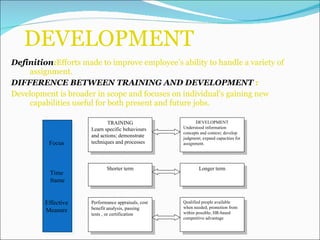
DEVELOPMENT Definition : Efforts made to improve employee’s ability to handle a variety of assignment. DIFFERENCE BETWEEN TRAINING AND DEVELOPMENT  : Development is broader in scope and focuses on individual’s gaining new capabilities useful for both present and future jobs. Focus  Time  frame Effective  Measure  TRAINING Learn specific behaviours and actions; demonstrate techniques and processes DEVELOPMENT Understood information concepts and context; develop judgment; expand capacities for assignment. Shorter term Longer term Qualified people available when needed; promotion from within possible; HR-based competitive advantage Performance appraisals, cost benefit analysis, passing tests , or certification
TYPES OF TRAINING  Required and regular training  : company with various mandated legal requirements (e.g., occupational safety, EEO) and serves as training for all employees (new employee orientation) Job/technical training : enable employees to perform their jobs, tasks and responsibilities well (e.g. product knowledge, technical process and procedures, customer relations) Interpersonal and problem solving training  : address both operational and interpersonal problems and seeks improve organizational working relationships. Development and innovative training  : provides a long term focus to enhance individual and organizational capabilities for the future (e.g. business practice, executive development, organizational change)
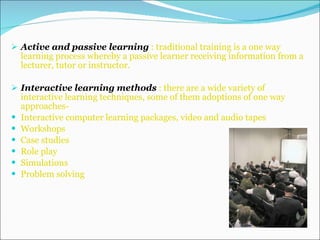
Active and passive learning  : traditional training is a one way learning process whereby a passive learner receiving information from a lecturer, tutor or instructor. Interactive learning methods  : there are a wide variety of interactive learning techniques, some of them adoptions of one way approaches- Interactive computer learning packages, video and audio tapes Workshops Case studies  Role play Simulations Problem solving
BENEFITS OF TRAINING Benefits To The Organization Improved profitability. Improved job knowledge at all level of organization. Improved morale of the workforce. Helps people identify with organizational goal. Helps create a better corporate image. Fosters authenticity, openness and trust. Improves relationship between employees. Aids in organizational development. Learns from the trainee. Helps prepare guidelines for the work. Contd..
BENEFITS OF TRAINING  (Contd..) Aids in setting organizational policies. Provides information for future needs. More effectiveness in decision making and problem solving. Development for promotion from within Development of leadership, motivation, loyalty etc. Increase productivity and quality of work Keeps the cost down in any area. Develops a sense of responsibility. Improves labor-management relation. Reduces outside consulting cost. Creates an appropriate climate for growth and communication. Helps employees adjust to change.
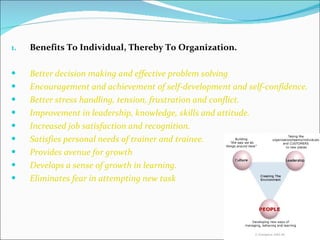
Benefits To Individual, Thereby To Organization. Better decision making and effective problem solving Encouragement and achievement of self-development and self-confidence. Better stress handling, tension, frustration and conflict. Improvement in leadership, knowledge, skills and attitude. Increased job satisfaction and recognition. Satisfies personal needs of trainer and trainee. Provides avenue for growth Develops a sense of growth in learning. Eliminates fear in attempting new task
3.  Benefits in personnel and human relation: Intra and Inter Group Improves  communication between individual and groups. Aids in orientation of new employees. Provides information on equal opportunity and affirmative action. Provides information on other government laws and policies. Improves inter personal skills. Makes organisational policies, rules and regulations viable. Improves morale. Builds cohesiveness in groups. Provides a good climate for learning, growth, and co-ordination. Makes the organistaion a better place to work and live.
THE NEED FOR TRAINING Companies initially used to emphasize only on production process training i.e. teaching technical skill required to perform jobs, such as training assembles to solder wires or teachers to device lesson plans. however training and development programs and their objectives change in the 1980s and 1990s. Employers had to adapt to rapid technological changes, improve product and service quality, and boost productivity to stay competitive improving quality often requires remedial-education training, since quality-improvement programs assume employees can use critical thinking skills, produce charts and graphs and analyse data. Employees must also use or acquire skills in team building, decision making, and communication. As firms become more technologically advance, employees require training in technological and computer skills (such as desk top publishing and computer aided design and manufacturing). Contd…
THE NEED FOR TRAINING  ( Contd … ) As increased competition has put a premium on better service, employers have turned increasingly to customer-service training to provide employees with the tools and abilities they need to deal more effectively with customers, such as effective listening skills. More employers today are also taking advantage of the fact that training can strengthen employee commitment.this is one reason why high commitment firms like toyota provide two weeks of training per year for all employers-about double the national average
PLANNING AND STRATEGISING FOR TRAINING Planning and strategic training are two important aspects of human resource development, whereby there are no set procedures which organisations should strictly follow in creating a human resource development plan (HRM). However the eight points listed bellow can act as a guidance. A HUMAN RESOURCE DEVELOPMENT PLAN: Discern the training and developing requirements from organisational strategy and business objectives. Analyse the training requirements for effective work performance in organisational functions and jobs. Analysing the existing qualities and training needs of current employees. Devise an HRD plan which fills the gap between organisational requirements and the present skills and knowledge of the employees. Decide on the appropriate training and development methods to be used for individuals and groups. Decide who is to have responsibility for the plan and its various parts. Implement the plan and evaluate its progress.  Amend the HRD plan in the light of monitoring/evaluation and changes in business strategy.
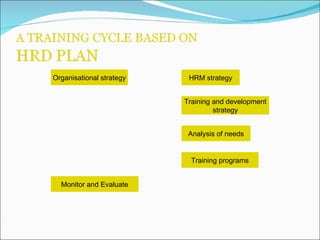
Organisational strategy HRM strategy Training and development strategy Analysis of needs Training programs Monitor and Evaluate
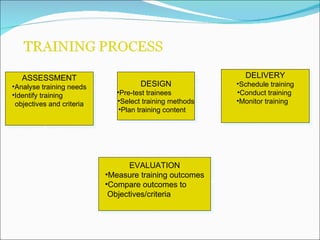
DESIGN Pre-test trainees  Select training methods Plan training content  DELIVERY Schedule training Conduct training  Monitor training  EVALUATION Measure training outcomes Compare outcomes to  Objectives/criteria  ASSESSMENT Analyse training needs Identify training  objectives and criteria
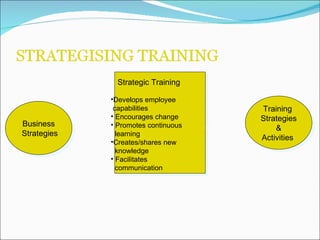
STRATEGIC TRAINING Strategic training-  It focuses on efforts that develop competencies, value and competitive advantages for the organizations which means training must be based on organizations strategic plans and HR planning efforts. Strategic training  also implies that HR and training professionals need to be involved in organizational change and strategic planning in order to develop training plans and activities that support management’s strategic decisions.
Strategic Training Develops employee capabilities  Encourages change  Promotes continuous  learning  Creates/shares new knowledge  Facilitates  communication  Business Strategies Training  Strategies & Activities
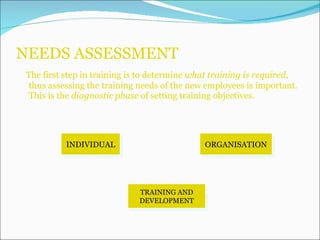
NEEDS ASSESSMENT   The first step in training is to determine  what training is required , thus assessing the training needs of the new employees is important. This is the  diagnostic phase  of setting training objectives. INDIVIDUAL ORGANISATION TRAINING AND DEVELOPMENT
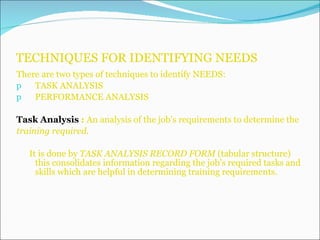
TECHNIQUES FOR IDENTIFYING NEEDS There are two types of techniques to identify NEEDS: TASK ANALYSIS PERFORMANCE ANALYSIS Task Analysis  :  An analysis of the job’s requirements to determine the  training required. It is done by  TASK ANALYSIS RECORD FORM  (tabular structure) this consolidates information regarding the job’s required tasks and skills which are helpful in determining training requirements.
Performance Analysis : Verifies  performance deficiency and determine whether that deficiency should be rectified through training or some other means. The first step is to appraise employees’ performance, since to improve it, first determine person’s current performance compared to what it should be. To distinguish between  can’t do  and  won’t do  problems, their specific causes and solutions.
SETTING TRAINING OBJECTIVES After analysing training needs, concrete measurable training objectives should be set. Training objective is defined as  “  A description of performance you want learners to be able to exhibit before you consider them competent  .” Objectives specify what the trainee should be able to accomplish after training.
TYPES OF TRAINING OBJECTIVES Training objectives are of three types and can be set as : Knowledge - Impart cognitive information and details to trainees. Skill - Develop behaviour changes in how jobs and task requirement are performed. Attitude - Create interest in and awareness of the importance of training. The success of training should be measured in terms of  objectives set .  Objectives serve as a check on internationalization, or whether the person is able to use the training.
TECHNIQUES OF TRAINING Vestibule or simulated training : training employees on special off-the-job equipment, as in airplane pilot training, whereby training costs and hazards can be reduced. In this it is not necessary to rely on computer. Computer based training : in this trainee uses computer-based system to interactively increase his/her knowledge/skills. It reduces the learning time and is cost effective.
3.  Teletraining A trainer in a central location   can   train a group of employees   at remote locations via television hookups. 4.   Videoconferencing  An increasingly popular way to train employees defined as “a means of joining two or more distant groups using a combination of audio and visual equipment.” It allows people in one location to communicate live with people in another city or country or with groups in several other cities.
5.  Audio Visual Techniques   Like films, closed-circuit television, audiotapes, and video-tapes are used in this process. Audiovisuals are more expensive than conventional lectures. They are used in following situation: When there is a need to illustrate how a certain sequence should be followed over time. When there is a need to expose trainees to events not easily demonstrable in live lectures. When the training is going to be used organization wide.
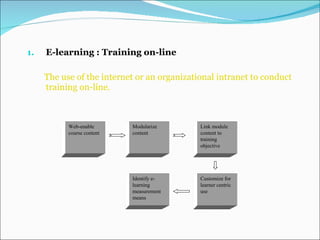
E-learning : Training on-line The use of the internet or an organizational intranet to conduct training on-line. Web-enable course content  Link module content to training objective Customize for learner centric use  Identify e-learning  measurement means Modularize content
Programmed learning Is a   systematic method for teaching job skills which involves following functions: Presenting questions, facts or problems to the learner. Allowing the person to respond Providing feedback on the accuracy of answers. Its main advantages are, first it reduces the time, second learner learns at its own pace.
TRAINING DESIGN  Training must be designed to address the assessed need. Effective training design comprises of : Learning – The Focus Of Training  Transfer of training   Contd….
TRAINING DESIGN  (Contd..)   LEARNING  –  The Focus Of Training Learning is a complex psychological process that is not fully understood by practitioners.   It comprises of - a)  Determining Learner Readiness : they must have basic skills necessary for learning i.e. ability to learn, motivation to learn and self-efficacy. b)  Understanding Different Learning Styles :  Auditory learners   (one who learn best by listening), Tactile learners  (one who must get their hands on and use training resources),  Visual learners   (one who learn most by pictures and images  Designing Training For Transfer . Contd…
TRAINING DESIGN  (Contd..) Training design must consider that all the trainees are adults, but have varying learning style, experience and anxieties. Adult learning : Adults have need to know why they are learning something. Adults have self need to be self directed. Adults bring more work-related experiences into the learning process. Adults enter into learning experience with a problem centered approach. Adults are motivated to learn by both extrinsic and intrinsic factors. For effective training adults should be actively engaged in learning and problem solving process
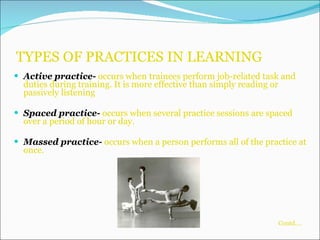
TYPES OF PRACTICES IN LEARNING Active practice-  occurs when trainees perform job-related task and duties during training. It is more effective than simply reading or passively listening Spaced practice-  occurs when several practice sessions are spaced over a period of hour or day. Massed practice-  occurs when a person performs all of the practice at once.   Contd….
TYPES OF PRACTICES IN LEARNING  (Contd…) Behaviour Modeling  – It is the most elementary way to learn. It is learning by copying someone else’s behaviours.It is used extensively as the primary means for training supervisors and managers in interpersonal skills. Reinforcement and immediate confirmation-  Reinforcement means people tend to repeat responses that give them some type of positive reward and avoid actions associated with negative consequences. Immediate confirmation means people learn best if reinforcement and feedback is given after training.
TRAINING DESIGN  ( Contd..) Transfer of training-  In transfer of training, trainers should design training intervention for the highest possible transfer of training. This transfer occurs when trainees actually use on the job what they learnt in training. Effective transfer needs following: Trainees can use things learned in training and apply it to the job. Employees maintain their use of the learned material overtime .
IMPLEMENTATION OF TRAINING TRAINING TECHNIQUES  : ON-THE-JOB TRAINING  (OJT):  In this training a person  learns a job while working.  Various types of OJT : a)   Coaching  (understudy method), here employee is trained by an experienced worker. b)  Job Rotation , here employee moves from job to job at planned intervals.  c)  Apprenticeship Training , a process by which individuals become skilled workers through a combination of class room instruction and OJT.
IMPLEMENTATION OF TRAINING Advantages of On-The-Job Training  :  a) relatively inexpensive b) trainees learn while producing c) no need for expensive off-job facilities d) get quick feedback about the correctness of performance
IMPLEMENTATION OF TRAINING STEP-BY-STEP PROCEDURE of OJT  : STEP 1 –  PREPARATION OF THE LEARNER Put the learner at ease- relieve the tension. Explain why he/she is being taught. Create interest, encourage questions, find out about the knowledge of the learner. Explain the why of the job, relate it to some job the worker already knows. Place the learner as close to normal working position as possible. Familiarize the worker with equipment, materials, tools, trade terms. Contd…
IMPLEMENTATION OF TRAINING  (Contd..) STEP 2 –  PRESENTATION OF THE OPERATION: Explain quantity and quality requirements. Go through the job at the normal work pace. Explain each step between operations, difficult parts or those in which errors are likely to be made. Explain the key points several times. Make the learner explain the steps. Contd…
IMPLEMENTATION OF TRAINING (Contd…) STEP 3 –   PERFORMANCE TRYOUT Correct the mistakes and if necessary, repeat few complicated steps. Make the trainer run the job at normal pace. Have the learner do the job gradually building up skill and speed. As soon as learner demonstrate ability to do the job, let the work begin. Contd...
IMPLEMENTATION OF TRAINING  (contd..) STEP 4 –  FOLLOW-UP Designate to whom the learner should go for help. Gradually decrease supervision. Correct faulty work patterns that begin to creep in. Compliment good work, encourage the worker to meet quality/quantity standard.
IMPLEMENTATION OF TRAINING (contd..) 2) JOB INSTRUCTION TRAINING (JIT):   It is  listing of each job’s basic tasks, along with key point in order to provide step-by-step training for employees. The steps for JIT include:  what  is to be done,  how  it is to be done and  why  it is to be done. Contd…
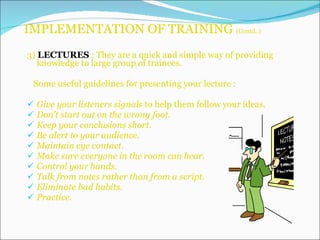
IMPLEMENTATION OF TRAINING  (Contd..) 3)  LECTURES  : They are a quick and simple way of providing knowledge to large group of trainees. Some useful guidelines for presenting your lecture : Give your listeners signals  to help them follow your ideas. Don’t start out on the wrong foot. Keep your conclusions short. Be alert to your audience. Maintain eye contact. Make sure everyone in the room can hear. Control your hands. Talk from notes rather than from a script. Eliminate bad habits. Practice.
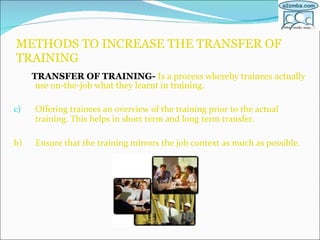
METHODS TO INCREASE THE TRANSFER OF TRAINING TRANSFER OF TRAINING-  Is a process whereby trainees actually use on-the-job what they learnt in training. Offering trainees an overview of the training prior to the actual training. This helps in short term and long term transfer. b)  Ensure that the training mirrors the job context as much as possible.
EVALUATION AND MONITORING OF TRAINING The penultimate stage in the training strategy is the evaluation and monitoring of training. It is the  most important and often the most neglected or least adequately carried out part of the training process. It is both- Simplistic  and  Complicated. Simplistic  because monitoring is a process whereby information is gleaned from trainee and then the course and the program are amended in the light of these comments. Complicated   because there are other ‘stakeholders’ in the process besides the trainees, i.e. designers of the courses, the trainers and the sponsors.
Questionnaires   (Feedback forms) or ‘happiness sheets’ are common way of eliciting trainee response programs. Tests or examinations  are common on formal courses which provide a certificate,  e.g. diploma in word processing skills although end-of-course tests can be provided after short courses to check the progress of trainees. Projects  initially seen as learning methods but they can also be provide valuable information to instructors. Structured   exercises and case studies   are opportunities to apply learned skills and techniques under the observation of tutors and evaluators. Tutor reports .  It is important to have the opinions of those who deliver the training. This gives a valuable assessment from a different perspective. contd…
METHODS OF EVALUATION   ( contd… ) Interviews   of trainees post course or instruction period. These can be informal or formal, individual or group or by telephone. Observation   of courses and training by those devising  training strategies in the training department is very useful and information from these observations can be compared with trainee responses. Participation and discussion   during training needs people who are adept at intercepting responses as this can be highly subjective.
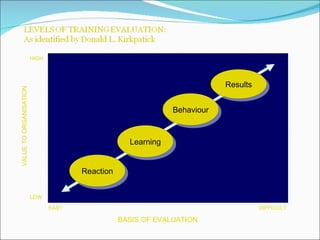
Reaction Learning Behaviour Results DIFFICULT EASY   LOW   HIGH  BASIS OF EVALUATION VALUE TO ORGANISATION
It is best to consider how training is to be evaluated before it begins. As shown in the figure in last slide, evaluating training becomes successively more difficult as evaluation moves from  reaction  to  learning  to  behaviou r , and then to  results  measures. REACTIONS :  Oganisations evaluate the reaction levels of trainees by conducting interviews or by administrating questionnaires to the trainees.  LEARNING:   Learning levels can be evaluated by measuring how well trainees have learned facts, ideas, concepts, theories and attitudes. Tests on the training material are commonly used for evaluating learning. Of course, learning enough to pass a test does not guarantee trainee will remember the training content months latter or will change job behavior. BEHAVIOUR:   Evaluating training at the behavioural level means: Measuring the effect of training on job performance through interview of trainee and their co-workers. Observing job performance. However, behaviours are more difficult to measure than reaction and learning. Even if behaviurs do change, the resultsthat management desires may not be obtained. contd…
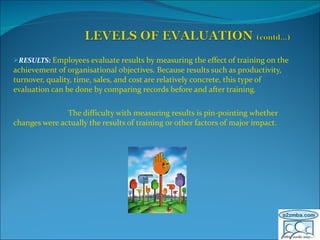
RESULTS:   Employees evaluate results by measuring the effect of training on the achievement of organisational objectives. Because results such as productivity, turnover, quality, time, sales, and cost are relatively concrete, this type of evaluation can be done by comparing records before and after training. The difficulty with measuring results is pin-pointing whether changes were actually the results of training or other factors of major impact.
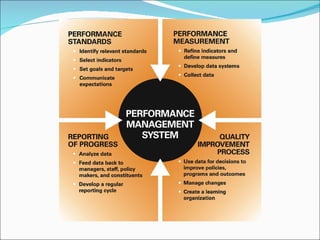
INTEGRATING TRAINING WITH PMS PMS:  Performance Management System It is the process used to identify, encourage, measure, evaluate, improve and reward employee performance. It is defined as a performance appraisal system that does not force managers to give false or misleading measurement and instead facilitates open, job-related discussion between the supervisor and the employee. It is the integration of performance appraisal system with broader human resource systems as a means of aligning employees’ work behaviours with organisation’s goals.    contd…
 
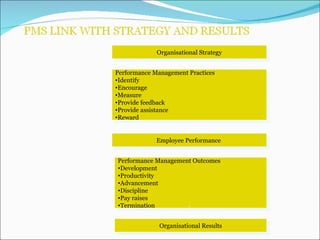
INTEGRATING TRAINING WITH PMS    (contd…) Functions of PMS: Links organisational strategy to the results Provides information to the employees about their performance. Clarifies what the organisation expects. Identifies development needs. Documents performance for personnel records.
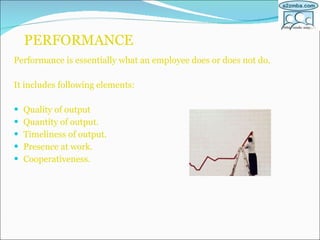
PERFORMANCE Performance is essentially what an employee does or does not do. It includes following elements: Quality of output Quantity of output. Timeliness of output. Presence at work. Cooperativeness.
PERFORMANCE MEASUREMENT There are three basic categories of performance information and its measurement: Trait-based   assessment systems assesses or identifies the abilities or a subjective character trait of employee such as-attitude, initiative or creativity. e Behaviour-based   systems measures the extent to which an employee engages in specific, relatively well defined behaviours while at the job, which leads to success. Results-based   systems measures the bottom line associated with an employees work and his/her accomplishments.
EFFECTIVE PERFORMANCE MANAGEMENT Performance Management is used to develop employees as resources. It can lead to higher employees motivation and satisfaction. But in an era of continuous improvement, and ineffective PMS poses a huge liability. To be effective a PMS should be: Consistent with strategic mission of the organisation. Beneficial as a development tool. Useful as an administrative tool. Legal and job-related. Viewed as generally fair by employees. Effective in documenting employees performance .
ENHANCING PMS PMS  can be improved by training supervisors in doing performance appraisals. Training should center around minimising rater errors and providing a common frame of reference on how raters observe and recall information. Skills of employees also affects performance rating because employees use “upward influence”. Training evaluators and giving them feedbacks are ways to improve raters’ ability to make accurate assessment. Training programs are classified into: Rater-error Training :  It means to reduce rating errors, such as leniency, severity, central errors and halo-errors. Frame-of-Reference Training :  It is a common frame of reference in evaluating performance of employees into good or poor depending upon actual behaviour of employee in the organisation. Information-Processing Approach :  It is an approach where raters are trained to be accurate in observing and rememberig the behaviour and performance of employees. It comprises of  Observation Training  and  Decision-making Training.
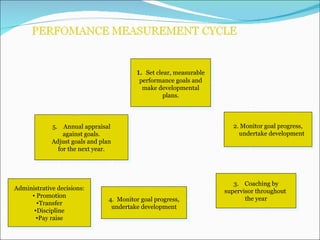
Administrative decisions: Promotion Transfer Discipline Pay raise 4.  Monitor goal progress, undertake development 3.  Coaching by supervisor throughout  the year 2. Monitor goal progress, undertake development 1.  Set clear, measurable performance goals and make developmental plans. 5.  Annual appraisal against goals. Adjust goals and plan for the next year.
Organisational Strategy Performance Management Practices Identify  Encourage Measure Provide feedback Provide assistance Reward  Employee Performance  Performance Management Outcomes Development  Productivity Advancement Discipline Pay raises Termination  Organisational Results
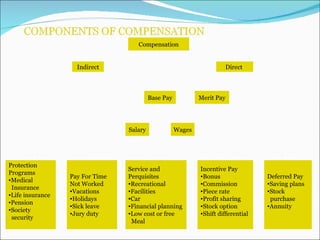
Compensation Indirect Direct  Base Pay Merit Pay Salary Wages Protection Programs Medical Insurance Life insurance Pension Society  security Pay For Time  Not Worked Vacations  Holidays Sick leave Jury duty Service and  Perquisites  Recreational  Facilities Car Financial planning  Low cost or free  Meal  Incentive Pay Bonus Commission Piece rate Profit sharing Stock option Shift differential Deferred Pay Saving plans Stock  purchase Annuity
INTEGRATING TRAINING WITH COMPENSATION Compensation  : employee compensation refers to all forms of pay or rewards going to employees and arising from their employment. It is an important factor affecting how and why people chose to work at one organization over others. It helps in attracting and retaining employees in a competitive manner.
TYPES OF COMPENSATION Rewards can be both  Intrinsic  and  Extrinsic . Intrinsic Rewards  include praise for completing a project. It includes psychological and social effects of compensation. Extrinsic Rewards  include tangible (monetary and non-monetary) forms. It is of two types. Direct Compensation  : monetary rewards for work done. Ex.- Base Pay (Wages, Salaries), Variable Pay (bonuses, incentives, stock options)  Indirect Compensation  : based on membership in an organization and consist of  benefits.  Ex.- Medical/Life Insurance, Paid Time Off, Retirement Pension.
TRAINING AND COMPENSATION Compensation is basically based on entitlement (indirect), performance (direct) and company’s policies. Performance can be enhanced by proper training whereby increasing the compensation. Company’s policies are set by HR managers who can be trained so as to utilize human resource in best proper way. Current trends in compensation are Skill-Based, where skill can be enhanced by proper training.
REFERENCES Handbook of Human Resource Management Practices, 9 th  Edition  -  Michael Armstrong Human Resources And Personnel Management, 3 rd  Edition -  K. Ashwathappa Human Resource Management, 7 th  Edition -  Gary Dessler Human Resource Management, 10 th  Edition -  Robert L. Mathis, John H. Jackson Human Resource Management, 5 th  Edition -  Fisher, Schoenfeldt, Shaw

Developingpeopleppt 100225205209-phpapp01

  • 1.
  • 2.
    CHAPTER OUTLINE Trainingand development Types of training Benefits of training and development Need for training Planning and strategising for training Needs assessment Setting training objectives Training design and implementation Transfer of training (learning) Types of training Training evaluation Integrating training with PMS and compensation
  • 3.
    TRAINING: Definition Trainingis a process whereby people acquire capabilities to aid in the achievement of organizational goals. - Mathis And Jackson Training is a process of teaching a new employees the basic skills to perform their jobs - Garry Dessler A planned process to modify attitude , knowledge or skill behaviour through learning experience to achieve effective performance in an activity or range of activities. Its purpose, in the work situation, is to develop the abilities of the individual and to satisfy the current and future needs of the organization. -Manpower service commission,1981a
  • 4.
    DEVELOPMENT Definition :Efforts made to improve employee’s ability to handle a variety of assignment. DIFFERENCE BETWEEN TRAINING AND DEVELOPMENT : Development is broader in scope and focuses on individual’s gaining new capabilities useful for both present and future jobs. Focus Time frame Effective Measure TRAINING Learn specific behaviours and actions; demonstrate techniques and processes DEVELOPMENT Understood information concepts and context; develop judgment; expand capacities for assignment. Shorter term Longer term Qualified people available when needed; promotion from within possible; HR-based competitive advantage Performance appraisals, cost benefit analysis, passing tests , or certification
  • 5.
    TYPES OF TRAINING Required and regular training : company with various mandated legal requirements (e.g., occupational safety, EEO) and serves as training for all employees (new employee orientation) Job/technical training : enable employees to perform their jobs, tasks and responsibilities well (e.g. product knowledge, technical process and procedures, customer relations) Interpersonal and problem solving training : address both operational and interpersonal problems and seeks improve organizational working relationships. Development and innovative training : provides a long term focus to enhance individual and organizational capabilities for the future (e.g. business practice, executive development, organizational change)
  • 6.
    Active and passivelearning : traditional training is a one way learning process whereby a passive learner receiving information from a lecturer, tutor or instructor. Interactive learning methods : there are a wide variety of interactive learning techniques, some of them adoptions of one way approaches- Interactive computer learning packages, video and audio tapes Workshops Case studies Role play Simulations Problem solving
  • 7.
    BENEFITS OF TRAININGBenefits To The Organization Improved profitability. Improved job knowledge at all level of organization. Improved morale of the workforce. Helps people identify with organizational goal. Helps create a better corporate image. Fosters authenticity, openness and trust. Improves relationship between employees. Aids in organizational development. Learns from the trainee. Helps prepare guidelines for the work. Contd..
  • 8.
    BENEFITS OF TRAINING (Contd..) Aids in setting organizational policies. Provides information for future needs. More effectiveness in decision making and problem solving. Development for promotion from within Development of leadership, motivation, loyalty etc. Increase productivity and quality of work Keeps the cost down in any area. Develops a sense of responsibility. Improves labor-management relation. Reduces outside consulting cost. Creates an appropriate climate for growth and communication. Helps employees adjust to change.
  • 9.
    Benefits To Individual,Thereby To Organization. Better decision making and effective problem solving Encouragement and achievement of self-development and self-confidence. Better stress handling, tension, frustration and conflict. Improvement in leadership, knowledge, skills and attitude. Increased job satisfaction and recognition. Satisfies personal needs of trainer and trainee. Provides avenue for growth Develops a sense of growth in learning. Eliminates fear in attempting new task
  • 10.
    3. Benefitsin personnel and human relation: Intra and Inter Group Improves communication between individual and groups. Aids in orientation of new employees. Provides information on equal opportunity and affirmative action. Provides information on other government laws and policies. Improves inter personal skills. Makes organisational policies, rules and regulations viable. Improves morale. Builds cohesiveness in groups. Provides a good climate for learning, growth, and co-ordination. Makes the organistaion a better place to work and live.
  • 11.
    THE NEED FORTRAINING Companies initially used to emphasize only on production process training i.e. teaching technical skill required to perform jobs, such as training assembles to solder wires or teachers to device lesson plans. however training and development programs and their objectives change in the 1980s and 1990s. Employers had to adapt to rapid technological changes, improve product and service quality, and boost productivity to stay competitive improving quality often requires remedial-education training, since quality-improvement programs assume employees can use critical thinking skills, produce charts and graphs and analyse data. Employees must also use or acquire skills in team building, decision making, and communication. As firms become more technologically advance, employees require training in technological and computer skills (such as desk top publishing and computer aided design and manufacturing). Contd…
  • 12.
    THE NEED FORTRAINING ( Contd … ) As increased competition has put a premium on better service, employers have turned increasingly to customer-service training to provide employees with the tools and abilities they need to deal more effectively with customers, such as effective listening skills. More employers today are also taking advantage of the fact that training can strengthen employee commitment.this is one reason why high commitment firms like toyota provide two weeks of training per year for all employers-about double the national average
  • 13.
    PLANNING AND STRATEGISINGFOR TRAINING Planning and strategic training are two important aspects of human resource development, whereby there are no set procedures which organisations should strictly follow in creating a human resource development plan (HRM). However the eight points listed bellow can act as a guidance. A HUMAN RESOURCE DEVELOPMENT PLAN: Discern the training and developing requirements from organisational strategy and business objectives. Analyse the training requirements for effective work performance in organisational functions and jobs. Analysing the existing qualities and training needs of current employees. Devise an HRD plan which fills the gap between organisational requirements and the present skills and knowledge of the employees. Decide on the appropriate training and development methods to be used for individuals and groups. Decide who is to have responsibility for the plan and its various parts. Implement the plan and evaluate its progress. Amend the HRD plan in the light of monitoring/evaluation and changes in business strategy.
  • 14.
    Organisational strategy HRMstrategy Training and development strategy Analysis of needs Training programs Monitor and Evaluate
  • 15.
    DESIGN Pre-test trainees Select training methods Plan training content DELIVERY Schedule training Conduct training Monitor training EVALUATION Measure training outcomes Compare outcomes to Objectives/criteria ASSESSMENT Analyse training needs Identify training objectives and criteria
  • 16.
    STRATEGIC TRAINING Strategictraining- It focuses on efforts that develop competencies, value and competitive advantages for the organizations which means training must be based on organizations strategic plans and HR planning efforts. Strategic training also implies that HR and training professionals need to be involved in organizational change and strategic planning in order to develop training plans and activities that support management’s strategic decisions.
  • 17.
    Strategic Training Developsemployee capabilities Encourages change Promotes continuous learning Creates/shares new knowledge Facilitates communication Business Strategies Training Strategies & Activities
  • 18.
    NEEDS ASSESSMENT The first step in training is to determine what training is required , thus assessing the training needs of the new employees is important. This is the diagnostic phase of setting training objectives. INDIVIDUAL ORGANISATION TRAINING AND DEVELOPMENT
  • 19.
    TECHNIQUES FOR IDENTIFYINGNEEDS There are two types of techniques to identify NEEDS: TASK ANALYSIS PERFORMANCE ANALYSIS Task Analysis : An analysis of the job’s requirements to determine the training required. It is done by TASK ANALYSIS RECORD FORM (tabular structure) this consolidates information regarding the job’s required tasks and skills which are helpful in determining training requirements.
  • 20.
    Performance Analysis :Verifies performance deficiency and determine whether that deficiency should be rectified through training or some other means. The first step is to appraise employees’ performance, since to improve it, first determine person’s current performance compared to what it should be. To distinguish between can’t do and won’t do problems, their specific causes and solutions.
  • 21.
    SETTING TRAINING OBJECTIVESAfter analysing training needs, concrete measurable training objectives should be set. Training objective is defined as “ A description of performance you want learners to be able to exhibit before you consider them competent .” Objectives specify what the trainee should be able to accomplish after training.
  • 22.
    TYPES OF TRAININGOBJECTIVES Training objectives are of three types and can be set as : Knowledge - Impart cognitive information and details to trainees. Skill - Develop behaviour changes in how jobs and task requirement are performed. Attitude - Create interest in and awareness of the importance of training. The success of training should be measured in terms of objectives set . Objectives serve as a check on internationalization, or whether the person is able to use the training.
  • 23.
    TECHNIQUES OF TRAININGVestibule or simulated training : training employees on special off-the-job equipment, as in airplane pilot training, whereby training costs and hazards can be reduced. In this it is not necessary to rely on computer. Computer based training : in this trainee uses computer-based system to interactively increase his/her knowledge/skills. It reduces the learning time and is cost effective.
  • 24.
    3. TeletrainingA trainer in a central location can train a group of employees at remote locations via television hookups. 4. Videoconferencing An increasingly popular way to train employees defined as “a means of joining two or more distant groups using a combination of audio and visual equipment.” It allows people in one location to communicate live with people in another city or country or with groups in several other cities.
  • 25.
    5. AudioVisual Techniques Like films, closed-circuit television, audiotapes, and video-tapes are used in this process. Audiovisuals are more expensive than conventional lectures. They are used in following situation: When there is a need to illustrate how a certain sequence should be followed over time. When there is a need to expose trainees to events not easily demonstrable in live lectures. When the training is going to be used organization wide.
  • 26.
    E-learning : Trainingon-line The use of the internet or an organizational intranet to conduct training on-line. Web-enable course content Link module content to training objective Customize for learner centric use Identify e-learning measurement means Modularize content
  • 27.
    Programmed learning Isa systematic method for teaching job skills which involves following functions: Presenting questions, facts or problems to the learner. Allowing the person to respond Providing feedback on the accuracy of answers. Its main advantages are, first it reduces the time, second learner learns at its own pace.
  • 28.
    TRAINING DESIGN Training must be designed to address the assessed need. Effective training design comprises of : Learning – The Focus Of Training Transfer of training Contd….
  • 29.
    TRAINING DESIGN (Contd..) LEARNING – The Focus Of Training Learning is a complex psychological process that is not fully understood by practitioners. It comprises of - a) Determining Learner Readiness : they must have basic skills necessary for learning i.e. ability to learn, motivation to learn and self-efficacy. b) Understanding Different Learning Styles : Auditory learners (one who learn best by listening), Tactile learners (one who must get their hands on and use training resources), Visual learners (one who learn most by pictures and images Designing Training For Transfer . Contd…
  • 30.
    TRAINING DESIGN (Contd..) Training design must consider that all the trainees are adults, but have varying learning style, experience and anxieties. Adult learning : Adults have need to know why they are learning something. Adults have self need to be self directed. Adults bring more work-related experiences into the learning process. Adults enter into learning experience with a problem centered approach. Adults are motivated to learn by both extrinsic and intrinsic factors. For effective training adults should be actively engaged in learning and problem solving process
  • 31.
    TYPES OF PRACTICESIN LEARNING Active practice- occurs when trainees perform job-related task and duties during training. It is more effective than simply reading or passively listening Spaced practice- occurs when several practice sessions are spaced over a period of hour or day. Massed practice- occurs when a person performs all of the practice at once. Contd….
  • 32.
    TYPES OF PRACTICESIN LEARNING (Contd…) Behaviour Modeling – It is the most elementary way to learn. It is learning by copying someone else’s behaviours.It is used extensively as the primary means for training supervisors and managers in interpersonal skills. Reinforcement and immediate confirmation- Reinforcement means people tend to repeat responses that give them some type of positive reward and avoid actions associated with negative consequences. Immediate confirmation means people learn best if reinforcement and feedback is given after training.
  • 33.
    TRAINING DESIGN ( Contd..) Transfer of training- In transfer of training, trainers should design training intervention for the highest possible transfer of training. This transfer occurs when trainees actually use on the job what they learnt in training. Effective transfer needs following: Trainees can use things learned in training and apply it to the job. Employees maintain their use of the learned material overtime .
  • 34.
    IMPLEMENTATION OF TRAININGTRAINING TECHNIQUES : ON-THE-JOB TRAINING (OJT): In this training a person learns a job while working. Various types of OJT : a) Coaching (understudy method), here employee is trained by an experienced worker. b) Job Rotation , here employee moves from job to job at planned intervals. c) Apprenticeship Training , a process by which individuals become skilled workers through a combination of class room instruction and OJT.
  • 35.
    IMPLEMENTATION OF TRAININGAdvantages of On-The-Job Training : a) relatively inexpensive b) trainees learn while producing c) no need for expensive off-job facilities d) get quick feedback about the correctness of performance
  • 36.
    IMPLEMENTATION OF TRAININGSTEP-BY-STEP PROCEDURE of OJT : STEP 1 – PREPARATION OF THE LEARNER Put the learner at ease- relieve the tension. Explain why he/she is being taught. Create interest, encourage questions, find out about the knowledge of the learner. Explain the why of the job, relate it to some job the worker already knows. Place the learner as close to normal working position as possible. Familiarize the worker with equipment, materials, tools, trade terms. Contd…
  • 37.
    IMPLEMENTATION OF TRAINING (Contd..) STEP 2 – PRESENTATION OF THE OPERATION: Explain quantity and quality requirements. Go through the job at the normal work pace. Explain each step between operations, difficult parts or those in which errors are likely to be made. Explain the key points several times. Make the learner explain the steps. Contd…
  • 38.
    IMPLEMENTATION OF TRAINING(Contd…) STEP 3 – PERFORMANCE TRYOUT Correct the mistakes and if necessary, repeat few complicated steps. Make the trainer run the job at normal pace. Have the learner do the job gradually building up skill and speed. As soon as learner demonstrate ability to do the job, let the work begin. Contd...
  • 39.
    IMPLEMENTATION OF TRAINING (contd..) STEP 4 – FOLLOW-UP Designate to whom the learner should go for help. Gradually decrease supervision. Correct faulty work patterns that begin to creep in. Compliment good work, encourage the worker to meet quality/quantity standard.
  • 40.
    IMPLEMENTATION OF TRAINING(contd..) 2) JOB INSTRUCTION TRAINING (JIT): It is listing of each job’s basic tasks, along with key point in order to provide step-by-step training for employees. The steps for JIT include: what is to be done, how it is to be done and why it is to be done. Contd…
  • 41.
    IMPLEMENTATION OF TRAINING (Contd..) 3) LECTURES : They are a quick and simple way of providing knowledge to large group of trainees. Some useful guidelines for presenting your lecture : Give your listeners signals to help them follow your ideas. Don’t start out on the wrong foot. Keep your conclusions short. Be alert to your audience. Maintain eye contact. Make sure everyone in the room can hear. Control your hands. Talk from notes rather than from a script. Eliminate bad habits. Practice.
  • 42.
    METHODS TO INCREASETHE TRANSFER OF TRAINING TRANSFER OF TRAINING- Is a process whereby trainees actually use on-the-job what they learnt in training. Offering trainees an overview of the training prior to the actual training. This helps in short term and long term transfer. b) Ensure that the training mirrors the job context as much as possible.
  • 43.
    EVALUATION AND MONITORINGOF TRAINING The penultimate stage in the training strategy is the evaluation and monitoring of training. It is the most important and often the most neglected or least adequately carried out part of the training process. It is both- Simplistic and Complicated. Simplistic because monitoring is a process whereby information is gleaned from trainee and then the course and the program are amended in the light of these comments. Complicated because there are other ‘stakeholders’ in the process besides the trainees, i.e. designers of the courses, the trainers and the sponsors.
  • 44.
    Questionnaires (Feedback forms) or ‘happiness sheets’ are common way of eliciting trainee response programs. Tests or examinations are common on formal courses which provide a certificate, e.g. diploma in word processing skills although end-of-course tests can be provided after short courses to check the progress of trainees. Projects initially seen as learning methods but they can also be provide valuable information to instructors. Structured exercises and case studies are opportunities to apply learned skills and techniques under the observation of tutors and evaluators. Tutor reports . It is important to have the opinions of those who deliver the training. This gives a valuable assessment from a different perspective. contd…
  • 45.
    METHODS OF EVALUATION ( contd… ) Interviews of trainees post course or instruction period. These can be informal or formal, individual or group or by telephone. Observation of courses and training by those devising training strategies in the training department is very useful and information from these observations can be compared with trainee responses. Participation and discussion during training needs people who are adept at intercepting responses as this can be highly subjective.
  • 46.
    Reaction Learning BehaviourResults DIFFICULT EASY LOW HIGH BASIS OF EVALUATION VALUE TO ORGANISATION
  • 47.
    It is bestto consider how training is to be evaluated before it begins. As shown in the figure in last slide, evaluating training becomes successively more difficult as evaluation moves from reaction to learning to behaviou r , and then to results measures. REACTIONS : Oganisations evaluate the reaction levels of trainees by conducting interviews or by administrating questionnaires to the trainees. LEARNING: Learning levels can be evaluated by measuring how well trainees have learned facts, ideas, concepts, theories and attitudes. Tests on the training material are commonly used for evaluating learning. Of course, learning enough to pass a test does not guarantee trainee will remember the training content months latter or will change job behavior. BEHAVIOUR: Evaluating training at the behavioural level means: Measuring the effect of training on job performance through interview of trainee and their co-workers. Observing job performance. However, behaviours are more difficult to measure than reaction and learning. Even if behaviurs do change, the resultsthat management desires may not be obtained. contd…
  • 48.
    RESULTS: Employees evaluate results by measuring the effect of training on the achievement of organisational objectives. Because results such as productivity, turnover, quality, time, sales, and cost are relatively concrete, this type of evaluation can be done by comparing records before and after training. The difficulty with measuring results is pin-pointing whether changes were actually the results of training or other factors of major impact.
  • 49.
    INTEGRATING TRAINING WITHPMS PMS: Performance Management System It is the process used to identify, encourage, measure, evaluate, improve and reward employee performance. It is defined as a performance appraisal system that does not force managers to give false or misleading measurement and instead facilitates open, job-related discussion between the supervisor and the employee. It is the integration of performance appraisal system with broader human resource systems as a means of aligning employees’ work behaviours with organisation’s goals. contd…
  • 50.
  • 51.
    INTEGRATING TRAINING WITHPMS (contd…) Functions of PMS: Links organisational strategy to the results Provides information to the employees about their performance. Clarifies what the organisation expects. Identifies development needs. Documents performance for personnel records.
  • 52.
    PERFORMANCE Performance isessentially what an employee does or does not do. It includes following elements: Quality of output Quantity of output. Timeliness of output. Presence at work. Cooperativeness.
  • 53.
    PERFORMANCE MEASUREMENT Thereare three basic categories of performance information and its measurement: Trait-based assessment systems assesses or identifies the abilities or a subjective character trait of employee such as-attitude, initiative or creativity. e Behaviour-based systems measures the extent to which an employee engages in specific, relatively well defined behaviours while at the job, which leads to success. Results-based systems measures the bottom line associated with an employees work and his/her accomplishments.
  • 54.
    EFFECTIVE PERFORMANCE MANAGEMENTPerformance Management is used to develop employees as resources. It can lead to higher employees motivation and satisfaction. But in an era of continuous improvement, and ineffective PMS poses a huge liability. To be effective a PMS should be: Consistent with strategic mission of the organisation. Beneficial as a development tool. Useful as an administrative tool. Legal and job-related. Viewed as generally fair by employees. Effective in documenting employees performance .
  • 55.
    ENHANCING PMS PMS can be improved by training supervisors in doing performance appraisals. Training should center around minimising rater errors and providing a common frame of reference on how raters observe and recall information. Skills of employees also affects performance rating because employees use “upward influence”. Training evaluators and giving them feedbacks are ways to improve raters’ ability to make accurate assessment. Training programs are classified into: Rater-error Training : It means to reduce rating errors, such as leniency, severity, central errors and halo-errors. Frame-of-Reference Training : It is a common frame of reference in evaluating performance of employees into good or poor depending upon actual behaviour of employee in the organisation. Information-Processing Approach : It is an approach where raters are trained to be accurate in observing and rememberig the behaviour and performance of employees. It comprises of Observation Training and Decision-making Training.
  • 56.
    Administrative decisions: PromotionTransfer Discipline Pay raise 4. Monitor goal progress, undertake development 3. Coaching by supervisor throughout the year 2. Monitor goal progress, undertake development 1. Set clear, measurable performance goals and make developmental plans. 5. Annual appraisal against goals. Adjust goals and plan for the next year.
  • 57.
    Organisational Strategy PerformanceManagement Practices Identify Encourage Measure Provide feedback Provide assistance Reward Employee Performance Performance Management Outcomes Development Productivity Advancement Discipline Pay raises Termination Organisational Results
  • 58.
    Compensation Indirect Direct Base Pay Merit Pay Salary Wages Protection Programs Medical Insurance Life insurance Pension Society security Pay For Time Not Worked Vacations Holidays Sick leave Jury duty Service and Perquisites Recreational Facilities Car Financial planning Low cost or free Meal Incentive Pay Bonus Commission Piece rate Profit sharing Stock option Shift differential Deferred Pay Saving plans Stock purchase Annuity
  • 59.
    INTEGRATING TRAINING WITHCOMPENSATION Compensation : employee compensation refers to all forms of pay or rewards going to employees and arising from their employment. It is an important factor affecting how and why people chose to work at one organization over others. It helps in attracting and retaining employees in a competitive manner.
  • 60.
    TYPES OF COMPENSATIONRewards can be both Intrinsic and Extrinsic . Intrinsic Rewards include praise for completing a project. It includes psychological and social effects of compensation. Extrinsic Rewards include tangible (monetary and non-monetary) forms. It is of two types. Direct Compensation : monetary rewards for work done. Ex.- Base Pay (Wages, Salaries), Variable Pay (bonuses, incentives, stock options) Indirect Compensation : based on membership in an organization and consist of benefits. Ex.- Medical/Life Insurance, Paid Time Off, Retirement Pension.
  • 61.
    TRAINING AND COMPENSATIONCompensation is basically based on entitlement (indirect), performance (direct) and company’s policies. Performance can be enhanced by proper training whereby increasing the compensation. Company’s policies are set by HR managers who can be trained so as to utilize human resource in best proper way. Current trends in compensation are Skill-Based, where skill can be enhanced by proper training.
  • 62.
    REFERENCES Handbook ofHuman Resource Management Practices, 9 th Edition - Michael Armstrong Human Resources And Personnel Management, 3 rd Edition - K. Ashwathappa Human Resource Management, 7 th Edition - Gary Dessler Human Resource Management, 10 th Edition - Robert L. Mathis, John H. Jackson Human Resource Management, 5 th Edition - Fisher, Schoenfeldt, Shaw