ANALYSIS PHASE…
WHY YOU NEED TO ANALYSE?
DR. PEEYUSH VERMA
Instructional Design ProcessAnalysis Phase

1
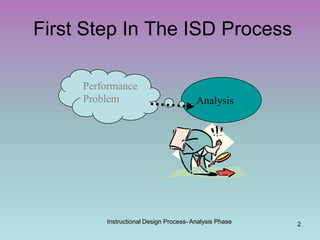
First Step In The ISD Process
Performance
Problem

Analysis

Instructional Design Process- Analysis Phase

2
Analysis Phase
• Training Needs Analysis

• Seven types of analysis

7

• Output of analysis
• Evaluation

Instructional Design ProcessAnalysis Phase

-3
Instructional Design ProcessAnalysis Phase

4
Instructional Design ProcessAnalysis Phase

5
Instructional Design ProcessAnalysis Phase

6
Instructional Design ProcessAnalysis Phase

7
WHY TRAINING??
WHOSE NEED IS THIS?
TRAINING SHOULD BE

MEANINGFUL
PURPOSEFUL
FOCUSSED

Instructional Design ProcessAnalysis Phase

8
TRAINING INTERVENTIONS
Is it a formal need- found through proactive
analysis
Is it a response to request- found through
reactive analysis

Instructional Design ProcessAnalysis Phase

9
EXTERNAL ENVIRONMENT

ORGANISATIONAL
INPUT

PROCESS

OUTPUT

INTERNAL ENVIRONMENT

EXTERNAL ENVIRONMENT
Instructional Design ProcessAnalysis Phase

10
CHANGING ORGANISATIONAL CLIMATE

POLICY
CHANGE

Instructional Design ProcessAnalysis Phase

11
TRAINING NEEDS
A needs assessment is a
systematic & scientific set of
procedures undertaken for the
purpose of setting priorities and
making decisions about program
for organizational improvement
and allocation of resources.
Instructional Design ProcessAnalysis Phase

12
TRAINING NEEDS
Needs assessments enable you to
identify and measure gaps
between what is and what ought to
be, from which program goals and
objectives can be identified. Needs
assessments ultimately address
questions about the future (What
should be done?).
Instructional Design ProcessAnalysis Phase

13
E

GAP
P
Instructional Design ProcessAnalysis Phase

14
TRAINING NEEDS
In the broadest sense, needs assessment is
concerned with policy and programs, not
individual diagnosis. If a needs assessment
is done well, however, it should lead to
actions that will directly benefit those with
the needs.
Needs assessment should progress through
a defined series of phases that involve
preparing for the assessment, implementing
the assessment, and then applying the
results to improve theDesign ProcessInstructional program.
15
Analysis Phase
WHY CONDUCT NEEDS ASSESSMENT?
Reduces uncertainty about a specific issue or
problem. While we might think we already know
what the needs are, usually our knowledge may be
based on impressions, or experiences of limited
situations or of observations of only a few persons
who may not be representative of the population we
are concerned with.
Identifies both program strengths and weaknesses.
Can be used as a baseline against which to
compare future changes in the program status.
Facilitates your ability to plan, make better informed
decisions, set priorities about your program
16
development and improvement needs.
Instructional Design ProcessAnalysis Phase
WHY CONDUCT NEEDS ASSESSMENT?
• Whether can be conducted with limited
resources and time.
• Facilitates your ability to more effectively
and efficiently allocate and use program
resources.
• Adds credibility to your program.
• Educates others about your program.
• Garners additional resources and funding.
• Address the perceived changes in the
existing system, processes or products.
Instructional Design ProcessAnalysis Phase

17
Analysis of the existing situation?
Analysis of the existing situation with reference
to work environment may include

 Work culture,
 Job descriptions
 Nature of duties
 Type of personnel
 Resource Utilisation

 Constraints
Instructional Design ProcessAnalysis Phase

18
What does perceived situation include?
Perceived situation with reference to work
environment include

 Change in work culture,
 Change in duties, roles, responsibilities,
 Change in policies and address socital issues
 Additions and alterations in type of personnel
 Additions and change in resource provision
 Measures to address constraints
Instructional Design ProcessAnalysis Phase

19
TYPES OF TRAINING NEEDS ANALYSIS
Context Analysis. An analysis of the business needs or
other reasons the training is desired. The important
questions being answered by this analysis are who decided
that training should be conducted, why a training program is
seen as the recommended solution to a business
problem, what the history of the organization has been with
regard to employee training and other management
interventions.
User Analysis. Analysis dealing with potential participants
and instructors involved in the process. The important
questions being answered by this analysis are who will
receive the training and their level of existing knowledge
on the subject, what is their learning style, and who will
conduct the training.
Instructional Design ProcessAnalysis Phase

20
TYPES OF TRAINING NEEDS ANALYSIS
Work analysis. Analysis of the tasks being performed. This
is an analysis of the job and the requirements for performing
the work. Also known as a task analysis or job analysis, this
analysis seeks to specify the main duties and skill level
required. This helps ensure that the training which is
developed will include relevant links to the content of the
job.

Content Analysis. Analysis of documents, policies, plans
& procedures used on the job. This analysis answers
questions about what knowledge or information is used on
this job. This information comes from
manuals, documents, or regulations. It is important that the
content of the training does not conflict or contradict job
requirements. An experienced worker can assist (as a
Instructional Design Process21
subject matter expert) in determining the appropriate
Analysis Phase
TYPES OF TRAINING NEEDS ANALYSIS
Training Suitability Analysis. Analysis of whether
training is the desired solution. Training is one of
several solutions to employment problems.
However, it may not always be the best solution. It
is important to determine if training will be effective
in its usage.
Cost-Benefit Analysis. Analysis of the return on
investment (ROI) of training. Effective training
results in a return of value to the organization that
is greater than the initial investment to produce or
administer the training.
Instructional Design ProcessAnalysis Phase

22
WHO CONDUCTS NEEDS ASSESSMENT?
Depending on your experience and the
complexity of the assessment, could
plan and conduct the assessment on
your own.
Consider utilizing an internal, in-house
evaluator.
Consider hiring a consultant to
conduct part or all of the needs
assessment activities.
Obtain technical assistance from
CENTRES Instructional Design ProcessOF EXCELLENCE.
23
Analysis Phase
HOW TO CONDUCT NEED ASSESSMENT?
Several basic Needs Assessment techniques include:

Direct observation
Questionnaires
Consultation with persons in key
positions, and/or with specific knowledge
Review of relevant literature
Interviews
Focus groups
Tests
Records & report studies
Work samples
Instructional Design ProcessAnalysis Phase

24
SAFEGAURDS AGAINST NEED ASSESSMENT?
IMPERCEPTIONS
ASSUMED VALUES OR ROLES
BIASES
WRONG PERSON CONDUCTING TNA
USING INAPPROPRIATE TOOL
IMPROPER RECORDS OR
INSUFFICIENT DATA
INCOMPLETE OBSERVATIONS
WRONG INTERPRETATIONS
FAKING THE DATA
Instructional Design ProcessAnalysis Phase

25
Seven Types of Analysis
Resource analysis
Constraints analysis
Job analysis
Task analysis

Instructional Design ProcessAnalysis Phase

- 26
Seven Types of Analysis
Problem analysis
Goal analysis
Audience analysis

Instructional Design ProcessAnalysis Phase

- 27
Output: Analysis Phase
• JA Report with…
– Training recommendations (performance
requirements)
– Course content

Instructional Design ProcessAnalysis Phase

- 28
Analysis Phase

A Problem

Analysis
Phase

Instructional Design ProcessAnalysis Phase

Job Analysis
Report

- 29
Model of TNA for Competency Development Requirements
ASSSSMENT OF TRAINING
INTERVENTIONS
THROUGH FORMAL
INSTRUMENTS

ELEMENTS OF
TRAINING
INTERVENTIONS

ASSESSMENT OF
TRAINIGNG
INTERVENTIONS
THROUGH INFORMAL
SESSIONS

TNA
KNOWLEDGE
COMPONENTS

COMPETENCY
DEVELOPMENT
REQUIREMENT
S

ATTITUDE
DEVELOPMENT

TRAINING DESIGN

TRAINING
RESOURCES

Instructional Design ProcessAnalysis Phase

TRAINING PLAN
FOR LEVEL

30

Training Needs Analysis

  • 1.
    ANALYSIS PHASE… WHY YOUNEED TO ANALYSE? DR. PEEYUSH VERMA Instructional Design ProcessAnalysis Phase 1
  • 2.
    First Step InThe ISD Process Performance Problem Analysis Instructional Design Process- Analysis Phase 2
  • 3.
    Analysis Phase • TrainingNeeds Analysis • Seven types of analysis 7 • Output of analysis • Evaluation Instructional Design ProcessAnalysis Phase -3
  • 4.
  • 5.
  • 6.
  • 7.
  • 8.
    WHY TRAINING?? WHOSE NEEDIS THIS? TRAINING SHOULD BE MEANINGFUL PURPOSEFUL FOCUSSED Instructional Design ProcessAnalysis Phase 8
  • 9.
    TRAINING INTERVENTIONS Is ita formal need- found through proactive analysis Is it a response to request- found through reactive analysis Instructional Design ProcessAnalysis Phase 9
  • 10.
    EXTERNAL ENVIRONMENT ORGANISATIONAL INPUT PROCESS OUTPUT INTERNAL ENVIRONMENT EXTERNALENVIRONMENT Instructional Design ProcessAnalysis Phase 10
  • 11.
  • 12.
    TRAINING NEEDS A needsassessment is a systematic & scientific set of procedures undertaken for the purpose of setting priorities and making decisions about program for organizational improvement and allocation of resources. Instructional Design ProcessAnalysis Phase 12
  • 13.
    TRAINING NEEDS Needs assessmentsenable you to identify and measure gaps between what is and what ought to be, from which program goals and objectives can be identified. Needs assessments ultimately address questions about the future (What should be done?). Instructional Design ProcessAnalysis Phase 13
  • 14.
  • 15.
    TRAINING NEEDS In thebroadest sense, needs assessment is concerned with policy and programs, not individual diagnosis. If a needs assessment is done well, however, it should lead to actions that will directly benefit those with the needs. Needs assessment should progress through a defined series of phases that involve preparing for the assessment, implementing the assessment, and then applying the results to improve theDesign ProcessInstructional program. 15 Analysis Phase
  • 16.
    WHY CONDUCT NEEDSASSESSMENT? Reduces uncertainty about a specific issue or problem. While we might think we already know what the needs are, usually our knowledge may be based on impressions, or experiences of limited situations or of observations of only a few persons who may not be representative of the population we are concerned with. Identifies both program strengths and weaknesses. Can be used as a baseline against which to compare future changes in the program status. Facilitates your ability to plan, make better informed decisions, set priorities about your program 16 development and improvement needs. Instructional Design ProcessAnalysis Phase
  • 17.
    WHY CONDUCT NEEDSASSESSMENT? • Whether can be conducted with limited resources and time. • Facilitates your ability to more effectively and efficiently allocate and use program resources. • Adds credibility to your program. • Educates others about your program. • Garners additional resources and funding. • Address the perceived changes in the existing system, processes or products. Instructional Design ProcessAnalysis Phase 17
  • 18.
    Analysis of theexisting situation? Analysis of the existing situation with reference to work environment may include  Work culture,  Job descriptions  Nature of duties  Type of personnel  Resource Utilisation  Constraints Instructional Design ProcessAnalysis Phase 18
  • 19.
    What does perceivedsituation include? Perceived situation with reference to work environment include  Change in work culture,  Change in duties, roles, responsibilities,  Change in policies and address socital issues  Additions and alterations in type of personnel  Additions and change in resource provision  Measures to address constraints Instructional Design ProcessAnalysis Phase 19
  • 20.
    TYPES OF TRAININGNEEDS ANALYSIS Context Analysis. An analysis of the business needs or other reasons the training is desired. The important questions being answered by this analysis are who decided that training should be conducted, why a training program is seen as the recommended solution to a business problem, what the history of the organization has been with regard to employee training and other management interventions. User Analysis. Analysis dealing with potential participants and instructors involved in the process. The important questions being answered by this analysis are who will receive the training and their level of existing knowledge on the subject, what is their learning style, and who will conduct the training. Instructional Design ProcessAnalysis Phase 20
  • 21.
    TYPES OF TRAININGNEEDS ANALYSIS Work analysis. Analysis of the tasks being performed. This is an analysis of the job and the requirements for performing the work. Also known as a task analysis or job analysis, this analysis seeks to specify the main duties and skill level required. This helps ensure that the training which is developed will include relevant links to the content of the job. Content Analysis. Analysis of documents, policies, plans & procedures used on the job. This analysis answers questions about what knowledge or information is used on this job. This information comes from manuals, documents, or regulations. It is important that the content of the training does not conflict or contradict job requirements. An experienced worker can assist (as a Instructional Design Process21 subject matter expert) in determining the appropriate Analysis Phase
  • 22.
    TYPES OF TRAININGNEEDS ANALYSIS Training Suitability Analysis. Analysis of whether training is the desired solution. Training is one of several solutions to employment problems. However, it may not always be the best solution. It is important to determine if training will be effective in its usage. Cost-Benefit Analysis. Analysis of the return on investment (ROI) of training. Effective training results in a return of value to the organization that is greater than the initial investment to produce or administer the training. Instructional Design ProcessAnalysis Phase 22
  • 23.
    WHO CONDUCTS NEEDSASSESSMENT? Depending on your experience and the complexity of the assessment, could plan and conduct the assessment on your own. Consider utilizing an internal, in-house evaluator. Consider hiring a consultant to conduct part or all of the needs assessment activities. Obtain technical assistance from CENTRES Instructional Design ProcessOF EXCELLENCE. 23 Analysis Phase
  • 24.
    HOW TO CONDUCTNEED ASSESSMENT? Several basic Needs Assessment techniques include: Direct observation Questionnaires Consultation with persons in key positions, and/or with specific knowledge Review of relevant literature Interviews Focus groups Tests Records & report studies Work samples Instructional Design ProcessAnalysis Phase 24
  • 25.
    SAFEGAURDS AGAINST NEEDASSESSMENT? IMPERCEPTIONS ASSUMED VALUES OR ROLES BIASES WRONG PERSON CONDUCTING TNA USING INAPPROPRIATE TOOL IMPROPER RECORDS OR INSUFFICIENT DATA INCOMPLETE OBSERVATIONS WRONG INTERPRETATIONS FAKING THE DATA Instructional Design ProcessAnalysis Phase 25
  • 26.
    Seven Types ofAnalysis Resource analysis Constraints analysis Job analysis Task analysis Instructional Design ProcessAnalysis Phase - 26
  • 27.
    Seven Types ofAnalysis Problem analysis Goal analysis Audience analysis Instructional Design ProcessAnalysis Phase - 27
  • 28.
    Output: Analysis Phase •JA Report with… – Training recommendations (performance requirements) – Course content Instructional Design ProcessAnalysis Phase - 28
  • 29.
    Analysis Phase A Problem Analysis Phase InstructionalDesign ProcessAnalysis Phase Job Analysis Report - 29
  • 30.
    Model of TNAfor Competency Development Requirements ASSSSMENT OF TRAINING INTERVENTIONS THROUGH FORMAL INSTRUMENTS ELEMENTS OF TRAINING INTERVENTIONS ASSESSMENT OF TRAINIGNG INTERVENTIONS THROUGH INFORMAL SESSIONS TNA KNOWLEDGE COMPONENTS COMPETENCY DEVELOPMENT REQUIREMENT S ATTITUDE DEVELOPMENT TRAINING DESIGN TRAINING RESOURCES Instructional Design ProcessAnalysis Phase TRAINING PLAN FOR LEVEL 30