STABILITY STUDIES OF DRUG
Dr.Gurumeet C Wadhawa
,Assistant Professor, Department of
Chemistry.
Rayat Shikshan sansthas Veer
Wajekar ASC
College,Phunde,Uran
STABILITY –
The capacity of a drug or product to remain within established
specifications of identity , quality, purity in a specific period of time.
OR
The capacity or the capability of a particular formulation in a specific
container to remain with in particular chemical , microbiological ,
therapeutically , and toxicological specifications.
OR
USP defines stability of pharmaceutical product as , “extent to which a
product retains with in specified limits and throughout its period of
storage and use ( i.e. shelf life).
Stability testing is used to:
Provide evidence as to how the quality of the drug product varies with
time.
Establish shelf life for the drug product.
Determine recommended storage conditions.
Determine container closure system suitability.
Why Stability studies are necessary ?
Chemical degradation of the product leads to lowering of the concentration
of the drug in the dosage form.
Toxic products may be formed , due to chemical degradation of the active
ingredient.
Advantages of Stability studies
Assurance to the patient Economic considerations Legal requirement
OBJECTIVES
1. To determine maximum expiration date/ shelf life.
2. To provide better storage condition.
3. To determine the packaging components.
4. To gather information during preformulation stage to
produce a stable product.
Study Storage condition Minimum time
period covered by
data at submission
Long Term
(Ambient)
25º C ± 2º C
60%RH ± 5%
12months
Intermediat
e
(controlled)
30º C ± 2º C
60%RH ± 5%
6 months
Accelerated 40º C ± 2º C
75%RH ± 5%
6months
DEGRADATIVE PATHWAYS
Degradation of active drug leads to lowering of quantity of the therapeutic
agent in the dosage form.
It may not be extensive , a toxic product formation may take place due to
decomposition instability of drug product can lead to a decrease in its
bioavailability .
Changes in physical appearance of given dosage form may take place.
Degradation may increase or may decrease the potency of drug.
Sometimes active drug may retain its potency , but excipients like –
antimicrobial , preservatives , solubilizers , emulsifying or suspending agent
may degrade , lead to compromising the integrity of drug product.
EXAMPLE :
Drugs like 5-fluorouracil , carbamazipine , digioxin and theophylline have
narrow therapeutic indices these needs to be carefully treated in patient so
that plasma levels are neither too high as to be toxic nor too low as to be
ineffective
The antimicrobial chloroquine can produce toxic reactions that are attribute
to the photochemical degradation of the substance.
DEGRADATION MAY BE OF TWO TYPES
PHYSICAL DEGRADATION
CHEMICAL DEGRADATION
1. OXIDATION
2. DECARBOXYLATION
3. PHOTOLYSIS
4. RACEMIZATION
5. HYDROLYSIS
PHYSICAL DEGRADATION
The physical stability properties includes appearance, palatability ,uniformity
,dissolution and suspend ability are retained . Maintained throughout the shelf
life of the drug.
It includes following :
Loss of water
loss of volatile oil
WaterAbsorbance
Polymorphism
Color change
Physical degradation includes following :
LOSS OF VOLATILE CONTENT: Volatile compounds used such as
Alcohol ether , camphor oils , etc . Try to escape from the
formulation leads to degradation of formulation.
Example : nitroglycerine from drugs evaporate.
LOSS OF WATER : Water loss from liquid preparation (o/w emulsion)
leads to changes in stability .It causes crystallization of drug product
.which may lead to increase in potency , and decrease in weight.
Example : water evaporates from Na2SO4 .BORAX.
WATER ABSORBANCE : pharmaceutical formulations which are
hygroscopic in nature absorb the water from its external environment
leads to degradation .
Example : gelatin capsule , deliquescent salts like –Cacl3 ,
Potassium citrate.
POLYMORPHISM: A stable crystal form is effected (it may loosen)
leads to the formation of polymorph and cause instability in formulation.
This may lead to alteration in solubility , dissolution of drug
COLOR CHANGE: Loss or development of color may occur . (due to
change in PH , use of reducing agent , exposure to light )
Physical Stability
Physical stability implies that:
The formulation is totally unchanged throughout its shelf
life and has not suffered any changes by way of appearance,
organoleptic properties, hardness, brittleness, particle size
etc.
It is significant as it affects:
1.pharmaceutical elegance
2.drug content uniformity
3.drug release rate.
Physical Stability
Formulation Likely physical
instability problems
Effects
Oral solutions 1- Loss of flavor
2- Change in taste
3- Presence of off
flavors due to
interaction with plastic
bottle
4- Loss of dye
5- Precipitation
6- discoloration
Change in smell
or feel or taste
Formulation Likely physical
instability problems
Effects
Parenteral
solutions
1. Discoloration due to
photo chemical
reaction or oxidation
2. Presence of precipitate
due to interaction
with container or
stopper
3. Presence of “whiskers”
4. Clouds due to:
(i) Chemical changes
(ii) The original
preparation of a
supersaturated
solution
Change in
appearance and in
bio-availability
Physical stability
Formulation Likely physical
instability
problems
Effects
Suspensions 1- settling
2- caking
3- crystal
growth
1-Loss of drug
content
uniformity in
different doses
from the bottle
2- loss of
elegance.
Physical stability
Formulation Likely physical
instability
problems
Effects
Emulsions 1- Creaming
2- coalescence
1- Loss of drug
content
uniformity in
different doses
from the bottle
2- loss of
elegance
Physical stability
Physical stability
Formulation Likely physical
instability
problems
Effects
Semisolids
(Ointments and
suppositories)
1. Changes in:
a) Particle size
b) Consistency
2. Caking or
coalescence
3. Bleeding
1-Loss of drug
content
uniformity
2- loss of
elegance
3-change in
drug release
rate.
Physical stability
Formulation Likely physical
instability problems
Effects
Tablets Change in:
a) Disintegration
time
b) Dissolution profile
c) Hardness
d) Appearance (soft
and ugly or
become very
hard)
Change in
drug release
CHEMICAL DEGRADATION
Chemical degradation of a dosage form occurs through several pathways
like –hydrolysis , oxidation , decarboxylation , photolysis , racemization.
which may lead to lowering of therapeutic agent in the dosage form,
formation of toxic product , decreased bioavailability etc.
1. HYDROLYSIS
Most important in systems containing water such as emulsion , suspension ,
solutions , etc.
Also for drugs which are affected by moisture (water vapor) from
atmosphere.
It is usually catalysed by hydrogen ion(acid) or hydroxyl ion(base).
In this active drug is decomposed with solvent.
Usually solvent is water some time reaction may involve pharmaceutical
co solvents such as ethyl alcohol or poly ethylene glycol
Main classes of drugs that undergo hydrolysis are the ESTERS ,AMIDE
,ALKALI, ACID.
Cont…
ESTER HYDROLYSIS involve acyl – acid cleavage.
Example of drugs: aspirin ,atropine , physostigmine , procaine..
R .COOR (ester) + H2O RCOOH (acid) + HOR(alcohol)
AMIDE HYDROLYSIS is more stable than ester , susceptible to specific and
general acid base hydrolysis. It involves cleavage of amide linkage to give an
amine instead of alcohol as in case of esters.
Example of drugs : chloramphenicol , barbiturates .
RCONHR(amide) + H2 O RCOOH + NH2 R(AMINE)
Some functional groups subject to
Hydrolysis
Drug type Examples
Esters Aspirin, alkaloids
Dexmethasne sodium
phosphate
Nitroglycerin
Lactones Pilocarpine
Spironolactone
Amides Chloramphenicol
Imides Glutethimide
Malonic ureas Barbiturates
PROTECTION AGAINST OXIDATION
Avoiding contact with moisture at time of manufacture.
Packaging in suitable moisture resistant packs such as strip packs and storage in
controlled humidity and temperature.
In liquid dosage form since , hydrolysis is acid or base catalyzed , an optimum
PH for max stability should be selected and the formulation should be stabilized
at this PH by inclusion of proper buffering agents.
Hydrolysis of certain drugs such as benzocaine and procaine can be decreased
by the addition of specific complexing agent like caffeine to the drug solutions .
Hydrolysis susceptible drugs such as penicillin and derivatives can be prevented
by formulating them in the dry powder form for reconstitution or dispersible
tablets instead of a liquid dosage form such as solutions or suspensions.
2. OXIDATION
Oxidation is controlled by environment i.e, light ,trace elements , oxygen and
oxidizing agent .
Occurs when exposed to atmospheric oxygen.
Either the addition of oxygen or removal of hydrogen .
Oxidation is the loss of electrons while reduction is the gain of electrons.
AUTOXIDATION
The reaction between the compounds and molecular oxygen is required for
initiating the chain reaction is called autoxidation .
Free radicals produced during initial reaction are highly reactive and further
catalyze the reaction produced additional free radicals and causing a chain
reaction.
Heavy metals such as copper , iron , cobalt , and nickel have been known to
catalyze the oxidative degradation .Heat and light further influence the kinetics
of oxidative degradation processes.
STEPS INVOLVED OXIDATION REACTION
INITIATION : Formation of free radicals is taken place .
R--H R’ + [H’}
PROPOGATION : here the free radical is regenerated and react with more oxygen .
R’ + O2 R’—O2
R’O2 + RH ROOH + R’
HYDROPEROXIDE DECOMPOSITION
ROOH RO’ + OH’
TERMINATION : free radicals react with each other resulting in inactive products.
R’--O2 + X Inactive product
RO2 + RO2 Inactive product
EXAMPLE OF DRUGS DECOMPOSED BY OXIDATION PATHWAYS
Archis oil , clove oil , ethyl oleate ,Heparin , Ascorbic acid , Morphine ,Vitamin A ,
Vitamin
B12 , etc.
PROTECTION AGAINST OXIDATION
USE OF ANTIOXIDANTS : antioxidants are Mainly of 3 types :
1. The first group probably inhibits the oxidation by reacting with free radicals.
Example – tocopheral , butylated hydroxyl anisole (BHA) , butylated hydroxyl
toluene's (BHT). Concentration 0.001 – 0.1%.
2. The second group comprising the reducing agents , have a lower redox potential
than the drug or other substance that they should protect and are therefore more
readily oxidized.
Example –ascorbic acid and iso ascorbic acid , potassium or sodium salts of
metabisulfite.
3. The third group, little antioxidant effect themselelf but enhance the action of true
antioxidant .example
Example -- Citric acid , tartaric acid , disodium edetate and lecithin .
USE OF CHELATINGAGENT
when heavy metals catalyze oxidation .
Example -- EDTA , citric acid , tartaric acid form complexes.
3. PHOTOLYSIS
Exposure to light cause substantial degradation of drug molecule.
• When molecules are exposed to electromagnetic radiation they absorb light
(photons) at characteristic wavelength which cause increase in energy which
can :
Cause decomposition.
Retained or transferred.
Be converted to heat .
Result in light emission at a new wavelength (fluorescence ,
phosphorescence).
• Natural sun light lies in wavelength range (290– 780nm) of which only higher
energy (UV) range (290 --320) cause photo degradation of drugs.
`
Example of phototoxic drugs:
Furosemide , acetazolamide , cynocobalamine .
EXAMPLE
Sodium nitropruside in aqueous solution (which is administered by IV infusion
for management of acute hypertension ).
If protected from light it is stable to at least 1yr.
If exposed to normal room light it has a shelf life of 4 hrs.
PROTECTION
Use of amber colored bottles .
Storing the product in dark , packaging in cartons also act as physical barrier to
light.
Coating of tablets with polymer films.
Accelerated Stability Studies
Stability study to predict the shelf life of the product, by accelerating
the rate of decomposition, preferably by increasing the temperature of
reaction conditions.
With the advancement in branch of kinetics, shelf life of a dosage form
can be predicted within months based on accelerated stability reports
Preparations are subjected to high stresses during stability testing.
Common high stresses include :
Temperature
Humidity
Light
It is defined as the time required for the concentration of the reactant to reduce to
90% of its initial concentration .Represented as t90 and the units of time /conc.
t90 = (a-0.9a) = 0.1 a
ko ko
Where , a = initial concentration .
ko = specific rate constant for zero order reaction.
(the time from the date of manufacture and packaging of the formulation until its
chemical or therapeutic activity is maintained to a predetermined level of labeled
potency and ,
its physical characteristic have not changed appreciably or deleteriously ).
Arrhenius equation
It explains the effect of temperature on rate of a reaction.
According to Arrhenius, for every 10º rise in temperature, the speed
of reaction increases about 2-3 times.
k = A e -Ea / RT
Arrhenius factor
Energy of activation
Ideal gas constant
Arrhenius factor is the frequency of molecular collisions occuring between
the molecules.
Log k = log A – Ea / 2.303 RT
Estimation of k value
The reaction is conducted at several temperatures.
Concentration of reactants is determined.
Appropriate graphs are drawn for the kinetic data.
Data is processed for all the orders.
The order of the reaction is identified.
From the slopes of the lines, k values are calculated for all
temperatures.
Estimation of energy of activation
A graph can be drawn by taking log k on y-axis and reciprocal
temperature (1/T) on x-axis.
A straight line is obtained, the slope of the line is negative and the
magnitude is Ea / 2.303 R.
The intercept corresponds to log A
All the constants in the Arrhenius equation can be obtained from the
graph.
Activation energy is the minimum energy that a molecule should
possess so that the molecular collisions produce the product.
Steps involved in prediction of shelf life
The Preparation is stored at different elevated temperatures, to
accelerate the degradation
Samples are withdrawn at different time intervals
The Order of the reaction is determined by plotting the appropriate
function of concentration against time and linear relationship is
determined
Straight line in a graph permits the estimation of k value from the slope
Similarly graphs are drawn for different elevated temperatures.
K value for each temperature are calculated.
By using Arrhenius relationship, Log k values are plotted against
reciprocal of absolute temperature, energy of activation can be
calculated.
Extrapolate the straight line to room temperature (k
25
) or
refrigerated temperature and read the log k value on y-axis.
Substitute the k value in the appropriate equation to get the shelf
life of the product.
Arrhenius plot for predicting the rate constant at ambient
temperature(25ºC).
Stability
investigation
Dosage form Storage condition Storage period
Organoleptic and
physicochemical
stability
Photostability
Chemical stability
Solid
Semisolid
Liquid
All
Solid
Semisolid
Liquid
Storage in open
container until
equilibrium is reached at
25ºC/60%,30ºC/70%,
40ºC/75%
5ºC
≥ - 10ºC
5ºC -40ºC Temperature
cycle within 24 hrs
40ºC(content uniformity)
5ºC
≥ -10ºC
Xenon lamp
40ºC, 50ºC, 60ºC, 70ºC
30ºC, 40ºC, 50ºC
40ºC, 50ºC, 60ºC, 70ºC
1-2 weeks
4 weeks
4 weeks
2 weeks
3 months
4 Weeks
4 weeks
48 hrs
3 months
3 months
3 months
LONG
Accor
d
under
RECO
TEMP
25’C+
/
30’C
+
ACCE
TERM STABILITY STUDIES :
ing to WHO, long term stability testing during and beyond expected shelf life
storage conditions in the intended market.
MMENDED CONDITIONS FOR LONG TERM STABILITY
CONDITIONS
ERATURE (‘C) RELATIVE HUMIDITY% MINIMUM TIME
- 2’C 60 +/- 5% 12 MONTHS
/- 2’C 30+/- 5% 6 MONTHS
LERATED STABILITY STUDIES:
STOR GE CONDITIONS
TEMP RATURE (‘C) RELATIVE HUMIDITY% MINIMUM TIME
40’C +/- 2’C 75 +/-5% 6 MONTHS
In , ge
actual
neral the accelerated stability conditions must be at least 15’C above the
storage temperature and appropriate relative humidity . Substances and
STORAGE
A
E
TestingFrequency:
For Long term testing, during first year sampling should be done
every
three months, during second year, sampling should be done every six
months and after two years, sampling should be done once a year.
Accelerated testing should be done atleast six months and it
suggests
sampling points of 0, 3, 6 months.
Methods Of Accelerated Stability
Testing In Dosage forms
Freeze Thaw test
Centrifugal Test
Shaking test
Elevated Temperature test
AcceleratedStability Testingin Emulsions
Anemulsion isstoredat elevated temperature. Thisdecreasesviscosity ofthe
continuousphase.If the emulsionwithstandsthisstressit isassumedto be
stableat normalconditionsof storage.
Centrifugation Method:
Creamingandflocculationare slowprocesses.
Centrifugationaccelerates rateofcreamingandflocculationinemulsions.
Theemulsion issubjectedto differentcentrifugalspeedsandseparationof
phasesisobservedat differenttime periods.
Bademulsionseparatesoil instantly.
Goodemulsiondoesnotexhibitdetectableseparationof oil phaseuntil certain
time period.
AcceleratedtestsforSuspensions
Cakeformation isacceleratedbycentrifugation.
Highspeedcentrifugationishencenot preferred, low speedcentrifugation
isusedto studythe physicalstability.
AFreeze-Thawcyclingtechnique isoneofthe stresstesting . Thiscycling
treatment promotesparticle growthand hasprimary importancefor
changes inabsoluteparticle size, particle sizedistributionand
crystalhabit.
AcceleratedTestsfor moistureabsorption
Inthis method, productsare placedin anenvironment of highrelative
humidityandcontrolledtemperature.
Theirphysicalandchemicalstabilitiesare assessed.
Theresultswill indicatewhetherthe productissusceptibleto moisture
andalsowhetherthe container needsto providea highdegreeof
protection.
Limitations
StabilitypredictionsbasedonArrheniusequationare valid only
whenthe breakdowndependsontemperature.
Theenergyof activationobtained inthe studyshouldbebetween
10to 30 kcal/mole.
Whendegradationisdueto
Microbialcontamination
Photochemical reactions
Whenthe product loosesits physical integrity at highertemperatures.
Whenthe orderchangesat elevated temperatures.
Incaseof disperse systems,whentemperature iselevated viscosity is
decreasedandthis mayintroduceerrorsinthe predictionof stability.
Describes regarding sampling times ,storage conditions&
specifictest parameters for each dosage form.
The FDA & The expert working group of the ICH of technical
requirements for the registration of pharmaceuticals for
human use have published guidelines for conducting the
actual studies.
ICH Guidelines
• Quality Guidelines “Q” (chemical and pharmaceutical QA)
• Safety Guidelines “S” (in vitro and in vivo pre-clinical studies)
– covering Carcinogenicity Testing, Genotoxicity Testing,
Toxicokinetics and Pharmacokinetics ….. etc.
• Efficacy Guidelines “E” (clinical studies in human subject)
– Covering clinical safety, Dose Response Studies, Good
Clinical Practices, Clinical evaluation …. etc.
• Multidisciplinary Guidelines “M”
– Covering Medical Terminology, Electronic Standards for
Transmission of Regulatory Information …… etc.
– Important for Stability !
» Guideline M4: The Common Technical Document (CTD)
ICH – Q – Guidelines
Stability Testing Q1
Stability Testing in Climatic Zone I and II (Q1A)
Photo stability Testing (Q1B)
Stability Testing for New Dosage Forms (Q1C)
Bracketing and Matrixing Designs (Q1D)
Evaluation of Stability Data (Q1E)
Stability Testing in Climatic Zones III and IV (Q1F)
Validation of Analytical Procedures (Q2)
Impurities (Q3)
Impurities in New Drug Substances (Q3A)
Impurities in New Drug Products (Q3B)
Pharmacopoeial Harmonization (Q4)
Biotechnological Products (Q5)
Specifications (Q6)
DEFINITIONS
Shelflife (expiration dating period, conformance period)
Self life is the time period during which a drug product is expected to
remain within the approved specification for use, provided that it is
stored under the conditions defined on the container label.
Re-test period
The period of time during which the drug substance is expected to remain
within its specification and, therefore, can be used in the manufacture of a
given drug product, provided that the drug substance has been stored
under the defined conditions.
Formal stability studies
Long term and accelerated (and intermediate) studies undertaken on primary
and/or commitment batches according to a prescribed stability protocol to
establish or confirm the re-test period of an API or the shelf life of a FPP.
Stress testing – forced degradation (API)
Studies undertaken to elucidate the intrinsic stability of the API. Such testing
is part of the development strategy and is normally carried out under more
severe conditions than those used for accelerated testing.
Stress testing – forced degradation (FPP)
Studies undertaken to assess the effect of severe conditions on the FPP. Such
studies include photostability testing (see ICH Q1B) and compatibility testing
on APIs with each other in FDCs and API(s) with excipients during
formulation development.
Primary batch (called also exhibit batch)
A batch of an API or FPP used in a formal stability study, from which stability
data are submitted in a registration application for the purpose of establishing a
re-test period or shelf life, respectively. A primary batch of an API should be at
least a pilot scale batch. For a FPP, two of the three batches should be at least pilot
scale batch, and the third batch a production batch.
Commitment batches
Production batches of a drug substance or drug product for which the stability
studies are initiated or completed post approval through a commitment made in
the registration application.
Pilot (scale) batch
A batch of an API or FPP manufactured by a procedure fully representative of
and simulating that to be applied to a full production scale batch. (For solid oral
dosage forms, a pilot scale is generally, at a minimum, one-tenth that of a full
production scale or 100,000 tablets or capsules, whichever is the larger.)
Production (scale) batch
A batch of an API or FPP manufactured at production scale by using production
equipment in a production facility as specified in the application.
Specification - Release
The combination of physical, chemical, biological, and microbiological tests
and acceptance criteria that determine the suitability of a drug product at the
time of its release.
Specification - Shelf life
The combination of physical, chemical, biological, and microbiological tests
and acceptance criteria that determine the suitability of an API throughout
its re-test period, or that anFPP should meet throughout its shelf life.
Mass balance
The process of adding together the assay value and levels of degradation
products to see how closely these add up to 100% of the initial value, with
due consideration of the margin of analytical error.
WORLDWIDE ZONES / TEMPERATURE AND
HUMIDITY CONDITIONS
Zone Mean kinetic
temperature
Yearly average
humidity (%RH)
Zone I ( Moderate) 21 ̊C 45
Zone II (Mediterranean) 25̊C 60
Zone III (Hot, dry) 30 ̊C 35
Zone IV (Very hot, moist) 30̊ C 70
COUNTRIES AND ZONES
Regions Zone I &II Zone III&IV
EUROPE All countries
AMERICA Argentina, Bolivia, Canada,
Mexico, US
Brazil, Columbia, Cuba,
Jamaica
ASIA Afghanistan, China, Iran,
Nepal, Turkey, Japan
Bahrain , Hong Kong, India,
Oman , Pakistan, Srilanka,
UAE
AFRICA Egypt,Algeria, SouthAfrica,
Libya
Angola, Benin, Congo,
Uganda, Sudan, Somalia,
Senegal
Study
Long term
Intermediate
Accelerated
Minimum time period covered
by data at submission
12 months
Storage condition
25°C ± 2°C / 60% ± 5% r.h or
30°C ± 2°C / 65% ± 5% r.h.
30°C ± 2°C / 65% ± 5% r.h. 6 months
40°C ± 2°C / 75% ± 5% r.h. 6 months
STORAGE IN A REFRIGERATOR
Study Storage condition Minimum time period covered
by data at submission
Long term 5°C ± 3°C 12 months
Accelerated 25°C ± 2°C / 60% ± 5% r.h. 6 months
STORAGE CONDITIONS FOR STABILITY STUDY
API/DRUG SUBSTANCES TO BE STOTRED ATAMBIENT TEMPERATURES
Study Storage condition Minimum time period
covered by data at
submission
Long term -20°C ± 5°C 12 months
STORAGE IN FREEZER
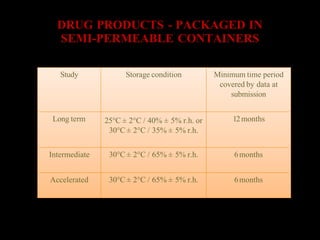
DRUG PRODUCTS - PACKAGED IN
SEMI-PERMEABLE CONTAINERS
Study Storage condition Minimum time period
covered by data at
submission
Long term 25°C ± 2°C / 40% ± 5% r.h. or
30°C ± 2°C / 35% ± 5% r.h.
12months
Intermediate 30°C ± 2°C / 65% ± 5% r.h. 6months
Accelerated 30°C ± 2°C / 65% ± 5% r.h. 6months
The Stability Chambers are designed for an operating range of 4°C to
70°C Temperature only, 5°C to 60°C Temperature with Humidity.
These units employ a programmable controller to control the
temperature, defrost and humidity settings. The cabinets use an
evaporator coil, located on top of the cabinet as the heat-removing
source. Through the refrigeration process, heat is captured in the
evaporator, transferred to the condensing unit on top of the cabinet,
and expelled to the surrounding outside air. It is extremely important
to allow a four-inch clearance on the top, rear, and sides of the unit
for the refrigeration process to function properly.
STABILITYCABINETS:
STABILITYCABINETS:
Packaging And Stability
1.Glass
Glass is resistant to chemical and
physical change and is the most commonly used material.
Limitations Overcome
1. Its alkaline surface use of Borosilicate glass
2. Ions may precipitate
insoluble crystals from the
glass
the use of buffers
3- Permits the transmission
of light which may accelerate
decomposition.
Amber coloured glass
Packing and Stability
2.PLASTICS
The problems with plastic are:
Migration of the drug through the plastic into the
environment.
Transfer of environmental moisture, oxygen, and other
elements into the pharmaceutical product.
Leaching of container ingredients into the drug.
Adsorption of the active drug or
excipients by the plastic.
Packing and Stability
3.Metals
Various alloys and aluminum tubes may be utilized as
containers for emulsions, ointments, creams and pastes.
Limitation: They may cause corrosion and precipitation in
the drug product.
Overcome: Coating the tubes with polymers may reduce
these tendencies.
Packing and Stability
Rubber
Rubber also has the problems of extraction of drug
ingredients and leaching of container ingredients.
The pretreatment of rubber vial stoppers and closures with
water and steam reduces potential leaching.
Physical stability
Formulation Likely physical
instability
problems
Effects
Capsules Change in:
a) Appearance
b) Dissolution
c) Strength
Change in drug
release
Types of Stability Studies
1.Long-Term (Real-Time) Stability Testing
Stability evaluation of the physical, chemical, biological
and microbiological characteristics of a drug product
duration of the shelf life
Packaging materials permeable to water vapor result in a
falsification of the results for semisolid and liquid dosage forms if
varying degrees of weight loss occur that leads to differences in the
active ingredient concentration or ion strength.
The use of inert standard packaging materials that are impermeable
to water vapor is important precondition for stress tests that are
evaluated in terms of reaction kinetics, and on the results on which
stability predictions are to be tested.
Solid dosage forms: 50-mL glass container with twist-off closure
polypropylene tube
Semisolid dosage forms: Standard tube, small volumetric flask,
Aluminum tube, inert internal lacquering
Liquid dosage forms: 25mL volumetric flask with ground-glass
stopper
However, furture investigations for the selection of the final
packaging are necessary.
On the basis of the results of the stress tests for solid dosage forms,
the sensitivity to moisture can be determined and suitable
packaging materials can be selected.
As a rule, no interactions are to be expected.
If the final packaging material has been selected and samples
packed in the final packaging material are available, the
investigation of photostability should be performed.
Photostability :The samples with and without container are
irradiated with a Xenon lamp for 24 hours.
Packaging: Aluminum tube internally lacquered, plastic tubes.
Problems: Corrosion , permeation, sorption.
Tests packaging material – dosage form:
To test for corrosion ,the filled metal tubes are stored horizontally
upright and inverted at 400C, for 3 months and are then
investigated.
To test for permeation and sorption the filled plastic tubes are
stored for 3 months at 500 C, 400 C, 300 C/70%.
If the final packaging material has been selected, the investigations
on the photostability are performed.
Packaging ampoule, injection vial with rubber stopper, glass bottle
or plastic bottle with screw closure.
Problems: leakage.
To test for permeation, and leakage, the finale formulation solution
is filled in the container, and for desorption placebo solution is
used.
The samples are stored vertically and inverted under 500 C, 400 C,
300C/70% for up to 12 weeks.
Tested intervals: 0, 1, 2, 3 months.
If the final packaging material has been selected the investigations
on the photostability are performed.
TABLET
Stable tablets retain their original size ,shape , weight ,roughness ,colour variation ,
cracking under normal handling andstorage conditions throughout their shelf life.
• FRIABILITYTEST: studies revelthe physical instability if any in tablet.
Maximum weight lossshould not be more than 1%.
• HARDNESS TEST: shows resistanceto crushing.
• COLORSTABILITY: by colorimeter , reflectometer with heat, sunlight and intense
artificial light.
Uniformity of weight , odor , texture , drug and moisture content , humidity effects
are alsoStudied during atablet test.
GELATINECAPSULE
Gelatin capsulesare found to bestable in dry
conditions but they rapidly reachequilibrium with
the atmospheric conditions underthey are stored.
Thisshows gelatin capsulesare largely effected by
temperature and humidity and susceptibilityto
microbial degradation .
soft gelatin capsule have Relative Humidity 20 to
30%at 21to 24’C.
hardgelatin capsulecontain 13to 16%moisture.
Humidity - capsule shell softens and becomes
sticky.
Dried- capsule shell becomesbrittle and crack.
Hard gelatin capsulearetested for Brittleness,
dissolution , water content and level of microbial
contamination.
EMULSIONS
Testedfor phaseseparation , PH, viscosity, level of microbial
contamination , and distribution of dispersed globules.
ORALSOLUTIONSANDSUSPENSIONS
Formation of precipitate , clarity for solutions , PH, viscosity,
microbial contamination.
Additionally for suspensions, redispersibility , rheological
properties ,mean sizeand distribution of particles should be
considered .
NASALSPRAYS: solution and suspensions
Clarity (for solution) , level of microbial contamination , PH,
particulate matter , unit spray medication , content uniformity
,droplet and/or particle size distribution , weight loss, pump
delivery.
Microscopic evaluation ,(for suspension), foreign particulate
matter and extractable/ leachable from components of the
container , closure and pump.
TOPICAL, OPTHALMICAND OTICPREPRATION
Included in this broad category are ointments ,creams , lotions
,paste , gel , solutions,eye drops and cutaneous sprays.
TOPICAL
preparations
resuspendibility
distribution
should be evaluated for clarity , homogeneity , PH ,
for lotions , consistency , viscosity , particle size
,level of microbial contamination / sterility and weight
loss
FOR OPTHALMIC OR OTIC PREPRATION
Should include the following additional attributes
,particulate matter ,and extractable.
: sterility
SUPPOSITORIES
Softening range , dissolution (at 37’C)
PARENTERALS
Color , clarity (for solutions) , particulate matter , PH, sterility ,
pyogen / endotoxins .
Stability studies for powders for injection solution ,include color
monitoring , reconstitution time and water content ,to be performed
at regular intervals .
stability study.pptx

stability study.pptx

  • 1.
    STABILITY STUDIES OFDRUG Dr.Gurumeet C Wadhawa ,Assistant Professor, Department of Chemistry. Rayat Shikshan sansthas Veer Wajekar ASC College,Phunde,Uran
  • 2.
    STABILITY – The capacityof a drug or product to remain within established specifications of identity , quality, purity in a specific period of time. OR The capacity or the capability of a particular formulation in a specific container to remain with in particular chemical , microbiological , therapeutically , and toxicological specifications. OR USP defines stability of pharmaceutical product as , “extent to which a product retains with in specified limits and throughout its period of storage and use ( i.e. shelf life).
  • 3.
    Stability testing isused to: Provide evidence as to how the quality of the drug product varies with time. Establish shelf life for the drug product. Determine recommended storage conditions. Determine container closure system suitability. Why Stability studies are necessary ? Chemical degradation of the product leads to lowering of the concentration of the drug in the dosage form. Toxic products may be formed , due to chemical degradation of the active ingredient. Advantages of Stability studies Assurance to the patient Economic considerations Legal requirement
  • 4.
    OBJECTIVES 1. To determinemaximum expiration date/ shelf life. 2. To provide better storage condition. 3. To determine the packaging components. 4. To gather information during preformulation stage to produce a stable product.
  • 5.
    Study Storage conditionMinimum time period covered by data at submission Long Term (Ambient) 25º C ± 2º C 60%RH ± 5% 12months Intermediat e (controlled) 30º C ± 2º C 60%RH ± 5% 6 months Accelerated 40º C ± 2º C 75%RH ± 5% 6months
  • 6.
    DEGRADATIVE PATHWAYS Degradation ofactive drug leads to lowering of quantity of the therapeutic agent in the dosage form. It may not be extensive , a toxic product formation may take place due to decomposition instability of drug product can lead to a decrease in its bioavailability . Changes in physical appearance of given dosage form may take place. Degradation may increase or may decrease the potency of drug. Sometimes active drug may retain its potency , but excipients like – antimicrobial , preservatives , solubilizers , emulsifying or suspending agent may degrade , lead to compromising the integrity of drug product. EXAMPLE : Drugs like 5-fluorouracil , carbamazipine , digioxin and theophylline have narrow therapeutic indices these needs to be carefully treated in patient so that plasma levels are neither too high as to be toxic nor too low as to be ineffective The antimicrobial chloroquine can produce toxic reactions that are attribute to the photochemical degradation of the substance.
  • 7.
    DEGRADATION MAY BEOF TWO TYPES PHYSICAL DEGRADATION CHEMICAL DEGRADATION 1. OXIDATION 2. DECARBOXYLATION 3. PHOTOLYSIS 4. RACEMIZATION 5. HYDROLYSIS PHYSICAL DEGRADATION The physical stability properties includes appearance, palatability ,uniformity ,dissolution and suspend ability are retained . Maintained throughout the shelf life of the drug. It includes following : Loss of water loss of volatile oil WaterAbsorbance Polymorphism Color change
  • 8.
    Physical degradation includesfollowing : LOSS OF VOLATILE CONTENT: Volatile compounds used such as Alcohol ether , camphor oils , etc . Try to escape from the formulation leads to degradation of formulation. Example : nitroglycerine from drugs evaporate. LOSS OF WATER : Water loss from liquid preparation (o/w emulsion) leads to changes in stability .It causes crystallization of drug product .which may lead to increase in potency , and decrease in weight. Example : water evaporates from Na2SO4 .BORAX. WATER ABSORBANCE : pharmaceutical formulations which are hygroscopic in nature absorb the water from its external environment leads to degradation . Example : gelatin capsule , deliquescent salts like –Cacl3 , Potassium citrate. POLYMORPHISM: A stable crystal form is effected (it may loosen) leads to the formation of polymorph and cause instability in formulation. This may lead to alteration in solubility , dissolution of drug COLOR CHANGE: Loss or development of color may occur . (due to change in PH , use of reducing agent , exposure to light )
  • 9.
    Physical Stability Physical stabilityimplies that: The formulation is totally unchanged throughout its shelf life and has not suffered any changes by way of appearance, organoleptic properties, hardness, brittleness, particle size etc. It is significant as it affects: 1.pharmaceutical elegance 2.drug content uniformity 3.drug release rate.
  • 10.
    Physical Stability Formulation Likelyphysical instability problems Effects Oral solutions 1- Loss of flavor 2- Change in taste 3- Presence of off flavors due to interaction with plastic bottle 4- Loss of dye 5- Precipitation 6- discoloration Change in smell or feel or taste
  • 11.
    Formulation Likely physical instabilityproblems Effects Parenteral solutions 1. Discoloration due to photo chemical reaction or oxidation 2. Presence of precipitate due to interaction with container or stopper 3. Presence of “whiskers” 4. Clouds due to: (i) Chemical changes (ii) The original preparation of a supersaturated solution Change in appearance and in bio-availability
  • 12.
    Physical stability Formulation Likelyphysical instability problems Effects Suspensions 1- settling 2- caking 3- crystal growth 1-Loss of drug content uniformity in different doses from the bottle 2- loss of elegance.
  • 13.
    Physical stability Formulation Likelyphysical instability problems Effects Emulsions 1- Creaming 2- coalescence 1- Loss of drug content uniformity in different doses from the bottle 2- loss of elegance
  • 14.
  • 15.
    Physical stability Formulation Likelyphysical instability problems Effects Semisolids (Ointments and suppositories) 1. Changes in: a) Particle size b) Consistency 2. Caking or coalescence 3. Bleeding 1-Loss of drug content uniformity 2- loss of elegance 3-change in drug release rate.
  • 16.
    Physical stability Formulation Likelyphysical instability problems Effects Tablets Change in: a) Disintegration time b) Dissolution profile c) Hardness d) Appearance (soft and ugly or become very hard) Change in drug release
  • 17.
    CHEMICAL DEGRADATION Chemical degradationof a dosage form occurs through several pathways like –hydrolysis , oxidation , decarboxylation , photolysis , racemization. which may lead to lowering of therapeutic agent in the dosage form, formation of toxic product , decreased bioavailability etc. 1. HYDROLYSIS Most important in systems containing water such as emulsion , suspension , solutions , etc. Also for drugs which are affected by moisture (water vapor) from atmosphere. It is usually catalysed by hydrogen ion(acid) or hydroxyl ion(base). In this active drug is decomposed with solvent. Usually solvent is water some time reaction may involve pharmaceutical co solvents such as ethyl alcohol or poly ethylene glycol Main classes of drugs that undergo hydrolysis are the ESTERS ,AMIDE ,ALKALI, ACID.
  • 18.
    Cont… ESTER HYDROLYSIS involveacyl – acid cleavage. Example of drugs: aspirin ,atropine , physostigmine , procaine.. R .COOR (ester) + H2O RCOOH (acid) + HOR(alcohol) AMIDE HYDROLYSIS is more stable than ester , susceptible to specific and general acid base hydrolysis. It involves cleavage of amide linkage to give an amine instead of alcohol as in case of esters. Example of drugs : chloramphenicol , barbiturates . RCONHR(amide) + H2 O RCOOH + NH2 R(AMINE)
  • 19.
    Some functional groupssubject to Hydrolysis Drug type Examples Esters Aspirin, alkaloids Dexmethasne sodium phosphate Nitroglycerin Lactones Pilocarpine Spironolactone Amides Chloramphenicol Imides Glutethimide Malonic ureas Barbiturates
  • 20.
    PROTECTION AGAINST OXIDATION Avoidingcontact with moisture at time of manufacture. Packaging in suitable moisture resistant packs such as strip packs and storage in controlled humidity and temperature. In liquid dosage form since , hydrolysis is acid or base catalyzed , an optimum PH for max stability should be selected and the formulation should be stabilized at this PH by inclusion of proper buffering agents. Hydrolysis of certain drugs such as benzocaine and procaine can be decreased by the addition of specific complexing agent like caffeine to the drug solutions . Hydrolysis susceptible drugs such as penicillin and derivatives can be prevented by formulating them in the dry powder form for reconstitution or dispersible tablets instead of a liquid dosage form such as solutions or suspensions.
  • 21.
    2. OXIDATION Oxidation iscontrolled by environment i.e, light ,trace elements , oxygen and oxidizing agent . Occurs when exposed to atmospheric oxygen. Either the addition of oxygen or removal of hydrogen . Oxidation is the loss of electrons while reduction is the gain of electrons. AUTOXIDATION The reaction between the compounds and molecular oxygen is required for initiating the chain reaction is called autoxidation . Free radicals produced during initial reaction are highly reactive and further catalyze the reaction produced additional free radicals and causing a chain reaction.
  • 22.
    Heavy metals suchas copper , iron , cobalt , and nickel have been known to catalyze the oxidative degradation .Heat and light further influence the kinetics of oxidative degradation processes. STEPS INVOLVED OXIDATION REACTION INITIATION : Formation of free radicals is taken place . R--H R’ + [H’} PROPOGATION : here the free radical is regenerated and react with more oxygen . R’ + O2 R’—O2 R’O2 + RH ROOH + R’ HYDROPEROXIDE DECOMPOSITION ROOH RO’ + OH’ TERMINATION : free radicals react with each other resulting in inactive products. R’--O2 + X Inactive product RO2 + RO2 Inactive product EXAMPLE OF DRUGS DECOMPOSED BY OXIDATION PATHWAYS Archis oil , clove oil , ethyl oleate ,Heparin , Ascorbic acid , Morphine ,Vitamin A , Vitamin B12 , etc.
  • 23.
    PROTECTION AGAINST OXIDATION USEOF ANTIOXIDANTS : antioxidants are Mainly of 3 types : 1. The first group probably inhibits the oxidation by reacting with free radicals. Example – tocopheral , butylated hydroxyl anisole (BHA) , butylated hydroxyl toluene's (BHT). Concentration 0.001 – 0.1%. 2. The second group comprising the reducing agents , have a lower redox potential than the drug or other substance that they should protect and are therefore more readily oxidized. Example –ascorbic acid and iso ascorbic acid , potassium or sodium salts of metabisulfite. 3. The third group, little antioxidant effect themselelf but enhance the action of true antioxidant .example Example -- Citric acid , tartaric acid , disodium edetate and lecithin . USE OF CHELATINGAGENT when heavy metals catalyze oxidation . Example -- EDTA , citric acid , tartaric acid form complexes.
  • 24.
    3. PHOTOLYSIS Exposure tolight cause substantial degradation of drug molecule. • When molecules are exposed to electromagnetic radiation they absorb light (photons) at characteristic wavelength which cause increase in energy which can : Cause decomposition. Retained or transferred. Be converted to heat . Result in light emission at a new wavelength (fluorescence , phosphorescence). • Natural sun light lies in wavelength range (290– 780nm) of which only higher energy (UV) range (290 --320) cause photo degradation of drugs. `
  • 25.
    Example of phototoxicdrugs: Furosemide , acetazolamide , cynocobalamine . EXAMPLE Sodium nitropruside in aqueous solution (which is administered by IV infusion for management of acute hypertension ). If protected from light it is stable to at least 1yr. If exposed to normal room light it has a shelf life of 4 hrs. PROTECTION Use of amber colored bottles . Storing the product in dark , packaging in cartons also act as physical barrier to light. Coating of tablets with polymer films.
  • 26.
    Accelerated Stability Studies AcceleratedStability Studies Stability study to predict the shelf life of the product, by accelerating the rate of decomposition, preferably by increasing the temperature of reaction conditions. With the advancement in branch of kinetics, shelf life of a dosage form can be predicted within months based on accelerated stability reports Preparations are subjected to high stresses during stability testing. Common high stresses include : Temperature Humidity Light
  • 27.
    It is definedas the time required for the concentration of the reactant to reduce to 90% of its initial concentration .Represented as t90 and the units of time /conc. t90 = (a-0.9a) = 0.1 a ko ko Where , a = initial concentration . ko = specific rate constant for zero order reaction. (the time from the date of manufacture and packaging of the formulation until its chemical or therapeutic activity is maintained to a predetermined level of labeled potency and , its physical characteristic have not changed appreciably or deleteriously ).
  • 28.
    Arrhenius equation It explainsthe effect of temperature on rate of a reaction. According to Arrhenius, for every 10º rise in temperature, the speed of reaction increases about 2-3 times. k = A e -Ea / RT Arrhenius factor Energy of activation Ideal gas constant Arrhenius factor is the frequency of molecular collisions occuring between the molecules. Log k = log A – Ea / 2.303 RT
  • 29.
    Estimation of kvalue The reaction is conducted at several temperatures. Concentration of reactants is determined. Appropriate graphs are drawn for the kinetic data. Data is processed for all the orders. The order of the reaction is identified. From the slopes of the lines, k values are calculated for all temperatures.
  • 30.
    Estimation of energyof activation A graph can be drawn by taking log k on y-axis and reciprocal temperature (1/T) on x-axis. A straight line is obtained, the slope of the line is negative and the magnitude is Ea / 2.303 R. The intercept corresponds to log A All the constants in the Arrhenius equation can be obtained from the graph. Activation energy is the minimum energy that a molecule should possess so that the molecular collisions produce the product.
  • 31.
    Steps involved inprediction of shelf life The Preparation is stored at different elevated temperatures, to accelerate the degradation Samples are withdrawn at different time intervals The Order of the reaction is determined by plotting the appropriate function of concentration against time and linear relationship is determined Straight line in a graph permits the estimation of k value from the slope Similarly graphs are drawn for different elevated temperatures. K value for each temperature are calculated. By using Arrhenius relationship, Log k values are plotted against reciprocal of absolute temperature, energy of activation can be calculated.
  • 32.
    Extrapolate the straightline to room temperature (k 25 ) or refrigerated temperature and read the log k value on y-axis. Substitute the k value in the appropriate equation to get the shelf life of the product.
  • 33.
    Arrhenius plot forpredicting the rate constant at ambient temperature(25ºC).
  • 34.
    Stability investigation Dosage form Storagecondition Storage period Organoleptic and physicochemical stability Photostability Chemical stability Solid Semisolid Liquid All Solid Semisolid Liquid Storage in open container until equilibrium is reached at 25ºC/60%,30ºC/70%, 40ºC/75% 5ºC ≥ - 10ºC 5ºC -40ºC Temperature cycle within 24 hrs 40ºC(content uniformity) 5ºC ≥ -10ºC Xenon lamp 40ºC, 50ºC, 60ºC, 70ºC 30ºC, 40ºC, 50ºC 40ºC, 50ºC, 60ºC, 70ºC 1-2 weeks 4 weeks 4 weeks 2 weeks 3 months 4 Weeks 4 weeks 48 hrs 3 months 3 months 3 months
  • 35.
    LONG Accor d under RECO TEMP 25’C+ / 30’C + ACCE TERM STABILITY STUDIES: ing to WHO, long term stability testing during and beyond expected shelf life storage conditions in the intended market. MMENDED CONDITIONS FOR LONG TERM STABILITY CONDITIONS ERATURE (‘C) RELATIVE HUMIDITY% MINIMUM TIME - 2’C 60 +/- 5% 12 MONTHS /- 2’C 30+/- 5% 6 MONTHS LERATED STABILITY STUDIES: STOR GE CONDITIONS TEMP RATURE (‘C) RELATIVE HUMIDITY% MINIMUM TIME 40’C +/- 2’C 75 +/-5% 6 MONTHS In , ge actual neral the accelerated stability conditions must be at least 15’C above the storage temperature and appropriate relative humidity . Substances and STORAGE A E
  • 36.
    TestingFrequency: For Long termtesting, during first year sampling should be done every three months, during second year, sampling should be done every six months and after two years, sampling should be done once a year. Accelerated testing should be done atleast six months and it suggests sampling points of 0, 3, 6 months.
  • 37.
    Methods Of AcceleratedStability Testing In Dosage forms Freeze Thaw test Centrifugal Test Shaking test Elevated Temperature test
  • 38.
    AcceleratedStability Testingin Emulsions Anemulsionisstoredat elevated temperature. Thisdecreasesviscosity ofthe continuousphase.If the emulsionwithstandsthisstressit isassumedto be stableat normalconditionsof storage. Centrifugation Method: Creamingandflocculationare slowprocesses. Centrifugationaccelerates rateofcreamingandflocculationinemulsions. Theemulsion issubjectedto differentcentrifugalspeedsandseparationof phasesisobservedat differenttime periods. Bademulsionseparatesoil instantly. Goodemulsiondoesnotexhibitdetectableseparationof oil phaseuntil certain time period.
  • 39.
    AcceleratedtestsforSuspensions Cakeformation isacceleratedbycentrifugation. Highspeedcentrifugationishencenot preferred,low speedcentrifugation isusedto studythe physicalstability. AFreeze-Thawcyclingtechnique isoneofthe stresstesting . Thiscycling treatment promotesparticle growthand hasprimary importancefor changes inabsoluteparticle size, particle sizedistributionand crystalhabit.
  • 40.
    AcceleratedTestsfor moistureabsorption Inthis method,productsare placedin anenvironment of highrelative humidityandcontrolledtemperature. Theirphysicalandchemicalstabilitiesare assessed. Theresultswill indicatewhetherthe productissusceptibleto moisture andalsowhetherthe container needsto providea highdegreeof protection.
  • 41.
    Limitations StabilitypredictionsbasedonArrheniusequationare valid only whenthebreakdowndependsontemperature. Theenergyof activationobtained inthe studyshouldbebetween 10to 30 kcal/mole. Whendegradationisdueto Microbialcontamination Photochemical reactions Whenthe product loosesits physical integrity at highertemperatures. Whenthe orderchangesat elevated temperatures. Incaseof disperse systems,whentemperature iselevated viscosity is decreasedandthis mayintroduceerrorsinthe predictionof stability.
  • 42.
    Describes regarding samplingtimes ,storage conditions& specifictest parameters for each dosage form. The FDA & The expert working group of the ICH of technical requirements for the registration of pharmaceuticals for human use have published guidelines for conducting the actual studies.
  • 43.
    ICH Guidelines • QualityGuidelines “Q” (chemical and pharmaceutical QA) • Safety Guidelines “S” (in vitro and in vivo pre-clinical studies) – covering Carcinogenicity Testing, Genotoxicity Testing, Toxicokinetics and Pharmacokinetics ….. etc. • Efficacy Guidelines “E” (clinical studies in human subject) – Covering clinical safety, Dose Response Studies, Good Clinical Practices, Clinical evaluation …. etc. • Multidisciplinary Guidelines “M” – Covering Medical Terminology, Electronic Standards for Transmission of Regulatory Information …… etc. – Important for Stability ! » Guideline M4: The Common Technical Document (CTD)
  • 44.
    ICH – Q– Guidelines Stability Testing Q1 Stability Testing in Climatic Zone I and II (Q1A) Photo stability Testing (Q1B) Stability Testing for New Dosage Forms (Q1C) Bracketing and Matrixing Designs (Q1D) Evaluation of Stability Data (Q1E) Stability Testing in Climatic Zones III and IV (Q1F) Validation of Analytical Procedures (Q2) Impurities (Q3) Impurities in New Drug Substances (Q3A) Impurities in New Drug Products (Q3B) Pharmacopoeial Harmonization (Q4) Biotechnological Products (Q5) Specifications (Q6)
  • 45.
    DEFINITIONS Shelflife (expiration datingperiod, conformance period) Self life is the time period during which a drug product is expected to remain within the approved specification for use, provided that it is stored under the conditions defined on the container label. Re-test period The period of time during which the drug substance is expected to remain within its specification and, therefore, can be used in the manufacture of a given drug product, provided that the drug substance has been stored under the defined conditions.
  • 46.
    Formal stability studies Longterm and accelerated (and intermediate) studies undertaken on primary and/or commitment batches according to a prescribed stability protocol to establish or confirm the re-test period of an API or the shelf life of a FPP. Stress testing – forced degradation (API) Studies undertaken to elucidate the intrinsic stability of the API. Such testing is part of the development strategy and is normally carried out under more severe conditions than those used for accelerated testing. Stress testing – forced degradation (FPP) Studies undertaken to assess the effect of severe conditions on the FPP. Such studies include photostability testing (see ICH Q1B) and compatibility testing on APIs with each other in FDCs and API(s) with excipients during formulation development.
  • 47.
    Primary batch (calledalso exhibit batch) A batch of an API or FPP used in a formal stability study, from which stability data are submitted in a registration application for the purpose of establishing a re-test period or shelf life, respectively. A primary batch of an API should be at least a pilot scale batch. For a FPP, two of the three batches should be at least pilot scale batch, and the third batch a production batch. Commitment batches Production batches of a drug substance or drug product for which the stability studies are initiated or completed post approval through a commitment made in the registration application. Pilot (scale) batch A batch of an API or FPP manufactured by a procedure fully representative of and simulating that to be applied to a full production scale batch. (For solid oral dosage forms, a pilot scale is generally, at a minimum, one-tenth that of a full production scale or 100,000 tablets or capsules, whichever is the larger.) Production (scale) batch A batch of an API or FPP manufactured at production scale by using production equipment in a production facility as specified in the application.
  • 48.
    Specification - Release Thecombination of physical, chemical, biological, and microbiological tests and acceptance criteria that determine the suitability of a drug product at the time of its release. Specification - Shelf life The combination of physical, chemical, biological, and microbiological tests and acceptance criteria that determine the suitability of an API throughout its re-test period, or that anFPP should meet throughout its shelf life. Mass balance The process of adding together the assay value and levels of degradation products to see how closely these add up to 100% of the initial value, with due consideration of the margin of analytical error.
  • 49.
    WORLDWIDE ZONES /TEMPERATURE AND HUMIDITY CONDITIONS Zone Mean kinetic temperature Yearly average humidity (%RH) Zone I ( Moderate) 21 ̊C 45 Zone II (Mediterranean) 25̊C 60 Zone III (Hot, dry) 30 ̊C 35 Zone IV (Very hot, moist) 30̊ C 70
  • 50.
    COUNTRIES AND ZONES RegionsZone I &II Zone III&IV EUROPE All countries AMERICA Argentina, Bolivia, Canada, Mexico, US Brazil, Columbia, Cuba, Jamaica ASIA Afghanistan, China, Iran, Nepal, Turkey, Japan Bahrain , Hong Kong, India, Oman , Pakistan, Srilanka, UAE AFRICA Egypt,Algeria, SouthAfrica, Libya Angola, Benin, Congo, Uganda, Sudan, Somalia, Senegal
  • 51.
    Study Long term Intermediate Accelerated Minimum timeperiod covered by data at submission 12 months Storage condition 25°C ± 2°C / 60% ± 5% r.h or 30°C ± 2°C / 65% ± 5% r.h. 30°C ± 2°C / 65% ± 5% r.h. 6 months 40°C ± 2°C / 75% ± 5% r.h. 6 months STORAGE IN A REFRIGERATOR Study Storage condition Minimum time period covered by data at submission Long term 5°C ± 3°C 12 months Accelerated 25°C ± 2°C / 60% ± 5% r.h. 6 months STORAGE CONDITIONS FOR STABILITY STUDY API/DRUG SUBSTANCES TO BE STOTRED ATAMBIENT TEMPERATURES Study Storage condition Minimum time period covered by data at submission Long term -20°C ± 5°C 12 months STORAGE IN FREEZER
  • 52.
    DRUG PRODUCTS -PACKAGED IN SEMI-PERMEABLE CONTAINERS Study Storage condition Minimum time period covered by data at submission Long term 25°C ± 2°C / 40% ± 5% r.h. or 30°C ± 2°C / 35% ± 5% r.h. 12months Intermediate 30°C ± 2°C / 65% ± 5% r.h. 6months Accelerated 30°C ± 2°C / 65% ± 5% r.h. 6months
  • 54.
    The Stability Chambersare designed for an operating range of 4°C to 70°C Temperature only, 5°C to 60°C Temperature with Humidity. These units employ a programmable controller to control the temperature, defrost and humidity settings. The cabinets use an evaporator coil, located on top of the cabinet as the heat-removing source. Through the refrigeration process, heat is captured in the evaporator, transferred to the condensing unit on top of the cabinet, and expelled to the surrounding outside air. It is extremely important to allow a four-inch clearance on the top, rear, and sides of the unit for the refrigeration process to function properly.
  • 55.
  • 56.
  • 57.
    Packaging And Stability 1.Glass Glassis resistant to chemical and physical change and is the most commonly used material. Limitations Overcome 1. Its alkaline surface use of Borosilicate glass 2. Ions may precipitate insoluble crystals from the glass the use of buffers 3- Permits the transmission of light which may accelerate decomposition. Amber coloured glass
  • 58.
    Packing and Stability 2.PLASTICS Theproblems with plastic are: Migration of the drug through the plastic into the environment. Transfer of environmental moisture, oxygen, and other elements into the pharmaceutical product. Leaching of container ingredients into the drug. Adsorption of the active drug or excipients by the plastic.
  • 59.
    Packing and Stability 3.Metals Variousalloys and aluminum tubes may be utilized as containers for emulsions, ointments, creams and pastes. Limitation: They may cause corrosion and precipitation in the drug product. Overcome: Coating the tubes with polymers may reduce these tendencies.
  • 60.
    Packing and Stability Rubber Rubberalso has the problems of extraction of drug ingredients and leaching of container ingredients. The pretreatment of rubber vial stoppers and closures with water and steam reduces potential leaching.
  • 61.
    Physical stability Formulation Likelyphysical instability problems Effects Capsules Change in: a) Appearance b) Dissolution c) Strength Change in drug release
  • 62.
    Types of StabilityStudies 1.Long-Term (Real-Time) Stability Testing Stability evaluation of the physical, chemical, biological and microbiological characteristics of a drug product duration of the shelf life
  • 63.
    Packaging materials permeableto water vapor result in a falsification of the results for semisolid and liquid dosage forms if varying degrees of weight loss occur that leads to differences in the active ingredient concentration or ion strength. The use of inert standard packaging materials that are impermeable to water vapor is important precondition for stress tests that are evaluated in terms of reaction kinetics, and on the results on which stability predictions are to be tested.
  • 64.
    Solid dosage forms:50-mL glass container with twist-off closure polypropylene tube Semisolid dosage forms: Standard tube, small volumetric flask, Aluminum tube, inert internal lacquering Liquid dosage forms: 25mL volumetric flask with ground-glass stopper However, furture investigations for the selection of the final packaging are necessary.
  • 65.
    On the basisof the results of the stress tests for solid dosage forms, the sensitivity to moisture can be determined and suitable packaging materials can be selected. As a rule, no interactions are to be expected. If the final packaging material has been selected and samples packed in the final packaging material are available, the investigation of photostability should be performed. Photostability :The samples with and without container are irradiated with a Xenon lamp for 24 hours.
  • 66.
    Packaging: Aluminum tubeinternally lacquered, plastic tubes. Problems: Corrosion , permeation, sorption. Tests packaging material – dosage form: To test for corrosion ,the filled metal tubes are stored horizontally upright and inverted at 400C, for 3 months and are then investigated. To test for permeation and sorption the filled plastic tubes are stored for 3 months at 500 C, 400 C, 300 C/70%. If the final packaging material has been selected, the investigations on the photostability are performed.
  • 67.
    Packaging ampoule, injectionvial with rubber stopper, glass bottle or plastic bottle with screw closure. Problems: leakage. To test for permeation, and leakage, the finale formulation solution is filled in the container, and for desorption placebo solution is used. The samples are stored vertically and inverted under 500 C, 400 C, 300C/70% for up to 12 weeks. Tested intervals: 0, 1, 2, 3 months. If the final packaging material has been selected the investigations on the photostability are performed.
  • 68.
    TABLET Stable tablets retaintheir original size ,shape , weight ,roughness ,colour variation , cracking under normal handling andstorage conditions throughout their shelf life. • FRIABILITYTEST: studies revelthe physical instability if any in tablet. Maximum weight lossshould not be more than 1%. • HARDNESS TEST: shows resistanceto crushing. • COLORSTABILITY: by colorimeter , reflectometer with heat, sunlight and intense artificial light. Uniformity of weight , odor , texture , drug and moisture content , humidity effects are alsoStudied during atablet test.
  • 69.
    GELATINECAPSULE Gelatin capsulesare foundto bestable in dry conditions but they rapidly reachequilibrium with the atmospheric conditions underthey are stored. Thisshows gelatin capsulesare largely effected by temperature and humidity and susceptibilityto microbial degradation . soft gelatin capsule have Relative Humidity 20 to 30%at 21to 24’C. hardgelatin capsulecontain 13to 16%moisture. Humidity - capsule shell softens and becomes sticky. Dried- capsule shell becomesbrittle and crack. Hard gelatin capsulearetested for Brittleness, dissolution , water content and level of microbial contamination.
  • 70.
    EMULSIONS Testedfor phaseseparation ,PH, viscosity, level of microbial contamination , and distribution of dispersed globules. ORALSOLUTIONSANDSUSPENSIONS Formation of precipitate , clarity for solutions , PH, viscosity, microbial contamination. Additionally for suspensions, redispersibility , rheological properties ,mean sizeand distribution of particles should be considered . NASALSPRAYS: solution and suspensions Clarity (for solution) , level of microbial contamination , PH, particulate matter , unit spray medication , content uniformity ,droplet and/or particle size distribution , weight loss, pump delivery. Microscopic evaluation ,(for suspension), foreign particulate matter and extractable/ leachable from components of the container , closure and pump. TOPICAL, OPTHALMICAND OTICPREPRATION Included in this broad category are ointments ,creams , lotions ,paste , gel , solutions,eye drops and cutaneous sprays.
  • 71.
    TOPICAL preparations resuspendibility distribution should be evaluatedfor clarity , homogeneity , PH , for lotions , consistency , viscosity , particle size ,level of microbial contamination / sterility and weight loss FOR OPTHALMIC OR OTIC PREPRATION Should include the following additional attributes ,particulate matter ,and extractable. : sterility SUPPOSITORIES Softening range , dissolution (at 37’C) PARENTERALS Color , clarity (for solutions) , particulate matter , PH, sterility , pyogen / endotoxins . Stability studies for powders for injection solution ,include color monitoring , reconstitution time and water content ,to be performed at regular intervals .