TARGETED DRUG
DELIVERY SYSTEMS
PRESENT BY :- BHATT MIT N.
M.PHARM SEM-2
MOLECULAR PHARMACEUTICS (NTDS)
INDEX
 CONCEPTS
 EVENTS
 BIOLOGICAL PROCESS INVOLVED IN DRUG TARGETING
DRUG TARGETING-concepts
 Drug Targeting is selective and effective localization of the pharmacologically-
active moiety at pre identified target(s) in therapeutic concentration, while
restricting its access to non- target(s) normal cellular linings, thus minimizing
toxic effects and maximizing the therapeutic index.
 The drug may thus be delivered:
1. To the capillary bed of the active sites,
2. To the specific type of cell (or) even an intracellular region. Ex- tumour cells
but not to normal cells.
3. To a specific organ (or) tissues by complexing with the carrier that
recognizes the target.
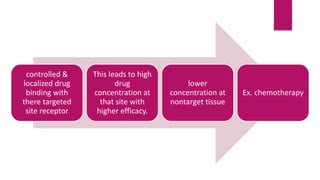
controlled &
localized drug
binding with
there targeted
site receptor
This leads to high
drug
concentration at
that site with
higher efficacy.
lower
concentration at
nontarget tissue
Ex. chemotherapy
PROPERTIES
OF IDEAL
TARGETED
DRUG
DELIVERY
SYSTEM
Minimal drug
leakage
during transit
should have
uniform
capillary
distribution.
preparation
should be
easy cost
effective
Carrier used
must be
biodegradabl
e
Nontoxic,
biocompatibl
e and
physicochemi
cal stable
TARGETED DRUG DELIVERY SYSTEM
 DRUG NANOCRYSTALS
 LIPID BASED SYSTEMS
 micelles
 liposomes
 hexosomes and
cubosomes
 solid lipid
nanoparticles,
nanoemulsions
 lipid complexes
 POLYMER BASED SYSTEMS
 polymeric
nanoparticles
 polymeric micelles
 polymeric conjugates
 dendrimers
 polymersomes
 polymer complexes
 INORGANIC MATERIALS
 silicon, silica
 metals
 carbon nanotubes
 MICROVESICLES
ANTIBODIES
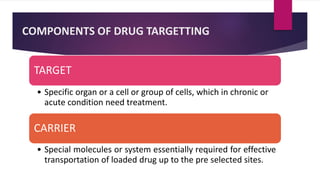
COMPONENTS OF DRUG TARGETTING
TARGET
• Specific organ or a cell or group of cells, which in chronic or
acute condition need treatment.
CARRIER
• Special molecules or system essentially required for effective
transportation of loaded drug up to the pre selected sites.
Drug carrier features:-
• Must be able to cross anatomical barriers.
• It must maintain the high affinity and
specificity of the surface legend and be
recognized properly and selectively by the
target cell.
• It should be stable in plasma, interstitial
and other bio fluid.
• It should be non toxic , non immunogenic
and biodegradable.
• Bio modules used for carrier navigation and
site recognition should not be widespread
other wise it may cross over the sites,
defeating the concept of targeting.
STRATEGIES OF DRUG
TARGETING
CHEMICAL
MODIFICATION
PRODRUG APPROACH
CHEMICAL DELIVERY
SYSTEM
CARRIER MEDIATED
ACTIVE TARGETING
FIRST ORDER
SECOND ORDER
THIRD ORDER
PASSIVE TARGETING
INVERSE TARGETING
PHYSICAL TARGETING
DUAL TARGETING
Double targeting
Combination targeting
Ligand mediated
targeting
Passive Targeting
 system’s that target the systemic circulation are generally
characterized as passive delivery system.
 It utilizes the natural course of biodistribution of the carrier.
 The colloids which are taken up by the reticulo-endothelial system
(RES) can be ideal vectors for passive targeting of drugs to RES
predominant compartments.
 Passive capture of colloidal carriers by macrophages offers
therapeutic opportunities for the delivery of anti-infective agents.
Inverse Targeting
 It is a result of the avoidance of passive uptake of colloidal carriers
by the RES.
 It can be achieved by suppressing the function of RES by pre-
junction of a large amount of blank colloidal carriers or
macromolecules like dextran sulphate.
 Other strategies include modification and defined manipulation of
the size, surface charge, composition, surface rigidity &
hydrophilicity characteristics of carriers for desirable biofate.
Active Targeting
 The facilitation of the binding of the drug-carrier to target cells throught the use
of ligands or engineered homing devices to increase receptor mediated
localization of the drug and target specific delivery of drug is referd to as active
targeting.
 It involves the modification or functionalization of the drug carriers so that the
contents are delivered exclusively to the site corresponding to which the carrier
is architected.
 Active targeting can be affected at different levels –
1. First order targeting (organ compartmentalization)
2. Second order targeting (cellular targeting)
3. Third order targeting (intercellular organelles targeting)
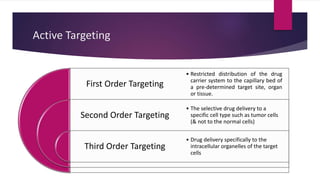
Active Targeting
First Order Targeting
Second Order Targeting
Third Order Targeting
• Restricted distribution of the drug
carrier system to the capillary bed of
a pre-determined target site, organ
or tissue.
• The selective drug delivery to a
specific cell type such as tumor cells
(& not to the normal cells)
• Drug delivery specifically to the
intracellular organelles of the target
cells
Ligand-mediated Targeting
 Ligands are carrier surface group(s), which can selectively direct the
carrier to the pre-specified site(s) housing the appropriate receptor units
to serve as ‘homimg device’ to the carrier/drug.
 Most of the carrier systems are colloidal in nature & can be specifically
functionalized using various biologically-relevant molecular ligands
including antibodies, polypeptides, oligosaccharides, viral proteins &
fusogenic residues.
 The ligands confer recognition & specificity upon drug carrier & endow
them with an ability to approach the respective target selectivity &
deliver the drug
Physical Targeting
 The selective drug delivery programmed and monitored at the
external level with the help of physical means is referred to as
physical targeting.
 Characteristics of environment changes like pH, temperature,
light intensity, electric field, and ionic strength.
 This approach was found exceptional for tumor targeting as
well as cytosolic delivery of entrapped drug or genetic
material.
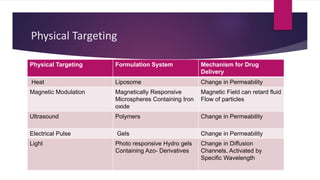
Physical Targeting
Physical Targeting Formulation System Mechanism for Drug
Delivery
Heat Liposome Change in Permeability
Magnetic Modulation Magnetically Responsive
Microspheres Containing Iron
oxide
Magnetic Field can retard fluid
Flow of particles
Ultrasound Polymers Change in Permeability
Electrical Pulse Gels Change in Permeability
Light Photo responsive Hydro gels
Containing Azo- Derivatives
Change in Diffusion
Channels, Activated by
Specific Wavelength
Dual Targeting
 In this targeting approach, carrier molecule, itself have
their own therapeutic activity and thus increase the
therapeutic effect of drug.
 A carrier molecule having its own antiviral activity can be
loaded with antiviral drug and for the synergistic effect of
drug conjugate
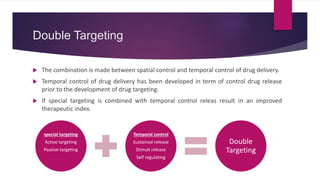
Double Targeting
 The combination is made between spatial control and temporal control of drug delivery.
 Temporal control of drug delivery has been developed in term of control drug release
prior to the development of drug targeting.
 If special targeting is combined with temporal control releas result in an improved
therapeutic index.
special targeting
Active targeting
Passive targeting
Temporal control
Sustained release
Stimuli release
Self regulating
Double
Targeting
Biological process involved in drug targeting
Cellular uptake and processing
Transport across epithelial barrier
Extravasation
Lymphatic uptake
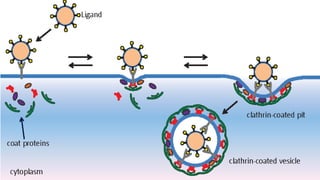
CELLULAR UPTAKE AND PROCESSING
 Following administration low molar mass drugs can enter into or pass through
various cells by simple diffusion process.
 Targeted drug delivery usually have macro molecular assemblies hence
cannot enter by such simple process. Hence take up by a process called
ENDOCYTOSIS
 Steps involved :
 Internalization of the plasma membrane
 Associated with engulfment of extracellular material
 However, large particles are able to enter cell by active transport process such as,
 Endocytosis : Endo = inside, within
Phagocytosis , ( phago =eat )
Pinocytosis , ( pino = drink )
 Compared with phagocytosis pinocytosis is a universal phenomenon in all the cells
pinocytosis does not require any external stimulus
 Pinocytosis is divided into two types:
 Fluid phases pinocytosis
 Adsorptive pinocytosis
 Compared with phagocytosis fluid phase pinocytic capture of molecules is relatively
slower being directly proportional to the concentration and size dependant .
TRANSPORT ACROSS EPITHELIAL BARRIER
 The oral, buccal, nasal, vaginal and rectal cavities are internally lined with
one or more layers of epithelial cells
 Depending on the position and function in the body epithelial cells can be
varied forms
 Three layer physiology: Epithelial, Lamina propria ,Basal lamina
 Low molar mass drugs cross the above by passive diffusion carrier
mediated systems and selective and non-selective endocytosis
 The polar materials diffuse through tight junctions of epithelial cells
 Passive transport is usually higher in damaged mucosa where as active
transport depends on structural integrity of epithelial cells
 Positively charged particles showed increased uptake than negatively
charged counterparts.
 Absorption of drugs from buccal via transcellular and paracellular later
being dominant.
EXTRAVASATION
 For a drug to exert its therapeutic effects, it must move from the central circulation
and interact with its extra vascular-extracellular or extra vascular- intracellular target.
This process of transvascular exchange is called “extravasation.”
 Extravasation is governed by ,
 permeability through blood capillary walls
 Rate of blood & lymph
 Physicochemical factors like,
1) molecular shape, size and charge of drug
2) Hlb characteristics
EXTRAVASATION
 The structure of the blood capillary varies in different organs tissues. It consists
of a single layer of endothelia cells joined together by intercellular junctions.
 The endothelium of brain is the strongest of all endothelia formed by
continuous non fenestrated endothelial cells which show no pinocytic activity
 Soluble macromolecules permeate the endothelial barrier more readily than
particulate macromolecules the rate of movement of fluid across the
endothelium appears to be directly related to the difference between the
hydrostatic and osmotic forces.
LYMPHATIC UPTAKE
 Following extravasation drug molecules can either reabsorb into the blood
stream directly or enter into the lymphatic system and return with the lymph
to the blood circulation.
 Also drugs administered by subcutaneous intracellular transdermal
peritoneal routes can reach the systemic circulation by lymphatic system.
 The direct delivery of drugs into lymphatics has been proposed as a potential
approach to kill malignant lymphoid cells located in lymph nodes.
LYMPHATIC UPTAKE
 Factors know to influence the clearance of drugs from interstitial sites
1. Route of administration
2. Size and surface characteristics of particles
3. Formulation medium
4. The composition and
5. pH of the interstitial fluid and
6. Disease within the interstitial
CONCLUSION
 Targeted drug delivery essentially implies for selective and effective
localization of the pharmacologically-active moiety at preidentified target(s)
in therapeutic concentration
 Various strategies such as active targeting, passive targeting etc. can be
applied to achieve efficient drug targeting.
 The targeted delivery is of great importance in cancer chemotherapy which
always demands for reduction in adverse effect.
targeting methods.pptx

targeting methods.pptx

  • 1.
    TARGETED DRUG DELIVERY SYSTEMS PRESENTBY :- BHATT MIT N. M.PHARM SEM-2 MOLECULAR PHARMACEUTICS (NTDS)
  • 2.
    INDEX  CONCEPTS  EVENTS BIOLOGICAL PROCESS INVOLVED IN DRUG TARGETING
  • 3.
    DRUG TARGETING-concepts  DrugTargeting is selective and effective localization of the pharmacologically- active moiety at pre identified target(s) in therapeutic concentration, while restricting its access to non- target(s) normal cellular linings, thus minimizing toxic effects and maximizing the therapeutic index.  The drug may thus be delivered: 1. To the capillary bed of the active sites, 2. To the specific type of cell (or) even an intracellular region. Ex- tumour cells but not to normal cells. 3. To a specific organ (or) tissues by complexing with the carrier that recognizes the target.
  • 4.
    controlled & localized drug bindingwith there targeted site receptor This leads to high drug concentration at that site with higher efficacy. lower concentration at nontarget tissue Ex. chemotherapy
  • 5.
    PROPERTIES OF IDEAL TARGETED DRUG DELIVERY SYSTEM Minimal drug leakage duringtransit should have uniform capillary distribution. preparation should be easy cost effective Carrier used must be biodegradabl e Nontoxic, biocompatibl e and physicochemi cal stable
  • 6.
    TARGETED DRUG DELIVERYSYSTEM  DRUG NANOCRYSTALS  LIPID BASED SYSTEMS  micelles  liposomes  hexosomes and cubosomes  solid lipid nanoparticles, nanoemulsions  lipid complexes  POLYMER BASED SYSTEMS  polymeric nanoparticles  polymeric micelles  polymeric conjugates  dendrimers  polymersomes  polymer complexes  INORGANIC MATERIALS  silicon, silica  metals  carbon nanotubes  MICROVESICLES ANTIBODIES
  • 7.
    COMPONENTS OF DRUGTARGETTING TARGET • Specific organ or a cell or group of cells, which in chronic or acute condition need treatment. CARRIER • Special molecules or system essentially required for effective transportation of loaded drug up to the pre selected sites.
  • 8.
    Drug carrier features:- •Must be able to cross anatomical barriers. • It must maintain the high affinity and specificity of the surface legend and be recognized properly and selectively by the target cell. • It should be stable in plasma, interstitial and other bio fluid. • It should be non toxic , non immunogenic and biodegradable. • Bio modules used for carrier navigation and site recognition should not be widespread other wise it may cross over the sites, defeating the concept of targeting.
  • 9.
    STRATEGIES OF DRUG TARGETING CHEMICAL MODIFICATION PRODRUGAPPROACH CHEMICAL DELIVERY SYSTEM CARRIER MEDIATED ACTIVE TARGETING FIRST ORDER SECOND ORDER THIRD ORDER PASSIVE TARGETING INVERSE TARGETING PHYSICAL TARGETING DUAL TARGETING Double targeting Combination targeting Ligand mediated targeting
  • 10.
    Passive Targeting  system’sthat target the systemic circulation are generally characterized as passive delivery system.  It utilizes the natural course of biodistribution of the carrier.  The colloids which are taken up by the reticulo-endothelial system (RES) can be ideal vectors for passive targeting of drugs to RES predominant compartments.  Passive capture of colloidal carriers by macrophages offers therapeutic opportunities for the delivery of anti-infective agents.
  • 11.
    Inverse Targeting  Itis a result of the avoidance of passive uptake of colloidal carriers by the RES.  It can be achieved by suppressing the function of RES by pre- junction of a large amount of blank colloidal carriers or macromolecules like dextran sulphate.  Other strategies include modification and defined manipulation of the size, surface charge, composition, surface rigidity & hydrophilicity characteristics of carriers for desirable biofate.
  • 12.
    Active Targeting  Thefacilitation of the binding of the drug-carrier to target cells throught the use of ligands or engineered homing devices to increase receptor mediated localization of the drug and target specific delivery of drug is referd to as active targeting.  It involves the modification or functionalization of the drug carriers so that the contents are delivered exclusively to the site corresponding to which the carrier is architected.  Active targeting can be affected at different levels – 1. First order targeting (organ compartmentalization) 2. Second order targeting (cellular targeting) 3. Third order targeting (intercellular organelles targeting)
  • 13.
    Active Targeting First OrderTargeting Second Order Targeting Third Order Targeting • Restricted distribution of the drug carrier system to the capillary bed of a pre-determined target site, organ or tissue. • The selective drug delivery to a specific cell type such as tumor cells (& not to the normal cells) • Drug delivery specifically to the intracellular organelles of the target cells
  • 14.
    Ligand-mediated Targeting  Ligandsare carrier surface group(s), which can selectively direct the carrier to the pre-specified site(s) housing the appropriate receptor units to serve as ‘homimg device’ to the carrier/drug.  Most of the carrier systems are colloidal in nature & can be specifically functionalized using various biologically-relevant molecular ligands including antibodies, polypeptides, oligosaccharides, viral proteins & fusogenic residues.  The ligands confer recognition & specificity upon drug carrier & endow them with an ability to approach the respective target selectivity & deliver the drug
  • 15.
    Physical Targeting  Theselective drug delivery programmed and monitored at the external level with the help of physical means is referred to as physical targeting.  Characteristics of environment changes like pH, temperature, light intensity, electric field, and ionic strength.  This approach was found exceptional for tumor targeting as well as cytosolic delivery of entrapped drug or genetic material.
  • 16.
    Physical Targeting Physical TargetingFormulation System Mechanism for Drug Delivery Heat Liposome Change in Permeability Magnetic Modulation Magnetically Responsive Microspheres Containing Iron oxide Magnetic Field can retard fluid Flow of particles Ultrasound Polymers Change in Permeability Electrical Pulse Gels Change in Permeability Light Photo responsive Hydro gels Containing Azo- Derivatives Change in Diffusion Channels, Activated by Specific Wavelength
  • 17.
    Dual Targeting  Inthis targeting approach, carrier molecule, itself have their own therapeutic activity and thus increase the therapeutic effect of drug.  A carrier molecule having its own antiviral activity can be loaded with antiviral drug and for the synergistic effect of drug conjugate
  • 18.
    Double Targeting  Thecombination is made between spatial control and temporal control of drug delivery.  Temporal control of drug delivery has been developed in term of control drug release prior to the development of drug targeting.  If special targeting is combined with temporal control releas result in an improved therapeutic index. special targeting Active targeting Passive targeting Temporal control Sustained release Stimuli release Self regulating Double Targeting
  • 19.
    Biological process involvedin drug targeting Cellular uptake and processing Transport across epithelial barrier Extravasation Lymphatic uptake
  • 20.
    CELLULAR UPTAKE ANDPROCESSING  Following administration low molar mass drugs can enter into or pass through various cells by simple diffusion process.  Targeted drug delivery usually have macro molecular assemblies hence cannot enter by such simple process. Hence take up by a process called ENDOCYTOSIS  Steps involved :  Internalization of the plasma membrane  Associated with engulfment of extracellular material
  • 22.
     However, largeparticles are able to enter cell by active transport process such as,  Endocytosis : Endo = inside, within Phagocytosis , ( phago =eat ) Pinocytosis , ( pino = drink )  Compared with phagocytosis pinocytosis is a universal phenomenon in all the cells pinocytosis does not require any external stimulus  Pinocytosis is divided into two types:  Fluid phases pinocytosis  Adsorptive pinocytosis  Compared with phagocytosis fluid phase pinocytic capture of molecules is relatively slower being directly proportional to the concentration and size dependant .
  • 23.
    TRANSPORT ACROSS EPITHELIALBARRIER  The oral, buccal, nasal, vaginal and rectal cavities are internally lined with one or more layers of epithelial cells  Depending on the position and function in the body epithelial cells can be varied forms  Three layer physiology: Epithelial, Lamina propria ,Basal lamina  Low molar mass drugs cross the above by passive diffusion carrier mediated systems and selective and non-selective endocytosis
  • 24.
     The polarmaterials diffuse through tight junctions of epithelial cells  Passive transport is usually higher in damaged mucosa where as active transport depends on structural integrity of epithelial cells  Positively charged particles showed increased uptake than negatively charged counterparts.  Absorption of drugs from buccal via transcellular and paracellular later being dominant.
  • 26.
    EXTRAVASATION  For adrug to exert its therapeutic effects, it must move from the central circulation and interact with its extra vascular-extracellular or extra vascular- intracellular target. This process of transvascular exchange is called “extravasation.”  Extravasation is governed by ,  permeability through blood capillary walls  Rate of blood & lymph  Physicochemical factors like, 1) molecular shape, size and charge of drug 2) Hlb characteristics
  • 27.
    EXTRAVASATION  The structureof the blood capillary varies in different organs tissues. It consists of a single layer of endothelia cells joined together by intercellular junctions.  The endothelium of brain is the strongest of all endothelia formed by continuous non fenestrated endothelial cells which show no pinocytic activity  Soluble macromolecules permeate the endothelial barrier more readily than particulate macromolecules the rate of movement of fluid across the endothelium appears to be directly related to the difference between the hydrostatic and osmotic forces.
  • 28.
    LYMPHATIC UPTAKE  Followingextravasation drug molecules can either reabsorb into the blood stream directly or enter into the lymphatic system and return with the lymph to the blood circulation.  Also drugs administered by subcutaneous intracellular transdermal peritoneal routes can reach the systemic circulation by lymphatic system.  The direct delivery of drugs into lymphatics has been proposed as a potential approach to kill malignant lymphoid cells located in lymph nodes.
  • 29.
    LYMPHATIC UPTAKE  Factorsknow to influence the clearance of drugs from interstitial sites 1. Route of administration 2. Size and surface characteristics of particles 3. Formulation medium 4. The composition and 5. pH of the interstitial fluid and 6. Disease within the interstitial
  • 30.
    CONCLUSION  Targeted drugdelivery essentially implies for selective and effective localization of the pharmacologically-active moiety at preidentified target(s) in therapeutic concentration  Various strategies such as active targeting, passive targeting etc. can be applied to achieve efficient drug targeting.  The targeted delivery is of great importance in cancer chemotherapy which always demands for reduction in adverse effect.