19/11/2016 1
A
Seminar
On
“DRUG STABILITY”
SUBMITTED TO
MUMBAI UNIVERSITY
By
Ms. Swati S. Bharati
(F.Y.M.Pharm)
Under the Guidance of
Dr. BHUSHAN RANE
HOD (Pharmaceutics)
SHRI. D.D. Vispute College of Pharmacy & Research Center
PANVEL
(2016-2017)
CONTENTS...
Introduction
Importance And Need Of Stability Testing
Degradation Pathways
Kinetic Stability
Solution Stability
Solid State Stability
pH Stability Profile
Conclusion
Reference
19/11/2016 2
INTRODUCTION
STABILITY:
USP defines stability of pharmaceutical product as,
“extent to which a product retains with in specified
limits and throughout its period of storage and use
(i.e. shelf life).
The capacity or the capability of a particular
formulation in a specific container to remain with
in particular chemical , microbiological ,
therapeutically , and toxicological specifications.
19/11/2016 3
Drug stability is defined as the ability of the
pharmaceutical dosage form to maintain the
physical, chemical, therapeutic and microbial
properties during the time of storage and usage by
the patient.
The purpose of stability studies is to provide
evidence on how the quality of the active
substance or pharmaceutical product varies with
time under the influence of a variety of
environmental factor such as temperature,
humidity and light
DRUG STABILITY
19/11/2016 4
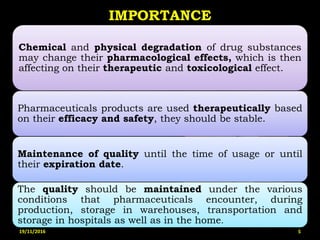
IMPORTANCE
Chemical and physical degradation of drug substances
may change their pharmacological effects, which is then
affecting on their therapeutic and toxicological effect.
Pharmaceuticals products are used therapeutically based
on their efficacy and safety, they should be stable.
Maintenance of quality until the time of usage or until
their expiration date.
The quality should be maintained under the various
conditions that pharmaceuticals encounter, during
production, storage in warehouses, transportation and
storage in hospitals as well as in the home.
19/11/2016 5
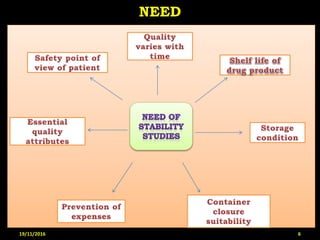
NEED
19/11/2016 6
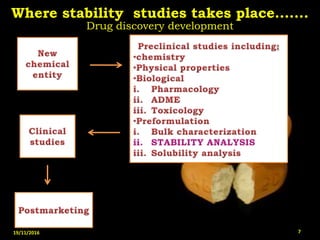
Where stability studies takes place.......
Drug discovery development
19/11/2016 7
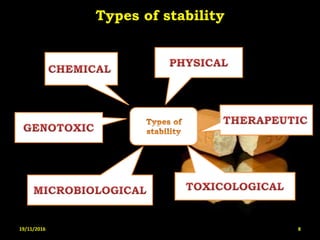
Types of stability
•
19/11/2016 8
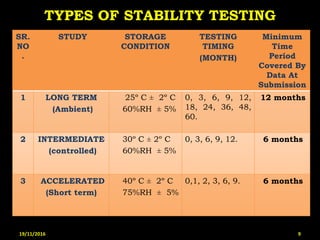
TYPES OF STABILITY TESTING
• Stability condition Study
SR.
NO
.
STUDY STORAGE
CONDITION
TESTING
TIMING
(MONTH)
Minimum
Time
Period
Covered By
Data At
Submission
1 LONG TERM
(Ambient)
25º C ± 2º C
60%RH ± 5%
0, 3, 6, 9, 12,
18, 24, 36, 48,
60.
12 months
2 INTERMEDIATE
(controlled)
30º C ± 2º C
60%RH ± 5%
0, 3, 6, 9, 12. 6 months
3 ACCELERATED
(Short term)
40º C ± 2º C
75%RH ± 5%
0,1, 2, 3, 6, 9. 6 months
19/11/2016 9
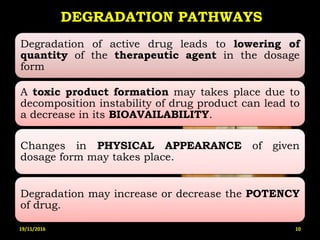
DEGRADATION PATHWAYS
Degradation of active drug leads to lowering of
quantity of the therapeutic agent in the dosage
form
A toxic product formation may takes place due to
decomposition instability of drug product can lead to
a decrease in its BIOAVAILABILITY.
Changes in PHYSICAL APPEARANCE of given
dosage form may takes place.
Degradation may increase or decrease the POTENCY
of drug.
19/11/2016 10
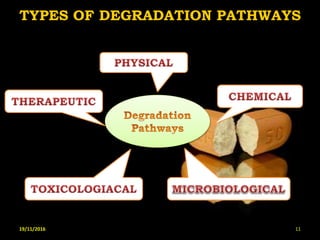
TYPES OF DEGRADATION PATHWAYS
19/11/2016 11
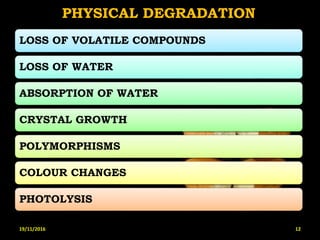
PHYSICAL DEGRADATION
LOSS OF VOLATILE COMPOUNDS
LOSS OF WATER
ABSORPTION OF WATER
CRYSTAL GROWTH
POLYMORPHISMS
COLOUR CHANGES
PHOTOLYSIS
19/11/2016 12
LOSS OF VOLATILE COMPOUNDS
Some of volatile components alcohol, ether, Iodine,
volatile oils, Camphor menthol etc escape from the
formulations exposé them degraded.
EXAMPLE:
Some types of tablets (Nitroglycerine tablets)
Aromatic water
PREVENTION:
Such product should be placed in well closed
container.
Temperature should be proper.
19/11/2016 13
LOSS OF WATER
Water loss from liquid preparation (o/w emulsion)
leads to changes in stability. It causes crystallization of
drug product .
which may lead to increase in potency , and decrease
in weight.
EXAMPLE :
Water evaporates from na2so4 .BORAX.
Creams: especially oil/water, they become dry by loss
of water.
PREVENTION:
Products should be placed in well-closed container.
19/11/2016 14
ABSORPTION OF WATER
Hygroscopic drugs absorb the water from external
atmosphere causing the physical degradation.
Effervescent powders and tablets will deteriorate if
stored in a moist atmosphere.
EXAMPLE:
Powders: Liquification and degradation may occur
as a result of absorption of water
Suppositories which base made from hydrophilic
substances as Glycerin, Gelatin, and polyethylene
glycol. The consistency of these forms becomes
jelly-like appearance.
PREVENTION:
Products should be placed in well-closed container
and in dry place.
19/11/2016 15
Drugs when loose water, become saturated and
crystal growth occurs.
Crystallization is enhanced in porous tablets.In
solutions after super saturation crystal growth
occurs.
EXAMPLE:
Injection of calcium glucconate
In suspensions crystals settle down and caking occurs
and suspension becomes unstable.
Ophthalmic preparations.
PREVENTION:
SOLUTIONS-Stabilizers are added
SUSPENSION-
·Incorporation of surface active agent
·By increasing viscosity of suspending material
CRYSTAL GROWTH
19/11/2016 16
Polymorphs show significant differences in important
physiochemical properties such as solubility, dissolution
rate and melting point. In polymorphic changes crystal
forms are changed. This may cause change in solubility
and possibly crystalline growth in aqueous suspension.
EXAMPLE:
Cortisone acetate suspension.
• PREVENTION:
suspension –suspending agent like methyl cellulose &
ethyl cellulose
POLYMORPHISMS
19/11/2016 17
When molecules are exposed to electromagnetic
radiation they absorb light (photons) at characteristic
wavelength which cause increase in energy which can
cause decomposition.
EXAMPLE:
Sodium nitropruside in aqueous solution (which is
administered by IV infusion for management of acute
hypertension).
Iodine
PREVENTION:
Use of amber colored bottles.
Storing the product in dark, packaging in cartons also
act as physical barrier to light.
PHOTOLYSIS
19/11/2016 18
Colour changes indicate chemical or photochemical
decomposition of the active ingredients, dyes or other
ingredients. Colour changes are of two types.
1) Loss of colour
2) Development of colour
EXAMPLE:
Phenolphthalein color changes as the PH changes. It is
colorless in acidic solution and pink in basic.
ascorbic acid tablet turn yellowish brown.
• PREVENTION:
• Protect the product from light and air
• Avoid the using reducing substances as additives.
COLOUR CHANGES
19/11/2016 19
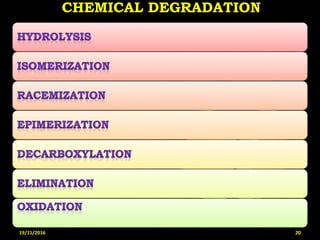
CHEMICAL DEGRADATION
19/11/2016 20
2
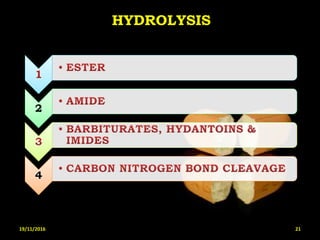
HYDROLYSIS
19/11/2016 21
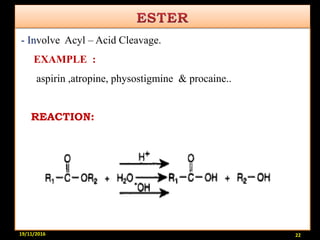
- Involve Acyl – Acid Cleavage.
EXAMPLE :
aspirin ,atropine, physostigmine & procaine..
REACTION:
19/11/2016 22
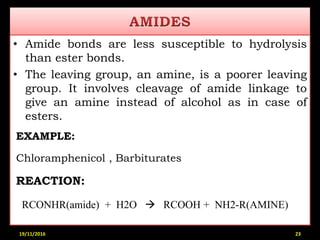
• Amide bonds are less susceptible to hydrolysis
than ester bonds.
• The leaving group, an amine, is a poorer leaving
group. It involves cleavage of amide linkage to
give an amine instead of alcohol as in case of
esters.
EXAMPLE:
Chloramphenicol , Barbiturates
REACTION:
RCONHR(amide) + H2O  RCOOH + NH2-R(AMINE)
19/11/2016 23
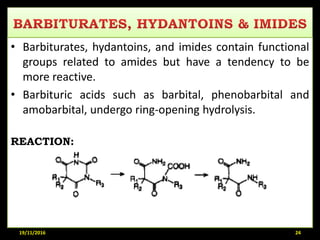
• Barbiturates, hydantoins, and imides contain functional
groups related to amides but have a tendency to be
more reactive.
• Barbituric acids such as barbital, phenobarbital and
amobarbital, undergo ring-opening hydrolysis.
REACTION:
19/11/2016 24
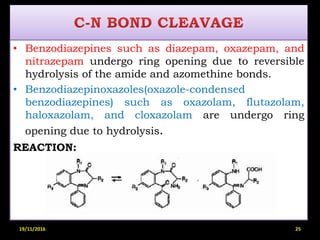
• Benzodiazepines such as diazepam, oxazepam, and
nitrazepam undergo ring opening due to reversible
hydrolysis of the amide and azomethine bonds.
• Benzodiazepinoxazoles(oxazole-condensed
benzodiazepines) such as oxazolam, flutazolam,
haloxazolam, and cloxazolam are undergo ring
opening due to hydrolysis.
REACTION:
19/11/2016 25
19/11/2016 26
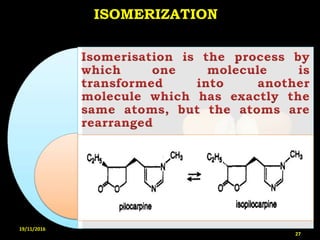
ISOMERIZATION
19/11/2016
27
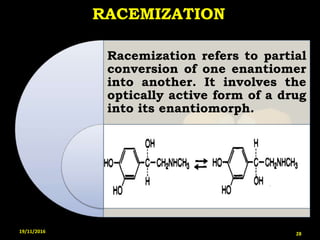
RACEMIZATION
Racemization refers to partial
conversion of one enantiomer
into another. It involves the
optically active form of a drug
into its enantiomorph.
19/11/2016 28
EPIMERIZATION
It occurs with the compound
having more than one asymetric
carbon atom in the molecule. At
equilibrium, both epimers are
present, but not in equal
proportion.
EXAMPLE:
Under prolonged storage
solution containing ergometrine
is decomposed by hydrolysis and
isomerized to ergometrinine
19/11/2016 29
DECARBOXYLATION
Elimination of CO2 from
compound. Drug substances
having a carboxylic acid group
is sometimes susceptible to
decarboxylation,
EXAMPLE:
4-Aminosalicylic acid
procain
19/11/2016 30
ELIMINATION
In elimination, reaction some
groups of the substance is
eliminated.
EXAMPLE:
Trimelamol eliminates its
hydroxymethyl groups and forms
formaldehyde.
19/11/2016 31
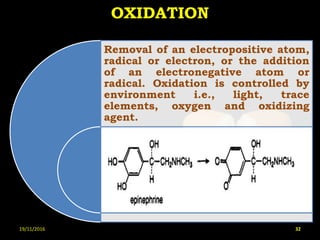
OXIDATION
Removal of an electropositive atom,
radical or electron, or the addition
of an electronegative atom or
radical. Oxidation is controlled by
environment i.e., light, trace
elements, oxygen and oxidizing
agent.
19/11/2016 32
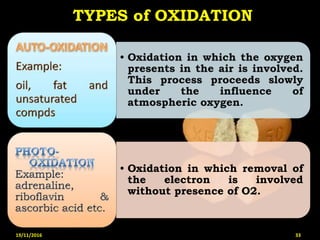
TYPES of OXIDATION
• Oxidation in which the oxygen
presents in the air is involved.
This process proceeds slowly
under the influence of
atmospheric oxygen.
• Oxidation in which removal of
the electron is involved
without presence of O2.
19/11/2016 33
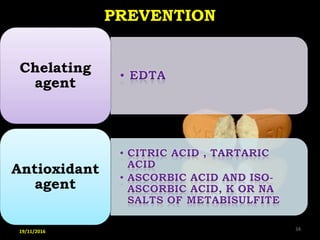
PREVENTION
Chelating
agent
Antioxidant
agent
19/11/2016 34
MICROBIAL DEGRADATION
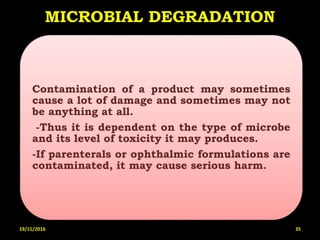
Contamination of a product may sometimes
cause a lot of damage and sometimes may not
be anything at all.
-Thus it is dependent on the type of microbe
and its level of toxicity it may produces.
-If parenterals or ophthalmic formulations are
contaminated, it may cause serious harm.
19/11/2016 35
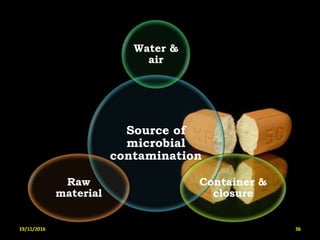
Source of
microbial
contamination
Water &
air
Container &
closure
Raw
material
19/11/2016 36
PREVENTION
Suitably designing the containers
Usually using single dose containers
Sticking to proper storage conditions
Adding an antimicrobial substance as
preservative
19/11/2016 37
THERAPEUTIC DEGRADATION
Therapeutic effect must be changed due
to hydrolysis, isomerisation or
epimerization .
Example:
Adrenaline
19/11/2016 38
Toxicological degradation
19/11/2016 39
Kinetic stability
Kinetics deals with the study of the rate at which processes
occur and mechanism of chemical reactions It involves the
study of rate of change and the way in which this rate is
influenced by the concentration of reactants, products, and
other chemical species that may be present, and by factors
such as solvents, pressure, and temperature.
Kinetics applies to:
Stability
Incompatibility
Dissolution
Absorption
Distribution
Drug action at molecular level
Elimination processes
19/11/2016 40
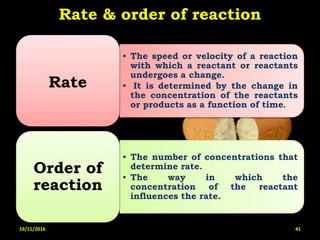
Rate & order of reaction
• The speed or velocity of a reaction
with which a reactant or reactants
undergoes a change.
• It is determined by the change in
the concentration of the reactants
or products as a function of time.
Rate
• The number of concentrations that
determine rate.
• The way in which the
concentration of the reactant
influences the rate.
Order of
reaction
19/11/2016 41
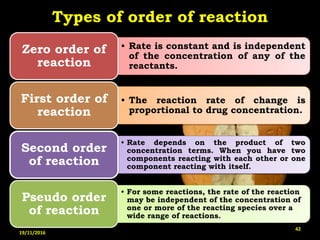
Types of order of reaction
• Rate is constant and is independent
of the concentration of any of the
reactants.
Zero order of
reaction
• The reaction rate of change is
proportional to drug concentration.
First order of
reaction
• Rate depends on the product of two
concentration terms. When you have two
components reacting with each other or one
component reacting with itself.
Second order
of reaction
• For some reactions, the rate of the reaction
may be independent of the concentration of
one or more of the reacting species over a
wide range of reactions.
Pseudo order
of reaction
19/11/2016
42
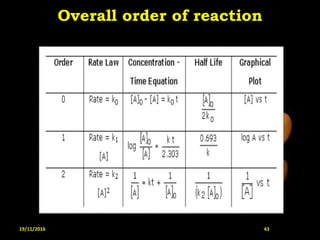
Overall order of reaction
19/11/2016 43
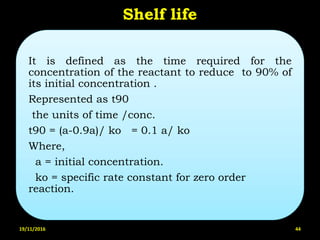
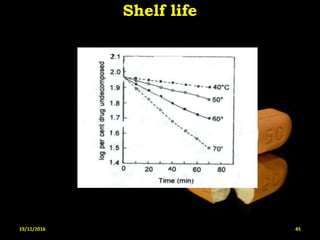
Shelf life
It is defined as the time required for the
concentration of the reactant to reduce to 90% of
its initial concentration .
Represented as t90
the units of time /conc.
t90 = (a-0.9a)/ ko = 0.1 a/ ko
Where,
a = initial concentration.
ko = specific rate constant for zero order
reaction.
19/11/2016 44
Shelf life
19/11/2016 45
SOLUTION STABILITY
The main purpose of solution stability is identification
of conditions necessary to form a stable solution Study.
Includes – effects of pH, Ionic strength, Co-solvent, light
, temperature and oxygen
Interested experiments at extremes conditions of pH and
temperature (0.01N HCl , water ,0.01N, NaOH all at
90°C).
Aq. Buffers are used to provide wide range with
constant levels of drug, co solvent and ionic strength
Compatible with physiological media
19/11/2016 46
SOLID STATE STABILITY
The purpose of solid state stability is
identifications of stable storage conditions for
drug in the solid state and identification of
compatible excipients for a formulations.
Affected by change in purity and crystallinity
Initial bulk lots and newer lots– to be studied
Solid state is slower and difficult to interpret than
solution state
TLC, UV-Vis, fluorescence
Polymorphic changes – DSC, IR or appearance
changes like oxidation – surface discoloration
19/11/2016 47
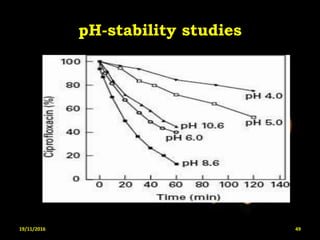
pH STABILITY STUDIES
The pH-stability profile is essential for
understanding how the compound behaves in
different environments and informs formulation
development, process development, drug product
stability and the route of administration of the
molecule.
To develop a pH-stability profile, it is important to
develop stability-indicating assays for the intact
drug at the various pH values to be studied.
19/11/2016 48
pH-stability studies
19/11/2016 49
CONCLUSION
Pharmaceutical products are assigned a shelf life which
determines the time when a product is considered to be
safe and effective under storage condition.
Stability studies should be based on the basis of
pharmaceutical R&D and regulatory requirements.
Degradation studies reveal the intrinsic chemical
properties of the API while formal stability studies
establish the retest date.
The shelf life is derived from stability studies
19/11/2016 50
REFERENCE
http://www.slideshare.net/GajananSanap/stability-studies-58779043on
date15/10/2016
C.V.S Subrahmanyam “Textbook of Physical Pharmaceutics” vallabh
prakashan, second edition, reprint 2007, page no: 13-50, 51-84.
http://www.slideshare.net/bknanjwade/drug-stability-and-stabilization-
techniques. On date 19/10/2016
http://uchpel.vscht.cz/files/uzel/0022888/Chemical%20and%20physical%20deg
radation%202015.pdf. On date 21/10/2016
http://www.slideshare.net/alaaalfayez/stability-tests-for-pharmaceutical-
products on date 19/10/2016
http://cst-kh.edu.ps/staff/mabujamee/wp-content/uploads/2010/10/Unit-4-
Drug-Stability.pdf.
Cartensen J, Marcel Dekker “ Drug Stability Principles and Practises ”Informa
healthcare, third edition,vol 107, 1990, page no:
19/11/2016 51
19/11/2016 52

Drug stability

  • 1.
    19/11/2016 1 A Seminar On “DRUG STABILITY” SUBMITTEDTO MUMBAI UNIVERSITY By Ms. Swati S. Bharati (F.Y.M.Pharm) Under the Guidance of Dr. BHUSHAN RANE HOD (Pharmaceutics) SHRI. D.D. Vispute College of Pharmacy & Research Center PANVEL (2016-2017)
  • 2.
    CONTENTS... Introduction Importance And NeedOf Stability Testing Degradation Pathways Kinetic Stability Solution Stability Solid State Stability pH Stability Profile Conclusion Reference 19/11/2016 2
  • 3.
    INTRODUCTION STABILITY: USP defines stabilityof pharmaceutical product as, “extent to which a product retains with in specified limits and throughout its period of storage and use (i.e. shelf life). The capacity or the capability of a particular formulation in a specific container to remain with in particular chemical , microbiological , therapeutically , and toxicological specifications. 19/11/2016 3
  • 4.
    Drug stability isdefined as the ability of the pharmaceutical dosage form to maintain the physical, chemical, therapeutic and microbial properties during the time of storage and usage by the patient. The purpose of stability studies is to provide evidence on how the quality of the active substance or pharmaceutical product varies with time under the influence of a variety of environmental factor such as temperature, humidity and light DRUG STABILITY 19/11/2016 4
  • 5.
    IMPORTANCE Chemical and physicaldegradation of drug substances may change their pharmacological effects, which is then affecting on their therapeutic and toxicological effect. Pharmaceuticals products are used therapeutically based on their efficacy and safety, they should be stable. Maintenance of quality until the time of usage or until their expiration date. The quality should be maintained under the various conditions that pharmaceuticals encounter, during production, storage in warehouses, transportation and storage in hospitals as well as in the home. 19/11/2016 5
  • 6.
  • 7.
    Where stability studiestakes place....... Drug discovery development 19/11/2016 7
  • 8.
  • 9.
    TYPES OF STABILITYTESTING • Stability condition Study SR. NO . STUDY STORAGE CONDITION TESTING TIMING (MONTH) Minimum Time Period Covered By Data At Submission 1 LONG TERM (Ambient) 25º C ± 2º C 60%RH ± 5% 0, 3, 6, 9, 12, 18, 24, 36, 48, 60. 12 months 2 INTERMEDIATE (controlled) 30º C ± 2º C 60%RH ± 5% 0, 3, 6, 9, 12. 6 months 3 ACCELERATED (Short term) 40º C ± 2º C 75%RH ± 5% 0,1, 2, 3, 6, 9. 6 months 19/11/2016 9
  • 10.
    DEGRADATION PATHWAYS Degradation ofactive drug leads to lowering of quantity of the therapeutic agent in the dosage form A toxic product formation may takes place due to decomposition instability of drug product can lead to a decrease in its BIOAVAILABILITY. Changes in PHYSICAL APPEARANCE of given dosage form may takes place. Degradation may increase or decrease the POTENCY of drug. 19/11/2016 10
  • 11.
    TYPES OF DEGRADATIONPATHWAYS 19/11/2016 11
  • 12.
    PHYSICAL DEGRADATION LOSS OFVOLATILE COMPOUNDS LOSS OF WATER ABSORPTION OF WATER CRYSTAL GROWTH POLYMORPHISMS COLOUR CHANGES PHOTOLYSIS 19/11/2016 12
  • 13.
    LOSS OF VOLATILECOMPOUNDS Some of volatile components alcohol, ether, Iodine, volatile oils, Camphor menthol etc escape from the formulations exposé them degraded. EXAMPLE: Some types of tablets (Nitroglycerine tablets) Aromatic water PREVENTION: Such product should be placed in well closed container. Temperature should be proper. 19/11/2016 13
  • 14.
    LOSS OF WATER Waterloss from liquid preparation (o/w emulsion) leads to changes in stability. It causes crystallization of drug product . which may lead to increase in potency , and decrease in weight. EXAMPLE : Water evaporates from na2so4 .BORAX. Creams: especially oil/water, they become dry by loss of water. PREVENTION: Products should be placed in well-closed container. 19/11/2016 14
  • 15.
    ABSORPTION OF WATER Hygroscopicdrugs absorb the water from external atmosphere causing the physical degradation. Effervescent powders and tablets will deteriorate if stored in a moist atmosphere. EXAMPLE: Powders: Liquification and degradation may occur as a result of absorption of water Suppositories which base made from hydrophilic substances as Glycerin, Gelatin, and polyethylene glycol. The consistency of these forms becomes jelly-like appearance. PREVENTION: Products should be placed in well-closed container and in dry place. 19/11/2016 15
  • 16.
    Drugs when loosewater, become saturated and crystal growth occurs. Crystallization is enhanced in porous tablets.In solutions after super saturation crystal growth occurs. EXAMPLE: Injection of calcium glucconate In suspensions crystals settle down and caking occurs and suspension becomes unstable. Ophthalmic preparations. PREVENTION: SOLUTIONS-Stabilizers are added SUSPENSION- ·Incorporation of surface active agent ·By increasing viscosity of suspending material CRYSTAL GROWTH 19/11/2016 16
  • 17.
    Polymorphs show significantdifferences in important physiochemical properties such as solubility, dissolution rate and melting point. In polymorphic changes crystal forms are changed. This may cause change in solubility and possibly crystalline growth in aqueous suspension. EXAMPLE: Cortisone acetate suspension. • PREVENTION: suspension –suspending agent like methyl cellulose & ethyl cellulose POLYMORPHISMS 19/11/2016 17
  • 18.
    When molecules areexposed to electromagnetic radiation they absorb light (photons) at characteristic wavelength which cause increase in energy which can cause decomposition. EXAMPLE: Sodium nitropruside in aqueous solution (which is administered by IV infusion for management of acute hypertension). Iodine PREVENTION: Use of amber colored bottles. Storing the product in dark, packaging in cartons also act as physical barrier to light. PHOTOLYSIS 19/11/2016 18
  • 19.
    Colour changes indicatechemical or photochemical decomposition of the active ingredients, dyes or other ingredients. Colour changes are of two types. 1) Loss of colour 2) Development of colour EXAMPLE: Phenolphthalein color changes as the PH changes. It is colorless in acidic solution and pink in basic. ascorbic acid tablet turn yellowish brown. • PREVENTION: • Protect the product from light and air • Avoid the using reducing substances as additives. COLOUR CHANGES 19/11/2016 19
  • 20.
  • 21.
  • 22.
    - Involve Acyl– Acid Cleavage. EXAMPLE : aspirin ,atropine, physostigmine & procaine.. REACTION: 19/11/2016 22
  • 23.
    • Amide bondsare less susceptible to hydrolysis than ester bonds. • The leaving group, an amine, is a poorer leaving group. It involves cleavage of amide linkage to give an amine instead of alcohol as in case of esters. EXAMPLE: Chloramphenicol , Barbiturates REACTION: RCONHR(amide) + H2O  RCOOH + NH2-R(AMINE) 19/11/2016 23
  • 24.
    • Barbiturates, hydantoins,and imides contain functional groups related to amides but have a tendency to be more reactive. • Barbituric acids such as barbital, phenobarbital and amobarbital, undergo ring-opening hydrolysis. REACTION: 19/11/2016 24
  • 25.
    • Benzodiazepines suchas diazepam, oxazepam, and nitrazepam undergo ring opening due to reversible hydrolysis of the amide and azomethine bonds. • Benzodiazepinoxazoles(oxazole-condensed benzodiazepines) such as oxazolam, flutazolam, haloxazolam, and cloxazolam are undergo ring opening due to hydrolysis. REACTION: 19/11/2016 25
  • 26.
  • 27.
  • 28.
    RACEMIZATION Racemization refers topartial conversion of one enantiomer into another. It involves the optically active form of a drug into its enantiomorph. 19/11/2016 28
  • 29.
    EPIMERIZATION It occurs withthe compound having more than one asymetric carbon atom in the molecule. At equilibrium, both epimers are present, but not in equal proportion. EXAMPLE: Under prolonged storage solution containing ergometrine is decomposed by hydrolysis and isomerized to ergometrinine 19/11/2016 29
  • 30.
    DECARBOXYLATION Elimination of CO2from compound. Drug substances having a carboxylic acid group is sometimes susceptible to decarboxylation, EXAMPLE: 4-Aminosalicylic acid procain 19/11/2016 30
  • 31.
    ELIMINATION In elimination, reactionsome groups of the substance is eliminated. EXAMPLE: Trimelamol eliminates its hydroxymethyl groups and forms formaldehyde. 19/11/2016 31
  • 32.
    OXIDATION Removal of anelectropositive atom, radical or electron, or the addition of an electronegative atom or radical. Oxidation is controlled by environment i.e., light, trace elements, oxygen and oxidizing agent. 19/11/2016 32
  • 33.
    TYPES of OXIDATION •Oxidation in which the oxygen presents in the air is involved. This process proceeds slowly under the influence of atmospheric oxygen. • Oxidation in which removal of the electron is involved without presence of O2. 19/11/2016 33
  • 34.
  • 35.
    MICROBIAL DEGRADATION Contamination ofa product may sometimes cause a lot of damage and sometimes may not be anything at all. -Thus it is dependent on the type of microbe and its level of toxicity it may produces. -If parenterals or ophthalmic formulations are contaminated, it may cause serious harm. 19/11/2016 35
  • 36.
    Source of microbial contamination Water & air Container& closure Raw material 19/11/2016 36
  • 37.
    PREVENTION Suitably designing thecontainers Usually using single dose containers Sticking to proper storage conditions Adding an antimicrobial substance as preservative 19/11/2016 37
  • 38.
    THERAPEUTIC DEGRADATION Therapeutic effectmust be changed due to hydrolysis, isomerisation or epimerization . Example: Adrenaline 19/11/2016 38
  • 39.
  • 40.
    Kinetic stability Kinetics dealswith the study of the rate at which processes occur and mechanism of chemical reactions It involves the study of rate of change and the way in which this rate is influenced by the concentration of reactants, products, and other chemical species that may be present, and by factors such as solvents, pressure, and temperature. Kinetics applies to: Stability Incompatibility Dissolution Absorption Distribution Drug action at molecular level Elimination processes 19/11/2016 40
  • 41.
    Rate & orderof reaction • The speed or velocity of a reaction with which a reactant or reactants undergoes a change. • It is determined by the change in the concentration of the reactants or products as a function of time. Rate • The number of concentrations that determine rate. • The way in which the concentration of the reactant influences the rate. Order of reaction 19/11/2016 41
  • 42.
    Types of orderof reaction • Rate is constant and is independent of the concentration of any of the reactants. Zero order of reaction • The reaction rate of change is proportional to drug concentration. First order of reaction • Rate depends on the product of two concentration terms. When you have two components reacting with each other or one component reacting with itself. Second order of reaction • For some reactions, the rate of the reaction may be independent of the concentration of one or more of the reacting species over a wide range of reactions. Pseudo order of reaction 19/11/2016 42
  • 43.
    Overall order ofreaction 19/11/2016 43
  • 44.
    Shelf life It isdefined as the time required for the concentration of the reactant to reduce to 90% of its initial concentration . Represented as t90 the units of time /conc. t90 = (a-0.9a)/ ko = 0.1 a/ ko Where, a = initial concentration. ko = specific rate constant for zero order reaction. 19/11/2016 44
  • 45.
  • 46.
    SOLUTION STABILITY The mainpurpose of solution stability is identification of conditions necessary to form a stable solution Study. Includes – effects of pH, Ionic strength, Co-solvent, light , temperature and oxygen Interested experiments at extremes conditions of pH and temperature (0.01N HCl , water ,0.01N, NaOH all at 90°C). Aq. Buffers are used to provide wide range with constant levels of drug, co solvent and ionic strength Compatible with physiological media 19/11/2016 46
  • 47.
    SOLID STATE STABILITY Thepurpose of solid state stability is identifications of stable storage conditions for drug in the solid state and identification of compatible excipients for a formulations. Affected by change in purity and crystallinity Initial bulk lots and newer lots– to be studied Solid state is slower and difficult to interpret than solution state TLC, UV-Vis, fluorescence Polymorphic changes – DSC, IR or appearance changes like oxidation – surface discoloration 19/11/2016 47
  • 48.
    pH STABILITY STUDIES ThepH-stability profile is essential for understanding how the compound behaves in different environments and informs formulation development, process development, drug product stability and the route of administration of the molecule. To develop a pH-stability profile, it is important to develop stability-indicating assays for the intact drug at the various pH values to be studied. 19/11/2016 48
  • 49.
  • 50.
    CONCLUSION Pharmaceutical products areassigned a shelf life which determines the time when a product is considered to be safe and effective under storage condition. Stability studies should be based on the basis of pharmaceutical R&D and regulatory requirements. Degradation studies reveal the intrinsic chemical properties of the API while formal stability studies establish the retest date. The shelf life is derived from stability studies 19/11/2016 50
  • 51.
    REFERENCE http://www.slideshare.net/GajananSanap/stability-studies-58779043on date15/10/2016 C.V.S Subrahmanyam “Textbookof Physical Pharmaceutics” vallabh prakashan, second edition, reprint 2007, page no: 13-50, 51-84. http://www.slideshare.net/bknanjwade/drug-stability-and-stabilization- techniques. On date 19/10/2016 http://uchpel.vscht.cz/files/uzel/0022888/Chemical%20and%20physical%20deg radation%202015.pdf. On date 21/10/2016 http://www.slideshare.net/alaaalfayez/stability-tests-for-pharmaceutical- products on date 19/10/2016 http://cst-kh.edu.ps/staff/mabujamee/wp-content/uploads/2010/10/Unit-4- Drug-Stability.pdf. Cartensen J, Marcel Dekker “ Drug Stability Principles and Practises ”Informa healthcare, third edition,vol 107, 1990, page no: 19/11/2016 51
  • 52.