Presented By :
AMIT ATTRI
M.PHARMA(IP)
Sem.- 1
Guided By :
Dr. DEEPAK KAUSHIK
Astt. Professor
(Pharmaceutics)
MDU
CONTENTS
• Introduction
• Types of stability
• Stability testing
• Factors influencing-media effects & pH
• Degradation kinetics
• Mechanism of degradation
• Solid-state stability
• Shelf-life assignment
• Accelerated stability studies
• Conclusion
• The capacity of a drug substance or drug product to
remain within established specifications to remain within
its physical, chemical, microbiological and therapeutical
specifications throughout the expiration dating period, is
stability.
• Purpose of stability testing is to demonstrate how
packaged and unpackaged pharmaceutical product
changes with time in different temperatue, humidity and
light conditions.
WHY STABILITY ?
• Provide an evidence on how the quality of a drug
substance or drug product varies with time under the
influence of a variety of environmental factors such as
• Temperature
• Humidity
• Light
NECESSITY OF STABILITY STUDIES
● Stability studies play a central role in drug development
● Permit understanding of the molecule
● Essential for developing analytical methods
● Essential for selecting packaging for drug substance and
drug product
● Essential for choosing storage conditions for drug
substance and drug product
STABILITY TESTING
Stability testing/studies is termed as a complex process
because of involvement of a variety of factors like
• stability of active pharmaceutical ingredients
• interaction b/w API & excipients
• types of dosage form etc.
NEED FOR STABILITY TESTING
• provide evidences as to how the quality of the product
varies with time.
• establish shelf life for the drug product.
• determine recommended storage conditions.
• safety point of view of the patient.
• Loss of pharmaceutical elegance and patient acceptibility.
TYPES OF STABILITY TESTING
1) Stress stability studies
2) Formal stability studies
a) Long-term stability study
b) accelerated and intermediate stability studies
c) In-use stability study
3) Abbreviated stability studies
Stress stability studies
• The stress testing heps in determining the intrinsic
stability of the molecule by establishing degradation
pathways in order to identify the likely degradation
products and to validate the stability indicating power of
the analytical procedures used.
Formal stability studies
• The storage conditions and the duration of these studies
are similar to those during the distribution, conservation
and use of the product.
• Two situations are taking into account while conducting
these studies:
Products to be stored under controlled conditions (freezer
etc)
Products to be stored under room temperature.
Abbreviated stability studies
• For known active substances and derived medicinal
products (acc. to European Medicines Agency guidelines)
• For modifications type II respect to an existing
authorisation of the product
(these studies are only for countries of the European union)
PRINCIPLES OF STABILITY TESTING
Basic principles which are applicable on all dosage forms
are :
Selection of batches and samples
Test attributes - describe the quality, safety and efficacy.
organoleptical attributes
 physicochemical attributes
 chemical attributes
 microbial attributes
 container closure system attributes
Analytical procedures - way of performing the analysis
should be specific to determine the drug substance and
impurities.
contt.......
• Storage conditions
• Storage period
• Testing frequency
• Number of batches
• Container closure system
• Evaluation
• Labeling criteria
These are some of the basic principles of stability testing.
FACTORS INFLUENCING- MEDIA EFFECTS & pH
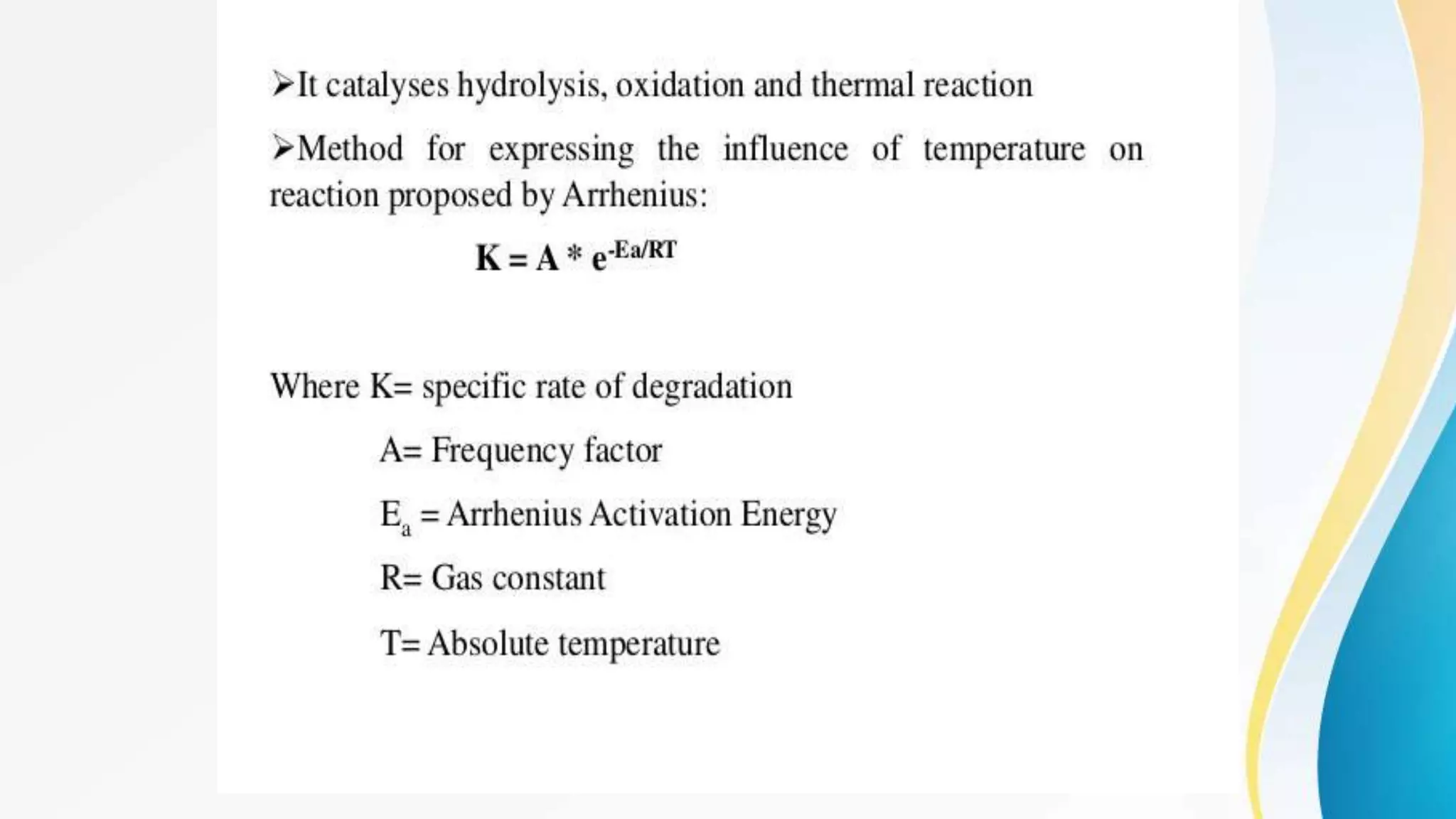
TEMPERATURE -
• primary factor affecting the drug stability.
• decomposition of product can occur at elevated
temperature.
• help in predicting stability of product at ordinary
temperature.
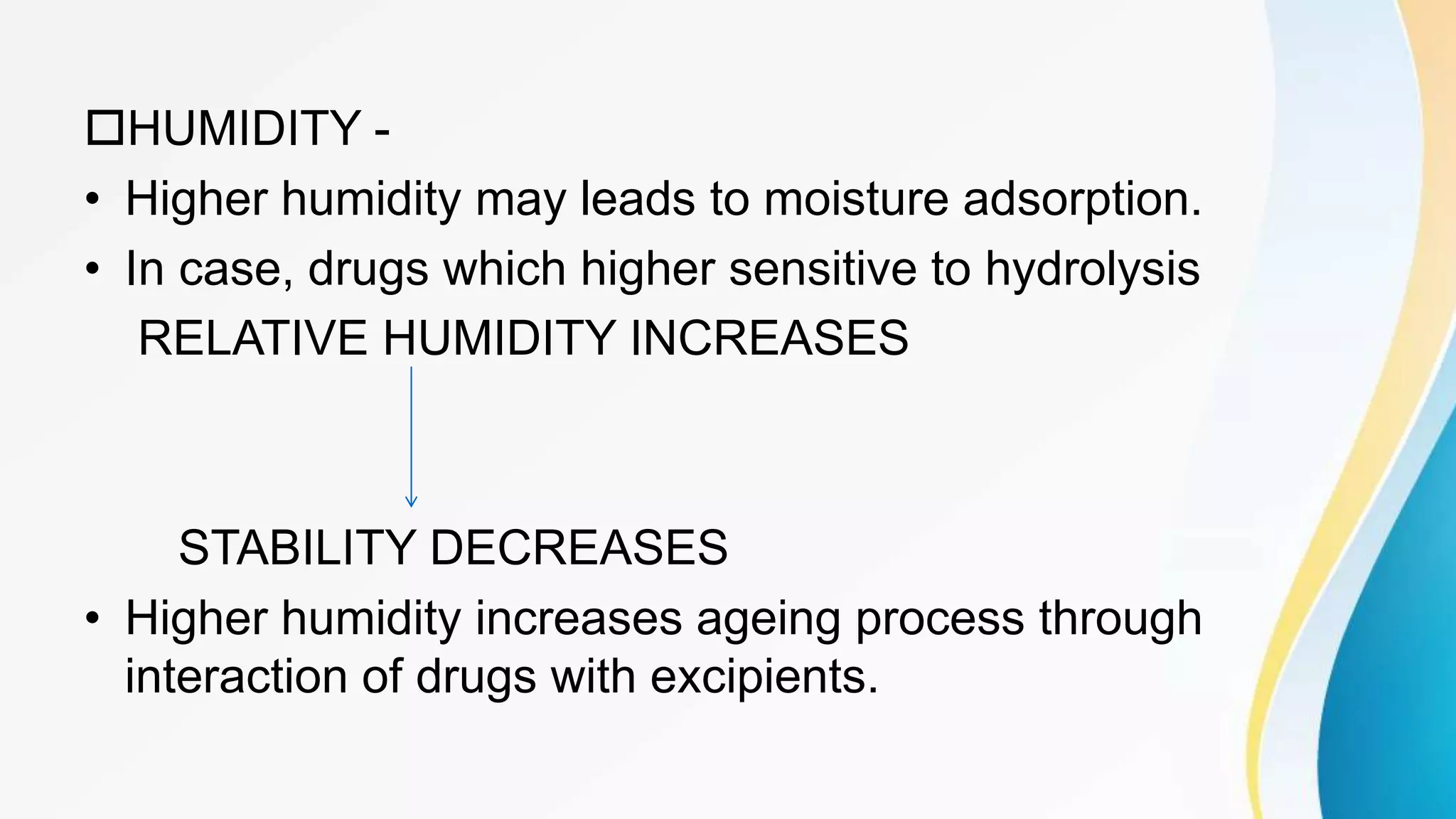
HUMIDITY -
• Higher humidity may leads to moisture adsorption.
• In case, drugs which higher sensitive to hydrolysis
RELATIVE HUMIDITY INCREASES
STABILITY DECREASES
• Higher humidity increases ageing process through
interaction of drugs with excipients.
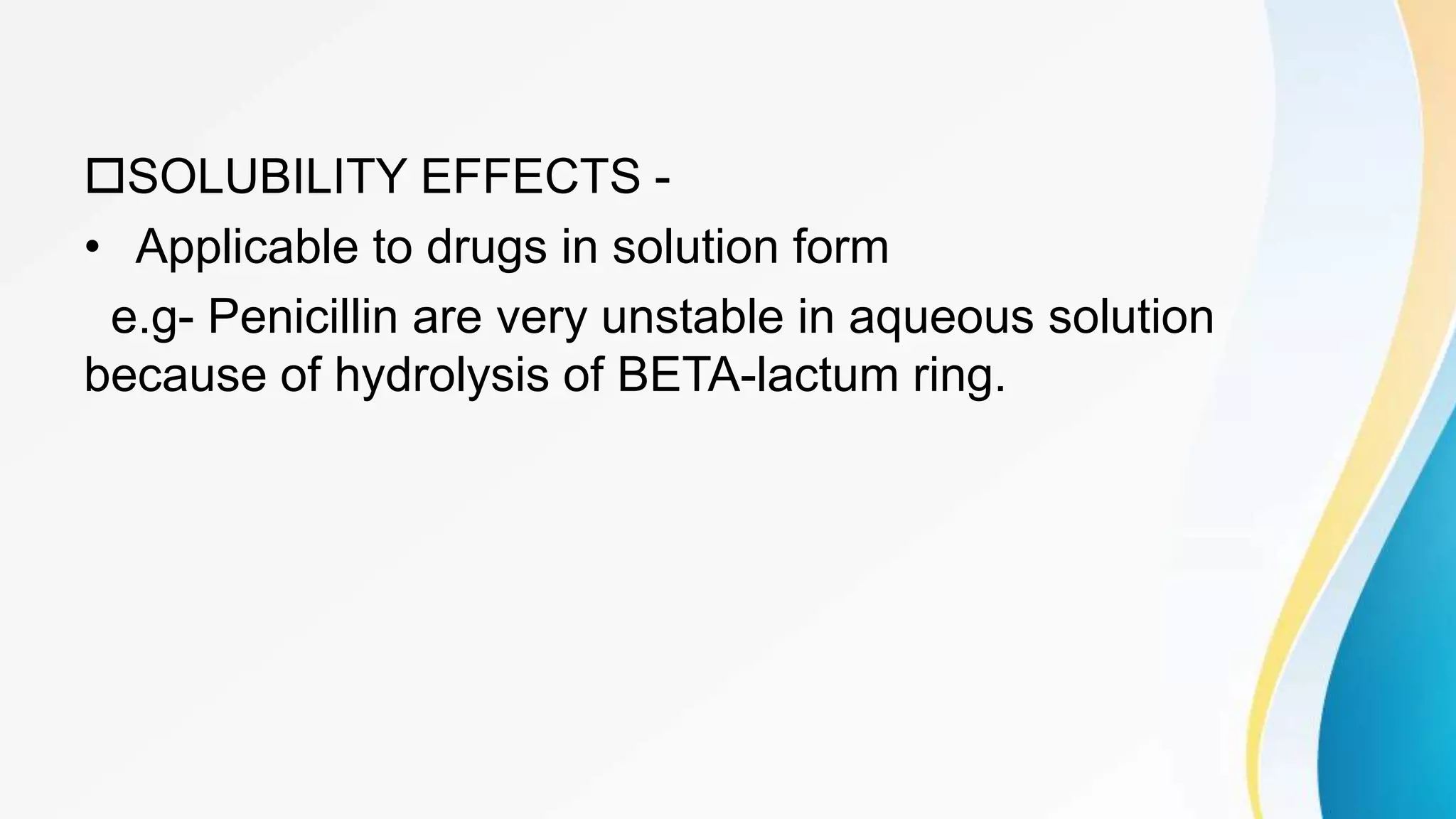
SOLUBILITY EFFECTS -
• Applicable to drugs in solution form
e.g- Penicillin are very unstable in aqueous solution
because of hydrolysis of BETA-lactum ring.
pH-EFFECT-
By changing 1 pH unit, there is change in more than 10
fold in rate constant.
Before formulating drug in solution, K vs pH should be
studied and optimum pH at lowest value of rate constant
is to be found.
Hydrogen ion catalysis occurs at lower pH ,while
Hydroxyl ion occurs at higher pH.
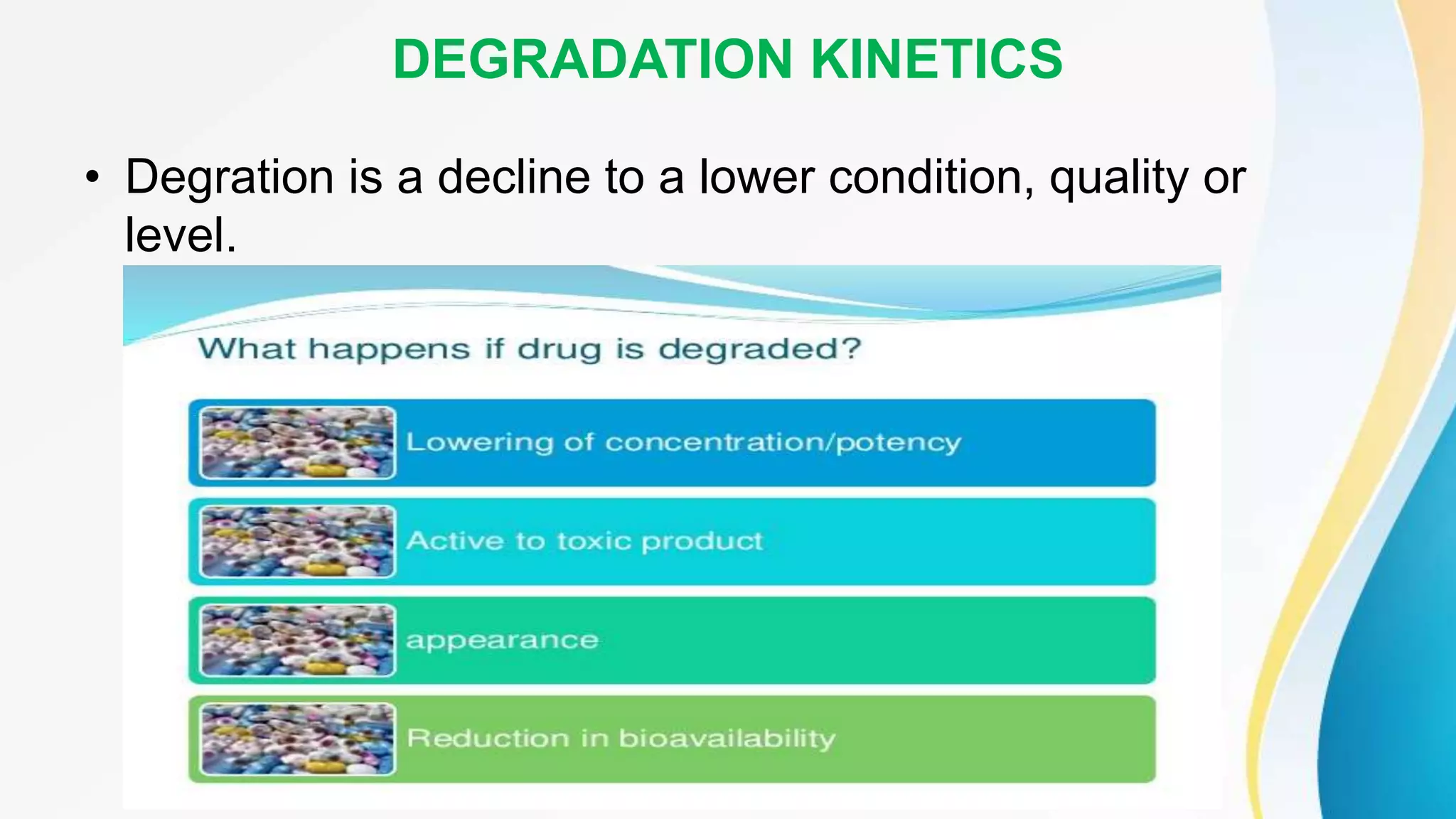
DEGRADATION KINETICS
• Degration is a decline to a lower condition, quality or
level.
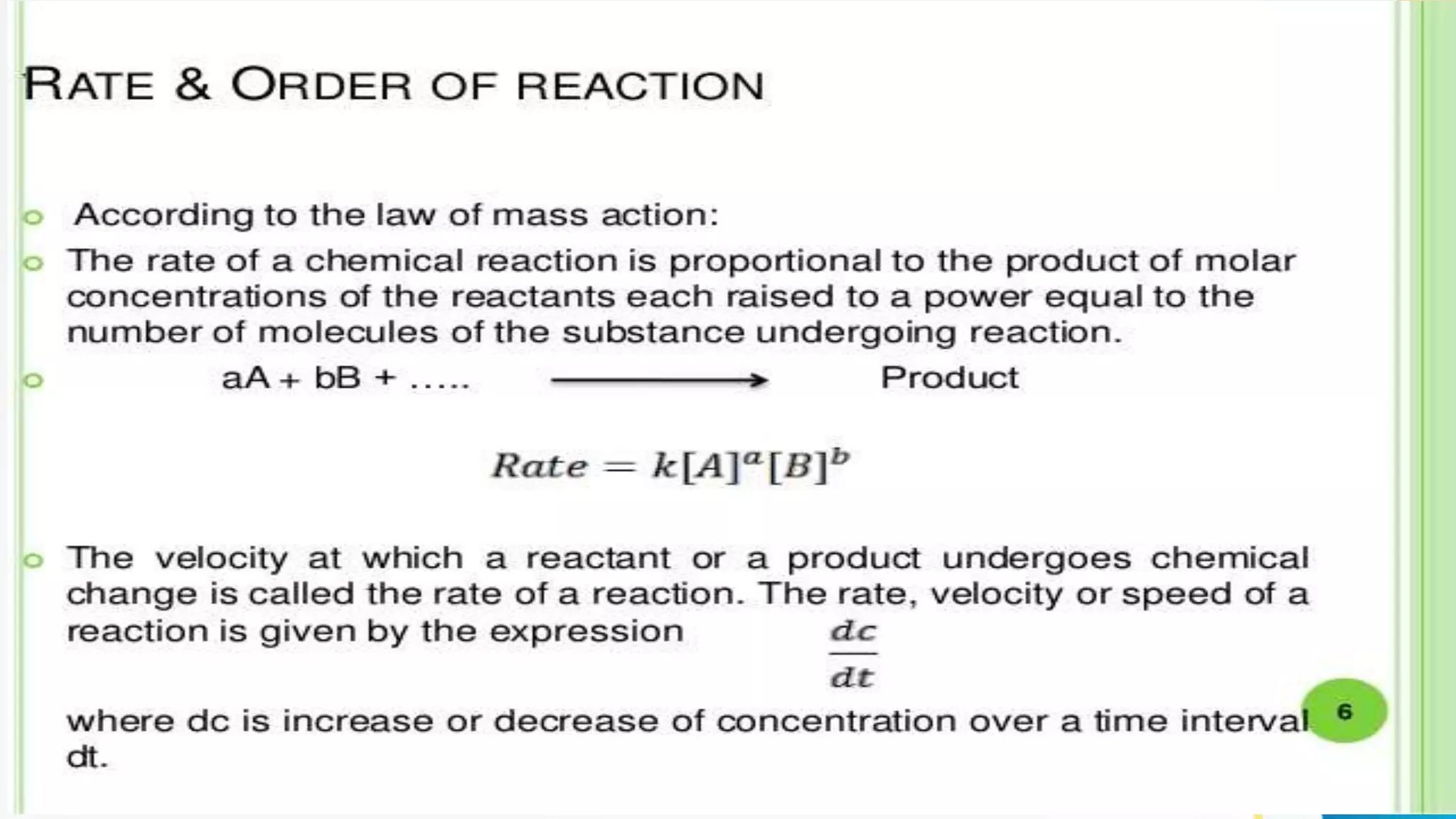
ORDER OF A REACTION
• The order of a reaction is defined as the manner in which
the rate of reaction varies with the concentration of
reactants.
• The overall order is the sum of the exponents of the
concentration terms.
• For the above reaction,
order of the reaction = a+b
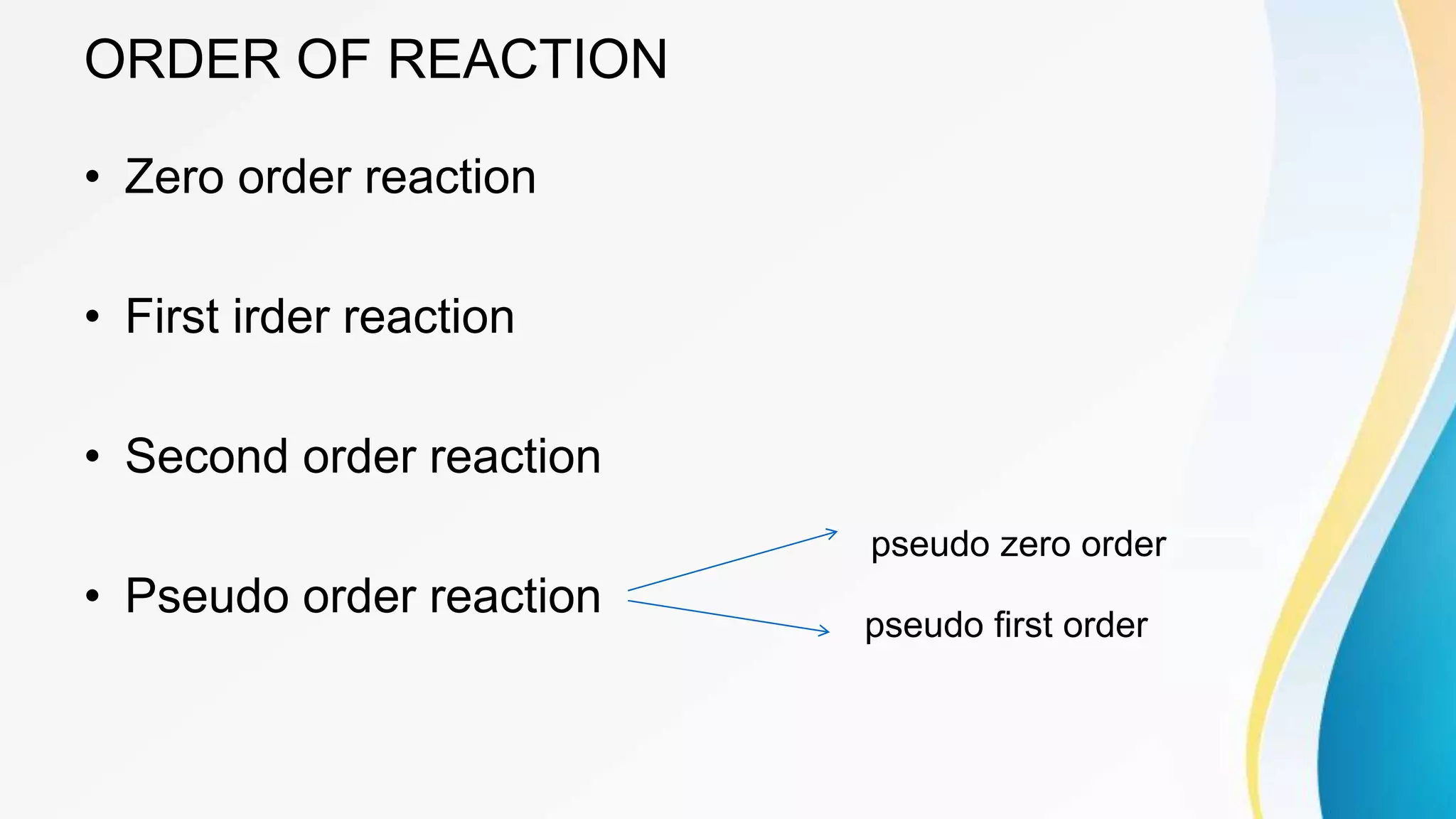
ORDER OF REACTION
• Zero order reaction
• First irder reaction
• Second order reaction
• Pseudo order reaction
pseudo zero order
pseudo first order
ZERO ORDER REACTION
• The rate of reaction doesn't depend on concentration of
reactant(s).
• The rate expression for chemical reaction
A B
Rate of reaction = -d[C]/dt = k
where , k = rate constant
[C]= decreasing conc. of reactant
FIRST ORDER REACTION
• Rate of reaction depends on concentration of any one
reactant
• the rate expression for chemical reaction
A B
rate of reaction = -d[C]/dt = kC
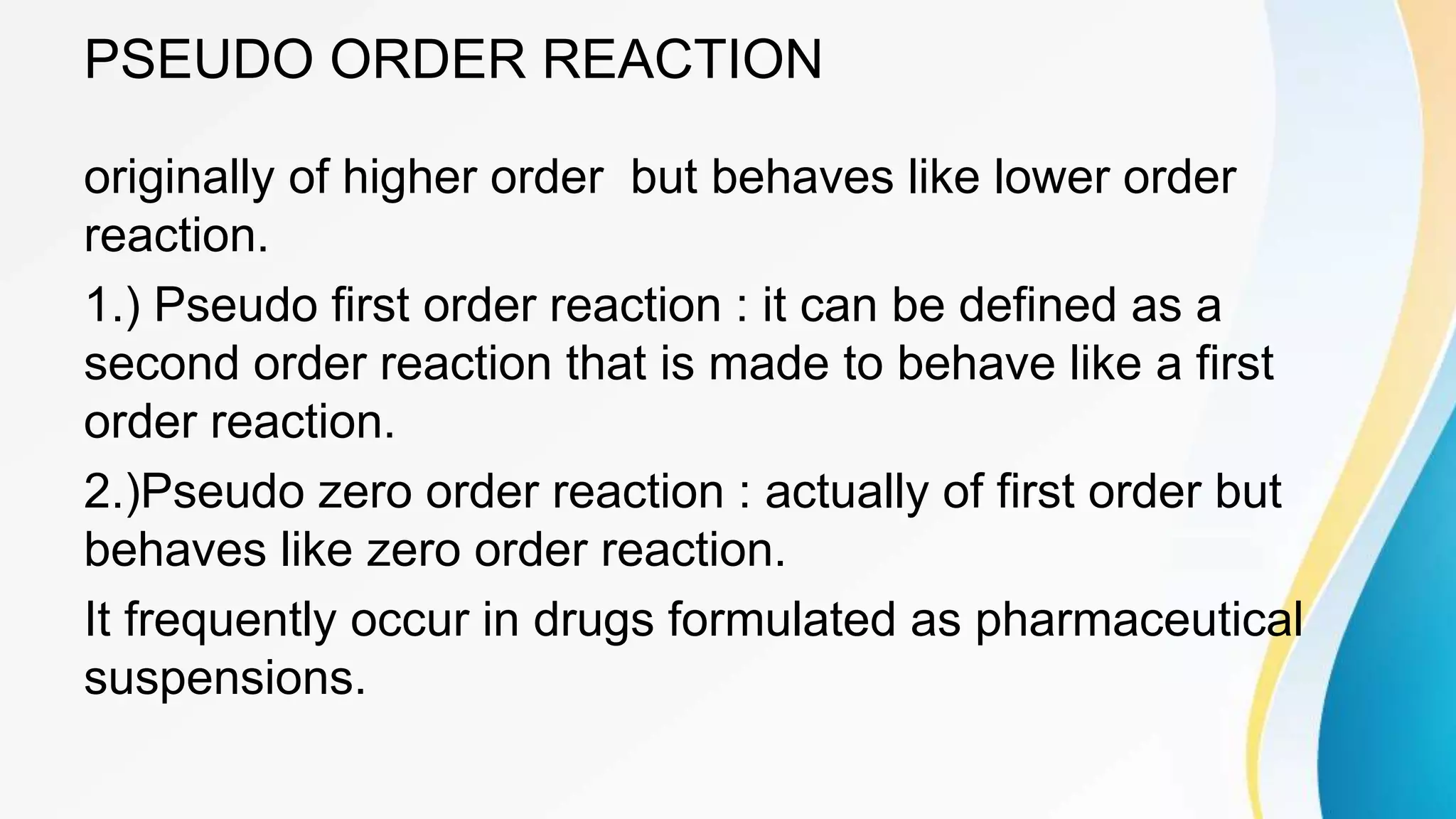
PSEUDO ORDER REACTION
originally of higher order but behaves like lower order
reaction.
1.) Pseudo first order reaction : it can be defined as a
second order reaction that is made to behave like a first
order reaction.
2.)Pseudo zero order reaction : actually of first order but
behaves like zero order reaction.
It frequently occur in drugs formulated as pharmaceutical
suspensions.
DEGRADATION MECHANISM
Pharmaceutical degradation
mechanisms
Physical
degradation
Chemical
degradation
Microbiological
degradation
PHYSICAL DEGRADATION
It is the degradation which results into the change of
physical nature of drug. The formulation is totally changed
by way of appearance, organoleptic properties, hardness,
brittleness etc.
Physical degradation can be caused by a range of factors
like :
• Loss of water
• Absorption of water
• Loss of volatile content
• temperature fluctuations
• freezing & thawing
• Abrasion & vibration
 Loss of water : leads to seperation of two phases in case
of EMULSIONS. Also it results in overall weight loss.
Absorption of water : It can cause liquification and
degradation of powdered formulations.
Freezing & thawing : freeze-thaw testing is conducted by
exosing the product to freezing temp.(-15℃ to -20℃) for
24 hours. The sample is then placed in a higher
temperature (25℃) for 24 hours. The sample is analysed
for significant changes.
Loss of volatile content : volatile compounds used such as
alcohol, ether etc gets evaporated from the formulation.
e.g. nitroglycerine from drugs gets evaporated
Temperature fluctuations are also one of the main causes
of physical degradation of drugs.
CHEMICAL DEGRADATION
Drug substances have diverse molecular structures and
thus they are more sucseptible to many degradation
pathways.
Possible chemical degradation pathways include
• Hydrolysis
• Oxidation
• Photodegradation
• Dehydration
• Isomerisation & racemisation
• Complex interactions with excipients
Mechanism of degradation of some commonly used
drugs
• Aspirin, Atropine, Amoxycillin
• Chloramphenicol, Cocain,Diazepam
Hydrolysis
• Captopril, Chlorpromazine
• Morphine, Hydrocortisone
Oxidation
• Chlorpromazine, Frusemide
• Ergotamine, Promethazine
Photodegradation
HYDROLYSIS
Drugs with functional groups such as esters, amides,
lactones or lactams may be susceptible to hydrolytic
degradation.
It is most commonly encountered mode of drug
degradation.
ESTER HYDROLYSIS :-It is a chemical degradative
process during which the ester group reacts with water
and yields an acid or alcohol.
e.g. drugs like ASPIRIN, COCAINE, PROCAINE etc are
AMIDE HYDROLYSIS -
Amide bonds are less susceptible to hydrolysis than ester
bonds because the carbonyl carbon of the amide bond is
less electrophillic.
e.g.- chloramphenicol, lincomycin etc are degraded by
amide hydrolysis
DEHYDRATION
• Sugars such as glucose and lactose are known to
undergo dhydration.
• Erythromycin is susceptible to acid catalysed dehydration.
• Prostaglandins E1 and E2 undergo dehydration follwed by
isomerisation.
ISOMERIZATION AND RACEMIZATION
Isomerisation is the process by which one molecule is
transformed into another molecule which has exactly the
same atoms but the atoms are rearranged.
e.g.- Tetracyclines such as ergotamine exhibit epimerization
by acid catalysis.
Racemization refers to partial conversion of one
enantiomer into another.
e.g- Epinephrine is oxidized and undergoes racemization
under strongly acid compound.
OXIDATION
• Oxidation mechanisms for drug substances depend on
the chemical structure of the drug and the presence of
reactive oxygen or any other oxidant.
e.g- Methyl-dopa and epinephrine are readily oxidized to
quinones.
captopril, morphine etc are also degraded by oxidation
reactions.
PHOTO-DEGRADATION
• Photodegradation is the process by which light sensitive
drugs or excipients are chemically degraded by light.
• The variation of degradation depends on the waelength of
light, shorter wavelengths causes more damage than
longer wavelength.
e.g- photodegradation of the chlorpromazine,chloroquine
and primaquine etc gives various products through different
pathways.
MICROBIOLOGICAL DEGRADATION
There are 2 ways in which the microbiological status of a
drug changes with time :
1. Microorganisms present in the product at the time of
manufacture may reproduce and thus can degrade the
drug product.
2. If package integrity is compromised during distribution or
storage, it is possible that the microbes causing adverse
effects may be ingressed in the product which results in
degradation.
SOLID STATE STABILITY
• The primary objectives of these studies are
 identification of stable storage conditions for drug in the
solid state
identification of compatible excipients for a formulation.
repetitive testing of the initial bulk lot in parallel with newer
bulk lots should be performed, and adequate material
should be set aside for these studies.
• In general, solid-state reactions are much slower and
more difficult to interpret than solution-state reactions.
• To study the many possible solid-state reactions, one may
need more than a specific assayfor the intact compound.
Eg. polymorphic changes are usually detected by
quantitative Infra-red (IR) analysis.
SHELF LIFE ASSIGNMENT
• Shelf life of a drug product is defined as the time at which
the average drug characteristic(e.g. potency etc) remains
within an approved specification after manufacture(FDA-
1987)
• It is the time at which a drug has decreased to 90% of its
initial conc.
FACTORS AFFECTING SHELF LIFE OF DRUGS
• Moisture , hydrolysis and pH
• Oxygen and oxidation
• Light
• Temperature
• Microbes
• APIs & excipients etc
TYPES OF SHELF LIFE STUDY
REAL TIME STABILITY STUDY.
ACCELERATED STABILITY STUDY.
REAL TIME STABILITY STUDY
• In real-time stability testing , a product is stored at
recommended storage conditions and monitored until it
fails the specifications.
• Real time stability esting is normally performed for longer
duration of the test period in order to allow significant
product degradation under recomended storage
conditions.
ACCELERATED STABILITY STUDIES
Stability study to predict the shelf life of the product, by
accelerating the rate of decomposition, preferably by elevating the
stress conditions(such as temperature, humidity, pH etc) of
reaction conditions.
With the advancement in branch of kinetics, shelf life of a dosage
form can be predicted within months based on accelerated
stability reports.
Degradation can be predicted using known relationships b/w the
acceleration factor and the degradation rate.
CONCLUSION
• Stability studies are important because they help in the
developement of a better drug product with higher stability
and efficacy.
• The study of degradation kinetics is important because it
can elucidate information about the mechanism of a
reaction and can also allow us to be more efficient in the
laboratory.
• It is also helpfull to improve the product stability.
REFERENCE
● K.Wolters ; “Rehmington The science and practice of
pharmacy”;21st edition volume - 2005;published in Philadelphia
College of Pharmacy and science”;page no – 1025 -1033.
● J.S Ptrick ; “Martin's Physical pharmacy and pharmaceutical
sciences”;5th edition ; published by Wolters Kluver
Health(India)Pvt. Ltd. New Delhi. Page no – 428-432.
● L Lachman , K.Herbert A. ; “The Theory and Practice of Industrial
Pharmacy” ; special Indian edition 2009 ; CBS Publishers and
Distributors Pvt. Ltd ;Page no – 772 ,777 ,849.”.
Product Stability Studies & Stability Testing

Product Stability Studies & Stability Testing

  • 1.
    Presented By : AMITATTRI M.PHARMA(IP) Sem.- 1 Guided By : Dr. DEEPAK KAUSHIK Astt. Professor (Pharmaceutics) MDU
  • 2.
    CONTENTS • Introduction • Typesof stability • Stability testing • Factors influencing-media effects & pH • Degradation kinetics • Mechanism of degradation • Solid-state stability • Shelf-life assignment • Accelerated stability studies • Conclusion
  • 3.
    • The capacityof a drug substance or drug product to remain within established specifications to remain within its physical, chemical, microbiological and therapeutical specifications throughout the expiration dating period, is stability. • Purpose of stability testing is to demonstrate how packaged and unpackaged pharmaceutical product changes with time in different temperatue, humidity and light conditions.
  • 4.
    WHY STABILITY ? •Provide an evidence on how the quality of a drug substance or drug product varies with time under the influence of a variety of environmental factors such as • Temperature • Humidity • Light
  • 5.
    NECESSITY OF STABILITYSTUDIES ● Stability studies play a central role in drug development ● Permit understanding of the molecule ● Essential for developing analytical methods ● Essential for selecting packaging for drug substance and drug product ● Essential for choosing storage conditions for drug substance and drug product
  • 7.
    STABILITY TESTING Stability testing/studiesis termed as a complex process because of involvement of a variety of factors like • stability of active pharmaceutical ingredients • interaction b/w API & excipients • types of dosage form etc.
  • 8.
    NEED FOR STABILITYTESTING • provide evidences as to how the quality of the product varies with time. • establish shelf life for the drug product. • determine recommended storage conditions. • safety point of view of the patient. • Loss of pharmaceutical elegance and patient acceptibility.
  • 10.
    TYPES OF STABILITYTESTING 1) Stress stability studies 2) Formal stability studies a) Long-term stability study b) accelerated and intermediate stability studies c) In-use stability study 3) Abbreviated stability studies
  • 11.
    Stress stability studies •The stress testing heps in determining the intrinsic stability of the molecule by establishing degradation pathways in order to identify the likely degradation products and to validate the stability indicating power of the analytical procedures used.
  • 12.
    Formal stability studies •The storage conditions and the duration of these studies are similar to those during the distribution, conservation and use of the product. • Two situations are taking into account while conducting these studies: Products to be stored under controlled conditions (freezer etc) Products to be stored under room temperature.
  • 13.
    Abbreviated stability studies •For known active substances and derived medicinal products (acc. to European Medicines Agency guidelines) • For modifications type II respect to an existing authorisation of the product (these studies are only for countries of the European union)
  • 14.
    PRINCIPLES OF STABILITYTESTING Basic principles which are applicable on all dosage forms are : Selection of batches and samples Test attributes - describe the quality, safety and efficacy. organoleptical attributes  physicochemical attributes  chemical attributes  microbial attributes  container closure system attributes Analytical procedures - way of performing the analysis should be specific to determine the drug substance and impurities.
  • 15.
    contt....... • Storage conditions •Storage period • Testing frequency • Number of batches • Container closure system • Evaluation • Labeling criteria These are some of the basic principles of stability testing.
  • 16.
    FACTORS INFLUENCING- MEDIAEFFECTS & pH TEMPERATURE - • primary factor affecting the drug stability. • decomposition of product can occur at elevated temperature. • help in predicting stability of product at ordinary temperature.
  • 18.
    HUMIDITY - • Higherhumidity may leads to moisture adsorption. • In case, drugs which higher sensitive to hydrolysis RELATIVE HUMIDITY INCREASES STABILITY DECREASES • Higher humidity increases ageing process through interaction of drugs with excipients.
  • 19.
    SOLUBILITY EFFECTS - •Applicable to drugs in solution form e.g- Penicillin are very unstable in aqueous solution because of hydrolysis of BETA-lactum ring.
  • 20.
    pH-EFFECT- By changing 1pH unit, there is change in more than 10 fold in rate constant. Before formulating drug in solution, K vs pH should be studied and optimum pH at lowest value of rate constant is to be found. Hydrogen ion catalysis occurs at lower pH ,while Hydroxyl ion occurs at higher pH.
  • 21.
    DEGRADATION KINETICS • Degrationis a decline to a lower condition, quality or level.
  • 23.
    ORDER OF AREACTION • The order of a reaction is defined as the manner in which the rate of reaction varies with the concentration of reactants. • The overall order is the sum of the exponents of the concentration terms. • For the above reaction, order of the reaction = a+b
  • 24.
    ORDER OF REACTION •Zero order reaction • First irder reaction • Second order reaction • Pseudo order reaction pseudo zero order pseudo first order
  • 25.
    ZERO ORDER REACTION •The rate of reaction doesn't depend on concentration of reactant(s). • The rate expression for chemical reaction A B Rate of reaction = -d[C]/dt = k where , k = rate constant [C]= decreasing conc. of reactant
  • 26.
    FIRST ORDER REACTION •Rate of reaction depends on concentration of any one reactant • the rate expression for chemical reaction A B rate of reaction = -d[C]/dt = kC
  • 27.
    PSEUDO ORDER REACTION originallyof higher order but behaves like lower order reaction. 1.) Pseudo first order reaction : it can be defined as a second order reaction that is made to behave like a first order reaction. 2.)Pseudo zero order reaction : actually of first order but behaves like zero order reaction. It frequently occur in drugs formulated as pharmaceutical suspensions.
  • 28.
  • 29.
    PHYSICAL DEGRADATION It isthe degradation which results into the change of physical nature of drug. The formulation is totally changed by way of appearance, organoleptic properties, hardness, brittleness etc.
  • 30.
    Physical degradation canbe caused by a range of factors like : • Loss of water • Absorption of water • Loss of volatile content • temperature fluctuations • freezing & thawing • Abrasion & vibration
  • 31.
     Loss ofwater : leads to seperation of two phases in case of EMULSIONS. Also it results in overall weight loss. Absorption of water : It can cause liquification and degradation of powdered formulations. Freezing & thawing : freeze-thaw testing is conducted by exosing the product to freezing temp.(-15℃ to -20℃) for 24 hours. The sample is then placed in a higher temperature (25℃) for 24 hours. The sample is analysed for significant changes.
  • 32.
    Loss of volatilecontent : volatile compounds used such as alcohol, ether etc gets evaporated from the formulation. e.g. nitroglycerine from drugs gets evaporated Temperature fluctuations are also one of the main causes of physical degradation of drugs.
  • 33.
    CHEMICAL DEGRADATION Drug substanceshave diverse molecular structures and thus they are more sucseptible to many degradation pathways. Possible chemical degradation pathways include • Hydrolysis • Oxidation • Photodegradation • Dehydration • Isomerisation & racemisation • Complex interactions with excipients
  • 34.
    Mechanism of degradationof some commonly used drugs • Aspirin, Atropine, Amoxycillin • Chloramphenicol, Cocain,Diazepam Hydrolysis • Captopril, Chlorpromazine • Morphine, Hydrocortisone Oxidation • Chlorpromazine, Frusemide • Ergotamine, Promethazine Photodegradation
  • 35.
    HYDROLYSIS Drugs with functionalgroups such as esters, amides, lactones or lactams may be susceptible to hydrolytic degradation. It is most commonly encountered mode of drug degradation. ESTER HYDROLYSIS :-It is a chemical degradative process during which the ester group reacts with water and yields an acid or alcohol. e.g. drugs like ASPIRIN, COCAINE, PROCAINE etc are
  • 36.
    AMIDE HYDROLYSIS - Amidebonds are less susceptible to hydrolysis than ester bonds because the carbonyl carbon of the amide bond is less electrophillic. e.g.- chloramphenicol, lincomycin etc are degraded by amide hydrolysis
  • 37.
    DEHYDRATION • Sugars suchas glucose and lactose are known to undergo dhydration. • Erythromycin is susceptible to acid catalysed dehydration. • Prostaglandins E1 and E2 undergo dehydration follwed by isomerisation.
  • 38.
    ISOMERIZATION AND RACEMIZATION Isomerisationis the process by which one molecule is transformed into another molecule which has exactly the same atoms but the atoms are rearranged. e.g.- Tetracyclines such as ergotamine exhibit epimerization by acid catalysis. Racemization refers to partial conversion of one enantiomer into another. e.g- Epinephrine is oxidized and undergoes racemization under strongly acid compound.
  • 39.
    OXIDATION • Oxidation mechanismsfor drug substances depend on the chemical structure of the drug and the presence of reactive oxygen or any other oxidant. e.g- Methyl-dopa and epinephrine are readily oxidized to quinones. captopril, morphine etc are also degraded by oxidation reactions.
  • 40.
    PHOTO-DEGRADATION • Photodegradation isthe process by which light sensitive drugs or excipients are chemically degraded by light. • The variation of degradation depends on the waelength of light, shorter wavelengths causes more damage than longer wavelength. e.g- photodegradation of the chlorpromazine,chloroquine and primaquine etc gives various products through different pathways.
  • 41.
    MICROBIOLOGICAL DEGRADATION There are2 ways in which the microbiological status of a drug changes with time : 1. Microorganisms present in the product at the time of manufacture may reproduce and thus can degrade the drug product. 2. If package integrity is compromised during distribution or storage, it is possible that the microbes causing adverse effects may be ingressed in the product which results in degradation.
  • 42.
    SOLID STATE STABILITY •The primary objectives of these studies are  identification of stable storage conditions for drug in the solid state identification of compatible excipients for a formulation. repetitive testing of the initial bulk lot in parallel with newer bulk lots should be performed, and adequate material should be set aside for these studies.
  • 43.
    • In general,solid-state reactions are much slower and more difficult to interpret than solution-state reactions. • To study the many possible solid-state reactions, one may need more than a specific assayfor the intact compound. Eg. polymorphic changes are usually detected by quantitative Infra-red (IR) analysis.
  • 44.
    SHELF LIFE ASSIGNMENT •Shelf life of a drug product is defined as the time at which the average drug characteristic(e.g. potency etc) remains within an approved specification after manufacture(FDA- 1987) • It is the time at which a drug has decreased to 90% of its initial conc.
  • 45.
    FACTORS AFFECTING SHELFLIFE OF DRUGS • Moisture , hydrolysis and pH • Oxygen and oxidation • Light • Temperature • Microbes • APIs & excipients etc
  • 46.
    TYPES OF SHELFLIFE STUDY REAL TIME STABILITY STUDY. ACCELERATED STABILITY STUDY.
  • 47.
    REAL TIME STABILITYSTUDY • In real-time stability testing , a product is stored at recommended storage conditions and monitored until it fails the specifications. • Real time stability esting is normally performed for longer duration of the test period in order to allow significant product degradation under recomended storage conditions.
  • 48.
    ACCELERATED STABILITY STUDIES Stabilitystudy to predict the shelf life of the product, by accelerating the rate of decomposition, preferably by elevating the stress conditions(such as temperature, humidity, pH etc) of reaction conditions. With the advancement in branch of kinetics, shelf life of a dosage form can be predicted within months based on accelerated stability reports. Degradation can be predicted using known relationships b/w the acceleration factor and the degradation rate.
  • 50.
    CONCLUSION • Stability studiesare important because they help in the developement of a better drug product with higher stability and efficacy. • The study of degradation kinetics is important because it can elucidate information about the mechanism of a reaction and can also allow us to be more efficient in the laboratory. • It is also helpfull to improve the product stability.
  • 51.
    REFERENCE ● K.Wolters ;“Rehmington The science and practice of pharmacy”;21st edition volume - 2005;published in Philadelphia College of Pharmacy and science”;page no – 1025 -1033. ● J.S Ptrick ; “Martin's Physical pharmacy and pharmaceutical sciences”;5th edition ; published by Wolters Kluver Health(India)Pvt. Ltd. New Delhi. Page no – 428-432. ● L Lachman , K.Herbert A. ; “The Theory and Practice of Industrial Pharmacy” ; special Indian edition 2009 ; CBS Publishers and Distributors Pvt. Ltd ;Page no – 772 ,777 ,849.”.