DRUG STABILITY STUDIES
T.ABARAJITHA Mr.S.MUTHUKUMAR,M.Pharm.,
Final year B.Pharm., ASSISTANT PROFESSOR,
KMCH COLLEGE OF PHARMACY
INTRODUCTION
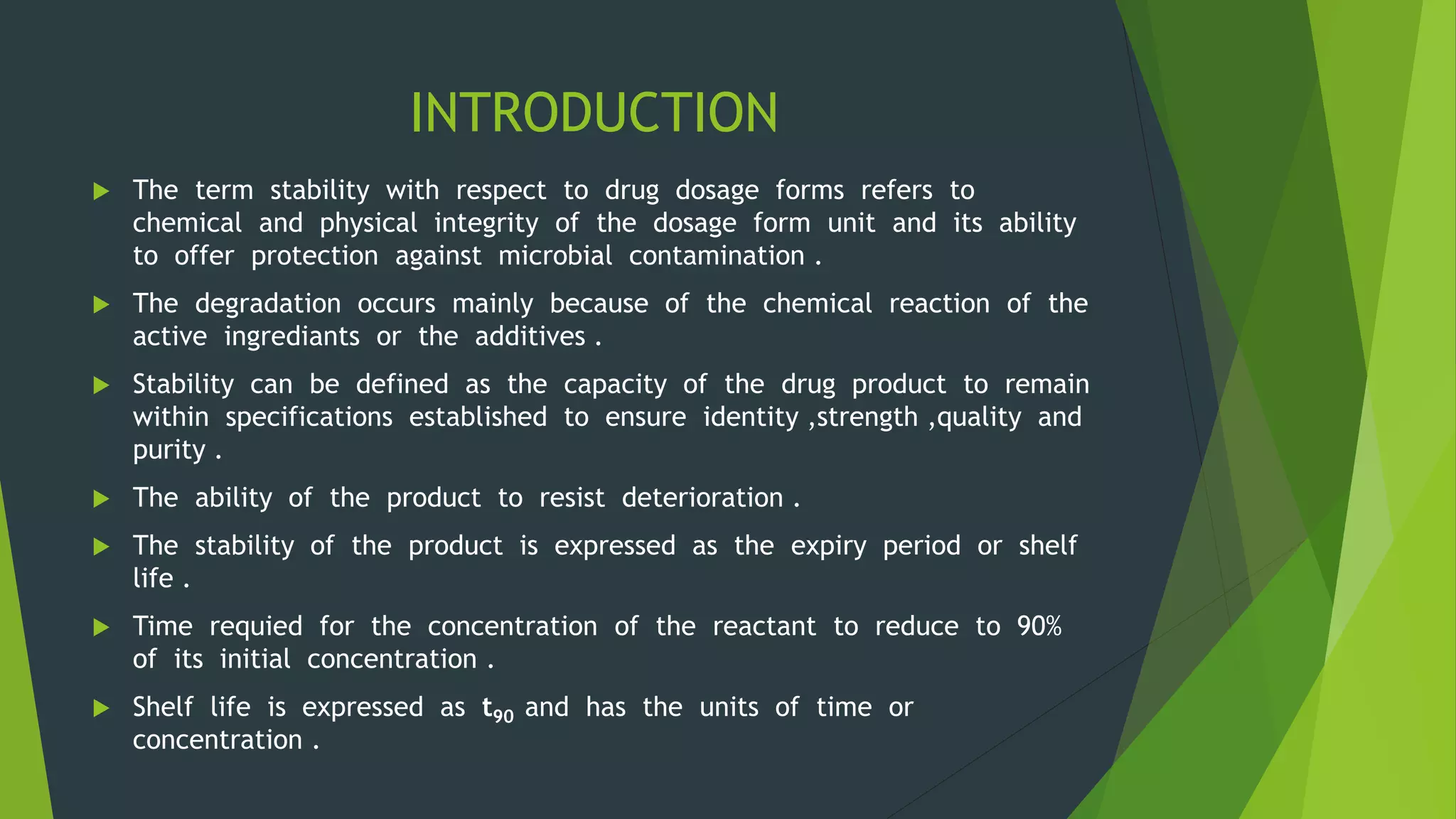
 The term stability with respect to drug dosage forms refers to
chemical and physical integrity of the dosage form unit and its ability
to offer protection against microbial contamination .
 The degradation occurs mainly because of the chemical reaction of the
active ingrediants or the additives .
 Stability can be defined as the capacity of the drug product to remain
within specifications established to ensure identity ,strength ,quality and
purity .
 The ability of the product to resist deterioration .
 The stability of the product is expressed as the expiry period or shelf
life .
 Time requied for the concentration of the reactant to reduce to 90%
of its initial concentration .
 Shelf life is expressed as t90 and has the units of time or
concentration .
IMPORTANCE OF STABILITY STUDIES
 This is an assurance given by the manufacturer that the patient would
receive an uniform dose throughout the shelf life .
 Stability testing prevents the possibility of the marketing an unstable
product both physical and chemical degradation of the drug can result
in unstable product .
PHYSICAL DEGRADATION
 Physical degradation may be due to ,
 Loss of volatile constituents - example : nitroglycerine tablets.
 Loss of water - example : an effervescent supstance loose water.
 Absorption of water – example : calcium chloride – a deliquescent
substance absorbs water .
 Crystals growth – example : 10% w/v calcium gluconate injection gives
precipitation ad undergo crystallization due to supersaturated solution .
 Colour change – example : aspirin tablets becomes pink and ascorbic acid
tablets turns yellowish brown when exposed to air .
CHEMICAL DEGRADATION
 May be due to functional group present . Some of them are ,
 Hydrolysis [aspirin and procaine]
 Oxidation [ascorbaic acid vegetable oil ]
 Isomerisation [(-) adrenaline is more active and (+) adrenaline is more
potent .trans vitamin A palmitate is more active .
 Absorption of Carbondioxide – sodium hexabarbitone IV INJECTION .
 Decarboxylation – procain gives a dark colored liquid due to loss of
carbondioxide .
PURPOSE OF STABILITY STUDIES
 Stability studies are done to understand how to design a product and
its packaging such that product has appropriate physical, chemical and
microbiological properties during a defined shelf life when stored and
used .
ROUTES OF DEGRADATION
 The major routes of drug degradation are summarized in the following,
 Oxidation :-
 Addition of antioxidant
 Adjustment of pH
 Providing inert environment
 Hydrolysis :-
 Adjustment of pH
 Use of non-aqueous solvents
 Use of complexing agent
 Photo chemical degradation :-
 Strored in amber colored container
 Use of opaque wrapper
 Use of opacifiers and incorporation of UV light absobers .
ROUTES OF DEGRADATION
 Racermization acylation decarboxylation
solute - formation
polymerization
polymorphism
HYDROLYSIS
 Many pharmaceuticals contain ester or amide functional group which
undergo hydrolysis in solution .
 Examples of drugs that tend to degrade by hydrolytic cleavage of an
ester or amide linkage are anesthetics ,antibiotics ,vitamins and
barbiturates .
 Ester hydrolysis :-
 The hydrolysis of an into a mixture of an acid and alcohol essesntial
involves the rupture of a covalent between a carbon atom and an
oxygen atom .
 Amide hydrolysis :-
 Pharmaceutical compounds containing an amide group can undergo
hydrolysis resulting in the formlation of an acid and an amine .
ASPIRIN HYDROLYSIS
 The pH of optimum stability is at 2.4
 At a pH of 5 – 7 the degradation reaction reaction is essential pH -
independent and a pH above 10 , the stability of aspirin is found to
decreased rapidly with increase in pH.
1. pH:- if physiological permissible ,the solution of the drug should be
formulated as close possible to its pH of optimum stability .
2. Type of solvent :- partial or full replacement of water with a solvent
of lower dielectric constant generally causes a considerable decrease in
the velocity of ester hydrolysis .
3. Complexation :- the hydrolysis rates may be influenced in two ways
by complex and mannitol solution and substituted amides .
4. Surfactants :- non – ionic , cation and anionic surfactans stabilize the
durg against base catalysis .
5. Modification of chemical structure :- by increasing the length of or by
branching the acyl alkyl chain , the rate of hydrolysis of the ester
usually decrease , owing to steric hindrance .
6. Salts and esters :- another technique that is sometimes employed to
increase the stability of pharmaceuticals undergoing degradation through
ester hydrolysis to reduce their solubility by forming less soluble ester
of the drug.
RING ALTERATION
 A hydrolytic reaction can proceed as a result of ring cleavage with
subsequent attack by hydrogen or hydroxyl ion.
 Examples of that have been reported to undergo hydrolysis by this mechanism
include hydrochlorthiazides, pilocarpine and reserpine.
 Example: The hydrolysis of pilocarpine in aqueous solution has been reported
to involve a cyclic equilibrium process, which is catalyzed by hydrogen ion
and hydroxyl ion.
 The concentration pilocarpate and pilocarpic acid are influenced by pH.
 Pilocarpine is relatively stable in solutions of acidic pH. As the pH increases,
pilocarpine progressively becomes unstable.
OXIDATION-REDUCTION
 The oxidative decomposition of pharmaceuticals compounds is responsible for
the instability of a considerable number of pharmaceutical preparations.
 For example: steroids, vitamins, antibiotics and epinephrine undergo
oxidative degration. These reaction are mediated either by free radicals or by
molecular oxygen.
 A substance is said to be oxidixed if electrons are removed from it. Oxidation
often involves the addition of oxygen or the removal of hydrogen.
 Heavy metals,particularly those prossessing two or more valency state, with
suitable oxidation-reduction potential between them (copper,iron,cobalt and
nickel) generally catalyze oxidative deteriorations.
 These metals reduce the length of the induction period the time in which no
measurable oxidation occurs and increase the maximum rate of oxidation.
 Many oxidations are catalyzed by hydrogen and hydroxyl ions.
 Example: Quinone to hydroquinone.
 Although the oxygen concentration is of importance in the auto-oxidation
process, its significance is usually not adequately considered. For the most
part, oxidative degradations to pharmaceutical compounds follow first order
or second order kinetics expressions.
 The solutions not containing any chelating agent degraded more rapidly as the
buffer concentration increased, while the buffered solution containing
chelating agents showed that the rate of degradation was independent of the
concentration of the buffer.
 Ranicity, which can affect nearly all oils and fats is a widely known term
covering many typical off-flavours formed by the auto-oxidation of
unsaturated fatty acids present in an oil or fat.
 These off-flavours have a more or less distinct odour and are due to the
volatile compounds that are formed upon oxidation of the oils and fats.
 These volatile compounds are generally short chain monomers that are
formed by cleavage of the non-volatile hydroperoxide primary oxidation
product.
 Determination of iodine numbers can be employed as an indication of
whether oxidation takes place across the double bond.
 The stability of pharmaceutical compounds undergoing oxidative degradation
can be increased by several approaches.
ANTI-OXIDANTS
 The effect of antioxidants is to break up the chains formed due to
propagation process by providing a hydrogen atom or an electron.
 Water soluble antioxidants act by preferentially undergoing in place of the
drug.
 Oil-soluble anti oxidants and serve as free radical acceptors and inhibit the
free radical chain process.
 Antioxidants commonly used for aqueous systems are:
 Sodium sulfite, sodium dioxide, thioglycolic acid, Sodium metabisulfite,
ascorbic acid, sodium thiosulfite, sodium bisulfite, thioglycerol, cysteine
hydrochloride.
 Antioxidants commonly used for oil systems are:
 Ascorbyl palmilate, butylated hydroxyl toluene, hydroquinone, alpha-
tocopherol, propyl gallate, lecithin.
CHELATING AGENTS
 Chelating agents tends to form complexes with the trace amount of heavy
metal ions inactivating their catalytic activity in the oxidation of medications.
 Examples of some chelating agents are ethylenediamine, tetracetic acids
derivatives and salts, dihydroxy ethyl glycerine, citric acid and tartaric acid.
 pH:
 It is desirable to buffer solutions containing ingredients that are readily
oxidizable to a pH in the acid range.
 This causes an increase of the oxidation potential of the system with a
concurrent increase in stability when oxidations are catalyzed by hydrogen or
hydroxyl ion.
 The pH of optimum stability in the acid range, however, must be determined
experimentally for each drug.
 Solvent:
 Solvents other than water may have a catalyzing effect on oxidation reactions
when used in combination with water or alone.
 For example, aldehyde, ethers and ketones may be influence free radical
reactions significantly.
RACEMIZATION
 A racemization is a reaction in which, an optically active substance loses its
optical activity without changing its chemical composition.
 This reaction is important to the stability of pharmaceutical formulations,
since the biologic effect of the dextro form can be considerably less than that
of the levo form.
 For example, levo adrenaline is 15 to 20 times more than dextro-adrenaline.
 Racemization reaction, in general, undergo degradation in accordance with
first-order kinetics principle.
 The Racemization of a compound appears to depend upon on the functional
group bound to the asymmetric carbon atom.
 Aromatic groups tend to accelerate the racemization process.
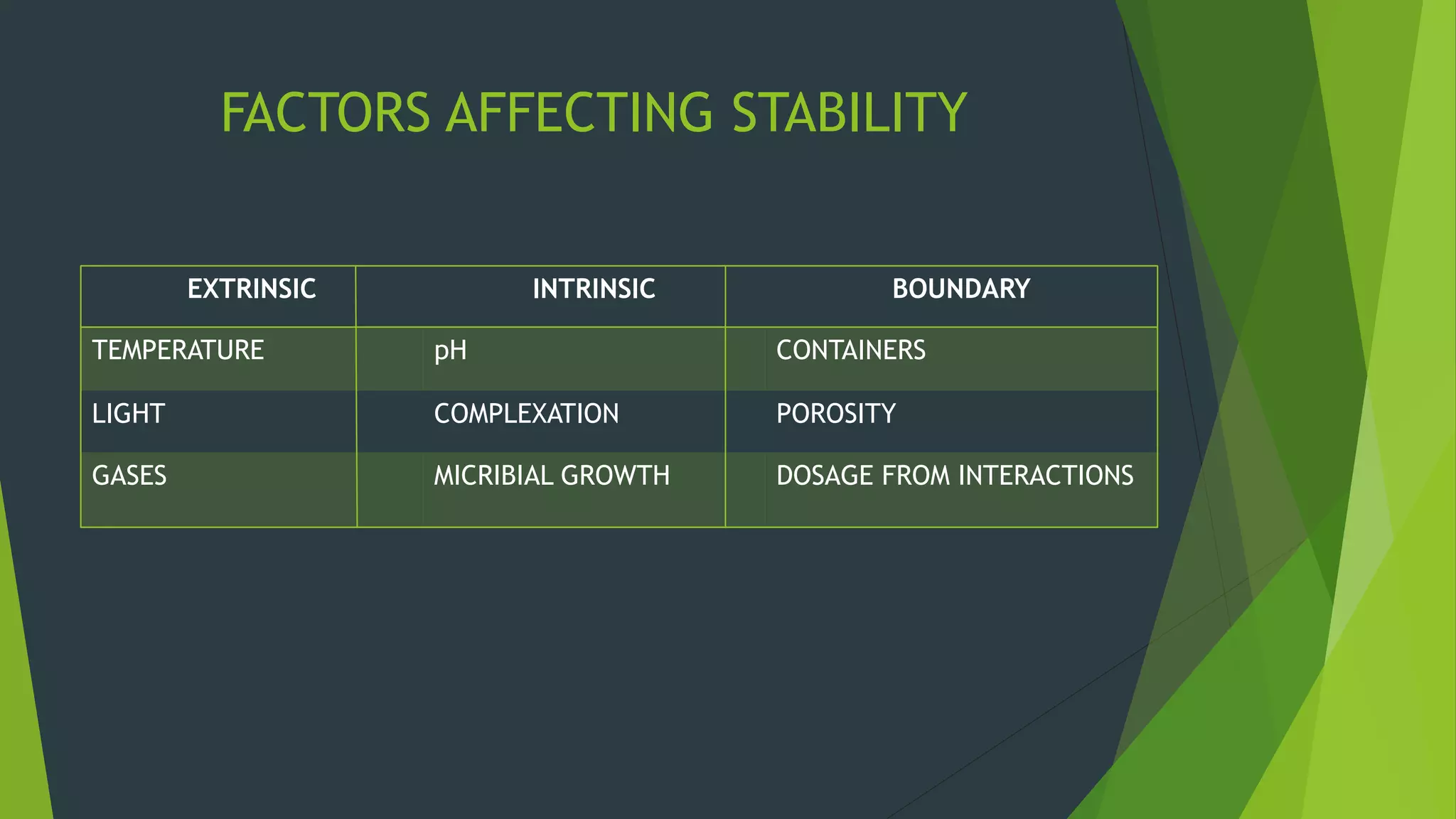
FACTORS AFFECTING STABILITY
EXTRINSIC INTRINSIC BOUNDARY
TEMPERATURE pH CONTAINERS
LIGHT COMPLEXATION POROSITY
GASES MICRIBIAL GROWTH DOSAGE FROM INTERACTIONS
INFLUENCE OF pH ON DEGRADATION
 The magnitude of the rate of hydrolytic reactions catalyzed hydrogen and
hydroxyl ions can vary considerably with pH.
 Hydrogen ions catalysis predominates at the lower pH range whereas hydroxyl
ion catalysis operates at the higher pH range.
 For such a study, product samples are kept at pH 2-12 at one selected
temperature between 55-90degree C for two weeks.
 To determine the influence the pH on the degradative reaction, the
decomposition is measured at several hydrogen ion concentrations.
 The pH of optimum stability can be determined by plotting the log of rate
constant versus pH.
 The point of inflection of such a plot represents the pH of optimum stability.
PHOTO STABILITY STUDIES
 Exposure to sunlight can change the color of product, degrade packaging
leads to chemical decomposition of active ingredient.
 However to study the determines the effects of light on drug product,
samples are placed in open Petri dishes and packaged both clear and amper
containers.
 Controls are placed in light-resistant container such as, amber, glass, foil-
wrapped or in a cardboard box.
 These are placed into a well-vent temperature monitored cabinet of
specified lumens, exposed for at least four weeks and catalyzed.
 Effect on humidity:
 In order to obtain relevant information, it is preferable to employ a range of
humidity.
 This is achieved by preparing salt solution.
 The test is be carried out both final packaged product and the unpacked
material to get information regarding formulation adjuvant, type of
environment suitable for a drug and the type of packing needed.
 Effect of oxygen:
 To study the effect of oxygen, the product samples are placed into containers
are stored at 75-degree Celsius for one week.
 Prior to sealing, the head space is evacuated and purged with an inert gas
such as argon or nitrogen.
 Air head space samples as sample as positive controls.
 Oxidative may be evident by evident by potency loss and or color change.
AUTOCLAVING STUDIES
 For parenteral, determation of stability to autoclaving is necessary.
 Solutions at established pH range are exposed to autoclaving conditions of 121
degree C at 15 psr for 30,45 and 90 mins.
 Studies of microbial quality:
 The presence of microbes in the products posses a stability causing
degradation of drug resulting in dosage impotency or toxic products.
 Bacterial or mold growth is undesirable from therapeutic and an aesthetic
point of view.
 For evaluating microbiological stability, it is necessary to monitor the
preservative content at interval throughout the projected expiration period.
 This can be done of microbial challenge tests and by chemical assays of the
preservatives.
 Products, that do not contain preservatives but require control of microbes
are subjected to microbial limit tests.
DOSAGE FORM FACTORS
 The objective of preformulation studies is to identify compatible,
parenterally useful pharmaceutical excipients, so that a stable formulation
can be developed.
 Three types of dosage forms are there ,if it is a
 Solid state dosage forms: Crystallinity, UV, IR, TLC, HPTLC analysis should be
carried out.
 Semi-solid dosage forms: X-ray crystallinity, particle size, shape and particle
distribution should be found out.
 Liquid dosage forms: pH studies, co-solvent studies are to be carried out. If it
is a suspension-the particle size distribution, sedimentation rate should be
studied out.
EFFECTS OF PACKAGE ON STABILITY
 The package has been described as an economical method of providing
convenience, identification, presentation and protected for a given product
until such time that is consumed.
 Protection is the main emphasis for packaging pharmaceutical products and
should act to protect the drug during product shelf-life.
 The commonly used packaging materials include glass, metal, plastic and
rubber.
 For solid dosage forms: Strip and blister packaging are used.
 Containers are made up of plastic or bottle, even silica bag is used to avoid
the absorbency of moisture.
 For liquid dosage forms: Bottles are most commonly used.
 For air resistance, moisture resistance, amber colored bottles are used.
 Blue colored bottled are used for milk of magnesia.
 Respective tests should be carried out.
 For semi-solid dosage forms: Collapsible tubes are used as a container which
is made up of plastic .
 Respective tests should be carried out.
STORAGE CONDITIONS
 The storage information can be found on the label of the immediate pack or
subsequent package.
 The pharmacist should be highly concerned about maintaining the integrity of
the product and necessity of storing it in the proper environment.
 In addition to this general storage restrictions should be given to certain
individual drug applicable to particular drug product.
 When no specific compendia storage directions or limitations is provided, it is
understood that the storage conditions include protection from moisture,
freezing and excessive heat.
 Expiration date is meaningless unless accompanied by labelled direction for
storage under controlled condition.
 The following tables give the data recurred for long term and other stability
studies.
CLIMATIC ZONES STORAGE CONDITIONS
TEMPERATURE
[Degree C]
RH
[%]
Temperature climate 19 40-60
Mediterranean and Sub-tropical
climate
26 60-65
Hot and dry climate 31 <65
Hot and humid climate 31 >65
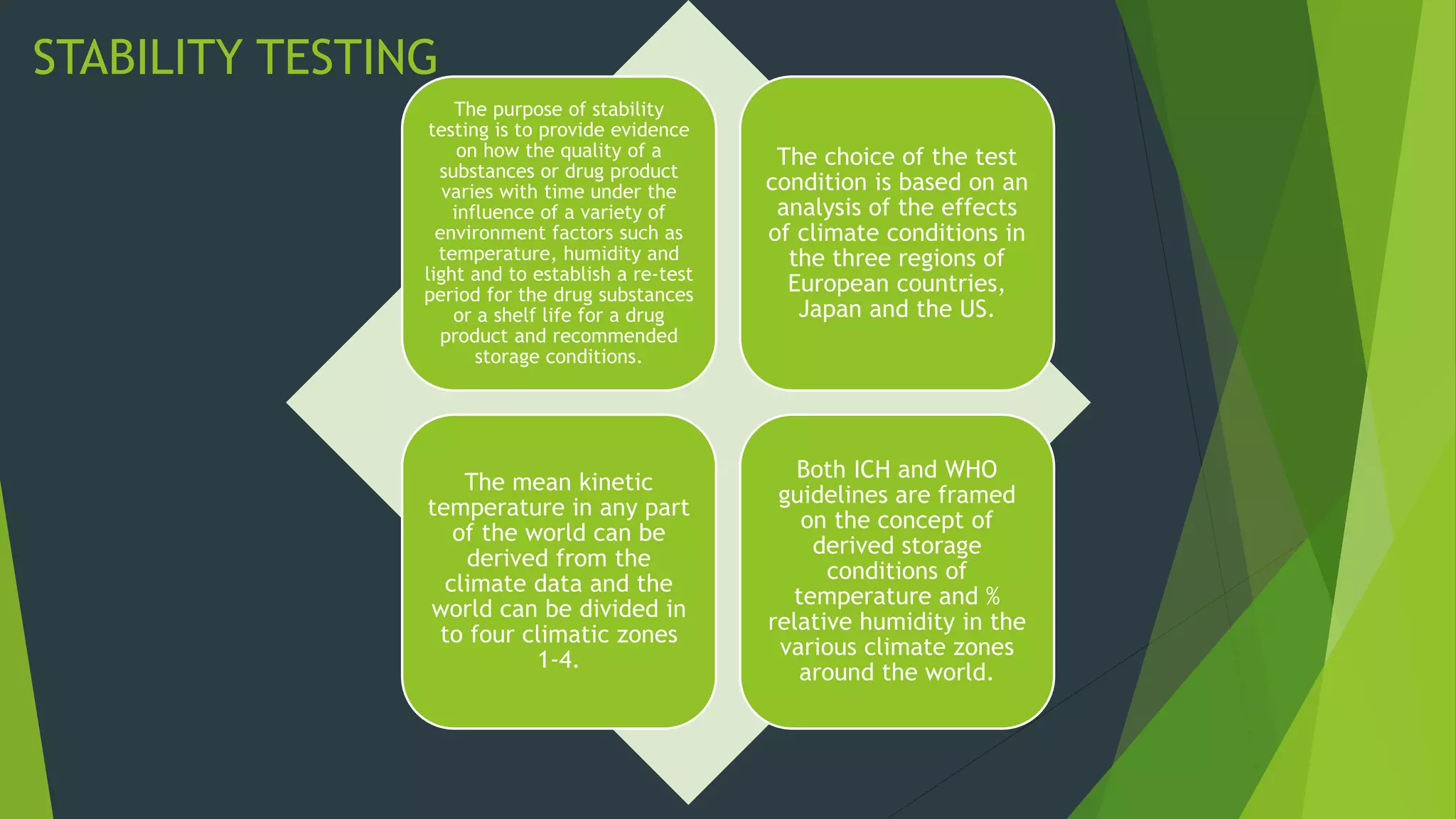
STABILITY TESTING
The purpose of stability
testing is to provide evidence
on how the quality of a
substances or drug product
varies with time under the
influence of a variety of
environment factors such as
temperature, humidity and
light and to establish a re-test
period for the drug substances
or a shelf life for a drug
product and recommended
storage conditions.
The choice of the test
condition is based on an
analysis of the effects
of climate conditions in
the three regions of
European countries,
Japan and the US.
The mean kinetic
temperature in any part
of the world can be
derived from the
climate data and the
world can be divided in
to four climatic zones
1-4.
Both ICH and WHO
guidelines are framed
on the concept of
derived storage
conditions of
temperature and %
relative humidity in the
various climate zones
around the world.
GENERAL CONSIDERATIONS OF ICH DRUG
STABILITY TESTING GUIDELINES
 Concept: ICH guidelines have been developed to harmonize drug stability data
required to be submitted to registration authorities in ICH countries.
 Agencies involved in development: Drug regulatory authorities and experts
from the pharmaceutical industry.
 Countries of application: 17 countries in 3 regions viz. USA,Japan and EC.
 Applicability: New chemical entities and their finished products.
 Stage of development: Final draft endorsed by ICH steering committee on 27th
October,1993.
 Date of implementation: 1st January,1998.
 Contents: Preamble, Objective, Scope, Drug Substances, General, Stress
Testing, Formal Studies, Selection of Batches, Test Procedures, Specifications,
Storage Conditions, Testing Frequency, Packaging Containers, Evaluation,
Statements/Labeling, Drug Products.
TECHNICAL FEATURES OF ICH DRUG STABILITY
TESTING GUIDELINES
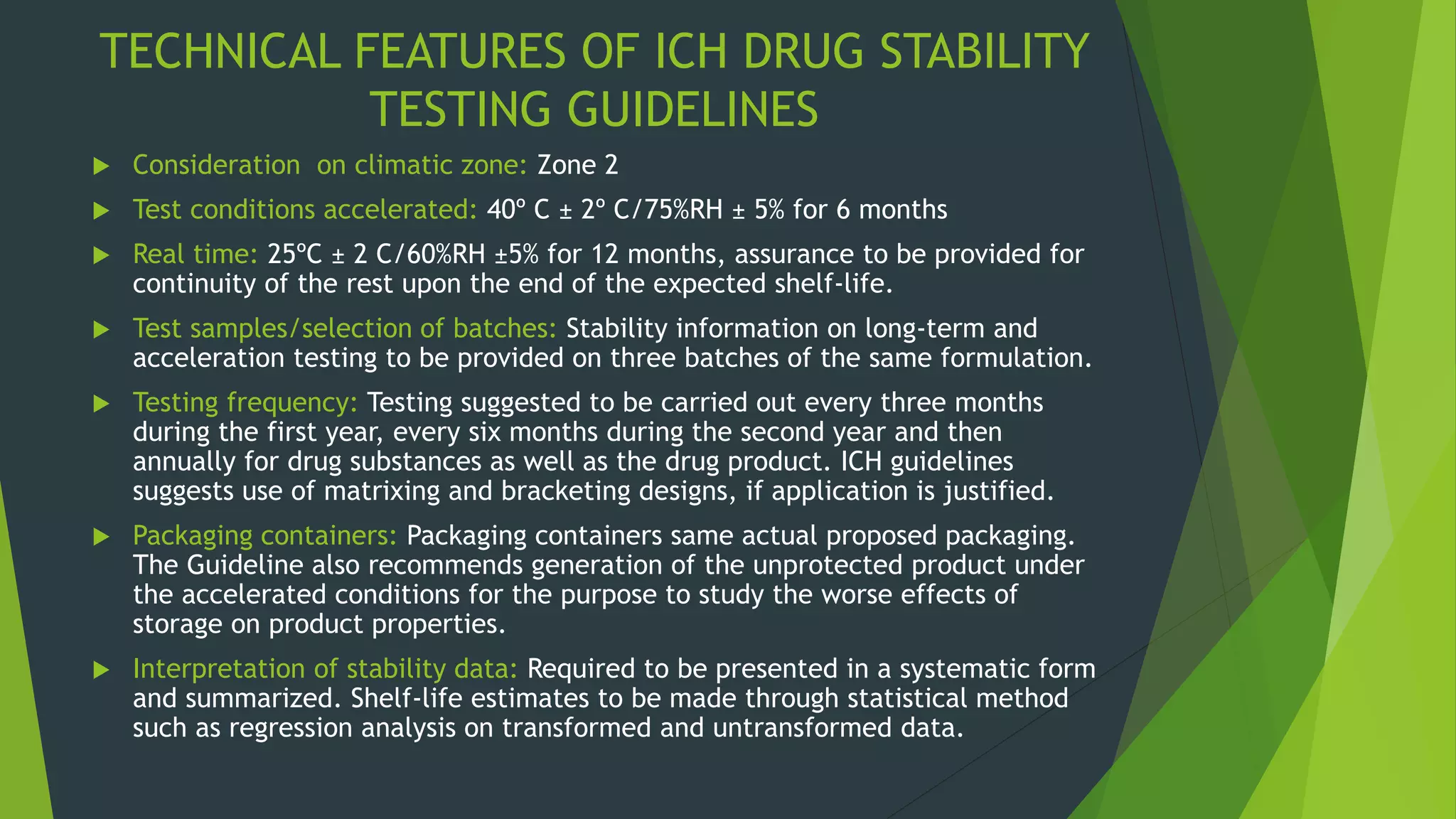
 Consideration on climatic zone: Zone 2
 Test conditions accelerated: 40º C ± 2º C/75%RH ± 5% for 6 months
 Real time: 25ºC ± 2 C/60%RH ±5% for 12 months, assurance to be provided for
continuity of the rest upon the end of the expected shelf-life.
 Test samples/selection of batches: Stability information on long-term and
acceleration testing to be provided on three batches of the same formulation.
 Testing frequency: Testing suggested to be carried out every three months
during the first year, every six months during the second year and then
annually for drug substances as well as the drug product. ICH guidelines
suggests use of matrixing and bracketing designs, if application is justified.
 Packaging containers: Packaging containers same actual proposed packaging.
The Guideline also recommends generation of the unprotected product under
the accelerated conditions for the purpose to study the worse effects of
storage on product properties.
 Interpretation of stability data: Required to be presented in a systematic form
and summarized. Shelf-life estimates to be made through statistical method
such as regression analysis on transformed and untransformed data.
GENERAL CONSIDERATIONS OF WHO DRUG
STABILITY TESTING GUIDELINES
 Concept: WHO guidelines similarly are meant to harmonize drug stability
requirements of registration authorities in WHO associated countries.
 Agencies involed in development: WHO expert committee involving regulatory
authorities, scientists and the pharmaceutical industries.
 Countries of application: Global,meant to cover 170 WHO member states
outside the ICH exercise.
 Applicability: Pharmaceutical products containing well established drug
substances in conventional dosage forms.
 Stage of development: Appeared recently as Annexure 4 to the report of 34th
meeting of Expert Committee on Specifications for Pharmaceutical
preparations.
 Date of implementation: Not available.
 Contents: General, Definition of Terms, Purpose of Stability Testing, In the
development phase for the registration dossier in the post-registration period,
Intended market, Design of stability studies, Real time studies, Frequency of
testing and evaluation of test results, Analytical methods, Stability Report,
Shelf-life and recommended storage conditions, References, Appendix 1
Survey of stability of pharmaceutical preparations included in the WHO model
list of essential drugs.
TECHNICAL FEATURES OF WHO DRUG
STABILITY TESTING GUIDELINES
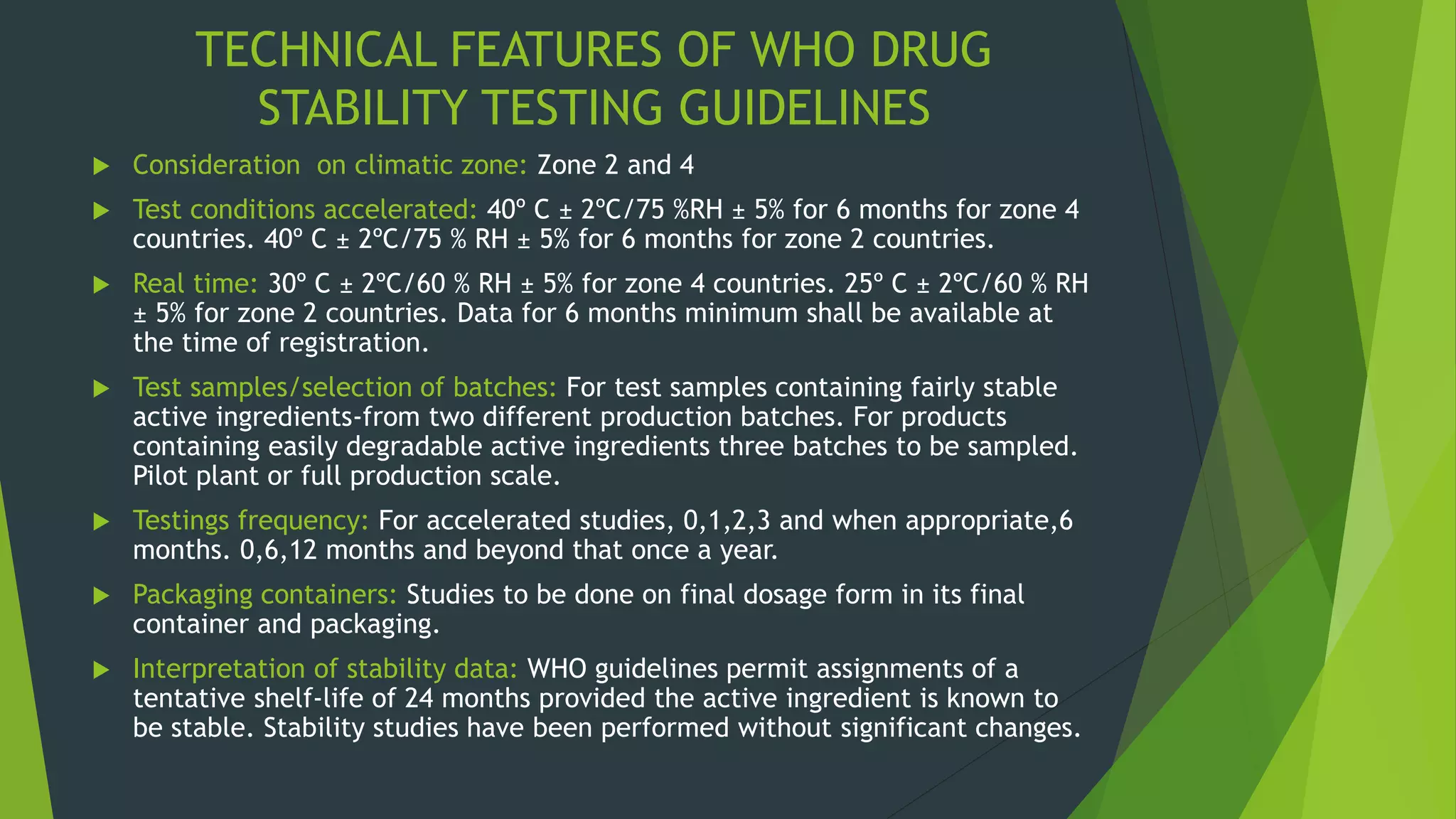
 Consideration on climatic zone: Zone 2 and 4
 Test conditions accelerated: 40º C ± 2ºC/75 %RH ± 5% for 6 months for zone 4
countries. 40º C ± 2ºC/75 % RH ± 5% for 6 months for zone 2 countries.
 Real time: 30º C ± 2ºC/60 % RH ± 5% for zone 4 countries. 25º C ± 2ºC/60 % RH
± 5% for zone 2 countries. Data for 6 months minimum shall be available at
the time of registration.
 Test samples/selection of batches: For test samples containing fairly stable
active ingredients-from two different production batches. For products
containing easily degradable active ingredients three batches to be sampled.
Pilot plant or full production scale.
 Testings frequency: For accelerated studies, 0,1,2,3 and when appropriate,6
months. 0,6,12 months and beyond that once a year.
 Packaging containers: Studies to be done on final dosage form in its final
container and packaging.
 Interpretation of stability data: WHO guidelines permit assignments of a
tentative shelf-life of 24 months provided the active ingredient is known to
be stable. Stability studies have been performed without significant changes.
Drug  stability  studies

Drug stability studies

  • 1.
    DRUG STABILITY STUDIES T.ABARAJITHAMr.S.MUTHUKUMAR,M.Pharm., Final year B.Pharm., ASSISTANT PROFESSOR, KMCH COLLEGE OF PHARMACY
  • 2.
    INTRODUCTION  The termstability with respect to drug dosage forms refers to chemical and physical integrity of the dosage form unit and its ability to offer protection against microbial contamination .  The degradation occurs mainly because of the chemical reaction of the active ingrediants or the additives .  Stability can be defined as the capacity of the drug product to remain within specifications established to ensure identity ,strength ,quality and purity .  The ability of the product to resist deterioration .  The stability of the product is expressed as the expiry period or shelf life .  Time requied for the concentration of the reactant to reduce to 90% of its initial concentration .  Shelf life is expressed as t90 and has the units of time or concentration .
  • 3.
    IMPORTANCE OF STABILITYSTUDIES  This is an assurance given by the manufacturer that the patient would receive an uniform dose throughout the shelf life .  Stability testing prevents the possibility of the marketing an unstable product both physical and chemical degradation of the drug can result in unstable product .
  • 4.
    PHYSICAL DEGRADATION  Physicaldegradation may be due to ,  Loss of volatile constituents - example : nitroglycerine tablets.  Loss of water - example : an effervescent supstance loose water.  Absorption of water – example : calcium chloride – a deliquescent substance absorbs water .  Crystals growth – example : 10% w/v calcium gluconate injection gives precipitation ad undergo crystallization due to supersaturated solution .  Colour change – example : aspirin tablets becomes pink and ascorbic acid tablets turns yellowish brown when exposed to air .
  • 5.
    CHEMICAL DEGRADATION  Maybe due to functional group present . Some of them are ,  Hydrolysis [aspirin and procaine]  Oxidation [ascorbaic acid vegetable oil ]  Isomerisation [(-) adrenaline is more active and (+) adrenaline is more potent .trans vitamin A palmitate is more active .  Absorption of Carbondioxide – sodium hexabarbitone IV INJECTION .  Decarboxylation – procain gives a dark colored liquid due to loss of carbondioxide .
  • 6.
    PURPOSE OF STABILITYSTUDIES  Stability studies are done to understand how to design a product and its packaging such that product has appropriate physical, chemical and microbiological properties during a defined shelf life when stored and used .
  • 7.
    ROUTES OF DEGRADATION The major routes of drug degradation are summarized in the following,  Oxidation :-  Addition of antioxidant  Adjustment of pH  Providing inert environment  Hydrolysis :-  Adjustment of pH  Use of non-aqueous solvents  Use of complexing agent  Photo chemical degradation :-  Strored in amber colored container  Use of opaque wrapper  Use of opacifiers and incorporation of UV light absobers .
  • 8.
    ROUTES OF DEGRADATION Racermization acylation decarboxylation solute - formation polymerization polymorphism
  • 9.
    HYDROLYSIS  Many pharmaceuticalscontain ester or amide functional group which undergo hydrolysis in solution .  Examples of drugs that tend to degrade by hydrolytic cleavage of an ester or amide linkage are anesthetics ,antibiotics ,vitamins and barbiturates .  Ester hydrolysis :-  The hydrolysis of an into a mixture of an acid and alcohol essesntial involves the rupture of a covalent between a carbon atom and an oxygen atom .  Amide hydrolysis :-  Pharmaceutical compounds containing an amide group can undergo hydrolysis resulting in the formlation of an acid and an amine .
  • 10.
    ASPIRIN HYDROLYSIS  ThepH of optimum stability is at 2.4  At a pH of 5 – 7 the degradation reaction reaction is essential pH - independent and a pH above 10 , the stability of aspirin is found to decreased rapidly with increase in pH. 1. pH:- if physiological permissible ,the solution of the drug should be formulated as close possible to its pH of optimum stability . 2. Type of solvent :- partial or full replacement of water with a solvent of lower dielectric constant generally causes a considerable decrease in the velocity of ester hydrolysis . 3. Complexation :- the hydrolysis rates may be influenced in two ways by complex and mannitol solution and substituted amides . 4. Surfactants :- non – ionic , cation and anionic surfactans stabilize the durg against base catalysis . 5. Modification of chemical structure :- by increasing the length of or by branching the acyl alkyl chain , the rate of hydrolysis of the ester usually decrease , owing to steric hindrance . 6. Salts and esters :- another technique that is sometimes employed to increase the stability of pharmaceuticals undergoing degradation through ester hydrolysis to reduce their solubility by forming less soluble ester of the drug.
  • 11.
    RING ALTERATION  Ahydrolytic reaction can proceed as a result of ring cleavage with subsequent attack by hydrogen or hydroxyl ion.  Examples of that have been reported to undergo hydrolysis by this mechanism include hydrochlorthiazides, pilocarpine and reserpine.  Example: The hydrolysis of pilocarpine in aqueous solution has been reported to involve a cyclic equilibrium process, which is catalyzed by hydrogen ion and hydroxyl ion.  The concentration pilocarpate and pilocarpic acid are influenced by pH.  Pilocarpine is relatively stable in solutions of acidic pH. As the pH increases, pilocarpine progressively becomes unstable.
  • 12.
    OXIDATION-REDUCTION  The oxidativedecomposition of pharmaceuticals compounds is responsible for the instability of a considerable number of pharmaceutical preparations.  For example: steroids, vitamins, antibiotics and epinephrine undergo oxidative degration. These reaction are mediated either by free radicals or by molecular oxygen.  A substance is said to be oxidixed if electrons are removed from it. Oxidation often involves the addition of oxygen or the removal of hydrogen.  Heavy metals,particularly those prossessing two or more valency state, with suitable oxidation-reduction potential between them (copper,iron,cobalt and nickel) generally catalyze oxidative deteriorations.  These metals reduce the length of the induction period the time in which no measurable oxidation occurs and increase the maximum rate of oxidation.  Many oxidations are catalyzed by hydrogen and hydroxyl ions.  Example: Quinone to hydroquinone.
  • 13.
     Although theoxygen concentration is of importance in the auto-oxidation process, its significance is usually not adequately considered. For the most part, oxidative degradations to pharmaceutical compounds follow first order or second order kinetics expressions.  The solutions not containing any chelating agent degraded more rapidly as the buffer concentration increased, while the buffered solution containing chelating agents showed that the rate of degradation was independent of the concentration of the buffer.  Ranicity, which can affect nearly all oils and fats is a widely known term covering many typical off-flavours formed by the auto-oxidation of unsaturated fatty acids present in an oil or fat.  These off-flavours have a more or less distinct odour and are due to the volatile compounds that are formed upon oxidation of the oils and fats.  These volatile compounds are generally short chain monomers that are formed by cleavage of the non-volatile hydroperoxide primary oxidation product.  Determination of iodine numbers can be employed as an indication of whether oxidation takes place across the double bond.  The stability of pharmaceutical compounds undergoing oxidative degradation can be increased by several approaches.
  • 14.
    ANTI-OXIDANTS  The effectof antioxidants is to break up the chains formed due to propagation process by providing a hydrogen atom or an electron.  Water soluble antioxidants act by preferentially undergoing in place of the drug.  Oil-soluble anti oxidants and serve as free radical acceptors and inhibit the free radical chain process.  Antioxidants commonly used for aqueous systems are:  Sodium sulfite, sodium dioxide, thioglycolic acid, Sodium metabisulfite, ascorbic acid, sodium thiosulfite, sodium bisulfite, thioglycerol, cysteine hydrochloride.  Antioxidants commonly used for oil systems are:  Ascorbyl palmilate, butylated hydroxyl toluene, hydroquinone, alpha- tocopherol, propyl gallate, lecithin.
  • 15.
    CHELATING AGENTS  Chelatingagents tends to form complexes with the trace amount of heavy metal ions inactivating their catalytic activity in the oxidation of medications.  Examples of some chelating agents are ethylenediamine, tetracetic acids derivatives and salts, dihydroxy ethyl glycerine, citric acid and tartaric acid.  pH:  It is desirable to buffer solutions containing ingredients that are readily oxidizable to a pH in the acid range.  This causes an increase of the oxidation potential of the system with a concurrent increase in stability when oxidations are catalyzed by hydrogen or hydroxyl ion.  The pH of optimum stability in the acid range, however, must be determined experimentally for each drug.  Solvent:  Solvents other than water may have a catalyzing effect on oxidation reactions when used in combination with water or alone.  For example, aldehyde, ethers and ketones may be influence free radical reactions significantly.
  • 16.
    RACEMIZATION  A racemizationis a reaction in which, an optically active substance loses its optical activity without changing its chemical composition.  This reaction is important to the stability of pharmaceutical formulations, since the biologic effect of the dextro form can be considerably less than that of the levo form.  For example, levo adrenaline is 15 to 20 times more than dextro-adrenaline.  Racemization reaction, in general, undergo degradation in accordance with first-order kinetics principle.  The Racemization of a compound appears to depend upon on the functional group bound to the asymmetric carbon atom.  Aromatic groups tend to accelerate the racemization process.
  • 17.
    FACTORS AFFECTING STABILITY EXTRINSICINTRINSIC BOUNDARY TEMPERATURE pH CONTAINERS LIGHT COMPLEXATION POROSITY GASES MICRIBIAL GROWTH DOSAGE FROM INTERACTIONS
  • 18.
    INFLUENCE OF pHON DEGRADATION  The magnitude of the rate of hydrolytic reactions catalyzed hydrogen and hydroxyl ions can vary considerably with pH.  Hydrogen ions catalysis predominates at the lower pH range whereas hydroxyl ion catalysis operates at the higher pH range.  For such a study, product samples are kept at pH 2-12 at one selected temperature between 55-90degree C for two weeks.  To determine the influence the pH on the degradative reaction, the decomposition is measured at several hydrogen ion concentrations.  The pH of optimum stability can be determined by plotting the log of rate constant versus pH.  The point of inflection of such a plot represents the pH of optimum stability.
  • 19.
    PHOTO STABILITY STUDIES Exposure to sunlight can change the color of product, degrade packaging leads to chemical decomposition of active ingredient.  However to study the determines the effects of light on drug product, samples are placed in open Petri dishes and packaged both clear and amper containers.  Controls are placed in light-resistant container such as, amber, glass, foil- wrapped or in a cardboard box.  These are placed into a well-vent temperature monitored cabinet of specified lumens, exposed for at least four weeks and catalyzed.  Effect on humidity:  In order to obtain relevant information, it is preferable to employ a range of humidity.  This is achieved by preparing salt solution.  The test is be carried out both final packaged product and the unpacked material to get information regarding formulation adjuvant, type of environment suitable for a drug and the type of packing needed.
  • 20.
     Effect ofoxygen:  To study the effect of oxygen, the product samples are placed into containers are stored at 75-degree Celsius for one week.  Prior to sealing, the head space is evacuated and purged with an inert gas such as argon or nitrogen.  Air head space samples as sample as positive controls.  Oxidative may be evident by evident by potency loss and or color change.
  • 21.
    AUTOCLAVING STUDIES  Forparenteral, determation of stability to autoclaving is necessary.  Solutions at established pH range are exposed to autoclaving conditions of 121 degree C at 15 psr for 30,45 and 90 mins.  Studies of microbial quality:  The presence of microbes in the products posses a stability causing degradation of drug resulting in dosage impotency or toxic products.  Bacterial or mold growth is undesirable from therapeutic and an aesthetic point of view.  For evaluating microbiological stability, it is necessary to monitor the preservative content at interval throughout the projected expiration period.  This can be done of microbial challenge tests and by chemical assays of the preservatives.  Products, that do not contain preservatives but require control of microbes are subjected to microbial limit tests.
  • 22.
    DOSAGE FORM FACTORS The objective of preformulation studies is to identify compatible, parenterally useful pharmaceutical excipients, so that a stable formulation can be developed.  Three types of dosage forms are there ,if it is a  Solid state dosage forms: Crystallinity, UV, IR, TLC, HPTLC analysis should be carried out.  Semi-solid dosage forms: X-ray crystallinity, particle size, shape and particle distribution should be found out.  Liquid dosage forms: pH studies, co-solvent studies are to be carried out. If it is a suspension-the particle size distribution, sedimentation rate should be studied out.
  • 23.
    EFFECTS OF PACKAGEON STABILITY  The package has been described as an economical method of providing convenience, identification, presentation and protected for a given product until such time that is consumed.  Protection is the main emphasis for packaging pharmaceutical products and should act to protect the drug during product shelf-life.  The commonly used packaging materials include glass, metal, plastic and rubber.  For solid dosage forms: Strip and blister packaging are used.  Containers are made up of plastic or bottle, even silica bag is used to avoid the absorbency of moisture.  For liquid dosage forms: Bottles are most commonly used.  For air resistance, moisture resistance, amber colored bottles are used.  Blue colored bottled are used for milk of magnesia.  Respective tests should be carried out.  For semi-solid dosage forms: Collapsible tubes are used as a container which is made up of plastic .  Respective tests should be carried out.
  • 24.
    STORAGE CONDITIONS  Thestorage information can be found on the label of the immediate pack or subsequent package.  The pharmacist should be highly concerned about maintaining the integrity of the product and necessity of storing it in the proper environment.  In addition to this general storage restrictions should be given to certain individual drug applicable to particular drug product.  When no specific compendia storage directions or limitations is provided, it is understood that the storage conditions include protection from moisture, freezing and excessive heat.  Expiration date is meaningless unless accompanied by labelled direction for storage under controlled condition.  The following tables give the data recurred for long term and other stability studies.
  • 25.
    CLIMATIC ZONES STORAGECONDITIONS TEMPERATURE [Degree C] RH [%] Temperature climate 19 40-60 Mediterranean and Sub-tropical climate 26 60-65 Hot and dry climate 31 <65 Hot and humid climate 31 >65
  • 26.
    STABILITY TESTING The purposeof stability testing is to provide evidence on how the quality of a substances or drug product varies with time under the influence of a variety of environment factors such as temperature, humidity and light and to establish a re-test period for the drug substances or a shelf life for a drug product and recommended storage conditions. The choice of the test condition is based on an analysis of the effects of climate conditions in the three regions of European countries, Japan and the US. The mean kinetic temperature in any part of the world can be derived from the climate data and the world can be divided in to four climatic zones 1-4. Both ICH and WHO guidelines are framed on the concept of derived storage conditions of temperature and % relative humidity in the various climate zones around the world.
  • 27.
    GENERAL CONSIDERATIONS OFICH DRUG STABILITY TESTING GUIDELINES  Concept: ICH guidelines have been developed to harmonize drug stability data required to be submitted to registration authorities in ICH countries.  Agencies involved in development: Drug regulatory authorities and experts from the pharmaceutical industry.  Countries of application: 17 countries in 3 regions viz. USA,Japan and EC.  Applicability: New chemical entities and their finished products.  Stage of development: Final draft endorsed by ICH steering committee on 27th October,1993.  Date of implementation: 1st January,1998.  Contents: Preamble, Objective, Scope, Drug Substances, General, Stress Testing, Formal Studies, Selection of Batches, Test Procedures, Specifications, Storage Conditions, Testing Frequency, Packaging Containers, Evaluation, Statements/Labeling, Drug Products.
  • 28.
    TECHNICAL FEATURES OFICH DRUG STABILITY TESTING GUIDELINES  Consideration on climatic zone: Zone 2  Test conditions accelerated: 40º C ± 2º C/75%RH ± 5% for 6 months  Real time: 25ºC ± 2 C/60%RH ±5% for 12 months, assurance to be provided for continuity of the rest upon the end of the expected shelf-life.  Test samples/selection of batches: Stability information on long-term and acceleration testing to be provided on three batches of the same formulation.  Testing frequency: Testing suggested to be carried out every three months during the first year, every six months during the second year and then annually for drug substances as well as the drug product. ICH guidelines suggests use of matrixing and bracketing designs, if application is justified.  Packaging containers: Packaging containers same actual proposed packaging. The Guideline also recommends generation of the unprotected product under the accelerated conditions for the purpose to study the worse effects of storage on product properties.  Interpretation of stability data: Required to be presented in a systematic form and summarized. Shelf-life estimates to be made through statistical method such as regression analysis on transformed and untransformed data.
  • 29.
    GENERAL CONSIDERATIONS OFWHO DRUG STABILITY TESTING GUIDELINES  Concept: WHO guidelines similarly are meant to harmonize drug stability requirements of registration authorities in WHO associated countries.  Agencies involed in development: WHO expert committee involving regulatory authorities, scientists and the pharmaceutical industries.  Countries of application: Global,meant to cover 170 WHO member states outside the ICH exercise.  Applicability: Pharmaceutical products containing well established drug substances in conventional dosage forms.  Stage of development: Appeared recently as Annexure 4 to the report of 34th meeting of Expert Committee on Specifications for Pharmaceutical preparations.  Date of implementation: Not available.  Contents: General, Definition of Terms, Purpose of Stability Testing, In the development phase for the registration dossier in the post-registration period, Intended market, Design of stability studies, Real time studies, Frequency of testing and evaluation of test results, Analytical methods, Stability Report, Shelf-life and recommended storage conditions, References, Appendix 1 Survey of stability of pharmaceutical preparations included in the WHO model list of essential drugs.
  • 30.
    TECHNICAL FEATURES OFWHO DRUG STABILITY TESTING GUIDELINES  Consideration on climatic zone: Zone 2 and 4  Test conditions accelerated: 40º C ± 2ºC/75 %RH ± 5% for 6 months for zone 4 countries. 40º C ± 2ºC/75 % RH ± 5% for 6 months for zone 2 countries.  Real time: 30º C ± 2ºC/60 % RH ± 5% for zone 4 countries. 25º C ± 2ºC/60 % RH ± 5% for zone 2 countries. Data for 6 months minimum shall be available at the time of registration.  Test samples/selection of batches: For test samples containing fairly stable active ingredients-from two different production batches. For products containing easily degradable active ingredients three batches to be sampled. Pilot plant or full production scale.  Testings frequency: For accelerated studies, 0,1,2,3 and when appropriate,6 months. 0,6,12 months and beyond that once a year.  Packaging containers: Studies to be done on final dosage form in its final container and packaging.  Interpretation of stability data: WHO guidelines permit assignments of a tentative shelf-life of 24 months provided the active ingredient is known to be stable. Stability studies have been performed without significant changes.