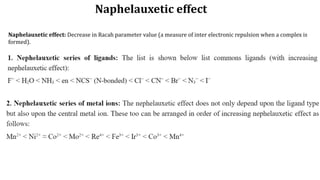
Naphelauxetic effect: Decrease in Racah parameter value (a measure of inter electronic repulsion when a complex is
formed).
Naphelauxetic effect
(NET 2021)
Stability of complexes and reaction mechanism
Stability
(aq. Soln.)
Thermodynamic
Stability
Kinetic Stability
Thermodynamic stability
 Existence of a complex under equilibrium condition.
 It is a measure of tendency of metal ion to form a particular complex ion.
 It is given by formation constant.
 If Kf value is higher, the product will be in higher amount, that is, ligand bind to the metal ion
more strongly than the water.
 If Kf value is lower, the product will be in lower amount, that is, ligand will not bind metal more
strongly than water.
𝛥G=-RTlnKf
 Positive value of Kf will give negative value of 𝛥G.
 Negative value of Kf will give positive value of 𝛥G.
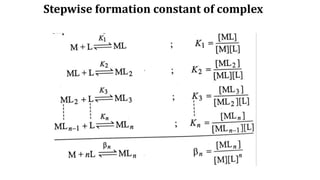
Stepwise formation constant of complex
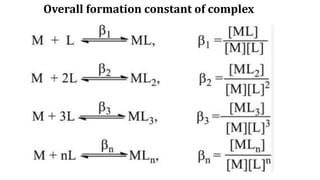
Overall formation constant of complex
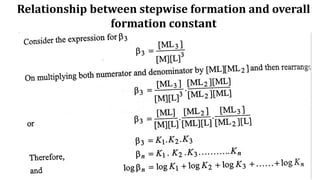
Relationship between stepwise formation and overall
formation constant
K1 > K2 > K3 > K4……..Kn-1 > Kn
 Increase in number of ligands in coordination sphere causes to decrease the number of replaceable water
molecule
 Steric hinderance increases
 Electrostatic factor (in charged ligand)
Factors affecting stability of complexes
 Nature of the central metal ion
Nature of the ligand
The chelate effect
 Macrocyclic effect
Resonance effect
Steric effcet
Nature of the central metal ion
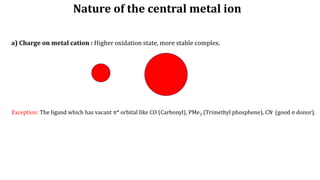
a) Charge on metal cation : Higher oxidation state, more stable complex.
Exception: The ligand which has vacant π* orbital like CO (Carbonyl), PMe3 (Trimethyl phosphene), CN- (good σ donor).
b) Charge on the central metal ion
Stability of complex increase with decrease in size of metal (if oxidation state is the same).
Nature of the central metal ion
Ni
2+ Co2+
Mn2+
Mg2+ Ca2+
Sr2+
Ba2+
Irving - Williams series
Nature of Ligands
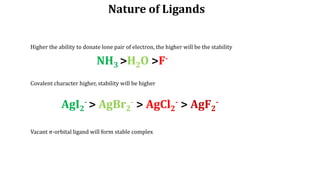
Higher the ability to donate lone pair of electron, the higher will be the stability
NH3 >H2O >F-
Covalent character higher, stability will be higher
AgI2
- > AgBr2
- > AgCl2
- > AgF2
-
Vacant 𝜋-orbital ligand will form stable complex
Chelate effect
𝛥G= 𝛥H-T𝛥S
𝛥G=-RTlnKf
Resonance effect
Steric hinderance effect
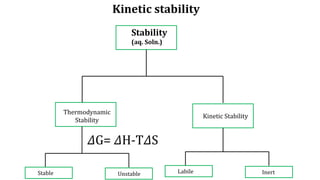
Kinetic stability
Stability
(aq. Soln.)
Thermodynamic
Stability
Kinetic Stability
Kinetic stability
Stable Unstable Labile Inert
𝛥G= 𝛥H-T𝛥S
Kinetic stability

reeaction_mechanism_coordination_complex.pptx