Coordination Compounds
By
Dr. P. Amutha
Assistant Professor
Department of Chemistry
PSGR Krishnammal College for Women
INTRODUCTION
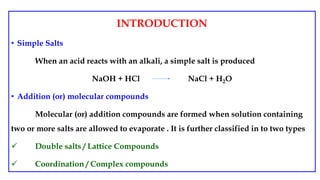
• Simple Salts
When an acid reacts with an alkali, a simple salt is produced
NaOH + HCl NaCl + H2O
• Addition (or) molecular compounds
Molecular (or) addition compounds are formed when solution containing
two or more salts are allowed to evaporate . It is further classified in to two types
 Double salts / Lattice Compounds
 Coordination / Complex compounds
Double Salts Co-ordination compound
These exist only in solid state and dissociate into
constituent species in their solution
Eg: Mohr’s salt: FeSO4.(NH4)2SO4.6H2O
They retain their identity in solid as well in
solution state
They lose their identity in dissolved state
Eg: An aqueous solution of potash alum will give
the tests for K+, Al3+, and SO4
-2
K2SO4.Al2(SO4)3.24H2O →2K++ 2Al+3 + 4SO4
-2+ 24H2O
They do not lose their identity in dissolved state
Their properties are essentially the same as those of
constituent species
Their properties are different from those of their
constituents
Eg: K4[Fe(CN)6] does not show the test of Fe2+ and
CN- ions
Coordination Compounds
• The central metal ion in the complex forms dative (or) coordinate
covalent bonds with the neutral/anionic/cationic species surrounding it
[Fe(CN)6]4-
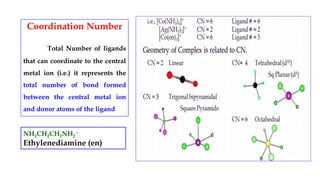
Coordination Number
Total Number of ligands
that can coordinate to the central
metal ion (i.e.) it represents the
total number of bond formed
between the central metal ion
and donor atoms of the ligand
NH2CH2CH2NH2
–
Ethylenediamine (en)
Coordination Sphere
[Fe(CN)6]3- - Comprises of metal ion and ligands
Oxidation State
K3[Fe(CN)6] = 3K+ + [Fe(CN)6]3- [Co(NH3)4Cl2]Cl = [Co(NH3)4Cl2]1+ + Cl-
Oxidation state of Fe = 3 Oxidation state of Co = 3
X + 6 (-1) = -3 X +4 (0)+2 (-1) = +1
X = -3+6 X = +1+2
= 3 = 3
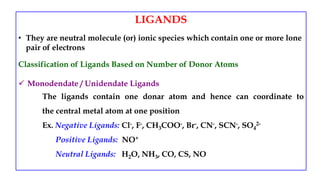
LIGANDS
• They are neutral molecule (or) ionic species which contain one or more lone
pair of electrons
Classification of Ligands Based on Number of Donor Atoms
 Monodendate / Unidendate Ligands
The ligands contain one donar atom and hence can coordinate to
the central metal atom at one position
Ex. Negative Ligands: Cl-, F-, CH3COO-, Br-, CN-, SCN-, SO4
2-
Positive Ligands: NO+
Neutral Ligands: H2O, NH3, CO, CS, NO
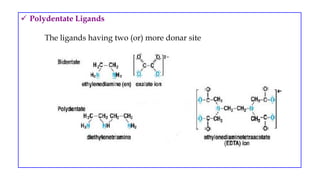
 Polydentate Ligands
The ligands having two (or) more donar site
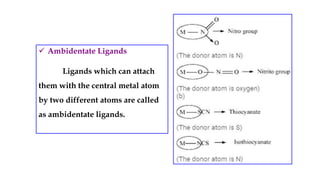
 Ambidentate Ligands
Ligands which can attach
them with the central metal atom
by two different atoms are called
as ambidentate ligands.
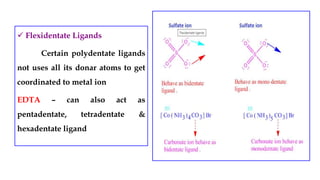
 Flexidentate Ligands
Certain polydentate ligands
not uses all its donar atoms to get
coordinated to metal ion
EDTA – can also act as
pentadentate, tetradentate &
hexadentate ligand
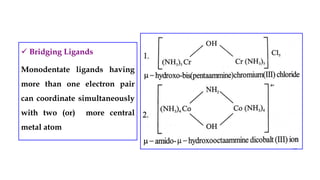
 Bridging Ligands
Monodentate ligands having
more than one electron pair
can coordinate simultaneously
with two (or) more central
metal atom
Naming Metal Complexes
(i)Ligands
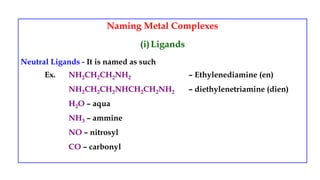
Neutral Ligands - It is named as such
Ex. NH2CH2CH2NH2 – Ethylenediamine (en)
NH2CH2CH2NHCH2CH2NH2 – diethylenetriamine (dien)
H2O – aqua
NH3 – ammine
NO – nitrosyl
CO – carbonyl
Naming Metal Complexes
(i)Ligands
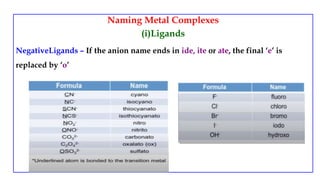
NegativeLigands – If the anion name ends in ide, ite or ate, the final ‘e’ is
replaced by ‘o’
Naming Metal Complexes
(i)Ligands
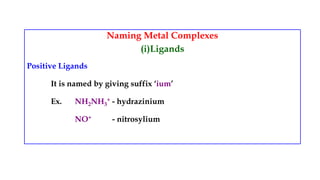
Positive Ligands
It is named by giving suffix ‘ium’
Ex. NH2NH3
+ - hydrazinium
NO+ - nitrosylium
Naming Metal Complexes
(i)Ligands
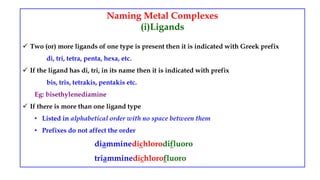
 Two (or) more ligands of one type is present then it is indicated with Greek prefix
di, tri, tetra, penta, hexa, etc.
 If the ligand has di, tri, in its name then it is indicated with prefix
bis, tris, tetrakis, pentakis etc.
Eg: bisethylenediamine
 If there is more than one ligand type
• Listed in alphabetical order with no space between them
• Prefixes do not affect the order
diamminedichlorodifluoro
triamminedichlorofluoro
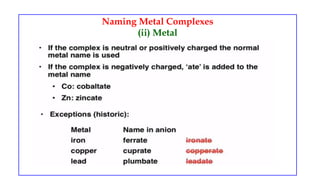
Naming Metal Complexes
(ii) Metal
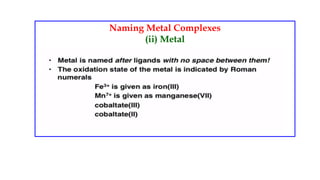
Naming Metal Complexes
(ii) Metal
Naming Metal Complexes
• Counter ions are named as separate words and are not numbered
Anionic Complex
[Cr(en)I4]- - ethylenediamminetetraiodochromate(III) ion
[Zn(OH)4]2- - tetrahydroxozincate(II) ion
K3[Co(CN)6] - potassium hexacyanocobaltate(III)
Cationic Complex
[Ag(NH3)2]+ - diamminesilver(I) ion
[Co(NH3)4Cl2]Cl – tetraamminedichlorocobalt(III) chloride
Neutral Complex
[Ni(CO)4] - tetracarbonylnickel(0)
1. [Cr(NH3)3(H2O)3]Cl3
triamminetriaquachromium(III) chloride
2. [Pt(NH3)5Cl]Br3
pentaamminechloroplatinum(IV) bromide
3. [Pt(H2NCH2CH2NH2)2Cl2]Cl2
dichlorobis(ethylenediamine)platinum(IV) chloride
4. Na2[NiCl4]
sodium tetrachloronickelate(II)
4. [Ag(NH3)2][Ag(CN)2] - diamminesilver(I) dicyanoargentate(I)
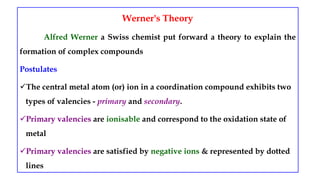
Werner's Theory
Alfred Werner a Swiss chemist put forward a theory to explain the
formation of complex compounds
Postulates
The central metal atom (or) ion in a coordination compound exhibits two
types of valencies - primary and secondary.
Primary valencies are ionisable and correspond to the oxidation state of
metal
Primary valencies are satisfied by negative ions & represented by dotted
lines
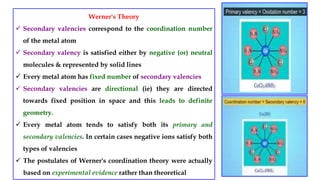
Werner's Theory
 Secondary valencies correspond to the coordination number
of the metal atom
 Secondary valency is satisfied either by negative (or) neutral
molecules & represented by solid lines
 Every metal atom has fixed number of secondary valencies
 Secondary valencies are directional (ie) they are directed
towards fixed position in space and this leads to definite
geometry.
 Every metal atom tends to satisfy both its primary and
secondary valencies. In certain cases negative ions satisfy both
types of valencies
 The postulates of Werner's coordination theory were actually
based on experimental evidence rather than theoretical
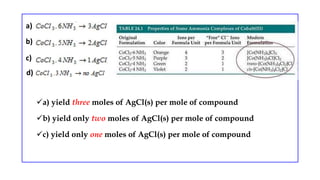
a) yield three moles of AgCl(s) per mole of compound
b) yield only two moles of AgCl(s) per mole of compound
c) yield only one moles of AgCl(s) per mole of compound
a)
b)
d)
c)
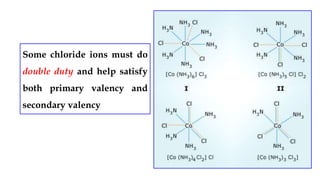
Some chloride ions must do
double duty and help satisfy
both primary valency and
secondary valency
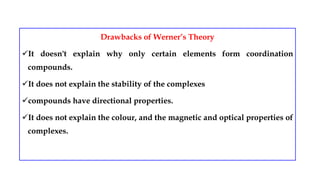
Drawbacks of Werner’s Theory
It doesn't explain why only certain elements form coordination
compounds.
It does not explain the stability of the complexes
compounds have directional properties.
It does not explain the colour, and the magnetic and optical properties of
complexes.
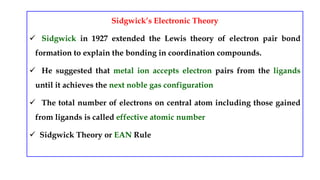
Sidgwick’s Electronic Theory
 Sidgwick in 1927 extended the Lewis theory of electron pair bond
formation to explain the bonding in coordination compounds.
 He suggested that metal ion accepts electron pairs from the ligands
until it achieves the next noble gas configuration
 The total number of electrons on central atom including those gained
from ligands is called effective atomic number
 Sidgwick Theory or EAN Rule
Effective Atomic Number
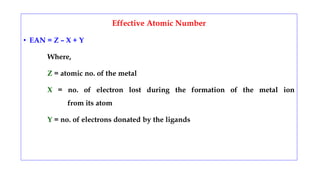
• EAN = Z – X + Y
Where,
Z = atomic no. of the metal
X = no. of electron lost during the formation of the metal ion
from its atom
Y = no. of electrons donated by the ligands
Example 1
EAN of Fe (II) in [Fe(CN)6]4-
Fe (0) atom Z= 26 electrons
Fe (II) ion (Z-X) = 26-2 = 24
Electrons donated by
6 CN- = Y = 2X6 = 12
EAN = Z – X + Y
= 24 + 12 = 36 (Kr)
Example 2
EAN of Pt (IV) in [Pt(NH3)6]4+
Pt (0) atom Z = 78 electrons
Pt (IV) ion (Z-X) = 78 – 4 = 74
Electrons donated by
6 NH3 = Y = 2 X 6 = 12
EAN = Z – X + Y
= 74 + 12 = 86 (Rn)
Draw Backs of Sidgwick Theory
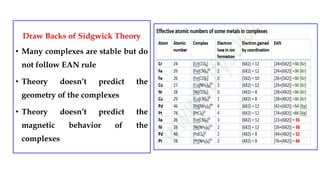
• Many complexes are stable but do
not follow EAN rule
• Theory doesn’t predict the
geometry of the complexes
• Theory doesn’t predict the
magnetic behavior of the
complexes
VALENCE BOND THEORY
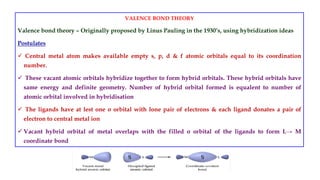
Valence bond theory – Originally proposed by Linus Pauling in the 1930’s, using hybridization ideas
Postulates
 Central metal atom makes available empty s, p, d & f atomic orbitals equal to its coordination
number.
 These vacant atomic orbitals hybridize together to form hybrid orbitals. These hybrid orbitals have
same energy and definite geometry. Number of hybrid orbital formed is equalent to number of
atomic orbital involved in hybridisation
 The ligands have at lest one σ orbital with lone pair of electrons & each ligand donates a pair of
electron to central metal ion
 Vacant hybrid orbital of metal overlaps with the filled σ orbital of the ligands to form L→ M
coordinate bond
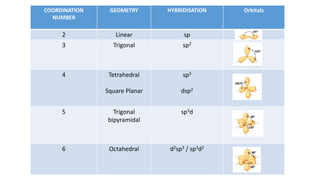
COORDINATION
NUMBER
GEOMETRY HYBRIDISATION Orbitals
2 Linear sp
3 Trigonal sp2
4 Tetrahedral
Square Planar
sp3
dsp2
5 Trigonal
bipyramidal
sp3d
6 Octahedral d2sp3 / sp3d2
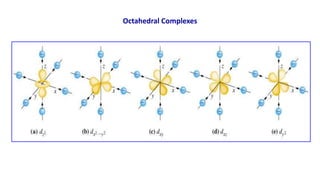
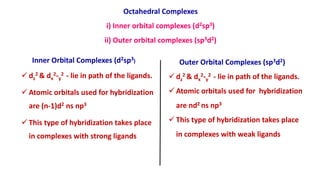
Octahedral Complexes
i) Inner orbital complexes (d2sp3)
ii) Outer orbital complexes (sp3d2)
Inner Orbital Complexes (d2sp3)
 dz
2 & dx
2-y
2 - lie in path of the ligands.
 Atomic orbitals used for hybridization
are (n-1)d2 ns np3
 This type of hybridization takes place
in complexes with strong ligands
Outer Orbital Complexes (sp3d2)
 dz
2 & dx
2-y
2 - lie in path of the ligands.
 Atomic orbitals used for hybridization
are nd2 ns np3
 This type of hybridization takes place
in complexes with weak ligands
Example:
[Fe(CN)6]3- - Hexacyanoferrate(III) ion (paramagnetic with one unpaired electron)
Fe = 3d6 4s2 4p0 & Fe3+ = 3d5 4s0 µ = √n(n+2) BM = √1(1+2) = 1.73 BM
Fe3+
Fe3+ in [Fe(CN)6]3-
[Fe(CN)6]3-
Octahedral d2sp3 Geometry
↑↓ ↑↓ ↑
xx xx xx xx
↑ ↑ ↑ ↑ ↑
mix
d2sp3
↑↓ ↑↓ ↑ xx xx
3d 4s 4p
3d
3d
4s
4s
4p
4p
dx
2-y
2 dz
2
dx
2-y
2 dz
2
Octahedral sp3d2 Geometry
Example:
[CoF6]3- - Hexafluorocobaltate (III) ion (paramagnetic with four unpaired electron)
Co = 3d7 4s2 4p0 & Co3+ = 3d6 4s0 µ = √n(n+2) BM
Co3+
Co3+ in [CoF6]3-
[CoF6]3-
↑↓ ↑ ↑ ↑ ↑
xx xx xx xx
↑↓ ↑ ↑ ↑ ↑
mix
sp3d2
↑↓ ↑ ↑ ↑ ↑
4dz
2 4dx
2-y
2
3d 4s 4p
3d 4s 4p
3d
4s 4p
xx xx
4dz
2 4dx
2-y
2
dx
2-y
2 dz
2
dx
2-y
2 dz
2
Tetrahedral sp3 Geometry
Example:
[MnCl4]2- (paramagnetic with five unpaired electron)
Mn = 3d5 4s2 4p0 & Mn2+ = 3d54s0 µ = √n(n+2) BM = √5(5+2) = 5.9 BM
Mn2+
Mn2+ in [MnCl4]2-
[MnCl4]2-
↑ ↑ ↑ ↑ ↑
xx xx xx xx
↑ ↑ ↑ ↑ ↑
mix
sp3
↑ ↑ ↑ ↑ ↑
3d 4s 4p
3d 4s 4p
3d
4s 4p
Square planar dsp2 Geometry
Example:
[Ni(CN)4]2- (Diamagnetic)
Ni = 3d8 4s2 4p0 & Ni2+ = 3d8 4s0
Ni2+
Ni2+ in [Ni(CN)4]2-
[Ni(CN)4]2-
↑↓ ↑↓ ↑↓ ↑↓
xx xx xx
↑↓ ↑↓ ↑↓ ↑ ↑
mix
dsp2
↑↓ ↑↓ ↑↓ ↑↓ xx
3d 4s py
3d 4s 4p
3d
4s 4p
3 dx
2-y
2 px
4p
Example:
[Cu(NH3)4]2+
Ni = 3d9 4s2 4p0 & Cu2+ = 3d9 4s0
a) Cu2+
b) Cu2+ in [Cu(NH3)4]2+
c) Cu2+ in [Cu(NH3)4]2+
↑↓ ↑↓ ↑↓ ↑↓ ↑
3d 4s 4p
↑↓ ↑↓ ↑↓ ↑↓ ↑
3d 4s 4p pz
↑↓ ↑↓ ↑↓ ↑↓
3d 4s 4p
↑
5s
↑↓ ↑↓ ↑↓ ↑↓ ↑ xx xx xx
3d 4s 4p
xx
5d
dx
2-y
2
sp2d
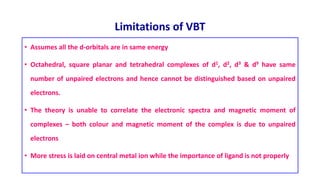
Limitations of VBT
• Assumes all the d-orbitals are in same energy
• Octahedral, square planar and tetrahedral complexes of d1, d2, d3 & d9 have same
number of unpaired electrons and hence cannot be distinguished based on unpaired
electrons.
• The theory is unable to correlate the electronic spectra and magnetic moment of
complexes – both colour and magnetic moment of the complex is due to unpaired
electrons
• More stress is laid on central metal ion while the importance of ligand is not properly

Coordination compounds upto VBT (2).pptx

  • 1.
    Coordination Compounds By Dr. P.Amutha Assistant Professor Department of Chemistry PSGR Krishnammal College for Women
  • 2.
    INTRODUCTION • Simple Salts Whenan acid reacts with an alkali, a simple salt is produced NaOH + HCl NaCl + H2O • Addition (or) molecular compounds Molecular (or) addition compounds are formed when solution containing two or more salts are allowed to evaporate . It is further classified in to two types  Double salts / Lattice Compounds  Coordination / Complex compounds
  • 3.
    Double Salts Co-ordinationcompound These exist only in solid state and dissociate into constituent species in their solution Eg: Mohr’s salt: FeSO4.(NH4)2SO4.6H2O They retain their identity in solid as well in solution state They lose their identity in dissolved state Eg: An aqueous solution of potash alum will give the tests for K+, Al3+, and SO4 -2 K2SO4.Al2(SO4)3.24H2O →2K++ 2Al+3 + 4SO4 -2+ 24H2O They do not lose their identity in dissolved state Their properties are essentially the same as those of constituent species Their properties are different from those of their constituents Eg: K4[Fe(CN)6] does not show the test of Fe2+ and CN- ions
  • 4.
    Coordination Compounds • Thecentral metal ion in the complex forms dative (or) coordinate covalent bonds with the neutral/anionic/cationic species surrounding it [Fe(CN)6]4-
  • 5.
    Coordination Number Total Numberof ligands that can coordinate to the central metal ion (i.e.) it represents the total number of bond formed between the central metal ion and donor atoms of the ligand NH2CH2CH2NH2 – Ethylenediamine (en)
  • 6.
    Coordination Sphere [Fe(CN)6]3- -Comprises of metal ion and ligands Oxidation State K3[Fe(CN)6] = 3K+ + [Fe(CN)6]3- [Co(NH3)4Cl2]Cl = [Co(NH3)4Cl2]1+ + Cl- Oxidation state of Fe = 3 Oxidation state of Co = 3 X + 6 (-1) = -3 X +4 (0)+2 (-1) = +1 X = -3+6 X = +1+2 = 3 = 3
  • 7.
    LIGANDS • They areneutral molecule (or) ionic species which contain one or more lone pair of electrons Classification of Ligands Based on Number of Donor Atoms  Monodendate / Unidendate Ligands The ligands contain one donar atom and hence can coordinate to the central metal atom at one position Ex. Negative Ligands: Cl-, F-, CH3COO-, Br-, CN-, SCN-, SO4 2- Positive Ligands: NO+ Neutral Ligands: H2O, NH3, CO, CS, NO
  • 8.
     Polydentate Ligands Theligands having two (or) more donar site
  • 9.
     Ambidentate Ligands Ligandswhich can attach them with the central metal atom by two different atoms are called as ambidentate ligands.
  • 10.
     Flexidentate Ligands Certainpolydentate ligands not uses all its donar atoms to get coordinated to metal ion EDTA – can also act as pentadentate, tetradentate & hexadentate ligand
  • 11.
     Bridging Ligands Monodentateligands having more than one electron pair can coordinate simultaneously with two (or) more central metal atom
  • 12.
    Naming Metal Complexes (i)Ligands NeutralLigands - It is named as such Ex. NH2CH2CH2NH2 – Ethylenediamine (en) NH2CH2CH2NHCH2CH2NH2 – diethylenetriamine (dien) H2O – aqua NH3 – ammine NO – nitrosyl CO – carbonyl
  • 13.
    Naming Metal Complexes (i)Ligands NegativeLigands– If the anion name ends in ide, ite or ate, the final ‘e’ is replaced by ‘o’
  • 14.
    Naming Metal Complexes (i)Ligands PositiveLigands It is named by giving suffix ‘ium’ Ex. NH2NH3 + - hydrazinium NO+ - nitrosylium
  • 15.
    Naming Metal Complexes (i)Ligands Two (or) more ligands of one type is present then it is indicated with Greek prefix di, tri, tetra, penta, hexa, etc.  If the ligand has di, tri, in its name then it is indicated with prefix bis, tris, tetrakis, pentakis etc. Eg: bisethylenediamine  If there is more than one ligand type • Listed in alphabetical order with no space between them • Prefixes do not affect the order diamminedichlorodifluoro triamminedichlorofluoro
  • 16.
  • 17.
  • 18.
    Naming Metal Complexes •Counter ions are named as separate words and are not numbered Anionic Complex [Cr(en)I4]- - ethylenediamminetetraiodochromate(III) ion [Zn(OH)4]2- - tetrahydroxozincate(II) ion K3[Co(CN)6] - potassium hexacyanocobaltate(III) Cationic Complex [Ag(NH3)2]+ - diamminesilver(I) ion [Co(NH3)4Cl2]Cl – tetraamminedichlorocobalt(III) chloride Neutral Complex [Ni(CO)4] - tetracarbonylnickel(0)
  • 19.
    1. [Cr(NH3)3(H2O)3]Cl3 triamminetriaquachromium(III) chloride 2.[Pt(NH3)5Cl]Br3 pentaamminechloroplatinum(IV) bromide 3. [Pt(H2NCH2CH2NH2)2Cl2]Cl2 dichlorobis(ethylenediamine)platinum(IV) chloride 4. Na2[NiCl4] sodium tetrachloronickelate(II) 4. [Ag(NH3)2][Ag(CN)2] - diamminesilver(I) dicyanoargentate(I)
  • 20.
    Werner's Theory Alfred Wernera Swiss chemist put forward a theory to explain the formation of complex compounds Postulates The central metal atom (or) ion in a coordination compound exhibits two types of valencies - primary and secondary. Primary valencies are ionisable and correspond to the oxidation state of metal Primary valencies are satisfied by negative ions & represented by dotted lines
  • 21.
    Werner's Theory  Secondaryvalencies correspond to the coordination number of the metal atom  Secondary valency is satisfied either by negative (or) neutral molecules & represented by solid lines  Every metal atom has fixed number of secondary valencies  Secondary valencies are directional (ie) they are directed towards fixed position in space and this leads to definite geometry.  Every metal atom tends to satisfy both its primary and secondary valencies. In certain cases negative ions satisfy both types of valencies  The postulates of Werner's coordination theory were actually based on experimental evidence rather than theoretical
  • 22.
    a) yield threemoles of AgCl(s) per mole of compound b) yield only two moles of AgCl(s) per mole of compound c) yield only one moles of AgCl(s) per mole of compound a) b) d) c)
  • 23.
    Some chloride ionsmust do double duty and help satisfy both primary valency and secondary valency
  • 24.
    Drawbacks of Werner’sTheory It doesn't explain why only certain elements form coordination compounds. It does not explain the stability of the complexes compounds have directional properties. It does not explain the colour, and the magnetic and optical properties of complexes.
  • 25.
    Sidgwick’s Electronic Theory Sidgwick in 1927 extended the Lewis theory of electron pair bond formation to explain the bonding in coordination compounds.  He suggested that metal ion accepts electron pairs from the ligands until it achieves the next noble gas configuration  The total number of electrons on central atom including those gained from ligands is called effective atomic number  Sidgwick Theory or EAN Rule
  • 26.
    Effective Atomic Number •EAN = Z – X + Y Where, Z = atomic no. of the metal X = no. of electron lost during the formation of the metal ion from its atom Y = no. of electrons donated by the ligands
  • 27.
    Example 1 EAN ofFe (II) in [Fe(CN)6]4- Fe (0) atom Z= 26 electrons Fe (II) ion (Z-X) = 26-2 = 24 Electrons donated by 6 CN- = Y = 2X6 = 12 EAN = Z – X + Y = 24 + 12 = 36 (Kr) Example 2 EAN of Pt (IV) in [Pt(NH3)6]4+ Pt (0) atom Z = 78 electrons Pt (IV) ion (Z-X) = 78 – 4 = 74 Electrons donated by 6 NH3 = Y = 2 X 6 = 12 EAN = Z – X + Y = 74 + 12 = 86 (Rn)
  • 28.
    Draw Backs ofSidgwick Theory • Many complexes are stable but do not follow EAN rule • Theory doesn’t predict the geometry of the complexes • Theory doesn’t predict the magnetic behavior of the complexes
  • 29.
    VALENCE BOND THEORY Valencebond theory – Originally proposed by Linus Pauling in the 1930’s, using hybridization ideas Postulates  Central metal atom makes available empty s, p, d & f atomic orbitals equal to its coordination number.  These vacant atomic orbitals hybridize together to form hybrid orbitals. These hybrid orbitals have same energy and definite geometry. Number of hybrid orbital formed is equalent to number of atomic orbital involved in hybridisation  The ligands have at lest one σ orbital with lone pair of electrons & each ligand donates a pair of electron to central metal ion  Vacant hybrid orbital of metal overlaps with the filled σ orbital of the ligands to form L→ M coordinate bond
  • 30.
    COORDINATION NUMBER GEOMETRY HYBRIDISATION Orbitals 2Linear sp 3 Trigonal sp2 4 Tetrahedral Square Planar sp3 dsp2 5 Trigonal bipyramidal sp3d 6 Octahedral d2sp3 / sp3d2
  • 31.
  • 32.
    Octahedral Complexes i) Innerorbital complexes (d2sp3) ii) Outer orbital complexes (sp3d2) Inner Orbital Complexes (d2sp3)  dz 2 & dx 2-y 2 - lie in path of the ligands.  Atomic orbitals used for hybridization are (n-1)d2 ns np3  This type of hybridization takes place in complexes with strong ligands Outer Orbital Complexes (sp3d2)  dz 2 & dx 2-y 2 - lie in path of the ligands.  Atomic orbitals used for hybridization are nd2 ns np3  This type of hybridization takes place in complexes with weak ligands
  • 33.
    Example: [Fe(CN)6]3- - Hexacyanoferrate(III)ion (paramagnetic with one unpaired electron) Fe = 3d6 4s2 4p0 & Fe3+ = 3d5 4s0 µ = √n(n+2) BM = √1(1+2) = 1.73 BM Fe3+ Fe3+ in [Fe(CN)6]3- [Fe(CN)6]3- Octahedral d2sp3 Geometry ↑↓ ↑↓ ↑ xx xx xx xx ↑ ↑ ↑ ↑ ↑ mix d2sp3 ↑↓ ↑↓ ↑ xx xx 3d 4s 4p 3d 3d 4s 4s 4p 4p dx 2-y 2 dz 2 dx 2-y 2 dz 2
  • 34.
    Octahedral sp3d2 Geometry Example: [CoF6]3-- Hexafluorocobaltate (III) ion (paramagnetic with four unpaired electron) Co = 3d7 4s2 4p0 & Co3+ = 3d6 4s0 µ = √n(n+2) BM Co3+ Co3+ in [CoF6]3- [CoF6]3- ↑↓ ↑ ↑ ↑ ↑ xx xx xx xx ↑↓ ↑ ↑ ↑ ↑ mix sp3d2 ↑↓ ↑ ↑ ↑ ↑ 4dz 2 4dx 2-y 2 3d 4s 4p 3d 4s 4p 3d 4s 4p xx xx 4dz 2 4dx 2-y 2 dx 2-y 2 dz 2 dx 2-y 2 dz 2
  • 35.
    Tetrahedral sp3 Geometry Example: [MnCl4]2-(paramagnetic with five unpaired electron) Mn = 3d5 4s2 4p0 & Mn2+ = 3d54s0 µ = √n(n+2) BM = √5(5+2) = 5.9 BM Mn2+ Mn2+ in [MnCl4]2- [MnCl4]2- ↑ ↑ ↑ ↑ ↑ xx xx xx xx ↑ ↑ ↑ ↑ ↑ mix sp3 ↑ ↑ ↑ ↑ ↑ 3d 4s 4p 3d 4s 4p 3d 4s 4p
  • 36.
    Square planar dsp2Geometry Example: [Ni(CN)4]2- (Diamagnetic) Ni = 3d8 4s2 4p0 & Ni2+ = 3d8 4s0 Ni2+ Ni2+ in [Ni(CN)4]2- [Ni(CN)4]2- ↑↓ ↑↓ ↑↓ ↑↓ xx xx xx ↑↓ ↑↓ ↑↓ ↑ ↑ mix dsp2 ↑↓ ↑↓ ↑↓ ↑↓ xx 3d 4s py 3d 4s 4p 3d 4s 4p 3 dx 2-y 2 px 4p
  • 37.
    Example: [Cu(NH3)4]2+ Ni = 3d94s2 4p0 & Cu2+ = 3d9 4s0 a) Cu2+ b) Cu2+ in [Cu(NH3)4]2+ c) Cu2+ in [Cu(NH3)4]2+ ↑↓ ↑↓ ↑↓ ↑↓ ↑ 3d 4s 4p ↑↓ ↑↓ ↑↓ ↑↓ ↑ 3d 4s 4p pz ↑↓ ↑↓ ↑↓ ↑↓ 3d 4s 4p ↑ 5s ↑↓ ↑↓ ↑↓ ↑↓ ↑ xx xx xx 3d 4s 4p xx 5d dx 2-y 2 sp2d
  • 38.
    Limitations of VBT •Assumes all the d-orbitals are in same energy • Octahedral, square planar and tetrahedral complexes of d1, d2, d3 & d9 have same number of unpaired electrons and hence cannot be distinguished based on unpaired electrons. • The theory is unable to correlate the electronic spectra and magnetic moment of complexes – both colour and magnetic moment of the complex is due to unpaired electrons • More stress is laid on central metal ion while the importance of ligand is not properly