Stability Of Complexes
Manahil Azam (860138)
Department of Chemistry
2
 Stability means that a complex exist under suitable
and required conditions it can be stored for a long
time.
But this cannot be generalized to all complexes.
 One particular complex may be stable towards a
reagent and highly reactive towards another reagent.
Defining Stability
3
Types Of Stability
There are two types of Stability:
Thermodynamic Stability
Kinetic Stability
Thermodynamic Stability
It is define as the measure of tendency of a metal ion
to selectively form a specific metal complex and is
directly related to the metal – ligand bond energies.
It is also define by two factors:
• Equilibrium constant
(High value then complex is stable)
(Low value then complex is unstable)
• Gib’s free energy (∆𝐺)
(+ve value then complex is stable)
(-ve value then complex is unstable)
4
Kinetic Stability
It is refers to the reactivity or ability of metal complex
to undergo Ligand substitution reaction.
It is also define by two factors:
• Rate of reaction
(Slow then kinetically stable)
(Fast then kinetically unstable)
• Energy of activation
(High value then complex is stable)
(Low value then complex is unstable)
Types of complexes
There are two types:
• Labile – the complex which rapidly exchange their
ligand with other specie.
• Inert – the complex which have ligand exchange
reaction rate is low.
Thermodynamic Stability
Thermodynamic stability of complexes explain on the
basis of two factors:
• Stepwise stability constant (kn)
• Overall stability constant (𝜷)
…………..……………………………….
………….………………………………..
6
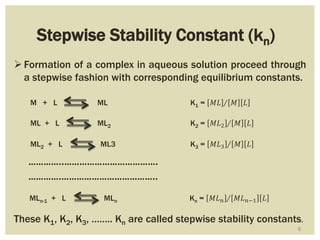
Stepwise Stability Constant (kn)
Formation of a complex in aqueous solution proceed through
a stepwise fashion with corresponding equilibrium constants.
M + L ML K1 = 𝑀𝐿 / 𝑀 𝐿
ML + L ML2 K2 = 𝑀𝐿2 / 𝑀 𝐿
ML2 + L ML3 K3 = 𝑀𝐿3 / 𝑀 𝐿
MLn-1 + L MLn Kn = 𝑀𝐿 𝑛 / 𝑀𝐿 𝑛−1 𝐿
These K1, K2, K3, …….. Kn are called stepwise stability constants.
7
Overall Stability Constant (𝜷)
If the complex formation is considered as a single step
process:
M + nL MLn
𝜷 = 𝑀𝐿 𝑛 / 𝑀 𝐿 n
• If the value of 𝜷 will become high then complex is
thermodynamically stable.
• If its value become low then complex is thermodynamically
unstable.
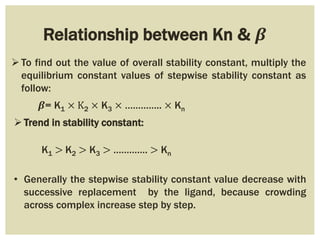
Relationship between Kn & 𝜷
To find out the value of overall stability constant, multiply the
equilibrium constant values of stepwise stability constant as
follow:
𝜷= K1 × K2 × K3 × ………….. × Kn
Trend in stability constant:
K1 > K2 > K3 > …………. > Kn
• Generally the stepwise stability constant value decrease with
successive replacement by the ligand, because crowding
across complex increase step by step.
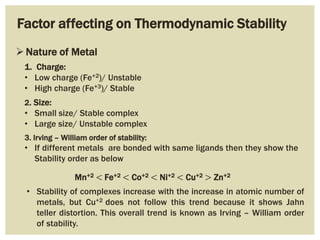
Factor affecting on Thermodynamic Stability
Nature of Metal
1. Charge:
• Low charge (Fe+2)/ Unstable
• High charge (Fe+3)/ Stable
2. Size:
• Small size/ Stable complex
• Large size/ Unstable complex
3. Irving – William order of stability:
• If different metals are bonded with same ligands then they show the
Stability order as below
Mn+2 < Fe+2 < Co+2 < Ni+2 < Cu+2 > Zn+2
• Stability of complexes increase with the increase in atomic number of
metals, but Cu+2 does not follow this trend because it shows Jahn
teller distortion. This overall trend is known as Irving – William order
of stability.
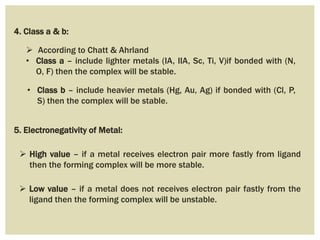
4. Class a & b:
 According to Chatt & Ahrland
• Class a – include lighter metals (IA, IIA, Sc, Ti, V)if bonded with (N,
O, F) then the complex will be stable.
• Class b – include heavier metals (Hg, Au, Ag) if bonded with (Cl, P,
S) then the complex will be stable.
5. Electronegativity of Metal:
 High value – if a metal receives electron pair more fastly from ligand
then the forming complex will be more stable.
 Low value – if a metal does not receives electron pair fastly from the
ligand then the forming complex will be unstable.
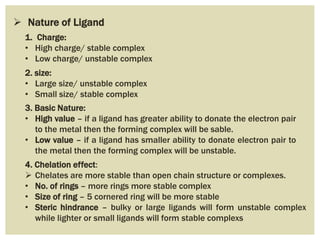
 Nature of Ligand
1. Charge:
• High charge/ stable complex
• Low charge/ unstable complex
2. size:
• Large size/ unstable complex
• Small size/ stable complex
3. Basic Nature:
• High value – if a ligand has greater ability to donate the electron pair
to the metal then the forming complex will be sable.
• Low value – if a ligand has smaller ability to donate electron pair to
the metal then the forming complex will be unstable.
4. Chelation effect:
 Chelates are more stable than open chain structure or complexes.
• No. of rings – more rings more stable complex
• Size of ring – 5 cornered ring will be more stable
• Steric hindrance – bulky or large ligands will form unstable complex
while lighter or small ligands will form stable complexs
Kinetic Stability
Kinetic stability (inertness & lability) of complexes explained
on the basis of two theories:
 According to:
• Valance Bond Theory (VBT)
• Cristal Field Theory (CFT)
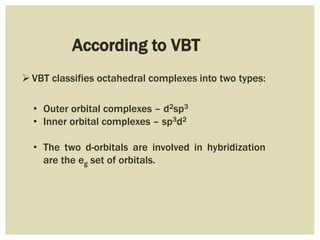
According to VBT
VBT classifies octahedral complexes into two types:
• Outer orbital complexes – d2sp3
• Inner orbital complexes – sp3d2
• The two d-orbitals are involved in hybridization
are the eg set of orbitals.
16
Outer orbital complexes
The complexes having sp3d2 hybridization are called
outer orbital complexes.
In term of VBT these bonds are weaker. It can easily
breakable so, new incoming ligand will replace the old
ligand fastly.
These complexes are generally labile.
17
Inner orbital complexes
These complexes generally have d2sp3 hybridization.
The hybrid orbitals are filled with the ligand electrons.
The t2g orbitals of metal accommodate the d electrons of
the metal.
If the t2g level are left vacant then the complex can
associate with an incoming ligand and the complex is
labile.
If the t2g levels are fully occupied then the complex will be
inert.
According to CFT
According to CFT ligand field splits d – orbitals.
This splitting leads to a decrease in energy of the system
whose magnitude depends on the no. of d – electrons
present.
If the CFSE value increase by association or dissociation of a
ligand then complex is labile.
On the other hand the complex will be inert if CFSE value
decrease.
Factors affecting on Kinetic Stability
1. Charge on Metal:
• High / Inert complex
• Low / Labile complex
2. Size of Metal:
• Small / Inert complex
• Large / Labile complex
3. Coordination no. of complex:
• CN = 04 (Labile complex)
• CN = 06 (Inert complex)
 Following are the factors affect on the Kinetic stability:

San complex stability

  • 1.
    Stability Of Complexes ManahilAzam (860138) Department of Chemistry
  • 2.
    2  Stability meansthat a complex exist under suitable and required conditions it can be stored for a long time. But this cannot be generalized to all complexes.  One particular complex may be stable towards a reagent and highly reactive towards another reagent. Defining Stability
  • 3.
    3 Types Of Stability Thereare two types of Stability: Thermodynamic Stability Kinetic Stability
  • 4.
    Thermodynamic Stability It isdefine as the measure of tendency of a metal ion to selectively form a specific metal complex and is directly related to the metal – ligand bond energies. It is also define by two factors: • Equilibrium constant (High value then complex is stable) (Low value then complex is unstable) • Gib’s free energy (∆𝐺) (+ve value then complex is stable) (-ve value then complex is unstable)
  • 5.
    4 Kinetic Stability It isrefers to the reactivity or ability of metal complex to undergo Ligand substitution reaction. It is also define by two factors: • Rate of reaction (Slow then kinetically stable) (Fast then kinetically unstable) • Energy of activation (High value then complex is stable) (Low value then complex is unstable)
  • 6.
    Types of complexes Thereare two types: • Labile – the complex which rapidly exchange their ligand with other specie. • Inert – the complex which have ligand exchange reaction rate is low.
  • 7.
    Thermodynamic Stability Thermodynamic stabilityof complexes explain on the basis of two factors: • Stepwise stability constant (kn) • Overall stability constant (𝜷)
  • 8.
    …………..………………………………. ………….……………………………….. 6 Stepwise Stability Constant(kn) Formation of a complex in aqueous solution proceed through a stepwise fashion with corresponding equilibrium constants. M + L ML K1 = 𝑀𝐿 / 𝑀 𝐿 ML + L ML2 K2 = 𝑀𝐿2 / 𝑀 𝐿 ML2 + L ML3 K3 = 𝑀𝐿3 / 𝑀 𝐿 MLn-1 + L MLn Kn = 𝑀𝐿 𝑛 / 𝑀𝐿 𝑛−1 𝐿 These K1, K2, K3, …….. Kn are called stepwise stability constants.
  • 9.
    7 Overall Stability Constant(𝜷) If the complex formation is considered as a single step process: M + nL MLn 𝜷 = 𝑀𝐿 𝑛 / 𝑀 𝐿 n • If the value of 𝜷 will become high then complex is thermodynamically stable. • If its value become low then complex is thermodynamically unstable.
  • 10.
    Relationship between Kn& 𝜷 To find out the value of overall stability constant, multiply the equilibrium constant values of stepwise stability constant as follow: 𝜷= K1 × K2 × K3 × ………….. × Kn Trend in stability constant: K1 > K2 > K3 > …………. > Kn • Generally the stepwise stability constant value decrease with successive replacement by the ligand, because crowding across complex increase step by step.
  • 11.
    Factor affecting onThermodynamic Stability Nature of Metal 1. Charge: • Low charge (Fe+2)/ Unstable • High charge (Fe+3)/ Stable 2. Size: • Small size/ Stable complex • Large size/ Unstable complex 3. Irving – William order of stability: • If different metals are bonded with same ligands then they show the Stability order as below Mn+2 < Fe+2 < Co+2 < Ni+2 < Cu+2 > Zn+2 • Stability of complexes increase with the increase in atomic number of metals, but Cu+2 does not follow this trend because it shows Jahn teller distortion. This overall trend is known as Irving – William order of stability.
  • 12.
    4. Class a& b:  According to Chatt & Ahrland • Class a – include lighter metals (IA, IIA, Sc, Ti, V)if bonded with (N, O, F) then the complex will be stable. • Class b – include heavier metals (Hg, Au, Ag) if bonded with (Cl, P, S) then the complex will be stable. 5. Electronegativity of Metal:  High value – if a metal receives electron pair more fastly from ligand then the forming complex will be more stable.  Low value – if a metal does not receives electron pair fastly from the ligand then the forming complex will be unstable.
  • 13.
     Nature ofLigand 1. Charge: • High charge/ stable complex • Low charge/ unstable complex 2. size: • Large size/ unstable complex • Small size/ stable complex 3. Basic Nature: • High value – if a ligand has greater ability to donate the electron pair to the metal then the forming complex will be sable. • Low value – if a ligand has smaller ability to donate electron pair to the metal then the forming complex will be unstable. 4. Chelation effect:  Chelates are more stable than open chain structure or complexes. • No. of rings – more rings more stable complex • Size of ring – 5 cornered ring will be more stable • Steric hindrance – bulky or large ligands will form unstable complex while lighter or small ligands will form stable complexs
  • 14.
    Kinetic Stability Kinetic stability(inertness & lability) of complexes explained on the basis of two theories:  According to: • Valance Bond Theory (VBT) • Cristal Field Theory (CFT)
  • 15.
    According to VBT VBTclassifies octahedral complexes into two types: • Outer orbital complexes – d2sp3 • Inner orbital complexes – sp3d2 • The two d-orbitals are involved in hybridization are the eg set of orbitals.
  • 16.
    16 Outer orbital complexes Thecomplexes having sp3d2 hybridization are called outer orbital complexes. In term of VBT these bonds are weaker. It can easily breakable so, new incoming ligand will replace the old ligand fastly. These complexes are generally labile.
  • 17.
    17 Inner orbital complexes Thesecomplexes generally have d2sp3 hybridization. The hybrid orbitals are filled with the ligand electrons. The t2g orbitals of metal accommodate the d electrons of the metal. If the t2g level are left vacant then the complex can associate with an incoming ligand and the complex is labile. If the t2g levels are fully occupied then the complex will be inert.
  • 18.
    According to CFT Accordingto CFT ligand field splits d – orbitals. This splitting leads to a decrease in energy of the system whose magnitude depends on the no. of d – electrons present. If the CFSE value increase by association or dissociation of a ligand then complex is labile. On the other hand the complex will be inert if CFSE value decrease.
  • 19.
    Factors affecting onKinetic Stability 1. Charge on Metal: • High / Inert complex • Low / Labile complex 2. Size of Metal: • Small / Inert complex • Large / Labile complex 3. Coordination no. of complex: • CN = 04 (Labile complex) • CN = 06 (Inert complex)  Following are the factors affect on the Kinetic stability: