COORDINATION CHEMISTRY-III
R.Mamani
Assistant Professor
Department of Chemistry
Bon Secours College for Women
Thanjavur
INTRODUCTION:
 LABILE AND INERT COMPLEX.
 FACTORS AFFECTING LABILITY.
STABILITY OF COMPLEX.
KINETIC STABILITY.
THERMODYNAMIC STABILITY.
FACTORS AFFECTING STABILITY.
TRANS EFFECT.
POLARISATION THEORY.
PI-BONDING THEORY.
STRUCTURE OF CHLOROPHYLL.
STRUCTURE OF HAEMOGLOBIN.
STRUCTURE OF VITAMIN B12.
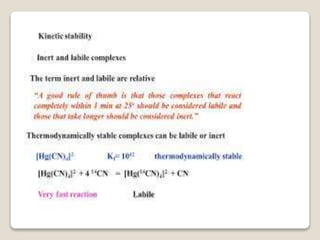
Labile and inertness:
 Complexes in which exchange of one
or more ligands are rapidly exchanged
are called labile complexes.
 If the rate of ligand exchange is slow
then the complex is said to be inert.
 Lability is not related to the
thermodynamic stability of a complex.
 A stable complex may be labile or inert
.so as the unstable complex.
Factors affecting lability of complex:
 size of the central metal ion
smaller the size of the metal ion
greater will be the inertness because the
ligands are held tightly by the metal ion.
 charge of the central metal ion
Greater the charge on the metal
ion greater will be the inertness of the
complex.since the M-L bonds are
stronger.
1. Size of the central metal ion
2. Charge of the central metal ion
Stability of coordination compounds:
 Thermodynamic equilibrium
constant.
 stability depend upon the
interaction between metal and ligand.
 If interaction strong
thermodynamic stability strong.
 Reaction between metal ion and
ligand is based on lewis acid and lewis
base.
 The greater the value of stability
constant more stable is the complex.
Stability of complex:
There are two types of stability of complex
1. Thermodynamic stability
2. kinetic stability
THERMODYNAMIC STABILITY:
• Thermodynamic stability so called stability of
the complex.
• Thermodynamically complexes divided into two
types
1. Stable complex.
2. Unstable complex.
KINETIC STABILITY:
 It refers to the speed with
which the transformations leading
to equilibrium will occur.
 Under this the rates of that the
substitutions;racemisations and
their mechanisms.
 The factors which are affecting
the rates of the reactions are also
studied.
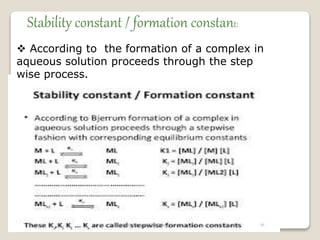
Stability constant / formation constant:
 According to the formation of a complex in
aqueous solution proceeds through the step
wise process.
Factors affecting stability of complex:
Size of the metal ion.
Charge of the metal ion.
Ligand field stabilization
energy.
John teller effect.
Acid base theory.
Basicity of the ligands.
Ph of the solution.
Denticity of the ligand.
Denticity of the chelate
ligand.
Size of ligand.
Macrocyclic effect.
Trans effect:
 Simply the trans effect is the
labilization (making more reactive ) of
ligands that are trans to certain other
ligands .
 which can thus be regarded as trans
directing ligands.
 The trans effect which is often called as
the kinetic trans effect.
 It refers to the observation that certain
ligands increases the rate of ligand.
 This substitution when positioned trans
to the seperating ligands.
Theories of trans effect:
 Two general theory of trans
effect are given below:
 POLARISATION THEORY.
 PI-BONDING THEORY.
POLARISATION THEORY:
 It was given by A.A.GRINBERG(1935).
 It is electrostatic in nature.
 According to this theory. The ligand
by the electrostatic effect.
 This polarisation theory weakens the
bond trans to it.
 This polarisation theory facilitates
the substitution in that position.
Success of polarization theory:
 Although subject to some criticism of
that theory.
 The polarization theory appears to
account nicely for the behavior of the
ligand like hydride methide phenyl and
chloride.
 In these the ligands pi-bonding is
expected to be of the minor importance.
Pi-bonding theory:
 This theory was given by chat in 1995
and orgel in 1956.
 According to this theory vacant pi
and pi* orbitals of the metal (pi and
pi*) to form M-L pi bond.
 In these cases a reduction of the
electron density on the metal.as a
result of the back donation and that
donation from the donation from M-L.
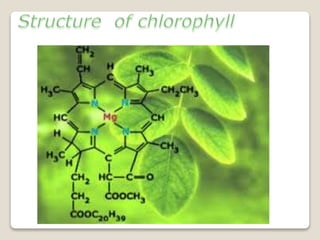
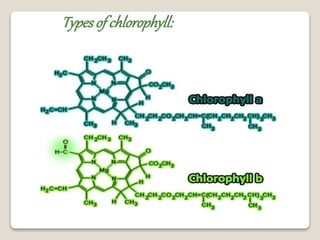
Typesof chlorophyll:
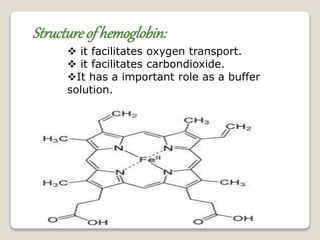
Structure of hemoglobin:
 it facilitates oxygen transport.
 it facilitates carbondioxide.
It has a important role as a buffer
solution.
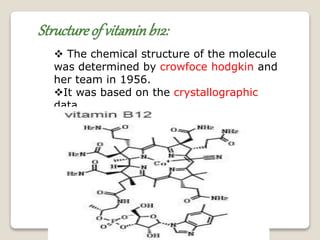
Structure of vitaminb12:
 The chemical structure of the molecule
was determined by crowfoce hodgkin and
her team in 1956.
It was based on the crystallographic
data.
Coordination  chemistry 3

Coordination chemistry 3

  • 1.
    COORDINATION CHEMISTRY-III R.Mamani Assistant Professor Departmentof Chemistry Bon Secours College for Women Thanjavur
  • 2.
    INTRODUCTION:  LABILE ANDINERT COMPLEX.  FACTORS AFFECTING LABILITY. STABILITY OF COMPLEX. KINETIC STABILITY. THERMODYNAMIC STABILITY. FACTORS AFFECTING STABILITY. TRANS EFFECT. POLARISATION THEORY. PI-BONDING THEORY. STRUCTURE OF CHLOROPHYLL. STRUCTURE OF HAEMOGLOBIN. STRUCTURE OF VITAMIN B12.
  • 3.
    Labile and inertness: Complexes in which exchange of one or more ligands are rapidly exchanged are called labile complexes.  If the rate of ligand exchange is slow then the complex is said to be inert.  Lability is not related to the thermodynamic stability of a complex.  A stable complex may be labile or inert .so as the unstable complex.
  • 4.
    Factors affecting labilityof complex:  size of the central metal ion smaller the size of the metal ion greater will be the inertness because the ligands are held tightly by the metal ion.  charge of the central metal ion Greater the charge on the metal ion greater will be the inertness of the complex.since the M-L bonds are stronger. 1. Size of the central metal ion 2. Charge of the central metal ion
  • 5.
    Stability of coordinationcompounds:  Thermodynamic equilibrium constant.  stability depend upon the interaction between metal and ligand.  If interaction strong thermodynamic stability strong.  Reaction between metal ion and ligand is based on lewis acid and lewis base.  The greater the value of stability constant more stable is the complex.
  • 6.
    Stability of complex: Thereare two types of stability of complex 1. Thermodynamic stability 2. kinetic stability THERMODYNAMIC STABILITY: • Thermodynamic stability so called stability of the complex. • Thermodynamically complexes divided into two types 1. Stable complex. 2. Unstable complex.
  • 7.
    KINETIC STABILITY:  Itrefers to the speed with which the transformations leading to equilibrium will occur.  Under this the rates of that the substitutions;racemisations and their mechanisms.  The factors which are affecting the rates of the reactions are also studied.
  • 9.
    Stability constant /formation constant:  According to the formation of a complex in aqueous solution proceeds through the step wise process.
  • 10.
    Factors affecting stabilityof complex: Size of the metal ion. Charge of the metal ion. Ligand field stabilization energy. John teller effect. Acid base theory. Basicity of the ligands. Ph of the solution. Denticity of the ligand. Denticity of the chelate ligand. Size of ligand. Macrocyclic effect.
  • 11.
    Trans effect:  Simplythe trans effect is the labilization (making more reactive ) of ligands that are trans to certain other ligands .  which can thus be regarded as trans directing ligands.  The trans effect which is often called as the kinetic trans effect.  It refers to the observation that certain ligands increases the rate of ligand.  This substitution when positioned trans to the seperating ligands.
  • 12.
    Theories of transeffect:  Two general theory of trans effect are given below:  POLARISATION THEORY.  PI-BONDING THEORY.
  • 13.
    POLARISATION THEORY:  Itwas given by A.A.GRINBERG(1935).  It is electrostatic in nature.  According to this theory. The ligand by the electrostatic effect.  This polarisation theory weakens the bond trans to it.  This polarisation theory facilitates the substitution in that position.
  • 14.
    Success of polarizationtheory:  Although subject to some criticism of that theory.  The polarization theory appears to account nicely for the behavior of the ligand like hydride methide phenyl and chloride.  In these the ligands pi-bonding is expected to be of the minor importance.
  • 15.
    Pi-bonding theory:  Thistheory was given by chat in 1995 and orgel in 1956.  According to this theory vacant pi and pi* orbitals of the metal (pi and pi*) to form M-L pi bond.  In these cases a reduction of the electron density on the metal.as a result of the back donation and that donation from the donation from M-L.
  • 18.
  • 19.
    Structure of hemoglobin: it facilitates oxygen transport.  it facilitates carbondioxide. It has a important role as a buffer solution.
  • 20.
    Structure of vitaminb12: The chemical structure of the molecule was determined by crowfoce hodgkin and her team in 1956. It was based on the crystallographic data.