Hatchability Determining Factors
 Fertility
 Metabolism of chick embryo
 Temperature during incubation
 Humidity during incubation
 Incubation at high altitude
 Air requirement during incubation
cont..
 Egg selection & handling of hatching eggs
 Position of egg during incubation
 Nutrition
 Genetics
 Diseases
 Other factors affecting hatchability
1-Fertility
 What is Fertility
Fertility refersto thecapacity to reproduce
 Role of male in fertility
Inducethesperm in femalereproductivesystem after
mating
Fertileeggsstart after 2 week of mating
(In somecasesfertileeggsstart after 24 hoursof mating )
Infertileeggsstart --- after 1 week of removal of malefrom flock
 Role of female in fertility
After receiving sperm fertilizeegg in femalereproductive
tract
Safethegerm plasmaafter fertilization
Conti...
 Factors affecting the fertility
Maleto femaleratio
(number of femalemated to onemale)
Maleto femaleratio (1:5)
Ageof breeder
Mating behavior
Saving eggsfor hatchability
Management Practices
 Losses of Infertility
Chancesof infertility 10% (USA based data)
Economic losses
Occupy valuableincubator space
Requiretimeconsuming labor & handling
Hatchery maintaining cost
Important Considerations
 Fertility can’t be predetermined
Can’t differentiateb/w fertile& nonfertileeggsprior incubation
With Special light system-check after few hour of incubation
with Commercial chandlers- check after several daysof incubation
 Egg must be broken to determine true fertility
Candling iscrudemethod
 Fertility inherited
Strainsdifference
Individual difference
Better fertility through genetic selection in breeds
2-Metabolism of Chick Embryo
 What is Metabolism
Necessary for growth & life
Physical & chemical processesoccurring
within aliving cell or animalsthat are necessary
for life
Anabolism (biosynthesis)
Catabolism (breakdown)
Cont..
Metabolism in chick embryo
Metabolic rateof chick embryo istheresult of
temperature
Higher optimal temperatureaccelerategrowth
Lower temperatureretard / delay growth
Asmetabolism cell of embryo demand moreO2 to
metabolizethefats, CH2O & other components
which in turn produceCO2 & water, or viceversa
Balancereversiblereaction isaindicator of correct
temperature
Optimal temperatureof setter is99.7o
F (37.5o
C)
Cont..
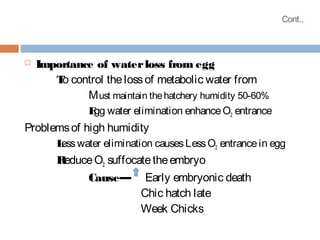
 Importance of waterloss from egg
To control thelossof metabolic water from
Must maintain thehatchery humidity 50-60%
Egg water elimination enhanceO2 entrance
Problemsof high humidity
Lesswater elimination causesLessO2 entrancein egg
ReduceO2 suffocatetheembryo
Cause— Early embryonic death
Chic hatch late
Week Chicks
Cont..
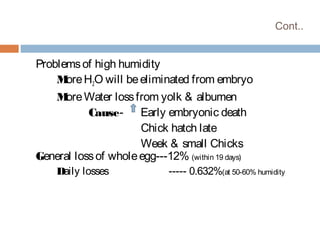
Problemsof high humidity
MoreH2O will beeliminated from embryo
MoreWater lossfrom yolk & albumen
Cause- Early embryonic death
Chick hatch late
Week & small Chicks
General lossof wholeegg---12% (within 19 days)
Daily losses ----- 0.632%(at 50-60% humidity
Cont..
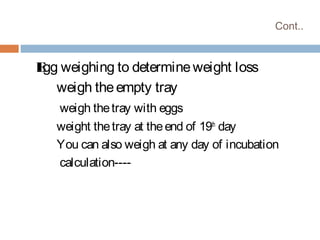
Egg weighing to determineweight loss
weigh theempty tray
weigh thetray with eggs
weight thetray at theend of 19th
day
You can also weigh at any day of incubation
calculation----
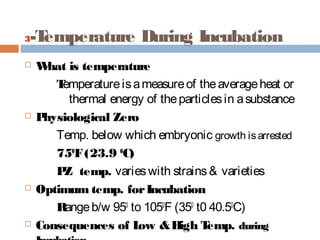
3-Temperature During Incubation
 What is temperature
Temperatureisameasureof theaverageheat or
thermal energy of theparticlesin asubstance
 Physiological Zero
Temp. below which embryonic growth isarrested
750
F(23.9 0
C)
PZ temp. varieswith strains& varieties
 Optimum temp. forIncubation
Rangeb/w 950
to 1050
F (350
t0 40.50
C)
 Consequences of Low &High Temp. during
Conti…
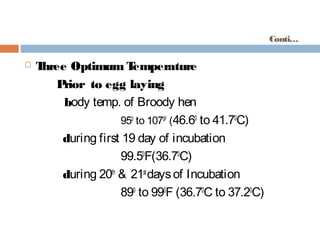
 Three Optimum Temperature
Prior to egg laying
body temp. of Broody hen
950
to 1070F
(46.60
to 41.70
C)
during first 19 day of incubation
99.50
F(36.70
C)
during 20th
& 21st
daysof Incubation
890
to 990
F (36.70
C to 37.20
C)
Conti…
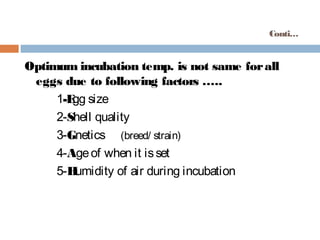
Optimum incubation temp. is not same forall
eggs due to following factors …..
1-Egg size
2-Shell quality
3-Gnetics (breed/ strain)
4-Ageof when it isset
5-Humidity of air during incubation
Conti…
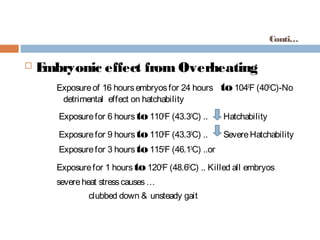
 Embryonic effect from Overheating
Exposureof 16 hoursembryosfor 24 hours to1040
F (400
C)-No
detrimental effect on hatchability
Exposurefor 6 hoursto1100
F (43.30
C) .. Hatchability
Exposurefor 9 hoursto1100
F (43.30
C) .. SevereHatchability
Exposurefor 3 hoursto1150
F (46.10
C) ..or
Exposurefor 1 hoursto1200
F (48.60
C) .. Killed all embryos
severeheat stresscauses…
clubbed down & unsteady gait
Conti…
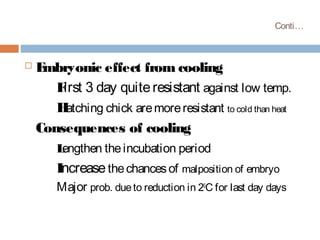
 Embryonic effect from cooling
First 3 day quiteresistant against low temp.
Hatching chick aremoreresistant to cold than heat
Consequences of cooling
Lengthen theincubation period
Increasethechancesof malposition of embryo
Major prob. dueto reduction in 20
C for last day days
Conti…
 What happen when electric powerfails
Heat not equally distribute(dueto fan )
Moreheat will beat top
At top—moreheat-embryo overheated
At bottom—lessheat/ chilling of embryos
So emergency electric supply isnecessary for
successful hatchery operation
Conti…
 Thermometers should be checked often
To check theThermometers
Placein refrigerator for 30 min & shakemercury down
or
Placein warm water & shakethemercury down
Reuniting separated mercury
when mercury in thermometer separates, temp.
reading sareincorrect
4-Humidity during Incubation
 What is Humidity
Percentageof moisturein air
Measuring relative Humidity
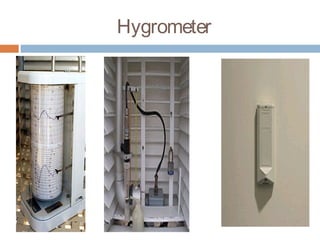
Hygrometer
By comparing thethermometersrecorded by
wet & dry bulbs
Dry bulb…..recorded normally
Wet bulb…..recorded ..bulb covered with a
water-moist wick
Hygrometer
Conti…
 Consequences of high humidity in setter(1-19
days)
Lengthen theincubation time
Consequences of low humidity
No pipping dueto beak sticking
Egg shell quality &humidity requirement
Poor shell quality-moremoisture movement/ losses
Thick denseshells–low moisturemovement/losses
Conti…
 Cracked eggs &humidity requirement
2% egg cracked -out of total egg set
1.1% -Cracked when trayed , 0.9% cracked at transfer
MoreHumidity dueto cracked eggs
Requiremoreair flow for normal O2 requirement
Morelossesdueto CO2
5-Incubation at High Altitude
 What is Altitude
Distancemeasured abovesealevel
 1944 NorthReported thedifferenceof hatchability
at different altitudes
 Hatchability & Altitudeisinversely proportional
 Highest at sealevel up 90-92%
 Optimum altitude
2500 ft (760 m)
hatchability 80-85%
at 3500 ft (1067 m) –acuteproblems
Conti…
 Problems at high altitude
Reduced wt of O2
Low air pressure
what happen
low availability of O2
lower hemoglobin concentration in blood
Parti. at 13-14 daysof incubation
lower / delayed hemoglobin production
low supply for embryo development
result …….heavy embryonic death
Conti…
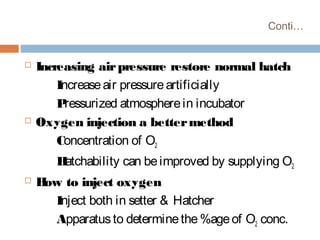
 Increasing airpressure restore normal hatch
Increaseair pressureartificially
Pressurized atmospherein incubator
 Oxygen injection a bettermethod
Concentration of O2
Hatchability can beimproved by supplying O2
 How to inject oxygen
Inject both in setter & Hatcher
Apparatusto determinethe%ageof O2 conc.
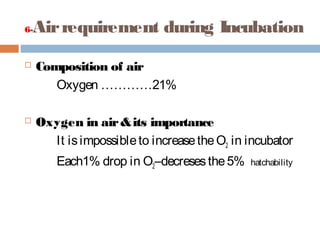
6-Airrequirement during Incubation
 Composition of air
Oxygen …………21%
 Oxygen in air&its importance
It isimpossibleto increasetheO2 in incubator
Each1% drop in O2–decresesthe5% hatchability
Conti…
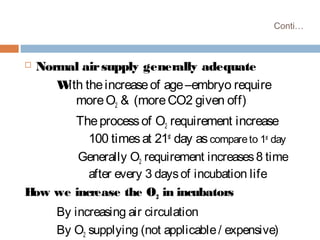
 Normal airsupply generally adequate
With theincreaseof age–embryo require
moreO2 & (moreCO2 given off)
Theprocessof O2 requirement increase
100 timesat 21st
day ascompareto 1st
day
Generally O2 requirement increases8 time
after every 3 daysof incubation life
How we increase the O2 in incubators
By increasing air circulation
By O2 supplying (not applicable/ expensive)
Conti..
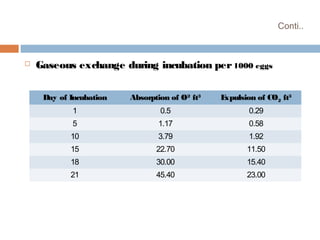
 Gaseous exchange during incubation per1000 eggs
Day of Incubation Absorption of O2
ft3
Expulsion of CO2 ft3
1 0.5 0.29
5 1.17 0.58
10 3.79 1.92
15 22.70 11.50
18 30.00 15.40
21 45.40 23.00
Conti…
 Carbon dioxide tolerance
At laying CO2 releasefrom egg and turn egg
contentsto alkaline
Normal pH of Egg contentsat laying….
Albumen pH 7.6 after oneweek 9.5
Yolk pH 6.0 after oneweek 6.8
CO2 concentration must bein rangelimit in
setter & hatcher
Tolerancelevel first 4 week……0.03%
At 1% …Significant reduction in hatchability
At 5% .... Completely lethal for hatchability
7-Egg selection &care &
storage, handling of hatching
eggs
 Exteriorquality
Genetic
parental charactershasgreat rolein
production of good hatching quality egg
Egg size
Normal size(53 gm, WLH) -Range54-64 gm
Egg shape
3 types(Oval, Oblong & round)
oval isdesirableshape
Oblong & round not desirable
Conti…
Egg shell color
Whitevswhitewith tints
Dark brown vslight brown
Shell texture
Shell thickness…0.33 – 0.35 mm
weak shell thickness….. 0.27 mm
Thin shell thicknesswasdueto deficiency of Vit D or Ca
Smooth shell vsPorousshell
Conti…
 Interiorquality
Position of yolk
Yolk should bein center of hatching eggs
Yolk wasnot in center in older egg-
Causesof low hatchability wasdueto sticking
of embryo with shell
Size of airshell
Largeair shell haslow hatchability
which wasdueto older egg
Blood &meat spots ..hasno any effect on hatchability
Poorshell condition A small crack haszero hatchability
Conti…
 Care &Storage of hatching eggs
Hatching egg quality may bedeterioratedue
to following reasons…
Improper temperature
Improper Handling
Improper humidity
Ageof eggs
Cleanlinessof shell
Position &Turning of egg
during incubation
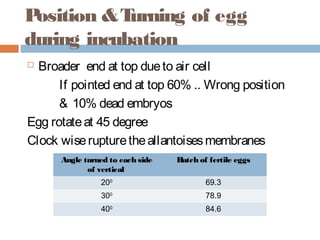
 Broader end at top dueto air cell
If pointed end at top 60% .. Wrong position
& 10% dead embryos
Egg rotateat 45 degree
Clock wiserupturetheallantoisesmembranes
Angle turned to each side
of vertical
Hatch of fertile eggs
200
69.3
300
78.9
400
84.6
Conti…
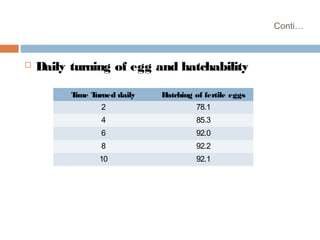
 Daily turning of egg and hatchability
Time Turned daily Hatching of fertile eggs
2 78.1
4 85.3
6 92.0
8 92.2
10 92.1
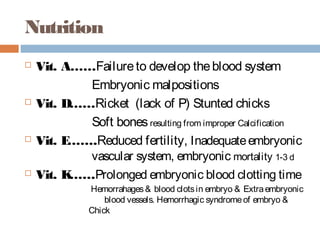
Nutrition
 Vit. A……Failureto develop theblood system
Embryonic malpositions
 Vit. D……Ricket (lack of P) Stunted chicks
Soft bonesresulting from improper Calcification
 Vit. E…….Reduced fertility, Inadequateembryonic
vascular system, embryonic mortality 1-3 d
 Vit. K……Prolonged embryonic blood clotting time
Hemorrahages& blood clotsin embryo & Extraembryonic
blood vessels. Hemorrhagic syndromeof embryo &
Chick
Conti…
 Riboflavin……High mortality 9-14 days. Edema,
Atrophied leg muscles, clubbed down, curled
toes, enlargeof sciatic nervesheaths, reduced
hatchability 2 after breeder ration becomedeficient.
 Pantothenic acid…… Abnormal feathering, S/c
hemorrhages in embryo, Chick hatch in weak condition
& most fail to survive.
 Biotin…….Perosis, Short long bone(micromelia), shortended
& twisted boneof feet, wing & skull. High mortality b/w
1 -7 days.
Conti…
 Vit. B12
Embryonic mal position, edema, short beak,
poor musclesdevelopment, High embryonic
mortality 8-14 days
Folacin
Similar to biotin deficiency, Chick dieafter
pipping theshell
B6
Reduced hatchability
Contii….
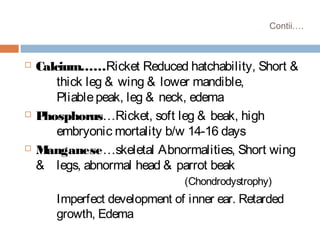
 Calcium……Ricket Reduced hatchability, Short &
thick leg & wing & lower mandible,
Pliablepeak, leg & neck, edema
 Phosphorus…Ricket, soft leg & beak, high
embryonic mortality b/w 14-16 days
 Manganese…skeletal Abnormalities, Short wing
& legs, abnormal head & parrot beak
(Chondrodystrophy)
Imperfect development of inner ear. Retarded
growth, Edema
Contii…
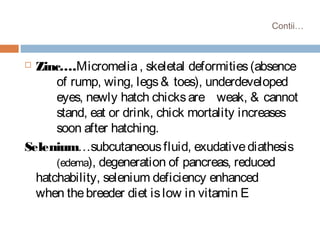
 Zinc….Micromelia, skeletal deformities(absence
of rump, wing, legs& toes), underdeveloped
eyes, newly hatch chicksare weak, & cannot
stand, eat or drink, chick mortality increases
soon after hatching.
Selenium…subcutaneousfluid, exudativediathesis
(edema), degeneration of pancreas, reduced
hatchability, selenium deficiency enhanced
when thebreeder diet islow in vitamin E
Excessive items
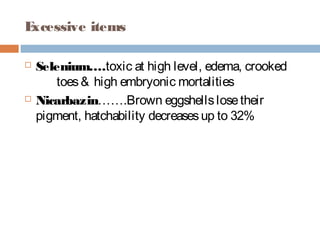
 Selenium….toxic at high level, edema, crooked
toes& high embryonic mortalities
 Nicarbazin…….Brown eggshellslosetheir
pigment, hatchability decreasesup to 32%
Genetics
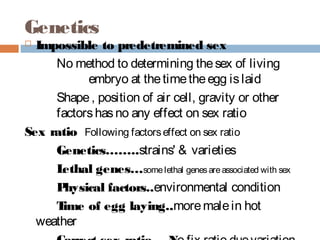
 Impossible to predetremined sex
No method to determining thesex of living
embryo at thetimetheegg islaid
Shape, position of air cell, gravity or other
factorshasno any effect on sex ratio
Sex ratio Following factorseffect on sex ratio
Genetics……..strains' & varieties
Lethal genes…somelethal genesareassociated with sex
Physical factors..environmental condition
Time of egg laying..moremalein hot
weather
Diseases
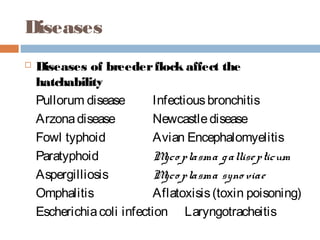
 Diseases of breederflock affect the
hatchability
Pullorum disease Infectiousbronchitis
Arzonadisease Newcastledisease
Fowl typhoid Avian Encephalomyelitis
Paratyphoid Myco plasma gallisepticum
Aspergilliosis Myco plasma syno viae
Omphalitis Aflatoxisis(toxin poisoning)
Escherichiacoli infection Laryngotracheitis
Otherfactors affecting
hatchability
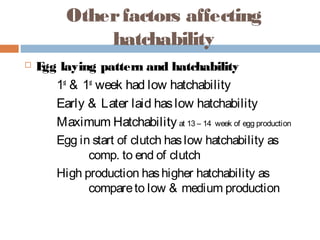
 Egg laying pattern and hatchability
1st
& 1st
week had low hatchability
Early & Later laid haslow hatchability
Maximum Hatchability at 13 – 14 week of egg production
Egg in start of clutch haslow hatchability as
comp. to end of clutch
High production hashigher hatchability as
compareto low & medium production
Conti…
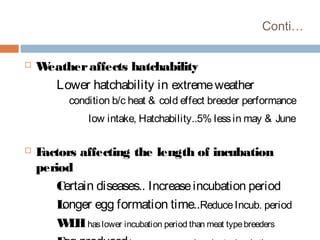
 Weatheraffects hatchability
Lower hatchability in extremeweather
condition b/c heat & cold effect breeder performance
low intake, Hatchability..5% lessin may & June
 Factors affecting the length of incubation
period
Certain diseases.. Increaseincubation period
Longer egg formation time..ReduceIncub. period
WLHhaslower incubation period than meat typebreeders
Conti…
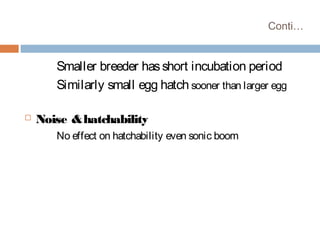
Smaller breeder hasshort incubation period
Similarly small egg hatch sooner than larger egg
 Noise &hatchability
No effect on hatchability even sonic boom
Conti…
 Age of breederaffects hatchability
Increasing ageof breeder effect thehatchability
Older breeder takemoreegg formation time
with strong egg shell ..increasehatching time
Position of embryo in egg
Normal position…
Embryo with head in larger end
of egg (near air cell) & with itshead under
right wing
Conti..
 Description of some male position
Chancesof malposition 1-4%
Head between thighs
Head in small end of egg
Head under left wing
Feet over head
Beak aboveright wing instead under
Hatching %ageof malposition chick

Factors affecting hatchability

  • 2.
    Hatchability Determining Factors Fertility  Metabolism of chick embryo  Temperature during incubation  Humidity during incubation  Incubation at high altitude  Air requirement during incubation
  • 3.
    cont..  Egg selection& handling of hatching eggs  Position of egg during incubation  Nutrition  Genetics  Diseases  Other factors affecting hatchability
  • 4.
    1-Fertility  What isFertility Fertility refersto thecapacity to reproduce  Role of male in fertility Inducethesperm in femalereproductivesystem after mating Fertileeggsstart after 2 week of mating (In somecasesfertileeggsstart after 24 hoursof mating ) Infertileeggsstart --- after 1 week of removal of malefrom flock  Role of female in fertility After receiving sperm fertilizeegg in femalereproductive tract Safethegerm plasmaafter fertilization
  • 5.
    Conti...  Factors affectingthe fertility Maleto femaleratio (number of femalemated to onemale) Maleto femaleratio (1:5) Ageof breeder Mating behavior Saving eggsfor hatchability Management Practices
  • 6.
     Losses ofInfertility Chancesof infertility 10% (USA based data) Economic losses Occupy valuableincubator space Requiretimeconsuming labor & handling Hatchery maintaining cost
  • 7.
    Important Considerations  Fertilitycan’t be predetermined Can’t differentiateb/w fertile& nonfertileeggsprior incubation With Special light system-check after few hour of incubation with Commercial chandlers- check after several daysof incubation  Egg must be broken to determine true fertility Candling iscrudemethod  Fertility inherited Strainsdifference Individual difference Better fertility through genetic selection in breeds
  • 8.
    2-Metabolism of ChickEmbryo  What is Metabolism Necessary for growth & life Physical & chemical processesoccurring within aliving cell or animalsthat are necessary for life Anabolism (biosynthesis) Catabolism (breakdown)
  • 9.
    Cont.. Metabolism in chickembryo Metabolic rateof chick embryo istheresult of temperature Higher optimal temperatureaccelerategrowth Lower temperatureretard / delay growth Asmetabolism cell of embryo demand moreO2 to metabolizethefats, CH2O & other components which in turn produceCO2 & water, or viceversa Balancereversiblereaction isaindicator of correct temperature Optimal temperatureof setter is99.7o F (37.5o C)
  • 10.
    Cont..  Importance ofwaterloss from egg To control thelossof metabolic water from Must maintain thehatchery humidity 50-60% Egg water elimination enhanceO2 entrance Problemsof high humidity Lesswater elimination causesLessO2 entrancein egg ReduceO2 suffocatetheembryo Cause— Early embryonic death Chic hatch late Week Chicks
  • 11.
    Cont.. Problemsof high humidity MoreH2Owill beeliminated from embryo MoreWater lossfrom yolk & albumen Cause- Early embryonic death Chick hatch late Week & small Chicks General lossof wholeegg---12% (within 19 days) Daily losses ----- 0.632%(at 50-60% humidity
  • 12.
    Cont.. Egg weighing todetermineweight loss weigh theempty tray weigh thetray with eggs weight thetray at theend of 19th day You can also weigh at any day of incubation calculation----
  • 13.
    3-Temperature During Incubation What is temperature Temperatureisameasureof theaverageheat or thermal energy of theparticlesin asubstance  Physiological Zero Temp. below which embryonic growth isarrested 750 F(23.9 0 C) PZ temp. varieswith strains& varieties  Optimum temp. forIncubation Rangeb/w 950 to 1050 F (350 t0 40.50 C)  Consequences of Low &High Temp. during
  • 14.
    Conti…  Three OptimumTemperature Prior to egg laying body temp. of Broody hen 950 to 1070F (46.60 to 41.70 C) during first 19 day of incubation 99.50 F(36.70 C) during 20th & 21st daysof Incubation 890 to 990 F (36.70 C to 37.20 C)
  • 15.
    Conti… Optimum incubation temp.is not same forall eggs due to following factors ….. 1-Egg size 2-Shell quality 3-Gnetics (breed/ strain) 4-Ageof when it isset 5-Humidity of air during incubation
  • 16.
    Conti…  Embryonic effectfrom Overheating Exposureof 16 hoursembryosfor 24 hours to1040 F (400 C)-No detrimental effect on hatchability Exposurefor 6 hoursto1100 F (43.30 C) .. Hatchability Exposurefor 9 hoursto1100 F (43.30 C) .. SevereHatchability Exposurefor 3 hoursto1150 F (46.10 C) ..or Exposurefor 1 hoursto1200 F (48.60 C) .. Killed all embryos severeheat stresscauses… clubbed down & unsteady gait
  • 17.
    Conti…  Embryonic effectfrom cooling First 3 day quiteresistant against low temp. Hatching chick aremoreresistant to cold than heat Consequences of cooling Lengthen theincubation period Increasethechancesof malposition of embryo Major prob. dueto reduction in 20 C for last day days
  • 18.
    Conti…  What happenwhen electric powerfails Heat not equally distribute(dueto fan ) Moreheat will beat top At top—moreheat-embryo overheated At bottom—lessheat/ chilling of embryos So emergency electric supply isnecessary for successful hatchery operation
  • 19.
    Conti…  Thermometers shouldbe checked often To check theThermometers Placein refrigerator for 30 min & shakemercury down or Placein warm water & shakethemercury down Reuniting separated mercury when mercury in thermometer separates, temp. reading sareincorrect
  • 20.
    4-Humidity during Incubation What is Humidity Percentageof moisturein air Measuring relative Humidity Hygrometer By comparing thethermometersrecorded by wet & dry bulbs Dry bulb…..recorded normally Wet bulb…..recorded ..bulb covered with a water-moist wick
  • 21.
  • 22.
    Conti…  Consequences ofhigh humidity in setter(1-19 days) Lengthen theincubation time Consequences of low humidity No pipping dueto beak sticking Egg shell quality &humidity requirement Poor shell quality-moremoisture movement/ losses Thick denseshells–low moisturemovement/losses
  • 23.
    Conti…  Cracked eggs&humidity requirement 2% egg cracked -out of total egg set 1.1% -Cracked when trayed , 0.9% cracked at transfer MoreHumidity dueto cracked eggs Requiremoreair flow for normal O2 requirement Morelossesdueto CO2
  • 24.
    5-Incubation at HighAltitude  What is Altitude Distancemeasured abovesealevel  1944 NorthReported thedifferenceof hatchability at different altitudes  Hatchability & Altitudeisinversely proportional  Highest at sealevel up 90-92%  Optimum altitude 2500 ft (760 m) hatchability 80-85% at 3500 ft (1067 m) –acuteproblems
  • 25.
    Conti…  Problems athigh altitude Reduced wt of O2 Low air pressure what happen low availability of O2 lower hemoglobin concentration in blood Parti. at 13-14 daysof incubation lower / delayed hemoglobin production low supply for embryo development result …….heavy embryonic death
  • 26.
    Conti…  Increasing airpressurerestore normal hatch Increaseair pressureartificially Pressurized atmospherein incubator  Oxygen injection a bettermethod Concentration of O2 Hatchability can beimproved by supplying O2  How to inject oxygen Inject both in setter & Hatcher Apparatusto determinethe%ageof O2 conc.
  • 27.
    6-Airrequirement during Incubation Composition of air Oxygen …………21%  Oxygen in air&its importance It isimpossibleto increasetheO2 in incubator Each1% drop in O2–decresesthe5% hatchability
  • 28.
    Conti…  Normal airsupplygenerally adequate With theincreaseof age–embryo require moreO2 & (moreCO2 given off) Theprocessof O2 requirement increase 100 timesat 21st day ascompareto 1st day Generally O2 requirement increases8 time after every 3 daysof incubation life How we increase the O2 in incubators By increasing air circulation By O2 supplying (not applicable/ expensive)
  • 29.
    Conti..  Gaseous exchangeduring incubation per1000 eggs Day of Incubation Absorption of O2 ft3 Expulsion of CO2 ft3 1 0.5 0.29 5 1.17 0.58 10 3.79 1.92 15 22.70 11.50 18 30.00 15.40 21 45.40 23.00
  • 30.
    Conti…  Carbon dioxidetolerance At laying CO2 releasefrom egg and turn egg contentsto alkaline Normal pH of Egg contentsat laying…. Albumen pH 7.6 after oneweek 9.5 Yolk pH 6.0 after oneweek 6.8 CO2 concentration must bein rangelimit in setter & hatcher Tolerancelevel first 4 week……0.03% At 1% …Significant reduction in hatchability At 5% .... Completely lethal for hatchability
  • 31.
    7-Egg selection &care& storage, handling of hatching eggs  Exteriorquality Genetic parental charactershasgreat rolein production of good hatching quality egg Egg size Normal size(53 gm, WLH) -Range54-64 gm Egg shape 3 types(Oval, Oblong & round) oval isdesirableshape Oblong & round not desirable
  • 32.
    Conti… Egg shell color Whitevswhitewithtints Dark brown vslight brown Shell texture Shell thickness…0.33 – 0.35 mm weak shell thickness….. 0.27 mm Thin shell thicknesswasdueto deficiency of Vit D or Ca Smooth shell vsPorousshell
  • 33.
    Conti…  Interiorquality Position ofyolk Yolk should bein center of hatching eggs Yolk wasnot in center in older egg- Causesof low hatchability wasdueto sticking of embryo with shell Size of airshell Largeair shell haslow hatchability which wasdueto older egg Blood &meat spots ..hasno any effect on hatchability Poorshell condition A small crack haszero hatchability
  • 34.
    Conti…  Care &Storageof hatching eggs Hatching egg quality may bedeterioratedue to following reasons… Improper temperature Improper Handling Improper humidity Ageof eggs Cleanlinessof shell
  • 35.
    Position &Turning ofegg during incubation  Broader end at top dueto air cell If pointed end at top 60% .. Wrong position & 10% dead embryos Egg rotateat 45 degree Clock wiserupturetheallantoisesmembranes Angle turned to each side of vertical Hatch of fertile eggs 200 69.3 300 78.9 400 84.6
  • 36.
    Conti…  Daily turningof egg and hatchability Time Turned daily Hatching of fertile eggs 2 78.1 4 85.3 6 92.0 8 92.2 10 92.1
  • 37.
    Nutrition  Vit. A……Failuretodevelop theblood system Embryonic malpositions  Vit. D……Ricket (lack of P) Stunted chicks Soft bonesresulting from improper Calcification  Vit. E…….Reduced fertility, Inadequateembryonic vascular system, embryonic mortality 1-3 d  Vit. K……Prolonged embryonic blood clotting time Hemorrahages& blood clotsin embryo & Extraembryonic blood vessels. Hemorrhagic syndromeof embryo & Chick
  • 38.
    Conti…  Riboflavin……High mortality9-14 days. Edema, Atrophied leg muscles, clubbed down, curled toes, enlargeof sciatic nervesheaths, reduced hatchability 2 after breeder ration becomedeficient.  Pantothenic acid…… Abnormal feathering, S/c hemorrhages in embryo, Chick hatch in weak condition & most fail to survive.  Biotin…….Perosis, Short long bone(micromelia), shortended & twisted boneof feet, wing & skull. High mortality b/w 1 -7 days.
  • 39.
    Conti…  Vit. B12 Embryonicmal position, edema, short beak, poor musclesdevelopment, High embryonic mortality 8-14 days Folacin Similar to biotin deficiency, Chick dieafter pipping theshell B6 Reduced hatchability
  • 40.
    Contii….  Calcium……Ricket Reducedhatchability, Short & thick leg & wing & lower mandible, Pliablepeak, leg & neck, edema  Phosphorus…Ricket, soft leg & beak, high embryonic mortality b/w 14-16 days  Manganese…skeletal Abnormalities, Short wing & legs, abnormal head & parrot beak (Chondrodystrophy) Imperfect development of inner ear. Retarded growth, Edema
  • 41.
    Contii…  Zinc….Micromelia, skeletaldeformities(absence of rump, wing, legs& toes), underdeveloped eyes, newly hatch chicksare weak, & cannot stand, eat or drink, chick mortality increases soon after hatching. Selenium…subcutaneousfluid, exudativediathesis (edema), degeneration of pancreas, reduced hatchability, selenium deficiency enhanced when thebreeder diet islow in vitamin E
  • 42.
    Excessive items  Selenium….toxicat high level, edema, crooked toes& high embryonic mortalities  Nicarbazin…….Brown eggshellslosetheir pigment, hatchability decreasesup to 32%
  • 43.
    Genetics  Impossible topredetremined sex No method to determining thesex of living embryo at thetimetheegg islaid Shape, position of air cell, gravity or other factorshasno any effect on sex ratio Sex ratio Following factorseffect on sex ratio Genetics……..strains' & varieties Lethal genes…somelethal genesareassociated with sex Physical factors..environmental condition Time of egg laying..moremalein hot weather
  • 44.
    Diseases  Diseases ofbreederflock affect the hatchability Pullorum disease Infectiousbronchitis Arzonadisease Newcastledisease Fowl typhoid Avian Encephalomyelitis Paratyphoid Myco plasma gallisepticum Aspergilliosis Myco plasma syno viae Omphalitis Aflatoxisis(toxin poisoning) Escherichiacoli infection Laryngotracheitis
  • 45.
    Otherfactors affecting hatchability  Egglaying pattern and hatchability 1st & 1st week had low hatchability Early & Later laid haslow hatchability Maximum Hatchability at 13 – 14 week of egg production Egg in start of clutch haslow hatchability as comp. to end of clutch High production hashigher hatchability as compareto low & medium production
  • 46.
    Conti…  Weatheraffects hatchability Lowerhatchability in extremeweather condition b/c heat & cold effect breeder performance low intake, Hatchability..5% lessin may & June  Factors affecting the length of incubation period Certain diseases.. Increaseincubation period Longer egg formation time..ReduceIncub. period WLHhaslower incubation period than meat typebreeders
  • 47.
    Conti… Smaller breeder hasshortincubation period Similarly small egg hatch sooner than larger egg  Noise &hatchability No effect on hatchability even sonic boom
  • 48.
    Conti…  Age ofbreederaffects hatchability Increasing ageof breeder effect thehatchability Older breeder takemoreegg formation time with strong egg shell ..increasehatching time Position of embryo in egg Normal position… Embryo with head in larger end of egg (near air cell) & with itshead under right wing
  • 49.
    Conti..  Description ofsome male position Chancesof malposition 1-4% Head between thighs Head in small end of egg Head under left wing Feet over head Beak aboveright wing instead under Hatching %ageof malposition chick