Livestock’s role in food security and resilience
Iain Wright
Deputy Director General, ILRI
USAID, 15 November 2019
GLOBAL
CONTEXT
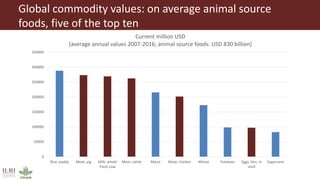
Global commodity values: on average animal source
foods, five of the top ten
0
50000
100000
150000
200000
250000
300000
350000
Rice, paddy Meat, pig Milk, whole
fresh cow
Meat, cattle Maize Meat, chicken Wheat Potatoes Eggs, hen, in
shell
Sugarcane
Current million USD
(average annual values 2007-2016; animal source foods: USD 830 billion)
0
50
100
150
200
250
E.AsiaPacific
China
SouthAsia
SSA
Highincome
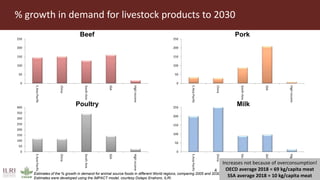
% growth in demand for livestock products to 2030
4
0
50
100
150
200
250
E.AsiaPacific
China
SouthAsia
SSA
Highincome
0
50
100
150
200
250
300
350
400
E.AsiaPacific
China
SouthAsia
SSA
Highincome
0
50
100
150
200
250
E.AsiaPacific
China
SouthAsia
SSA
Highincome
Estimates of the % growth in demand for animal source foods in different World regions, comparing 2005 and 2030.
Estimates were developed using the IMPACT model, courtesy Dolapo Enahoro, ILRI.
Beef Pork
Poultry Milk
Increases not because of overconsumption!
OECD average 2018 = 69 kg/capita meat
SSA average 2018 = 10 kg/capita meat
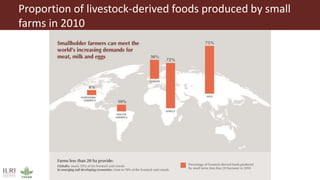
Proportion of livestock-derived foods produced by small
farms in 2010
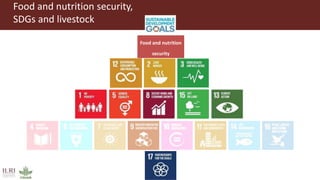
Food and nutrition security,
SDGs and livestock
Food and nutrition
security
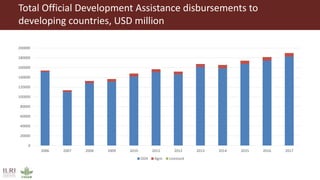
Total Official Development Assistance disbursements to
developing countries, USD million
0
20000
40000
60000
80000
100000
120000
140000
160000
180000
200000
2006 2007 2008 2009 2010 2011 2012 2013 2014 2015 2016 2017
ODA Agric Livestock
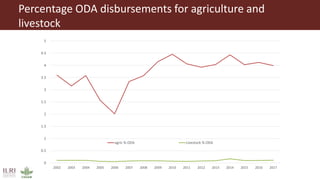
Percentage ODA disbursements for agriculture and
livestock
0
0.5
1
1.5
2
2.5
3
3.5
4
4.5
5
2002 2003 2004 2005 2006 2007 2008 2009 2010 2011 2012 2013 2014 2015 2016 2017
agric % ODA Livestock % ODA
NUTRITIONAL
SECURITY
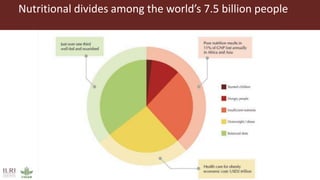
Nutritional divides among the world’s 7.5 billion people
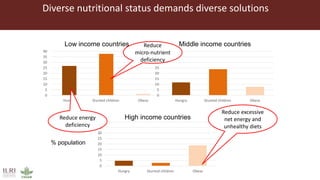
Diverse nutritional status demands diverse solutions
0
5
10
15
20
25
30
35
40
Hungry Stunted children Obese
0
5
10
15
20
25
30
35
40
Hungry Stunted children Obese
0
5
10
15
20
25
30
35
40
Hungry Stunted children Obese
Low income countries Middle income countries
High income countries
% population
Reduce energy
deficiency
Reduce
micro-nutrient
deficiency
Reduce excessive
net energy and
unhealthy diets
Animal-source foods are critical
for both physical and cognitive growth
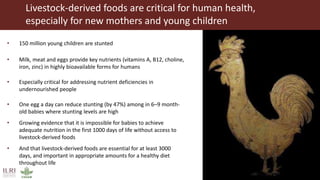
• 150 million young children are stunted
• Milk, meat and eggs provide key nutrients (vitamins A, B12, choline,
iron, zinc) in highly bioavailable forms for humans
• Especially critical for addressing nutrient deficiencies in
undernourished people
• One egg a day can reduce stunting (by 47%) among in 6–9 month-
old babies where stunting levels are high
• Growing evidence that it is impossible for babies to achieve
adequate nutrition in the first 1000 days of life without access to
livestock-derived foods
• And that livestock-derived foods are essential for at least 3000
days, and important in appropriate amounts for a healthy diet
throughout life
Livestock-derived foods are critical for human health,
especially for new mothers and young children
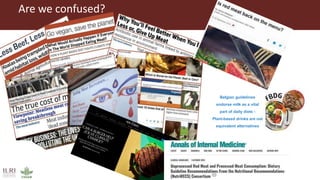
Are we confused?
Belgian guidelines
endorse milk as a vital
part of daily diets -
Plant-based drinks are not
equivalent alternatives
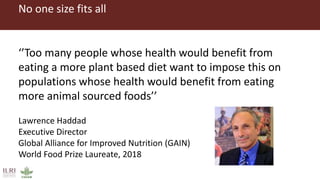
No one size fits all
‘’Too many people whose health would benefit from
eating a more plant based diet want to impose this on
populations whose health would benefit from eating
more animal sourced foods’’
Lawrence Haddad
Executive Director
Global Alliance for Improved Nutrition (GAIN)
World Food Prize Laureate, 2018
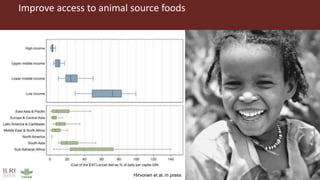
Improve access to animal source foods
Hirvonen et al. in press
FOOD
SECURITY
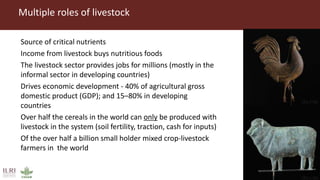
Multiple roles of livestock
Source of critical nutrients
Income from livestock buys nutritious foods
The livestock sector provides jobs for millions (mostly in the
informal sector in developing countries)
Drives economic development - 40% of agricultural gross
domestic product (GDP); and 15–80% in developing
countries
Over half the cereals in the world can only be produced with
livestock in the system (soil fertility, traction, cash for inputs)
Of the over half a billion small holder mixed crop-livestock
farmers in the world
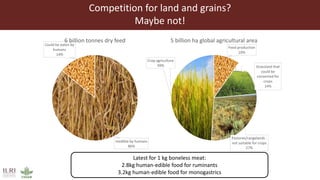
Competition for land and grains?
Maybe not!
Inedible by humans
86%
Could be eaten by
humans
14%
6 billion tonnes dry feed
Feed production
10%
Grassland that
could be
converted for
crops
14%
Pastures/rangelands -
not suitable for crops
27%
Crop agriculture
49%
5 billion ha global agricultural area
Latest for 1 kg boneless meat:
2.8kg human-edible food for ruminants
3.2kg human-edible food for monogastrics
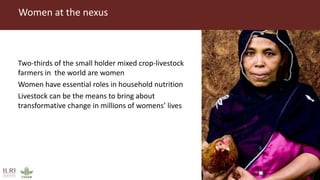
Women at the nexus
Two-thirds of the small holder mixed crop-livestock
farmers in the world are women
Women have essential roles in household nutrition
Livestock can be the means to bring about
transformative change in millions of womens’ lives
LIVESTOCK
AND THE
ENVIRONMENT
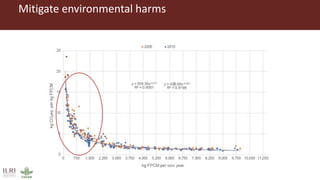
Mitigate environmental harms
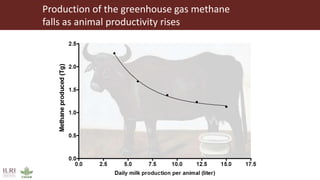
Production of the greenhouse gas methane
falls as animal productivity rises
LIVESTOCK
AND
HUMAN HEALTH
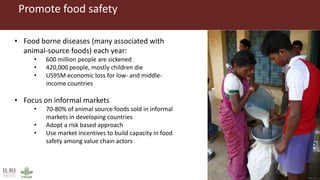
Promote food safety
• Food borne diseases (many associated with
animal-source foods) each year:
• 600 million people are sickened
• 420,000 people, mostly children die
• US95M economic loss for low- and middle-
income countries
• Focus on informal markets
• 70-80% of animal source foods sold in informal
markets in developing countries
• Adopt a risk based approach
• Use market incentives to build capacity in food
safety among value chain actors
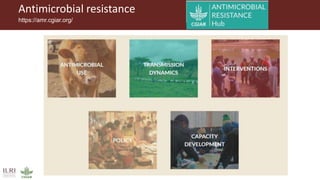
Antimicrobial resistance
https://amr.cgiar.org/
LIVESTOCK
AND
RESILIENCE
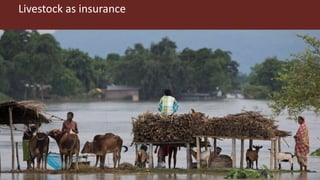
Livestock as insurance
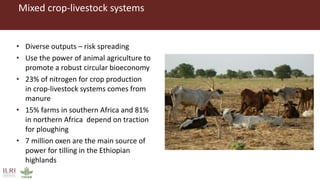
Mixed crop-livestock systems
• Diverse outputs – risk spreading
• Use the power of animal agriculture to
promote a robust circular bioeconomy
• 23% of nitrogen for crop production
in crop-livestock systems comes from
manure
• 15% farms in southern Africa and 81%
in northern Africa depend on traction
for ploughing
• 7 million oxen are the main source of
power for tilling in the Ethiopian
highlands
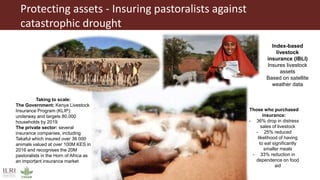
Protecting assets - Insuring pastoralists against
catastrophic drought
Those who purchased
insurance:
- 36% drop in distress
sales of livestock
- 25% reduced
likelihood of having
to eat significantly
smaller meals
- 33% reduction in
dependence on food
aid
Taking to scale:
The Government: Kenya Livestock
Insurance Program (KLIP):
underway and targets 80,000
households by 2019
The private sector: several
insurance companies, including
Takaful which insured over 36 000
animals valued at over 100M KES in
2016 and recognises the 20M
pastoralists in the Horn of Africa as
an important insurance market
Index-based
livestock
insurance (IBLI)
Insures livestock
assets
Based on satellite
weather data
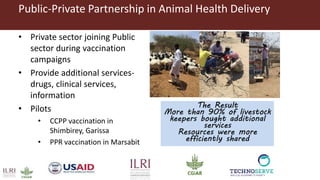
Public-Private Partnership in Animal Health Delivery
• Private sector joining Public
sector during vaccination
campaigns
• Provide additional services-
drugs, clinical services,
information
• Pilots
• CCPP vaccination in
Shimbirey, Garissa
• PPR vaccination in Marsabit
The Result
More than 90% of livestock
keepers bought additional
services
Resources were more
efficiently shared
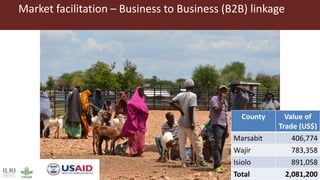
Market facilitation – Business to Business (B2B) linkage
County Value of
Trade (US$)
Marsabit 406,774
Wajir 783,358
Isiolo 891,058
Total 2,081,200
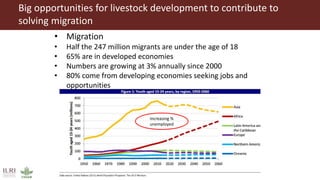
Big opportunities for livestock development to contribute to
solving migration
• Migration
• Half the 247 million migrants are under the age of 18
• 65% are in developed economies
• Numbers are growing at 3% annually since 2000
• 80% come from developing economies seeking jobs and
opportunities
Increasing %
unemployed
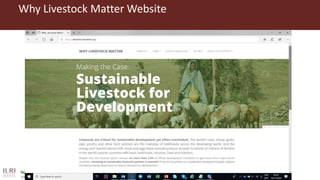
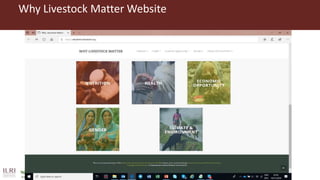
Why Livestock Matter Website
This presentation is licensed for use under the Creative Commons Attribution 4.0 International Licence.
better lives through livestock
ilri.org
ILRI thanks all donors and organizations who globally supported its work through their contributions to the CGIAR system

Livestock’s role in food security and resilience

  • 1.
    Livestock’s role infood security and resilience Iain Wright Deputy Director General, ILRI USAID, 15 November 2019
  • 2.
  • 3.
    Global commodity values:on average animal source foods, five of the top ten 0 50000 100000 150000 200000 250000 300000 350000 Rice, paddy Meat, pig Milk, whole fresh cow Meat, cattle Maize Meat, chicken Wheat Potatoes Eggs, hen, in shell Sugarcane Current million USD (average annual values 2007-2016; animal source foods: USD 830 billion)
  • 4.
    0 50 100 150 200 250 E.AsiaPacific China SouthAsia SSA Highincome % growth indemand for livestock products to 2030 4 0 50 100 150 200 250 E.AsiaPacific China SouthAsia SSA Highincome 0 50 100 150 200 250 300 350 400 E.AsiaPacific China SouthAsia SSA Highincome 0 50 100 150 200 250 E.AsiaPacific China SouthAsia SSA Highincome Estimates of the % growth in demand for animal source foods in different World regions, comparing 2005 and 2030. Estimates were developed using the IMPACT model, courtesy Dolapo Enahoro, ILRI. Beef Pork Poultry Milk Increases not because of overconsumption! OECD average 2018 = 69 kg/capita meat SSA average 2018 = 10 kg/capita meat
  • 5.
    Proportion of livestock-derivedfoods produced by small farms in 2010
  • 6.
    Food and nutritionsecurity, SDGs and livestock Food and nutrition security
  • 7.
    Total Official DevelopmentAssistance disbursements to developing countries, USD million 0 20000 40000 60000 80000 100000 120000 140000 160000 180000 200000 2006 2007 2008 2009 2010 2011 2012 2013 2014 2015 2016 2017 ODA Agric Livestock
  • 8.
    Percentage ODA disbursementsfor agriculture and livestock 0 0.5 1 1.5 2 2.5 3 3.5 4 4.5 5 2002 2003 2004 2005 2006 2007 2008 2009 2010 2011 2012 2013 2014 2015 2016 2017 agric % ODA Livestock % ODA
  • 9.
  • 10.
    Nutritional divides amongthe world’s 7.5 billion people
  • 11.
    Diverse nutritional statusdemands diverse solutions 0 5 10 15 20 25 30 35 40 Hungry Stunted children Obese 0 5 10 15 20 25 30 35 40 Hungry Stunted children Obese 0 5 10 15 20 25 30 35 40 Hungry Stunted children Obese Low income countries Middle income countries High income countries % population Reduce energy deficiency Reduce micro-nutrient deficiency Reduce excessive net energy and unhealthy diets
  • 12.
    Animal-source foods arecritical for both physical and cognitive growth • 150 million young children are stunted • Milk, meat and eggs provide key nutrients (vitamins A, B12, choline, iron, zinc) in highly bioavailable forms for humans • Especially critical for addressing nutrient deficiencies in undernourished people • One egg a day can reduce stunting (by 47%) among in 6–9 month- old babies where stunting levels are high • Growing evidence that it is impossible for babies to achieve adequate nutrition in the first 1000 days of life without access to livestock-derived foods • And that livestock-derived foods are essential for at least 3000 days, and important in appropriate amounts for a healthy diet throughout life Livestock-derived foods are critical for human health, especially for new mothers and young children
  • 13.
    Are we confused? Belgianguidelines endorse milk as a vital part of daily diets - Plant-based drinks are not equivalent alternatives
  • 14.
    No one sizefits all ‘’Too many people whose health would benefit from eating a more plant based diet want to impose this on populations whose health would benefit from eating more animal sourced foods’’ Lawrence Haddad Executive Director Global Alliance for Improved Nutrition (GAIN) World Food Prize Laureate, 2018
  • 15.
    Improve access toanimal source foods Hirvonen et al. in press
  • 16.
  • 17.
    Multiple roles oflivestock Source of critical nutrients Income from livestock buys nutritious foods The livestock sector provides jobs for millions (mostly in the informal sector in developing countries) Drives economic development - 40% of agricultural gross domestic product (GDP); and 15–80% in developing countries Over half the cereals in the world can only be produced with livestock in the system (soil fertility, traction, cash for inputs) Of the over half a billion small holder mixed crop-livestock farmers in the world
  • 18.
    Competition for landand grains? Maybe not! Inedible by humans 86% Could be eaten by humans 14% 6 billion tonnes dry feed Feed production 10% Grassland that could be converted for crops 14% Pastures/rangelands - not suitable for crops 27% Crop agriculture 49% 5 billion ha global agricultural area Latest for 1 kg boneless meat: 2.8kg human-edible food for ruminants 3.2kg human-edible food for monogastrics
  • 19.
    Women at thenexus Two-thirds of the small holder mixed crop-livestock farmers in the world are women Women have essential roles in household nutrition Livestock can be the means to bring about transformative change in millions of womens’ lives
  • 20.
  • 21.
  • 22.
    Production of thegreenhouse gas methane falls as animal productivity rises
  • 23.
  • 24.
    Promote food safety •Food borne diseases (many associated with animal-source foods) each year: • 600 million people are sickened • 420,000 people, mostly children die • US95M economic loss for low- and middle- income countries • Focus on informal markets • 70-80% of animal source foods sold in informal markets in developing countries • Adopt a risk based approach • Use market incentives to build capacity in food safety among value chain actors
  • 25.
  • 26.
  • 27.
  • 28.
    Mixed crop-livestock systems •Diverse outputs – risk spreading • Use the power of animal agriculture to promote a robust circular bioeconomy • 23% of nitrogen for crop production in crop-livestock systems comes from manure • 15% farms in southern Africa and 81% in northern Africa depend on traction for ploughing • 7 million oxen are the main source of power for tilling in the Ethiopian highlands
  • 29.
    Protecting assets -Insuring pastoralists against catastrophic drought Those who purchased insurance: - 36% drop in distress sales of livestock - 25% reduced likelihood of having to eat significantly smaller meals - 33% reduction in dependence on food aid Taking to scale: The Government: Kenya Livestock Insurance Program (KLIP): underway and targets 80,000 households by 2019 The private sector: several insurance companies, including Takaful which insured over 36 000 animals valued at over 100M KES in 2016 and recognises the 20M pastoralists in the Horn of Africa as an important insurance market Index-based livestock insurance (IBLI) Insures livestock assets Based on satellite weather data
  • 30.
    Public-Private Partnership inAnimal Health Delivery • Private sector joining Public sector during vaccination campaigns • Provide additional services- drugs, clinical services, information • Pilots • CCPP vaccination in Shimbirey, Garissa • PPR vaccination in Marsabit The Result More than 90% of livestock keepers bought additional services Resources were more efficiently shared
  • 31.
    Market facilitation –Business to Business (B2B) linkage County Value of Trade (US$) Marsabit 406,774 Wajir 783,358 Isiolo 891,058 Total 2,081,200
  • 32.
    Big opportunities forlivestock development to contribute to solving migration • Migration • Half the 247 million migrants are under the age of 18 • 65% are in developed economies • Numbers are growing at 3% annually since 2000 • 80% come from developing economies seeking jobs and opportunities Increasing % unemployed
  • 33.
  • 34.
  • 35.
    This presentation islicensed for use under the Creative Commons Attribution 4.0 International Licence. better lives through livestock ilri.org ILRI thanks all donors and organizations who globally supported its work through their contributions to the CGIAR system