Ensuring access
to animal-source foods
Tom Randolph
Science Forum 2013
Nutrition and health outcomes: targets for agricultural
research, Bonn, Germany, 23‒25 September 2013
Our challenge
Protect and enhance adequate access of both rural and
urban poor to a particularly valuable nutritional resource
in their diet: animal-source foods
• Demand growing faster than capacity to supply
• Aspects of both food and nutritional security
• Change from traditional CGIAR focus on livestock for
livelihoods
• Conclusion: Not simply a production or nutrition issue
 Requires a multidimensional food systems approach
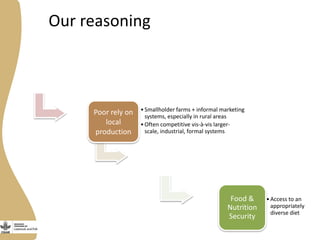
Our reasoning
Food &
Nutrition
Security
•Access to an
appropriately
diverse diet
Poor rely on
local
production
•Smallholder farms + informal marketing
systems, especially in rural areas
•Often competitive vis-à-vis larger-
scale, industrial, formal systems
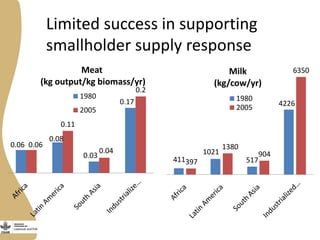
Limited success in supporting
smallholder supply response
0.06
0.08
0.03
0.17
0.06
0.11
0.04
0.2
Meat
(kg output/kg biomass/yr)
1980
2005
411
1021
517
4226
397
1380
904
6350Milk
(kg/cow/yr)
1980
2005
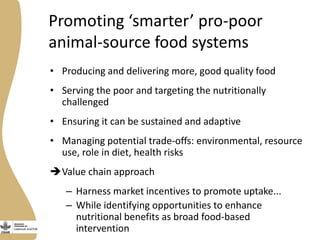
Promoting ‘smarter’ pro-poor
animal-source food systems
• Producing and delivering more, good quality food
• Serving the poor and targeting the nutritionally
challenged
• Ensuring it can be sustained and adaptive
• Managing potential trade-offs: environmental, resource
use, role in diet, health risks
Value chain approach
– Harness market incentives to promote uptake...
– While identifying opportunities to enhance
nutritional benefits as broad food-based
intervention
Premise for CGIAR Research
Program on Livestock and Fish
Research for development and impact that:
• Puts together and pilots an integrated intervention
across the targeted value chain
• While conducting longer-term research on more
fundamental productivity constraints
• Works together with development partners from the
start so they can take intervention to scale
• Focuses on only a few selected value chains
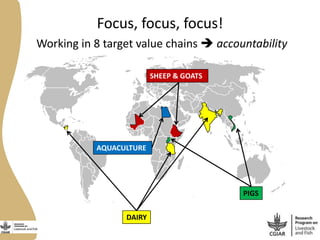
Focus, focus, focus!
Working in 8 target value chains  accountability
PIGS
AQUACULTURE
SHEEP & GOATS
DAIRY
Status
• Partnership of 4 CGIAR Centers
• Officially started January 1st, 2012
• Activities and momentum achieved in 4 value chains
Will it work?
Can livestock & aquaculture interventions improve
nutrition security?
Series of literature reviews (Webb, 2012) have concluded:
• Projects rarely have explicit food or nutrition security
objectives
• Among those, very few appropriately designed
impact studies
• Weak evidence, but suggests positive
benefits, especially if accompanied by nutrition
education
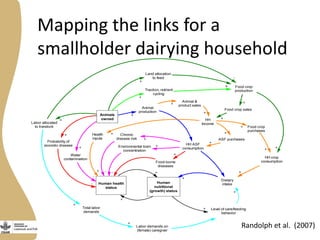
Nutrition influenced through several pathways
Mapping the links for a
smallholder dairying household
Randolph et al. (2007)
Animals
owned
Human
nutritional
(growth) status
Human health
status
+
+
Probability of
zoonotic disease
Animal
production
Food crop
production
Food crop sales
Animal &
product sales
+
+ +
+
-
HH
Income
+
+
Dietary
intake
+
Level of care/feeding
behavior
+
Labor allocated
to livestock
+
-
Labor demands on
(female) caregiver
Total labor
demands
+
+
Health
inputs
+
Food crop
purchases
ASF purchases
HH crop
consumption
HH ASF
consumption
+
+
+
+
+
Chronic
disease risk +
-
Land allocation
to feed
Traction, nutrient
cycling
+
-
+
+
+
+
+
Environmental toxin
concentration
-
+
test
test
Food-borne
diseases
+
-
Water
contamination
+
-
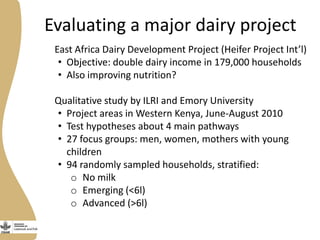
Evaluating a major dairy project
East Africa Dairy Development Project (Heifer Project Int’l)
• Objective: double dairy income in 179,000 households
• Also improving nutrition?
Qualitative study by ILRI and Emory University
• Project areas in Western Kenya, June-August 2010
• Test hypotheses about 4 main pathways
• 27 focus groups: men, women, mothers with young
children
• 94 randomly sampled households, stratified:
o No milk
o Emerging (<6l)
o Advanced (>6l)
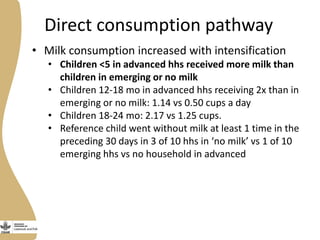
Direct consumption pathway
• Milk consumption increased with intensification
• Children <5 in advanced hhs received more milk than
children in emerging or no milk
• Children 12-18 mo in advanced hhs receiving 2x than in
emerging or no milk: 1.14 vs 0.50 cups a day
• Children 18-24 mo: 2.17 vs 1.25 cups.
• Reference child went without milk at least 1 time in the
preceding 30 days in 3 of 10 hhs in ‘no milk’ vs 1 of 10
emerging hhs vs no household in advanced
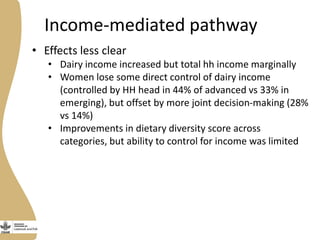
Income-mediated pathway
• Effects less clear
• Dairy income increased but total hh income marginally
• Women lose some direct control of dairy income
(controlled by HH head in 44% of advanced vs 33% in
emerging), but offset by more joint decision-making (28%
vs 14%)
• Improvements in dietary diversity score across
categories, but ability to control for income was limited
“MILK BELONGS TO THE WOMAN AND THE
MONEY BELONGS TO THE MAN”- MALE
FARMER, EMERGING GROUP, CHEBORGE
“MEAT IS A MUST WHEN WE GET PAID
[FROM THE DAIRY].”- MALE
FARMER, EMERGING GROUP, KIPKELION
Soundbites
FROM THE FOCUS GROUP DISCUSSIONS:
Childcare pathway
• Increased workload for women in emerging category
meant a significant share of daytime childcare
entrusted to pre-teen siblings (25%)
• Transition dynamic : workload decreased among
advanced hhs, as did daytime childcare by siblings
• Cessation of breastfeeding and introduction of other
foods advances across intensification categories 
role for nutrition education
Health pathway
• Inconclusive: samples too small and other
measurement challenges to detect differences in
disease incidence as measure of exposure to risk of
zoonoses
• Similarly, data on health expenditures too limited to
evaluate offsetting effect
Summing up…
• It’s complicated, and that was just for on-farm…
• Teasing out clear net benefits will require large
samples and extensive surveys, and even then…
• Consider challenges at community or regional level
when extending to other actors in the value chain
From our perspective
• Major progress:
o Systematic conceptualization of food systems to
understand the links between agriculture and nutrition
• Major gaps:
o Framework for considering
 role of different food commodities in achieving
appropriate diet accessible to the poor
 Implications for policy to influence land use and
investment
• Innovative approaches:
o Systems approach / scenario analysis to putting
nutritional objectives into a food systems context, and
how different food systems contribute to an appropriate
diet
Acknowledgements
• Int’l Livestock Research Institute (ILRI), Nairobi
– Isabelle Baltenweck
– Delia Grace
– Jemimah Njuki
– Thomas Randolph
• Emory University, Atlanta
– Aimee Girard-Webb (faculty, HDGH, Nutrition)
– Craig Hadley (faculty, Anthropology, HDGH)
– Peter Little (faculty, Anthropology, Development Studies)
– Claire Null (faculty, HDGH, Economics)
– Usha Ramakrishnan (faculty, HDGH, Nutrition)
– Shreyas Sreenath (student, Economics)
– Amanda Watkins (student, Nursing)
– Amanda Wyatt (student, Hubert Dept of Global
Health, HDGH)
– Anna Yearous-Algozin (student, Nursing)
– Kathryn Yount (faculty HDGH, Sociology)
• University of Nairobi, Nairobi
– Prof. Erastus Kang’ethe
• Egerton University, Njoro
– Samwel Mbugua
• East Africa Dairy Development
Project
• The Global Health
Institute, Emory University
• The Halle Institute, Emory
University
• Program in Development
Studies, Emory University
Collaborators (alphabetical order) Funding
CGIAR is a global partnership that unites organizations engaged in research for a food secure future. The CGIAR
Research Program on Livestock and Fish aims to increase the productivity of small-scale livestock and fish systems
in sustainable ways, making meat, milk and fish more available and affordable across the developing world.
CGIAR Research Program on Livestock and Fish
livestockfish.cgiar.org

Ensuring access to animal-source foods

  • 1.
    Ensuring access to animal-sourcefoods Tom Randolph Science Forum 2013 Nutrition and health outcomes: targets for agricultural research, Bonn, Germany, 23‒25 September 2013
  • 2.
    Our challenge Protect andenhance adequate access of both rural and urban poor to a particularly valuable nutritional resource in their diet: animal-source foods • Demand growing faster than capacity to supply • Aspects of both food and nutritional security • Change from traditional CGIAR focus on livestock for livelihoods • Conclusion: Not simply a production or nutrition issue  Requires a multidimensional food systems approach
  • 3.
    Our reasoning Food & Nutrition Security •Accessto an appropriately diverse diet Poor rely on local production •Smallholder farms + informal marketing systems, especially in rural areas •Often competitive vis-à-vis larger- scale, industrial, formal systems
  • 4.
    Limited success insupporting smallholder supply response 0.06 0.08 0.03 0.17 0.06 0.11 0.04 0.2 Meat (kg output/kg biomass/yr) 1980 2005 411 1021 517 4226 397 1380 904 6350Milk (kg/cow/yr) 1980 2005
  • 5.
    Promoting ‘smarter’ pro-poor animal-sourcefood systems • Producing and delivering more, good quality food • Serving the poor and targeting the nutritionally challenged • Ensuring it can be sustained and adaptive • Managing potential trade-offs: environmental, resource use, role in diet, health risks Value chain approach – Harness market incentives to promote uptake... – While identifying opportunities to enhance nutritional benefits as broad food-based intervention
  • 6.
    Premise for CGIARResearch Program on Livestock and Fish Research for development and impact that: • Puts together and pilots an integrated intervention across the targeted value chain • While conducting longer-term research on more fundamental productivity constraints • Works together with development partners from the start so they can take intervention to scale • Focuses on only a few selected value chains
  • 7.
    Focus, focus, focus! Workingin 8 target value chains  accountability PIGS AQUACULTURE SHEEP & GOATS DAIRY
  • 8.
    Status • Partnership of4 CGIAR Centers • Officially started January 1st, 2012 • Activities and momentum achieved in 4 value chains
  • 9.
    Will it work? Canlivestock & aquaculture interventions improve nutrition security? Series of literature reviews (Webb, 2012) have concluded: • Projects rarely have explicit food or nutrition security objectives • Among those, very few appropriately designed impact studies • Weak evidence, but suggests positive benefits, especially if accompanied by nutrition education Nutrition influenced through several pathways
  • 10.
    Mapping the linksfor a smallholder dairying household Randolph et al. (2007) Animals owned Human nutritional (growth) status Human health status + + Probability of zoonotic disease Animal production Food crop production Food crop sales Animal & product sales + + + + - HH Income + + Dietary intake + Level of care/feeding behavior + Labor allocated to livestock + - Labor demands on (female) caregiver Total labor demands + + Health inputs + Food crop purchases ASF purchases HH crop consumption HH ASF consumption + + + + + Chronic disease risk + - Land allocation to feed Traction, nutrient cycling + - + + + + + Environmental toxin concentration - + test test Food-borne diseases + - Water contamination + -
  • 11.
    Evaluating a majordairy project East Africa Dairy Development Project (Heifer Project Int’l) • Objective: double dairy income in 179,000 households • Also improving nutrition? Qualitative study by ILRI and Emory University • Project areas in Western Kenya, June-August 2010 • Test hypotheses about 4 main pathways • 27 focus groups: men, women, mothers with young children • 94 randomly sampled households, stratified: o No milk o Emerging (<6l) o Advanced (>6l)
  • 12.
    Direct consumption pathway •Milk consumption increased with intensification • Children <5 in advanced hhs received more milk than children in emerging or no milk • Children 12-18 mo in advanced hhs receiving 2x than in emerging or no milk: 1.14 vs 0.50 cups a day • Children 18-24 mo: 2.17 vs 1.25 cups. • Reference child went without milk at least 1 time in the preceding 30 days in 3 of 10 hhs in ‘no milk’ vs 1 of 10 emerging hhs vs no household in advanced
  • 13.
    Income-mediated pathway • Effectsless clear • Dairy income increased but total hh income marginally • Women lose some direct control of dairy income (controlled by HH head in 44% of advanced vs 33% in emerging), but offset by more joint decision-making (28% vs 14%) • Improvements in dietary diversity score across categories, but ability to control for income was limited
  • 14.
    “MILK BELONGS TOTHE WOMAN AND THE MONEY BELONGS TO THE MAN”- MALE FARMER, EMERGING GROUP, CHEBORGE “MEAT IS A MUST WHEN WE GET PAID [FROM THE DAIRY].”- MALE FARMER, EMERGING GROUP, KIPKELION Soundbites FROM THE FOCUS GROUP DISCUSSIONS:
  • 15.
    Childcare pathway • Increasedworkload for women in emerging category meant a significant share of daytime childcare entrusted to pre-teen siblings (25%) • Transition dynamic : workload decreased among advanced hhs, as did daytime childcare by siblings • Cessation of breastfeeding and introduction of other foods advances across intensification categories  role for nutrition education
  • 16.
    Health pathway • Inconclusive:samples too small and other measurement challenges to detect differences in disease incidence as measure of exposure to risk of zoonoses • Similarly, data on health expenditures too limited to evaluate offsetting effect
  • 17.
    Summing up… • It’scomplicated, and that was just for on-farm… • Teasing out clear net benefits will require large samples and extensive surveys, and even then… • Consider challenges at community or regional level when extending to other actors in the value chain
  • 18.
    From our perspective •Major progress: o Systematic conceptualization of food systems to understand the links between agriculture and nutrition • Major gaps: o Framework for considering  role of different food commodities in achieving appropriate diet accessible to the poor  Implications for policy to influence land use and investment • Innovative approaches: o Systems approach / scenario analysis to putting nutritional objectives into a food systems context, and how different food systems contribute to an appropriate diet
  • 19.
    Acknowledgements • Int’l LivestockResearch Institute (ILRI), Nairobi – Isabelle Baltenweck – Delia Grace – Jemimah Njuki – Thomas Randolph • Emory University, Atlanta – Aimee Girard-Webb (faculty, HDGH, Nutrition) – Craig Hadley (faculty, Anthropology, HDGH) – Peter Little (faculty, Anthropology, Development Studies) – Claire Null (faculty, HDGH, Economics) – Usha Ramakrishnan (faculty, HDGH, Nutrition) – Shreyas Sreenath (student, Economics) – Amanda Watkins (student, Nursing) – Amanda Wyatt (student, Hubert Dept of Global Health, HDGH) – Anna Yearous-Algozin (student, Nursing) – Kathryn Yount (faculty HDGH, Sociology) • University of Nairobi, Nairobi – Prof. Erastus Kang’ethe • Egerton University, Njoro – Samwel Mbugua • East Africa Dairy Development Project • The Global Health Institute, Emory University • The Halle Institute, Emory University • Program in Development Studies, Emory University Collaborators (alphabetical order) Funding
  • 20.
    CGIAR is aglobal partnership that unites organizations engaged in research for a food secure future. The CGIAR Research Program on Livestock and Fish aims to increase the productivity of small-scale livestock and fish systems in sustainable ways, making meat, milk and fish more available and affordable across the developing world. CGIAR Research Program on Livestock and Fish livestockfish.cgiar.org