DTA vs STA
Timing Analysis of an IC
By
PAYAL DWIVEDI
What is Timing Analysis in VLSI?
• Timing analysis is the process used to verify the timing of large digital
circuits (gate level) in order to meet the timing requirements.
• The functionality of an IC depends on the time period of the clock.
• Timing analysis can be done with or without input stimuli.
• It is an integral part of ASIC/VLSI design flow, as we cannot
compromise with the timing of an IC.
TYPES OF TIMING ANALYSIS
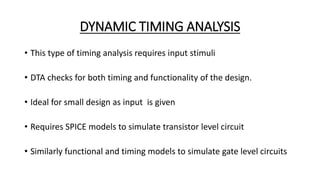
• The timing analysis in VLSI can be broadly divided as:
• A. Dynamic Timing Analysis
• B. Static Timing Analysis
DTA STA
DYNAMIC TIMING ANALYSIS
• This type of timing analysis requires input stimuli
• DTA checks for both timing and functionality of the design.
• Ideal for small design as input is given
• Requires SPICE models to simulate transistor level circuit
• Similarly functional and timing models to simulate gate level circuits
Limitations of DTA
• There are some limitations in DTA analysis that gave rise for the need
of STA. Few of them are:
• Designs with large number of inputs will require very large number of
input stimuli combinations for checking functionality and timing.
• Unrealistic number of combinations is required to simulate using DTA
• DTA will not work for large VLSI circuits.
STATIC TIMING ANALYSIS
• It is a non-vector based approach
• Here, the functionality of the design is pre assumed to be correct
only.
• It is the process of verifying large gate level circuits without the need
for input stimuli
• STA only checks the timing. Functionality is checked during RTL
Verification stage.
PROS & CONS OF STA
ADVANTAGES
• It verifies the timing check for all
paths in design
• It is fast as no input given
• Suitable for large designs
DISADVANTAGES
• Difficult for using in
asynchronous design
• Defined timing
constraints/exceptions required.
• Results are pessimistic
DTA vs STA
DTA
• DTA analyses only those paths of
a design that get resolved by
respective input vectors.
• If vector set is incomplete,
resulting in some violation.
• Add more coverage to increase
the coverage.
STA
• STA considers every path of the
design.
• False timing violations are
reported.
• In order to eliminate false
violations, timing exceptions are
added.
THANK YOU !

STA vs DTA.pptx

  • 1.
    DTA vs STA TimingAnalysis of an IC By PAYAL DWIVEDI
  • 2.
    What is TimingAnalysis in VLSI? • Timing analysis is the process used to verify the timing of large digital circuits (gate level) in order to meet the timing requirements. • The functionality of an IC depends on the time period of the clock. • Timing analysis can be done with or without input stimuli. • It is an integral part of ASIC/VLSI design flow, as we cannot compromise with the timing of an IC.
  • 3.
    TYPES OF TIMINGANALYSIS • The timing analysis in VLSI can be broadly divided as: • A. Dynamic Timing Analysis • B. Static Timing Analysis DTA STA
  • 4.
    DYNAMIC TIMING ANALYSIS •This type of timing analysis requires input stimuli • DTA checks for both timing and functionality of the design. • Ideal for small design as input is given • Requires SPICE models to simulate transistor level circuit • Similarly functional and timing models to simulate gate level circuits
  • 5.
    Limitations of DTA •There are some limitations in DTA analysis that gave rise for the need of STA. Few of them are: • Designs with large number of inputs will require very large number of input stimuli combinations for checking functionality and timing. • Unrealistic number of combinations is required to simulate using DTA • DTA will not work for large VLSI circuits.
  • 6.
    STATIC TIMING ANALYSIS •It is a non-vector based approach • Here, the functionality of the design is pre assumed to be correct only. • It is the process of verifying large gate level circuits without the need for input stimuli • STA only checks the timing. Functionality is checked during RTL Verification stage.
  • 7.
    PROS & CONSOF STA ADVANTAGES • It verifies the timing check for all paths in design • It is fast as no input given • Suitable for large designs DISADVANTAGES • Difficult for using in asynchronous design • Defined timing constraints/exceptions required. • Results are pessimistic
  • 8.
    DTA vs STA DTA •DTA analyses only those paths of a design that get resolved by respective input vectors. • If vector set is incomplete, resulting in some violation. • Add more coverage to increase the coverage. STA • STA considers every path of the design. • False timing violations are reported. • In order to eliminate false violations, timing exceptions are added.
  • 9.