> Introduction
> Preventing conflict
> Managing conflict
> Learn from conflict
Communication Skills & Conflict Management
INTRODUCTION
Unit
WHY IS IT IMPORTANT?
“Effective communication
skills and conflict
management techniques
can significantly reduce
incidence of workplace
violence.”
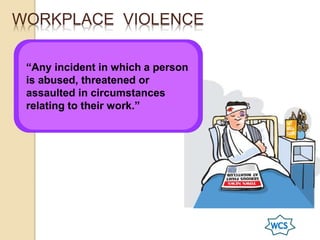
WORKPLACE VIOLENCE
“Any incident in which a person
is abused, threatened or
assaulted in circumstances
relating to their work.”
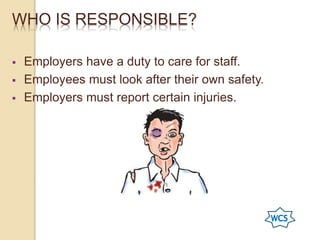
WHO IS RESPONSIBLE?
 Employers have a duty to care for staff.
 Employees must look after their own safety.
 Employers must report certain injuries.
Preventing
Conflict
Unit
2
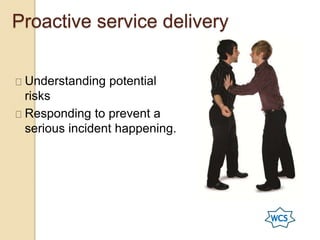
Proactive service delivery
Understanding potential
risks
Responding to prevent a
serious incident happening.
Common flashpoints
Queues
Reprimands
Disputes/complaints
Closing time.
Being proactive
Learn to recognise common flashpoints
Agree policies to reduce incidents
Regular team meetings to agree
procedures
Regular debriefs following incidents.
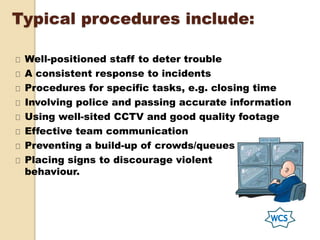
Typical procedures include:
Well-positioned staff to deter trouble
A consistent response to incidents
Procedures for specific tasks, e.g. closing time
Involving police and passing accurate information
Using well-sited CCTV and good quality footage
Effective team communication
Preventing a build-up of crowds/queues
Placing signs to discourage violent
behaviour.
Dynamic Risk Assessment
“A method of continuously
assessing situations to ensure
that risks of violence are
quickly recognised, assessed
and responded to”
A conscious and reliable
process.
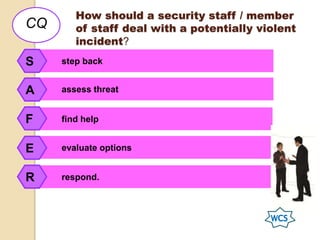
How should a security staff / member
of staff deal with a potentially violent
incident?
find help
evaluate options
respond.
step back
assess threat
S
A
F
E
R
CQ
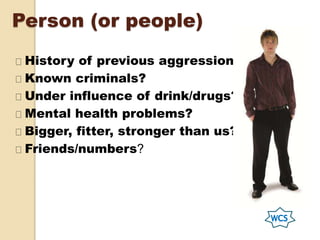
Person (or people)
History of previous aggression?
Known criminals?
Under influence of drink/drugs?
Mental health problems?
Bigger, fitter, stronger than us?
Friends/numbers?
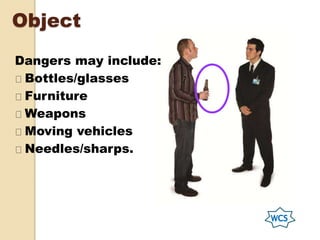
Object
Dangers may include:
Bottles/glasses
Furniture
Weapons
Moving vehicles
Needles/sharps.
Place
Where is the incident happening?
Staircase
Secluded area
Wet floor
Broken glass
Covered by CCTV
Blocked exit.
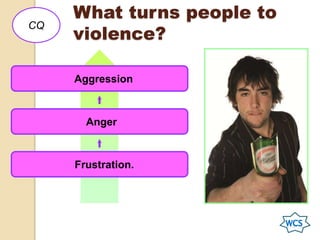
What turns people to
violence?
Aggression
Anger
Frustration.
CQCQ
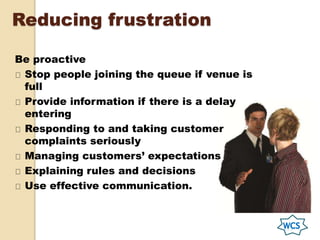
Reducing frustration
Be proactive
Stop people joining the queue if venue is
full
Provide information if there is a delay
entering
Responding to and taking customer
complaints seriously
Managing customers’ expectations
Explaining rules and decisions
Use effective communication.
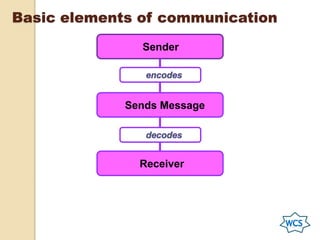
Basic elements of communication
Sender
Sends Message
Receiver
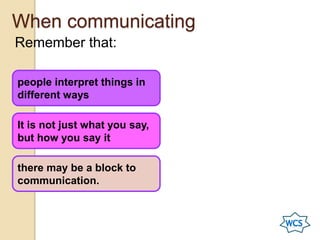
When communicating
Remember that:
people interpret things in
different ways
It is not just what you say,
but how you say it
there may be a block to
communication.
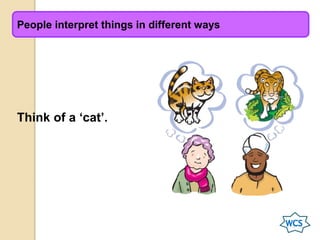
People interpret things in different ways
Think of a ‘cat’.
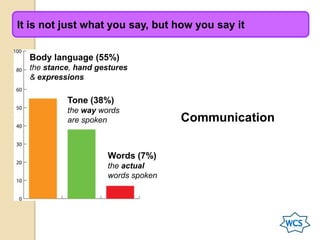
It is not just what you say, but how you say it
Communication
Body language (55%)
the stance, hand gestures
& expressions
Tone (38%)
the way words
are spoken
Words (7%)
the actual
words spoken
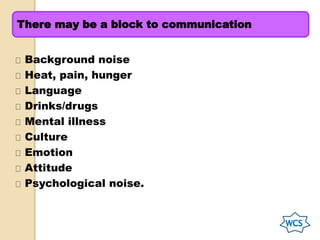
Background noise
Heat, pain, hunger
Language
Drinks/drugs
Mental illness
Culture
Emotion
Attitude
Psychological noise.
There may be a block to communication
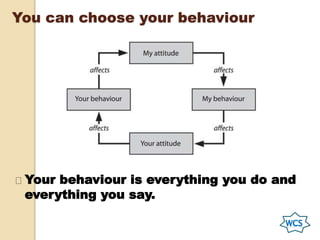
You can choose your behaviour
Your behaviour is everything you do and
everything you say.
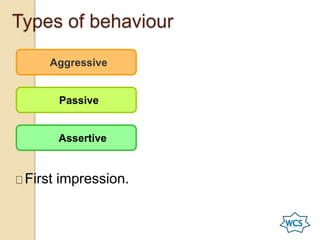
Types of behaviour
First impression.
Aggressive
Passive
Assertive
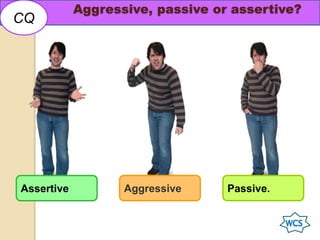
Aggressive
Aggressive, passive or assertive?
Passive.Assertive
CQ
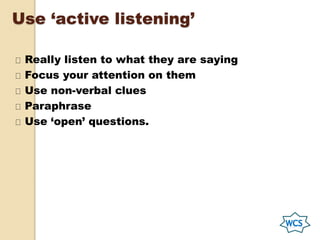
Use ‘active listening’
Really listen to what they are saying
Focus your attention on them
Use non-verbal clues
Paraphrase
Use ‘open’ questions.
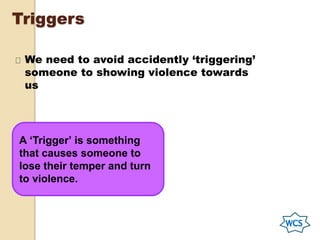
Triggers
We need to avoid accidently ‘triggering’
someone to showing violence towards
us
A ‘Trigger’ is something
that causes someone to
lose their temper and turn
to violence.
Triggers include:
Embarrassment
Disrespect
Insults
Rudeness
Being ridiculed
Being ignored
Being patronised.
Inhibitors
An inhibitor is the opposite of a trigger.
An ‘Inhibitor’ is something that stops
someone from losing their temper
and turning to violence
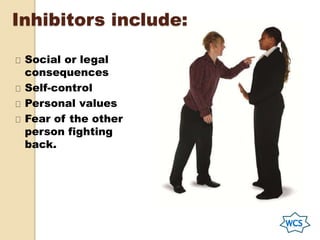
Inhibitors include:
Social or legal
consequences
Self-control
Personal values
Fear of the other
person fighting
back.
Unit
3
Managing
Conflict
Managing Conflict - contents
How people respond to threats
Fight or flight
Signalling non-aggression
Responding to conflict.
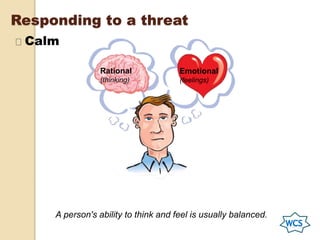
Responding to a threat
Calm
A person's ability to think and feel is usually balanced.
Emotional
(feelings)
Rational
(thinking)
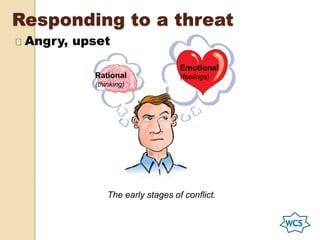
Responding to a threat
Angry, upset
The early stages of conflict.
Emotional
(feelings)Rational
(thinking)
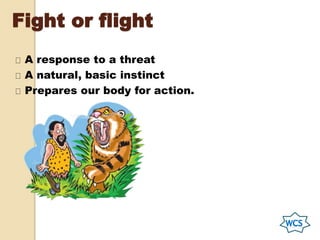
Fight or flight
A response to a threat
A natural, basic instinct
Prepares our body for action.
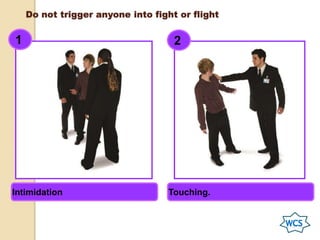
Do not trigger anyone into fight or flight
1 2
Intimidation Touching.
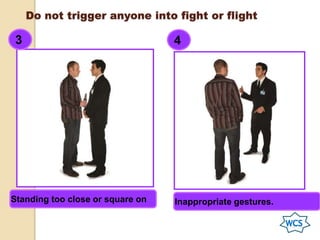
Do not trigger anyone into fight or flight
3 4
Standing too close or square on Inappropriate gestures.
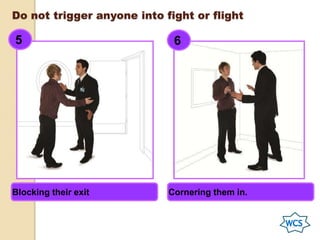
Do not trigger anyone into fight or flight
5 6
Blocking their exit Cornering them in.
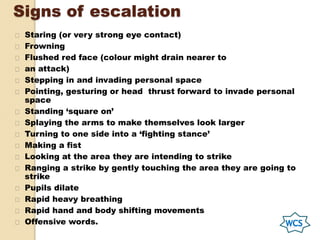
Signs of escalation
Staring (or very strong eye contact)
Frowning
Flushed red face (colour might drain nearer to
an attack)
Stepping in and invading personal space
Pointing, gesturing or head thrust forward to invade personal
space
Standing ‘square on’
Splaying the arms to make themselves look larger
Turning to one side into a ‘fighting stance’
Making a fist
Looking at the area they are intending to strike
Ranging a strike by gently touching the area they are going to
strike
Pupils dilate
Rapid heavy breathing
Rapid hand and body shifting movements
Offensive words.
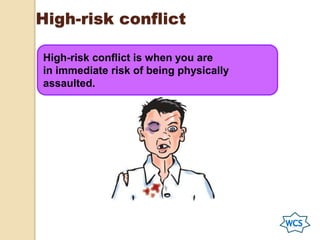
High-risk conflict
High-risk conflict is when you are
in immediate risk of being physically
assaulted.
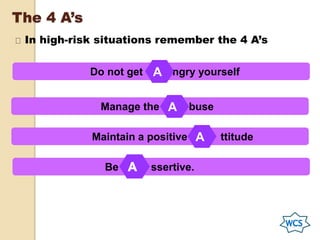
The 4 A’s
In high-risk situations remember the 4 A’s
Do not get ngry yourselfA
Be ssertive.
Maintain a positive ttitudeA
Manage the buseA
Diffusing high-risk conflict
Signal non-aggression (P.A.L.M.S.)
Actively listen
Empathise
Win their trust
Look for a ‘win-win’
Deliver a gift?
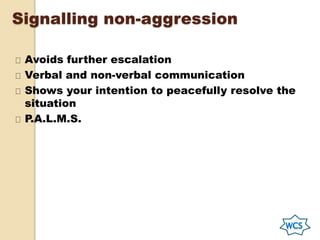
Signalling non-aggression
Avoids further escalation
Verbal and non-verbal communication
Shows your intention to peacefully resolve the
situation
P.A.L.M.S.
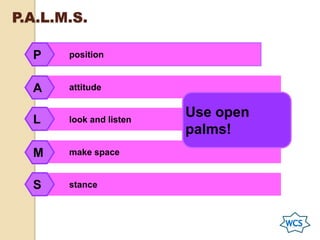
P.A.L.M.S.
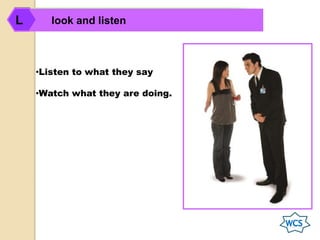
look and listen
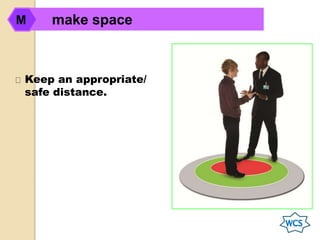
make space
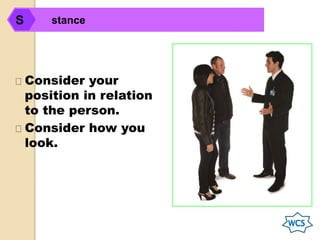
stance
position
attitude
P
A
L
M
S
Use open
palms!
Consider your position in
relation to the person.
positionP
attitudeA attitudeA
Maintain a positive
attitude.
attitudeA look and listenL
•Listen to what they say
•Watch what they are doing.
Keep an appropriate/
safe distance.
make spaceM
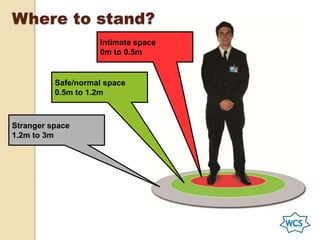
Where to stand?
Intimate space
0m to 0.5m
Safe/normal space
0.5m to 1.2m
Stranger space
1.2m to 3m
Consider your
position in relation
to the person.
Consider how you
look.
stanceS
Empathy
Empathising means:
Putting yourself in their shoes
Acknowledging their feelings
Stepping alongside them
Seeing things from their point of view
“I understand why you are upset, but…”
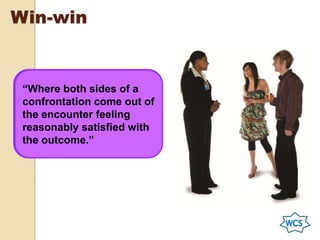
Win-win
“Where both sides of a
confrontation come out of
the encounter feeling
reasonably satisfied with
the outcome.”
What is your ‘win’?
Minimal aggression and stress
Doing a professional job
Finding a successful solution
Leaving other person satisfied that
you have done your best.
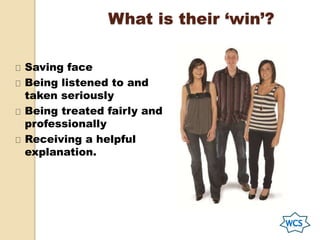
What is their ‘win’?
Saving face
Being listened to and
taken seriously
Being treated fairly and
professionally
Receiving a helpful
explanation.
Delivering a ‘gift’
Gifts
Let the person think you have done
them a favour
Leave them with a positive
impression of you.
Exit strategies
“A prepared way of
getting yourself away
from a difficult/
dangerous situation.”
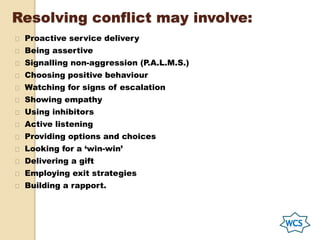
Resolving conflict may involve:
Proactive service delivery
Being assertive
Signalling non-aggression (P.A.L.M.S.)
Choosing positive behaviour
Watching for signs of escalation
Showing empathy
Using inhibitors
Active listening
Providing options and choices
Looking for a ‘win-win’
Delivering a gift
Employing exit strategies
Building a rapport.
Unit
4
Learn from
conflict
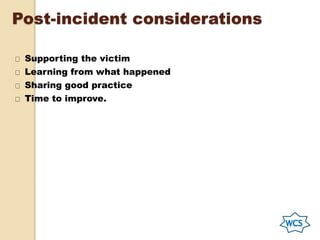
Post-incident considerations
Supporting the victim
Learning from what happened
Sharing good practice
Time to improve.
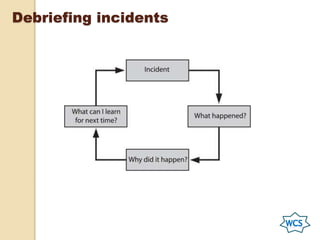
Debriefing incidents
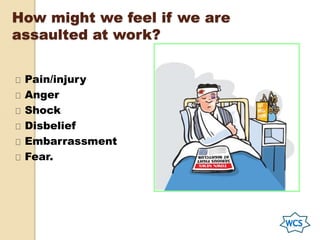
How might we feel if we are
assaulted at work?
Pain/injury
Anger
Shock
Disbelief
Embarrassment
Fear.
And remember…
All injuries involving staff must be recorded.
Any use of force must be justified
Security policies and procedure must be reviewed
regularly
Recording conflict incidents
Pocketbook
Incident book
First Aid book
Police statement (if
necessary)

Communication Skills & Conflict Management