WELCOME
Natural Gas Fueling Stations
2
South shore Clean Cities CNG Roundtable
June 11, 2014
Natural Gas Basics
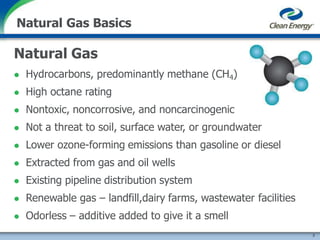
Natural Gas
 Hydrocarbons, predominantly methane (CH4)
 High octane rating
 Nontoxic, noncorrosive, and noncarcinogenic
 Not a threat to soil, surface water, or groundwater
 Lower ozone-forming emissions than gasoline or diesel
 Extracted from gas and oil wells
 Existing pipeline distribution system
 Renewable gas – landfill,dairy farms, wastewater facilities
 Odorless – additive added to give it a smell
3
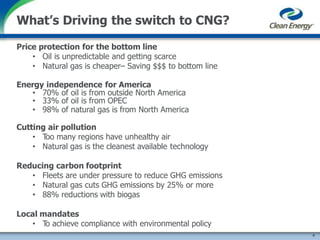
Price protection for the bottom line
• Oil is unpredictable and getting scarce
• Natural gas is cheaper– Saving $$$ to bottom line
Energy independence for America
• 70% of oil is from outside North America
• 33% of oil is from OPEC
• 98% of natural gas is from North America
Cutting air pollution
• Too many regions have unhealthy air
• Natural gas is the cleanest available technology
Reducing carbon footprint
• Fleets are under pressure to reduce GHG emissions
• Natural gas cuts GHG emissions by 25% or more
• 88% reductions with biogas
Local mandates
• To achieve compliance with environmental policy
4
What’s Driving the switch to CNG?
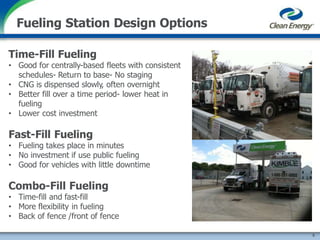
Time-Fill Fueling
• Good for centrally-based fleets with consistent
schedules- Return to base- No staging
• CNG is dispensed slowly, often overnight
• Better fill over a time period- lower heat in
fueling
• Lower cost investment
Fast-Fill Fueling
• Fueling takes place in minutes
• No investment if use public fueling
• Good for vehicles with little downtime
Combo-Fill Fueling
• Time-fill and fast-fill
• More flexibility in fueling
• Back of fence /front of fence
Fueling Station Design Options
5
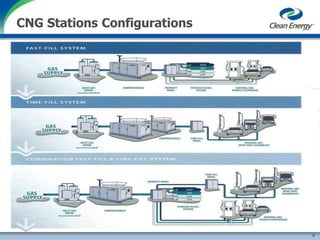
CNG Stations Configurations
6
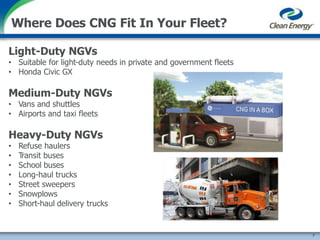
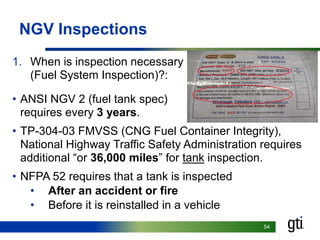
Light-Duty NGVs
• Suitable for light-duty needs in private and government fleets
• Honda Civic GX
Medium-Duty NGVs
• Vans and shuttles
• Airports and taxi fleets
Heavy-Duty NGVs
• Refuse haulers
• Transit buses
• School buses
• Long-haul trucks
• Street sweepers
• Snowplows
• Short-haul delivery trucks
Where Does CNG Fit In Your Fleet?
7
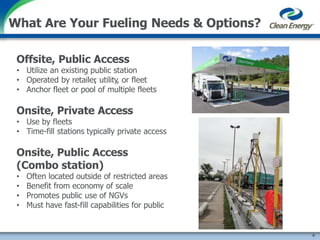
Offsite, Public Access
• Utilize an existing public station
• Operated by retailer, utility, or fleet
• Anchor fleet or pool of multiple fleets
Onsite, Private Access
• Use by fleets
• Time-fill stations typically private access
Onsite, Public Access
(Combo station)
• Often located outside of restricted areas
• Benefit from economy of scale
• Promotes public use of NGVs
• Must have fast-fill capabilities for public
What Are Your Fueling Needs & Options?
8
• Evaluate fleet- types of vehicles i.e. cars , pick-up, vans, dump trucks,
garbage trucks, box trucks, tractors….
• How many vehicles will be fueled each day?
• How much fuel will each vehicle need?
• When and how often will vehicles need to be fueled?
• What are the site development requirements?
• What are my routes?
• What are my truck replacement cycles?
• Can I support my own station? Or do I need to utilize Public Fueling?
9
Start the Process!
Prepare Fleet Inventory & Replacement Schedule
• Identify vehicle replacement potential &sizing
• Determine station sizing plan
Explore Your Options
• Contact vehicle vendors
• Contact equipment vendors
• Meet with station developers
Visit Existing Sites
• Fast-fill and time-fill
• Private and public
Ask Questions
• South Shore Clean Cities
• Station developers
• CNG users and providers
1
You’ve Made the Decision to Evaluate…
Now What?
Thanks You!
Brian Houston
Business Development Manager
(574)297-4576
bhouston@cleanenergyfuels.com
10
Questions?
National Alternative Fuels Training
Consortium
South Shore Clean Cities
June 11, 2014
Presenter:
Kenneth Zanders
Today’s Objective:
An Overview of the
National Alternative Fuels
Training Consortium (NAFTC)
National Alternative Fuels
Training Consortium
“To improve air quality and decrease
U.S. dependence on foreign oil by
promoting, supporting, and expanding
the use of advanced technology vehicles
and alternative fuel vehicles.”
Program of West Virginia University, headquartered in Morgantown, WV
Founded in 1992
Only nationwide curricula development and training organization that
focuses on alternative fuel and advanced technology vehicles
Mission Statement
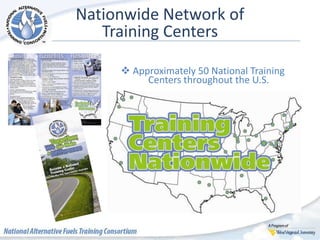
 Approximately 50 National Training
Centers throughout the U.S.
Nationwide Network of
Training Centers
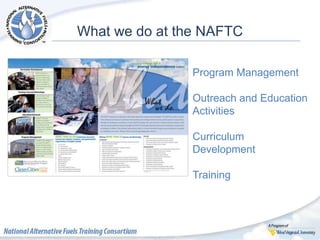
Program Management
Outreach and Education
Activities
Curriculum
Development
Training
What we do at the NAFTC
Program Management
Federally Funded Programs
Hydrogen Vehicle Test Project at Yeager Airport
•Evaluates the use of hydrogen vehicles through real-world
demonstration in West Virginia and provides outreach and education
on hydrogen vehicles
Hydrogen Fuel Dispensing Station at West Virginia University
•Demonstrates that hydrogen is a safe and competitive alternative to
petroleum by building, operating, and evaluating a hydrogen station at
WVU
Program Management
Federally Funded Programs
 Federal Emergency Management Agency (FEMA) Fire
Prevention & Safety Grant
• Will allow the NAFTC to enhance State Fire Academies’
curricula by offering First Responder Safety Train-the-
Trainer courses to Academy instructors, as well as through
pre-conference workshops at industry conferences, and
online training. The project also includes updates to and
the development of an in-cab version of the Quick
Reference Guide, which was developed to help the first
responder identify and respond to an alternative fuel
vehicle or advanced technology vehicle at the scene of an
accident.
Program Management
Recently Completed Federally Funded Programs
 Advanced Electric Drive Vehicle Education Program
• Provides educational and outreach materials about
advanced electric drive vehicles, including battery, hybrid,
plug-in, and fuel cell electric vehicles
 Clean Cities Learning Program
• Raises awareness about alternative fuel and advanced
technology vehicles through a strategic outreach and
education effort, funded by the Clean Cities Program
Outreach and Education
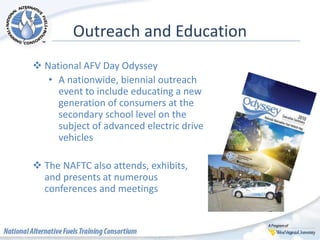
 National AFV Day Odyssey
• A nationwide, biennial outreach
event to include educating a new
generation of consumers at the
secondary school level on the
subject of advanced electric drive
vehicles
 The NAFTC also attends, exhibits,
and presents at numerous
conferences and meetings
Outreach and Education
 National AFV Day Odyssey 2012 statistics
•150 Sites
– 148 U.S. (in 43 states) and 2 International (France and
Sweden)
•Over 250,000 attendees
•Over 200 million reached through media and
Internet
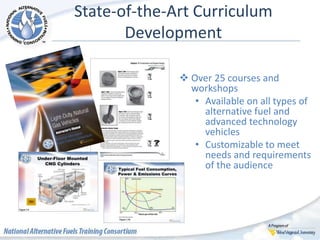
State-of-the-Art Curriculum
Development
 Over 25 courses and
workshops
• Available on all types of
alternative fuel and
advanced technology
vehicles
• Customizable to meet
needs and requirements
of the audience
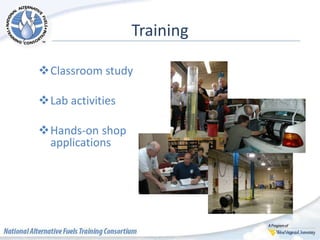
Training
Classroom study
Lab activities
Hands-on shop
applications
Training Impact
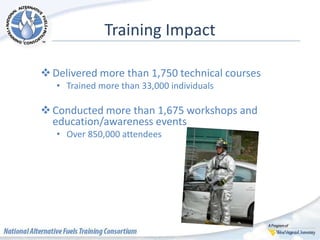
Delivered more than 1,750 technical courses
• Trained more than 33,000 individuals
Conducted more than 1,675 workshops and
education/awareness events
• Over 850,000 attendees
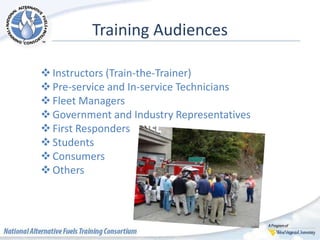
Training Audiences
Instructors (Train-the-Trainer)
Pre-service and In-service Technicians
Fleet Managers
Government and Industry Representatives
First Responders
Students
Consumers
Others
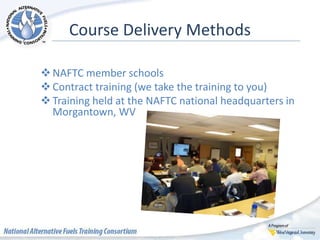
Course Delivery Methods
NAFTC member schools
Contract training (we take the training to you)
Training held at the NAFTC national headquarters in
Morgantown, WV
A Sample of NAFTC Courses
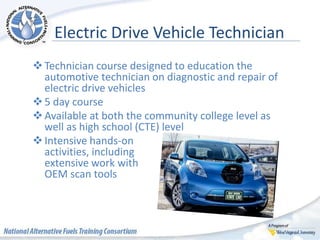
Electric Drive Vehicle Technician
Technician course designed to education the
automotive technician on diagnostic and repair of
electric drive vehicles
5 day course
Available at both the community college level as
well as high school (CTE) level
Intensive hands-on
activities, including
extensive work with
OEM scan tools
Natural Gas Vehicle Training
Suite of courses to cover CNG and LNG vehicles
Light-Duty CNG Vehicles (3 day course)
Heavy-Duty CNG Vehicles (3 day course)
Liquefied Natural Gas (LNG) Vehicles (3 day course)
CNG Fuel System Inspector (2 day course)
Courses can be combined into a targeted “custom”
class based on client need
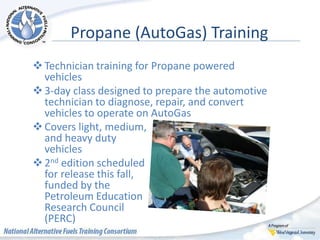
Propane (AutoGas) Training
Technician training for Propane powered
vehicles
3-day class designed to prepare the automotive
technician to diagnose, repair, and convert
vehicles to operate on AutoGas
Covers light, medium,
and heavy duty
vehicles
2nd edition scheduled
for release this fall,
funded by the
Petroleum Education
Research Council
(PERC)
Biodiesel Technician
Training on the basics of Biodiesel
2-day course that covers the need, properties,
and production of Biodiesel as a vehicle fuel
source
Students participate in the production of
biodiesel from waste oil
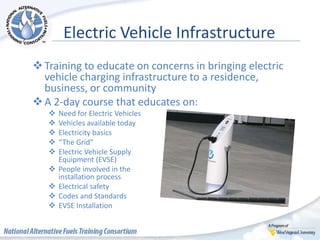
Electric Vehicle Infrastructure
Training to educate on concerns in bringing electric
vehicle charging infrastructure to a residence,
business, or community
A 2-day course that educates on:
 Need for Electric Vehicles
 Vehicles available today
 Electricity basics
 “The Grid”
 Electric Vehicle Supply
Equipment (EVSE)
 People involved in the
installation process
 Electrical safety
 Codes and Standards
 EVSE Installation
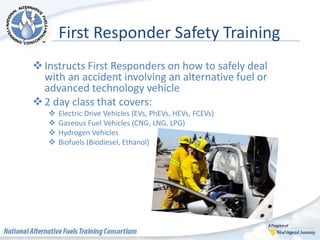
First Responder Safety Training
Instructs First Responders on how to safely deal
with an accident involving an alternative fuel or
advanced technology vehicle
2 day class that covers:
 Electric Drive Vehicles (EVs, PhEVs, HEVs, FCEVs)
 Gaseous Fuel Vehicles (CNG, LNG, LPG)
 Hydrogen Vehicles
 Biofuels (Biodiesel, Ethanol)
Petroleum Reduction Technologies
“Modularized” overview of alternative fuel vehicles
Contains both fuel and fleet information
Can be taught as a 2 day class or individual module
 Importance of Petroleum Reduction Technologies
 Biodiesel
 Ethanol
 Natural Gas
 Propane
 Hydrogen
 Electric Drive
 Fuel Economy
 Idle reduction
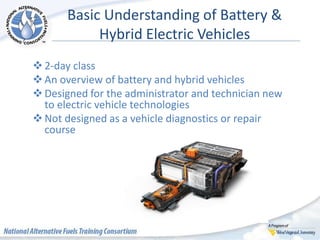
Basic Understanding of Battery &
Hybrid Electric Vehicles
2-day class
An overview of battery and hybrid vehicles
Designed for the administrator and technician new
to electric vehicle technologies
Not designed as a vehicle diagnostics or repair
course
NAFTC Workshops
2 Hour Workshops
Introduction to Alternative Fuels and Advanced
Technology Vehicles
Introduction to Hybrid Electric Vehicles
Introduction to Hydrogen-powered Vehicles
Introduction to Fuel Cell Vehicles
Introduction to Battery-Powered Vehicles
Introduction to Biodiesel Vehicles
Introduction to Natural Gas Vehicles
Introduction to Propane Vehicles
Introduction to Ethanol Vehicles
Other Educational Items and
Training Materials
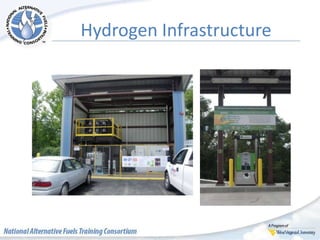
Hydrogen Vehicle Infrastructure
• Hydrogen Vehicle Fueling Station
commissioned 2013 at the NAFTC National
Headquarters in Morgantown, WV
• Dispenser to dispense Hydrogen to NAFTC’s
fleet of 5 hydrogen powered vehicles
– 2 bi-fuel pickups
– 1 dedicated hydrogen pickup
– 2 hydrogen-electric drive hybrid cars
Hydrogen Infrastructure
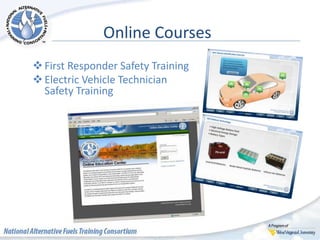
Online Courses
First Responder Safety Training
Electric Vehicle Technician
Safety Training
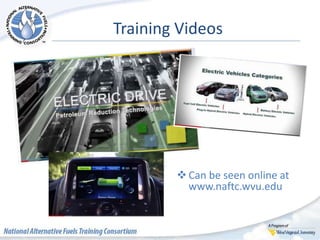
Training Videos
Can be seen online at
www.naftc.wvu.edu
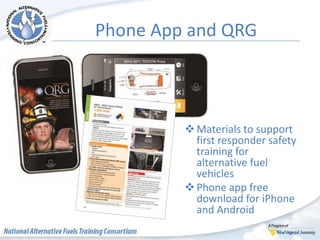
Phone App and QRG
Materials to support
first responder safety
training for
alternative fuel
vehicles
Phone app free
download for iPhone
and Android
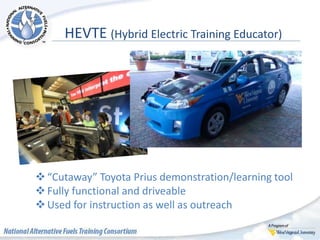
HEVTE (Hybrid Electric Training Educator)
“Cutaway” Toyota Prius demonstration/learning tool
Fully functional and driveable
Used for instruction as well as outreach
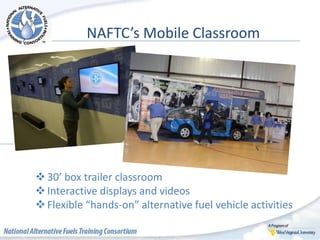
NAFTC’s Mobile Classroom
30’ box trailer classroom
Interactive displays and videos
Flexible “hands-on” alternative fuel vehicle activities
Contact Information
Ken Zanders
Automotive Trainer
Carlton196100@yahoo.com
Micheal Smyth
Assistant Director for Curriculum Development & Training
Micheal.Smyth@mail.wvu.edu
National Alternative Fuels Training Consortium
Ridgeview Business Park
1100 Frederick Lane
Morgantown, WV 26508
Phone: 304-293-7882
www.naftc.wvu.edu
LARRY STUMP
IN State Dept. of Weights and Measures
Natural Gas Roundtable:
Natural Gas Inspection and
Installation
Ted Barnes, P.E.
Gas Technology Institute
June 2014
4848
Objectives
I. GTI R&D Background
II. Alternative Fuel Training
III. NGV Purchasing and Inspection Guidelines
IV. CNG Station Codes and Standards
4949
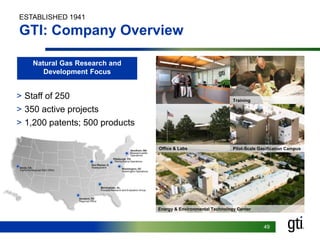
ESTABLISHED 1941
GTI: Company Overview
> Staff of 250
> 350 active projects
> 1,200 patents; 500 products
Energy & Environmental Technology Center
Office & Labs Pilot-Scale Gasification Campus
Training
Natural Gas Research and
Development Focus
5050
GTI: Leading with Research
> GTI has a robust portfolio of NGV RD&D
projects (vehicle & infrastructure)
> Vehicles and On-Board Storage
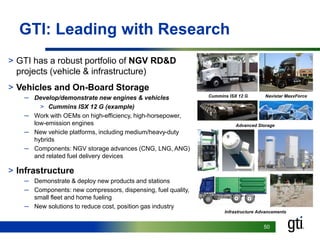
─ Develop/demonstrate new engines & vehicles
> Cummins ISX 12 G (example)
─ Work with OEMs on high-efficiency, high-horsepower,
low-emission engines
─ New vehicle platforms, including medium/heavy-duty
hybrids
─ Components: NGV storage advances (CNG, LNG, ANG)
and related fuel delivery devices
> Infrastructure
─ Demonstrate & deploy new products and stations
─ Components: new compressors, dispensing, fuel quality,
small fleet and home fueling
─ New solutions to reduce cost, position gas industry
Cummins ISX 12 G Navistar MaxxForce
Advanced Storage
Infrastructure Advancements
51
GTI: Continuing with Training –
Lake Michigan Consortium
Webinar Series
I. Inspection Guidelines for CNG/LPG
Vehicle Conversions
II. Considerations for Garage &
Maintenance Shops When Using CNG/LPG
III. Station Installation Guidelines for CNG
IV. Station Installation Guidelines for LPG
V. Best Practices for End Users for CNG,
LPG & Electric Vehicles
The webinars and slides are available online
at www.wicleancities.org/webinars.php
Barriers Survey
Survey to gather barriers for adoption
of alternative fuels
Please complete the survey at:
www.wicleancities.org
5252
NGV Purchase: Light-duty after-
market conversions
Key Takeaways:
1. US EPA and CARB emission certified conversion kits are
allowable under current federal regulation.
• NGVA List:
http://www.ngvc.org/pdfs/availablevehiclesandconversions_130920_f
inal.pdf
• EPA Website: Certified Clean Alternative Fuel Conversion Systems
http://www.epa.gov/otaq/consumer/fuels/altfuels/documents/certified-
conversions.xls
2. Converters need to be approved by kit manufacturer. It is
preferred to confirm converter has ASE/CSA qualified
technicians installing conversion kits.
5353
Converted NGV Purchase
(Continued)
Key Takeaways:
3. Expand knowledge base. Use the following documents
to educate yourself in the basics.
• “Have Your Vehicle Converted to Compressed Natural Gas-
Safety”, Clean Vehicle Education Foundation
(http://www.cleanvehicle.org/committee/technical/PDFs/Con
vert_Your_Vehicle_Safely_Final.pdf).
• “Fact Sheet: Converting Light Duty Vehicles to Natural
Gas”, NGVAmerica
(http://www.ngvc.org/pdfs/FAQs_Converting_to_NGVs.pdf.)
4. Determine fueling logistics. Ideally want to identify and
secure two fueling options.
5454
NGV Inspections
1. When is inspection necessary
(Fuel System Inspection)?:
• ANSI NGV 2 (fuel tank spec)
requires every 3 years.
• TP-304-03 FMVSS (CNG Fuel Container Integrity),
National Highway Traffic Safety Administration requires
additional “or 36,000 miles” for tank inspection.
• NFPA 52 requires that a tank is inspected
• After an accident or fire
• Before it is reinstalled in a vehicle
5555
NGV Inspection (Continued)
2. Who is a qualified inspector?:
• Compressed Gas Association (CGA) defines a qualified
inspector as:
Best Way: Certification from nationally recognized
organization (e.g. CSA – Fuel SYSTEM Inspection)
2 years experience conducting inspections
Supervision by person with 2 years experience conducting
inspections
Approved by fuel cylinder manufacturer
Certification from original equipment manufacturer through
training center
Certification as approved by Authority Having Jurisdiction
5656
NGV Inspection (Continued)
3. How to find a certified inspector?:
• CSA provides certification for CNG fuel system inspection which
includes all major components and tanks.
• CSA list of inspectors by area on their website.
http://www.csagroup.org/us/en/services/education-and-
training/personnel-certification/people-search
4. How to become an inspector?:
• Take a class: http://www.ngvamerica.org/buz_dir/index.html
 Business Directory → Other → Training and Certification
• Take the test: http://shop.csa.ca/en/canada/invt/2703393/
5757
Municipal/Licensing Entity: NGV
Inspection
• Some entities (i.e. municipalities or trade orgs.)
license/approve vehicles for service but do not have
CNG experience
• GTI provided guidance to City of Chicago taxi inspector
• GTI has prepared a template checklist for
inspection of CNG vehicles
• Checklist is available through CACC, WICC, and SSCC
• Checklist is NOT a substitute for certified vehicle
inspections
5858
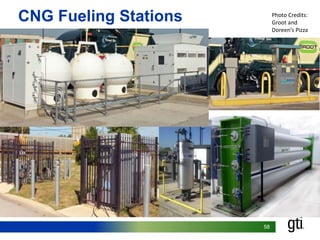
CNG Fueling Stations Photo Credits:
Groot and
Doreen’s Pizza
5959
Codes and Standards
CNG Station Codes: long-standing, mature codes:
oNFPA 52: Vehicular Gaseous Fuel Systems Code
2013
oNFPA 70: National Electric Code (NEC) 2011:
Article 500: Hazardous (Classified) Locations,
Article 501: Class 1 Div.1 & 2 Hazardous Locations
oNFPA 30A: Code for Motor Fuel Dispensing
Facilities and Repair Garages 2012 (Addresses
additional requires when CNG fueling is added to
existing liquid petroleum station)
oInternational Fire Code (IFC)
6060
Equipment Location Details
NFPA 30A, Chapter 12 & NFPA 52, Chapter 7
address equipment placement and set backs.
o Compression, Storage, and Dispensing Equipment
are addressed in these chapters.
o Location, either indoors and outdoors, of the
equipment matters.
o In some instances a combination of both codes will
give guides on final equipment placement e.g. tank
separation (from other aboveground fuel tanks &
dispenser).
6161
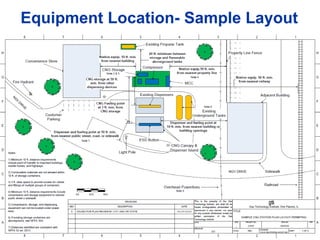
Equipment Location- Sample Layout
6262
Electrical Hazardous Area Location
NFPA 30A & NFPA 52 establish electrical area classification for
CNG fueling stations.
oCompressors, Aboveground Storage Tanks, Dispensers,
Pressure Relief Discharge, Vents and ancillary equipment
(dryers) are classified per Table 7.4.2.9 in NFPA 52.
Electrical Conduits and Wiring must be installed per approved
methods indicated in NEC for classified areas.
With AHJ approval, classified areas specified in Table 7.4.2.9 are
permitted to be reduced or eliminated by positive pressure
ventilation from a source of clean air and/or inert gas per NFPA
496.
6363
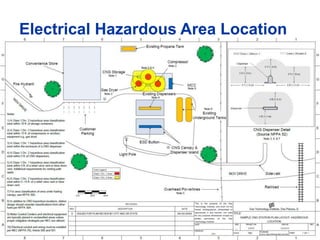
Electrical Hazardous Area Location
6464
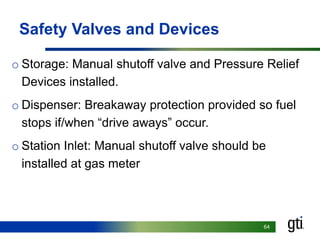
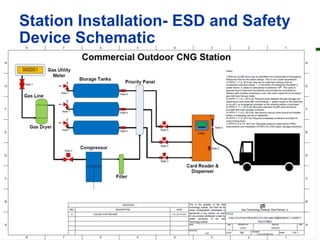
Safety Valves and Devices
o Storage: Manual shutoff valve and Pressure Relief
Devices installed.
o Dispenser: Breakaway protection provided so fuel
stops if/when “drive aways” occur.
o Station Inlet: Manual shutoff valve should be
installed at gas meter
6565
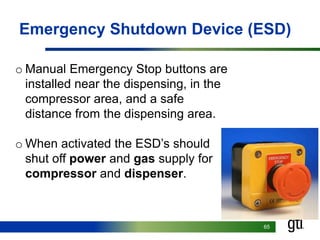
Emergency Shutdown Device (ESD)
o Manual Emergency Stop buttons are
installed near the dispensing, in the
compressor area, and a safe
distance from the dispensing area.
o When activated the ESD’s should
shut off power and gas supply for
compressor and dispenser.
6666
Station Installation- ESD and Safety
Device Schematic
6767
Got Barriers?
What are the barriers for CNG Station Installations in
Indiana?
What are the barriers for purchasing/converting NGVs
in Indiana?
6868
Acknowledgement of Support
6969
CNG Fuel
o CNG or Compressed Natural Gas is predominately
Methane (chemical formula CH4).
o It is a nontoxic, colorless, and odorless gas(odorant is
typically added for detection).
o Natural Gas typically exists in a gaseous vapor form.
o Unlike gasoline, diesel, or propane; natural gas is lighter
than air.
o5.66 lbs (~125 SCF) of natural gas is a Gasoline Gallon
Equivalent (GGE)
o 6.312 lbs (~139 SCF) is a Diesel Gallon Equivalent (DGE) –
Proposal to NIST
7070
CNG Fueling Basics
oNominal pressure of CNG fuel systems in the
U.S. have been standardized to 3600 psig. Older
3000 psig systems have largely been phased out.
o CNG fuel tanks are allowed to be filled to 3600
psig at 70° F (settled pressure), and no more than
4500 psig at any temperature.
o Fueling is either stopped by the dispenser when
a temperature compensated full fill pressure is
achieved or manually stopped by operator with a
switch at the dispenser.
7171
Station Installation - General
Requirements
NFPA 52 addresses general site requirements of station
construction and installation.
oMajor equipment (compression, storage, or dispensers) shall
be protected to prevent damage from vehicles and minimize
physical damage and vandalism.
o Where compression equipment operates unattended, it shall
be equipped with high discharge and low suction pressure
automatic shutdown control.
o Control circuits that are shut down shall remain shutdown
until manually reset.
7272
Station Installation - General
Requirements
NFPA 52 ed. 2013 incorporates new sections emphasizing
general requirements of station construction.
oInstallation CNG systems shall be supervised by qualified
personnel with reference to their construction and use.
oModifications to fuel stations requires a HAZOP and start up
plan completed prior to completion or operation of the facility.
oCompression, storage, and dispensing equipment shall be
installed on foundations with anchoring system designed to
meeting building code requirements and able to withstand
seismic and wind loads.
7373
Station Installation – Storage
Containers
o Storage containers are to be installed above
ground on stable, non combustible foundations or
in vaults with proper ventilation and drainage.
o Individual groups of manifolded ASME vessels
without individual storage valves shall be limited to
a maximum of 10,000 scf.
o PRVs are to be inspected every three years
o In IL, pressure vessels are to be registered with
the State Fire Marshal
7474
Station Installation – Piping/Tubing
o Piping and fittings are to be fabricated, installed,
and tested per ASME B31.3, Process Piping Code.
o Exterior piping shall be buried or installed above
ground and supported and protected against
mechanical damage.
oUnderground and aboveground piping shall be
protected from corrosion in compliance to
recognized practices.
oThreaded pipe and fittings are not allowed
underground.
7575
Station Operation & Fire Protection
o During fueling a vehicle should be turned off.
o Sources of ignition shall not be permitted inside
transfer point. Vehicles themselves are not
considered source of ignition per.
o Warning signs are to be displayed at dispensing
points.
o A portable fire extinguisher having a rating of not
less than 20- B:C shall be provided at the
dispensing area.
SOUTH SHORE CLEAN CITIES
TRANSPORTATION ROUNDTABLE
Natural Gas Initiatives Update
Carl Lisek, Ex. Director
South Shore Clean Cities
June 11th, 2014
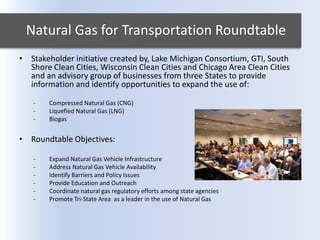
Natural Gas for Transportation Roundtable
• Stakeholder initiative created by, Lake Michigan Consortium, GTI, South
Shore Clean Cities, Wisconsin Clean Cities and Chicago Area Clean Cities
and an advisory group of businesses from three States to provide
information and identify opportunities to expand the use of:
- Compressed Natural Gas (CNG)
- Liquefied Natural Gas (LNG)
- Biogas
• Roundtable Objectives:
- Expand Natural Gas Vehicle Infrastructure
- Address Natural Gas Vehicle Availability
- Identify Barriers and Policy Issues
- Provide Education and Outreach
- Coordinate natural gas regulatory efforts among state agencies
- Promote Tri-State Area as a leader in the use of Natural Gas
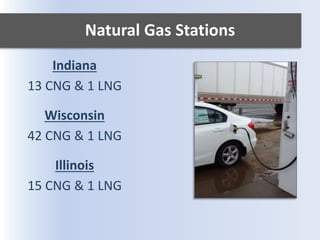
Natural Gas Stations
Indiana
13 CNG & 1 LNG
Wisconsin
42 CNG & 1 LNG
Illinois
15 CNG & 1 LNG
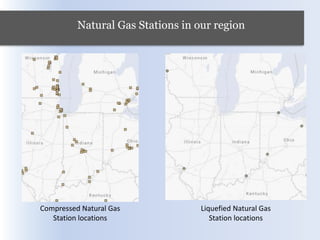
Natural Gas Stations in our region
Compressed Natural Gas
Station locations
Liquefied Natural Gas
Station locations
Policy & Incentive Developments
Indiana:
• BP CADER PROGRAM
• Green Fleet Program
• SSCC/Northern Indiana CMAQ
• IN Diesel Wise (Contact SSCC)
- Available to Northern Indiana
- Opportunities for Vehicles and Fueling Infrastructure
Policy & Incentive Developments
Federal:
• Tax Extender Package
– 30% investment tax credit for alternative vehicle refueling
property
– Extension of the 50 cents per gallon alternative fuel tax credit
and alternative fuel mixture tax credit.
• 2014 National Clean Diesel Funding Assistance
Program (EPA)
• National Clean Diesel Campaign has issued a
stand alone Diesel Emissions Reduction Act
(DERA) Tribal Competition
Policy & Incentive Developments
Federal:
• U.S. DOT has announced the availability of up to
$100 million in competitive grant funds through
the Federal Transit Administration’s (FTA)
“Ladders of Opportunity” initiative. The goal is
to invest in projects that improve the mobility of
Americans with transportation disadvantages.
The FTA will fund up to 80% of the total project
cost; a 20% local match is required. The
application submission deadline is August 4,
2014.
Policy & Incentive Developments
• Alternative Fuels Vehicle Deployment Initiatives
(DOE - pending official announcement):
– Alternative Fuel Vehicle Demonstration and Enhanced Driver
Experience Projects;
– Alternative Fuel Training for First Responders, Public Safety
Officials and Critical Service Providers; and,
– Incorporation of Alternative Fuels into Emergency Response
and Preparedness Operations.
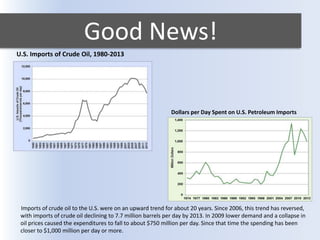
Imports of crude oil to the U.S. were on an upward trend for about 20 years. Since 2006, this trend has reversed,
with imports of crude oil declining to 7.7 million barrels per day by 2013. In 2009 lower demand and a collapse in
oil prices caused the expenditures to fall to about $750 million per day. Since that time the spending has been
closer to $1,000 million per day or more.
Good News!
Dollars per Day Spent on U.S. Petroleum Imports
U.S. Imports of Crude Oil, 1980-2013
Clean Cities - Tools You Can Use
AFLEET Tool
Evaluate benefits of Alternative Fuel Vehicles
•Total Cost of Ownership Calculator
•Fleet Energy & Emission Footprint Calculator
•Payback Calculator
VICE Model
Evaluate investments in CNG Vehicles and/or fueling infrastructure
www.afdc.energy.gov
Questions?
Carl Lisek
Executive Director
South Shore Clean Cities
clisek@southshorecleancities.org
(219) 644-3690

SSCC Natural Gas Roundtable_June 11, 2014

  • 1.
  • 2.
    Natural Gas FuelingStations 2 South shore Clean Cities CNG Roundtable June 11, 2014
  • 3.
    Natural Gas Basics NaturalGas  Hydrocarbons, predominantly methane (CH4)  High octane rating  Nontoxic, noncorrosive, and noncarcinogenic  Not a threat to soil, surface water, or groundwater  Lower ozone-forming emissions than gasoline or diesel  Extracted from gas and oil wells  Existing pipeline distribution system  Renewable gas – landfill,dairy farms, wastewater facilities  Odorless – additive added to give it a smell 3
  • 4.
    Price protection forthe bottom line • Oil is unpredictable and getting scarce • Natural gas is cheaper– Saving $$$ to bottom line Energy independence for America • 70% of oil is from outside North America • 33% of oil is from OPEC • 98% of natural gas is from North America Cutting air pollution • Too many regions have unhealthy air • Natural gas is the cleanest available technology Reducing carbon footprint • Fleets are under pressure to reduce GHG emissions • Natural gas cuts GHG emissions by 25% or more • 88% reductions with biogas Local mandates • To achieve compliance with environmental policy 4 What’s Driving the switch to CNG?
  • 5.
    Time-Fill Fueling • Goodfor centrally-based fleets with consistent schedules- Return to base- No staging • CNG is dispensed slowly, often overnight • Better fill over a time period- lower heat in fueling • Lower cost investment Fast-Fill Fueling • Fueling takes place in minutes • No investment if use public fueling • Good for vehicles with little downtime Combo-Fill Fueling • Time-fill and fast-fill • More flexibility in fueling • Back of fence /front of fence Fueling Station Design Options 5
  • 6.
  • 7.
    Light-Duty NGVs • Suitablefor light-duty needs in private and government fleets • Honda Civic GX Medium-Duty NGVs • Vans and shuttles • Airports and taxi fleets Heavy-Duty NGVs • Refuse haulers • Transit buses • School buses • Long-haul trucks • Street sweepers • Snowplows • Short-haul delivery trucks Where Does CNG Fit In Your Fleet? 7
  • 8.
    Offsite, Public Access •Utilize an existing public station • Operated by retailer, utility, or fleet • Anchor fleet or pool of multiple fleets Onsite, Private Access • Use by fleets • Time-fill stations typically private access Onsite, Public Access (Combo station) • Often located outside of restricted areas • Benefit from economy of scale • Promotes public use of NGVs • Must have fast-fill capabilities for public What Are Your Fueling Needs & Options? 8
  • 9.
    • Evaluate fleet-types of vehicles i.e. cars , pick-up, vans, dump trucks, garbage trucks, box trucks, tractors…. • How many vehicles will be fueled each day? • How much fuel will each vehicle need? • When and how often will vehicles need to be fueled? • What are the site development requirements? • What are my routes? • What are my truck replacement cycles? • Can I support my own station? Or do I need to utilize Public Fueling? 9 Start the Process!
  • 10.
    Prepare Fleet Inventory& Replacement Schedule • Identify vehicle replacement potential &sizing • Determine station sizing plan Explore Your Options • Contact vehicle vendors • Contact equipment vendors • Meet with station developers Visit Existing Sites • Fast-fill and time-fill • Private and public Ask Questions • South Shore Clean Cities • Station developers • CNG users and providers 1 You’ve Made the Decision to Evaluate… Now What?
  • 11.
    Thanks You! Brian Houston BusinessDevelopment Manager (574)297-4576 bhouston@cleanenergyfuels.com 10 Questions?
  • 12.
    National Alternative FuelsTraining Consortium South Shore Clean Cities June 11, 2014 Presenter: Kenneth Zanders
  • 13.
    Today’s Objective: An Overviewof the National Alternative Fuels Training Consortium (NAFTC)
  • 14.
    National Alternative Fuels TrainingConsortium “To improve air quality and decrease U.S. dependence on foreign oil by promoting, supporting, and expanding the use of advanced technology vehicles and alternative fuel vehicles.” Program of West Virginia University, headquartered in Morgantown, WV Founded in 1992 Only nationwide curricula development and training organization that focuses on alternative fuel and advanced technology vehicles Mission Statement
  • 15.
     Approximately 50National Training Centers throughout the U.S. Nationwide Network of Training Centers
  • 16.
    Program Management Outreach andEducation Activities Curriculum Development Training What we do at the NAFTC
  • 17.
    Program Management Federally FundedPrograms Hydrogen Vehicle Test Project at Yeager Airport •Evaluates the use of hydrogen vehicles through real-world demonstration in West Virginia and provides outreach and education on hydrogen vehicles Hydrogen Fuel Dispensing Station at West Virginia University •Demonstrates that hydrogen is a safe and competitive alternative to petroleum by building, operating, and evaluating a hydrogen station at WVU
  • 18.
    Program Management Federally FundedPrograms  Federal Emergency Management Agency (FEMA) Fire Prevention & Safety Grant • Will allow the NAFTC to enhance State Fire Academies’ curricula by offering First Responder Safety Train-the- Trainer courses to Academy instructors, as well as through pre-conference workshops at industry conferences, and online training. The project also includes updates to and the development of an in-cab version of the Quick Reference Guide, which was developed to help the first responder identify and respond to an alternative fuel vehicle or advanced technology vehicle at the scene of an accident.
  • 19.
    Program Management Recently CompletedFederally Funded Programs  Advanced Electric Drive Vehicle Education Program • Provides educational and outreach materials about advanced electric drive vehicles, including battery, hybrid, plug-in, and fuel cell electric vehicles  Clean Cities Learning Program • Raises awareness about alternative fuel and advanced technology vehicles through a strategic outreach and education effort, funded by the Clean Cities Program
  • 20.
    Outreach and Education National AFV Day Odyssey • A nationwide, biennial outreach event to include educating a new generation of consumers at the secondary school level on the subject of advanced electric drive vehicles  The NAFTC also attends, exhibits, and presents at numerous conferences and meetings
  • 21.
    Outreach and Education National AFV Day Odyssey 2012 statistics •150 Sites – 148 U.S. (in 43 states) and 2 International (France and Sweden) •Over 250,000 attendees •Over 200 million reached through media and Internet
  • 22.
    State-of-the-Art Curriculum Development  Over25 courses and workshops • Available on all types of alternative fuel and advanced technology vehicles • Customizable to meet needs and requirements of the audience
  • 23.
  • 24.
    Training Impact Delivered morethan 1,750 technical courses • Trained more than 33,000 individuals Conducted more than 1,675 workshops and education/awareness events • Over 850,000 attendees
  • 25.
    Training Audiences Instructors (Train-the-Trainer) Pre-serviceand In-service Technicians Fleet Managers Government and Industry Representatives First Responders Students Consumers Others
  • 26.
    Course Delivery Methods NAFTCmember schools Contract training (we take the training to you) Training held at the NAFTC national headquarters in Morgantown, WV
  • 27.
    A Sample ofNAFTC Courses
  • 28.
    Electric Drive VehicleTechnician Technician course designed to education the automotive technician on diagnostic and repair of electric drive vehicles 5 day course Available at both the community college level as well as high school (CTE) level Intensive hands-on activities, including extensive work with OEM scan tools
  • 29.
    Natural Gas VehicleTraining Suite of courses to cover CNG and LNG vehicles Light-Duty CNG Vehicles (3 day course) Heavy-Duty CNG Vehicles (3 day course) Liquefied Natural Gas (LNG) Vehicles (3 day course) CNG Fuel System Inspector (2 day course) Courses can be combined into a targeted “custom” class based on client need
  • 30.
    Propane (AutoGas) Training Techniciantraining for Propane powered vehicles 3-day class designed to prepare the automotive technician to diagnose, repair, and convert vehicles to operate on AutoGas Covers light, medium, and heavy duty vehicles 2nd edition scheduled for release this fall, funded by the Petroleum Education Research Council (PERC)
  • 31.
    Biodiesel Technician Training onthe basics of Biodiesel 2-day course that covers the need, properties, and production of Biodiesel as a vehicle fuel source Students participate in the production of biodiesel from waste oil
  • 32.
    Electric Vehicle Infrastructure Trainingto educate on concerns in bringing electric vehicle charging infrastructure to a residence, business, or community A 2-day course that educates on:  Need for Electric Vehicles  Vehicles available today  Electricity basics  “The Grid”  Electric Vehicle Supply Equipment (EVSE)  People involved in the installation process  Electrical safety  Codes and Standards  EVSE Installation
  • 33.
    First Responder SafetyTraining Instructs First Responders on how to safely deal with an accident involving an alternative fuel or advanced technology vehicle 2 day class that covers:  Electric Drive Vehicles (EVs, PhEVs, HEVs, FCEVs)  Gaseous Fuel Vehicles (CNG, LNG, LPG)  Hydrogen Vehicles  Biofuels (Biodiesel, Ethanol)
  • 34.
    Petroleum Reduction Technologies “Modularized”overview of alternative fuel vehicles Contains both fuel and fleet information Can be taught as a 2 day class or individual module  Importance of Petroleum Reduction Technologies  Biodiesel  Ethanol  Natural Gas  Propane  Hydrogen  Electric Drive  Fuel Economy  Idle reduction
  • 35.
    Basic Understanding ofBattery & Hybrid Electric Vehicles 2-day class An overview of battery and hybrid vehicles Designed for the administrator and technician new to electric vehicle technologies Not designed as a vehicle diagnostics or repair course
  • 36.
    NAFTC Workshops 2 HourWorkshops Introduction to Alternative Fuels and Advanced Technology Vehicles Introduction to Hybrid Electric Vehicles Introduction to Hydrogen-powered Vehicles Introduction to Fuel Cell Vehicles Introduction to Battery-Powered Vehicles Introduction to Biodiesel Vehicles Introduction to Natural Gas Vehicles Introduction to Propane Vehicles Introduction to Ethanol Vehicles
  • 37.
    Other Educational Itemsand Training Materials
  • 38.
    Hydrogen Vehicle Infrastructure •Hydrogen Vehicle Fueling Station commissioned 2013 at the NAFTC National Headquarters in Morgantown, WV • Dispenser to dispense Hydrogen to NAFTC’s fleet of 5 hydrogen powered vehicles – 2 bi-fuel pickups – 1 dedicated hydrogen pickup – 2 hydrogen-electric drive hybrid cars
  • 39.
  • 40.
    Online Courses First ResponderSafety Training Electric Vehicle Technician Safety Training
  • 41.
    Training Videos Can beseen online at www.naftc.wvu.edu
  • 42.
    Phone App andQRG Materials to support first responder safety training for alternative fuel vehicles Phone app free download for iPhone and Android
  • 43.
    HEVTE (Hybrid ElectricTraining Educator) “Cutaway” Toyota Prius demonstration/learning tool Fully functional and driveable Used for instruction as well as outreach
  • 44.
    NAFTC’s Mobile Classroom 30’box trailer classroom Interactive displays and videos Flexible “hands-on” alternative fuel vehicle activities
  • 45.
    Contact Information Ken Zanders AutomotiveTrainer Carlton196100@yahoo.com Micheal Smyth Assistant Director for Curriculum Development & Training Micheal.Smyth@mail.wvu.edu National Alternative Fuels Training Consortium Ridgeview Business Park 1100 Frederick Lane Morgantown, WV 26508 Phone: 304-293-7882 www.naftc.wvu.edu
  • 46.
    LARRY STUMP IN StateDept. of Weights and Measures
  • 47.
    Natural Gas Roundtable: NaturalGas Inspection and Installation Ted Barnes, P.E. Gas Technology Institute June 2014
  • 48.
    4848 Objectives I. GTI R&DBackground II. Alternative Fuel Training III. NGV Purchasing and Inspection Guidelines IV. CNG Station Codes and Standards
  • 49.
    4949 ESTABLISHED 1941 GTI: CompanyOverview > Staff of 250 > 350 active projects > 1,200 patents; 500 products Energy & Environmental Technology Center Office & Labs Pilot-Scale Gasification Campus Training Natural Gas Research and Development Focus
  • 50.
    5050 GTI: Leading withResearch > GTI has a robust portfolio of NGV RD&D projects (vehicle & infrastructure) > Vehicles and On-Board Storage ─ Develop/demonstrate new engines & vehicles > Cummins ISX 12 G (example) ─ Work with OEMs on high-efficiency, high-horsepower, low-emission engines ─ New vehicle platforms, including medium/heavy-duty hybrids ─ Components: NGV storage advances (CNG, LNG, ANG) and related fuel delivery devices > Infrastructure ─ Demonstrate & deploy new products and stations ─ Components: new compressors, dispensing, fuel quality, small fleet and home fueling ─ New solutions to reduce cost, position gas industry Cummins ISX 12 G Navistar MaxxForce Advanced Storage Infrastructure Advancements
  • 51.
    51 GTI: Continuing withTraining – Lake Michigan Consortium Webinar Series I. Inspection Guidelines for CNG/LPG Vehicle Conversions II. Considerations for Garage & Maintenance Shops When Using CNG/LPG III. Station Installation Guidelines for CNG IV. Station Installation Guidelines for LPG V. Best Practices for End Users for CNG, LPG & Electric Vehicles The webinars and slides are available online at www.wicleancities.org/webinars.php Barriers Survey Survey to gather barriers for adoption of alternative fuels Please complete the survey at: www.wicleancities.org
  • 52.
    5252 NGV Purchase: Light-dutyafter- market conversions Key Takeaways: 1. US EPA and CARB emission certified conversion kits are allowable under current federal regulation. • NGVA List: http://www.ngvc.org/pdfs/availablevehiclesandconversions_130920_f inal.pdf • EPA Website: Certified Clean Alternative Fuel Conversion Systems http://www.epa.gov/otaq/consumer/fuels/altfuels/documents/certified- conversions.xls 2. Converters need to be approved by kit manufacturer. It is preferred to confirm converter has ASE/CSA qualified technicians installing conversion kits.
  • 53.
    5353 Converted NGV Purchase (Continued) KeyTakeaways: 3. Expand knowledge base. Use the following documents to educate yourself in the basics. • “Have Your Vehicle Converted to Compressed Natural Gas- Safety”, Clean Vehicle Education Foundation (http://www.cleanvehicle.org/committee/technical/PDFs/Con vert_Your_Vehicle_Safely_Final.pdf). • “Fact Sheet: Converting Light Duty Vehicles to Natural Gas”, NGVAmerica (http://www.ngvc.org/pdfs/FAQs_Converting_to_NGVs.pdf.) 4. Determine fueling logistics. Ideally want to identify and secure two fueling options.
  • 54.
    5454 NGV Inspections 1. Whenis inspection necessary (Fuel System Inspection)?: • ANSI NGV 2 (fuel tank spec) requires every 3 years. • TP-304-03 FMVSS (CNG Fuel Container Integrity), National Highway Traffic Safety Administration requires additional “or 36,000 miles” for tank inspection. • NFPA 52 requires that a tank is inspected • After an accident or fire • Before it is reinstalled in a vehicle
  • 55.
    5555 NGV Inspection (Continued) 2.Who is a qualified inspector?: • Compressed Gas Association (CGA) defines a qualified inspector as: Best Way: Certification from nationally recognized organization (e.g. CSA – Fuel SYSTEM Inspection) 2 years experience conducting inspections Supervision by person with 2 years experience conducting inspections Approved by fuel cylinder manufacturer Certification from original equipment manufacturer through training center Certification as approved by Authority Having Jurisdiction
  • 56.
    5656 NGV Inspection (Continued) 3.How to find a certified inspector?: • CSA provides certification for CNG fuel system inspection which includes all major components and tanks. • CSA list of inspectors by area on their website. http://www.csagroup.org/us/en/services/education-and- training/personnel-certification/people-search 4. How to become an inspector?: • Take a class: http://www.ngvamerica.org/buz_dir/index.html  Business Directory → Other → Training and Certification • Take the test: http://shop.csa.ca/en/canada/invt/2703393/
  • 57.
    5757 Municipal/Licensing Entity: NGV Inspection •Some entities (i.e. municipalities or trade orgs.) license/approve vehicles for service but do not have CNG experience • GTI provided guidance to City of Chicago taxi inspector • GTI has prepared a template checklist for inspection of CNG vehicles • Checklist is available through CACC, WICC, and SSCC • Checklist is NOT a substitute for certified vehicle inspections
  • 58.
    5858 CNG Fueling StationsPhoto Credits: Groot and Doreen’s Pizza
  • 59.
    5959 Codes and Standards CNGStation Codes: long-standing, mature codes: oNFPA 52: Vehicular Gaseous Fuel Systems Code 2013 oNFPA 70: National Electric Code (NEC) 2011: Article 500: Hazardous (Classified) Locations, Article 501: Class 1 Div.1 & 2 Hazardous Locations oNFPA 30A: Code for Motor Fuel Dispensing Facilities and Repair Garages 2012 (Addresses additional requires when CNG fueling is added to existing liquid petroleum station) oInternational Fire Code (IFC)
  • 60.
    6060 Equipment Location Details NFPA30A, Chapter 12 & NFPA 52, Chapter 7 address equipment placement and set backs. o Compression, Storage, and Dispensing Equipment are addressed in these chapters. o Location, either indoors and outdoors, of the equipment matters. o In some instances a combination of both codes will give guides on final equipment placement e.g. tank separation (from other aboveground fuel tanks & dispenser).
  • 61.
  • 62.
    6262 Electrical Hazardous AreaLocation NFPA 30A & NFPA 52 establish electrical area classification for CNG fueling stations. oCompressors, Aboveground Storage Tanks, Dispensers, Pressure Relief Discharge, Vents and ancillary equipment (dryers) are classified per Table 7.4.2.9 in NFPA 52. Electrical Conduits and Wiring must be installed per approved methods indicated in NEC for classified areas. With AHJ approval, classified areas specified in Table 7.4.2.9 are permitted to be reduced or eliminated by positive pressure ventilation from a source of clean air and/or inert gas per NFPA 496.
  • 63.
  • 64.
    6464 Safety Valves andDevices o Storage: Manual shutoff valve and Pressure Relief Devices installed. o Dispenser: Breakaway protection provided so fuel stops if/when “drive aways” occur. o Station Inlet: Manual shutoff valve should be installed at gas meter
  • 65.
    6565 Emergency Shutdown Device(ESD) o Manual Emergency Stop buttons are installed near the dispensing, in the compressor area, and a safe distance from the dispensing area. o When activated the ESD’s should shut off power and gas supply for compressor and dispenser.
  • 66.
    6666 Station Installation- ESDand Safety Device Schematic
  • 67.
    6767 Got Barriers? What arethe barriers for CNG Station Installations in Indiana? What are the barriers for purchasing/converting NGVs in Indiana?
  • 68.
  • 69.
    6969 CNG Fuel o CNGor Compressed Natural Gas is predominately Methane (chemical formula CH4). o It is a nontoxic, colorless, and odorless gas(odorant is typically added for detection). o Natural Gas typically exists in a gaseous vapor form. o Unlike gasoline, diesel, or propane; natural gas is lighter than air. o5.66 lbs (~125 SCF) of natural gas is a Gasoline Gallon Equivalent (GGE) o 6.312 lbs (~139 SCF) is a Diesel Gallon Equivalent (DGE) – Proposal to NIST
  • 70.
    7070 CNG Fueling Basics oNominalpressure of CNG fuel systems in the U.S. have been standardized to 3600 psig. Older 3000 psig systems have largely been phased out. o CNG fuel tanks are allowed to be filled to 3600 psig at 70° F (settled pressure), and no more than 4500 psig at any temperature. o Fueling is either stopped by the dispenser when a temperature compensated full fill pressure is achieved or manually stopped by operator with a switch at the dispenser.
  • 71.
    7171 Station Installation -General Requirements NFPA 52 addresses general site requirements of station construction and installation. oMajor equipment (compression, storage, or dispensers) shall be protected to prevent damage from vehicles and minimize physical damage and vandalism. o Where compression equipment operates unattended, it shall be equipped with high discharge and low suction pressure automatic shutdown control. o Control circuits that are shut down shall remain shutdown until manually reset.
  • 72.
    7272 Station Installation -General Requirements NFPA 52 ed. 2013 incorporates new sections emphasizing general requirements of station construction. oInstallation CNG systems shall be supervised by qualified personnel with reference to their construction and use. oModifications to fuel stations requires a HAZOP and start up plan completed prior to completion or operation of the facility. oCompression, storage, and dispensing equipment shall be installed on foundations with anchoring system designed to meeting building code requirements and able to withstand seismic and wind loads.
  • 73.
    7373 Station Installation –Storage Containers o Storage containers are to be installed above ground on stable, non combustible foundations or in vaults with proper ventilation and drainage. o Individual groups of manifolded ASME vessels without individual storage valves shall be limited to a maximum of 10,000 scf. o PRVs are to be inspected every three years o In IL, pressure vessels are to be registered with the State Fire Marshal
  • 74.
    7474 Station Installation –Piping/Tubing o Piping and fittings are to be fabricated, installed, and tested per ASME B31.3, Process Piping Code. o Exterior piping shall be buried or installed above ground and supported and protected against mechanical damage. oUnderground and aboveground piping shall be protected from corrosion in compliance to recognized practices. oThreaded pipe and fittings are not allowed underground.
  • 75.
    7575 Station Operation &Fire Protection o During fueling a vehicle should be turned off. o Sources of ignition shall not be permitted inside transfer point. Vehicles themselves are not considered source of ignition per. o Warning signs are to be displayed at dispensing points. o A portable fire extinguisher having a rating of not less than 20- B:C shall be provided at the dispensing area.
  • 76.
    SOUTH SHORE CLEANCITIES TRANSPORTATION ROUNDTABLE Natural Gas Initiatives Update Carl Lisek, Ex. Director South Shore Clean Cities June 11th, 2014
  • 77.
    Natural Gas forTransportation Roundtable • Stakeholder initiative created by, Lake Michigan Consortium, GTI, South Shore Clean Cities, Wisconsin Clean Cities and Chicago Area Clean Cities and an advisory group of businesses from three States to provide information and identify opportunities to expand the use of: - Compressed Natural Gas (CNG) - Liquefied Natural Gas (LNG) - Biogas • Roundtable Objectives: - Expand Natural Gas Vehicle Infrastructure - Address Natural Gas Vehicle Availability - Identify Barriers and Policy Issues - Provide Education and Outreach - Coordinate natural gas regulatory efforts among state agencies - Promote Tri-State Area as a leader in the use of Natural Gas
  • 78.
    Natural Gas Stations Indiana 13CNG & 1 LNG Wisconsin 42 CNG & 1 LNG Illinois 15 CNG & 1 LNG
  • 79.
    Natural Gas Stationsin our region Compressed Natural Gas Station locations Liquefied Natural Gas Station locations
  • 80.
    Policy & IncentiveDevelopments Indiana: • BP CADER PROGRAM • Green Fleet Program • SSCC/Northern Indiana CMAQ • IN Diesel Wise (Contact SSCC) - Available to Northern Indiana - Opportunities for Vehicles and Fueling Infrastructure
  • 81.
    Policy & IncentiveDevelopments Federal: • Tax Extender Package – 30% investment tax credit for alternative vehicle refueling property – Extension of the 50 cents per gallon alternative fuel tax credit and alternative fuel mixture tax credit. • 2014 National Clean Diesel Funding Assistance Program (EPA) • National Clean Diesel Campaign has issued a stand alone Diesel Emissions Reduction Act (DERA) Tribal Competition
  • 82.
    Policy & IncentiveDevelopments Federal: • U.S. DOT has announced the availability of up to $100 million in competitive grant funds through the Federal Transit Administration’s (FTA) “Ladders of Opportunity” initiative. The goal is to invest in projects that improve the mobility of Americans with transportation disadvantages. The FTA will fund up to 80% of the total project cost; a 20% local match is required. The application submission deadline is August 4, 2014.
  • 83.
    Policy & IncentiveDevelopments • Alternative Fuels Vehicle Deployment Initiatives (DOE - pending official announcement): – Alternative Fuel Vehicle Demonstration and Enhanced Driver Experience Projects; – Alternative Fuel Training for First Responders, Public Safety Officials and Critical Service Providers; and, – Incorporation of Alternative Fuels into Emergency Response and Preparedness Operations.
  • 84.
    Imports of crudeoil to the U.S. were on an upward trend for about 20 years. Since 2006, this trend has reversed, with imports of crude oil declining to 7.7 million barrels per day by 2013. In 2009 lower demand and a collapse in oil prices caused the expenditures to fall to about $750 million per day. Since that time the spending has been closer to $1,000 million per day or more. Good News! Dollars per Day Spent on U.S. Petroleum Imports U.S. Imports of Crude Oil, 1980-2013
  • 85.
    Clean Cities -Tools You Can Use AFLEET Tool Evaluate benefits of Alternative Fuel Vehicles •Total Cost of Ownership Calculator •Fleet Energy & Emission Footprint Calculator •Payback Calculator VICE Model Evaluate investments in CNG Vehicles and/or fueling infrastructure www.afdc.energy.gov
  • 86.
    Questions? Carl Lisek Executive Director SouthShore Clean Cities clisek@southshorecleancities.org (219) 644-3690