






PROBLEM STATEMENT
• We are a part of a company which is the world leader in commercial vehicle
segment. Our responsibility as a new product development team is to
provide solution to various problem faced by the company.
CASE STUDY
• To meet the upcoming emission norms our company decides to convert an
existing diesel engine to a dedicated CNG engine for commercial application.
TEAM STRUCTURE
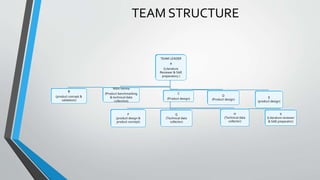
TEAM LEADER
A
(Literature
Reviewer & SAE
preparatory )
B
(product concept &
validation)
Nitin Verma
(Product benchmarking
& technical data
collection)
C
(Product design)
D
(Product design)
E
(product design)
F
(product design &
product concept)
G
(Technical data
collector)
H
(Technical data
collector)
X
(Literature reviewer
& SAE preparator)
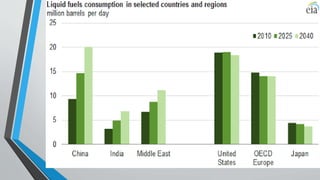
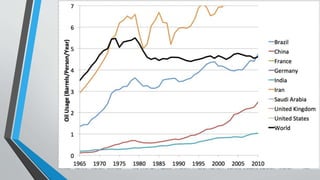
Current Market trends/requirement for given
engine.
• An automotive natural gas vehicle uses compressed natural gas as an
alternative to the mineral oils can be stated with examples like:Trucks,
buses, heavy duty trucks and locomotives.
ADVANTAGES OF CNG
• 20 to 25 per cent less carbon dioxide.
• Up to 90 per cent less carbon monoxide.
• 75 to 90 per cent less non-methane hydrocarbons.
• CNG-powered vehicles have lower maintenance costs.
• No acid smell from exhaust gases.
• No heavy metal additives necessary to increase knock rating.
• No losses through vaporization from the tank and/or while refuelling.
• No carcinogenic substances.
• CNG mixes easily and evenly in air being a gaseous fuel.
DISADVANTAGES OF CNG
• Methane emission.
• Approximately 50 per cent more nitrogen oxides in comparison with Diesel.
• 10 to 20 per cent less power output with existing engines.
• Additional fuel station network necessary.
• Weight and space requirements for gas cylinders in a vehicle.
• Shorter operating range of vehicles.
• Running on a close to empty tank reduces the pressure and increases the risk of
the valves bursting.
• Conversion kits tend to come with a high cost.
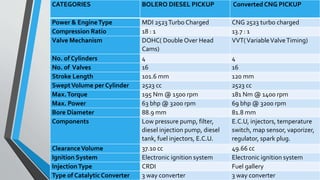
CATEGORIES BOLERO DIESEL PICKUP Converted CNG PICKUP
Power & EngineType MDI 2523Turbo Charged CNG 2523 turbo charged
Compression Ratio 18 : 1 13.7 : 1
Valve Mechanism DOHC( Double Over Head
Cams)
VVT(VariableValveTiming)
No. of Cylinders 4 4
No. of Valves 16 16
Stroke Length 101.6 mm 120 mm
SweptVolume per Cylinder 2523 cc 2523 cc
Max.Torque 195 Nm @ 1500 rpm 181 Nm @ 1400 rpm
Max. Power 63 bhp @ 3200 rpm 69 bhp @ 3200 rpm
Bore Diameter 88.9 mm 81.8 mm
Components Low pressure pump, filter,
diesel injection pump, diesel
tank, fuel injectors, E.C.U.
E.C.U, injectors, temperature
switch, map sensor, vaporizer,
regulator, spark plug.
ClearanceVolume 37.10 cc 49.66 cc
Ignition System Electronic ignition system Electronic ignition system
InjectionType CRDI Fuel gallery
Type of Catalytic Converter 3 way converter 3 way converter
ENGINE DESIGN
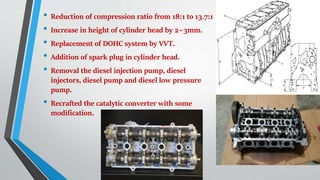
• Reduction of compression ratio from 18:1 to 13.7:1
• Increase in height of cylinder head by 2~3mm.
• Replacement of DOHC system by VVT.
• Addition of spark plug in cylinder head.
• Removal the diesel injection pump, diesel
injectors, diesel pump and diesel low pressure
pump.
• Recrafted the catalytic converter with some
modification.
VARIABLEVALVETIMING
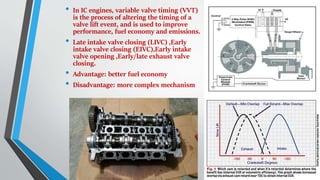
• In IC engines, variable valve timing (VVT)
is the process of altering the timing of a
valve lift event, and is used to improve
performance, fuel economy and emissions.
• Late intake valve closing (LIVC) ,Early
intake valve closing (EIVC),Early intake
valve opening ,Early/late exhaust valve
closing.
• Advantage: better fuel economy
• Disadvantage: more complex mechanism
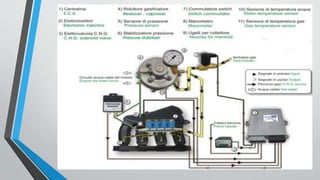
COMPONENTS OF CNG KIT
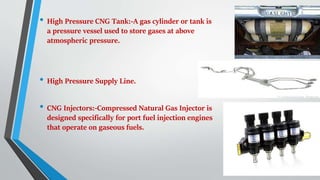
• High Pressure CNG Tank:-A gas cylinder or tank is
a pressure vessel used to store gases at above
atmospheric pressure.
• High Pressure Supply Line.
• CNG Injectors:-Compressed Natural Gas Injector is
designed specifically for port fuel injection engines
that operate on gaseous fuels.
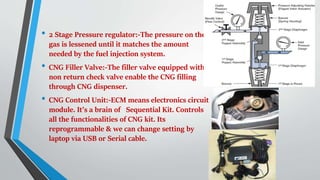
• 2 Stage Pressure regulator:-The pressure on the
gas is lessened until it matches the amount
needed by the fuel injection system.
• CNG Filler Valve:-The filler valve equipped with
non return check valve enable the CNG filling
through CNG dispenser.
• CNG Control Unit:-ECM means electronics circuit
module. It’s a brain of Sequential Kit. Controls
all the functionalities of CNG kit. Its
reprogrammable & we can change setting by
laptop via USB or Serial cable.
COOLING SYSTEM
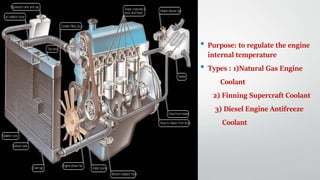
• Purpose: to regulate the engine
internal temperature
• Types : 1)Natural Gas Engine
Coolant
2) Finning Supercraft Coolant
3) Diesel Engine Antifreeze
Coolant
EXHAUST SYSTEM
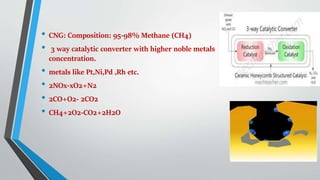
• CNG: Composition: 95-98% Methane (CH4)
• 3 way catalytic converter with higher noble metals
concentration.
• metals like Pt,Ni,Pd ,Rh etc.
• 2NOx-xO2+N2
• 2CO+O2- 2CO2
• CH4+2O2-CO2+2H2O
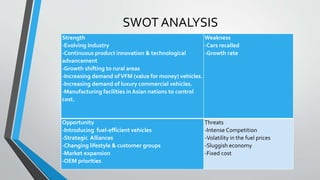
SWOT ANALYSIS
Strength
-Evolving Industry
-Continuous product innovation & technological
advancement
-Growth shifting to rural areas
-Increasing demand ofVFM (value for money) vehicles.
-Increasing demand of luxury commercial vehicles.
-Manufacturing facilities in Asian nations to control
cost.
Weakness
-Cars recalled
-Growth rate
Opportunity
-Introducing fuel-efficient vehicles
-Strategic Alliances
-Changing lifestyle & customer groups
-Market expansion
-OEM priorities
Threats
-Intense Competition
-Volatility in the fuel prices
-Sluggish economy
-Fixed cost
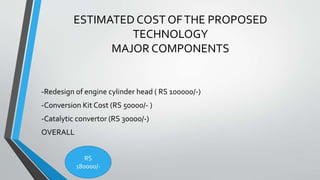
ESTIMATED COST OFTHE PROPOSED
TECHNOLOGY
MAJOR COMPONENTS
-Redesign of engine cylinder head ( RS 100000/-)
-Conversion Kit Cost (RS 50000/- )
-Catalytic convertor (RS 30000/-)
OVERALL
RS
180000/-
Marketing concept
• High annual millage
• High vehicle age
• Adequate standard of maintenance
• Torque and power of engine
• Lower emission
• Less noisy
THANKYOU

power point presentation on conversion of Diesel engine into CNG engine

  • 2.
    PROBLEM STATEMENT • Weare a part of a company which is the world leader in commercial vehicle segment. Our responsibility as a new product development team is to provide solution to various problem faced by the company.
  • 3.
    CASE STUDY • Tomeet the upcoming emission norms our company decides to convert an existing diesel engine to a dedicated CNG engine for commercial application.
  • 4.
    TEAM STRUCTURE TEAM LEADER A (Literature Reviewer& SAE preparatory ) B (product concept & validation) Nitin Verma (Product benchmarking & technical data collection) C (Product design) D (Product design) E (product design) F (product design & product concept) G (Technical data collector) H (Technical data collector) X (Literature reviewer & SAE preparator)
  • 5.
    Current Market trends/requirementfor given engine. • An automotive natural gas vehicle uses compressed natural gas as an alternative to the mineral oils can be stated with examples like:Trucks, buses, heavy duty trucks and locomotives.
  • 8.
  • 9.
    • 20 to25 per cent less carbon dioxide. • Up to 90 per cent less carbon monoxide. • 75 to 90 per cent less non-methane hydrocarbons. • CNG-powered vehicles have lower maintenance costs. • No acid smell from exhaust gases. • No heavy metal additives necessary to increase knock rating. • No losses through vaporization from the tank and/or while refuelling. • No carcinogenic substances. • CNG mixes easily and evenly in air being a gaseous fuel.
  • 10.
  • 11.
    • Methane emission. •Approximately 50 per cent more nitrogen oxides in comparison with Diesel. • 10 to 20 per cent less power output with existing engines. • Additional fuel station network necessary. • Weight and space requirements for gas cylinders in a vehicle. • Shorter operating range of vehicles. • Running on a close to empty tank reduces the pressure and increases the risk of the valves bursting. • Conversion kits tend to come with a high cost.
  • 12.
    CATEGORIES BOLERO DIESELPICKUP Converted CNG PICKUP Power & EngineType MDI 2523Turbo Charged CNG 2523 turbo charged Compression Ratio 18 : 1 13.7 : 1 Valve Mechanism DOHC( Double Over Head Cams) VVT(VariableValveTiming) No. of Cylinders 4 4 No. of Valves 16 16 Stroke Length 101.6 mm 120 mm SweptVolume per Cylinder 2523 cc 2523 cc Max.Torque 195 Nm @ 1500 rpm 181 Nm @ 1400 rpm Max. Power 63 bhp @ 3200 rpm 69 bhp @ 3200 rpm Bore Diameter 88.9 mm 81.8 mm Components Low pressure pump, filter, diesel injection pump, diesel tank, fuel injectors, E.C.U. E.C.U, injectors, temperature switch, map sensor, vaporizer, regulator, spark plug. ClearanceVolume 37.10 cc 49.66 cc Ignition System Electronic ignition system Electronic ignition system InjectionType CRDI Fuel gallery Type of Catalytic Converter 3 way converter 3 way converter
  • 13.
  • 14.
    • Reduction ofcompression ratio from 18:1 to 13.7:1 • Increase in height of cylinder head by 2~3mm. • Replacement of DOHC system by VVT. • Addition of spark plug in cylinder head. • Removal the diesel injection pump, diesel injectors, diesel pump and diesel low pressure pump. • Recrafted the catalytic converter with some modification.
  • 15.
  • 16.
    • In ICengines, variable valve timing (VVT) is the process of altering the timing of a valve lift event, and is used to improve performance, fuel economy and emissions. • Late intake valve closing (LIVC) ,Early intake valve closing (EIVC),Early intake valve opening ,Early/late exhaust valve closing. • Advantage: better fuel economy • Disadvantage: more complex mechanism
  • 17.
  • 19.
    • High PressureCNG Tank:-A gas cylinder or tank is a pressure vessel used to store gases at above atmospheric pressure. • High Pressure Supply Line. • CNG Injectors:-Compressed Natural Gas Injector is designed specifically for port fuel injection engines that operate on gaseous fuels.
  • 20.
    • 2 StagePressure regulator:-The pressure on the gas is lessened until it matches the amount needed by the fuel injection system. • CNG Filler Valve:-The filler valve equipped with non return check valve enable the CNG filling through CNG dispenser. • CNG Control Unit:-ECM means electronics circuit module. It’s a brain of Sequential Kit. Controls all the functionalities of CNG kit. Its reprogrammable & we can change setting by laptop via USB or Serial cable.
  • 21.
  • 22.
    • Purpose: toregulate the engine internal temperature • Types : 1)Natural Gas Engine Coolant 2) Finning Supercraft Coolant 3) Diesel Engine Antifreeze Coolant
  • 23.
  • 24.
    • CNG: Composition:95-98% Methane (CH4) • 3 way catalytic converter with higher noble metals concentration. • metals like Pt,Ni,Pd ,Rh etc. • 2NOx-xO2+N2 • 2CO+O2- 2CO2 • CH4+2O2-CO2+2H2O
  • 25.
    SWOT ANALYSIS Strength -Evolving Industry -Continuousproduct innovation & technological advancement -Growth shifting to rural areas -Increasing demand ofVFM (value for money) vehicles. -Increasing demand of luxury commercial vehicles. -Manufacturing facilities in Asian nations to control cost. Weakness -Cars recalled -Growth rate Opportunity -Introducing fuel-efficient vehicles -Strategic Alliances -Changing lifestyle & customer groups -Market expansion -OEM priorities Threats -Intense Competition -Volatility in the fuel prices -Sluggish economy -Fixed cost
  • 26.
    ESTIMATED COST OFTHEPROPOSED TECHNOLOGY MAJOR COMPONENTS -Redesign of engine cylinder head ( RS 100000/-) -Conversion Kit Cost (RS 50000/- ) -Catalytic convertor (RS 30000/-) OVERALL RS 180000/-
  • 27.
    Marketing concept • Highannual millage • High vehicle age • Adequate standard of maintenance • Torque and power of engine • Lower emission • Less noisy
  • 28.