Connecting the world in
responsible and resourceful ways
The 3 Rs of Energy Savings
Reduce
 Reduce fuel consumption with active asset management – right
vehicle/right route
 Reductions in fuel consumption = reduction in emissions
Replace
 Replace older vehicles with more fuel efficient vehicles
Revolutionize
 Drive the creation of new technologies to benefit the customer, the
company and the environment
March 2014 2
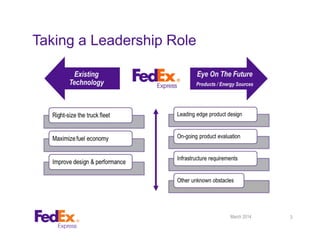
Taking a Leadership Role
March 2014 3
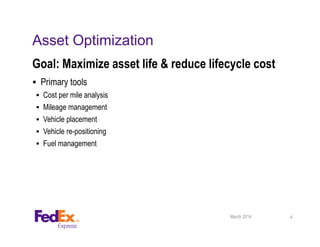
Asset Optimization
Goal: Maximize asset life & reduce lifecycle cost
 Primary tools
 Cost per mile analysis
 Mileage management
 Vehicle placement
 Vehicle re-positioning
 Fuel management
March 2014 4
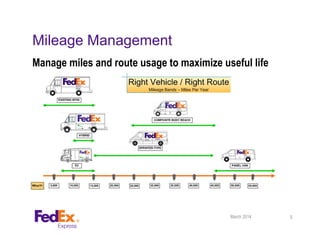
Mileage Management
Manage miles and route usage to maximize useful life
March 2014 5
Gallons Saved
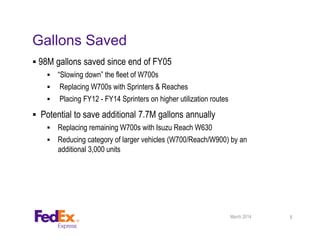
 98M gallons saved since end of FY05
 “Slowing down” the fleet of W700s
 Replacing W700s with Sprinters & Reaches
 Placing FY12 - FY14 Sprinters on higher utilization routes
 Potential to save additional 7.7M gallons annually
 Replacing remaining W700s with Isuzu Reach W630
 Reducing category of larger vehicles (W700/Reach/W900) by an
additional 3,000 units
March 2014 6
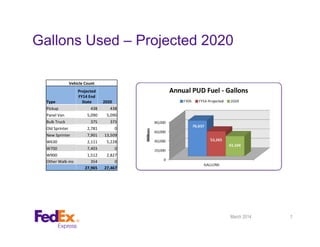
Gallons Used – Projected 2020
Vehicle Count
Type
Projected
FY14 End
State 2020
Pickup 438 438
Panel Van 5,090 5,090
Bulk Truck 375 375
Old Sprinter 2,781 0
New Sprinter 7,901 13,509
W630 2,111 5,228
W700 7,403 0
W900 1,512 2,827
Other Walk-ins 354 0
27,965 27,467
March 2014 7
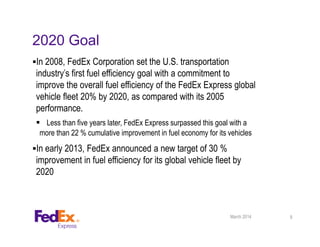
2020 Goal
In 2008, FedEx Corporation set the U.S. transportation
industry's first fuel efficiency goal with a commitment to
improve the overall fuel efficiency of the FedEx Express global
vehicle fleet 20% by 2020, as compared with its 2005
performance.
 Less than five years later, FedEx Express surpassed this goal with a
more than 22 % cumulative improvement in fuel economy for its vehicles
In early 2013, FedEx announced a new target of 30 %
improvement in fuel efficiency for its global vehicle fleet by
2020
March 2014 8
9
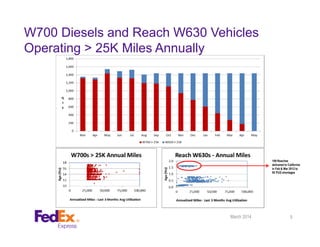
W700 Diesels and Reach W630 Vehicles
Operating > 25K Miles Annually
109 Reaches
delivered to California
in Feb & Mar 2012 to
fill PUD shortages
March 2014
Fuel Saving Technologies – Driving
Change
As early as 2005, Global Vehicles was telling the asset supplier market
that we require more fuel efficient vehicles and GSE
Global Vehicles leadership has moved (driven) our supplier base to
make available fuel efficient assets.
In the area of walk-ins, GV procured Sprinters and the commercial
delivery vehicle model called the “Reach”
Tractor and trailer specifications have continued to change to improve
fuel efficiency
GSE improvements include the implementation of Convertor Power
Units (CPU), some of which include cockpit air conditioning
March 2014 10
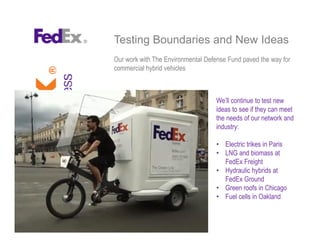
Testing Boundaries and New Ideas
Our work with The Environmental Defense Fund paved the way for
commercial hybrid vehicles
We’ll continue to test new
ideas to see if they can meet
the needs of our network and
industry:
• Electric trikes in Paris
• LNG and biomass at
FedEx Freight
• Hydraulic hybrids at
FedEx Ground
• Green roofs in Chicago
• Fuel cells in Oakland
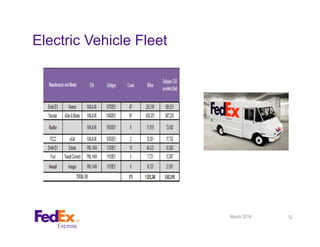
Electric Vehicle Fleet
March 2014 12
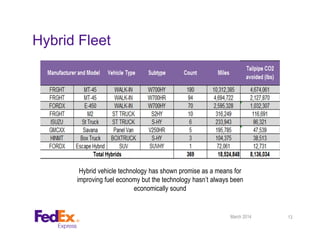
Hybrid Fleet
March 2014 13
Hybrid vehicle technology has shown promise as a means for
improving fuel economy but the technology hasn’t always been
economically sound
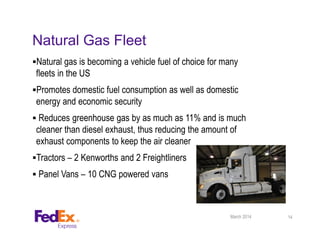
Natural Gas Fleet
Natural gas is becoming a vehicle fuel of choice for many
fleets in the US
Promotes domestic fuel consumption as well as domestic
energy and economic security
 Reduces greenhouse gas by as much as 11% and is much
cleaner than diesel exhaust, thus reducing the amount of
exhaust components to keep the air cleaner
Tractors – 2 Kenworths and 2 Freightliners
 Panel Vans – 10 CNG powered vans
March 2014 14
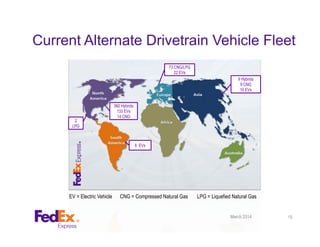
Current Alternate Drivetrain Vehicle Fleet
March 2014 15
360 Hybrids
133 EVs
14 CNG
6 EVs
73 CNG/LPG
22 EVs
9 Hybrids
9 CNG
10 EVs
2
LPG
EV = Electric Vehicle CNG = Compressed Natural Gas LPG = Liquefied Natural Gas
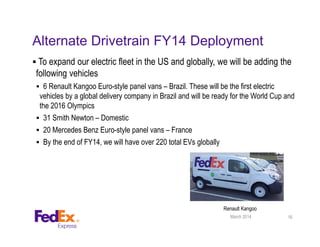
Alternate Drivetrain FY14 Deployment
 To expand our electric fleet in the US and globally, we will be adding the
following vehicles
 6 Renault Kangoo Euro-style panel vans – Brazil. These will be the first electric
vehicles by a global delivery company in Brazil and will be ready for the World Cup and
the 2016 Olympics
 31 Smith Newton – Domestic
 20 Mercedes Benz Euro-style panel vans – France
 By the end of FY14, we will have over 220 total EVs globally
16March 2014
Renault Kangoo
Alternate Drivetrain FY14 & FY15 Testing
and Planning
Nissan EV test
 First major manufacturer with plans to launch an electric panel van globally.
Previous tests in Singapore and the United Kingdom. Testing planned for Brazil in
January, 2014 with U.S. testing to follow
Future FY15 plans include testing more technologies that have the
potential to improve fuel economy and durability while improving
emissions.
 Natural gas as a vehicle fuel is becoming more important. Our mission is to
determine the feasibility of an all-CNG station, including onsite fueling.
 We will be looking at several up and coming companies that have produced cost-
effective parallel hybrid drive systems. We’ve placed these on older vehicles with low
fuel economy in the past but we’d like to evaluate what improvements may be realized
by placing hybrid systems on our newer, more efficient vehicles
17March 2014
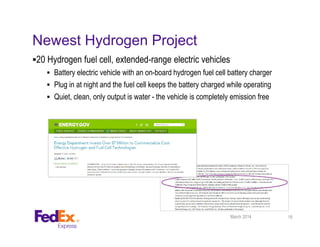
Newest Hydrogen Project
20 Hydrogen fuel cell, extended-range electric vehicles
 Battery electric vehicle with an on-board hydrogen fuel cell battery charger
 Plug in at night and the fuel cell keeps the battery charged while operating
 Quiet, clean, only output is water - the vehicle is completely emission free
March 2014 18
Hydrogen Fuel Cells
Hydrogen fuel cells offer an alternative to batteries, their output
is electricity and water
Provides option where electricity is being mandated
On-highway use and GSE use
Provides greater range than batteries alone
Infrastructure is minimal compared to electric charging for each
vehicle
March 2014 19
Hydrogen Fuel Cells
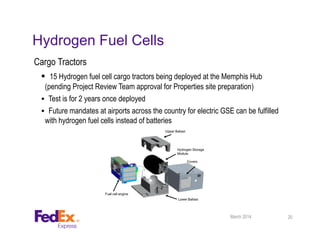
Cargo Tractors
 15 Hydrogen fuel cell cargo tractors being deployed at the Memphis Hub
(pending Project Review Team approval for Properties site preparation)
 Test is for 2 years once deployed
 Future mandates at airports across the country for electric GSE can be fulfilled
with hydrogen fuel cells instead of batteries
March 2014 20

FedEx Connecting the World in Responsible and Resourceful Ways

  • 1.
    Connecting the worldin responsible and resourceful ways
  • 2.
    The 3 Rsof Energy Savings Reduce  Reduce fuel consumption with active asset management – right vehicle/right route  Reductions in fuel consumption = reduction in emissions Replace  Replace older vehicles with more fuel efficient vehicles Revolutionize  Drive the creation of new technologies to benefit the customer, the company and the environment March 2014 2
  • 3.
    Taking a LeadershipRole March 2014 3
  • 4.
    Asset Optimization Goal: Maximizeasset life & reduce lifecycle cost  Primary tools  Cost per mile analysis  Mileage management  Vehicle placement  Vehicle re-positioning  Fuel management March 2014 4
  • 5.
    Mileage Management Manage milesand route usage to maximize useful life March 2014 5
  • 6.
    Gallons Saved  98Mgallons saved since end of FY05  “Slowing down” the fleet of W700s  Replacing W700s with Sprinters & Reaches  Placing FY12 - FY14 Sprinters on higher utilization routes  Potential to save additional 7.7M gallons annually  Replacing remaining W700s with Isuzu Reach W630  Reducing category of larger vehicles (W700/Reach/W900) by an additional 3,000 units March 2014 6
  • 7.
    Gallons Used –Projected 2020 Vehicle Count Type Projected FY14 End State 2020 Pickup 438 438 Panel Van 5,090 5,090 Bulk Truck 375 375 Old Sprinter 2,781 0 New Sprinter 7,901 13,509 W630 2,111 5,228 W700 7,403 0 W900 1,512 2,827 Other Walk-ins 354 0 27,965 27,467 March 2014 7
  • 8.
    2020 Goal In 2008,FedEx Corporation set the U.S. transportation industry's first fuel efficiency goal with a commitment to improve the overall fuel efficiency of the FedEx Express global vehicle fleet 20% by 2020, as compared with its 2005 performance.  Less than five years later, FedEx Express surpassed this goal with a more than 22 % cumulative improvement in fuel economy for its vehicles In early 2013, FedEx announced a new target of 30 % improvement in fuel efficiency for its global vehicle fleet by 2020 March 2014 8
  • 9.
    9 W700 Diesels andReach W630 Vehicles Operating > 25K Miles Annually 109 Reaches delivered to California in Feb & Mar 2012 to fill PUD shortages March 2014
  • 10.
    Fuel Saving Technologies– Driving Change As early as 2005, Global Vehicles was telling the asset supplier market that we require more fuel efficient vehicles and GSE Global Vehicles leadership has moved (driven) our supplier base to make available fuel efficient assets. In the area of walk-ins, GV procured Sprinters and the commercial delivery vehicle model called the “Reach” Tractor and trailer specifications have continued to change to improve fuel efficiency GSE improvements include the implementation of Convertor Power Units (CPU), some of which include cockpit air conditioning March 2014 10
  • 11.
    Testing Boundaries andNew Ideas Our work with The Environmental Defense Fund paved the way for commercial hybrid vehicles We’ll continue to test new ideas to see if they can meet the needs of our network and industry: • Electric trikes in Paris • LNG and biomass at FedEx Freight • Hydraulic hybrids at FedEx Ground • Green roofs in Chicago • Fuel cells in Oakland
  • 12.
  • 13.
    Hybrid Fleet March 201413 Hybrid vehicle technology has shown promise as a means for improving fuel economy but the technology hasn’t always been economically sound
  • 14.
    Natural Gas Fleet Naturalgas is becoming a vehicle fuel of choice for many fleets in the US Promotes domestic fuel consumption as well as domestic energy and economic security  Reduces greenhouse gas by as much as 11% and is much cleaner than diesel exhaust, thus reducing the amount of exhaust components to keep the air cleaner Tractors – 2 Kenworths and 2 Freightliners  Panel Vans – 10 CNG powered vans March 2014 14
  • 15.
    Current Alternate DrivetrainVehicle Fleet March 2014 15 360 Hybrids 133 EVs 14 CNG 6 EVs 73 CNG/LPG 22 EVs 9 Hybrids 9 CNG 10 EVs 2 LPG EV = Electric Vehicle CNG = Compressed Natural Gas LPG = Liquefied Natural Gas
  • 16.
    Alternate Drivetrain FY14Deployment  To expand our electric fleet in the US and globally, we will be adding the following vehicles  6 Renault Kangoo Euro-style panel vans – Brazil. These will be the first electric vehicles by a global delivery company in Brazil and will be ready for the World Cup and the 2016 Olympics  31 Smith Newton – Domestic  20 Mercedes Benz Euro-style panel vans – France  By the end of FY14, we will have over 220 total EVs globally 16March 2014 Renault Kangoo
  • 17.
    Alternate Drivetrain FY14& FY15 Testing and Planning Nissan EV test  First major manufacturer with plans to launch an electric panel van globally. Previous tests in Singapore and the United Kingdom. Testing planned for Brazil in January, 2014 with U.S. testing to follow Future FY15 plans include testing more technologies that have the potential to improve fuel economy and durability while improving emissions.  Natural gas as a vehicle fuel is becoming more important. Our mission is to determine the feasibility of an all-CNG station, including onsite fueling.  We will be looking at several up and coming companies that have produced cost- effective parallel hybrid drive systems. We’ve placed these on older vehicles with low fuel economy in the past but we’d like to evaluate what improvements may be realized by placing hybrid systems on our newer, more efficient vehicles 17March 2014
  • 18.
    Newest Hydrogen Project 20Hydrogen fuel cell, extended-range electric vehicles  Battery electric vehicle with an on-board hydrogen fuel cell battery charger  Plug in at night and the fuel cell keeps the battery charged while operating  Quiet, clean, only output is water - the vehicle is completely emission free March 2014 18
  • 19.
    Hydrogen Fuel Cells Hydrogenfuel cells offer an alternative to batteries, their output is electricity and water Provides option where electricity is being mandated On-highway use and GSE use Provides greater range than batteries alone Infrastructure is minimal compared to electric charging for each vehicle March 2014 19
  • 20.
    Hydrogen Fuel Cells CargoTractors  15 Hydrogen fuel cell cargo tractors being deployed at the Memphis Hub (pending Project Review Team approval for Properties site preparation)  Test is for 2 years once deployed  Future mandates at airports across the country for electric GSE can be fulfilled with hydrogen fuel cells instead of batteries March 2014 20