Presented by: Matthew Lake, M.S., CMS4S
Executive Director
MERRILLVILLE
LOW IMPACT DEVELOPMENT
Call to Action
Defining Low Impact
Development
Low-impact development (LID) is a term used to describe a land planning and
engineering design approach to manage stormwater runoff. LID emphasizes
conservation and use of on-site natural features to protect water quality. This
approach implements engineered small-scale hydrologic controls to replicate the
pre-development hydrologic regime of watersheds through infiltrating, filtering,
storing, evaporating, and detaining runoff close to its source.
5 Basic Principals
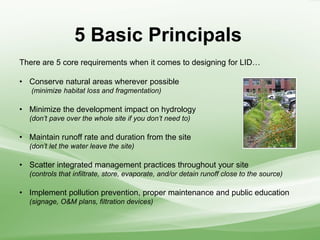
There are 5 core requirements when it comes to designing for LID…
• Conserve natural areas wherever possible
(minimize habitat loss and fragmentation)
• Minimize the development impact on hydrology
(don’t pave over the whole site if you don’t need to)
• Maintain runoff rate and duration from the site
(don’t let the water leave the site)
• Scatter integrated management practices throughout your site
(controls that infiltrate, store, evaporate, and/or detain runoff close to the source)
• Implement pollution prevention, proper maintenance and public education
(signage, O&M plans, filtration devices)
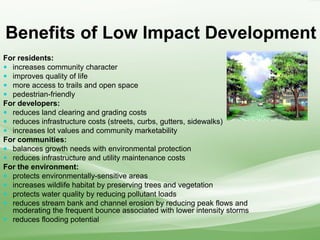
Benefits of Low Impact Development
For residents:
 increases community character
 improves quality of life
 more access to trails and open space
 pedestrian-friendly
For developers:
 reduces land clearing and grading costs
 reduces infrastructure costs (streets, curbs, gutters, sidewalks)
 increases lot values and community marketability
For communities:
 balances growth needs with environmental protection
 reduces infrastructure and utility maintenance costs
For the environment:
 protects environmentally-sensitive areas
 increases wildlife habitat by preserving trees and vegetation
 protects water quality by reducing pollutant loads
 reduces stream bank and channel erosion by reducing peak flows and
moderating the frequent bounce associated with lower intensity storms
 reduces flooding potential
SO WHY IS THIS NOT
THE CURRENT
STANDARD?
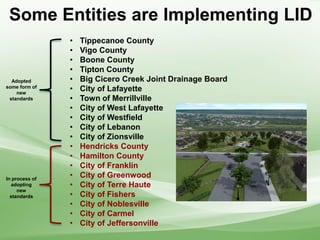
• Tippecanoe County
• Vigo County
• Boone County
• Tipton County
• Big Cicero Creek Joint Drainage Board
• City of Lafayette
• Town of Merrillville
• City of West Lafayette
• City of Westfield
• City of Lebanon
• City of Zionsville
• Hendricks County
• Hamilton County
• City of Franklin
• City of Greenwood
• City of Terre Haute
• City of Fishers
• City of Noblesville
• City of Carmel
• City of Jeffersonville
Adopted
some form of
new
standards
In process of
adopting
new
standards
Some Entities are Implementing LID
Stereotypical Barriers….
Costs?
LID is economical. Typically it costs less than conventional stormwater management systems to construct and maintain, in part, because of
fewer pipes, fewer below-ground infrastructure requirements, and less imperviousness. It is a more environmentally sound technology and a
more economically sustainable approach to addressing the adverse impacts of urbanization. New techniques and products are making
implementation even more cost-effective.
Takes away space?
Space once dedicated to stormwater ponds can now be used for additional development to increase lot yields or be left as is for
conservation or to meet open space ordinance requirements.
Maintenance?
The greater use of on-lot multi-purpose landscaping / vegetation also offers human "quality of life" opportunities by greening neighborhoods
and contributing to livability, value, sense of place, and aesthetics. Other benefits include enhanced property values and re-development
potential, greater marketability, improved wildlife habitat, thermal pollution reduction, energy savings, smog reduction, enhanced wetlands
protection, and decreased flooding. many projects, the LID practice was originally designed as a landscaped feature before its functionality
as a stormwater control was introduced. In these situations, the landscaping and construction costs for stormwater are essentially free.
Will delay my project?
Local permitting agencies can use LID as a model in revising local zoning and subdivision regulations in favor of more cost-effective,
ecologically sound development practices. This will prevent delays from receiving project approval
Do we need LID?
The need for such an approach has never been greater. Stormwater programs require that a wide array of complex and challenging
ecosystem and human health protection goals be addressed. Many of these goals are not being met by conventional stormwater
management technology, and communities are struggling with the economic reality of funding aging and ever-expanding stormwater
infrastructure.
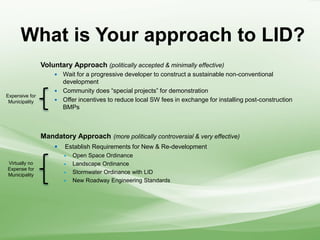
What is Your approach to LID?
Voluntary Approach (politically accepted & minimally effective)
 Wait for a progressive developer to construct a sustainable non-conventional
development
 Community does “special projects” for demonstration
 Offer incentives to reduce local SW fees in exchange for installing post-construction
BMPs
Mandatory Approach (more politically controversial & very effective)
 Establish Requirements for New & Re-development
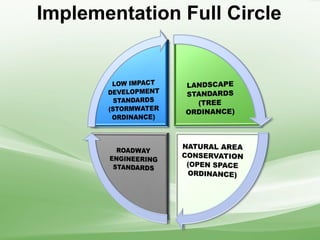
 Open Space Ordinance
 Landscape Ordinance
 Stormwater Ordinance with LID
 New Roadway Engineering Standards
Expensive for
Municipality
Virtually no
Expense for
Municipality
HOW CAN WE
IMPLEMENT
MANDATORY LID
REQUIREMENTS?
Strategically Introduce LID
Get political acceptance
 Have to market and explain to get consensus
 Special council workshop to introduce the idea
 Recommend a simple approach (foot-in-door)
 Implement an achievable standard that will not completely
redefine development
 Allows engineers and developers to acclimate to LID
(can “ramp up” requirements later)
Prepare sample ordinances and standards
 Provide scenarios using previous development projects with
proposed requirements
 Keep your standards simple (don’t over complicate your
methods)
 Allow for flexibility (LID practices need to fit each site)
 Can make LID requirements part of SW Ordinance
Education/Outreach
 Host workshops to explain the overall concept and
advantages
 Present specifically to local developers & engineers
Timing
 Sometime you have to wait for specific opportunity
 Need key players in place to implement new/revised
ordinances
 First Community in NW Indiana to develop and
implement Low Impact Development Standards
 LID was added intentionally as a separate chapter
so it’s not overlooked
 LID implementation is required to get a Stormwater
Permit
 LID is above and beyond 80%TSS and existing
detention requirements
 Often results in meetings with developers and
engineers prior to detailed site design
Merrillville Low Impact
Development Standards
LID Chapter
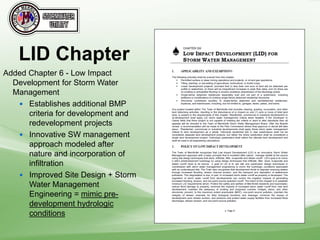
Added Chapter 6 - Low Impact
Development for Storm Water
Management
 Establishes additional BMP
criteria for development and
redevelopment projects
 Innovative SW management
approach modeled after
nature and incorporation of
infiltration
 Improved Site Design + Storm
Water Management
Engineering = mimic pre-
development hydrologic
conditions
Revised Ordinance &
Tech. Standards Manual
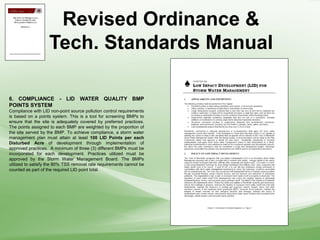
6. COMPLIANCE - LID WATER QUALITY BMP
POINTS SYSTEM
Compliance with LID non-point source pollution control requirements
is based on a points system. This is a tool for screening BMPs to
ensure that the site is adequately covered by preferred practices.
The points assigned to each BMP are weighted by the proportion of
the site served by the BMP. To achieve compliance, a storm water
management plan must attain at least 100 LID Points per each
Disturbed Acre of development through implementation of
approved practices. A minimum of three (3) different BMPs must be
incorporated for each development. Practices utilized must be
approved by the Storm Water Management Board. The BMPs
utilized to satisfy the 80% TSS removal rate requirements cannot be
counted as part of the required LID point total.
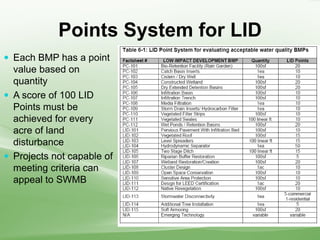
Points System for LID
 Each BMP has a point
value based on
quantity
 A score of 100 LID
Points must be
achieved for every
acre of land
disturbance
 Projects not capable of
meeting criteria can
appeal to SWMB
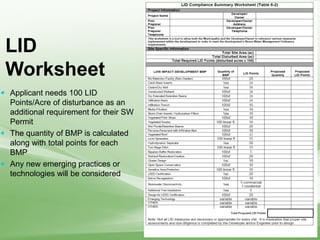
LID
Worksheet
 Applicant needs 100 LID
Points/Acre of disturbance as an
additional requirement for their SW
Permit
 The quantity of BMP is calculated
along with total points for each
BMP
 Any new emerging practices or
technologies will be considered
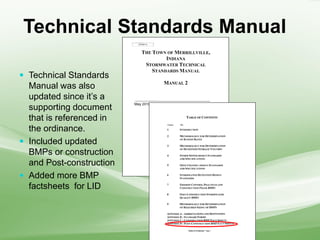
Technical Standards Manual
 Technical Standards
Manual was also
updated since it’s a
supporting document
that is referenced in
the ordinance.
 Included updated
BMPs or construction
and Post-construction
 Added more BMP
factsheets for LID
Low Impact Development BMP
Factsheets
 Revised Appendix D to
Include additional BMPs for
Low Impact Development
Strategies.
 Factsheets contain details
and specifications as well
as advantages of each
practice.
 Additional BMPs can be
added after they are proven
effective.
 Need to setup protocol to
accept new techniques or
devices.
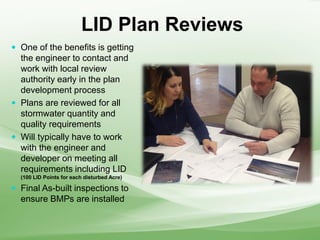
LID Plan Reviews
 One of the benefits is getting
the engineer to contact and
work with local review
authority early in the plan
development process
 Plans are reviewed for all
stormwater quantity and
quality requirements
 Will typically have to work
with the engineer and
developer on meeting all
requirements including LID
(100 LID Points for each disturbed Acre)
 Final As-built inspections to
ensure BMPs are installed
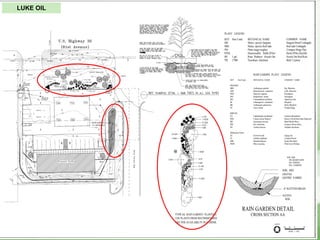
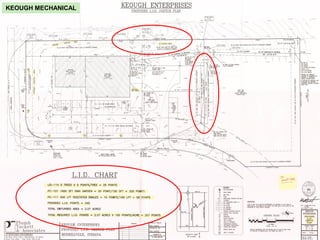
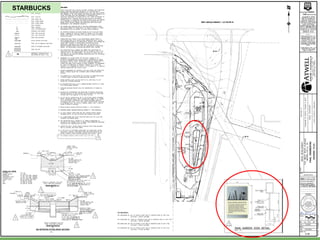
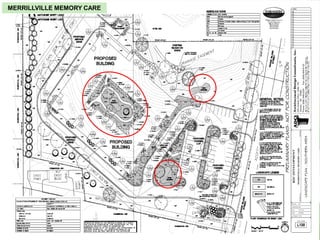
DOES THIS LID
REQUIREMENT WORK?
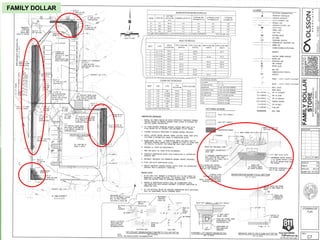
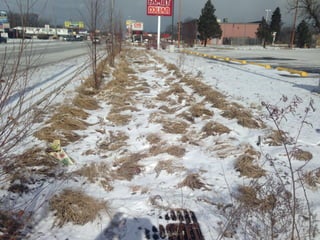
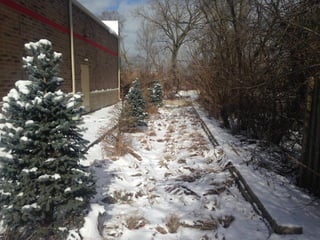
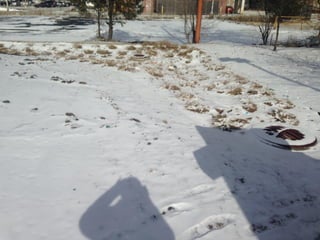
FAMILY DOLLAR
LUKE OIL
KEOUGH MECHANICAL
STARBUCKS
MERRILLVILLE MEMORY CARE
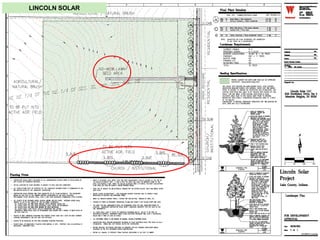
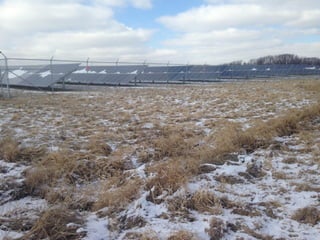
LINCOLN SOLAR
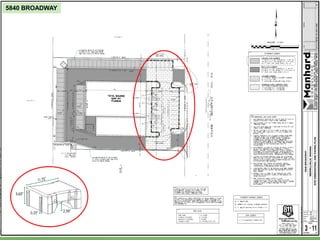
5840 BROADWAY
RILEY BUILDING
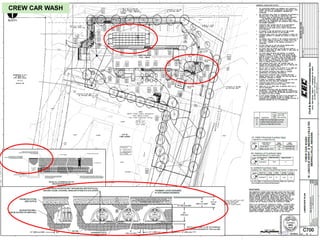
CREW CAR WASH
TAKING IT TO THE
STREETS
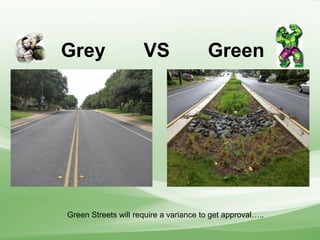
Grey VS Green
Green Streets will require a variance to get approval…..
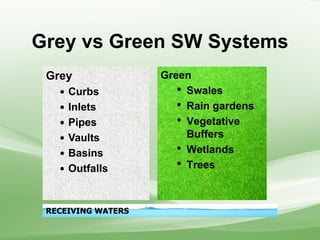
Grey vs Green SW Systems
Grey
 Curbs
 Inlets
 Pipes
 Vaults
 Basins
 Outfalls
Green
• Swales
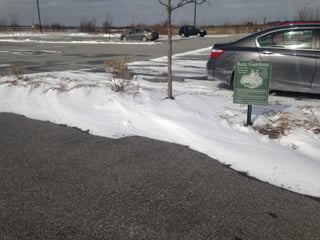
• Rain gardens
• Vegetative
Buffers
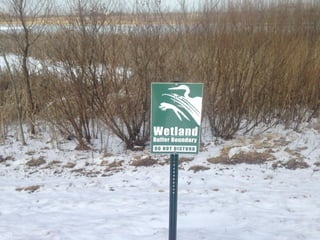
• Wetlands
• Trees
RECEIVING WATERS
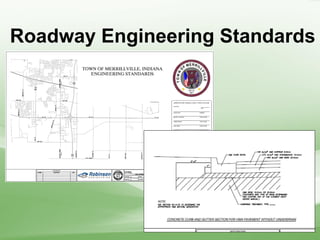
Roadway Engineering Standards
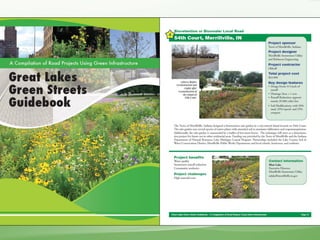
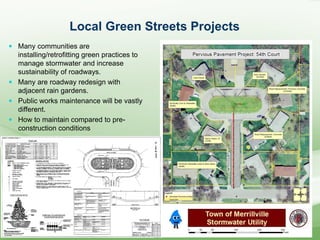
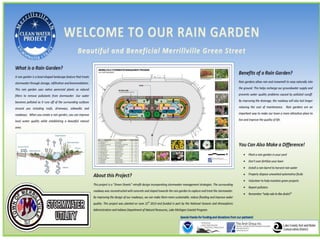
Local Green Streets Projects
 Many communities are
installing/retrofitting green practices to
manage stormwater and increase
sustainability of roadways.
 Many are roadway redesign with
adjacent rain gardens.
 Public works maintenance will be vastly
different.
 How to maintain compared to pre-
construction conditions
LANDSCAPING
&
URBAN FOREST
MANAGEMENT
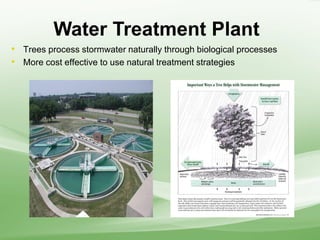
Water Treatment Plant
• Trees process stormwater naturally through biological processes
• More cost effective to use natural treatment strategies
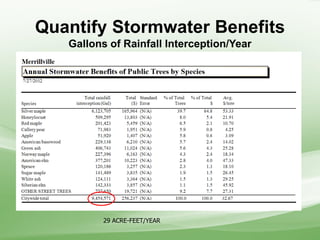
Quantify Stormwater Benefits
Gallons of Rainfall Interception/Year
29 ACRE-FEET/YEAR
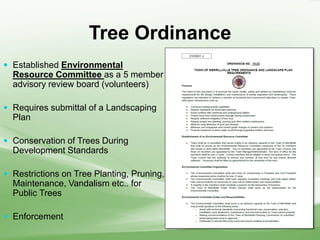
Tree Ordinance
 Established Environmental
Resource Committee as a 5 member
advisory review board (volunteers)
 Requires submittal of a Landscaping
Plan
 Conservation of Trees During
Development Standards
 Restrictions on Tree Planting, Pruning,
Maintenance, Vandalism etc.. for
Public Trees
 Enforcement
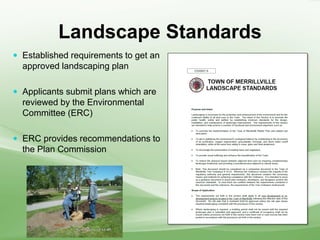
Landscape Standards
 Established requirements to get an
approved landscaping plan
 Applicants submit plans which are
reviewed by the Environmental
Committee (ERC)
 ERC provides recommendations to
the Plan Commission
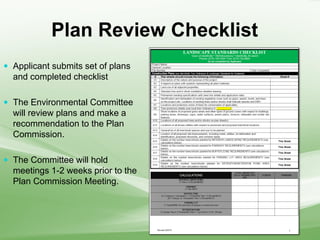
Plan Review Checklist
 Applicant submits set of plans
and completed checklist
 The Environmental Committee
will review plans and make a
recommendation to the Plan
Commission.
 The Committee will hold
meetings 1-2 weeks prior to the
Plan Commission Meeting.
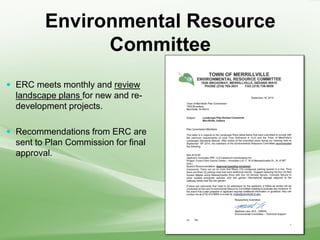
Environmental Resource
Committee
 ERC meets monthly and review
landscape plans for new and re-
development projects.
 Recommendations from ERC are
sent to Plan Commission for final
approval.
NO IMPACT
DEVELOPMENT
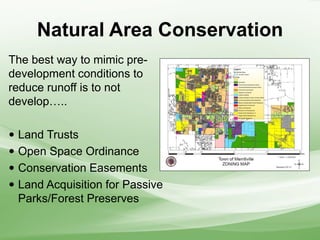
Natural Area Conservation
The best way to mimic pre-
development conditions to
reduce runoff is to not
develop…..
 Land Trusts
 Open Space Ordinance
 Conservation Easements
 Land Acquisition for Passive
Parks/Forest Preserves
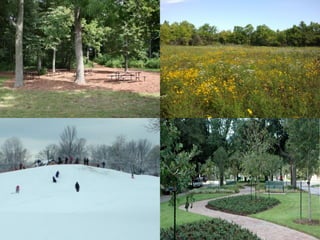
Open Space Ordinance
 Applies to all residential
subdivisions or PUDs
 Dedicates at least 10% of
gross land area
 Cannot be detention, wetland,
ROW or easement
 Must be contiguous
 Native landscaping
encouraged
 Shall preserve important
habitats for fish, wildlife, flora
and significant trees.
BRINGING IT ALL
TOGETHER
Implementation Full Circle
TAKING ACTION
Next Steps 1,2,3
Consultants/Engineers
 Market LID to clients, develop new ordinances/standards
 Offer local workshops on LID for developers and elected officials
Department Heads
 Talk to elected officials/decision makers (don’t overwhelm them)
 Get support of other department heads
Elected Officials
 Pass new ordinances
 Take credit for all the positive outcomes
OPPORTUNITIES FOR TREATMENT AND STORAGE
Questions?
 Merrillville applied to
become an IDEM Clean
Community
 Set goals to improve the
quality of life
 Voluntary recognition
program that recognizes
and rewards Indiana
communities for proactively
managing environmental
impacts associated with
governmental operations
IDEM Clean Community
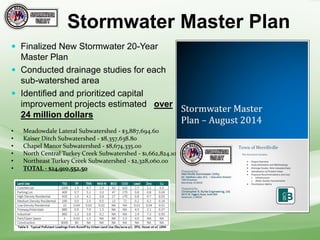
 Finalized New Stormwater 20-Year
Master Plan
 Conducted drainage studies for each
sub-watershed area
 Identified and prioritized capital
improvement projects estimated over
24 million dollars
Stormwater Master Plan
• Meadowdale Lateral Subwatershed - $3,887,694.60
• Kaiser Ditch Subwatershed - $8,357,638.80
• Chapel Manor Subwatershed - $8,674,335.00
• North Central Turkey Creek Subwatershed - $1,662,824.10
• Northeast Turkey Creek Subwatershed - $2,328,060.00
• TOTAL - $24,910,552.50

Low Impact Development - Call to Action

  • 1.
    Presented by: MatthewLake, M.S., CMS4S Executive Director MERRILLVILLE LOW IMPACT DEVELOPMENT Call to Action
  • 2.
    Defining Low Impact Development Low-impactdevelopment (LID) is a term used to describe a land planning and engineering design approach to manage stormwater runoff. LID emphasizes conservation and use of on-site natural features to protect water quality. This approach implements engineered small-scale hydrologic controls to replicate the pre-development hydrologic regime of watersheds through infiltrating, filtering, storing, evaporating, and detaining runoff close to its source.
  • 3.
    5 Basic Principals Thereare 5 core requirements when it comes to designing for LID… • Conserve natural areas wherever possible (minimize habitat loss and fragmentation) • Minimize the development impact on hydrology (don’t pave over the whole site if you don’t need to) • Maintain runoff rate and duration from the site (don’t let the water leave the site) • Scatter integrated management practices throughout your site (controls that infiltrate, store, evaporate, and/or detain runoff close to the source) • Implement pollution prevention, proper maintenance and public education (signage, O&M plans, filtration devices)
  • 4.
    Benefits of LowImpact Development For residents:  increases community character  improves quality of life  more access to trails and open space  pedestrian-friendly For developers:  reduces land clearing and grading costs  reduces infrastructure costs (streets, curbs, gutters, sidewalks)  increases lot values and community marketability For communities:  balances growth needs with environmental protection  reduces infrastructure and utility maintenance costs For the environment:  protects environmentally-sensitive areas  increases wildlife habitat by preserving trees and vegetation  protects water quality by reducing pollutant loads  reduces stream bank and channel erosion by reducing peak flows and moderating the frequent bounce associated with lower intensity storms  reduces flooding potential
  • 5.
    SO WHY ISTHIS NOT THE CURRENT STANDARD?
  • 6.
    • Tippecanoe County •Vigo County • Boone County • Tipton County • Big Cicero Creek Joint Drainage Board • City of Lafayette • Town of Merrillville • City of West Lafayette • City of Westfield • City of Lebanon • City of Zionsville • Hendricks County • Hamilton County • City of Franklin • City of Greenwood • City of Terre Haute • City of Fishers • City of Noblesville • City of Carmel • City of Jeffersonville Adopted some form of new standards In process of adopting new standards Some Entities are Implementing LID
  • 7.
    Stereotypical Barriers…. Costs? LID iseconomical. Typically it costs less than conventional stormwater management systems to construct and maintain, in part, because of fewer pipes, fewer below-ground infrastructure requirements, and less imperviousness. It is a more environmentally sound technology and a more economically sustainable approach to addressing the adverse impacts of urbanization. New techniques and products are making implementation even more cost-effective. Takes away space? Space once dedicated to stormwater ponds can now be used for additional development to increase lot yields or be left as is for conservation or to meet open space ordinance requirements. Maintenance? The greater use of on-lot multi-purpose landscaping / vegetation also offers human "quality of life" opportunities by greening neighborhoods and contributing to livability, value, sense of place, and aesthetics. Other benefits include enhanced property values and re-development potential, greater marketability, improved wildlife habitat, thermal pollution reduction, energy savings, smog reduction, enhanced wetlands protection, and decreased flooding. many projects, the LID practice was originally designed as a landscaped feature before its functionality as a stormwater control was introduced. In these situations, the landscaping and construction costs for stormwater are essentially free. Will delay my project? Local permitting agencies can use LID as a model in revising local zoning and subdivision regulations in favor of more cost-effective, ecologically sound development practices. This will prevent delays from receiving project approval Do we need LID? The need for such an approach has never been greater. Stormwater programs require that a wide array of complex and challenging ecosystem and human health protection goals be addressed. Many of these goals are not being met by conventional stormwater management technology, and communities are struggling with the economic reality of funding aging and ever-expanding stormwater infrastructure.
  • 8.
    What is Yourapproach to LID? Voluntary Approach (politically accepted & minimally effective)  Wait for a progressive developer to construct a sustainable non-conventional development  Community does “special projects” for demonstration  Offer incentives to reduce local SW fees in exchange for installing post-construction BMPs Mandatory Approach (more politically controversial & very effective)  Establish Requirements for New & Re-development  Open Space Ordinance  Landscape Ordinance  Stormwater Ordinance with LID  New Roadway Engineering Standards Expensive for Municipality Virtually no Expense for Municipality
  • 9.
  • 10.
    Strategically Introduce LID Getpolitical acceptance  Have to market and explain to get consensus  Special council workshop to introduce the idea  Recommend a simple approach (foot-in-door)  Implement an achievable standard that will not completely redefine development  Allows engineers and developers to acclimate to LID (can “ramp up” requirements later) Prepare sample ordinances and standards  Provide scenarios using previous development projects with proposed requirements  Keep your standards simple (don’t over complicate your methods)  Allow for flexibility (LID practices need to fit each site)  Can make LID requirements part of SW Ordinance Education/Outreach  Host workshops to explain the overall concept and advantages  Present specifically to local developers & engineers Timing  Sometime you have to wait for specific opportunity  Need key players in place to implement new/revised ordinances
  • 11.
     First Communityin NW Indiana to develop and implement Low Impact Development Standards  LID was added intentionally as a separate chapter so it’s not overlooked  LID implementation is required to get a Stormwater Permit  LID is above and beyond 80%TSS and existing detention requirements  Often results in meetings with developers and engineers prior to detailed site design Merrillville Low Impact Development Standards
  • 12.
    LID Chapter Added Chapter6 - Low Impact Development for Storm Water Management  Establishes additional BMP criteria for development and redevelopment projects  Innovative SW management approach modeled after nature and incorporation of infiltration  Improved Site Design + Storm Water Management Engineering = mimic pre- development hydrologic conditions
  • 13.
    Revised Ordinance & Tech.Standards Manual 6. COMPLIANCE - LID WATER QUALITY BMP POINTS SYSTEM Compliance with LID non-point source pollution control requirements is based on a points system. This is a tool for screening BMPs to ensure that the site is adequately covered by preferred practices. The points assigned to each BMP are weighted by the proportion of the site served by the BMP. To achieve compliance, a storm water management plan must attain at least 100 LID Points per each Disturbed Acre of development through implementation of approved practices. A minimum of three (3) different BMPs must be incorporated for each development. Practices utilized must be approved by the Storm Water Management Board. The BMPs utilized to satisfy the 80% TSS removal rate requirements cannot be counted as part of the required LID point total.
  • 14.
    Points System forLID  Each BMP has a point value based on quantity  A score of 100 LID Points must be achieved for every acre of land disturbance  Projects not capable of meeting criteria can appeal to SWMB
  • 15.
    LID Worksheet  Applicant needs100 LID Points/Acre of disturbance as an additional requirement for their SW Permit  The quantity of BMP is calculated along with total points for each BMP  Any new emerging practices or technologies will be considered
  • 16.
    Technical Standards Manual Technical Standards Manual was also updated since it’s a supporting document that is referenced in the ordinance.  Included updated BMPs or construction and Post-construction  Added more BMP factsheets for LID
  • 17.
    Low Impact DevelopmentBMP Factsheets  Revised Appendix D to Include additional BMPs for Low Impact Development Strategies.  Factsheets contain details and specifications as well as advantages of each practice.  Additional BMPs can be added after they are proven effective.  Need to setup protocol to accept new techniques or devices.
  • 18.
    LID Plan Reviews One of the benefits is getting the engineer to contact and work with local review authority early in the plan development process  Plans are reviewed for all stormwater quantity and quality requirements  Will typically have to work with the engineer and developer on meeting all requirements including LID (100 LID Points for each disturbed Acre)  Final As-built inspections to ensure BMPs are installed
  • 19.
  • 20.
  • 24.
  • 25.
  • 26.
  • 27.
  • 28.
  • 31.
  • 35.
  • 39.
  • 40.
    TAKING IT TOTHE STREETS
  • 41.
    Grey VS Green GreenStreets will require a variance to get approval…..
  • 42.
    Grey vs GreenSW Systems Grey  Curbs  Inlets  Pipes  Vaults  Basins  Outfalls Green • Swales • Rain gardens • Vegetative Buffers • Wetlands • Trees RECEIVING WATERS
  • 43.
  • 48.
    Local Green StreetsProjects  Many communities are installing/retrofitting green practices to manage stormwater and increase sustainability of roadways.  Many are roadway redesign with adjacent rain gardens.  Public works maintenance will be vastly different.  How to maintain compared to pre- construction conditions
  • 51.
  • 52.
    Water Treatment Plant •Trees process stormwater naturally through biological processes • More cost effective to use natural treatment strategies
  • 53.
    Quantify Stormwater Benefits Gallonsof Rainfall Interception/Year 29 ACRE-FEET/YEAR
  • 54.
    Tree Ordinance  EstablishedEnvironmental Resource Committee as a 5 member advisory review board (volunteers)  Requires submittal of a Landscaping Plan  Conservation of Trees During Development Standards  Restrictions on Tree Planting, Pruning, Maintenance, Vandalism etc.. for Public Trees  Enforcement
  • 55.
    Landscape Standards  Establishedrequirements to get an approved landscaping plan  Applicants submit plans which are reviewed by the Environmental Committee (ERC)  ERC provides recommendations to the Plan Commission
  • 56.
    Plan Review Checklist Applicant submits set of plans and completed checklist  The Environmental Committee will review plans and make a recommendation to the Plan Commission.  The Committee will hold meetings 1-2 weeks prior to the Plan Commission Meeting.
  • 57.
    Environmental Resource Committee  ERCmeets monthly and review landscape plans for new and re- development projects.  Recommendations from ERC are sent to Plan Commission for final approval.
  • 58.
  • 59.
    Natural Area Conservation Thebest way to mimic pre- development conditions to reduce runoff is to not develop…..  Land Trusts  Open Space Ordinance  Conservation Easements  Land Acquisition for Passive Parks/Forest Preserves
  • 60.
    Open Space Ordinance Applies to all residential subdivisions or PUDs  Dedicates at least 10% of gross land area  Cannot be detention, wetland, ROW or easement  Must be contiguous  Native landscaping encouraged  Shall preserve important habitats for fish, wildlife, flora and significant trees.
  • 62.
  • 63.
  • 64.
  • 65.
    Next Steps 1,2,3 Consultants/Engineers Market LID to clients, develop new ordinances/standards  Offer local workshops on LID for developers and elected officials Department Heads  Talk to elected officials/decision makers (don’t overwhelm them)  Get support of other department heads Elected Officials  Pass new ordinances  Take credit for all the positive outcomes
  • 67.
  • 68.
  • 69.
     Merrillville appliedto become an IDEM Clean Community  Set goals to improve the quality of life  Voluntary recognition program that recognizes and rewards Indiana communities for proactively managing environmental impacts associated with governmental operations IDEM Clean Community
  • 70.
     Finalized NewStormwater 20-Year Master Plan  Conducted drainage studies for each sub-watershed area  Identified and prioritized capital improvement projects estimated over 24 million dollars Stormwater Master Plan • Meadowdale Lateral Subwatershed - $3,887,694.60 • Kaiser Ditch Subwatershed - $8,357,638.80 • Chapel Manor Subwatershed - $8,674,335.00 • North Central Turkey Creek Subwatershed - $1,662,824.10 • Northeast Turkey Creek Subwatershed - $2,328,060.00 • TOTAL - $24,910,552.50