SPUTUM AND BODY FLUIDS
DR.PRAGATI SATHE
SPUTUM EXAMINATION
Specimen Collection –
•Ideal – should contain lower respiratory tract secretions
1st
morning sample is ideal ,contaminant may be prt.
•Needs patient co-operation and understanding.
•May be spontaneous/induced.
•In children – 3 methods –
Nasopharyngeal swab, Cough plate, Cough swab
•Collection in sterile,disposable container with a screw cap
•Delivered to the lab immediately
SPUTUM –GROSS EXAMINATION
Consistency and appearance – normal – viscoelastic
Opaqueness – due to pus,epithelial cells, Curshmann’s spirals,
caseous material,bronchial casts,food subs.
Colour – Yellow – pus,epithelial cells
Green – pseudomonas
Rust coloured – infarct,pneumonia
Bright red – acute LVF, TB,malignancy.
Odour – normal – no odour
putrid – lung abscess,cavities.
Others – foreign bodies,parasites,broncholiths
SPUTUM –MICROSCOPIC EXAMINATION
•All suspicious particles – transferred with sterile instrument
•Smears can be dried ,heat fixed to kill organisms
•Special stains to be applied – Grams,ZN,pap,Giemsa,H&E
•Presence of alveolar macrophage – sample is representative
•Other cells – bronchial epithelial cells
•Abnormal cells – Intact neutrophils – pyogenic infections
Eosinophils – in large nos– bronchial asthma
RBC’s in large nos. exudate, haemorrhage
SPUTUM –MICROSCOPIC EXAMINATION
•Organisms – Mycobacteria – ZN stain
Fungi – direct mount with 10% NaOH
Gram positive cocci
Gram negative bacilli
SPUTUM CULTURE
•Microscopic examination should preceede culture
•2 methods –
Classic technique – streaking on agar plate
should be corelated with Grams stained smears.
Quantitive analysis of the organisms
SPUTUM IN DISEASE
•Tuberculosis – 24 hr specimen,early morning,bronchial
• washings,transtracheal aspiration & gastric
•Pretreatment by digestion procedures facilitates demonstration
•Liquefying sputum, lowering specific gravity,
Decontamination of other organisms
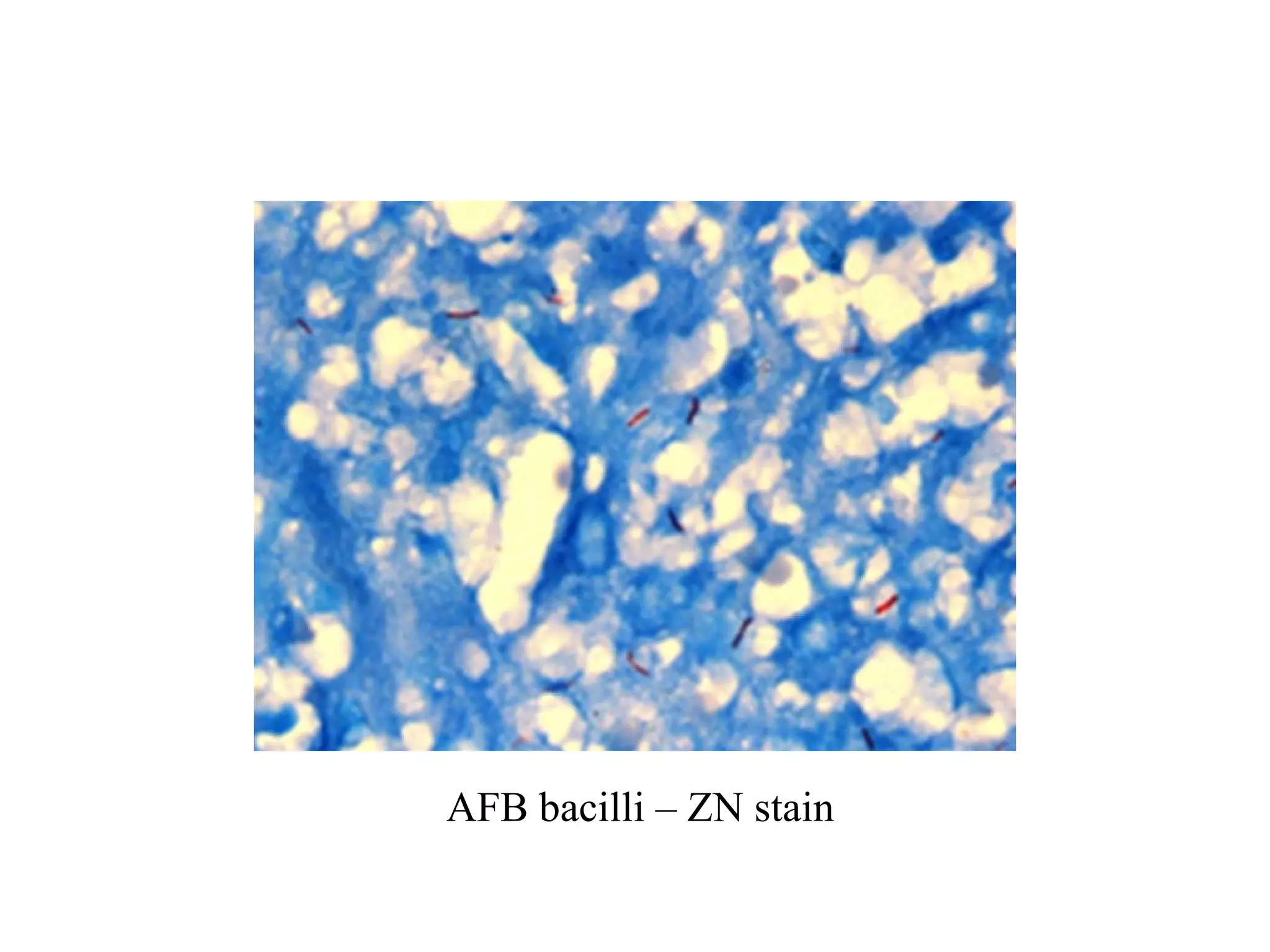
•Staining with ZN stain
•Flourescent microscopy.
AFB bacilli – ZN stain
SPUTUM IN DISEASE
•Fungal Diseases –Histoplasmosis,Coccidioides,Blastomyces,
Cryptococci , Aspergillus,Candida
•Bronchial Asthma – Eosinophilia >80%
Charcot Leyden crystals
Bronchial epi cells- Creola bodies-50%
Curschmann’s spirals
•Bronchiectasis – putrid odor,greenish
epithelial cells,Dittrich’s plugs,bacteria
•Chronic bronchitis – copious,mucoid,tenacious
histiocytes and monocytes,organisms,PMN’s
•Lung Abscess – initially less
after rupture foul smelling,copious
multiple organisms identified.
SPUTUM IN DISEASE
•Pneumonia- blood tinged sputum
epithelial cells,leucocytes
organisms seen - streptococci,staph,Haemophilus
•Pneumoconiosis – quantity and color varies
macrophages
dumb-bell shaped needles of asbestosis
needle shaped elongated bodies of silicosis
•PCP – protozoan parasite,cysts
•Viral infections – inclusion bodies intranuclear,intracyto
•Malignancy – single,early morning deep cough sputum
look for malignant cells from lung cancers
pap and giemsa stains
Viral Infections
Adenovirus CMV
Fungal Infections
Aspergillus Cyrptococcus
Strongyloidosis stercoralis
Pneumocystis carinii organisms
Malignant cells – Pap Stain
• Pleural
• Peritoneal / Ascitic
• Pericardial
• Synovial
• Amniotic
• Gastric and duodenal
BODY FLUIDS
SEROUS FLUIDS
•Pleural
•Peritoneal
•Pericardial
TRANSUDATE EXUDATE
• Appearance clear/straw cloudy/purulent
• Coagulation absent freq present
• Sp. Gravity <1.018 >1.018
• Proteins <2 gm% >2 gm%
• Cells few many
mesothelial inflammatory
• Bacteria absent present
• Serous memb normal inflamed
FLUID - TYPES
SPECIMEN COLLECTION
•Done by attending physician/nurse
•Delivered to the lab immediately
•Should be examined fresh – as cells disintegrate
bacteria grow fast
altered chemical composition
•Need for another collection to be avoided
•Avoid traumatic tap
•Anticoagulant may be needed
•Collection in 3 bulbs – microbiology,cells & proteins,
biochemistry.
Pleural effusion
• Transudate – CCF, hepatic cirrhosis, hypoproteinemia,
• Exudate - neoplasm,infection, trauma,pulmonary infarct,
Rheumatoid disease,SLE, pancreatitis
• Chylous - trauma, TB, lymphoma, Ca,
CAUSES OF FLUID ACCUMULATION
Peritoneal effusion
• Transudate – CCF, hepatic cirrhosis,hypoproteinemia
• Exudate - neoplasm,infection, trauma,pancreatitis, bile
peritonitis
• Chylous - trauma, TB, lymphoma, Ca, parasitic
infestation
• Pseudochylous – due to long standing effusions –
TB,rheumatoid pleuritis.
CAUSES OF FLUID ACCUMULATION
Pericardial effusion
•Infections – bacterial,TB,Fungal,viral
•Neoplastic – Ca,Lymphoma
•Haemorrhagic – trauma,anticoagulant therapy,aortic aneurysm
•Metabolic – uremia
•Hypersensitivity – SLE,rheumatoid dis.
FLUID - INDICATIONS
1. Pleural tap –
• Effusion of unknown aetiology
• Dyspnoea and fluid accumulation
• Intrapleural instillation of drugs
• Haemothorax
• Empyema
2. Pericardial tap –
• Effusion of unknown aetiology
• Acute / Chronic cardiac tamponade
3. Peritoneal tap –
• Ascites of unknown aetiology
• Dyspnoea and fluid accumulation
• Suspected intestinal gangrene
• Intestinal perforation
• Intra-abdominal haemorrhage-?traumatic
• Instillation of cytotoxic drugs
FLUID - INDICATIONS
•Physical Examination
•Chemical Examination
•Microscopic Examination
•Microbiologic study
•Immunologic Studies
LABORATORY INVESTIGATIONS
Whole fluid without centrifugation-
• Appearance – clear,cloudy,chylous
• Colour – milky,red,yellow etc.
Normal = clear/straw-coloured
Red = trauma/rupture/tumour/ bleeding disorder
Milky = chylous - filariasis
Mucinous = adenocarcinoma
Purulent = empyema/peritonitis
FLUID – PHYSICAL EXAMINATION
•Turbid fluids can be centrifuged-
If supernatent clear – turbidity due to cells
If supernatent turbid – chylous/pseudochylous
•Specific Gravity – to decide whether transudate/exudate
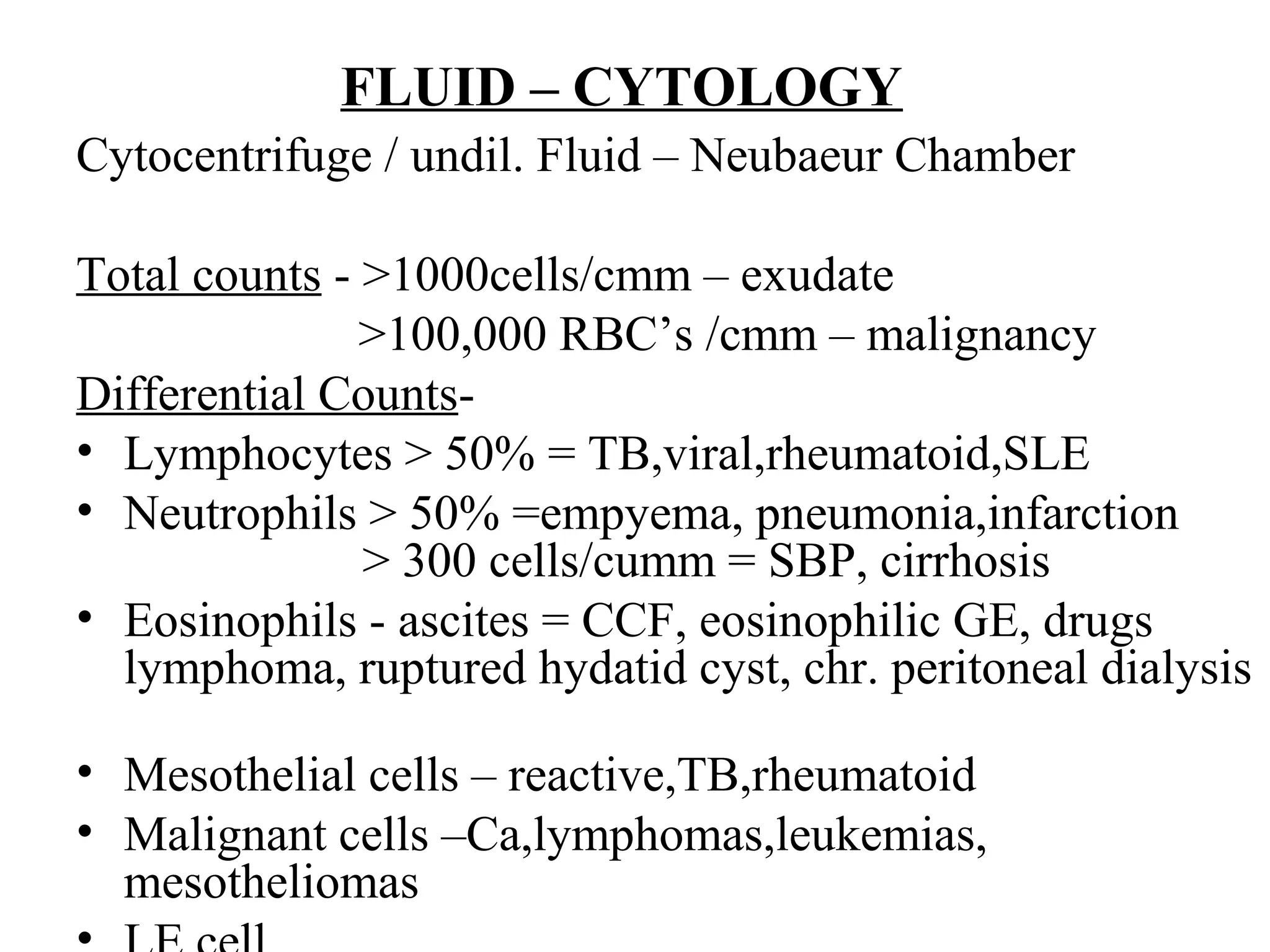
Cytocentrifuge / undil. Fluid – Neubaeur Chamber
Total counts - >1000cells/cmm – exudate
>100,000 RBC’s /cmm – malignancy
Differential Counts-
• Lymphocytes > 50% = TB,viral,rheumatoid,SLE
• Neutrophils > 50% =empyema, pneumonia,infarction
> 300 cells/cumm = SBP, cirrhosis
• Eosinophils - ascites = CCF, eosinophilic GE, drugs
lymphoma, ruptured hydatid cyst, chr. peritoneal dialysis
• Mesothelial cells – reactive,TB,rheumatoid
• Malignant cells –Ca,lymphomas,leukemias,
mesotheliomas
FLUID – CYTOLOGY
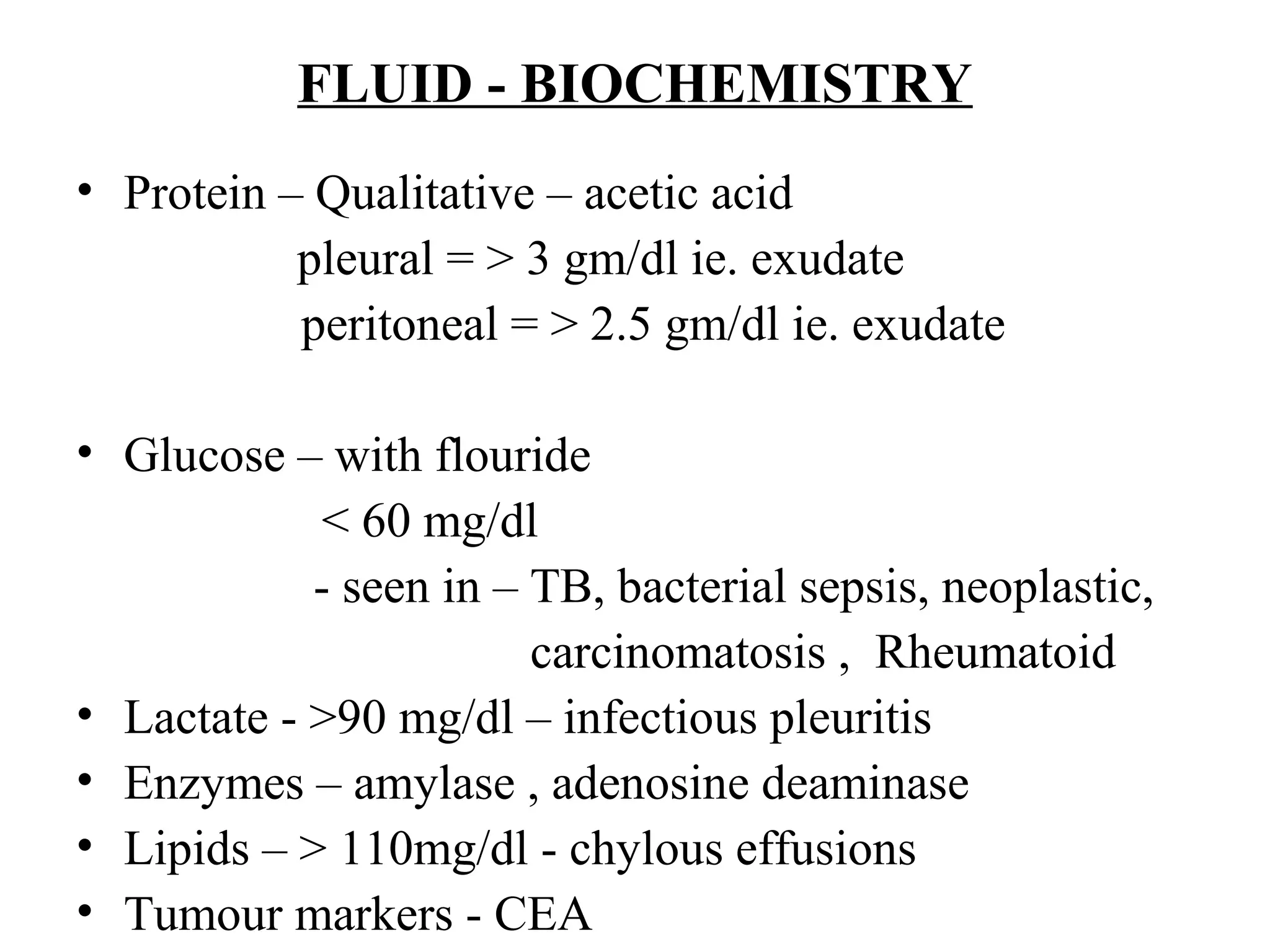
• Protein – Qualitative – acetic acid
pleural = > 3 gm/dl ie. exudate
peritoneal = > 2.5 gm/dl ie. exudate
• Glucose – with flouride
< 60 mg/dl
- seen in – TB, bacterial sepsis, neoplastic,
carcinomatosis , Rheumatoid
• Lactate - >90 mg/dl – infectious pleuritis
• Enzymes – amylase , adenosine deaminase
• Lipids – > 110mg/dl - chylous effusions
• Tumour markers - CEA
FLUID - BIOCHEMISTRY
FLUID- MICROBIOLOGY
•Smear Preparation – Gram stain
ZN stain
•Culture Examination – first tube to be used
centrifuged specimen – use sediment.
FLUID- IMMUNOLOGY
•RF – seropositive RA
•ANA titers – lupus pleuritis - 1:160
•Decreased complement levels – rheumatoid ,lupus pleuritis
Plasma ultrafiltrate with added hyaluronic acid.
• Indications
a. synovitis - acute suppurative
- gout / pseudogout
b. DD of arthritis
• Collection - sterile, disposable plastic heparinized
syringe (1 ml in each large joint)
- Despatch similar to the other fluids
SYNOVIAL FLUID
LABORATORY INVESTIGATION
•Physical Examination
•Chemical Examination
•Microscopic Examination
•Microbiologic study
•Unique tests – Viscosity
Mucin clot test
•Immunologic Studies
Physical Examination –
Appearance – Clear,cloudy,pale yellow,milky,xanthochromic
reddish,dark brown,greenish
•Normal – Clear and viscous , straw-coloured ,does not clot
•Cloudy – inflammatory,crystals,fibrin,amyloid,cartilage frag.
•Purulent – Acute septic arthritis
•Xanthochromia – hemophilia,tumours,trauma
•Haemorrhagic – traumatic/non traumatic
SYNOVIAL FLUID
SYNOVIAL FLUID
Tests for viscosity –
Principle – based on presence of hyaluronic acid
•String test -hold a drop of fluid between thumb &index finger
-pull them apart to form a string
-normal -a string can be formed – 4-6 cm long
-abnormal - < 3 cm long and breaks
•Mucin clot test – clot formation on addition of acetic acid
-grading of clots
-normal – firm clot
-abnormal – poor clot.
SYNOVIAL FLUID - BIOCHEMISTRY
•Glucose Examination-
-Must be taken from fasting patient and treated with flouride
-Reported as difference between blood-synovial fluid glucose
-Normal and Non inflammatory arthritis – diff =10mg/dl
-Infectious arthritis –diff=25-50 mg/dl
-Severe inflammatory – diff=increased.
•Protein Content –
increased in severe inflammatory conditions
•Lactate – more values – septic arthritis
SYNOVIAL FLUID - MICROSCOPY
•Total and differential count – EDTA sample
Normal – count<200 cells/cumm,upto 25% neutrophils
Non inflammatory – counts <5000/cmm ,upto 25%neutrophils
Mild inflammatory – counts <10,000/cmm,upto 50%neutrophils
Severe inflammatory – counts-500-50,000/cmm, upto 90%
Infectious – counts – 500-2,00,000/cmm,upto 100% neutrophils
•Crystals – Wet preparation and sealed ,polarised,no anticoag
Gout – needle shaped – urate
Pseudogout – rhomboid calcium pyrophosphate
Rheumatoid arthritis – cholesterol – flat clear
Sodium urate Sodium urate
Ca pyrophosphate Ca pyrophosphate
SYNOVIAL FLUID- MICROBIOLOGY
•Smear Preparation – Gram stain
ZN stain
•Culture Examination – first tube to be used
centrifuged specimen – use sediment.
•Rh factor - +ve in 60% of RA patients
•ANA - +ve in SLE
•C4 - ↓ed in RA, SLE, arthritis, gout, etc.
SYNOVIAL FLUID - IMMUNOLOGY
• Water(99%),hydrocloric acid,organic acids,various
enzymes, mucin and intrinsic factor.saliva and
regurgitated duodenal contents are also present.
• Psycological factors,systemic diseases,GITract ds,
hence co related with clinical and other findings.
• No defined normal values.
• Unpleasant for the pt, time consuming and
cumbersome procedure
GASTRIC AND DUODENAL CONTENTS`
• To determine gastric acid secretion. Macrocytic
anaemia, pernicious anaemia, peptic ulcerand other
ulcerative lesions
• To measure amount of acid production in peptic ulcer
and post operative stomach ulcer
• Diagnosis of Zollinger-Ellison syndrome
• To determine completeness of vagotomy by insulin
tests
• M. tuberculosis isolation in children
• Detection of malignancy by cytology
INDICATIONS
GASTRIC INTUBATION
• Overnight fasting
• 55cms mark- antrum
• Contraindicated in esophageal varices, diverticula,
stenosis,aortic aneurysms,recent gastric haemorrhage,CCF
and pregnancy.
• Volume in ml, titrable acidity(0.1 N NaOH and phenol red
as indicator), pH measured electrometrically.
GASTRIC JUICE - Physical examination
• Pale grey,transluscent,slightly viscid and pungent
• Fasting volume varies upto 50ml
• Food particles indicate delayed gastric emptying
• Bile is seen in regurgitation, excess seen in intestinal
obstruction beyond the ampulla of Vater
• Blood may be due to trauma. Coffee ground may be
due to gastritis,ulcer, carcinoma or blood swallowed
from mouth, nasopharynx or pulmonary sources
GASTRIC JUICE - MICROSCOPY
•Normal - RBC’s,WBC’s,epithelial cells,yeasts,bacteria,mucus
•Neutrophils – increased nos. - gastric mucosal inflammation
•Epithelial cells – increased in gastritis
•Parasites rarely found – giardia,ascaris,strongyloides etc.
•Not really useful
AMNIOTIC FLUID
Indications –
•Cytogenetic – increased maternal age,chromosomal abn,
previous history,exposure to irradiation,single gene
disorders
•AFP – neural tube defects
•Erythroblastosis fetalis – based on presence of products of
hemolysis
•Surfactant analysis – lung maturation
•Intrauterine infections –
TORCH,syphilis,TB,Salmonella,candida,HIV
Cerebro-spinal fluid examination
Dr.Chetan Chaudhari
Asst.Prof. Dept.of Pathology
LTMG Hospital,Sion
CONTENT
• Anatomy and Physiology
• Specimen Collection
• Opening Pressure
• Total cell count
• Differential cell count
• Glucose
• Protein
Anatomy and Physiology
Clear & Colourless fluid
Produced by choroid
plexus & ultrafiltration
 leaves ventricular system by
lateral & medial foramina
 flows within subarachnoid
space
 CSF resorption occurs at
arachnoid villi.
Volume: 120 – 180 ml in adultsVolume: 120 – 180 ml in adults
60 – 80 ml in babies60 – 80 ml in babies
Functions of CSF
• Mechanical protection
• Transport of biomolecules
• Clearance of catabolites
• Maintenance of constant ICT
Diagnosis by CSF
• High sensitivity, high specificity
– Bacterial, TB, and fungal meningitis
• High sensitivity, moderate specificity
– Viral meningitis, SAH, MS, CNS syphilis, abcess
• Moderate sensitivity, high specificity
– Meningeal malignancy
• Moderate sensitivity, moderate specificity
– Intracranial hemorrhage, viral encephalitis,
subdural hematoma
Indications
• Meningeal infection
• Subarachnoid hemorrhage (SAH)
• CNS malignancy
• Demyelinating diseases
Specimen Collection
• Lumbar puncture (LP) is the insertion of a needle
into the subarachnoid space (the area under the
membrane that surrounds the brain and spinal cord)
of the lumbar (lower back) region for diagnostic or
therapeutic purposes. This allows access to the
cerebrospinal fluid (CSF) in which the brain and
spinal cord float.
• Although the subarachnoid space can be accessed
from other levels, the lumbar region is most often
used as it allows the needle to be inserted below the
end of the spinal cord.
Routine Lab Tests
• Required
• Opening CSF pressure
• Total cell count and differential (stained)
• Glucose (CSF/plasma ratio)
• Protein
• Optional
• Cultures, gram stain, antigens, cytology
• Protein electrophoresis, VDRL, D-dimers
Opening Pressure
• Normal opening pressure in adults
is 90~180mmH2O, 10~100mmH2O
in children.
Elevated pressure
• Congestive heart failure
• Meningitis
• Superior vena cava syndrome
• Cerebral edema
• Mass lesion
Decreased pressure
• Spinal-subarachnoid block
• Dehydration
• Circulatory collapse
• CSF leakage
CSF specimen is usually devided into 3 serially collected sterile tubes
Tube-1 For chemistry & immunological studies
Tube-2 For microbiological examination
Tube-3 For cell counts
Specimen should be delivered to the lab & processesd within 1 hr.
Refrigeration is contraindicated for culture examination
Gross Examination:
Normal CSF is clear & colourless
Abnormal CSF may appear cloudy, frankly purulent or pigment tinged
Viscous CSF may be seen in metastatic mucin producing
adenocarcinoma, cryptococcal meningitis.
Xanthochromia
• Pink, orange, or yellow discoloration
• RBC lysis or hemoglobin breakdown
• May be seen within hours of LP
• Peak intensity at 24 - 36 hours
• RBC > 6000/uL (SAH, ICH, infarct,
traumatic)
• Oxyhemoglobin, bilirubin, increased
protein
• Carotinoids, melanin, rifampin
therapy
CSF supernatantCSF supernatant
colourcolour
Disease/DisordersDisease/Disorders
PinkPink RBC lysisRBC lysis
YellowYellow HyperbilirubenemiaHyperbilirubenemia
OrangeOrange Hypervitaminosis AHypervitaminosis A
Yellow-GreenYellow-Green HyperbilirubenemiaHyperbilirubenemia
BrownBrown Metastatic melanomaMetastatic melanoma
Differential Dx of Bloody CSF
• Traumatic tap - blood clears between tubes
• Xanthochromia - pink tinge, RBCs
• SAH - blood does not clear or clot
Microscopic examination
Done on undiluted CSF in a manual Neubauer’s counting chamber.
No RBCs should be present in normal CSF
If numerous (except a traumatic trap) indicates trauma or pathologic
processes like malignancy, infarct, hemorrhage
Increased Neutrophils in CSF
• Meningitis (bacterial, early TB, viral, fungal)
• Other infections
• Following seizures
• Following CNS hemorrhage
• Following CNS infarct
• Reaction to repeated LP
• Foreign materials
• Metastatic tumor
Increased Lymphocytes in CSF
• Meningitis (aseptic, L
monocytogenes,Viral,tuberculous,fun
gal,syphilitic)
• Parasitic infections
• Degenerative disorders
– SSPE, MS, encephalopathy due to
drugs, GBS
• Other inflammatory conditions
– Sarcoidosis, polyneuritis,
periarteritis involving the CNS
Eosinophilic pleocytosis in CSF
• Commonly associated with
• Parasitic infections
• Fungal infections
• Reaction to foreign material
• Infrequently associated with
• Bacterial or tuberculous
meningitis
• Viral, rickettsial infection,
lymphoma, sarcoidosis
Conditions Associated with Increased
CSF Total Protein
• Increased blood-CSF permeability
– Meningitis (bacterial, fungal, TB)
– Hemorrhage (SAH, ICH)
– Endocrine disorders
– Mechanical obstruction (tumor, disc, abcess)
– Neurosypilis, MS, SSPE, GBS, CVD
Bacterial Meningitis
• 0 - 1m: Group B strept & E. coli (GNR)
• 1m - 5y: H. influenzae
• 5 - 29y: N. meningitidis
• >29y: S. pneumoniae
• Listeria monocytogenes common in newborns,
elderly, and other immunocompromised hosts
Bacterial Meningitis
CSF Gram stain showingCSF Gram stain showing Gram-negativeGram-negative
diplococcidiplococci characteristic of N.meningitidis.characteristic of N.meningitidis.
Granulocytic type of reaction:
1) Purulen meningitis
2) Initial phase of
serous inflammation
Purulent Meningitis – Prevalence of Granulocytes
Typical CSF Findings in Meningitis
TestTest BacterialBacterial ViralViral FungalFungal TuberculouTuberculou
ss
OpeningOpening
pressurepressure
ElevatedElevated Usually normalUsually normal VariableVariable VariableVariable
LeukocyteLeukocyte
countcount
>1000/microL>1000/microL <100/microL<100/microL VariableVariable VariableVariable
Cell differentialCell differential MainlyMainly
neutrophilsneutrophils
MainlyMainly
lymphocyteslymphocytes
MainlyMainly
lymphocyteslymphocytes
MainlyMainly
lymphocyteslymphocytes
ProteinProtein MarkedlyMarkedly
increasedincreased
Normal to mildNormal to mild
increaseincrease
IncreasedIncreased IncreasedIncreased
GlucoseGlucose <40 mg/dl<40 mg/dl NormalNormal DecreasedDecreased DecreasedDecreased
CSF to serumCSF to serum
glucose ratioglucose ratio
MarkedlyMarkedly
decreasedecrease
Usually normalUsually normal LowLow LowLow
Lactic acidLactic acid MarkedlyMarkedly
increaseincrease
Normal to mildNormal to mild
increaseincrease
Mild to modMild to mod
increaseincrease
Mild to modMild to mod
increaseincrease
• Gradual onset of headache and decreased
consciousness
– Low grade evening fevers
– Night sweats
– Weight loss
– Neck stiffness and positive Kernig’s sign
– Cranial nerve palsies result from exudate
around base of the brain
Mycobacterial Infection: M. tuberculosis
(TB Meningitis)
Presenting Signs and Symptoms
Diagnostics
• CSF Values
– Normal: 5-10%
– Protein: High (40mg/dl-100 mg/dl)
– WBC: 5-2000 (average is 60-70%
lymphocytes)
– Glucose: low (<20 mg/dl)
– AFB smear pos: 20%
Fungal Infection: Cryptococcus neoformans
(cryptococcal meningitis)
Diagnostics
• CSF Values
– Normal 20%
– Protein 30-150/dl
– WBC: 0-100 (mainly lymphocytes)
– Glucose decreased: 50-70mg/dl
– Culture positive: 95-100%
– India ink positive: 60-80%
– Crypt Ag nearly 100% sensitive and specific
Cryptoccocal meningitis: CSF
Indian ink examination
Tumorous type of reaction:
1)Malignant meningeal infiltration
2) Localized tumours
3) Special staining procedures required
Hypopituitary Carcinoma Lung Carcinoma – Toluidine Blue
Non-Hodgkin Lymphoma
THANK YOU
Sputum and body fluids, csf for bpmt

Sputum and body fluids, csf for bpmt

  • 1.
    SPUTUM AND BODYFLUIDS DR.PRAGATI SATHE
  • 2.
    SPUTUM EXAMINATION Specimen Collection– •Ideal – should contain lower respiratory tract secretions 1st morning sample is ideal ,contaminant may be prt. •Needs patient co-operation and understanding. •May be spontaneous/induced. •In children – 3 methods – Nasopharyngeal swab, Cough plate, Cough swab •Collection in sterile,disposable container with a screw cap •Delivered to the lab immediately
  • 3.
    SPUTUM –GROSS EXAMINATION Consistencyand appearance – normal – viscoelastic Opaqueness – due to pus,epithelial cells, Curshmann’s spirals, caseous material,bronchial casts,food subs. Colour – Yellow – pus,epithelial cells Green – pseudomonas Rust coloured – infarct,pneumonia Bright red – acute LVF, TB,malignancy. Odour – normal – no odour putrid – lung abscess,cavities. Others – foreign bodies,parasites,broncholiths
  • 4.
    SPUTUM –MICROSCOPIC EXAMINATION •Allsuspicious particles – transferred with sterile instrument •Smears can be dried ,heat fixed to kill organisms •Special stains to be applied – Grams,ZN,pap,Giemsa,H&E •Presence of alveolar macrophage – sample is representative •Other cells – bronchial epithelial cells •Abnormal cells – Intact neutrophils – pyogenic infections Eosinophils – in large nos– bronchial asthma RBC’s in large nos. exudate, haemorrhage
  • 5.
    SPUTUM –MICROSCOPIC EXAMINATION •Organisms– Mycobacteria – ZN stain Fungi – direct mount with 10% NaOH Gram positive cocci Gram negative bacilli
  • 6.
    SPUTUM CULTURE •Microscopic examinationshould preceede culture •2 methods – Classic technique – streaking on agar plate should be corelated with Grams stained smears. Quantitive analysis of the organisms
  • 7.
    SPUTUM IN DISEASE •Tuberculosis– 24 hr specimen,early morning,bronchial • washings,transtracheal aspiration & gastric •Pretreatment by digestion procedures facilitates demonstration •Liquefying sputum, lowering specific gravity, Decontamination of other organisms •Staining with ZN stain •Flourescent microscopy.
  • 8.
  • 9.
    SPUTUM IN DISEASE •FungalDiseases –Histoplasmosis,Coccidioides,Blastomyces, Cryptococci , Aspergillus,Candida •Bronchial Asthma – Eosinophilia >80% Charcot Leyden crystals Bronchial epi cells- Creola bodies-50% Curschmann’s spirals •Bronchiectasis – putrid odor,greenish epithelial cells,Dittrich’s plugs,bacteria •Chronic bronchitis – copious,mucoid,tenacious histiocytes and monocytes,organisms,PMN’s •Lung Abscess – initially less after rupture foul smelling,copious multiple organisms identified.
  • 10.
    SPUTUM IN DISEASE •Pneumonia-blood tinged sputum epithelial cells,leucocytes organisms seen - streptococci,staph,Haemophilus •Pneumoconiosis – quantity and color varies macrophages dumb-bell shaped needles of asbestosis needle shaped elongated bodies of silicosis •PCP – protozoan parasite,cysts •Viral infections – inclusion bodies intranuclear,intracyto •Malignancy – single,early morning deep cough sputum look for malignant cells from lung cancers pap and giemsa stains
  • 11.
  • 12.
  • 13.
  • 14.
  • 15.
  • 16.
    • Pleural • Peritoneal/ Ascitic • Pericardial • Synovial • Amniotic • Gastric and duodenal BODY FLUIDS
  • 17.
  • 18.
    TRANSUDATE EXUDATE • Appearanceclear/straw cloudy/purulent • Coagulation absent freq present • Sp. Gravity <1.018 >1.018 • Proteins <2 gm% >2 gm% • Cells few many mesothelial inflammatory • Bacteria absent present • Serous memb normal inflamed FLUID - TYPES
  • 19.
    SPECIMEN COLLECTION •Done byattending physician/nurse •Delivered to the lab immediately •Should be examined fresh – as cells disintegrate bacteria grow fast altered chemical composition •Need for another collection to be avoided •Avoid traumatic tap •Anticoagulant may be needed •Collection in 3 bulbs – microbiology,cells & proteins, biochemistry.
  • 20.
    Pleural effusion • Transudate– CCF, hepatic cirrhosis, hypoproteinemia, • Exudate - neoplasm,infection, trauma,pulmonary infarct, Rheumatoid disease,SLE, pancreatitis • Chylous - trauma, TB, lymphoma, Ca, CAUSES OF FLUID ACCUMULATION
  • 21.
    Peritoneal effusion • Transudate– CCF, hepatic cirrhosis,hypoproteinemia • Exudate - neoplasm,infection, trauma,pancreatitis, bile peritonitis • Chylous - trauma, TB, lymphoma, Ca, parasitic infestation • Pseudochylous – due to long standing effusions – TB,rheumatoid pleuritis. CAUSES OF FLUID ACCUMULATION
  • 22.
    CAUSES OF FLUIDACCUMULATION Pericardial effusion •Infections – bacterial,TB,Fungal,viral •Neoplastic – Ca,Lymphoma •Haemorrhagic – trauma,anticoagulant therapy,aortic aneurysm •Metabolic – uremia •Hypersensitivity – SLE,rheumatoid dis.
  • 23.
    FLUID - INDICATIONS 1.Pleural tap – • Effusion of unknown aetiology • Dyspnoea and fluid accumulation • Intrapleural instillation of drugs • Haemothorax • Empyema 2. Pericardial tap – • Effusion of unknown aetiology • Acute / Chronic cardiac tamponade
  • 24.
    3. Peritoneal tap– • Ascites of unknown aetiology • Dyspnoea and fluid accumulation • Suspected intestinal gangrene • Intestinal perforation • Intra-abdominal haemorrhage-?traumatic • Instillation of cytotoxic drugs FLUID - INDICATIONS
  • 25.
    •Physical Examination •Chemical Examination •MicroscopicExamination •Microbiologic study •Immunologic Studies LABORATORY INVESTIGATIONS
  • 26.
    Whole fluid withoutcentrifugation- • Appearance – clear,cloudy,chylous • Colour – milky,red,yellow etc. Normal = clear/straw-coloured Red = trauma/rupture/tumour/ bleeding disorder Milky = chylous - filariasis Mucinous = adenocarcinoma Purulent = empyema/peritonitis FLUID – PHYSICAL EXAMINATION
  • 27.
    FLUID – PHYSICALEXAMINATION •Turbid fluids can be centrifuged- If supernatent clear – turbidity due to cells If supernatent turbid – chylous/pseudochylous •Specific Gravity – to decide whether transudate/exudate
  • 28.
    Cytocentrifuge / undil.Fluid – Neubaeur Chamber Total counts - >1000cells/cmm – exudate >100,000 RBC’s /cmm – malignancy Differential Counts- • Lymphocytes > 50% = TB,viral,rheumatoid,SLE • Neutrophils > 50% =empyema, pneumonia,infarction > 300 cells/cumm = SBP, cirrhosis • Eosinophils - ascites = CCF, eosinophilic GE, drugs lymphoma, ruptured hydatid cyst, chr. peritoneal dialysis • Mesothelial cells – reactive,TB,rheumatoid • Malignant cells –Ca,lymphomas,leukemias, mesotheliomas FLUID – CYTOLOGY
  • 29.
    • Protein –Qualitative – acetic acid pleural = > 3 gm/dl ie. exudate peritoneal = > 2.5 gm/dl ie. exudate • Glucose – with flouride < 60 mg/dl - seen in – TB, bacterial sepsis, neoplastic, carcinomatosis , Rheumatoid • Lactate - >90 mg/dl – infectious pleuritis • Enzymes – amylase , adenosine deaminase • Lipids – > 110mg/dl - chylous effusions • Tumour markers - CEA FLUID - BIOCHEMISTRY
  • 30.
    FLUID- MICROBIOLOGY •Smear Preparation– Gram stain ZN stain •Culture Examination – first tube to be used centrifuged specimen – use sediment.
  • 31.
    FLUID- IMMUNOLOGY •RF –seropositive RA •ANA titers – lupus pleuritis - 1:160 •Decreased complement levels – rheumatoid ,lupus pleuritis
  • 32.
    Plasma ultrafiltrate withadded hyaluronic acid. • Indications a. synovitis - acute suppurative - gout / pseudogout b. DD of arthritis • Collection - sterile, disposable plastic heparinized syringe (1 ml in each large joint) - Despatch similar to the other fluids SYNOVIAL FLUID
  • 34.
    LABORATORY INVESTIGATION •Physical Examination •ChemicalExamination •Microscopic Examination •Microbiologic study •Unique tests – Viscosity Mucin clot test •Immunologic Studies
  • 35.
    Physical Examination – Appearance– Clear,cloudy,pale yellow,milky,xanthochromic reddish,dark brown,greenish •Normal – Clear and viscous , straw-coloured ,does not clot •Cloudy – inflammatory,crystals,fibrin,amyloid,cartilage frag. •Purulent – Acute septic arthritis •Xanthochromia – hemophilia,tumours,trauma •Haemorrhagic – traumatic/non traumatic SYNOVIAL FLUID
  • 36.
    SYNOVIAL FLUID Tests forviscosity – Principle – based on presence of hyaluronic acid •String test -hold a drop of fluid between thumb &index finger -pull them apart to form a string -normal -a string can be formed – 4-6 cm long -abnormal - < 3 cm long and breaks •Mucin clot test – clot formation on addition of acetic acid -grading of clots -normal – firm clot -abnormal – poor clot.
  • 37.
    SYNOVIAL FLUID -BIOCHEMISTRY •Glucose Examination- -Must be taken from fasting patient and treated with flouride -Reported as difference between blood-synovial fluid glucose -Normal and Non inflammatory arthritis – diff =10mg/dl -Infectious arthritis –diff=25-50 mg/dl -Severe inflammatory – diff=increased. •Protein Content – increased in severe inflammatory conditions •Lactate – more values – septic arthritis
  • 38.
    SYNOVIAL FLUID -MICROSCOPY •Total and differential count – EDTA sample Normal – count<200 cells/cumm,upto 25% neutrophils Non inflammatory – counts <5000/cmm ,upto 25%neutrophils Mild inflammatory – counts <10,000/cmm,upto 50%neutrophils Severe inflammatory – counts-500-50,000/cmm, upto 90% Infectious – counts – 500-2,00,000/cmm,upto 100% neutrophils •Crystals – Wet preparation and sealed ,polarised,no anticoag Gout – needle shaped – urate Pseudogout – rhomboid calcium pyrophosphate Rheumatoid arthritis – cholesterol – flat clear
  • 39.
    Sodium urate Sodiumurate Ca pyrophosphate Ca pyrophosphate
  • 40.
    SYNOVIAL FLUID- MICROBIOLOGY •SmearPreparation – Gram stain ZN stain •Culture Examination – first tube to be used centrifuged specimen – use sediment.
  • 41.
    •Rh factor -+ve in 60% of RA patients •ANA - +ve in SLE •C4 - ↓ed in RA, SLE, arthritis, gout, etc. SYNOVIAL FLUID - IMMUNOLOGY
  • 42.
    • Water(99%),hydrocloric acid,organicacids,various enzymes, mucin and intrinsic factor.saliva and regurgitated duodenal contents are also present. • Psycological factors,systemic diseases,GITract ds, hence co related with clinical and other findings. • No defined normal values. • Unpleasant for the pt, time consuming and cumbersome procedure GASTRIC AND DUODENAL CONTENTS`
  • 43.
    • To determinegastric acid secretion. Macrocytic anaemia, pernicious anaemia, peptic ulcerand other ulcerative lesions • To measure amount of acid production in peptic ulcer and post operative stomach ulcer • Diagnosis of Zollinger-Ellison syndrome • To determine completeness of vagotomy by insulin tests • M. tuberculosis isolation in children • Detection of malignancy by cytology INDICATIONS
  • 44.
    GASTRIC INTUBATION • Overnightfasting • 55cms mark- antrum • Contraindicated in esophageal varices, diverticula, stenosis,aortic aneurysms,recent gastric haemorrhage,CCF and pregnancy. • Volume in ml, titrable acidity(0.1 N NaOH and phenol red as indicator), pH measured electrometrically.
  • 45.
    GASTRIC JUICE -Physical examination • Pale grey,transluscent,slightly viscid and pungent • Fasting volume varies upto 50ml • Food particles indicate delayed gastric emptying • Bile is seen in regurgitation, excess seen in intestinal obstruction beyond the ampulla of Vater • Blood may be due to trauma. Coffee ground may be due to gastritis,ulcer, carcinoma or blood swallowed from mouth, nasopharynx or pulmonary sources
  • 46.
    GASTRIC JUICE -MICROSCOPY •Normal - RBC’s,WBC’s,epithelial cells,yeasts,bacteria,mucus •Neutrophils – increased nos. - gastric mucosal inflammation •Epithelial cells – increased in gastritis •Parasites rarely found – giardia,ascaris,strongyloides etc. •Not really useful
  • 47.
    AMNIOTIC FLUID Indications – •Cytogenetic– increased maternal age,chromosomal abn, previous history,exposure to irradiation,single gene disorders •AFP – neural tube defects •Erythroblastosis fetalis – based on presence of products of hemolysis •Surfactant analysis – lung maturation •Intrauterine infections – TORCH,syphilis,TB,Salmonella,candida,HIV
  • 48.
    Cerebro-spinal fluid examination Dr.ChetanChaudhari Asst.Prof. Dept.of Pathology LTMG Hospital,Sion
  • 49.
    CONTENT • Anatomy andPhysiology • Specimen Collection • Opening Pressure • Total cell count • Differential cell count • Glucose • Protein
  • 50.
    Anatomy and Physiology Clear& Colourless fluid Produced by choroid plexus & ultrafiltration  leaves ventricular system by lateral & medial foramina  flows within subarachnoid space  CSF resorption occurs at arachnoid villi. Volume: 120 – 180 ml in adultsVolume: 120 – 180 ml in adults 60 – 80 ml in babies60 – 80 ml in babies
  • 51.
    Functions of CSF •Mechanical protection • Transport of biomolecules • Clearance of catabolites • Maintenance of constant ICT
  • 52.
    Diagnosis by CSF •High sensitivity, high specificity – Bacterial, TB, and fungal meningitis • High sensitivity, moderate specificity – Viral meningitis, SAH, MS, CNS syphilis, abcess • Moderate sensitivity, high specificity – Meningeal malignancy • Moderate sensitivity, moderate specificity – Intracranial hemorrhage, viral encephalitis, subdural hematoma
  • 53.
    Indications • Meningeal infection •Subarachnoid hemorrhage (SAH) • CNS malignancy • Demyelinating diseases
  • 54.
    Specimen Collection • Lumbarpuncture (LP) is the insertion of a needle into the subarachnoid space (the area under the membrane that surrounds the brain and spinal cord) of the lumbar (lower back) region for diagnostic or therapeutic purposes. This allows access to the cerebrospinal fluid (CSF) in which the brain and spinal cord float. • Although the subarachnoid space can be accessed from other levels, the lumbar region is most often used as it allows the needle to be inserted below the end of the spinal cord.
  • 56.
    Routine Lab Tests •Required • Opening CSF pressure • Total cell count and differential (stained) • Glucose (CSF/plasma ratio) • Protein • Optional • Cultures, gram stain, antigens, cytology • Protein electrophoresis, VDRL, D-dimers
  • 57.
    Opening Pressure • Normalopening pressure in adults is 90~180mmH2O, 10~100mmH2O in children.
  • 58.
    Elevated pressure • Congestiveheart failure • Meningitis • Superior vena cava syndrome • Cerebral edema • Mass lesion
  • 59.
    Decreased pressure • Spinal-subarachnoidblock • Dehydration • Circulatory collapse • CSF leakage
  • 60.
    CSF specimen isusually devided into 3 serially collected sterile tubes Tube-1 For chemistry & immunological studies Tube-2 For microbiological examination Tube-3 For cell counts Specimen should be delivered to the lab & processesd within 1 hr. Refrigeration is contraindicated for culture examination Gross Examination: Normal CSF is clear & colourless Abnormal CSF may appear cloudy, frankly purulent or pigment tinged Viscous CSF may be seen in metastatic mucin producing adenocarcinoma, cryptococcal meningitis.
  • 61.
    Xanthochromia • Pink, orange,or yellow discoloration • RBC lysis or hemoglobin breakdown • May be seen within hours of LP • Peak intensity at 24 - 36 hours • RBC > 6000/uL (SAH, ICH, infarct, traumatic) • Oxyhemoglobin, bilirubin, increased protein • Carotinoids, melanin, rifampin therapy CSF supernatantCSF supernatant colourcolour Disease/DisordersDisease/Disorders PinkPink RBC lysisRBC lysis YellowYellow HyperbilirubenemiaHyperbilirubenemia OrangeOrange Hypervitaminosis AHypervitaminosis A Yellow-GreenYellow-Green HyperbilirubenemiaHyperbilirubenemia BrownBrown Metastatic melanomaMetastatic melanoma
  • 67.
    Differential Dx ofBloody CSF • Traumatic tap - blood clears between tubes • Xanthochromia - pink tinge, RBCs • SAH - blood does not clear or clot
  • 68.
    Microscopic examination Done onundiluted CSF in a manual Neubauer’s counting chamber. No RBCs should be present in normal CSF If numerous (except a traumatic trap) indicates trauma or pathologic processes like malignancy, infarct, hemorrhage
  • 70.
    Increased Neutrophils inCSF • Meningitis (bacterial, early TB, viral, fungal) • Other infections • Following seizures • Following CNS hemorrhage • Following CNS infarct • Reaction to repeated LP • Foreign materials • Metastatic tumor
  • 71.
    Increased Lymphocytes inCSF • Meningitis (aseptic, L monocytogenes,Viral,tuberculous,fun gal,syphilitic) • Parasitic infections • Degenerative disorders – SSPE, MS, encephalopathy due to drugs, GBS • Other inflammatory conditions – Sarcoidosis, polyneuritis, periarteritis involving the CNS
  • 72.
    Eosinophilic pleocytosis inCSF • Commonly associated with • Parasitic infections • Fungal infections • Reaction to foreign material • Infrequently associated with • Bacterial or tuberculous meningitis • Viral, rickettsial infection, lymphoma, sarcoidosis
  • 73.
    Conditions Associated withIncreased CSF Total Protein • Increased blood-CSF permeability – Meningitis (bacterial, fungal, TB) – Hemorrhage (SAH, ICH) – Endocrine disorders – Mechanical obstruction (tumor, disc, abcess) – Neurosypilis, MS, SSPE, GBS, CVD
  • 74.
    Bacterial Meningitis • 0- 1m: Group B strept & E. coli (GNR) • 1m - 5y: H. influenzae • 5 - 29y: N. meningitidis • >29y: S. pneumoniae • Listeria monocytogenes common in newborns, elderly, and other immunocompromised hosts
  • 75.
    Bacterial Meningitis CSF Gramstain showingCSF Gram stain showing Gram-negativeGram-negative diplococcidiplococci characteristic of N.meningitidis.characteristic of N.meningitidis.
  • 76.
    Granulocytic type ofreaction: 1) Purulen meningitis 2) Initial phase of serous inflammation Purulent Meningitis – Prevalence of Granulocytes
  • 77.
    Typical CSF Findingsin Meningitis TestTest BacterialBacterial ViralViral FungalFungal TuberculouTuberculou ss OpeningOpening pressurepressure ElevatedElevated Usually normalUsually normal VariableVariable VariableVariable LeukocyteLeukocyte countcount >1000/microL>1000/microL <100/microL<100/microL VariableVariable VariableVariable Cell differentialCell differential MainlyMainly neutrophilsneutrophils MainlyMainly lymphocyteslymphocytes MainlyMainly lymphocyteslymphocytes MainlyMainly lymphocyteslymphocytes ProteinProtein MarkedlyMarkedly increasedincreased Normal to mildNormal to mild increaseincrease IncreasedIncreased IncreasedIncreased GlucoseGlucose <40 mg/dl<40 mg/dl NormalNormal DecreasedDecreased DecreasedDecreased CSF to serumCSF to serum glucose ratioglucose ratio MarkedlyMarkedly decreasedecrease Usually normalUsually normal LowLow LowLow Lactic acidLactic acid MarkedlyMarkedly increaseincrease Normal to mildNormal to mild increaseincrease Mild to modMild to mod increaseincrease Mild to modMild to mod increaseincrease
  • 78.
    • Gradual onsetof headache and decreased consciousness – Low grade evening fevers – Night sweats – Weight loss – Neck stiffness and positive Kernig’s sign – Cranial nerve palsies result from exudate around base of the brain Mycobacterial Infection: M. tuberculosis (TB Meningitis) Presenting Signs and Symptoms
  • 79.
    Diagnostics • CSF Values –Normal: 5-10% – Protein: High (40mg/dl-100 mg/dl) – WBC: 5-2000 (average is 60-70% lymphocytes) – Glucose: low (<20 mg/dl) – AFB smear pos: 20%
  • 80.
    Fungal Infection: Cryptococcusneoformans (cryptococcal meningitis) Diagnostics • CSF Values – Normal 20% – Protein 30-150/dl – WBC: 0-100 (mainly lymphocytes) – Glucose decreased: 50-70mg/dl – Culture positive: 95-100% – India ink positive: 60-80% – Crypt Ag nearly 100% sensitive and specific
  • 81.
  • 82.
    Tumorous type ofreaction: 1)Malignant meningeal infiltration 2) Localized tumours 3) Special staining procedures required
  • 83.
    Hypopituitary Carcinoma LungCarcinoma – Toluidine Blue Non-Hodgkin Lymphoma
  • 84.