PLATELET COUNT
Dr. Pandian M
Dept. of Physiology
DYPMCKOP
MATERIALS:
• MICROSCOPE
• NEUBAUER’S CHAMBER
• PLATELET DILUTING FLUID (REES ECKER FLUID)
• RBC PIPETTE
• COTTON,SPRIT,LANCET
what is the functions of Platelets
• It serve four main functions in the body :
1. Temporary hemostasis
2. Clotting of blood
3. Phagocytosis of small particles and organisms, and
4. Storage and transport of chemicals
• Normal values – 1.5 to 4 lakhs / cumm.
• Average 2.59 lakhs / cumm.
• Size - Diameter : 2.5 μ (2 to 4 μ).
• Life span – 8 to 12 days.
REES ECKER FLUID:
Composition:
• Sodium citrate- prevents the coagulation, preserves
RBC,provides the necessary low specific gravity
• Formaline-act as fixative
• Distilled water-solvent
• Other fluid can used- 1% ammonium oxalate
RBC Diluting fluid we’re using here
PROCEDURE:
• Focus Neubauer’s chamber under low power
• Under aseptic precaution take a bold prick
• Suck blood up to 1 mark
• Followed by platelet diluting fluid up to 101
• Mix thoroughly by holding between palms
• Discard first 2 drops and charge the chamber
• Count the cells 4 corner square and 1 central square
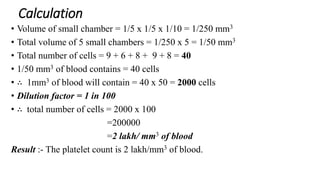
Calculation
• Volume of small chamber = 1/5 x 1/5 x 1/10 = 1/250 mm3
• Total volume of 5 small chambers = 1/250 x 5 = 1/50 mm3
• Total number of cells = 9 + 6 + 8 + 9 + 8 = 40
• 1/50 mm3 of blood contains = 40 cells
• ∴ 1mm3 of blood will contain = 40 x 50 = 2000 cells
• Dilution factor = 1 in 100
• ∴ total number of cells = 2000 x 100
=200000
=2 lakh/ mm3 of blood
Result :- The platelet count is 2 lakh/mm3 of blood.
• THROMBOCYTOSIS –
Increase in the number of platelets above normal count
• Polycythemia vera,
• Iron deficiency anemia,
• Splenectomy,
• Bone marrow malignancy,
• After trauma e.g. Surgery, injury, child birth, etc.
• THROMBOCYTOPENIA-
Decrease in the no of platelets below normal count.
1. Bone marrow depression
2. Hypersplenism
3. Viral infections – e.g. dengue fever, it particularly attacks
platelets.
4. Drug hypersensitivity and etc.
Thrombocythemia- ??
• Glanzmann’s Thrombasthenia-?????
• Inherited hemorrhagic disorder,
• Caused by structural or functional abnormality of platelets.
• The platelet count is normal.
• It is characterized by normal clotting time, normal or
prolonged bleeding time but defective clot retraction.

PLATELET COUNT by Dr. Pandian M .pptx

  • 2.
    PLATELET COUNT Dr. PandianM Dept. of Physiology DYPMCKOP
  • 3.
    MATERIALS: • MICROSCOPE • NEUBAUER’SCHAMBER • PLATELET DILUTING FLUID (REES ECKER FLUID) • RBC PIPETTE • COTTON,SPRIT,LANCET
  • 4.
    what is thefunctions of Platelets • It serve four main functions in the body : 1. Temporary hemostasis 2. Clotting of blood 3. Phagocytosis of small particles and organisms, and 4. Storage and transport of chemicals
  • 5.
    • Normal values– 1.5 to 4 lakhs / cumm. • Average 2.59 lakhs / cumm. • Size - Diameter : 2.5 μ (2 to 4 μ). • Life span – 8 to 12 days.
  • 6.
    REES ECKER FLUID: Composition: •Sodium citrate- prevents the coagulation, preserves RBC,provides the necessary low specific gravity • Formaline-act as fixative • Distilled water-solvent • Other fluid can used- 1% ammonium oxalate RBC Diluting fluid we’re using here
  • 7.
    PROCEDURE: • Focus Neubauer’schamber under low power • Under aseptic precaution take a bold prick • Suck blood up to 1 mark • Followed by platelet diluting fluid up to 101 • Mix thoroughly by holding between palms • Discard first 2 drops and charge the chamber • Count the cells 4 corner square and 1 central square
  • 9.
    Calculation • Volume ofsmall chamber = 1/5 x 1/5 x 1/10 = 1/250 mm3 • Total volume of 5 small chambers = 1/250 x 5 = 1/50 mm3 • Total number of cells = 9 + 6 + 8 + 9 + 8 = 40 • 1/50 mm3 of blood contains = 40 cells • ∴ 1mm3 of blood will contain = 40 x 50 = 2000 cells • Dilution factor = 1 in 100 • ∴ total number of cells = 2000 x 100 =200000 =2 lakh/ mm3 of blood Result :- The platelet count is 2 lakh/mm3 of blood.
  • 10.
    • THROMBOCYTOSIS – Increasein the number of platelets above normal count • Polycythemia vera, • Iron deficiency anemia, • Splenectomy, • Bone marrow malignancy, • After trauma e.g. Surgery, injury, child birth, etc.
  • 11.
    • THROMBOCYTOPENIA- Decrease inthe no of platelets below normal count. 1. Bone marrow depression 2. Hypersplenism 3. Viral infections – e.g. dengue fever, it particularly attacks platelets. 4. Drug hypersensitivity and etc.
  • 12.
    Thrombocythemia- ?? • Glanzmann’sThrombasthenia-????? • Inherited hemorrhagic disorder, • Caused by structural or functional abnormality of platelets. • The platelet count is normal. • It is characterized by normal clotting time, normal or prolonged bleeding time but defective clot retraction.