HISTOTECHNIQUE
Histopathology
It is a branch of pathology which deals with
the study of disease in a tissue section.
The tissue undergoes a series of steps before it
reaches the examiners desk.
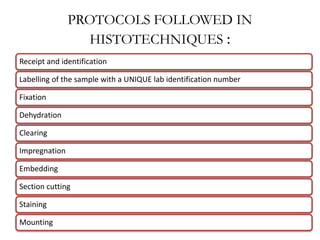
PROTOCOLS FOLLOWED IN
HISTOTECHNIQUES :
Receipt and identification
Labelling of the sample with a UNIQUE lab identification number
Fixation
Dehydration
Clearing
Impregnation
Embedding
Section cutting
Staining
Mounting
Type of material obtained in laboratory
The human tissue comes from the surgery and the
autopsy room.
From surgery two types of tissue are obtained.
1. A small piece of lesions or tumor which is sent for
diagnosis before final removal of the lesion or the
tumor (Incisional biopsy).
2. If the whole of the tumor or lesion is sent for
examination and diagnosis by the pathologist, it is
called excisional biopsy.
Tissues from the autopsy are sent for the study of
disease and its course.
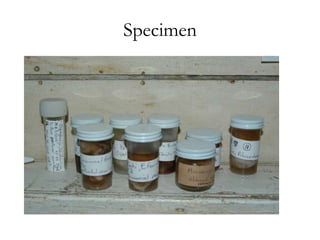
Specimen
As soon as the specimen is received in the
laboratory
Check label (name, age, Hospital Registration No. and
the nature of tissue to be examined, clinical diagnosis
and the requisition form is also duly filled.)
Check if the specimen is in proper fixative.
Check if the financial matters have been taken
care off.
 Make the entries in biopsy register and give the
specimen a pathology number which is also
known as an accession number.
FIXATION
 It is a complex series of chemical events which
brings about changes in the various chemical
constituents of cell like hardening, however the cell
morphology and structural detail is preserved.
Unless a tissue is fixed soon after the removal from
the body it will undergo degenerative changes due
to autolysis and putrefaction hence, tissue
architecture will be lost.
Principle of fixation- The fixative brings about
crosslinking of proteins which produces
denaturation or coagulation of proteins; so that
it maintains everything in their in vivo relation.
Aims & effects of fixation
 The preservation of cells & tissue constituents in
as life-like manner as possible.
To check against bacterial contamination.
Hardening : the hardening effect of fixatives allows
easy manipulation of soft tissue like brain,
intestines etc.
Solidification: solidify colloid material.
Properties of fixatives
 Coagulation and precipitation (as described above).
 Penetrate rapidly.
Solubility of fixatives - All fixatives should be
soluble in a suitable solvent, preferably in water so
that adequate concentrations can be prepared.
 Concentration - It is important that the
concentration of fixative is isotonic.(Osmosis)
Reaction - Most fixatives are acidic. It may help in
fixation but can affect staining so has to be
neutralized.
NO fixative will penetrate a piece of tissue thicker
than 1 cm hence while dealing with thicker specimen
following methods are recommended.
 SOLID ORGAN :- cut slices as necessary ,but not
thicker than 5 mm.
HOLLOW ORGAN :- either open or pack lightly
with wool soaked in fixative
LARGE ORGAN :- It requires dissection, inject
fixative along the vessels or bronchi as in case of
lung so that it reaches all parts of the organ.
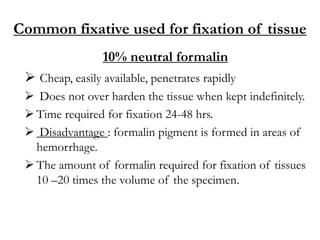
Common fixative used for fixation of tissue
10% neutral formalin
 Cheap, easily available, penetrates rapidly
 Does not over harden the tissue when kept indefinitely.
 Time required for fixation 24-48 hrs.
 Disadvantage : formalin pigment is formed in areas of
hemorrhage.
 The amount of formalin required for fixation of tissues
10 –20 times the volume of the specimen.
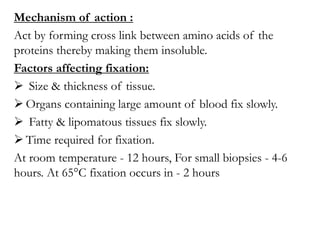
Mechanism of action :
Act by forming cross link between amino acids of the
proteins thereby making them insoluble.
Factors affecting fixation:
 Size & thickness of tissue.
 Organs containing large amount of blood fix slowly.
 Fatty & lipomatous tissues fix slowly.
 Time required for fixation.
At room temperature - 12 hours, For small biopsies - 4-6
hours. At 65°C fixation occurs in - 2 hours
Other fixatives
Glutaraldehyde
Mercuric Chloride (HgCl2)
Alcohol (Ethyl Alcohol)
Acetone
Potassium dichromate
Osmium tetraoxide
Acetic acid
Bouin’s fluid
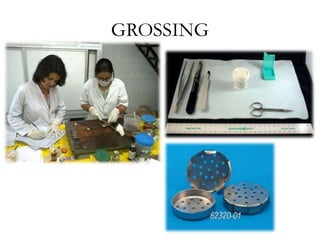
GROSSING
Decalcification
Bone is a hard tissue so it is difficult to cut by
microtome it hence needs to be softened before
sectioning. The process of softening is done by
removing the calcium from the bone. This is called
Decalcification.
 Decalcifying Agents : Two major types are :
1) Acids
 Strong acids :Nitric acid (5-10 % -commonest),
HCL
 Weak acids : Formic acid, acetic acid, picric acid
2) Chelating Agents : EDTA
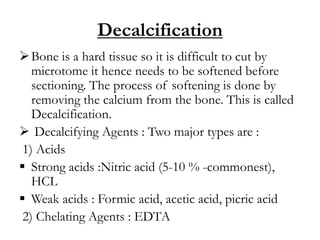
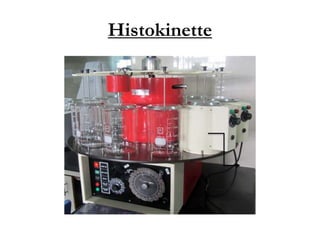
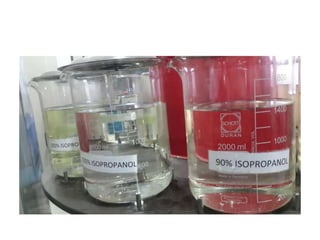
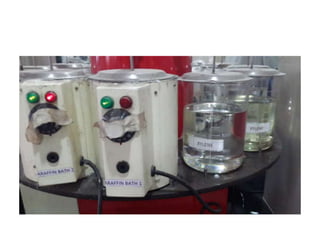
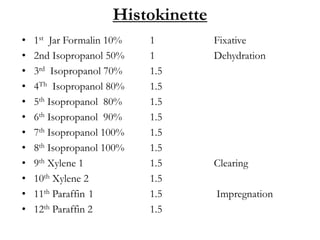
Histokinette
Histokinette
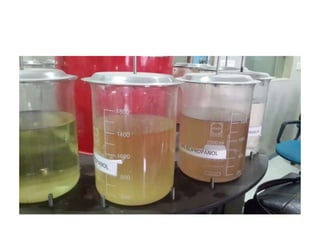
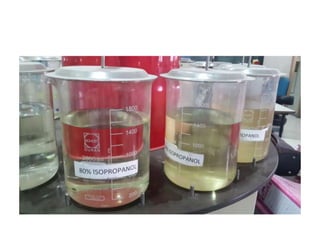
• 1st Jar Formalin 10% 1 Fixative
• 2nd Isopropanol 50% 1 Dehydration
• 3rd Isopropanol 70% 1.5
• 4Th Isopropanol 80% 1.5
• 5th Isopropanol 80% 1.5
• 6th Isopropanol 90% 1.5
• 7th Isopropanol 100% 1.5
• 8th Isopropanol 100% 1.5
• 9th Xylene 1 1.5 Clearing
• 10th Xylene 2 1.5
• 11th Paraffin 1 1.5 Impregnation
• 12th Paraffin 2 1.5
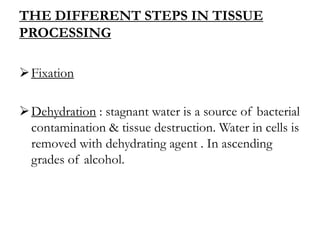
THE DIFFERENT STEPS IN TISSUE
PROCESSING
Fixation
Dehydration : stagnant water is a source of bacterial
contamination & tissue destruction. Water in cells is
removed with dehydrating agent . In ascending
grades of alcohol.
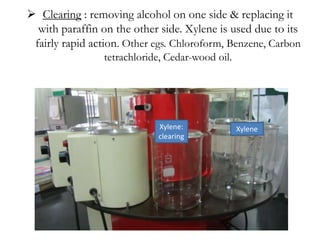
 Clearing : removing alcohol on one side & replacing it
with paraffin on the other side. Xylene is used due to its
fairly rapid action. Other egs. Chloroform, Benzene, Carbon
tetrachloride, Cedar-wood oil.
Xylene:
clearing
Xylene
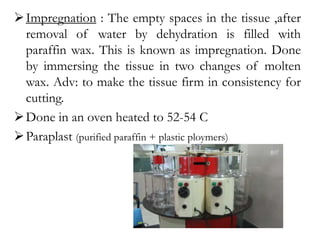
Impregnation : The empty spaces in the tissue ,after
removal of water by dehydration is filled with
paraffin wax. This is known as impregnation. Done
by immersing the tissue in two changes of molten
wax. Adv: to make the tissue firm in consistency for
cutting.
Done in an oven heated to 52-54 C
Paraplast (purified paraffin + plastic ploymers)
In order to prepare a tissue for embedding, it
must be infiltrated with paraffin. Because water
and paraffin are not miscible, the specimens
must be gradually dehydrated to achieve
replacement of water with alcohol before the
clearing agent is introduced.
Once successfully dehydrated, a clearing agent
that is miscible with alcohol and paraffin (i.e.
xylene ) is infiltrated through the tissue. Finally,
the paraffin is introduced and completes the
tissue for embedding.
Embedding : The impregnated tissue is put in a
mould & molten wax is added so as to make a wax
block to hold the tissue for cutting.
Wax with melting point of 54-56 C is used.
Once the tissue has been processed it is ready to be
orientated into a paraffin block and subsequently
sectioned.
Orientation during embedding is crucial for the
representation of proper morphology.
(structures in skin, small gastrointestinal biopsies, and
vas deferens are among those for which orientation is
especially critical.)
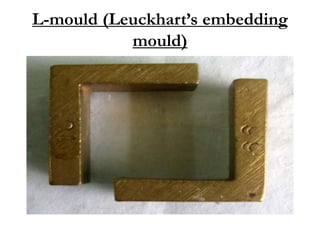
L-mould (Leuckhart’s embedding
mould)
L-mould (Leuckhart’s embedding
mould)
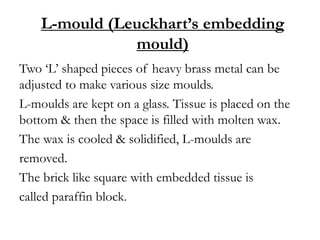
Two ‘L’ shaped pieces of heavy brass metal can be
adjusted to make various size moulds.
L-moulds are kept on a glass. Tissue is placed on the
bottom & then the space is filled with molten wax.
The wax is cooled & solidified, L-moulds are
removed.
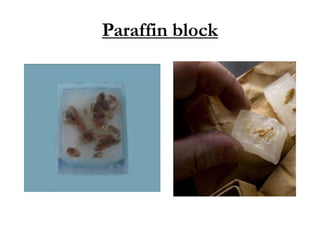
The brick like square with embedded tissue is
called paraffin block.
Paraffin block
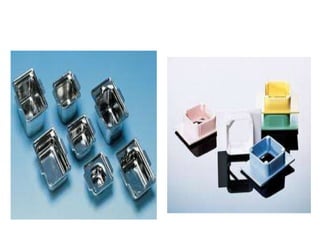
Tissue –Tek-system
 Two parts
stainless steel base mould & plastic mould.
 Tissue is placed in steel mould & filled with molten
wax.
 Plastic mould is placed on top of steel mould & again
filled with molten wax.
 Once the wax is cooled & solidified, steel mould is
taken out.
 Plastic mould remains & act as a holder for microtome
for sectioning.
Microtome
A microtome (from the Greek mikros, meaning
“small”, and temnein, meaning “to cut”) is a tool used
to cut extremely thin slices of material, known as
sections.
TYPES OF MICROTOME
I. Sledge Microtome (Typical cut thickness achievable is
between 10 and 60 micron)
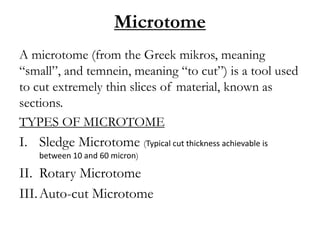
II. Rotary Microtome
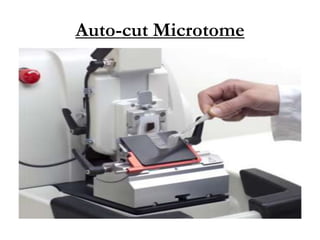
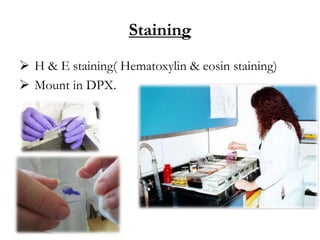
III.Auto-cut Microtome
Rotary Microtome
Auto-cut Microtome
WATER BATH
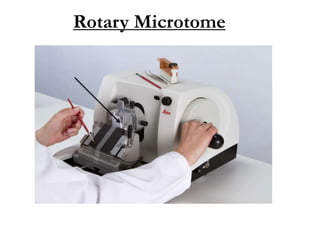
Staining
 H & E staining( Hematoxylin & eosin staining)
 Mount in DPX.
Cryostat
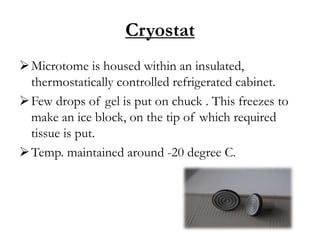
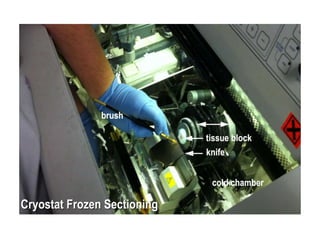
Microtome is housed within an insulated,
thermostatically controlled refrigerated cabinet.
Few drops of gel is put on chuck . This freezes to
make an ice block, on the tip of which required
tissue is put.
Temp. maintained around -20 degree C.
Frozen section
Rapid diagnosis of tumors
Demonstration of fat by special stains
Quick Demonstration of amyloid
Localization of immunoglobulins
Intraoperative guide to surgeon as to surgical
margins are free of tumor
Mountant
The final stage in the preparation of tissues for
microscopy is mounting.
DPX (DISTRENE, PLASTICISER,
XYLENE)
One of the most commonly used mountants, DPX is a
colourless, neutral medium in which most standard stains
are well preserved. It is prepared by dissolving the
common plastic, polystyrene, in a suitable hydrocarbon
solvent (usually xylene).
Labelling and storage of slides
Slide mounted sections are identified during
preparation by inscribing the slide with the tissue
accession number or suitable code using a diamond
marker or pencil (frosted slides)
 slides are usually stored, standing on their short
side, in metal or plastic drawers. Labels need to be
fixed to the opposite end and orientated so the
details can be read with the slide in this upright
position.
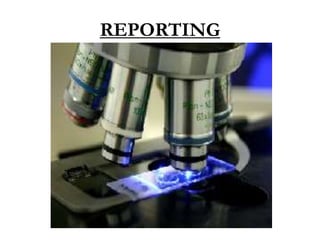
REPORTING

Histotechnique for practicals pathology

  • 1.
  • 2.
    Histopathology It is abranch of pathology which deals with the study of disease in a tissue section. The tissue undergoes a series of steps before it reaches the examiners desk.
  • 3.
    PROTOCOLS FOLLOWED IN HISTOTECHNIQUES: Receipt and identification Labelling of the sample with a UNIQUE lab identification number Fixation Dehydration Clearing Impregnation Embedding Section cutting Staining Mounting
  • 4.
    Type of materialobtained in laboratory The human tissue comes from the surgery and the autopsy room. From surgery two types of tissue are obtained. 1. A small piece of lesions or tumor which is sent for diagnosis before final removal of the lesion or the tumor (Incisional biopsy). 2. If the whole of the tumor or lesion is sent for examination and diagnosis by the pathologist, it is called excisional biopsy. Tissues from the autopsy are sent for the study of disease and its course.
  • 5.
  • 6.
    As soon asthe specimen is received in the laboratory Check label (name, age, Hospital Registration No. and the nature of tissue to be examined, clinical diagnosis and the requisition form is also duly filled.) Check if the specimen is in proper fixative. Check if the financial matters have been taken care off.  Make the entries in biopsy register and give the specimen a pathology number which is also known as an accession number.
  • 7.
    FIXATION  It isa complex series of chemical events which brings about changes in the various chemical constituents of cell like hardening, however the cell morphology and structural detail is preserved. Unless a tissue is fixed soon after the removal from the body it will undergo degenerative changes due to autolysis and putrefaction hence, tissue architecture will be lost.
  • 8.
    Principle of fixation-The fixative brings about crosslinking of proteins which produces denaturation or coagulation of proteins; so that it maintains everything in their in vivo relation.
  • 9.
    Aims & effectsof fixation  The preservation of cells & tissue constituents in as life-like manner as possible. To check against bacterial contamination. Hardening : the hardening effect of fixatives allows easy manipulation of soft tissue like brain, intestines etc. Solidification: solidify colloid material.
  • 10.
    Properties of fixatives Coagulation and precipitation (as described above).  Penetrate rapidly. Solubility of fixatives - All fixatives should be soluble in a suitable solvent, preferably in water so that adequate concentrations can be prepared.  Concentration - It is important that the concentration of fixative is isotonic.(Osmosis) Reaction - Most fixatives are acidic. It may help in fixation but can affect staining so has to be neutralized.
  • 11.
    NO fixative willpenetrate a piece of tissue thicker than 1 cm hence while dealing with thicker specimen following methods are recommended.  SOLID ORGAN :- cut slices as necessary ,but not thicker than 5 mm. HOLLOW ORGAN :- either open or pack lightly with wool soaked in fixative LARGE ORGAN :- It requires dissection, inject fixative along the vessels or bronchi as in case of lung so that it reaches all parts of the organ.
  • 12.
    Common fixative usedfor fixation of tissue 10% neutral formalin  Cheap, easily available, penetrates rapidly  Does not over harden the tissue when kept indefinitely.  Time required for fixation 24-48 hrs.  Disadvantage : formalin pigment is formed in areas of hemorrhage.  The amount of formalin required for fixation of tissues 10 –20 times the volume of the specimen.
  • 13.
    Mechanism of action: Act by forming cross link between amino acids of the proteins thereby making them insoluble. Factors affecting fixation:  Size & thickness of tissue.  Organs containing large amount of blood fix slowly.  Fatty & lipomatous tissues fix slowly.  Time required for fixation. At room temperature - 12 hours, For small biopsies - 4-6 hours. At 65°C fixation occurs in - 2 hours
  • 14.
    Other fixatives Glutaraldehyde Mercuric Chloride(HgCl2) Alcohol (Ethyl Alcohol) Acetone Potassium dichromate Osmium tetraoxide Acetic acid Bouin’s fluid
  • 15.
  • 16.
    Decalcification Bone is ahard tissue so it is difficult to cut by microtome it hence needs to be softened before sectioning. The process of softening is done by removing the calcium from the bone. This is called Decalcification.  Decalcifying Agents : Two major types are : 1) Acids  Strong acids :Nitric acid (5-10 % -commonest), HCL  Weak acids : Formic acid, acetic acid, picric acid 2) Chelating Agents : EDTA
  • 17.
  • 22.
    Histokinette • 1st JarFormalin 10% 1 Fixative • 2nd Isopropanol 50% 1 Dehydration • 3rd Isopropanol 70% 1.5 • 4Th Isopropanol 80% 1.5 • 5th Isopropanol 80% 1.5 • 6th Isopropanol 90% 1.5 • 7th Isopropanol 100% 1.5 • 8th Isopropanol 100% 1.5 • 9th Xylene 1 1.5 Clearing • 10th Xylene 2 1.5 • 11th Paraffin 1 1.5 Impregnation • 12th Paraffin 2 1.5
  • 23.
    THE DIFFERENT STEPSIN TISSUE PROCESSING Fixation Dehydration : stagnant water is a source of bacterial contamination & tissue destruction. Water in cells is removed with dehydrating agent . In ascending grades of alcohol.
  • 24.
     Clearing :removing alcohol on one side & replacing it with paraffin on the other side. Xylene is used due to its fairly rapid action. Other egs. Chloroform, Benzene, Carbon tetrachloride, Cedar-wood oil. Xylene: clearing Xylene
  • 25.
    Impregnation : Theempty spaces in the tissue ,after removal of water by dehydration is filled with paraffin wax. This is known as impregnation. Done by immersing the tissue in two changes of molten wax. Adv: to make the tissue firm in consistency for cutting. Done in an oven heated to 52-54 C Paraplast (purified paraffin + plastic ploymers)
  • 26.
    In order toprepare a tissue for embedding, it must be infiltrated with paraffin. Because water and paraffin are not miscible, the specimens must be gradually dehydrated to achieve replacement of water with alcohol before the clearing agent is introduced. Once successfully dehydrated, a clearing agent that is miscible with alcohol and paraffin (i.e. xylene ) is infiltrated through the tissue. Finally, the paraffin is introduced and completes the tissue for embedding.
  • 27.
    Embedding : Theimpregnated tissue is put in a mould & molten wax is added so as to make a wax block to hold the tissue for cutting. Wax with melting point of 54-56 C is used. Once the tissue has been processed it is ready to be orientated into a paraffin block and subsequently sectioned. Orientation during embedding is crucial for the representation of proper morphology. (structures in skin, small gastrointestinal biopsies, and vas deferens are among those for which orientation is especially critical.)
  • 28.
  • 29.
    L-mould (Leuckhart’s embedding mould) Two‘L’ shaped pieces of heavy brass metal can be adjusted to make various size moulds. L-moulds are kept on a glass. Tissue is placed on the bottom & then the space is filled with molten wax. The wax is cooled & solidified, L-moulds are removed. The brick like square with embedded tissue is called paraffin block.
  • 30.
  • 32.
    Tissue –Tek-system  Twoparts stainless steel base mould & plastic mould.  Tissue is placed in steel mould & filled with molten wax.  Plastic mould is placed on top of steel mould & again filled with molten wax.  Once the wax is cooled & solidified, steel mould is taken out.  Plastic mould remains & act as a holder for microtome for sectioning.
  • 33.
    Microtome A microtome (fromthe Greek mikros, meaning “small”, and temnein, meaning “to cut”) is a tool used to cut extremely thin slices of material, known as sections. TYPES OF MICROTOME I. Sledge Microtome (Typical cut thickness achievable is between 10 and 60 micron) II. Rotary Microtome III.Auto-cut Microtome
  • 34.
  • 35.
  • 36.
  • 37.
    Staining  H &E staining( Hematoxylin & eosin staining)  Mount in DPX.
  • 39.
    Cryostat Microtome is housedwithin an insulated, thermostatically controlled refrigerated cabinet. Few drops of gel is put on chuck . This freezes to make an ice block, on the tip of which required tissue is put. Temp. maintained around -20 degree C.
  • 41.
    Frozen section Rapid diagnosisof tumors Demonstration of fat by special stains Quick Demonstration of amyloid Localization of immunoglobulins Intraoperative guide to surgeon as to surgical margins are free of tumor
  • 42.
    Mountant The final stagein the preparation of tissues for microscopy is mounting. DPX (DISTRENE, PLASTICISER, XYLENE) One of the most commonly used mountants, DPX is a colourless, neutral medium in which most standard stains are well preserved. It is prepared by dissolving the common plastic, polystyrene, in a suitable hydrocarbon solvent (usually xylene).
  • 43.
    Labelling and storageof slides Slide mounted sections are identified during preparation by inscribing the slide with the tissue accession number or suitable code using a diamond marker or pencil (frosted slides)  slides are usually stored, standing on their short side, in metal or plastic drawers. Labels need to be fixed to the opposite end and orientated so the details can be read with the slide in this upright position.
  • 44.