SPORE-BEARING PLANTS
- Plants that reproduce by bearing spores.
- They are called as sporophytes.
- Ex:
- Mosses
- Ferns
FERNS
• vascular seedless plants. Approximately 15,000 species grow in mountains, deserts
or open fields, and even near bodies of water.
• Vascular plants – plants that have tubes running through them, and tubes are
found in the leaves, stems, and roots. Tubes carry sugar, water and minerals through
the plants.
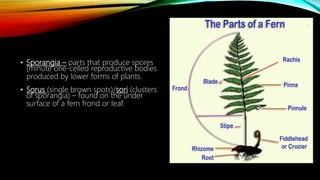
• Rhizomes – stems of sporophyte ferns grow horizontally under the surface of the
ground. Rhizoids (stem) – rootlike structures that absorb water and mineral salts
from the soil.
• Fiddleheads – young unrolling leaves, develop from the stem.
• Nature leaves or fonds – contain sporangia, which are found on the underside.
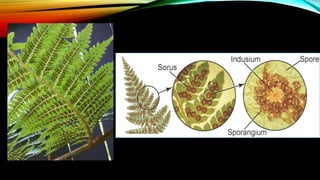
• Sporangia – parts that produce spores
(minute one-celled reproductive bodies
produced by lower forms of plants.
• Sorus (single brown spots)/sori (clusters
of sporangia) – found on the under
surface of a fern frond or leaf.
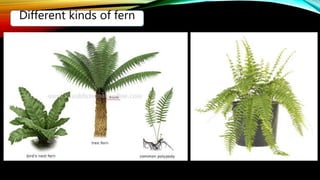
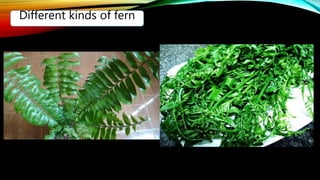
Different kinds of fern
LIFE CYCLES OF FERN
- Ferns exhibit a life cycle known as alteration of
generations.
- Alteration of generations means there is a stage:
sporophyte (spore formation), and gametophyte
(produces gametes; egg and sperm cells).
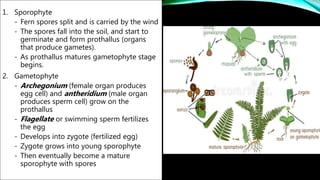
1. Sporophyte
- Fern spores split and is carried by the wind
- The spores fall into the soil, and start to
germinate and form prothallus (organs
that produce gametes).
- As prothallus matures gametophyte stage
begins.
2. Gametophyte
- Archegonium (female organ produces
egg cell) and antheridium (male organ
produces sperm cell) grow on the
prothallus
- Flagellate or swimming sperm fertilizes
the egg
- Develops into zygote (fertilized egg)
- Zygote grows into young sporophyte
- Then eventually become a mature
sporophyte with spores
USES OF FERN
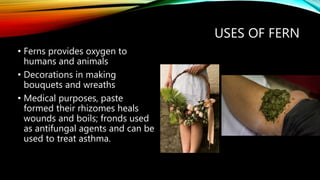
• Ferns provides oxygen to
humans and animals
• Decorations in making
bouquets and wreaths
• Medical purposes, paste
formed their rhizomes heals
wounds and boils; fronds used
as antifungal agents and can be
used to treat asthma.
MOSSES
• nonvascular, small, soft plants
• Water soaks in them and moves from one cell to another to pass food
through the plants.
• They grow in moist, shady places or near springs and waterfalls, where rocks
are wet, often cling to trees but never depend on them, and grows naturally
in gardens and landscapes.
• NO true roots, stems, and leaves, DO NOT produce seeds. They have group
of cells that grow into the ground and absorb water and nutrients.
• Green part carry out PHOTOSYNTHESIS.
LIFE CYCLES OF MOSSES
- includes both sexual (involves the union of male and female sex cells) and asexual
reproduction (involves only one parent in the production of spores).
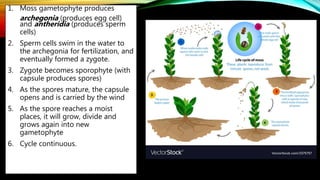
1. Moss gametophyte produces
archegonia (produces egg cell)
and antheridia (produces sperm
cells)
2. Sperm cells swim in the water to
the archegonia for fertilization, and
eventually formed a zygote.
3. Zygote becomes sporophyte (with
capsule produces spores)
4. As the spores mature, the capsule
opens and is carried by the wind
5. As the spore reaches a moist
places, it will grow, divide and
grows again into new
gametophyte
6. Cycle continuous.
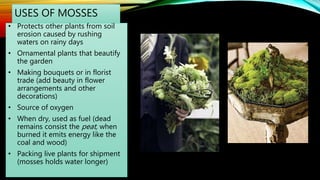
USES OF MOSSES
• Protects other plants from soil
erosion caused by rushing
waters on rainy days
• Ornamental plants that beautify
the garden
• Making bouquets or in florist
trade (add beauty in flower
arrangements and other
decorations)
• Source of oxygen
• When dry, used as fuel (dead
remains consist the peat, when
burned it emits energy like the
coal and wood)
• Packing live plants for shipment
(mosses holds water longer)

Spore bearing plants

  • 1.
  • 2.
    - Plants thatreproduce by bearing spores. - They are called as sporophytes. - Ex: - Mosses - Ferns
  • 4.
    FERNS • vascular seedlessplants. Approximately 15,000 species grow in mountains, deserts or open fields, and even near bodies of water. • Vascular plants – plants that have tubes running through them, and tubes are found in the leaves, stems, and roots. Tubes carry sugar, water and minerals through the plants. • Rhizomes – stems of sporophyte ferns grow horizontally under the surface of the ground. Rhizoids (stem) – rootlike structures that absorb water and mineral salts from the soil. • Fiddleheads – young unrolling leaves, develop from the stem. • Nature leaves or fonds – contain sporangia, which are found on the underside.
  • 5.
    • Sporangia –parts that produce spores (minute one-celled reproductive bodies produced by lower forms of plants. • Sorus (single brown spots)/sori (clusters of sporangia) – found on the under surface of a fern frond or leaf.
  • 7.
  • 8.
  • 9.
    LIFE CYCLES OFFERN - Ferns exhibit a life cycle known as alteration of generations. - Alteration of generations means there is a stage: sporophyte (spore formation), and gametophyte (produces gametes; egg and sperm cells).
  • 10.
    1. Sporophyte - Fernspores split and is carried by the wind - The spores fall into the soil, and start to germinate and form prothallus (organs that produce gametes). - As prothallus matures gametophyte stage begins. 2. Gametophyte - Archegonium (female organ produces egg cell) and antheridium (male organ produces sperm cell) grow on the prothallus - Flagellate or swimming sperm fertilizes the egg - Develops into zygote (fertilized egg) - Zygote grows into young sporophyte - Then eventually become a mature sporophyte with spores
  • 11.
    USES OF FERN •Ferns provides oxygen to humans and animals • Decorations in making bouquets and wreaths • Medical purposes, paste formed their rhizomes heals wounds and boils; fronds used as antifungal agents and can be used to treat asthma.
  • 13.
    MOSSES • nonvascular, small,soft plants • Water soaks in them and moves from one cell to another to pass food through the plants. • They grow in moist, shady places or near springs and waterfalls, where rocks are wet, often cling to trees but never depend on them, and grows naturally in gardens and landscapes. • NO true roots, stems, and leaves, DO NOT produce seeds. They have group of cells that grow into the ground and absorb water and nutrients. • Green part carry out PHOTOSYNTHESIS.
  • 14.
    LIFE CYCLES OFMOSSES - includes both sexual (involves the union of male and female sex cells) and asexual reproduction (involves only one parent in the production of spores).
  • 15.
    1. Moss gametophyteproduces archegonia (produces egg cell) and antheridia (produces sperm cells) 2. Sperm cells swim in the water to the archegonia for fertilization, and eventually formed a zygote. 3. Zygote becomes sporophyte (with capsule produces spores) 4. As the spores mature, the capsule opens and is carried by the wind 5. As the spore reaches a moist places, it will grow, divide and grows again into new gametophyte 6. Cycle continuous.
  • 17.
    USES OF MOSSES •Protects other plants from soil erosion caused by rushing waters on rainy days • Ornamental plants that beautify the garden • Making bouquets or in florist trade (add beauty in flower arrangements and other decorations) • Source of oxygen • When dry, used as fuel (dead remains consist the peat, when burned it emits energy like the coal and wood) • Packing live plants for shipment (mosses holds water longer)