Kinematic Equations
 Forces cause objects to accelerate.
 When a constant force is applied to an object, it will
have a constant acceleration.
 Such type of acceleration is commonly known as
uniformly accelerated motion or UAM
 It is mathematically described by a set of equations
known as kinematic equations.
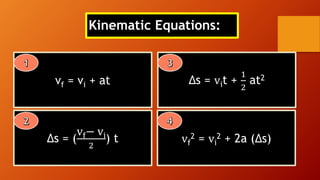
Kinematic Equations:
vf = vi + at
∆s = (
vf− vi
2
) t vf
2 = vi
2 + 2a (∆s)
∆s = vit +
1
2
at2
Where:
and – initial and final velocity
- constant acceleration of the object
- displacement of the object
- time interval when motion takes place
NOTE: vi and vf are instantaneous velocity of the object not the
average velocity of the object.
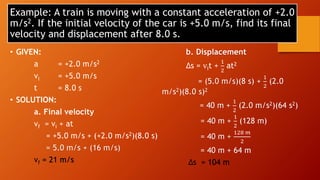
Example: A train is moving with a constant acceleration of +2.0
m/s2. If the initial velocity of the car is +5.0 m/s, find its final
velocity and displacement after 8.0 s.
• GIVEN:
a = +2.0 m/s2
vi = +5.0 m/s
t = 8.0 s
• SOLUTION:
a. Final velocity
vf = vi + at
= +5.0 m/s + (+2.0 m/s2)(8.0 s)
= 5.0 m/s + (16 m/s)
vf = 21 m/s
b. Displacement
∆s = vit +
1
2
at2
= (5.0 m/s)(8 s) +
1
2
(2.0
m/s2)(8.0 s)2
= 40 m +
1
2
(2.0 m/s2)(64 s2)
= 40 m +
1
2
(128 m)
= 40 m +
128 𝑚
2
= 40 m + 64 m
∆s = 104 m
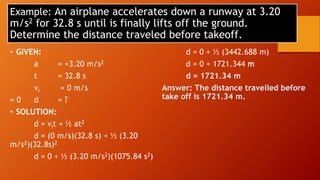
Example: An airplane accelerates down a runway at 3.20
m/s2 for 32.8 s until is finally lifts off the ground.
Determine the distance traveled before takeoff.
• GIVEN:
a = +3.20 m/s2
t = 32.8 s
vi = 0 m/s
= 0 d = ?
• SOLUTION:
d = vit + ½ at2
d = (0 m/s)(32.8 s) + ½ (3.20
m/s2)(32.8s)2
d = 0 + ½ (3.20 m/s2)(1075.84 s2)
d = 0 + ½ (3442.688 m)
d = 0 + 1721.344 m
d = 1721.34 m
Answer: The distance travelled before
take off is 1721.34 m.

Kinematic equations

  • 1.
  • 2.
     Forces causeobjects to accelerate.  When a constant force is applied to an object, it will have a constant acceleration.  Such type of acceleration is commonly known as uniformly accelerated motion or UAM  It is mathematically described by a set of equations known as kinematic equations.
  • 3.
    Kinematic Equations: vf =vi + at ∆s = ( vf− vi 2 ) t vf 2 = vi 2 + 2a (∆s) ∆s = vit + 1 2 at2
  • 4.
    Where: and – initialand final velocity - constant acceleration of the object - displacement of the object - time interval when motion takes place NOTE: vi and vf are instantaneous velocity of the object not the average velocity of the object.
  • 5.
    Example: A trainis moving with a constant acceleration of +2.0 m/s2. If the initial velocity of the car is +5.0 m/s, find its final velocity and displacement after 8.0 s. • GIVEN: a = +2.0 m/s2 vi = +5.0 m/s t = 8.0 s • SOLUTION: a. Final velocity vf = vi + at = +5.0 m/s + (+2.0 m/s2)(8.0 s) = 5.0 m/s + (16 m/s) vf = 21 m/s b. Displacement ∆s = vit + 1 2 at2 = (5.0 m/s)(8 s) + 1 2 (2.0 m/s2)(8.0 s)2 = 40 m + 1 2 (2.0 m/s2)(64 s2) = 40 m + 1 2 (128 m) = 40 m + 128 𝑚 2 = 40 m + 64 m ∆s = 104 m
  • 6.
    Example: An airplaneaccelerates down a runway at 3.20 m/s2 for 32.8 s until is finally lifts off the ground. Determine the distance traveled before takeoff. • GIVEN: a = +3.20 m/s2 t = 32.8 s vi = 0 m/s = 0 d = ? • SOLUTION: d = vit + ½ at2 d = (0 m/s)(32.8 s) + ½ (3.20 m/s2)(32.8s)2 d = 0 + ½ (3.20 m/s2)(1075.84 s2) d = 0 + ½ (3442.688 m) d = 0 + 1721.344 m d = 1721.34 m Answer: The distance travelled before take off is 1721.34 m.