ENERGY
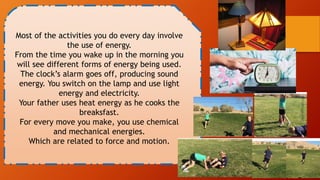
Most of the activities you do every day involve
the use of energy.
From the time you wake up in the morning you
will see different forms of energy being used.
The clock’s alarm goes off, producing sound
energy. You switch on the lamp and use light
energy and electricity.
Your father uses heat energy as he cooks the
breaksfast.
For every move you make, you use chemical
and mechanical energies.
Which are related to force and motion.
Force and Motion
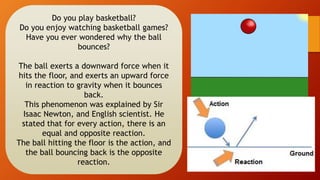
Do you play basketball?
Do you enjoy watching basketball games?
Have you ever wondered why the ball
bounces?
The ball exerts a downward force when it
hits the floor, and exerts an upward force
in reaction to gravity when it bounces
back.
This phenomenon was explained by Sir
Isaac Newton, and English scientist. He
stated that for every action, there is an
equal and opposite reaction.
The ball hitting the floor is the action, and
the ball bouncing back is the opposite
reaction.
Factors that make the objects move:
Position and Reference Point
• Position - a place where someone or something is located or has
been put.
• Reference Point - a place or object used for comparison to
determine if something is in motion. An object is in motion if it
changes position relative to a reference point.
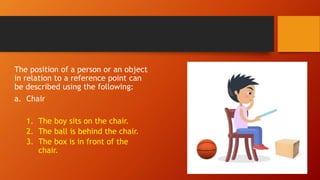
The position of a person or an object
in relation to a reference point can
be described using the following:
a. Chair
1. The boy sits on the chair.
2. The ball is behind the chair.
3. The box is in front of the
chair.
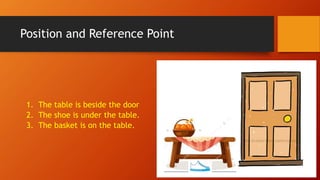
Position and Reference Point
1. The table is beside the door
2. The shoe is under the table.
3. The basket is on the table.
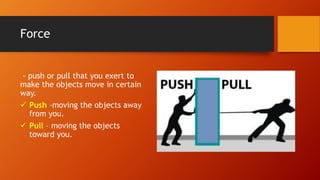
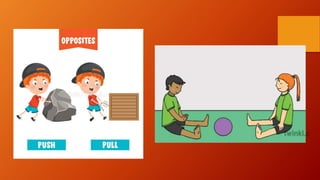
Force
- push or pull that you exert to
make the objects move in certain
way.
 Push –moving the objects away
from you.
 Pull – moving the objects
toward you.
Kinds of Forces
1. Gravity
- a force that pulls objects
toward the ground.
- This force is the reason why the
leaves of trees fall off and why
you fall back to the floor after
jumping.
2. Wind
- force that makes kites fly and
the leaves and branches if trees
sway.
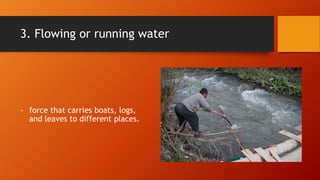
3. Flowing or running water
- force that carries boats, logs,
and leaves to different places.
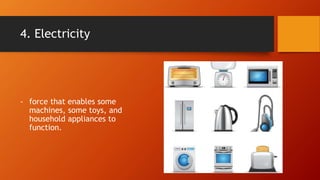
4. Electricity
- force that enables some
machines, some toys, and
household appliances to
function.
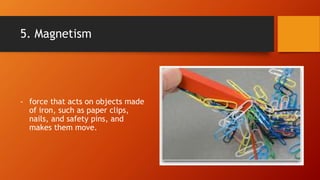
5. Magnetism
- force that acts on objects made
of iron, such as paper clips,
nails, and safety pins, and
makes them move.
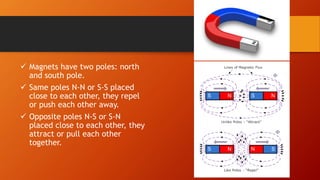
 Magnets have two poles: north
and south pole.
 Same poles N-N or S-S placed
close to each other, they repel
or push each other away.
 Opposite poles N-S or S-N
placed close to each other, they
attract or pull each other
together.
Effects of Force
Motion
- Change of position because of force that pushed or pulle the
object.
- It is one of the common effects of force.
1. Force and movement
• When force is applied to an object (either be at rest or in motion),
it will cause for them to move, or to stop/continue moving.
• It demonstrate Inertia. It states that an object at rest will remain
at rest unless a force is applied to make it move. Likewise, a
moving object will continue moving unless force is applied to
make it stop.
• Ex
• Book in the table
• Rolling ball
2. Fast and Slow Motion
• Force can also speed up and slow down the movement of an
object.
• Increase amount of force makes the object moves faster. Decrease
amount of force makes the object moves slower.
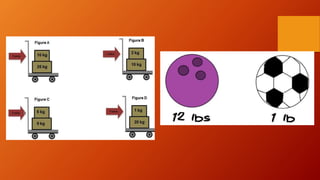
• Amount of force required to move an object depends on the
weight of the object.
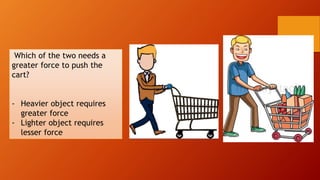
Which of the two needs a
greater force to push the
cart?
- Heavier object requires
greater force
- Lighter object requires
lesser force
3. Forward and Backward Movement
• Do you know why some objects do not
move at all, while other objects move
in a certain direction in relation to
other objects, after forces are applied
to them?
• In the illustration, it shows that the
man exerts in pushing is balanced by
the force of the wall. Thus, no
movement takes place. This activity
shows how forces act against each
other.
3. Forward and Backward Movement
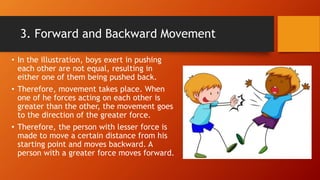
• In the illustration, boys exert in pushing
each other are not equal, resulting in
either one of them being pushed back.
• Therefore, movement takes place. When
one of he forces acting on each other is
greater than the other, the movement goes
to the direction of the greater force.
• Therefore, the person with lesser force is
made to move a certain distance from his
starting point and moves backward. A
person with a greater force moves forward.
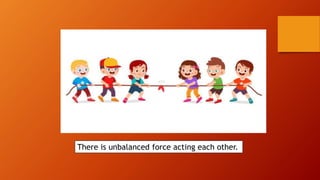
There is unbalanced force acting each other.
4. Stretching and Compressing Movement
• There are objects with elastic properties.
• Applying a pull force to an object, it will
stretch or expand up to a particular point
or distance.
• Upon releasing, it will compress or go back
to their starting point.
• Ex: rubber band, garter, and other objects
made of rubber
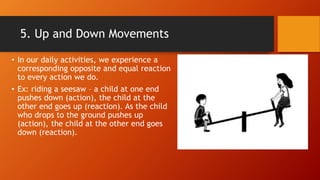
5. Up and Down Movements
• In our daily activities, we experience a
corresponding opposite and equal reaction
to every action we do.
• Ex: riding a seesaw – a child at one end
pushes down (action), the child at the
other end goes up (reaction). As the child
who drops to the ground pushes up
(action), the child at the other end goes
down (reaction).

Energy

  • 1.
  • 2.
    Most of theactivities you do every day involve the use of energy. From the time you wake up in the morning you will see different forms of energy being used. The clock’s alarm goes off, producing sound energy. You switch on the lamp and use light energy and electricity. Your father uses heat energy as he cooks the breaksfast. For every move you make, you use chemical and mechanical energies. Which are related to force and motion.
  • 3.
  • 4.
    Do you playbasketball? Do you enjoy watching basketball games? Have you ever wondered why the ball bounces? The ball exerts a downward force when it hits the floor, and exerts an upward force in reaction to gravity when it bounces back. This phenomenon was explained by Sir Isaac Newton, and English scientist. He stated that for every action, there is an equal and opposite reaction. The ball hitting the floor is the action, and the ball bouncing back is the opposite reaction.
  • 5.
    Factors that makethe objects move:
  • 6.
    Position and ReferencePoint • Position - a place where someone or something is located or has been put. • Reference Point - a place or object used for comparison to determine if something is in motion. An object is in motion if it changes position relative to a reference point.
  • 7.
    The position ofa person or an object in relation to a reference point can be described using the following: a. Chair 1. The boy sits on the chair. 2. The ball is behind the chair. 3. The box is in front of the chair.
  • 8.
    Position and ReferencePoint 1. The table is beside the door 2. The shoe is under the table. 3. The basket is on the table.
  • 9.
    Force - push orpull that you exert to make the objects move in certain way.  Push –moving the objects away from you.  Pull – moving the objects toward you.
  • 10.
  • 11.
    1. Gravity - aforce that pulls objects toward the ground. - This force is the reason why the leaves of trees fall off and why you fall back to the floor after jumping.
  • 12.
    2. Wind - forcethat makes kites fly and the leaves and branches if trees sway.
  • 13.
    3. Flowing orrunning water - force that carries boats, logs, and leaves to different places.
  • 14.
    4. Electricity - forcethat enables some machines, some toys, and household appliances to function.
  • 15.
    5. Magnetism - forcethat acts on objects made of iron, such as paper clips, nails, and safety pins, and makes them move.
  • 16.
     Magnets havetwo poles: north and south pole.  Same poles N-N or S-S placed close to each other, they repel or push each other away.  Opposite poles N-S or S-N placed close to each other, they attract or pull each other together.
  • 17.
  • 18.
    Motion - Change ofposition because of force that pushed or pulle the object. - It is one of the common effects of force.
  • 19.
    1. Force andmovement • When force is applied to an object (either be at rest or in motion), it will cause for them to move, or to stop/continue moving. • It demonstrate Inertia. It states that an object at rest will remain at rest unless a force is applied to make it move. Likewise, a moving object will continue moving unless force is applied to make it stop. • Ex • Book in the table • Rolling ball
  • 21.
    2. Fast andSlow Motion • Force can also speed up and slow down the movement of an object. • Increase amount of force makes the object moves faster. Decrease amount of force makes the object moves slower. • Amount of force required to move an object depends on the weight of the object.
  • 22.
    Which of thetwo needs a greater force to push the cart? - Heavier object requires greater force - Lighter object requires lesser force
  • 24.
    3. Forward andBackward Movement • Do you know why some objects do not move at all, while other objects move in a certain direction in relation to other objects, after forces are applied to them? • In the illustration, it shows that the man exerts in pushing is balanced by the force of the wall. Thus, no movement takes place. This activity shows how forces act against each other.
  • 25.
    3. Forward andBackward Movement • In the illustration, boys exert in pushing each other are not equal, resulting in either one of them being pushed back. • Therefore, movement takes place. When one of he forces acting on each other is greater than the other, the movement goes to the direction of the greater force. • Therefore, the person with lesser force is made to move a certain distance from his starting point and moves backward. A person with a greater force moves forward.
  • 26.
    There is unbalancedforce acting each other.
  • 27.
    4. Stretching andCompressing Movement • There are objects with elastic properties. • Applying a pull force to an object, it will stretch or expand up to a particular point or distance. • Upon releasing, it will compress or go back to their starting point. • Ex: rubber band, garter, and other objects made of rubber
  • 28.
    5. Up andDown Movements • In our daily activities, we experience a corresponding opposite and equal reaction to every action we do. • Ex: riding a seesaw – a child at one end pushes down (action), the child at the other end goes up (reaction). As the child who drops to the ground pushes up (action), the child at the other end goes down (reaction).