Objectives:
identify the specialized structures of terrestrial and aquatic plants
S4LT-IIe-f-9
ULC:
• Identify terrestrial plants and their specialized structures
• Identify aquatic plants and their specialized structures
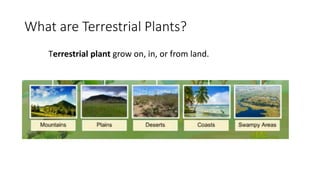
What are Terrestrial Plants?
Terrestrial plant grow on, in, or from land.
Adaptation
Habitat:
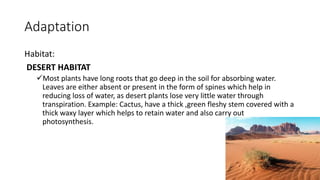
DESERT HABITAT
Most plants have long roots that go deep in the soil for absorbing water.
Leaves are either absent or present in the form of spines which help in
reducing loss of water, as desert plants lose very little water through
transpiration. Example: Cactus, have a thick ,green fleshy stem covered with a
thick waxy layer which helps to retain water and also carry out
photosynthesis.
Adaptation
Habitat:
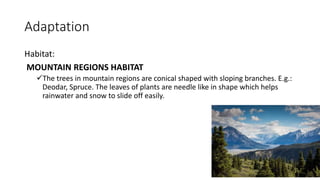
MOUNTAIN REGIONS HABITAT
The trees in mountain regions are conical shaped with sloping branches. E.g.:
Deodar, Spruce. The leaves of plants are needle like in shape which helps
rainwater and snow to slide off easily.
Adaptation
Habitat:
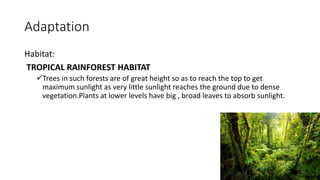
TROPICAL RAINFOREST HABITAT
Trees in such forests are of great height so as to reach the top to get
maximum sunlight as very little sunlight reaches the ground due to dense
vegetation.Plants at lower levels have big , broad leaves to absorb sunlight.
Adaptation
Habitat:
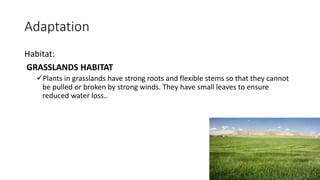
GRASSLANDS HABITAT
Plants in grasslands have strong roots and flexible stems so that they cannot
be pulled or broken by strong winds. They have small leaves to ensure
reduced water loss..
What are Aquatic Plants?
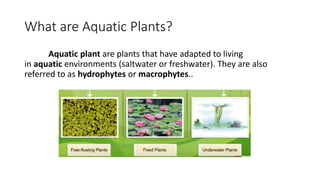
Aquatic plant are plants that have adapted to living
in aquatic environments (saltwater or freshwater). They are also
referred to as hydrophytes or macrophytes..
Adaptation
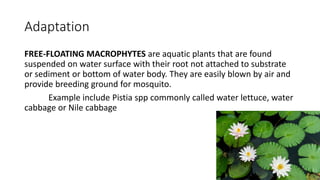
FREE-FLOATING MACROPHYTES are aquatic plants that are found
suspended on water surface with their root not attached to substrate
or sediment or bottom of water body. They are easily blown by air and
provide breeding ground for mosquito.
Example include Pistia spp commonly called water lettuce, water
cabbage or Nile cabbage
Adaptation
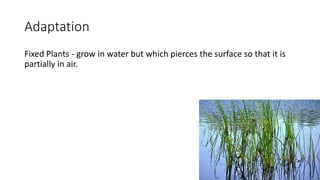
Fixed Plants - grow in water but which pierces the surface so that it is
partially in air.
Adaptation
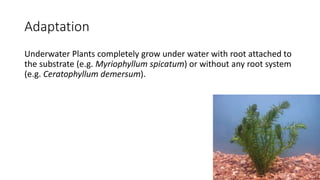
Underwater Plants completely grow under water with root attached to
the substrate (e.g. Myriophyllum spicatum) or without any root system
(e.g. Ceratophyllum demersum).

Terrestrial and aquatic plants

  • 2.
    Objectives: identify the specializedstructures of terrestrial and aquatic plants S4LT-IIe-f-9 ULC: • Identify terrestrial plants and their specialized structures • Identify aquatic plants and their specialized structures
  • 3.
    What are TerrestrialPlants? Terrestrial plant grow on, in, or from land.
  • 4.
    Adaptation Habitat: DESERT HABITAT Most plantshave long roots that go deep in the soil for absorbing water. Leaves are either absent or present in the form of spines which help in reducing loss of water, as desert plants lose very little water through transpiration. Example: Cactus, have a thick ,green fleshy stem covered with a thick waxy layer which helps to retain water and also carry out photosynthesis.
  • 5.
    Adaptation Habitat: MOUNTAIN REGIONS HABITAT Thetrees in mountain regions are conical shaped with sloping branches. E.g.: Deodar, Spruce. The leaves of plants are needle like in shape which helps rainwater and snow to slide off easily.
  • 6.
    Adaptation Habitat: TROPICAL RAINFOREST HABITAT Treesin such forests are of great height so as to reach the top to get maximum sunlight as very little sunlight reaches the ground due to dense vegetation.Plants at lower levels have big , broad leaves to absorb sunlight.
  • 7.
    Adaptation Habitat: GRASSLANDS HABITAT Plants ingrasslands have strong roots and flexible stems so that they cannot be pulled or broken by strong winds. They have small leaves to ensure reduced water loss..
  • 8.
    What are AquaticPlants? Aquatic plant are plants that have adapted to living in aquatic environments (saltwater or freshwater). They are also referred to as hydrophytes or macrophytes..
  • 9.
    Adaptation FREE-FLOATING MACROPHYTES areaquatic plants that are found suspended on water surface with their root not attached to substrate or sediment or bottom of water body. They are easily blown by air and provide breeding ground for mosquito. Example include Pistia spp commonly called water lettuce, water cabbage or Nile cabbage
  • 10.
    Adaptation Fixed Plants -grow in water but which pierces the surface so that it is partially in air.
  • 11.
    Adaptation Underwater Plants completelygrow under water with root attached to the substrate (e.g. Myriophyllum spicatum) or without any root system (e.g. Ceratophyllum demersum).