THIRD QUARTER
SCIENCE 10 - THIRD QUARTER, WEEK 1
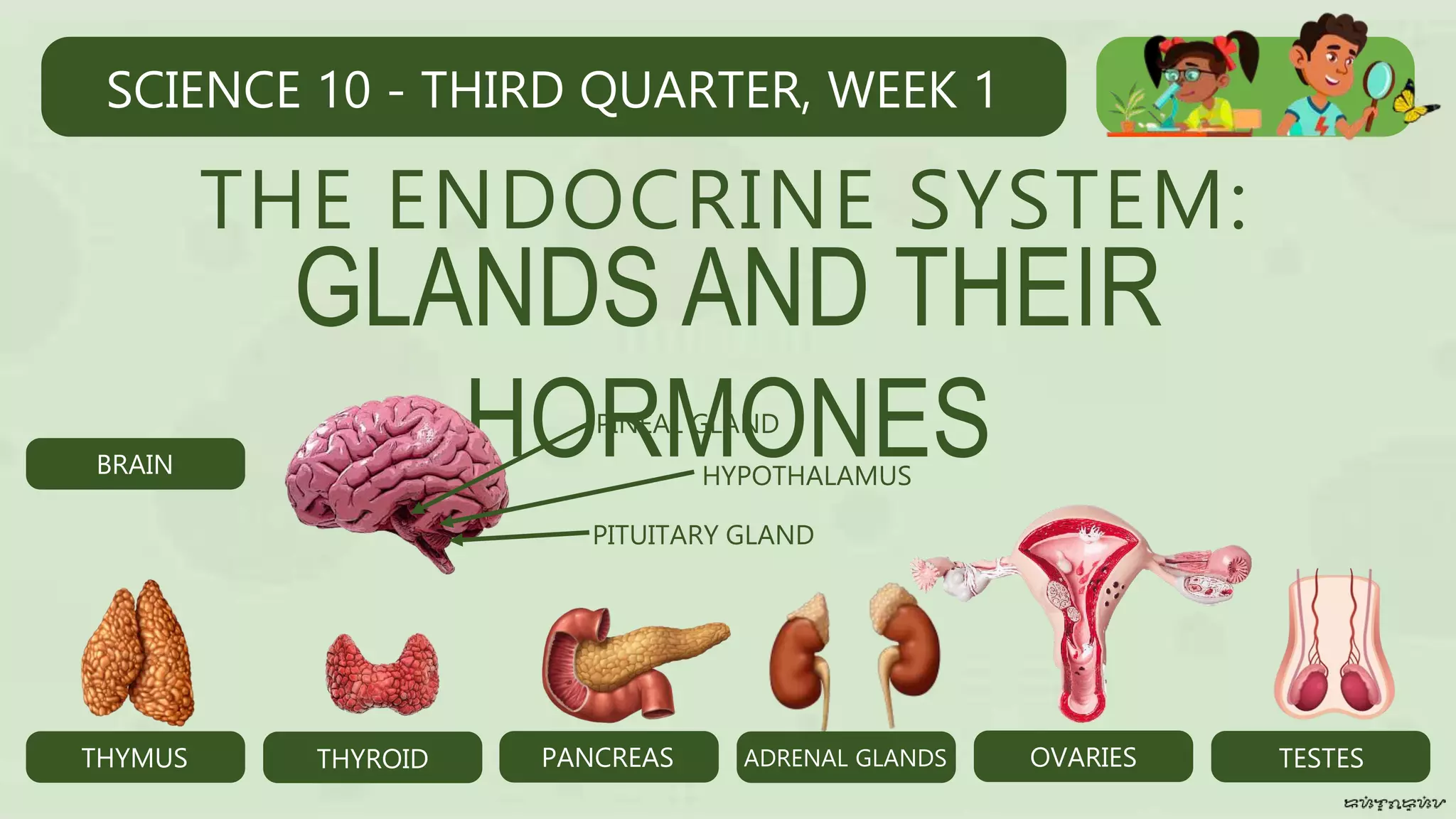
THE ENDOCRINE SYSTEM:
GLANDS AND THEIR
HORMONES
BRAIN
THYMUS THYROID PANCREAS ADRENAL GLANDS OVARIES TESTES
PINEAL GLAND
PITUITARY GLAND
HYPOTHALAMUS
SCIENCE 10 - THIRD QUARTER, WEEK 1
At the end of this lesson, you are expected to:
1. Identify the major endocrine glands in the human body
2. Explain the role of hormones involved in the female and
male reproductive systems (S10LT-IIIb-34)
3. Explain the different disorders in the endocrine system
MOST ESSENTIAL LEARNING COMPETENCY
Explain the role of
hormones involved in the
female and male
reproductive systems
(S10LT-IIIb-34)
ENDOCRINE SYSTEM
The endocrine system is
composed of glands that
secrete different types of
hormones that affect
almost every cell, organ,
and function of our body.
ENDOCRINE SYSTEM
The endocrine system is
composed of different
glands which secrete
hormones that regulate
metabolism, growth and
development, mood, and
reproduction.
HORMONES
The glands that make up
the endocrine system
produce chemical
messengers called
hormones that travel
through the blood to
other parts of the body.
HORMONES
• organic substances released by the
glands of the endocrine system directly
into the bloodstream
• can change the physiological and
metabolic behaviors of its target cells
to maintain homeostasis
BRAIN
The brain relies on chemical
messengers sent by the endocrine
system to transmit instructions
around the body via the nervous
system to key organs for growth and
metabolism.
BRAIN
• secretes the hormone
melatonin
• help control the circadian cycle
of sleep and wakefulness by
secreting melatonin
PINEAL GLAND
HYPOTHALAMUS
PITUITARY GLAND
PINEAL GLAND
BRAIN
PINEAL GLAND
HYPOTHALAMUS
PITUITARY GLAND
PINEAL GLAND
Hormone Function
Melatonin
It helps with the
timing of your
circadian rhythms (24-
hour internal clock)
and with sleep.
BRAIN
• secretes hormones that stimulate or
suppress the release of hormones in
the pituitary gland
• control water balance, sleep,
temperature, appetite, blood
pressure, and mood
• Its main function is to keep your
body in a stable state called
homeostasis.
PINEAL GLAND
HYPOTHALAMUS
PITUITARY GLAND
HYPOTHALAMUS
BRAIN
PINEAL GLAND
HYPOTHALAMUS
PITUITARY GLAND
HYPOTHALAMUS
Hormone Function
Antidiuretic
hormone (ADH)
It helps to regulate the
amount of water in the
body. This helps with
blood pressure
control.
In conjunction with the pituitary gland, the hypothalamus
secretes the following hormones:
BRAIN
PINEAL GLAND
HYPOTHALAMUS
PITUITARY GLAND
HYPOTHALAMUS
Hormone Function
Corticotropin-
releasing
hormone (CRH)
A hormone that helps
regulate metabolism
and immune response,
particularly in
response to stress.
In conjunction with the pituitary gland, the hypothalamus
secretes the following hormones:
BRAIN
PINEAL GLAND
HYPOTHALAMUS
PITUITARY GLAND
HYPOTHALAMUS
Hormone Function
Gonadotropin-
releasing
hormone
This causes the
pituitary gland to
release hormones that
keep the sexual organs
of both men and
women working
properly.
In conjunction with the pituitary gland, the hypothalamus
secretes the following hormones:
BRAIN
• also known as the hypophysis
• a part of our endocrine system and
is in charge of making several
essential hormones such as
corticotrophin and growth hormone
PINEAL GLAND
HYPOTHALAMUS
PITUITARY GLAND
PITUITARY GLAND
BRAIN
PINEAL GLAND
HYPOTHALAMUS
PITUITARY GLAND
PITUITARY GLAND
Hormone Function
Oxytocin
It facilitates childbirth
and the release of a
mother’s breast milk.
BRAIN
PINEAL GLAND
HYPOTHALAMUS
PITUITARY GLAND
PITUITARY GLAND
Hormone Function
Growth
Hormone (GH)
It has many functions
including maintaining
normal body structure
and metabolism.
BRAIN
PINEAL GLAND
HYPOTHALAMUS
PITUITARY GLAND
PITUITARY GLAND
Hormone Function
Prolactin (PRL)
It causes the breasts to
grow and make milk
during pregnancy and
after birth.
BRAIN
PINEAL GLAND
HYPOTHALAMUS
PITUITARY GLAND
PITUITARY GLAND
Hormone Function
Luteinizing
Hormone (LH)
It supports sperm
production for males
and plays a vital role in
the menstrual cycle for
females.
BRAIN
PINEAL GLAND
HYPOTHALAMUS
PITUITARY GLAND
PITUITARY GLAND
Hormone Function
Follicle
Stimulating
Hormone (FSH)
Responsible for sperm
production for males
and control the
menstrual cycle for
females.
BRAIN
PINEAL GLAND
HYPOTHALAMUS
PITUITARY GLAND
PITUITARY GLAND
Hormone Function
Adrenocorticotropic
hormone (ACTH)
Its key function is to
stimulate the
production and
release of cortisol from
the cortex of the
adrenal gland.
BRAIN
PINEAL GLAND
HYPOTHALAMUS
PITUITARY GLAND
PITUITARY GLAND
Hormone Function
Thyroid Stimulating
Hormone (TSH)
It is the primary
stimulus for thyroid
hormone production
by the thyroid gland.
THYROID
The thyroid gland is an endocrine gland
in your neck. It makes two hormones that
are secreted into the blood: thyroxine (T4)
and triiodothyronine (T3). These
hormones are necessary for all the cells in
your body to work normally.
THYROID
Hormone Function
Thyroid Hormone
The hormone that
controls your body's
metabolism
PARATHYROID
The parathyroid glands are two pairs of
small, oval-shaped glands. They are
located next to the two thyroid gland
lobes in the neck. Each gland is usually
about the size of a pea.
PARATHYROID
Hormone Function
Parathormone
It plays a key role in
the regulation of
calcium levels in the
blood.
THYMUS
Located behind your sternum and
between your lungs, is only active until
puberty. After puberty, the thymus starts
to slowly shrink and become replaced by
fat. Thymosin is the hormone of the
thymus, and it stimulates the
development of disease-fighting T cells.
THYMUS
Hormone Function
Thymosin
It stimulates the
development of
disease-fighting T
cells.
ADRENAL GLANDS
They produce many important
hormones, including cortisol,
aldosterone, and adrenaline. The
adrenal hormones help regulate several
bodily functions including metabolism,
blood pressure, and your body's
response to stress.
ADRENAL GLANDS
Hormone Function
Adrenaline
It helps you prepare
for stressful or
dangerous situations.
PANCREAS
Produces enzymes that help
to digest food, particularly
protein. It makes the
hormone insulin, which helps
to control blood sugar levels.
PANCREAS
Hormone Function
Insulin
Its main role is to
control glucose levels
in our bodies.
(Decreases)
PANCREAS
Hormone Function
Glucagon
Produced to maintain
glucose levels in the
bloodstream when fasting
and to raise very low
glucose levels.
(Increases)
TESTES
The testes are known as gonads.
They secrete testosterone, a
hormone that is vital to the normal
development of male physical
characteristics.
TESTES
TESTES
TESTES
Hormone Function
Testosterone
Controls maturation of
sperm and development
of secondary male sexual
characteristics.
OVARIES
OVARIES
Maintain the health of the female
reproductive system and produce ova, the
ovaries also have the distinction of being an
endocrine gland because they secrete
hormones—primarily estrogen and
progesterone—that are vital to normal
reproductive development and fertility.
OVARIES
OVARIES
Hormone Function
Estrogen
It contributes to
reproductive and breast
health.
OVARIES
OVARIES
Hormone Function
Progesterone
It plays important role in
the menstrual cycle and
in maintaining the early
stages of pregnancy.
THE ROLE OF HORMONES IN FEMALE AND MALE REPRODUCTIVE SYSTEMS
Reproduction is a normal process
controlled by hormones. These hormones
keep both the male and female
reproductive systems functioning
properly. The pituitary gland controls the
functions of both the testes and ovaries.
ROLE OF HORMONES IN MALE REPRODUCTIVE SYSTEMS
Hypothalamus triggers the production of GnRH.
1 (Gonadotropin-releasing Hormone)
GnRH commands Pituitary Gland to release LH and FSH.
2 (Luteinizing Hormone and Follicle Stimulating Hormone)
FSH enters the testes to stimulate Sertoli Cells to produce Androgen
Binding Protein (ABP).
ABP enhances the spermatogenic cells to readily bind with Testosterone to stimulate Spermatogenesis.
LH enters the testes to stimulate Leydig Cells to release Testosterone.
3
ROLE OF HORMONES IN FEMALE REPRODUCTIVE SYSTEMS
Hypothalamus triggers the production of GnRH.
1 (Gonadotropin-releasing Hormone)
GnRH commands Pituitary Gland to release LH and FSH.
2 (Luteinizing Hormone and Follicle Stimulating Hormone)
FSH stimulates the follicles to produce cells around it that will in turn
produce estrogen.
Estrogen controls the growth (Oogenesis) and release of eggs from the ovaries.
LH stimulates ovulation and after the egg was released the remaining
cells will turn yellow and will produce Progesterone.
3
Progesterone prepares the uterus so that fertilized egg can grow in it.
ROLE OF HORMONES IN FEMALE REPRODUCTIVE SYSTEMS
Hypothalamus triggers the production of GnRH.
1 (Gonadotropin-releasing Hormone)
GnRH commands Pituitary Gland to release LH and FSH.
2 (Luteinizing Hormone and Follicle Stimulating Hormone)
FSH stimulates the follicles to produce
cells around it that will in turn produce
estrogen.
LH stimulates ovulation and after the egg was
released the remaining cells will turn yellow
and will produce Progesterone.
3
ENDOCRINE SYSTEM DISORDER
Hormonal imbalance will occur if the organs and hormones of
your body do not produce the right amount of chemicals
needed which in turn may lead to some dysfunctions.
1. Osteoporosis 3. Gigantism
2. Goiter 4. Dwarfism
ENDOCRINE SYSTEM DISORDER
Osteoporosis
a disease that happens when the mineral
density of the bone is reduced making it
brittle and porous
ENDOCRINE SYSTEM DISORDER
Goiter
an abnormal enlargement of the thyroid
gland, results from the underproduction or
overproduction of thyroid hormones
ENDOCRINE SYSTEM DISORDER
Gigantism
a disorder that happens during
childhood when there is an abnormal
increase in height associated with too
much secretion of growth hormones
ENDOCRINE SYSTEM DISORDER
Dwarfism
a condition wherein the production of
growth hormones in the pituitary gland is
insufficient resulting in short stature
REFERENCES
• LRDMS Portal. Science Modules. December 29, 2014. "Accessed October 13,
2019. https://lrmds.deped.gov.ph/detail/6838
• Lumen Candela. Hormonal Control of Human Reproduction. “Accessed March
15, 2021”.
https://courses.lumenlearning.com/boundlessbiology/chapter/hormonal-
control-of-human-reproduction/
• https://www.youtube.com/watch?v=F3zx9AHTjy8
• https://kidshealth.org/en/teens/endocrine.html
• 3D Model https://g.co/kgs/LMzaDt
Thank

Q3-1.-The-Endocrine-System-Glands-and-Their-Hormones.pptx

  • 1.
  • 2.
    SCIENCE 10 -THIRD QUARTER, WEEK 1 THE ENDOCRINE SYSTEM: GLANDS AND THEIR HORMONES BRAIN THYMUS THYROID PANCREAS ADRENAL GLANDS OVARIES TESTES PINEAL GLAND PITUITARY GLAND HYPOTHALAMUS
  • 3.
    SCIENCE 10 -THIRD QUARTER, WEEK 1 At the end of this lesson, you are expected to: 1. Identify the major endocrine glands in the human body 2. Explain the role of hormones involved in the female and male reproductive systems (S10LT-IIIb-34) 3. Explain the different disorders in the endocrine system
  • 4.
    MOST ESSENTIAL LEARNINGCOMPETENCY Explain the role of hormones involved in the female and male reproductive systems (S10LT-IIIb-34)
  • 5.
    ENDOCRINE SYSTEM The endocrinesystem is composed of glands that secrete different types of hormones that affect almost every cell, organ, and function of our body.
  • 6.
    ENDOCRINE SYSTEM The endocrinesystem is composed of different glands which secrete hormones that regulate metabolism, growth and development, mood, and reproduction.
  • 7.
    HORMONES The glands thatmake up the endocrine system produce chemical messengers called hormones that travel through the blood to other parts of the body.
  • 8.
    HORMONES • organic substancesreleased by the glands of the endocrine system directly into the bloodstream • can change the physiological and metabolic behaviors of its target cells to maintain homeostasis
  • 9.
    BRAIN The brain relieson chemical messengers sent by the endocrine system to transmit instructions around the body via the nervous system to key organs for growth and metabolism.
  • 10.
    BRAIN • secretes thehormone melatonin • help control the circadian cycle of sleep and wakefulness by secreting melatonin PINEAL GLAND HYPOTHALAMUS PITUITARY GLAND PINEAL GLAND
  • 11.
    BRAIN PINEAL GLAND HYPOTHALAMUS PITUITARY GLAND PINEALGLAND Hormone Function Melatonin It helps with the timing of your circadian rhythms (24- hour internal clock) and with sleep.
  • 12.
    BRAIN • secretes hormonesthat stimulate or suppress the release of hormones in the pituitary gland • control water balance, sleep, temperature, appetite, blood pressure, and mood • Its main function is to keep your body in a stable state called homeostasis. PINEAL GLAND HYPOTHALAMUS PITUITARY GLAND HYPOTHALAMUS
  • 13.
    BRAIN PINEAL GLAND HYPOTHALAMUS PITUITARY GLAND HYPOTHALAMUS HormoneFunction Antidiuretic hormone (ADH) It helps to regulate the amount of water in the body. This helps with blood pressure control. In conjunction with the pituitary gland, the hypothalamus secretes the following hormones:
  • 14.
    BRAIN PINEAL GLAND HYPOTHALAMUS PITUITARY GLAND HYPOTHALAMUS HormoneFunction Corticotropin- releasing hormone (CRH) A hormone that helps regulate metabolism and immune response, particularly in response to stress. In conjunction with the pituitary gland, the hypothalamus secretes the following hormones:
  • 15.
    BRAIN PINEAL GLAND HYPOTHALAMUS PITUITARY GLAND HYPOTHALAMUS HormoneFunction Gonadotropin- releasing hormone This causes the pituitary gland to release hormones that keep the sexual organs of both men and women working properly. In conjunction with the pituitary gland, the hypothalamus secretes the following hormones:
  • 16.
    BRAIN • also knownas the hypophysis • a part of our endocrine system and is in charge of making several essential hormones such as corticotrophin and growth hormone PINEAL GLAND HYPOTHALAMUS PITUITARY GLAND PITUITARY GLAND
  • 17.
    BRAIN PINEAL GLAND HYPOTHALAMUS PITUITARY GLAND PITUITARYGLAND Hormone Function Oxytocin It facilitates childbirth and the release of a mother’s breast milk.
  • 18.
    BRAIN PINEAL GLAND HYPOTHALAMUS PITUITARY GLAND PITUITARYGLAND Hormone Function Growth Hormone (GH) It has many functions including maintaining normal body structure and metabolism.
  • 19.
    BRAIN PINEAL GLAND HYPOTHALAMUS PITUITARY GLAND PITUITARYGLAND Hormone Function Prolactin (PRL) It causes the breasts to grow and make milk during pregnancy and after birth.
  • 20.
    BRAIN PINEAL GLAND HYPOTHALAMUS PITUITARY GLAND PITUITARYGLAND Hormone Function Luteinizing Hormone (LH) It supports sperm production for males and plays a vital role in the menstrual cycle for females.
  • 21.
    BRAIN PINEAL GLAND HYPOTHALAMUS PITUITARY GLAND PITUITARYGLAND Hormone Function Follicle Stimulating Hormone (FSH) Responsible for sperm production for males and control the menstrual cycle for females.
  • 22.
    BRAIN PINEAL GLAND HYPOTHALAMUS PITUITARY GLAND PITUITARYGLAND Hormone Function Adrenocorticotropic hormone (ACTH) Its key function is to stimulate the production and release of cortisol from the cortex of the adrenal gland.
  • 23.
    BRAIN PINEAL GLAND HYPOTHALAMUS PITUITARY GLAND PITUITARYGLAND Hormone Function Thyroid Stimulating Hormone (TSH) It is the primary stimulus for thyroid hormone production by the thyroid gland.
  • 24.
    THYROID The thyroid glandis an endocrine gland in your neck. It makes two hormones that are secreted into the blood: thyroxine (T4) and triiodothyronine (T3). These hormones are necessary for all the cells in your body to work normally.
  • 25.
    THYROID Hormone Function Thyroid Hormone Thehormone that controls your body's metabolism
  • 26.
    PARATHYROID The parathyroid glandsare two pairs of small, oval-shaped glands. They are located next to the two thyroid gland lobes in the neck. Each gland is usually about the size of a pea.
  • 27.
    PARATHYROID Hormone Function Parathormone It playsa key role in the regulation of calcium levels in the blood.
  • 28.
    THYMUS Located behind yoursternum and between your lungs, is only active until puberty. After puberty, the thymus starts to slowly shrink and become replaced by fat. Thymosin is the hormone of the thymus, and it stimulates the development of disease-fighting T cells.
  • 29.
    THYMUS Hormone Function Thymosin It stimulatesthe development of disease-fighting T cells.
  • 30.
    ADRENAL GLANDS They producemany important hormones, including cortisol, aldosterone, and adrenaline. The adrenal hormones help regulate several bodily functions including metabolism, blood pressure, and your body's response to stress.
  • 31.
    ADRENAL GLANDS Hormone Function Adrenaline Ithelps you prepare for stressful or dangerous situations.
  • 32.
    PANCREAS Produces enzymes thathelp to digest food, particularly protein. It makes the hormone insulin, which helps to control blood sugar levels.
  • 33.
    PANCREAS Hormone Function Insulin Its mainrole is to control glucose levels in our bodies. (Decreases)
  • 34.
    PANCREAS Hormone Function Glucagon Produced tomaintain glucose levels in the bloodstream when fasting and to raise very low glucose levels. (Increases)
  • 35.
    TESTES The testes areknown as gonads. They secrete testosterone, a hormone that is vital to the normal development of male physical characteristics. TESTES
  • 36.
    TESTES TESTES Hormone Function Testosterone Controls maturationof sperm and development of secondary male sexual characteristics.
  • 37.
    OVARIES OVARIES Maintain the healthof the female reproductive system and produce ova, the ovaries also have the distinction of being an endocrine gland because they secrete hormones—primarily estrogen and progesterone—that are vital to normal reproductive development and fertility.
  • 38.
  • 39.
    OVARIES OVARIES Hormone Function Progesterone It playsimportant role in the menstrual cycle and in maintaining the early stages of pregnancy.
  • 40.
    THE ROLE OFHORMONES IN FEMALE AND MALE REPRODUCTIVE SYSTEMS Reproduction is a normal process controlled by hormones. These hormones keep both the male and female reproductive systems functioning properly. The pituitary gland controls the functions of both the testes and ovaries.
  • 41.
    ROLE OF HORMONESIN MALE REPRODUCTIVE SYSTEMS Hypothalamus triggers the production of GnRH. 1 (Gonadotropin-releasing Hormone) GnRH commands Pituitary Gland to release LH and FSH. 2 (Luteinizing Hormone and Follicle Stimulating Hormone) FSH enters the testes to stimulate Sertoli Cells to produce Androgen Binding Protein (ABP). ABP enhances the spermatogenic cells to readily bind with Testosterone to stimulate Spermatogenesis. LH enters the testes to stimulate Leydig Cells to release Testosterone. 3
  • 42.
    ROLE OF HORMONESIN FEMALE REPRODUCTIVE SYSTEMS Hypothalamus triggers the production of GnRH. 1 (Gonadotropin-releasing Hormone) GnRH commands Pituitary Gland to release LH and FSH. 2 (Luteinizing Hormone and Follicle Stimulating Hormone) FSH stimulates the follicles to produce cells around it that will in turn produce estrogen. Estrogen controls the growth (Oogenesis) and release of eggs from the ovaries. LH stimulates ovulation and after the egg was released the remaining cells will turn yellow and will produce Progesterone. 3 Progesterone prepares the uterus so that fertilized egg can grow in it.
  • 43.
    ROLE OF HORMONESIN FEMALE REPRODUCTIVE SYSTEMS Hypothalamus triggers the production of GnRH. 1 (Gonadotropin-releasing Hormone) GnRH commands Pituitary Gland to release LH and FSH. 2 (Luteinizing Hormone and Follicle Stimulating Hormone) FSH stimulates the follicles to produce cells around it that will in turn produce estrogen. LH stimulates ovulation and after the egg was released the remaining cells will turn yellow and will produce Progesterone. 3
  • 44.
    ENDOCRINE SYSTEM DISORDER Hormonalimbalance will occur if the organs and hormones of your body do not produce the right amount of chemicals needed which in turn may lead to some dysfunctions. 1. Osteoporosis 3. Gigantism 2. Goiter 4. Dwarfism
  • 45.
    ENDOCRINE SYSTEM DISORDER Osteoporosis adisease that happens when the mineral density of the bone is reduced making it brittle and porous
  • 46.
    ENDOCRINE SYSTEM DISORDER Goiter anabnormal enlargement of the thyroid gland, results from the underproduction or overproduction of thyroid hormones
  • 47.
    ENDOCRINE SYSTEM DISORDER Gigantism adisorder that happens during childhood when there is an abnormal increase in height associated with too much secretion of growth hormones
  • 48.
    ENDOCRINE SYSTEM DISORDER Dwarfism acondition wherein the production of growth hormones in the pituitary gland is insufficient resulting in short stature
  • 49.
    REFERENCES • LRDMS Portal.Science Modules. December 29, 2014. "Accessed October 13, 2019. https://lrmds.deped.gov.ph/detail/6838 • Lumen Candela. Hormonal Control of Human Reproduction. “Accessed March 15, 2021”. https://courses.lumenlearning.com/boundlessbiology/chapter/hormonal- control-of-human-reproduction/ • https://www.youtube.com/watch?v=F3zx9AHTjy8 • https://kidshealth.org/en/teens/endocrine.html • 3D Model https://g.co/kgs/LMzaDt
  • 50.

Editor's Notes

  • #4 The idea of protein synthesis is often known as the central dogma of molecular biology
  • #5 …..And now, let’s have some brain teaser, raise your hand if you know the answer.
  • #8 The endocrine and nervous systems work closely together. The brain sends instructions to the endocrine system. In return, it gets constant feedback from the glands.
  • #9 Hormones are chemicals that coordinate different functions in your body by carrying messages through your blood to your organs, skin, muscles and other tissues. These signals tell your body what to do and when to do it. Hormones are essential for life and your health.
  • #11 It's a part of your endocrine system and secretes the hormone melatonin. Your pineal gland's main job is to help control the circadian cycle of sleep and wakefulness by secreting melatonin. The pineal gland is shaped like a tiny pinecone, which is how it got its name (“pine”-al gland).
  • #12 It's a part of your endocrine system and secretes the hormone melatonin. Your pineal gland's main job is to help control the circadian cycle of sleep and wakefulness by secreting melatonin. The pineal gland is shaped like a tiny pinecone, which is how it got its name (“pine”-al gland).
  • #13 Your hypothalamus, a structure deep in your brain, acts as your body’s smart control coordinating center. Its main function is to keep your body in a stable state called homeostasis. It does its job by directly influencing your autonomic nervous system or by managing hormones. Many conditions can damage your hypothalamus, which can affect many bodily functions.
  • #14 As different systems and parts of the body send signals to the brain, they can alert the hypothalamus to any unbalanced factors that need addressing. The hypothalamus responds by stimulating relevant endocrine activity to address this balance. For example, if the hypothalamus receives a signal that the internal temperature is too high, it will tell the body to sweat. If it receives the signal that the temperature is too cold, the body will create its own heat by shivering. It also plays a role in: growth thirst appetite weight control emotions sleep-wake cycles sex drive childbirth breast milk production
  • #17 A small, pea-sized gland located at the base of your brain below your hypothalamus It sits in its own little chamber under your brain known as the sella turcica. ACTH or corticotrophin plays a role in how your body responds to stress. In children, growth hormone stimulates growth. In other words, it helps children grow taller. In adults, growth hormone helps maintain healthy muscles and bones and impacts fat distribution. Produces hormones that stimulate growth, and controls the functions of other glands
  • #18 Oxytocin is a natural hormone that stimulates uterine contractions in childbirth and lactation after childbirth.
  • #25 Thyroid’s main job is to control the speed of your metabolism (metabolic rate), which is the process of how your body transforms the food you consume into energy. Produces hormones that control the calcium levels in your body and normalize bone growth. Produces hormones that regulate body metabolism, and storage of calcium in bones
  • #26 Thyroid hormone is the hormone that controls your body's metabolism, the process in which your body transforms the food you eat into energy.
  • #27 Thyroid’s main job is to control the speed of your metabolism (metabolic rate), which is the process of how your body transforms the food you consume into energy. Produces hormones that control the calcium levels in your body and normalize bone growth. Produces hormones that regulate body metabolism, and storage of calcium in bones
  • #28 Thyroid’s main job is to control the speed of your metabolism (metabolic rate), which is the process of how your body transforms the food you consume into energy. Produces hormones that control the calcium levels in your body and normalize bone growth. Produces hormones that regulate body metabolism, and storage of calcium in bones
  • #29 The thymus gland will not function throughout a full lifetime, but it has a big responsibility when it’s active—helping the body protect itself against autoimmunity, which occurs when the immune system turns against itself. 
  • #30 The thymus gland will not function throughout a full lifetime, but it has a big responsibility when it’s active—helping the body protect itself against autoimmunity, which occurs when the immune system turns against itself. Therefore, the thymus plays a vital role in the lymphatic system (your body’s defense network) and endocrine system. Before birth and throughout childhood, the thymus is instrumental in the production and maturation of T-lymphocytes or T cells, a specific type of white blood cell that protects the body from certain threats, including viruses and infections. The thymus produces and secretes thymosin, a hormone necessary for T cell development and production.
  • #31 located on top of your kidneys, their name directly relates to their location (ad—near or at; renes—kidneys) Also known as suprarenal glands Cortisol which helps regulate metabolism and helps your body respond to stress Aldosterone, which maintains the right balance of salt and water while helping control blood pressure. Adrenaline (Epinephrine) help you prepare for stressful or dangerous situations
  • #32 located on top of your kidneys, their name directly relates to their location (ad—near or at; renes—kidneys) Also known as suprarenal glands Cortisol which helps regulate metabolism and helps your body respond to stress Aldosterone, which maintains the right balance of salt and water while helping control blood pressure. Adrenaline (Epinephrine) help you prepare for stressful or dangerous situations
  • #33 The pancreas has dual roles - it is an organ of the digestive system and of the endocrine system
  • #36 Produces sperm cell. Testosterone is an important hormone during male development and maturation for developing muscles, deepening the voice, and growing body hair.
  • #37 Produces sperm cell. Testosterone is an important hormone during male development and maturation for developing muscles, deepening the voice, and growing body hair.
  • #38 Ovaries produce and release two groups of sex hormones—progesterone and estrogen. There are actually three major estrogens, known as estradiol, estrone, and estriol. These substances work together to promote the healthy development of female sex characteristics during puberty and to ensure fertility. Estrogen (estradiol, specifically) is instrumental in breast development, fat distribution in the hips, legs, and breasts, and the development of reproductive organs. To a lesser extent, the ovaries release the hormone relaxin prior to giving birth. Another minor hormone is inhibin, which is important for signaling to the pituitary to inhibit follicle-stimulating hormone secretion.
  • #39 Estrogen contributes to cognitive healthTrusted Source, bone health, the function of the cardiovascular systemTrusted Source, and other essential bodily processes.
  • #40 Estrogen contributes to cognitive healthTrusted Source, bone health, the function of the cardiovascular systemTrusted Source, and other essential bodily processes.
  • #41 A human being depends on reproduction for the continued production of species. If humans stop to reproduce, the human species will become extinct………………………..
  • #42 Inhibin Hormone - FSH
  • #46 Parathyroid hormone secretion is one of the possible causes of this disease.