Nonvascular & Simple
Vascular Plants
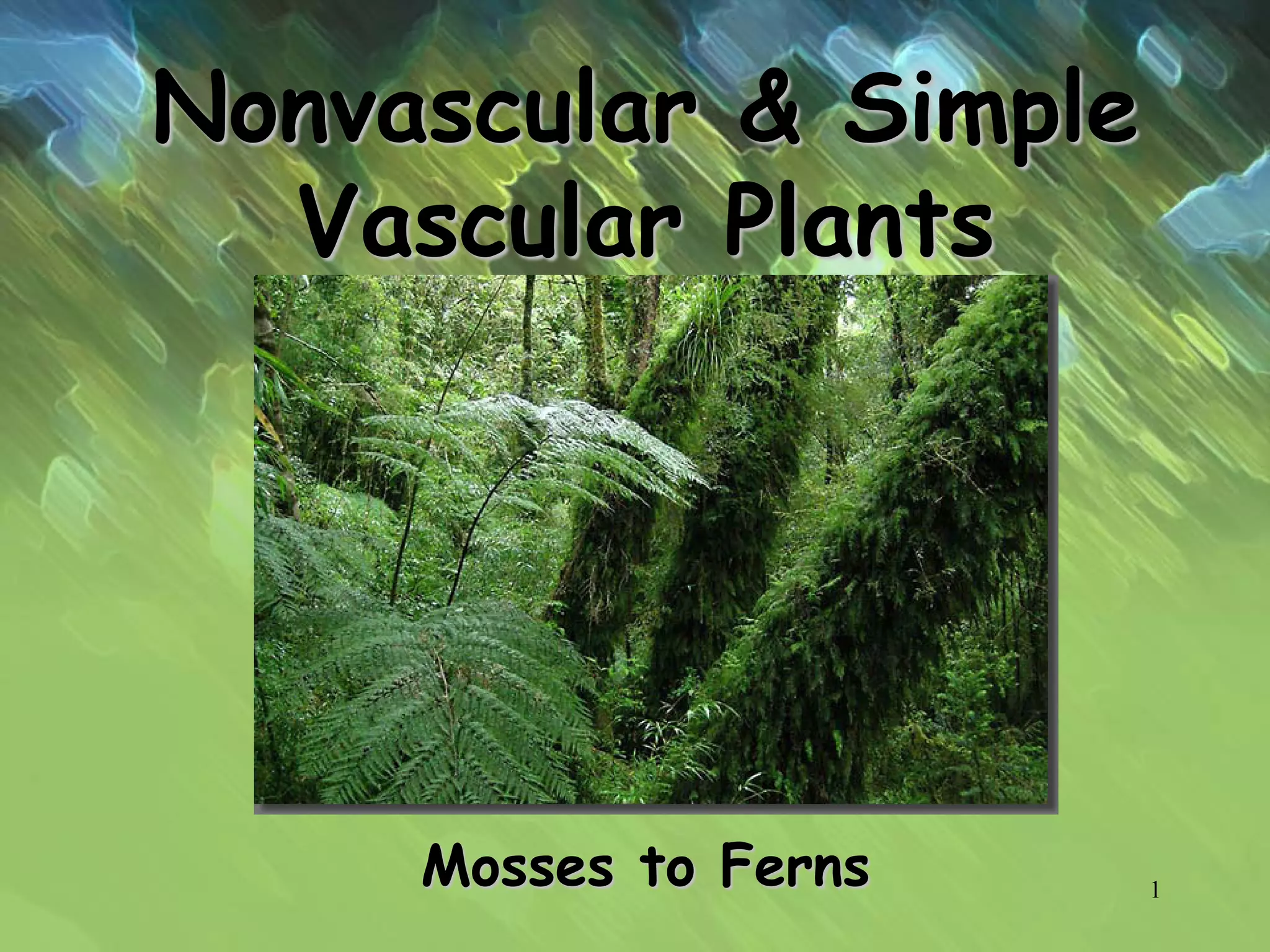
Mosses to Ferns 1
Seedless
Nonvascular
Plants
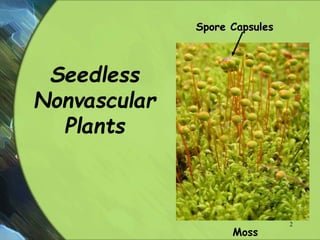
Spore Capsules
Moss
2
Divisions
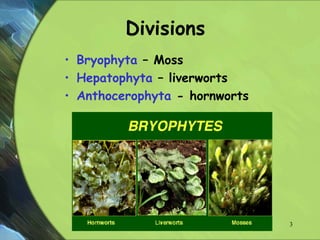
• Bryophyta – Moss
• Hepatophyta – liverworts
• Anthocerophyta - hornworts
3
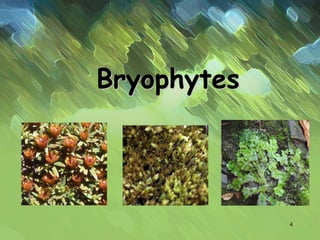
Bryophytes
4
Characteristics
• Includes liverworts, hornworts,
and mosses
• Lack vascular tissue (xylem &
phloem) to carry water and food
• Go through Alternation of
generations (sporophyte &
gametophyte stage)
• Gametophyte is dominant stage
• Reproduce by spores 5
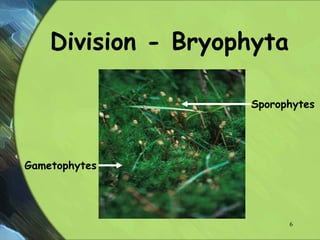
Division - Bryophyta
Sporophytes
Gametophytes
6
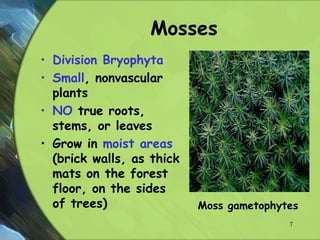
Mosses
• Division Bryophyta
• Small, nonvascular
plants
• NO true roots,
stems, or leaves
• Grow in moist areas
(brick walls, as thick
mats on the forest
floor, on the sides
of trees) Moss gametophytes
7
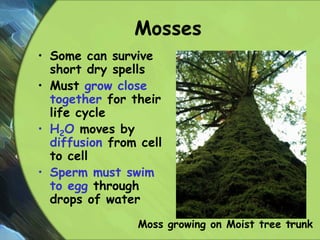
Mosses
• Some can survive
short dry spells
• Must grow close
together for their
life cycle
• H2O moves by
diffusion from cell
to cell
• Sperm must swim
to egg through
drops of water
Moss growing on Moist tree trunk8
Mosses
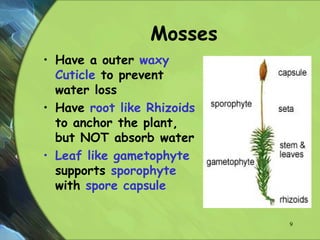
• Have a outer waxy
Cuticle to prevent
water loss
• Have root like Rhizoids
to anchor the plant,
but NOT absorb water
• Leaf like gametophyte
supports sporophyte
with spore capsule
9
Sphagnum Moss
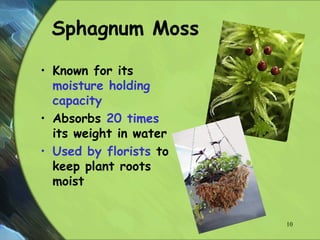
• Known for its
moisture holding
capacity
• Absorbs 20 times
its weight in water
• Used by florists to
keep plant roots
moist
10
Uses for Moss Plants
• Help decompose dead wood
• Serve as pioneer plants on bare
rock or ground
• Help prevent erosion
• Provide shelter for insects & small
animals
• Used as nesting material by birds
• Peat moss is burned as fuel
11
Asexual Reproduction in Moss
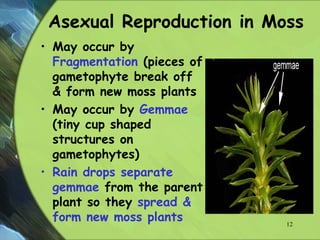
• May occur by
Fragmentation (pieces of
gametophyte break off
& form new moss plants
• May occur by Gemmae
(tiny cup shaped
structures on
gametophytes)
• Rain drops separate
gemmae from the parent
plant so they spread &
form new moss plants 12
Sexual Reproduction in Moss
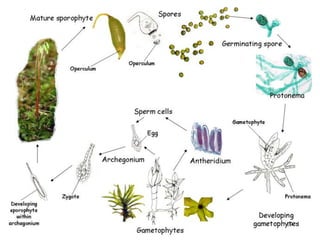
• Moss alternate between a dominant
haploid (1n) Gametophyte and a
diploid (2n) Sporophyte
• Gametophytes produce gametes (eggs
& sperm) containing half the
chromosome number
• Sporophytes have a complete set of
chromosomes & produces spores by
meiosis
13
Sexual Reproduction in Moss
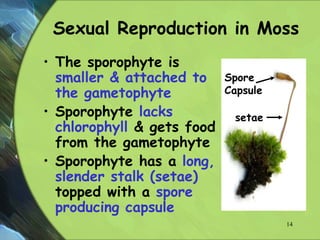
• The sporophyte is
smaller & attached to
the gametophyte
• Sporophyte lacks
chlorophyll & gets food
from the gametophyte
• Sporophyte has a long,
slender stalk (setae)
topped with a spore
producing capsule
setae
Spore
Capsule
14
Asexual Reproduction in
Moss
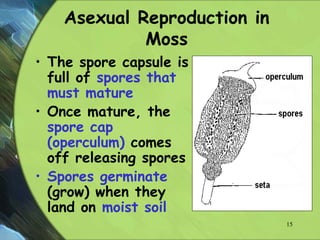
• The spore capsule is
full of spores that
must mature
• Once mature, the
spore cap
(operculum) comes
off releasing spores
• Spores germinate
(grow) when they
land on moist soil
15
Sexual Reproduction in Moss
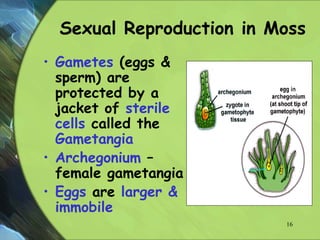
• Gametes (eggs &
sperm) are
protected by a
jacket of sterile
cells called the
Gametangia
• Archegonium –
female gametangia
• Eggs are larger &
immobile
16
Sexual Reproduction in Moss
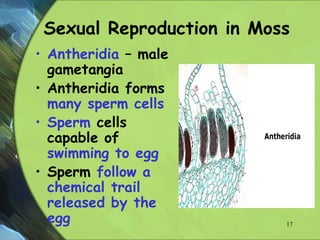
• Antheridia – male
gametangia
• Antheridia forms
many sperm cells
• Sperm cells
capable of
swimming to egg
• Sperm follow a
chemical trail
released by the
egg 17
Sexual Reproduction in Moss
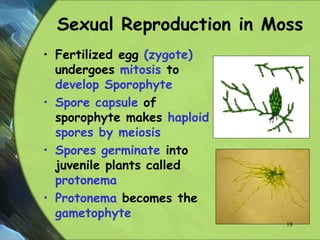
• Fertilized egg (zygote)
undergoes mitosis to
develop Sporophyte
• Spore capsule of
sporophyte makes haploid
spores by meiosis
• Spores germinate into
juvenile plants called
protonema
• Protonema becomes the
gametophyte
18
19
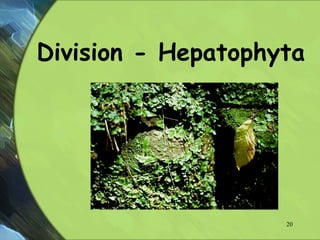
Division - Hepatophyta
20
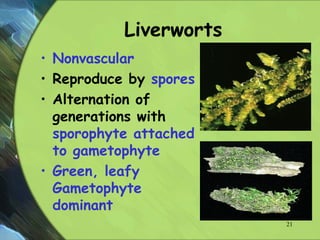
Liverworts
• Nonvascular
• Reproduce by spores
• Alternation of
generations with
sporophyte attached
to gametophyte
• Green, leafy
Gametophyte
dominant
21
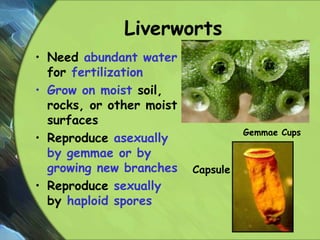
Liverworts
• Need abundant water
for fertilization
• Grow on moist soil,
rocks, or other moist
surfaces
• Reproduce asexually
by gemmae or by
growing new branches
• Reproduce sexually
by haploid spores
Gemmae Cups
Capsule
22
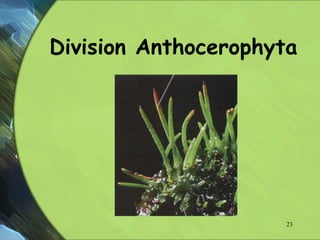
Division Anthocerophyta
23
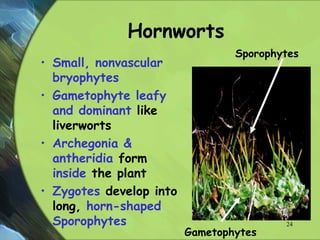
Hornworts
• Small, nonvascular
bryophytes
• Gametophyte leafy
and dominant like
liverworts
• Archegonia &
antheridia form
inside the plant
• Zygotes develop into
long, horn-shaped
Sporophytes
Sporophytes
Gametophytes
24
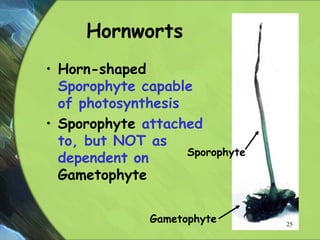
Hornworts
• Horn-shaped
Sporophyte capable
of photosynthesis
• Sporophyte attached
to, but NOT as
dependent on
Gametophyte
Sporophyte
Gametophyte 25
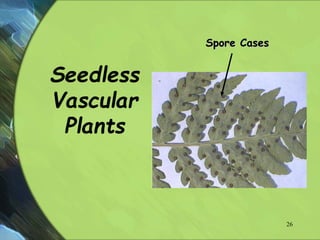
Seedless
Vascular
Plants
Spore Cases
26
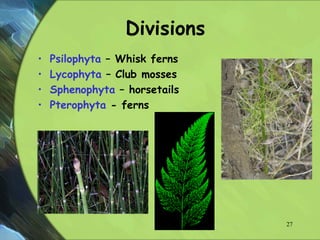
Divisions
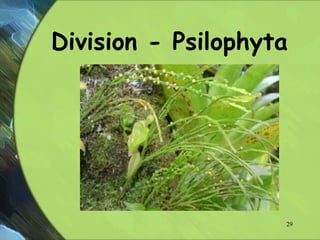
• Psilophyta – Whisk ferns
• Lycophyta – Club mosses
• Sphenophyta – horsetails
• Pterophyta - ferns
27
Characteristics
• Have specialized transport or
vascular tissues (xylem & phloem)
to carry food & water
• Have sporophyte & gametophyte
stages (alternation of generations)
• SPOROPHYTE is dominant
• Reproduce by spores
28
Division - Psilophyta
29
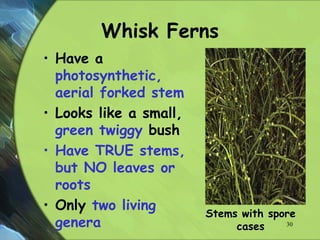
Whisk Ferns
• Have a
photosynthetic,
aerial forked stem
• Looks like a small,
green twiggy bush
• Have TRUE stems,
but NO leaves or
roots
• Only two living
genera
Stems with spore
cases 30
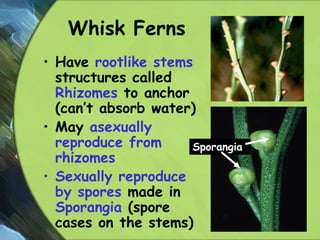
Whisk Ferns
• Have rootlike stems
structures called
Rhizomes to anchor
(can’t absorb water)
• May asexually
reproduce from
rhizomes
• Sexually reproduce
by spores made in
Sporangia (spore
cases on the stems)
Sporangia
31
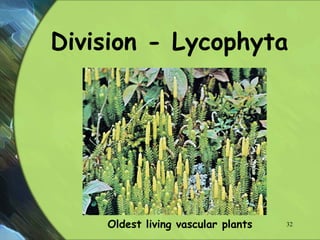
Division - Lycophyta
Oldest living vascular plants 32
Club Moss
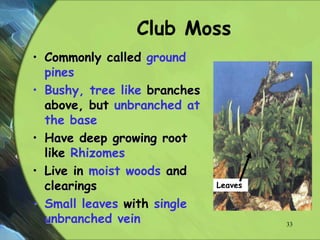
• Commonly called ground
pines
• Bushy, tree like branches
above, but unbranched at
the base
• Have deep growing root
like Rhizomes
• Live in moist woods and
clearings
• Small leaves with single
unbranched vein
Leaves
33
Club Moss
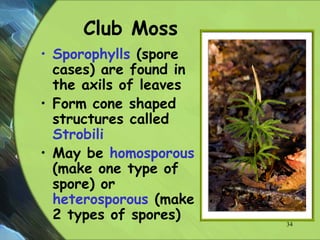
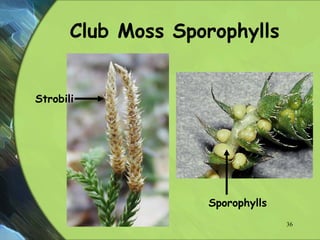
• Sporophylls (spore
cases) are found in
the axils of leaves
• Form cone shaped
structures called
Strobili
• May be homosporous
(make one type of
spore) or
heterosporous (make
2 types of spores) 34
Club Moss Spores
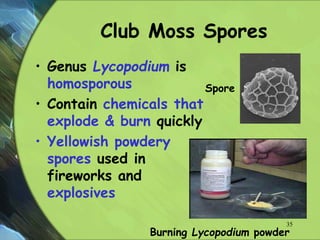
• Genus Lycopodium is
homosporous
• Contain chemicals that
explode & burn quickly
• Yellowish powdery
spores used in
fireworks and
explosives
Spore
Burning Lycopodium powder
35
Club Moss Sporophylls
Strobili
Sporophylls
36
Other Uses for Club Moss
• Sometimes boiled in water to
produce a medicinal tea or an eye
wash
• Ground pines, green all winter, are
used in Christmas decorations
• Ancestors of modern club mosses
helped form coal during the
carboniferous period
37
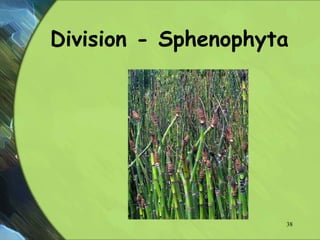
Division - Sphenophyta
38
Horsetails
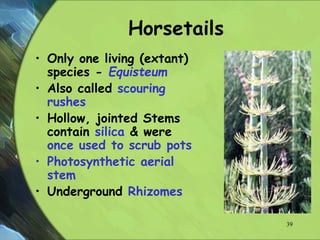
• Only one living (extant)
species - Equisteum
• Also called scouring
rushes
• Hollow, jointed Stems
contain silica & were
once used to scrub pots
• Photosynthetic aerial
stem
• Underground Rhizomes
39
Horsetails
• Reproduce by spores at the
tips of branches
• In prehistoric times, grew
as tall as trees
• Found in wetlands
• Stems with sunken stomata
to save water
• Some spores have elaters,
cells that act as moisture-
sensitive springs, assisting
spore dispersal
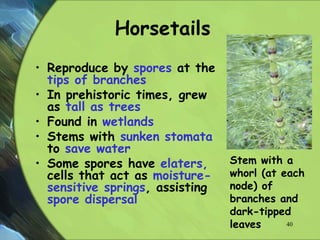
Stem with a
whorl (at each
node) of
branches and
dark-tipped
leaves 40
Uses for Horsetails
• Use to fight plant fungi
• Used in some mouthwashes to
cure mouth ulcers
• Used as diuretics to eliminate
excess water (weight loss
products)
• Toxic to animals (sheep, cattle,
horses)
41
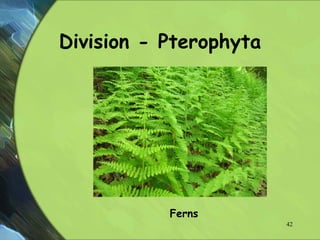
Division - Pterophyta
Ferns
42
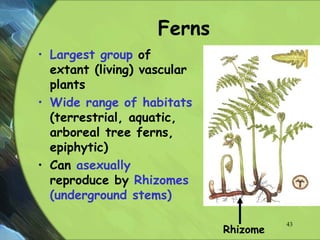
Ferns
• Largest group of
extant (living) vascular
plants
• Wide range of habitats
(terrestrial, aquatic,
arboreal tree ferns,
epiphytic)
• Can asexually
reproduce by Rhizomes
(underground stems)
Rhizome
43
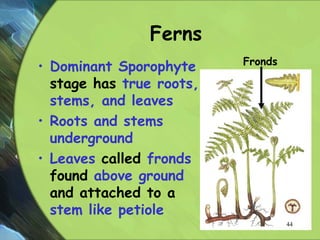
Ferns
• Dominant Sporophyte
stage has true roots,
stems, and leaves
• Roots and stems
underground
• Leaves called fronds
found above ground
and attached to a
stem like petiole
Fronds
44
Ferns
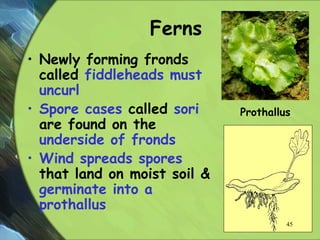
• Newly forming fronds
called fiddleheads must
uncurl
• Spore cases called sori
are found on the
underside of fronds
• Wind spreads spores
that land on moist soil &
germinate into a
prothallus
Prothallus
45
Ferns
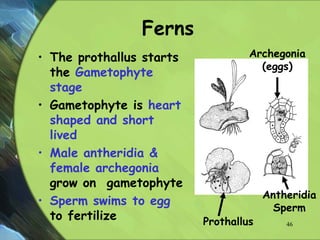
• The prothallus starts
the Gametophyte
stage
• Gametophyte is heart
shaped and short
lived
• Male antheridia &
female archegonia
grow on gametophyte
• Sperm swims to egg
to fertilize Prothallus
Archegonia
(eggs)
Antheridia
Sperm
46
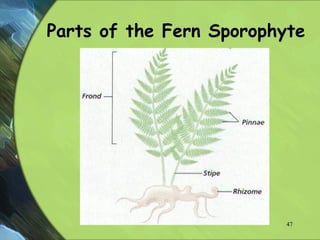
Parts of the Fern Sporophyte
47
48
Uses for Ferns
• Help prevent erosion
• Fiddleheads are eaten as food
• Ornamental plants for yards and
homes
• Helped form coal deposits
millions of years ago
49
50

Moss to ferns

  • 1.
    Nonvascular & Simple VascularPlants Mosses to Ferns 1
  • 2.
  • 3.
    Divisions • Bryophyta –Moss • Hepatophyta – liverworts • Anthocerophyta - hornworts 3
  • 4.
  • 5.
    Characteristics • Includes liverworts,hornworts, and mosses • Lack vascular tissue (xylem & phloem) to carry water and food • Go through Alternation of generations (sporophyte & gametophyte stage) • Gametophyte is dominant stage • Reproduce by spores 5
  • 6.
  • 7.
    Mosses • Division Bryophyta •Small, nonvascular plants • NO true roots, stems, or leaves • Grow in moist areas (brick walls, as thick mats on the forest floor, on the sides of trees) Moss gametophytes 7
  • 8.
    Mosses • Some cansurvive short dry spells • Must grow close together for their life cycle • H2O moves by diffusion from cell to cell • Sperm must swim to egg through drops of water Moss growing on Moist tree trunk8
  • 9.
    Mosses • Have aouter waxy Cuticle to prevent water loss • Have root like Rhizoids to anchor the plant, but NOT absorb water • Leaf like gametophyte supports sporophyte with spore capsule 9
  • 10.
    Sphagnum Moss • Knownfor its moisture holding capacity • Absorbs 20 times its weight in water • Used by florists to keep plant roots moist 10
  • 11.
    Uses for MossPlants • Help decompose dead wood • Serve as pioneer plants on bare rock or ground • Help prevent erosion • Provide shelter for insects & small animals • Used as nesting material by birds • Peat moss is burned as fuel 11
  • 12.
    Asexual Reproduction inMoss • May occur by Fragmentation (pieces of gametophyte break off & form new moss plants • May occur by Gemmae (tiny cup shaped structures on gametophytes) • Rain drops separate gemmae from the parent plant so they spread & form new moss plants 12
  • 13.
    Sexual Reproduction inMoss • Moss alternate between a dominant haploid (1n) Gametophyte and a diploid (2n) Sporophyte • Gametophytes produce gametes (eggs & sperm) containing half the chromosome number • Sporophytes have a complete set of chromosomes & produces spores by meiosis 13
  • 14.
    Sexual Reproduction inMoss • The sporophyte is smaller & attached to the gametophyte • Sporophyte lacks chlorophyll & gets food from the gametophyte • Sporophyte has a long, slender stalk (setae) topped with a spore producing capsule setae Spore Capsule 14
  • 15.
    Asexual Reproduction in Moss •The spore capsule is full of spores that must mature • Once mature, the spore cap (operculum) comes off releasing spores • Spores germinate (grow) when they land on moist soil 15
  • 16.
    Sexual Reproduction inMoss • Gametes (eggs & sperm) are protected by a jacket of sterile cells called the Gametangia • Archegonium – female gametangia • Eggs are larger & immobile 16
  • 17.
    Sexual Reproduction inMoss • Antheridia – male gametangia • Antheridia forms many sperm cells • Sperm cells capable of swimming to egg • Sperm follow a chemical trail released by the egg 17
  • 18.
    Sexual Reproduction inMoss • Fertilized egg (zygote) undergoes mitosis to develop Sporophyte • Spore capsule of sporophyte makes haploid spores by meiosis • Spores germinate into juvenile plants called protonema • Protonema becomes the gametophyte 18
  • 19.
  • 20.
  • 21.
    Liverworts • Nonvascular • Reproduceby spores • Alternation of generations with sporophyte attached to gametophyte • Green, leafy Gametophyte dominant 21
  • 22.
    Liverworts • Need abundantwater for fertilization • Grow on moist soil, rocks, or other moist surfaces • Reproduce asexually by gemmae or by growing new branches • Reproduce sexually by haploid spores Gemmae Cups Capsule 22
  • 23.
  • 24.
    Hornworts • Small, nonvascular bryophytes •Gametophyte leafy and dominant like liverworts • Archegonia & antheridia form inside the plant • Zygotes develop into long, horn-shaped Sporophytes Sporophytes Gametophytes 24
  • 25.
    Hornworts • Horn-shaped Sporophyte capable ofphotosynthesis • Sporophyte attached to, but NOT as dependent on Gametophyte Sporophyte Gametophyte 25
  • 26.
  • 27.
    Divisions • Psilophyta –Whisk ferns • Lycophyta – Club mosses • Sphenophyta – horsetails • Pterophyta - ferns 27
  • 28.
    Characteristics • Have specializedtransport or vascular tissues (xylem & phloem) to carry food & water • Have sporophyte & gametophyte stages (alternation of generations) • SPOROPHYTE is dominant • Reproduce by spores 28
  • 29.
  • 30.
    Whisk Ferns • Havea photosynthetic, aerial forked stem • Looks like a small, green twiggy bush • Have TRUE stems, but NO leaves or roots • Only two living genera Stems with spore cases 30
  • 31.
    Whisk Ferns • Haverootlike stems structures called Rhizomes to anchor (can’t absorb water) • May asexually reproduce from rhizomes • Sexually reproduce by spores made in Sporangia (spore cases on the stems) Sporangia 31
  • 32.
    Division - Lycophyta Oldestliving vascular plants 32
  • 33.
    Club Moss • Commonlycalled ground pines • Bushy, tree like branches above, but unbranched at the base • Have deep growing root like Rhizomes • Live in moist woods and clearings • Small leaves with single unbranched vein Leaves 33
  • 34.
    Club Moss • Sporophylls(spore cases) are found in the axils of leaves • Form cone shaped structures called Strobili • May be homosporous (make one type of spore) or heterosporous (make 2 types of spores) 34
  • 35.
    Club Moss Spores •Genus Lycopodium is homosporous • Contain chemicals that explode & burn quickly • Yellowish powdery spores used in fireworks and explosives Spore Burning Lycopodium powder 35
  • 36.
  • 37.
    Other Uses forClub Moss • Sometimes boiled in water to produce a medicinal tea or an eye wash • Ground pines, green all winter, are used in Christmas decorations • Ancestors of modern club mosses helped form coal during the carboniferous period 37
  • 38.
  • 39.
    Horsetails • Only oneliving (extant) species - Equisteum • Also called scouring rushes • Hollow, jointed Stems contain silica & were once used to scrub pots • Photosynthetic aerial stem • Underground Rhizomes 39
  • 40.
    Horsetails • Reproduce byspores at the tips of branches • In prehistoric times, grew as tall as trees • Found in wetlands • Stems with sunken stomata to save water • Some spores have elaters, cells that act as moisture- sensitive springs, assisting spore dispersal Stem with a whorl (at each node) of branches and dark-tipped leaves 40
  • 41.
    Uses for Horsetails •Use to fight plant fungi • Used in some mouthwashes to cure mouth ulcers • Used as diuretics to eliminate excess water (weight loss products) • Toxic to animals (sheep, cattle, horses) 41
  • 42.
  • 43.
    Ferns • Largest groupof extant (living) vascular plants • Wide range of habitats (terrestrial, aquatic, arboreal tree ferns, epiphytic) • Can asexually reproduce by Rhizomes (underground stems) Rhizome 43
  • 44.
    Ferns • Dominant Sporophyte stagehas true roots, stems, and leaves • Roots and stems underground • Leaves called fronds found above ground and attached to a stem like petiole Fronds 44
  • 45.
    Ferns • Newly formingfronds called fiddleheads must uncurl • Spore cases called sori are found on the underside of fronds • Wind spreads spores that land on moist soil & germinate into a prothallus Prothallus 45
  • 46.
    Ferns • The prothallusstarts the Gametophyte stage • Gametophyte is heart shaped and short lived • Male antheridia & female archegonia grow on gametophyte • Sperm swims to egg to fertilize Prothallus Archegonia (eggs) Antheridia Sperm 46
  • 47.
    Parts of theFern Sporophyte 47
  • 48.
  • 49.
    Uses for Ferns •Help prevent erosion • Fiddleheads are eaten as food • Ornamental plants for yards and homes • Helped form coal deposits millions of years ago 49
  • 50.