SPONTANEOUS MUTATIONS IN MICRO 
ORGANISMS. 
SUBMITTED TO: 
Dr.A.VIJAYA GOPAL 
ASST.PROFESSOR 
SUBMITTED BY: 
B.PRASANNA KUMAR 
ID.NO:RAM/14-81
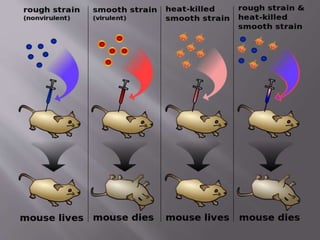
Griffith's experiment, was an experiment done in 1928 by Frederick Griffith. 
It was one of the first experiments showing thatbacteria can 
get DNA through a process called transformation.[1][2] 
Griffith used two strains of Pneumococcus. These bacteria infect mice. He 
used a type III-S (smooth) and type II-R (rough) strain. The III-S strain 
covers itself with a polysaccharide capsule that protects it from the 
host's immune system. This means that the host will die. The II-R strain does 
not have that protective shield around it and is killed by the host's immune 
system. 
In this experiment, bacteria from the III-S strain were killed by heat, and 
their remains were added to II-R strain bacteria. While neither harmed the 
mice on their own, the blend of the two was able to kill mice. 
Griffith was also able to get both live II-R and live III-S strains 
of pneumococcus from the blood of these dead mice. He concluded that the 
type II-R had been "transformed" into the lethal III-S strain by a 
"transforming principle" that was somehow part of the dead III-S strain 
bacteria.[3]
Today, we know that the "transforming principle" 
Griffith saw was the DNA of the III-S strain 
bacteria. While the bacteria had been killed, the 
DNA had survived the heating process and was 
taken up by the II-R strain bacteria. The III-S 
strain DNA contains the genes that form the 
shielding polysaccharide part from attack. Armed 
with this gene, the former II-R strain bacteria 
were now protected from the host's immune 
system and could kill the host. 
The exact nature of the transforming principle 
(DNA) was confirmed in the experiments done 
by Avery, McLeod and McCarty and by Hershey 
and Chase.
 Definition: 
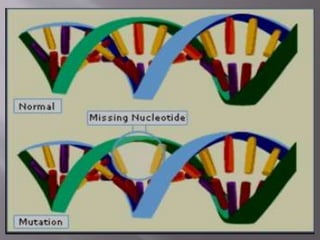
 A sudden and heritable change in the nucleotide 
sequence of a gene. 
 A mutation is a change in phenotype, which is sudden, 
heritable and is not produced due to segregation or 
recombination. 
 Mutation is the ultimate source of all the genetic 
variation existing in any organism. 
 Mutations always change the genotype and thus the 
phenotype of the microorganism.
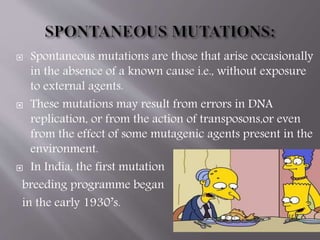
 Spontaneous mutations are those that arise occasionally 
in the absence of a known cause i.e., without exposure 
to external agents. 
 These mutations may result from errors in DNA 
replication, or from the action of transposons,or even 
from the effect of some mutagenic agents present in the 
environment. 
 In India, the first mutation 
breeding programme began 
in the early 1930’s.
 Mutations are random events interms of the time of 
their occurrence and the gene inwhich they occur. 
 Most mutations have harmful effects, but some 
mutations are beneficial. 
 Mutations are recurrent.i.e., the same mutation may be 
expected to occur in different individuals of a given 
generation. 
 Mutations can occur in any tissue or cell of an 
organism.
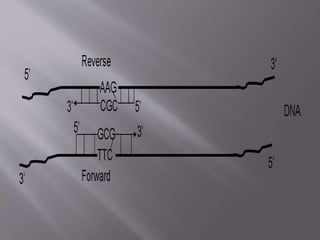
 Mutations occur in both forward & reverse directions. 
 Generally the rate of forward mutations are much higher 
than those for reverse mutations. 
 Mutations occur at very low frequencies in nature such 
mutations are called spontaneous mutations. 
 The rate of spontaneous mutations for most of the genes 
is very low ranging between 10⁻7 and 10⁻4. 
 Some genes increase the spontaneous mutation rates of 
some other genes of the genome. 
 Such genes are called mutator genes.
 The spontaneous mutation rate varies. Large gene provide 
a large target and tend to mutate more frequently. 
 Organisms possess a variety of cellular functions to 
suppress spontaneous mutagenesis, and the specificity 
and effectiveness of each function strongly affect the 
pattern of spontaneous mutations. 
 spontaneous mutations occur more randomly and much 
less frequently.
 There are several ways in which mutations can be 
classified; some of the common ones are 
 1.Direction of mutation: 
 a. Forward mutation:(mutation from wild type allele) 
 b.Reverse mutation:(mutation from a mutant allele to 
the normal one) 
 2.Cause of mutation: 
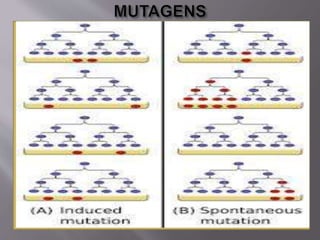
 a. Spontaneous mutation:(occur naturally without any 
apparent cause)
 Induced mutations:(originate due to a treatment with 
some physical or chemical agent) 
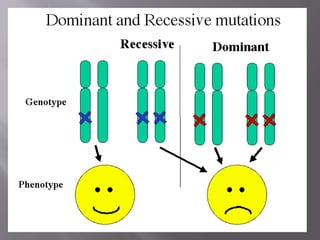
 3.Dominance relationship: 
 a. Dominant mutation: 
 b.Recessive mutation:(most often recessive) 
 c.Codominant mutation:(occationally codominant) 
 d.incompletely dominant mutation:(partially dominant) 
 4.Tissue of origin: 
 a.Somatic mutation:(mutation occuring in somatic cell) 
 Bud mutation:(somatic mutation occurs in an 
axillarybud)
 b.Germinal mutation:(occur in reproductive tissue) 
 In an sexually reproducing species only germinal 
mutations are transmitted to the next generation. 
 5.Effect on survival: 
 a.Lethal mutations:(kill all the individuals having them in 
appropriate genotype) 
 b.Sublethal mutations:(kill most of the individuals) 
 c.subvital mutations:(kill some of the individuals) 
 d.vital mutations:(do not affect survival) 
 e.supervital mutations:(increase the survival)
 6.Type of affected: 
 a.Morphological/visible mutations:(mutation that alters 
mutant allele is visually detected) 
 b.Biochemical mutations:(mutations prevent the 
production of a biochemical by the organism) 
 7.Quantum of morphological effect produced: 
 a.Macro mutations:(produce large enough changes in the 
phenotype detected without any confusion) e.g:short 
legged mutation in sheep. 
 b.Micro mutations:(quantitative characters generally 
produce small morphological effects,special techniques 
required for their detection)
 8.Cytological basis: 
 a.chromosomal mutations:(detectable changes in either 
chromosome number or structure) 
 e.g.,bar eye mutation in drosophila 
 b.gene mutations/point mutations:(produced by 
alternations in the base sequencens of genes) 
 c.cytoplasmic or plasmagene mutations:(changes in 
mitochondria or chloroplast DNA) 
 e.g.,cytoplasmic male sterility in maize, sorghum.
 9.Molecular basis: 
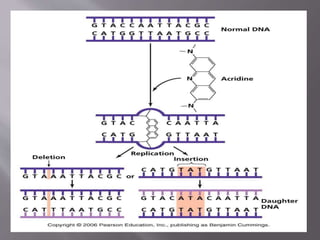
 a.base substitution:(single base in a DNA molecule is 
replaced by another base) 
 b.deletion mutation:(one or more bases are deleted or lost 
from a gene) 
 c.addition mutation:(insertion of one or more bases in a 
gene) 
 10.Type of amino acid replacement: 
 a.missense mutation:(replacement of a single amino acid 
of the respective polypeptides by another amino acid) 
 They are produced by base substitutions.
 b.nonsense mutation:(a codon does not code for any 
amino acid) 
 c.frameshift mutations:(all the amino acids of the 
polypeptide chain located beyond the site of mutation are 
substituted) 
 Frameshift mutations are produced due to deletion or 
addition of bases.
 1.Errors during DNA replication. 
 2.mutagenic effects of the natural environments of 
organisms. 
 3.transposons and incertion sequences. 
 4.methylation followed by spontaneous deamination of 
DNA bases, esp cytocine. 
 5.some of the solar radiations are surely mutagenic. 
 Both eukaryotic and prokaryotic genomes contain some 
transposable elements.e.g.,incersion 
sequences(IS),transposons,etc.
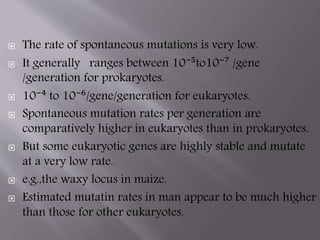
 The rate of spontaneous mutations is very low. 
 It generally ranges between 10⁻⁵to10⁻⁷ /gene 
/generation for prokaryotes. 
 10⁻⁴ to 10⁻⁶/gene/generation for eukaryotes. 
 Spontaneous mutation rates per generation are 
comparatively higher in eukaryotes than in prokaryotes. 
 But some eukaryotic genes are highly stable and mutate 
at a very low rate. 
 e.g.,the waxy locus in maize. 
 Estimated mutatin rates in man appear to be much higher 
than those for other eukaryotes.
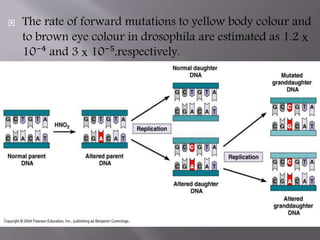
 The rate of forward mutations to yellow body colour and 
to brown eye colour in drosophila are estimated as 1.2 х 
10⁻⁴ and 3 х 10⁻⁵,respectively.
 Mutations produced due to the treatment with either a 
chemical or physical agent. 
 The agents capable of inducing mutations are known as 
mutagens. 
 The capacity of an agent for inducing mutations is 
termed as mutagenic property. 
 Induced mutations are useful in two different ways: 
 1.in genetic and biochemical studies. 
 2.in crop improvement.
 The process of induced mutations through treatment with 
a mutagen is known as mutagenesis. 
 The exploitation of induced mutations for crop 
improvement is called mutation breeding. 
 Some potent chemical mutagens may produce mutations 
at the rate of more than 1% per gene per generation in 
bacteria and bacteriophages. 
 This represents a more than 10,000-fold increase in the 
mutation rate.
 A large variety of microbial mutants have been isolated 
and studied intensively by microbiologists . some 
important ones: 
 1.AUXOTROPHIC MUTANTS 
 2.RESISTANT MUTANTS 
 3.CRYPTIC MUTANTS 
 4.CONDITIONALLY EXPRESSED MUTANTS 
 5.ANTIGENIC MUTNTS 
 6.METABOLIC MUTANT 
 7.REGULATORY MUTANTS 
 8.TEMPARATURE-SENSITIVE MUTANTS.
 1.AUXOTROPHIC MUTANTS: 
 Those that are nutritionally deficient ,i.e., they are unable 
to synthesize essential metabolites or growth 
factors(amino acid ,purine ,pyramidine,vit.,). 
 2.RESISTANT MUTANTS: 
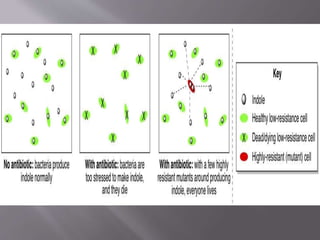
 It’s exhibit an increased tolerance to inhibitory agents, 
particularly antibiotics and phases. 
 Microbes may develop such mutants spontaneously 
through a range of mechanisms. 
 3.CRYPTIC MUTANTS: 
 Those that have lost a specific function but retain the 
intracellular activities.e.g,.loss of permease.
 4.CONDITIONALLY EXPRESSED MUTANTS: 
 These mutants remain as wild type phenotype under one 
set of conditions. 
 5.ANTIGENIC MUTNTS: 
 It’s show a change in the surface structure and 
composition of the microbial cell. 
 6.METABOLIC MUTANT: 
 These exhibit altered metabolic ability particularly the 
fermentation ability of decreased or increased capacity to 
produce some end-product.
 7.REGULATORY MUTANTS: 
 Mutation affects either regulatory region of the promoter 
gene or the activity of a regulatory protein. 
 Mutants of Bacillus subtilis are grossly deficient in the 
enzymes. 
 8.TEMPARATURE-SENSITIVE MUTANTS: 
 These will grow at one temparature but not at another. 
most of them are heat-sensitive ,some how-ever , are cold 
sensitive.
 Stress Survival 
 Adaptive mutation 
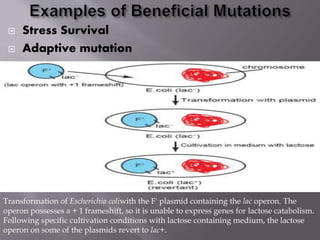
Transformation of Escherichia coliwith the F' plasmid containing the lac operon. The 
operon possesses a + 1 frameshift, so it is unable to express genes for lactose catabolism. 
Following specific cultivation conditions with lactose containing medium, the lactose 
operon on some of the plasmids revert to lac+.
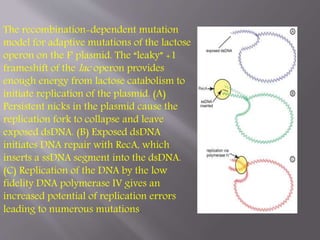
The recombination-dependent mutation 
model for adaptive mutations of the lactose 
operon on the F' plasmid. The “leaky” +1 
frameshift of thelac operon provides 
enough energy from lactose catabolism to 
initiate replication of the plasmid. (A) 
Persistent nicks in the plasmid cause the 
replication fork to collapse and leave 
exposed dsDNA. (B) Exposed dsDNA 
initiates DNA repair with RecA, which 
inserts a ssDNA segment into the dsDNA. 
(C) Replication of the DNA by the low 
fidelity DNA polymerase IV gives an 
increased potential of replication errors 
leading to numerous mutations.
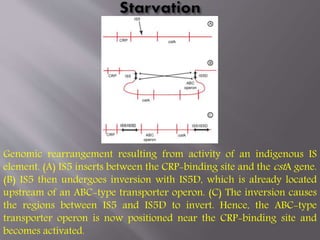
Genomic rearrangement resulting from activity of an indigenous IS 
element. (A) IS5 inserts between the CRP-binding site and thecstA gene. 
(B) IS5 then undergoes inversion with IS5D, which is already located 
upstream of an ABC-type transporter operon. (C) The inversion causes 
the regions between IS5 and IS5D to invert. Hence, the ABC-type 
transporter operon is now positioned near the CRP-binding site and 
becomes activated.
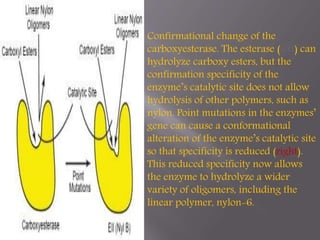
Confirmational change of the 
carboxyesterase. The esterase (left) can 
hydrolyze carboxy esters, but the 
confirmation specificity of the 
enzyme’s catalytic site does not allow 
hydrolysis of other polymers, such as 
nylon. Point mutations in the enzymes’ 
gene can cause a conformational 
alteration of the enzyme’s catalytic site 
so that specificity is reduced (right). 
This reduced specificity now allows 
the enzyme to hydrolyze a wider 
variety of oligomers, including the 
linear polymer, nylon-6.
 Bacteria frequently develop mutations that enable them 
to survive and adapt to a variety of environmental 
conditions. 
 However, most of these mutations can be classified as a 
form of antagonistic pleiotropy. 
 Bacteria face a variety of environmental conditions and 
stressful situations. 
 If the environmental conditions change, the mutation 
usually becomes less beneficial and perhaps even 
detrimental. 
 most bacteria need the ability to rapidly adapt to ever 
changing environments and food sources.
Spontaneous mutations in microorganisms

Spontaneous mutations in microorganisms

  • 1.
    SPONTANEOUS MUTATIONS INMICRO ORGANISMS. SUBMITTED TO: Dr.A.VIJAYA GOPAL ASST.PROFESSOR SUBMITTED BY: B.PRASANNA KUMAR ID.NO:RAM/14-81
  • 2.
    Griffith's experiment, wasan experiment done in 1928 by Frederick Griffith. It was one of the first experiments showing thatbacteria can get DNA through a process called transformation.[1][2] Griffith used two strains of Pneumococcus. These bacteria infect mice. He used a type III-S (smooth) and type II-R (rough) strain. The III-S strain covers itself with a polysaccharide capsule that protects it from the host's immune system. This means that the host will die. The II-R strain does not have that protective shield around it and is killed by the host's immune system. In this experiment, bacteria from the III-S strain were killed by heat, and their remains were added to II-R strain bacteria. While neither harmed the mice on their own, the blend of the two was able to kill mice. Griffith was also able to get both live II-R and live III-S strains of pneumococcus from the blood of these dead mice. He concluded that the type II-R had been "transformed" into the lethal III-S strain by a "transforming principle" that was somehow part of the dead III-S strain bacteria.[3]
  • 3.
    Today, we knowthat the "transforming principle" Griffith saw was the DNA of the III-S strain bacteria. While the bacteria had been killed, the DNA had survived the heating process and was taken up by the II-R strain bacteria. The III-S strain DNA contains the genes that form the shielding polysaccharide part from attack. Armed with this gene, the former II-R strain bacteria were now protected from the host's immune system and could kill the host. The exact nature of the transforming principle (DNA) was confirmed in the experiments done by Avery, McLeod and McCarty and by Hershey and Chase.
  • 5.
     Definition: A sudden and heritable change in the nucleotide sequence of a gene.  A mutation is a change in phenotype, which is sudden, heritable and is not produced due to segregation or recombination.  Mutation is the ultimate source of all the genetic variation existing in any organism.  Mutations always change the genotype and thus the phenotype of the microorganism.
  • 7.
     Spontaneous mutationsare those that arise occasionally in the absence of a known cause i.e., without exposure to external agents.  These mutations may result from errors in DNA replication, or from the action of transposons,or even from the effect of some mutagenic agents present in the environment.  In India, the first mutation breeding programme began in the early 1930’s.
  • 8.
     Mutations arerandom events interms of the time of their occurrence and the gene inwhich they occur.  Most mutations have harmful effects, but some mutations are beneficial.  Mutations are recurrent.i.e., the same mutation may be expected to occur in different individuals of a given generation.  Mutations can occur in any tissue or cell of an organism.
  • 9.
     Mutations occurin both forward & reverse directions.  Generally the rate of forward mutations are much higher than those for reverse mutations.  Mutations occur at very low frequencies in nature such mutations are called spontaneous mutations.  The rate of spontaneous mutations for most of the genes is very low ranging between 10⁻7 and 10⁻4.  Some genes increase the spontaneous mutation rates of some other genes of the genome.  Such genes are called mutator genes.
  • 10.
     The spontaneousmutation rate varies. Large gene provide a large target and tend to mutate more frequently.  Organisms possess a variety of cellular functions to suppress spontaneous mutagenesis, and the specificity and effectiveness of each function strongly affect the pattern of spontaneous mutations.  spontaneous mutations occur more randomly and much less frequently.
  • 11.
     There areseveral ways in which mutations can be classified; some of the common ones are  1.Direction of mutation:  a. Forward mutation:(mutation from wild type allele)  b.Reverse mutation:(mutation from a mutant allele to the normal one)  2.Cause of mutation:  a. Spontaneous mutation:(occur naturally without any apparent cause)
  • 13.
     Induced mutations:(originatedue to a treatment with some physical or chemical agent)  3.Dominance relationship:  a. Dominant mutation:  b.Recessive mutation:(most often recessive)  c.Codominant mutation:(occationally codominant)  d.incompletely dominant mutation:(partially dominant)  4.Tissue of origin:  a.Somatic mutation:(mutation occuring in somatic cell)  Bud mutation:(somatic mutation occurs in an axillarybud)
  • 15.
     b.Germinal mutation:(occurin reproductive tissue)  In an sexually reproducing species only germinal mutations are transmitted to the next generation.  5.Effect on survival:  a.Lethal mutations:(kill all the individuals having them in appropriate genotype)  b.Sublethal mutations:(kill most of the individuals)  c.subvital mutations:(kill some of the individuals)  d.vital mutations:(do not affect survival)  e.supervital mutations:(increase the survival)
  • 16.
     6.Type ofaffected:  a.Morphological/visible mutations:(mutation that alters mutant allele is visually detected)  b.Biochemical mutations:(mutations prevent the production of a biochemical by the organism)  7.Quantum of morphological effect produced:  a.Macro mutations:(produce large enough changes in the phenotype detected without any confusion) e.g:short legged mutation in sheep.  b.Micro mutations:(quantitative characters generally produce small morphological effects,special techniques required for their detection)
  • 17.
     8.Cytological basis:  a.chromosomal mutations:(detectable changes in either chromosome number or structure)  e.g.,bar eye mutation in drosophila  b.gene mutations/point mutations:(produced by alternations in the base sequencens of genes)  c.cytoplasmic or plasmagene mutations:(changes in mitochondria or chloroplast DNA)  e.g.,cytoplasmic male sterility in maize, sorghum.
  • 18.
     9.Molecular basis:  a.base substitution:(single base in a DNA molecule is replaced by another base)  b.deletion mutation:(one or more bases are deleted or lost from a gene)  c.addition mutation:(insertion of one or more bases in a gene)  10.Type of amino acid replacement:  a.missense mutation:(replacement of a single amino acid of the respective polypeptides by another amino acid)  They are produced by base substitutions.
  • 20.
     b.nonsense mutation:(acodon does not code for any amino acid)  c.frameshift mutations:(all the amino acids of the polypeptide chain located beyond the site of mutation are substituted)  Frameshift mutations are produced due to deletion or addition of bases.
  • 21.
     1.Errors duringDNA replication.  2.mutagenic effects of the natural environments of organisms.  3.transposons and incertion sequences.  4.methylation followed by spontaneous deamination of DNA bases, esp cytocine.  5.some of the solar radiations are surely mutagenic.  Both eukaryotic and prokaryotic genomes contain some transposable elements.e.g.,incersion sequences(IS),transposons,etc.
  • 22.
     The rateof spontaneous mutations is very low.  It generally ranges between 10⁻⁵to10⁻⁷ /gene /generation for prokaryotes.  10⁻⁴ to 10⁻⁶/gene/generation for eukaryotes.  Spontaneous mutation rates per generation are comparatively higher in eukaryotes than in prokaryotes.  But some eukaryotic genes are highly stable and mutate at a very low rate.  e.g.,the waxy locus in maize.  Estimated mutatin rates in man appear to be much higher than those for other eukaryotes.
  • 23.
     The rateof forward mutations to yellow body colour and to brown eye colour in drosophila are estimated as 1.2 х 10⁻⁴ and 3 х 10⁻⁵,respectively.
  • 24.
     Mutations produceddue to the treatment with either a chemical or physical agent.  The agents capable of inducing mutations are known as mutagens.  The capacity of an agent for inducing mutations is termed as mutagenic property.  Induced mutations are useful in two different ways:  1.in genetic and biochemical studies.  2.in crop improvement.
  • 25.
     The processof induced mutations through treatment with a mutagen is known as mutagenesis.  The exploitation of induced mutations for crop improvement is called mutation breeding.  Some potent chemical mutagens may produce mutations at the rate of more than 1% per gene per generation in bacteria and bacteriophages.  This represents a more than 10,000-fold increase in the mutation rate.
  • 27.
     A largevariety of microbial mutants have been isolated and studied intensively by microbiologists . some important ones:  1.AUXOTROPHIC MUTANTS  2.RESISTANT MUTANTS  3.CRYPTIC MUTANTS  4.CONDITIONALLY EXPRESSED MUTANTS  5.ANTIGENIC MUTNTS  6.METABOLIC MUTANT  7.REGULATORY MUTANTS  8.TEMPARATURE-SENSITIVE MUTANTS.
  • 28.
     1.AUXOTROPHIC MUTANTS:  Those that are nutritionally deficient ,i.e., they are unable to synthesize essential metabolites or growth factors(amino acid ,purine ,pyramidine,vit.,).  2.RESISTANT MUTANTS:  It’s exhibit an increased tolerance to inhibitory agents, particularly antibiotics and phases.  Microbes may develop such mutants spontaneously through a range of mechanisms.  3.CRYPTIC MUTANTS:  Those that have lost a specific function but retain the intracellular activities.e.g,.loss of permease.
  • 29.
     4.CONDITIONALLY EXPRESSEDMUTANTS:  These mutants remain as wild type phenotype under one set of conditions.  5.ANTIGENIC MUTNTS:  It’s show a change in the surface structure and composition of the microbial cell.  6.METABOLIC MUTANT:  These exhibit altered metabolic ability particularly the fermentation ability of decreased or increased capacity to produce some end-product.
  • 30.
     7.REGULATORY MUTANTS:  Mutation affects either regulatory region of the promoter gene or the activity of a regulatory protein.  Mutants of Bacillus subtilis are grossly deficient in the enzymes.  8.TEMPARATURE-SENSITIVE MUTANTS:  These will grow at one temparature but not at another. most of them are heat-sensitive ,some how-ever , are cold sensitive.
  • 31.
     Stress Survival  Adaptive mutation Transformation of Escherichia coliwith the F' plasmid containing the lac operon. The operon possesses a + 1 frameshift, so it is unable to express genes for lactose catabolism. Following specific cultivation conditions with lactose containing medium, the lactose operon on some of the plasmids revert to lac+.
  • 32.
    The recombination-dependent mutation model for adaptive mutations of the lactose operon on the F' plasmid. The “leaky” +1 frameshift of thelac operon provides enough energy from lactose catabolism to initiate replication of the plasmid. (A) Persistent nicks in the plasmid cause the replication fork to collapse and leave exposed dsDNA. (B) Exposed dsDNA initiates DNA repair with RecA, which inserts a ssDNA segment into the dsDNA. (C) Replication of the DNA by the low fidelity DNA polymerase IV gives an increased potential of replication errors leading to numerous mutations.
  • 33.
    Genomic rearrangement resultingfrom activity of an indigenous IS element. (A) IS5 inserts between the CRP-binding site and thecstA gene. (B) IS5 then undergoes inversion with IS5D, which is already located upstream of an ABC-type transporter operon. (C) The inversion causes the regions between IS5 and IS5D to invert. Hence, the ABC-type transporter operon is now positioned near the CRP-binding site and becomes activated.
  • 34.
    Confirmational change ofthe carboxyesterase. The esterase (left) can hydrolyze carboxy esters, but the confirmation specificity of the enzyme’s catalytic site does not allow hydrolysis of other polymers, such as nylon. Point mutations in the enzymes’ gene can cause a conformational alteration of the enzyme’s catalytic site so that specificity is reduced (right). This reduced specificity now allows the enzyme to hydrolyze a wider variety of oligomers, including the linear polymer, nylon-6.
  • 36.
     Bacteria frequentlydevelop mutations that enable them to survive and adapt to a variety of environmental conditions.  However, most of these mutations can be classified as a form of antagonistic pleiotropy.  Bacteria face a variety of environmental conditions and stressful situations.  If the environmental conditions change, the mutation usually becomes less beneficial and perhaps even detrimental.  most bacteria need the ability to rapidly adapt to ever changing environments and food sources.