SOFTWARE PROJECT
MANAGEMENT
Prof. Kanchana Devi V
Project Planning
 Step 0: Select Project
 Step 1: Identify Project Scope & Objectives
 Step 2: Identify Project Infrastructure
 Step 3: Analyse Project Characteristics
 Step 4: Identify Project Products & Activities
 Step 5: Estimate Effort for Each Activity
Project Planning- Continued…
 Step 6: Identify Activity Risks
 Step 7: Allocate Resources
 Step 8: Review/ Publicize Plan
 Step 9 & 10: Execute Plan/Lower Level
Planning
Step 0: Select Project
 It is outside the main project planning
process.
 A feasibility study might suggest that there is
a business case for the project.
Step 1 : Identify Project Scope and
Objectives
 1.1 Identify objectives and measures of
effectiveness in meeting them
 1.2 Establish a project authority
 1.3 Identify Stakeholders
 1.4 Modify objectives in light of stakeholder
analysis adding new features
 1.5 Establish methods of communication with
all parties
Step 2 : Identify Project Infrastructure
2.1 Establish relationship between project and
strategic planning
 Compliance with enterprise architecture.
2.2 Identify installation standards and procedures
 Define development procedures, Normal stages in software life
cycle.
 Change control and Configuration Management
2.3 Identify project team organization
 Decision about grouping business analysts and software
developers.
Step 3 : Analyze Project
Characteristics
 Ensure appropriate methods are used for
project.
 3.1 Distinguish project either objective or
product driven
 3.2 Analyze other project characteristics
 System will be safety critical,where human life could be
threatened.
 3.3 Identify high level project risks
 Most risks attributed to operational or development
environment.
 3.4 Take into account user requirements
concerning implementation.
 Client may have own procedural requirement
 3.5 Select development methodology and
life-cycle approach
 3.6 Review overall resource estimate
 Re-estimate the effort and other resources required to
implement the project.
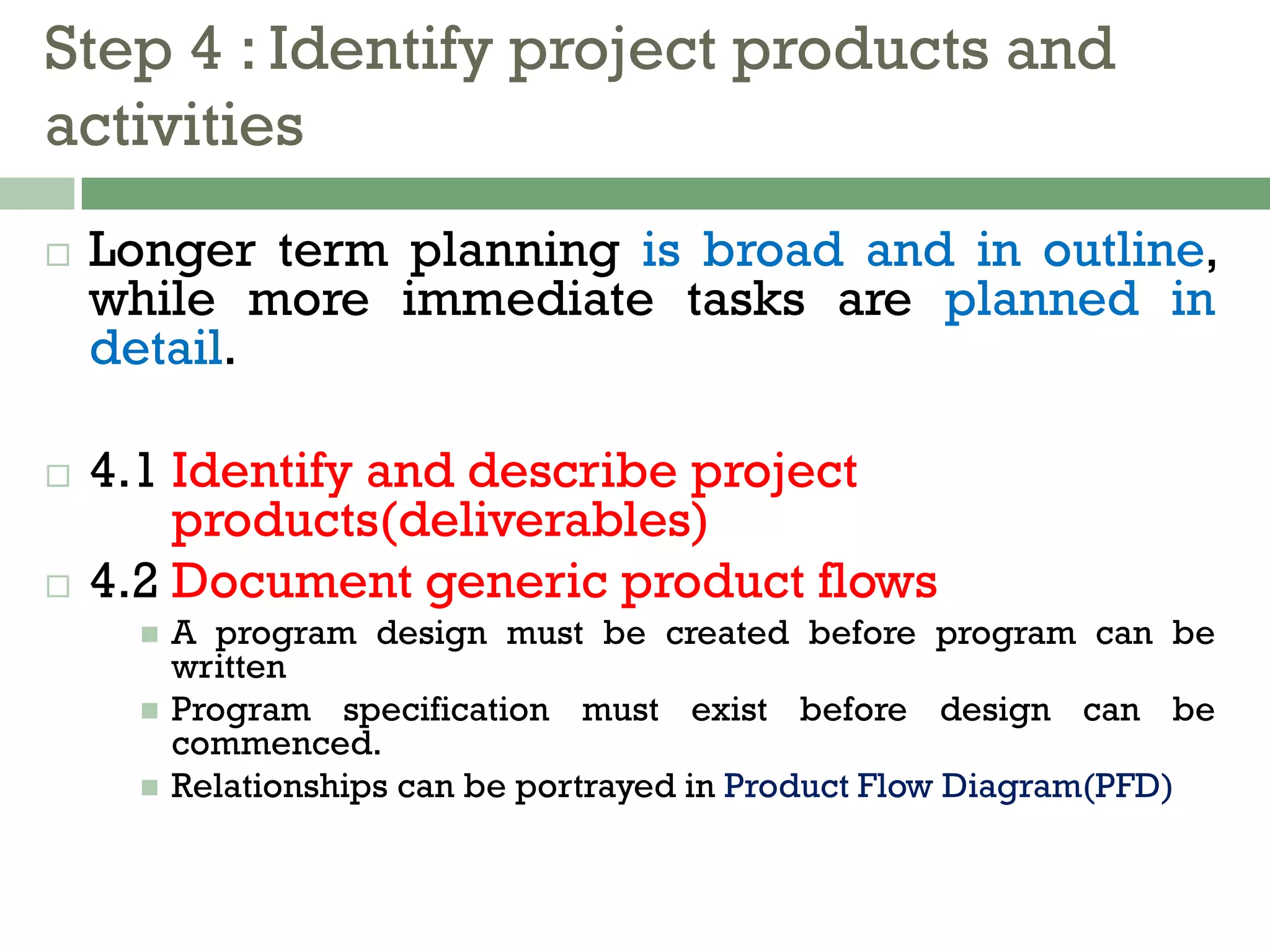
Step 4 : Identify project products and
activities
 Longer term planning is broad and in outline,
while more immediate tasks are planned in
detail.
 4.1 Identify and describe project
products(deliverables)
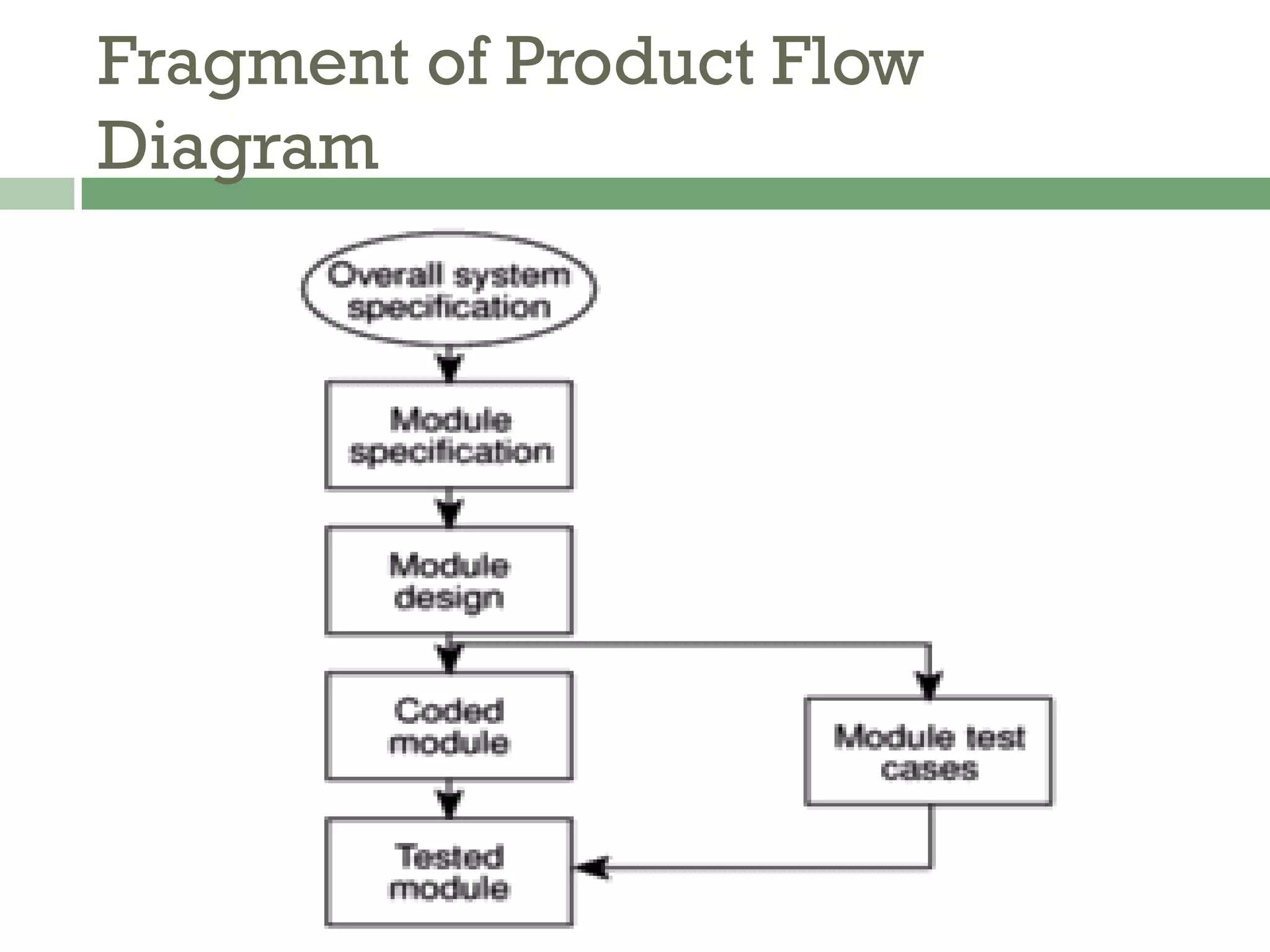
 4.2 Document generic product flows
 A program design must be created before program can be
written
 Program specification must exist before design can be
commenced.
 Relationships can be portrayed in Product Flow Diagram(PFD)
Product Description Contains
 Name/Identity of the product
 Purpose of the product
 Derivation of the product
 Composition of the product
 Relevant Standards
 Quality criteria that define whether the
product is acceptable.
Fragment of Product Flow
Diagram
…
 4.3 Recognize product instances
 Component software modules in the software to be
built.
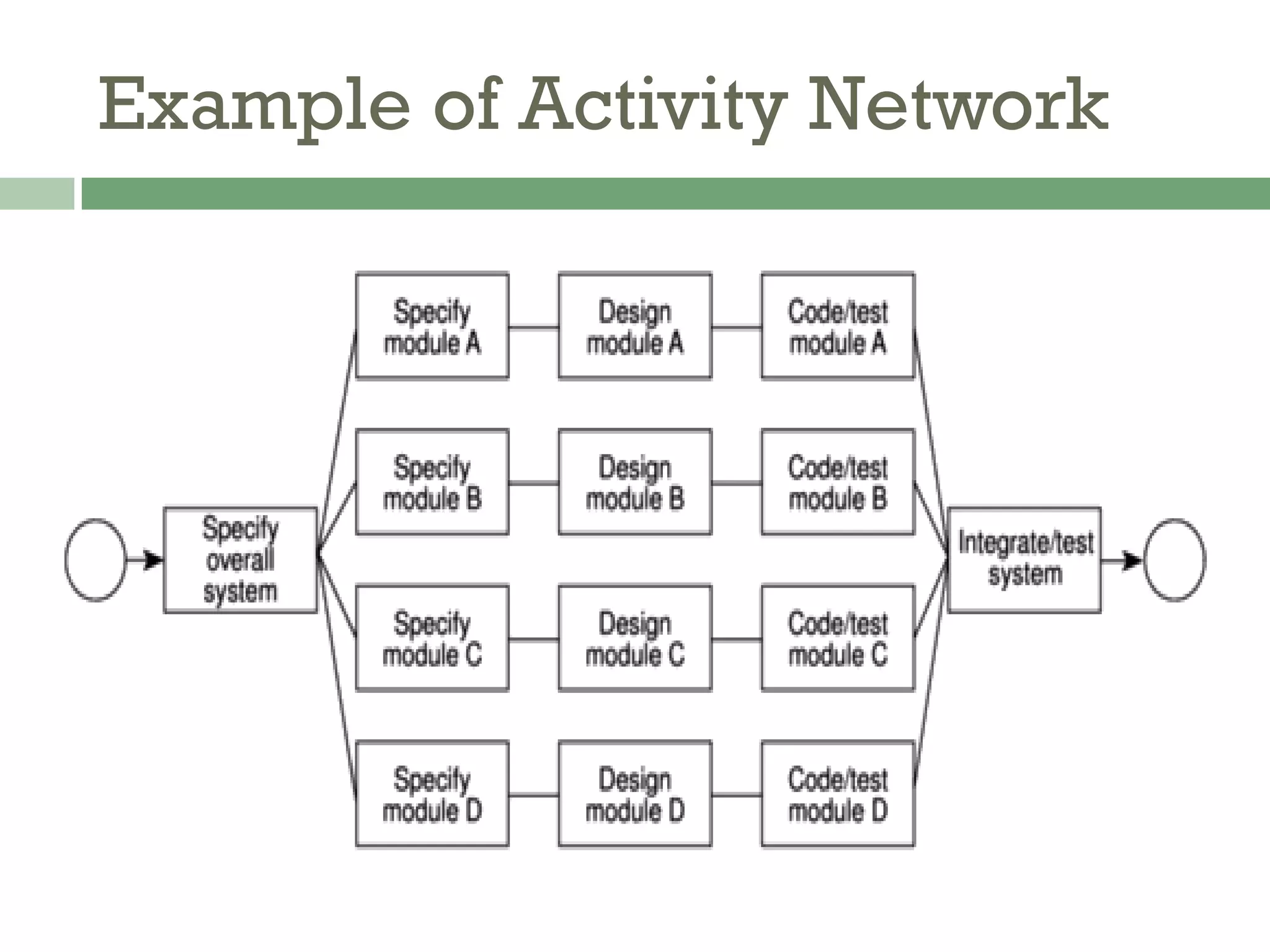
 4.4 Produce ideal activity network
 Resources are available for both software modules
to be developed in parallel.
Example of Activity Network
 4.5 Modify the ideal to take into account
need for stages and checkpoints
 Dividing the project into stages and introducing
checkpoint activities.
 Checkpoint activities are often useful milestones.
 Activity with no duration that indicates the start or
end of group of activities.
Step 5 : Estimate Effort for each
Activity
 5.1 Carry out bottom up estimates.
 Estimates of effort, cost and duration will already have
been done.
 5.2 Revise plan to create controllable activities.
 System testing involving longer time
Step 6: Identify Activity Risks
 6.1 Identify and Quantify activity based risks.
 6.2 Plan risk reduction and contingency
measures where appropriate
 6.3 Adjust overall plans and estimates to take
account of risks
Step 7 : Allocate resources
 7.1 Identify and Allocate Resources
 Type of staff needed for each activity and provisionally
allocated for each tasks.
 7.2 Revise plans and estimates to take into
account resource constraints
 Some staff may be needed for more than one task at the
same time and order of priority to be established.
 Decisions made will have an effect on overall duration of
project.
Step 8: Review/ Publicize plan
 8.1 Review quality aspects of the project plan
 8.2 Document plans and obtain agreement
Steps 9 and 10: Execute
plan/Lower levels of planning
 Provisional plans for more distant tasks has
to be performed
Software Effort Estimation
 Successful project is that the system is
delivered on time and within budget and
with the required quality.
Software effort estimation
Difficulties in Software estimation
 Subjective Nature of estimating
 Political Implications
 Changing Technology
 Lack of homogeneity of project experience
Project Data
Note:
SLOC - Source Number of Lines of Code
WM -Work in Month
Where are estimates done?
 Estimates are carried out at various stages of
software project.
 Strategic Planning
 Decide priority to each project.
 Feasibility Study
 Benefits of potential system
 System Specification
 Detailed requirement analysis at design stage.
 Evaluation of Suppliers Proposals
 Tender Management
 Project Planning
 Detailed estimates of smaller work components during
implementation.
Software Effort Estimation
Techniques
 Algorithmic Models
 Expert Judgment
 Analogy – Similar Completed Project
 Parkinson – Staff Effort available to do project
 Price to Win – Sufficiently low to win a contract.
 Top-down – Overall estimate is formulated
 Bottom-up – Individual components are
aggregated
Bottom-up Estimating
 Work Breakdown Structure
 Assumptions about characteristics of final
system
 Number and Size of software modules.
 Appropriate at detailed stages of project
planning.
 When a project is completely novel or no
historical data available.
Top-down Approach and
Parametric Models
 Effort = (system size ) * (productivity rate)
 System size in the form of KLOC
 Productivity rate 40 days per KLOC
 Software module to be constructed is 2 KLOC
 Effort = 2 * 80 = 160 days
Note:
KLOC- Thousands of Lines of Code
Expert Judgment
 Asking for estimate of task effort from
someone who is knowledgeable about either
application or development environment.
 Experts use the combination of informal
analogy approach where similar projects
from past are identified and bottom up
estimating.
Estimating by Analogy
 Called “Case Based Analogy”
 Estimator identifies completed projects
source cases with similar characteristics to
new project (target case)
 Effort of the source case used as base
estimate for target.
 TOOL – ANGEL software tool
 Measuring Euclidean Distance between the
cases
Euclidean Distance
Problems with Over and Under
Estimates
 Parkinson’s Law
 “Given an easy target staff will work less hard”
 Brook’s Law
 Effort required to implement a project will go up
disproportionately with the number of staff assigned
to the project
 “ Putting more people on a late job makes it later”
Measure of Work
 Measure such as SLOC ( Source Lines of Code)
 KLOC ( Thousand Lines of Code)
Albrecht Function Point Analysis
 Top - down method devised by Allan
Albrecht(IBM)
 Developed the idea of Function Points(FPs)
 Basis of function point analysis has five
components:
 External Input Types
 External Output Types
 External Inquiry Types – US spelling inquiry
 Logical Internal File Types – Data store
 External Interface File Types – To & Fro (BACS)
Albrecht Complexity Multipliers
IFPUG File Type Complexity
Function Points Mark II
 Sponsored by CCTA(Central Computer and
Telecommunications Agency)
 Mark II – Improvement and replacement in
Albrecht method
 In Albrecht method
 Information Processing Size is measured in
UFPs(Unadjusted Functional Points)
 Then TCA(Technical Complexity Adjustment) is
applied
Model of Transaction
Data Store
ProcessFrom User Return to
User
Input Output
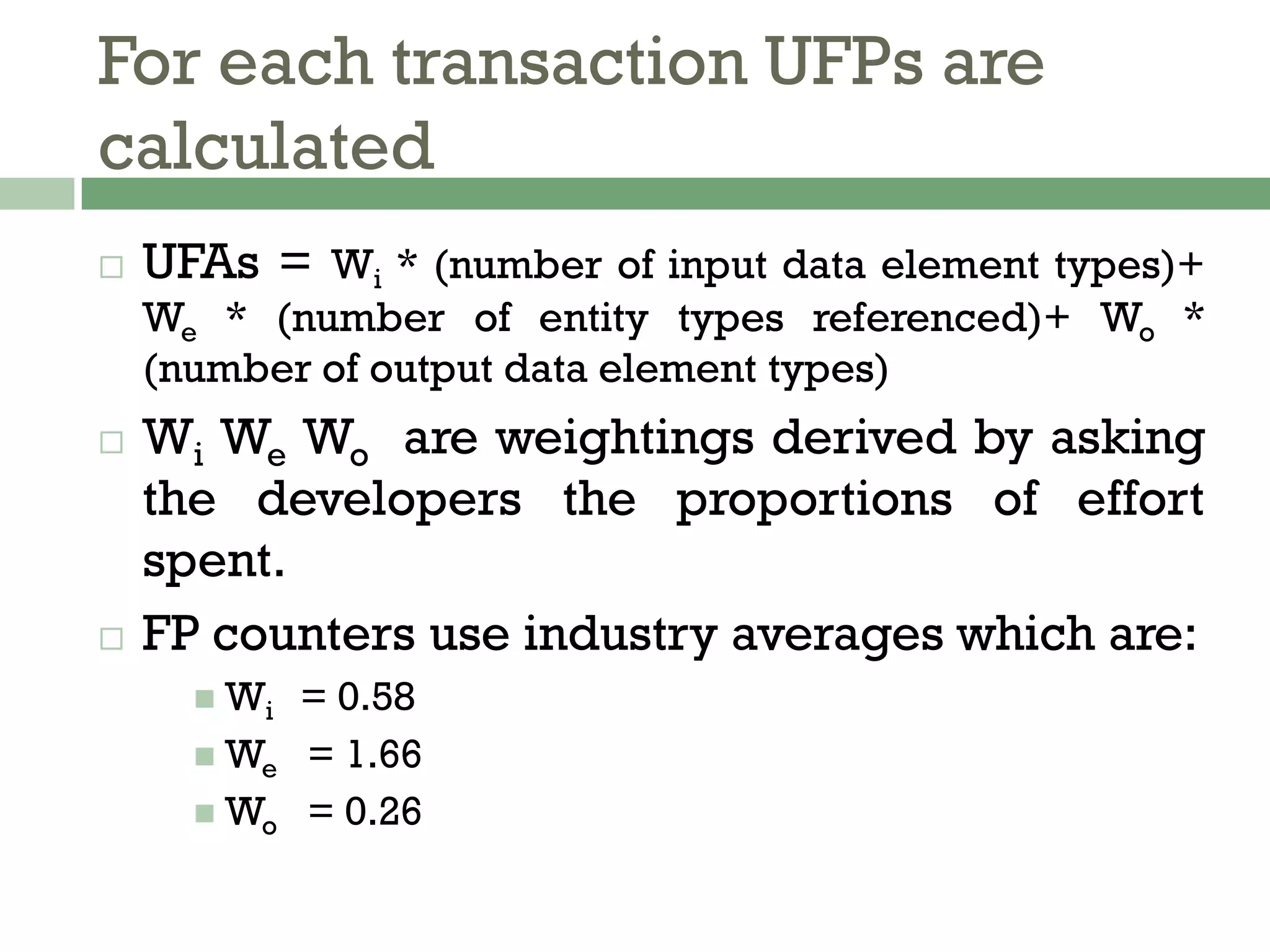
For each transaction UFPs are
calculated
 UFAs = Wi * (number of input data element types)+
We * (number of entity types referenced)+ Wo *
(number of output data element types)
 Wi We Wo are weightings derived by asking
the developers the proportions of effort
spent.
 FP counters use industry averages which are:
 Wi = 0.58
 We = 1.66
 Wo = 0.26
COSMIC Full Function Points
 Cosmic deals with decomposing the system
architecture into hierarchy of software layers.
 Inputs and outputs are aggregated into data
groups
 Each data group brings together data items that
relate to the same object of interest
 Groups can be moved in 4 ways:
 Entries(E)
 Exits(X)
 Reads ( R)
 Writes(W)

Spm project planning

  • 1.
  • 2.
    Project Planning  Step0: Select Project  Step 1: Identify Project Scope & Objectives  Step 2: Identify Project Infrastructure  Step 3: Analyse Project Characteristics  Step 4: Identify Project Products & Activities  Step 5: Estimate Effort for Each Activity
  • 3.
    Project Planning- Continued… Step 6: Identify Activity Risks  Step 7: Allocate Resources  Step 8: Review/ Publicize Plan  Step 9 & 10: Execute Plan/Lower Level Planning
  • 5.
    Step 0: SelectProject  It is outside the main project planning process.  A feasibility study might suggest that there is a business case for the project.
  • 6.
    Step 1 :Identify Project Scope and Objectives  1.1 Identify objectives and measures of effectiveness in meeting them  1.2 Establish a project authority  1.3 Identify Stakeholders  1.4 Modify objectives in light of stakeholder analysis adding new features  1.5 Establish methods of communication with all parties
  • 7.
    Step 2 :Identify Project Infrastructure 2.1 Establish relationship between project and strategic planning  Compliance with enterprise architecture. 2.2 Identify installation standards and procedures  Define development procedures, Normal stages in software life cycle.  Change control and Configuration Management 2.3 Identify project team organization  Decision about grouping business analysts and software developers.
  • 8.
    Step 3 :Analyze Project Characteristics  Ensure appropriate methods are used for project.  3.1 Distinguish project either objective or product driven  3.2 Analyze other project characteristics  System will be safety critical,where human life could be threatened.  3.3 Identify high level project risks  Most risks attributed to operational or development environment.
  • 9.
     3.4 Takeinto account user requirements concerning implementation.  Client may have own procedural requirement  3.5 Select development methodology and life-cycle approach  3.6 Review overall resource estimate  Re-estimate the effort and other resources required to implement the project.
  • 10.
    Step 4 :Identify project products and activities  Longer term planning is broad and in outline, while more immediate tasks are planned in detail.  4.1 Identify and describe project products(deliverables)  4.2 Document generic product flows  A program design must be created before program can be written  Program specification must exist before design can be commenced.  Relationships can be portrayed in Product Flow Diagram(PFD)
  • 11.
    Product Description Contains Name/Identity of the product  Purpose of the product  Derivation of the product  Composition of the product  Relevant Standards  Quality criteria that define whether the product is acceptable.
  • 12.
    Fragment of ProductFlow Diagram
  • 13.
    …  4.3 Recognizeproduct instances  Component software modules in the software to be built.  4.4 Produce ideal activity network  Resources are available for both software modules to be developed in parallel.
  • 14.
  • 15.
     4.5 Modifythe ideal to take into account need for stages and checkpoints  Dividing the project into stages and introducing checkpoint activities.  Checkpoint activities are often useful milestones.  Activity with no duration that indicates the start or end of group of activities.
  • 16.
    Step 5 :Estimate Effort for each Activity  5.1 Carry out bottom up estimates.  Estimates of effort, cost and duration will already have been done.  5.2 Revise plan to create controllable activities.  System testing involving longer time
  • 17.
    Step 6: IdentifyActivity Risks  6.1 Identify and Quantify activity based risks.  6.2 Plan risk reduction and contingency measures where appropriate  6.3 Adjust overall plans and estimates to take account of risks
  • 18.
    Step 7 :Allocate resources  7.1 Identify and Allocate Resources  Type of staff needed for each activity and provisionally allocated for each tasks.  7.2 Revise plans and estimates to take into account resource constraints  Some staff may be needed for more than one task at the same time and order of priority to be established.  Decisions made will have an effect on overall duration of project.
  • 19.
    Step 8: Review/Publicize plan  8.1 Review quality aspects of the project plan  8.2 Document plans and obtain agreement
  • 20.
    Steps 9 and10: Execute plan/Lower levels of planning  Provisional plans for more distant tasks has to be performed
  • 21.
    Software Effort Estimation Successful project is that the system is delivered on time and within budget and with the required quality.
  • 22.
    Software effort estimation Difficultiesin Software estimation  Subjective Nature of estimating  Political Implications  Changing Technology  Lack of homogeneity of project experience
  • 23.
    Project Data Note: SLOC -Source Number of Lines of Code WM -Work in Month
  • 24.
    Where are estimatesdone?  Estimates are carried out at various stages of software project.  Strategic Planning  Decide priority to each project.  Feasibility Study  Benefits of potential system  System Specification  Detailed requirement analysis at design stage.  Evaluation of Suppliers Proposals  Tender Management  Project Planning  Detailed estimates of smaller work components during implementation.
  • 25.
    Software Effort Estimation Techniques Algorithmic Models  Expert Judgment  Analogy – Similar Completed Project  Parkinson – Staff Effort available to do project  Price to Win – Sufficiently low to win a contract.  Top-down – Overall estimate is formulated  Bottom-up – Individual components are aggregated
  • 26.
    Bottom-up Estimating  WorkBreakdown Structure  Assumptions about characteristics of final system  Number and Size of software modules.  Appropriate at detailed stages of project planning.  When a project is completely novel or no historical data available.
  • 27.
    Top-down Approach and ParametricModels  Effort = (system size ) * (productivity rate)  System size in the form of KLOC  Productivity rate 40 days per KLOC  Software module to be constructed is 2 KLOC  Effort = 2 * 80 = 160 days Note: KLOC- Thousands of Lines of Code
  • 28.
    Expert Judgment  Askingfor estimate of task effort from someone who is knowledgeable about either application or development environment.  Experts use the combination of informal analogy approach where similar projects from past are identified and bottom up estimating.
  • 29.
    Estimating by Analogy Called “Case Based Analogy”  Estimator identifies completed projects source cases with similar characteristics to new project (target case)  Effort of the source case used as base estimate for target.  TOOL – ANGEL software tool  Measuring Euclidean Distance between the cases
  • 30.
  • 31.
    Problems with Overand Under Estimates  Parkinson’s Law  “Given an easy target staff will work less hard”  Brook’s Law  Effort required to implement a project will go up disproportionately with the number of staff assigned to the project  “ Putting more people on a late job makes it later”
  • 32.
    Measure of Work Measure such as SLOC ( Source Lines of Code)  KLOC ( Thousand Lines of Code)
  • 33.
    Albrecht Function PointAnalysis  Top - down method devised by Allan Albrecht(IBM)  Developed the idea of Function Points(FPs)  Basis of function point analysis has five components:  External Input Types  External Output Types  External Inquiry Types – US spelling inquiry  Logical Internal File Types – Data store  External Interface File Types – To & Fro (BACS)
  • 34.
  • 35.
    IFPUG File TypeComplexity
  • 36.
    Function Points MarkII  Sponsored by CCTA(Central Computer and Telecommunications Agency)  Mark II – Improvement and replacement in Albrecht method  In Albrecht method  Information Processing Size is measured in UFPs(Unadjusted Functional Points)  Then TCA(Technical Complexity Adjustment) is applied
  • 37.
    Model of Transaction DataStore ProcessFrom User Return to User Input Output
  • 38.
    For each transactionUFPs are calculated  UFAs = Wi * (number of input data element types)+ We * (number of entity types referenced)+ Wo * (number of output data element types)  Wi We Wo are weightings derived by asking the developers the proportions of effort spent.  FP counters use industry averages which are:  Wi = 0.58  We = 1.66  Wo = 0.26
  • 39.
    COSMIC Full FunctionPoints  Cosmic deals with decomposing the system architecture into hierarchy of software layers.  Inputs and outputs are aggregated into data groups  Each data group brings together data items that relate to the same object of interest  Groups can be moved in 4 ways:  Entries(E)  Exits(X)  Reads ( R)  Writes(W)