SPM-UNIT II
ACTIVITY PLANNING
Prof. Kanchana Devi
Activity Planning – Intro..
 A detailed project must include a schedule
indicating the start and completion times for
each activity.
2
Prof. Kanchana Devi
So that…
 Ensure resources will be available when required.
 Avoid different activities competing for the same
resource at same time.
 Produce a detailed schedule showing which staff
carry out each activity.
 Produce a detailed plan against which actual
achievement may be measured.
 Produce a timed cash flow forecast.
 Re-plan the project – correct drift from target
3
Prof. Kanchana Devi
Objectives
Prof. Kanchana Devi
4
 Feasibility Assessment
 Resource Allocation
 Detailed Costing
 Motivation
 Co-ordination
When to plan..
Prof. Kanchana Devi
5
 Planning is an ongoing process of refinement,
each iteration becoming more detailed and
more accurate than the last.
 Feasibility Study:
 Timescale
 Risk of not achieving the target completion date
 Keeping within budget.
 Activity plan:
 Resource availability
 Cash-flow control
Projects and Activities
Prof. Kanchana Devi
6
 A project
 Composed of number of interrelated activities
 May start when at least one of its activities is ready to start.
 Will be completed when all of the activities have been completed
 An Activity
 Clearly define start and end-point
 Requires a resource then requirement must be forecastable
 Duration of an activity must be forecastable
 Some activity might require that others are completed before
they can begin “Precedence Requirement”
Identifying Activities
Prof. Kanchana Devi
7
 Three Approaches
 The activity based approach
 The product based approach
 The hybrid approach
I. Activity Based Approach
Prof. Kanchana Devi
8
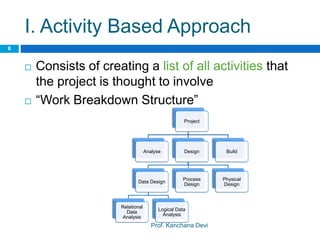
 Consists of creating a list of all activities that
the project is thought to involve
 “Work Breakdown Structure”
Project
Analyse Design
Data Design
Relational
Data
Analysis
Logical Data
Analysis
Process
Design
Physical
Design
Build
II. Product Based Approach
Prof. Kanchana Devi
9
 It consists of producing a Product Breakdown
Structure and a Product Flow Diagram(PFD).
 A PFD can easily be converted into an ordered
list of activities
III. The Hybrid Approach
Prof. Kanchana Devi
10
 IBM recommend the following five levels
should be used in WBS:
 Level 1: Project
 Level 2:Deliverables
 Level 3: Components
 Level 4: Work-Packages
 Level 5: Tasks
Sequencing and Scheduling
Activities11
We
eks
1 2 3 4 5 6 7 8 9 10 11 12 13
A:
B:
C:
D:
E:
F:
G:
H:
I:
A: Overall Design E:Code Module 1 I: System Testing
B: Specify Module 1 F:Code Module 3
C: Specify Module 2G:Code Module 2
D: Specify Module 3H:Integration Testing

SPM Activity Planning Introduction

  • 1.
  • 2.
    Activity Planning –Intro..  A detailed project must include a schedule indicating the start and completion times for each activity. 2 Prof. Kanchana Devi
  • 3.
    So that…  Ensureresources will be available when required.  Avoid different activities competing for the same resource at same time.  Produce a detailed schedule showing which staff carry out each activity.  Produce a detailed plan against which actual achievement may be measured.  Produce a timed cash flow forecast.  Re-plan the project – correct drift from target 3 Prof. Kanchana Devi
  • 4.
    Objectives Prof. Kanchana Devi 4 Feasibility Assessment  Resource Allocation  Detailed Costing  Motivation  Co-ordination
  • 5.
    When to plan.. Prof.Kanchana Devi 5  Planning is an ongoing process of refinement, each iteration becoming more detailed and more accurate than the last.  Feasibility Study:  Timescale  Risk of not achieving the target completion date  Keeping within budget.  Activity plan:  Resource availability  Cash-flow control
  • 6.
    Projects and Activities Prof.Kanchana Devi 6  A project  Composed of number of interrelated activities  May start when at least one of its activities is ready to start.  Will be completed when all of the activities have been completed  An Activity  Clearly define start and end-point  Requires a resource then requirement must be forecastable  Duration of an activity must be forecastable  Some activity might require that others are completed before they can begin “Precedence Requirement”
  • 7.
    Identifying Activities Prof. KanchanaDevi 7  Three Approaches  The activity based approach  The product based approach  The hybrid approach
  • 8.
    I. Activity BasedApproach Prof. Kanchana Devi 8  Consists of creating a list of all activities that the project is thought to involve  “Work Breakdown Structure” Project Analyse Design Data Design Relational Data Analysis Logical Data Analysis Process Design Physical Design Build
  • 9.
    II. Product BasedApproach Prof. Kanchana Devi 9  It consists of producing a Product Breakdown Structure and a Product Flow Diagram(PFD).  A PFD can easily be converted into an ordered list of activities
  • 10.
    III. The HybridApproach Prof. Kanchana Devi 10  IBM recommend the following five levels should be used in WBS:  Level 1: Project  Level 2:Deliverables  Level 3: Components  Level 4: Work-Packages  Level 5: Tasks
  • 11.
    Sequencing and Scheduling Activities11 We eks 12 3 4 5 6 7 8 9 10 11 12 13 A: B: C: D: E: F: G: H: I: A: Overall Design E:Code Module 1 I: System Testing B: Specify Module 1 F:Code Module 3 C: Specify Module 2G:Code Module 2 D: Specify Module 3H:Integration Testing