Software Project Management
(Step-Wise Project Planning)
Contents
❑ Overview of Project Planning
❑ Different Steps of Project Planning
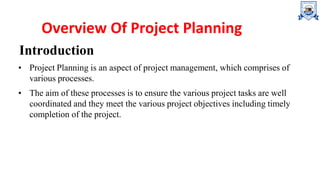
Overview Of Project Planning
Introduction
• Project Planning is an aspect of project management, which comprises of
various processes.
• The aim of these processes is to ensure the various project tasks are well
coordinated and they meet the various project objectives including timely
completion of the project.
Stepwise Project Planning
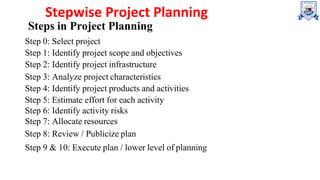
Steps in Project Planning
Step 0: Select project
Step 1: Identify project scope and objectives
Step 2: Identify project infrastructure
Step 3: Analyze project characteristics
Step 4: Identify project products and activities
Step 5: Estimate effort for each activity
Step 6: Identify activity risks
Step 7: Allocate resources
Step 8: Review / Publicize plan
Step 9 & 10: Execute plan / lower level of planning
Source:-Bob Hughes & Mike Cotterell [1]
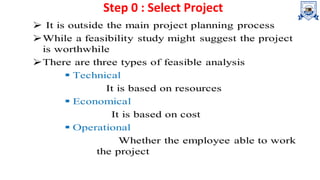
Step 0 : Select Project
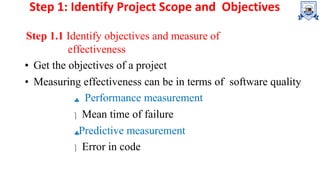
Step 1: Identify Project Scope and Objectives
Step 1.1 Identify objectives and measure of
effectiveness
• Get the objectives of a project
• Measuring effectiveness can be in terms of software quality
 Performance measurement
 Mean time of failure
Predictive measurement
 Error in code
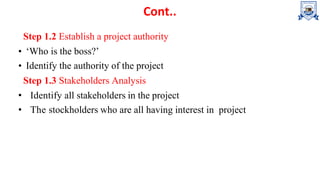
Cont..
Step 1.2 Establish a project authority
• ‘Who is the boss?’
• Identify the authority of the project
Step 1.3 Stakeholders Analysis
• Identify all stakeholders in the project
• The stockholders who are all having interest in project
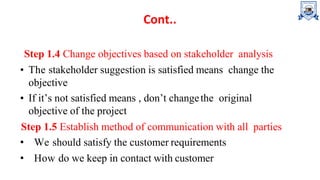
Cont..
Step 1.4 Change objectives based on stakeholder analysis
• The stakeholder suggestion is satisfied means change the
objective
• If it’s not satisfied means , don’t changethe original
objective of the project
Step 1.5 Establish method of communication with all parties
• We should satisfy the customer requirements
• How do we keep in contact with customer
Step 2: Establish project infrastructure
Step 2.1: Identify relationship between project and strategic
planning
• What are the standard methods going to complete the project
Step 2.2: Identify installation standards and procedures
• What are the front end and Back end
• Software are going to use in this project
Step 2.3: Identify project team organization
• Order of organizing to the project
Step 3:Analyze project characteristics
Step 3.1 :Distinguish project as objective driven or product driven
Product - It will be given by the user & design by external person
Objective - Problem is given
Step 3.2 : Analyze other project characteristics
Including quality – based ones
What are the problems going to solve
Cont..
Step 3.3: Identify high level of project risks
• Identify the level of risk
Step 3.4: Take user requirement concerning implementation
• Confirm with the user requirement
Step 3.5: Select development methodology and life cycle approach
• Step by step process ,what are the methods going to follow in the
project.
Step 3.6:Review overall resource estimation
• After risk identification, re-estimate effort & resources of project
Step 4 : Identify Project Products and Activities
Step 4.1: Identify and describes project products
Deliverable: Product handover to user
• In this step identify each and every phase
• Identify the project going to deliver
• Each and every stage consider as a product
• Product hierarchy
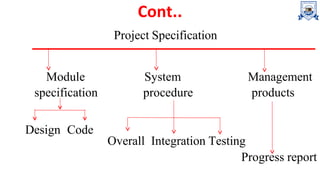
• Project Specification
Module specification
System product
Management product
Cont..
Project Specification
Design
Overall Integration Testing
Progress report
Module System Management
specification procedure products
Code
Cont..
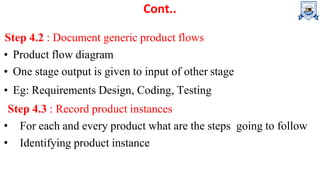
Step 4.2 : Document generic product flows
• Product flow diagram
• One stage output is given to input of other stage
• Eg: Requirements Design, Coding, Testing
Step 4.3 : Record product instances
• For each and every product what are the steps going to follow
• Identifying product instance
Cont..
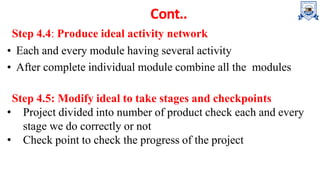
Step 4.4: Produce ideal activity network
• Each and every module having several activity
• After complete individual module combine all the modules
Step 4.5: Modify ideal to take stages and checkpoints
• Project divided into number of product check each and every
stage we do correctly or not
• Check point to check the progress of the project
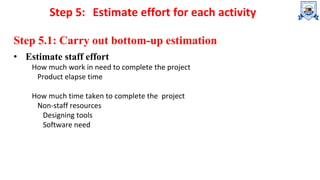
Step 5: Estimate effort for each activity
Step 5.1: Carry out bottom-up estimation
• Estimate staff effort
How much work in need to complete the project
Product elapse time
How much time taken to complete the project
Non-staff resources
Designing tools
Software need
Cont..
Step 5.2: Revise plan to create controllable activities
• Every phase we need to control
• Need to break a task into a series of manageable sub-
tasks
• Break up very long activities into a series of smaller
ones as we can’t judge the status in long activities
Step 6 : Identify activity risks
Step 6.1 : Identify and quantify activity based risks
• Identify risk for each activity
• During the design phase identify the risk
• Identify damage and likelihood
• Identify possibilities of mistakes
Cont..
Step 6.2: Plan risk reduction and contingency measures
where appropriate
Review plan and do some steps for reduce risk
Have the alternative plan
Alternative measurement
Otherwise specify a contingency plan
For example:
Contract temporary developer if team member becomes
unavailable through illness
Cont..
Step 6.3 : Adjust overall plans and estimates to take
account of the risks
Including add new activities - such as training and
practice - if needed
Add new activities which reduce risk
associated with other activities
E.g. Training
Pilot trials
Information gathering
Step 7 : Allocate resources
Step 7.1 : Identify and allocate resources
Type of staff needed for each activity
Staff availability are identified
Staff are provisionally allocated to task
Step 7.2 : Revise plans and estimates to take into
account resource constraints
Staffing constraints
Staffing issues
Step 8 : Review / Publicize Plan
Step 8.1 : Review quality aspects of the project plan
• To ensure each activity is completed with a quality
product
• Each activity should have “exit requirements”
• This ensures the quality of product on each activity
• Check quality of phase before going to next stage
Cont..
Step 8.2 : Document plans and obtain agreements
 All parties understand and agree to the
commitments in the plan
 Make sure everyone understands and agree
 Specify this task in a communication plan if needed
 Develop the documentation
Step 9 & 10 :Execute plan / lower level of
planning
• During the project draw up plans for activities in greater detail
as they become due
• Detail has to wait as more information becomes available
• Especially if you are using an iterative
development approach
• Maintain provisional plans for more important later tasks
• Planning in great detail too soon could be a waste of time
References
1. Bob Hughes, Mike Cotterell and Rajib Mall: Software
Project Management – Fifth Edition, McGraw Hill.
2. https://www.youtube.com/watch?v=B8VbuVIym7k&t=136s
Thank
You

Unit 1.2 Stepwise Project Planning.pdf

  • 1.
  • 2.
    Contents ❑ Overview ofProject Planning ❑ Different Steps of Project Planning
  • 3.
    Overview Of ProjectPlanning Introduction • Project Planning is an aspect of project management, which comprises of various processes. • The aim of these processes is to ensure the various project tasks are well coordinated and they meet the various project objectives including timely completion of the project.
  • 4.
    Stepwise Project Planning Stepsin Project Planning Step 0: Select project Step 1: Identify project scope and objectives Step 2: Identify project infrastructure Step 3: Analyze project characteristics Step 4: Identify project products and activities Step 5: Estimate effort for each activity Step 6: Identify activity risks Step 7: Allocate resources Step 8: Review / Publicize plan Step 9 & 10: Execute plan / lower level of planning
  • 5.
    Source:-Bob Hughes &Mike Cotterell [1]
  • 6.
    Step 0 :Select Project
  • 7.
    Step 1: IdentifyProject Scope and Objectives Step 1.1 Identify objectives and measure of effectiveness • Get the objectives of a project • Measuring effectiveness can be in terms of software quality  Performance measurement  Mean time of failure Predictive measurement  Error in code
  • 8.
    Cont.. Step 1.2 Establisha project authority • ‘Who is the boss?’ • Identify the authority of the project Step 1.3 Stakeholders Analysis • Identify all stakeholders in the project • The stockholders who are all having interest in project
  • 9.
    Cont.. Step 1.4 Changeobjectives based on stakeholder analysis • The stakeholder suggestion is satisfied means change the objective • If it’s not satisfied means , don’t changethe original objective of the project Step 1.5 Establish method of communication with all parties • We should satisfy the customer requirements • How do we keep in contact with customer
  • 10.
    Step 2: Establishproject infrastructure Step 2.1: Identify relationship between project and strategic planning • What are the standard methods going to complete the project Step 2.2: Identify installation standards and procedures • What are the front end and Back end • Software are going to use in this project Step 2.3: Identify project team organization • Order of organizing to the project
  • 11.
    Step 3:Analyze projectcharacteristics Step 3.1 :Distinguish project as objective driven or product driven Product - It will be given by the user & design by external person Objective - Problem is given Step 3.2 : Analyze other project characteristics Including quality – based ones What are the problems going to solve
  • 12.
    Cont.. Step 3.3: Identifyhigh level of project risks • Identify the level of risk Step 3.4: Take user requirement concerning implementation • Confirm with the user requirement Step 3.5: Select development methodology and life cycle approach • Step by step process ,what are the methods going to follow in the project. Step 3.6:Review overall resource estimation • After risk identification, re-estimate effort & resources of project
  • 13.
    Step 4 :Identify Project Products and Activities Step 4.1: Identify and describes project products Deliverable: Product handover to user • In this step identify each and every phase • Identify the project going to deliver • Each and every stage consider as a product • Product hierarchy • Project Specification Module specification System product Management product
  • 14.
    Cont.. Project Specification Design Overall IntegrationTesting Progress report Module System Management specification procedure products Code
  • 15.
    Cont.. Step 4.2 :Document generic product flows • Product flow diagram • One stage output is given to input of other stage • Eg: Requirements Design, Coding, Testing Step 4.3 : Record product instances • For each and every product what are the steps going to follow • Identifying product instance
  • 16.
    Cont.. Step 4.4: Produceideal activity network • Each and every module having several activity • After complete individual module combine all the modules Step 4.5: Modify ideal to take stages and checkpoints • Project divided into number of product check each and every stage we do correctly or not • Check point to check the progress of the project
  • 17.
    Step 5: Estimateeffort for each activity Step 5.1: Carry out bottom-up estimation • Estimate staff effort How much work in need to complete the project Product elapse time How much time taken to complete the project Non-staff resources Designing tools Software need
  • 18.
    Cont.. Step 5.2: Reviseplan to create controllable activities • Every phase we need to control • Need to break a task into a series of manageable sub- tasks • Break up very long activities into a series of smaller ones as we can’t judge the status in long activities
  • 19.
    Step 6 :Identify activity risks Step 6.1 : Identify and quantify activity based risks • Identify risk for each activity • During the design phase identify the risk • Identify damage and likelihood • Identify possibilities of mistakes
  • 20.
    Cont.. Step 6.2: Planrisk reduction and contingency measures where appropriate Review plan and do some steps for reduce risk Have the alternative plan Alternative measurement Otherwise specify a contingency plan For example: Contract temporary developer if team member becomes unavailable through illness
  • 21.
    Cont.. Step 6.3 :Adjust overall plans and estimates to take account of the risks Including add new activities - such as training and practice - if needed Add new activities which reduce risk associated with other activities E.g. Training Pilot trials Information gathering
  • 22.
    Step 7 :Allocate resources Step 7.1 : Identify and allocate resources Type of staff needed for each activity Staff availability are identified Staff are provisionally allocated to task Step 7.2 : Revise plans and estimates to take into account resource constraints Staffing constraints Staffing issues
  • 23.
    Step 8 :Review / Publicize Plan Step 8.1 : Review quality aspects of the project plan • To ensure each activity is completed with a quality product • Each activity should have “exit requirements” • This ensures the quality of product on each activity • Check quality of phase before going to next stage
  • 24.
    Cont.. Step 8.2 :Document plans and obtain agreements  All parties understand and agree to the commitments in the plan  Make sure everyone understands and agree  Specify this task in a communication plan if needed  Develop the documentation
  • 25.
    Step 9 &10 :Execute plan / lower level of planning • During the project draw up plans for activities in greater detail as they become due • Detail has to wait as more information becomes available • Especially if you are using an iterative development approach • Maintain provisional plans for more important later tasks • Planning in great detail too soon could be a waste of time
  • 26.
    References 1. Bob Hughes,Mike Cotterell and Rajib Mall: Software Project Management – Fifth Edition, McGraw Hill. 2. https://www.youtube.com/watch?v=B8VbuVIym7k&t=136s
  • 27.