
SOFTWARE PROJECT
MANAGEMENT
Prof. Kanchana Devi V
“Project Evaluation”
 “Business Case” document will contain
Introduction & background to the proposal -
Current Environment
Proposed project – Outline
Market- Estimated demand for product or
service
Organizational & Operational Infrastructure -
How structure of organization will be affected
by implementation of project.
“Project Evaluation”
 Benefits - A financial value
 Outline Implementation Plan - Marketing,
Promotion and operational and maintenance
infrastructure.
 Costs - Schedule of expected costs with planned
approach.
 The Financial case - Information on income and
costs can be analyzed.
 Risks- Threats to successful project execution –
from business risk – relating to factors threatening
benefits of delivered project
 Management Plan
“Project Portfolio Management”
 Provides an overview of all the
projects that an organization is
undertaking
 It priorities the allocation of resources
to the projects
 Decides which one to be accepted
and which one to be dropped
Concerns of portfolio management
 Identifying which project proposals are
worth implementation
 Assessing the amount of risk of failure
 Deciding how to share limited resources
 Aware of dependencies among projects
 Ensuring that projects do not duplicate
work
Portfolio can be categorized into
 Portfolio Definition
 Portfolio Management
 Portfolio Optimization
Portfolio Definition
 An organization should record in a single
repository details of all current projects
Portfolio Management
 More detailed costing of projects can be
recorded
 Actual performance will be tracked
Portfolio Optimization
 Performance can be tracked by high-level
managers on regular basis
 A better balance of projects may be achieved
 The portfolio should have careful thought-out
balance between two types of projects
 Modest benefit- Fewer risk
 Very profitable- Risky
Evaluation of Individual Projects
 Technical Assessment
 Whether the required functionality can be
achieved with current affordable technologies.
Cost Benefit Analysis (CBA)
You need to:
 Identify all the costs which could be:
 Development Costs - Recruitment and Staff Training
 Set-up Costs – Cost of putting the system into place
 Operational Costs – Operating the system after
installation.
 Expressing these costs and benefits in common
units
 Check benefits are greater than costs
Cost-benefit Evaluation Techniques
 ‘Year 0’ represents all the costs before system in operation
 ‘Cash-flow’ is value of income less outgoing
Year Cash-flow
0 -100,000
1 10,000
2 10,000
3 10,000
4 20,000
5 100,000
Net profit 50,000
Payback Period
 This is the time it takes to break or pay back
the initial investment.
 The project with shortest payback period will
be chosen.
Year Cash-flow Accumulated
0 -100,000 -100,000
1 10,000 -90,000
2 10,000 -80,000
3 10,000 -70,000
4 20,000 -50,000
5 100,000 50,000
Return On Investment (ROI)
ROI = Average Annual Profit
Total Investment
X 100
In the previous example
 Average Annual Profit
= 50,000/5
= 10,000
 ROI = 10,000/100,000 X 100 = 10%
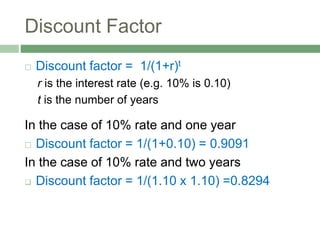
Discount Factor
 Discount factor = 1/(1+r)t
r is the interest rate (e.g. 10% is 0.10)
t is the number of years
In the case of 10% rate and one year
 Discount factor = 1/(1+0.10) = 0.9091
In the case of 10% rate and two years
 Discount factor = 1/(1.10 x 1.10) =0.8294
Net Present Value
 Project evaluation technique that considers
profitability of a project and timing of cash
flows that are produced.
 Present value of any future cash flow :
Present value = value in year t / (1+r)t
Applying Discount Factors
Year Cash-flow Discount factor Discounted
cash flow
0 -100,000 1.0000 -100,000
1 10,000 0.9091 9,091
2 10,000 0.8264 8,264
3 10,000 0.7513 7,513
4 20,000 0.6830 13,660
5 100,000 0.6209 62,090
NPV 618
NPV for a project is obtained by discounting each flow (both negative and
positive) and summing the discounted flows.
NPV-Net Present Value
 NPV for a project is obtained by discounting
each flow (both negative and positive) and
summing the discounted flows.

SPM Evaluation

  • 1.
  • 2.
    “Project Evaluation”  “BusinessCase” document will contain Introduction & background to the proposal - Current Environment Proposed project – Outline Market- Estimated demand for product or service Organizational & Operational Infrastructure - How structure of organization will be affected by implementation of project.
  • 3.
    “Project Evaluation”  Benefits- A financial value  Outline Implementation Plan - Marketing, Promotion and operational and maintenance infrastructure.  Costs - Schedule of expected costs with planned approach.  The Financial case - Information on income and costs can be analyzed.  Risks- Threats to successful project execution – from business risk – relating to factors threatening benefits of delivered project  Management Plan
  • 4.
    “Project Portfolio Management” Provides an overview of all the projects that an organization is undertaking  It priorities the allocation of resources to the projects  Decides which one to be accepted and which one to be dropped
  • 5.
    Concerns of portfoliomanagement  Identifying which project proposals are worth implementation  Assessing the amount of risk of failure  Deciding how to share limited resources  Aware of dependencies among projects  Ensuring that projects do not duplicate work
  • 6.
    Portfolio can becategorized into  Portfolio Definition  Portfolio Management  Portfolio Optimization
  • 7.
    Portfolio Definition  Anorganization should record in a single repository details of all current projects
  • 8.
    Portfolio Management  Moredetailed costing of projects can be recorded  Actual performance will be tracked
  • 9.
    Portfolio Optimization  Performancecan be tracked by high-level managers on regular basis  A better balance of projects may be achieved  The portfolio should have careful thought-out balance between two types of projects  Modest benefit- Fewer risk  Very profitable- Risky
  • 10.
    Evaluation of IndividualProjects  Technical Assessment  Whether the required functionality can be achieved with current affordable technologies.
  • 11.
    Cost Benefit Analysis(CBA) You need to:  Identify all the costs which could be:  Development Costs - Recruitment and Staff Training  Set-up Costs – Cost of putting the system into place  Operational Costs – Operating the system after installation.  Expressing these costs and benefits in common units  Check benefits are greater than costs
  • 12.
    Cost-benefit Evaluation Techniques ‘Year 0’ represents all the costs before system in operation  ‘Cash-flow’ is value of income less outgoing Year Cash-flow 0 -100,000 1 10,000 2 10,000 3 10,000 4 20,000 5 100,000 Net profit 50,000
  • 13.
    Payback Period  Thisis the time it takes to break or pay back the initial investment.  The project with shortest payback period will be chosen. Year Cash-flow Accumulated 0 -100,000 -100,000 1 10,000 -90,000 2 10,000 -80,000 3 10,000 -70,000 4 20,000 -50,000 5 100,000 50,000
  • 14.
    Return On Investment(ROI) ROI = Average Annual Profit Total Investment X 100 In the previous example  Average Annual Profit = 50,000/5 = 10,000  ROI = 10,000/100,000 X 100 = 10%
  • 15.
    Discount Factor  Discountfactor = 1/(1+r)t r is the interest rate (e.g. 10% is 0.10) t is the number of years In the case of 10% rate and one year  Discount factor = 1/(1+0.10) = 0.9091 In the case of 10% rate and two years  Discount factor = 1/(1.10 x 1.10) =0.8294
  • 16.
    Net Present Value Project evaluation technique that considers profitability of a project and timing of cash flows that are produced.  Present value of any future cash flow : Present value = value in year t / (1+r)t
  • 17.
    Applying Discount Factors YearCash-flow Discount factor Discounted cash flow 0 -100,000 1.0000 -100,000 1 10,000 0.9091 9,091 2 10,000 0.8264 8,264 3 10,000 0.7513 7,513 4 20,000 0.6830 13,660 5 100,000 0.6209 62,090 NPV 618 NPV for a project is obtained by discounting each flow (both negative and positive) and summing the discounted flows.
  • 18.
    NPV-Net Present Value NPV for a project is obtained by discounting each flow (both negative and positive) and summing the discounted flows.