SE403
SOFTWARE PROJECT
MANAGEMENT
CHAPTER 3
AN OVERVIEW OF
PROJECT PLANNING
Assist. Prof. Dr. Volkan TUNALI
Faculty of Engineering / Maltepe University
2
Overview
 Introduction to Step Wise Project Planning
 Select Project
 Identify Project Scope and Objectives
 Identify Project Infrastructure
 Analyze Project Characteristics
 Identify Project Products and Activities
 Estimate Effort for Each Activity
 Identify Activity Risks
 Allocate Resources
 Review/Publicize Plan
 Execute Plan/Lower Levels of Planning
3
Introduction to Project Planning
 Project planning
 guides the execution of the project, coordinating the activities.
 facilitates better communication between the project
stakeholders.
 provides a means of tracking and monitoring the progress.
 provides a detailed documentation regarding planning
decisions.
 Project planning is of significant importance for the success
of the project.
 Careful planning helps prevent costly mistakes.
 Good planning is the key to meet the project objectives within
defined time and budget.
4
Introduction to Project Planning
 Many different techniques can be used for project
planning.
 This chapter introduces the Step Wise method.
 An example to other methods is the PRINCE2 method.
 It is a set of project management standards that were originally
sponsored by the Office of Government Commerce (OGC) for
use on British governtment ICT and business change projects.
The standarts are now also widely used on non-government
projects in the UK.
 Step Wise method is also compatible with PRINCE2.
 Step Wise covers only the planning stages of a project and not
monitoring and control.
5
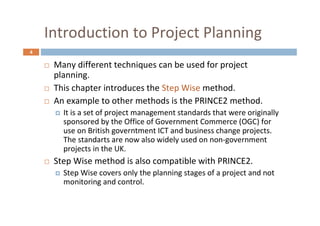
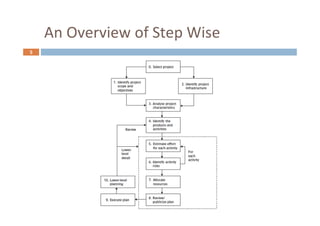
An Overview of Step Wise
6
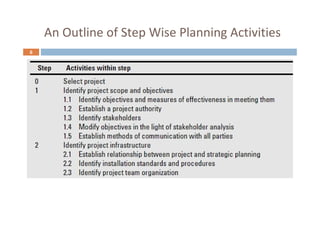
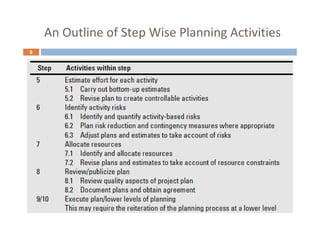
An Outline of Step Wise Planning Activities
7
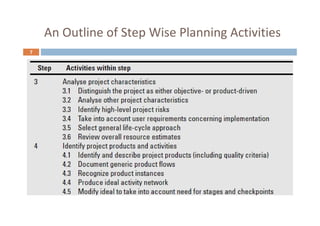
An Outline of Step Wise Planning Activities
8
An Outline of Step Wise Planning Activities
9
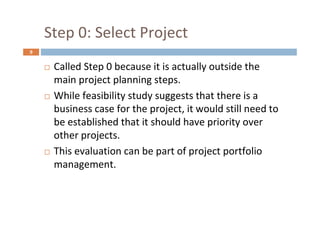
Step 0: Select Project
 Called Step 0 because it is actually outside the
main project planning steps.
 While feasibility study suggests that there is a
business case for the project, it would still need to
be established that it should have priority over
other projects.
 This evaluation can be part of project portfolio
management.
10
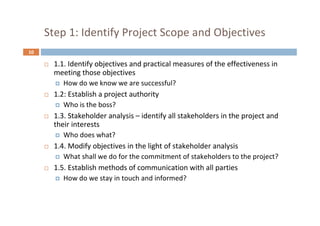
Step 1: Identify Project Scope and Objectives
 1.1. Identify objectives and practical measures of the effectiveness in
meeting those objectives
 How do we know we are successful?
 1.2: Establish a project authority
 Who is the boss?
 1.3. Stakeholder analysis – identify all stakeholders in the project and
their interests
 Who does what?
 1.4. Modify objectives in the light of stakeholder analysis
 What shall we do for the commitment of stakeholders to the project?
 1.5. Establish methods of communication with all parties
 How do we stay in touch and informed?
11
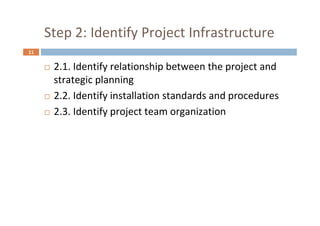
Step 2: Identify Project Infrastructure
 2.1. Identify relationship between the project and
strategic planning
 2.2. Identify installation standards and procedures
 2.3. Identify project team organization
12
Step 3: Analyze Project Characteristics
 3.1. Distinguish the project as either objective- or
product-driven
 3.2. Analyze other project characteristics (including
quality-based ones)
 3.3. Identify high-level project risks
 3.4. Take into account user requirements
concerning implementation
 3.5. Select development methodology and life-
cycle approach
 3.6. Review overall resource estimates
13
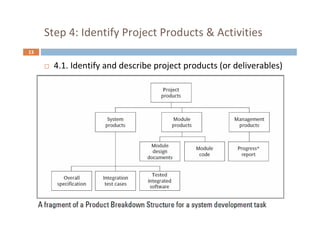
Step 4: Identify Project Products & Activities
 4.1. Identify and describe project products (or deliverables)
14
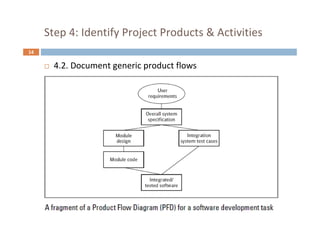
Step 4: Identify Project Products & Activities
 4.2. Document generic product flows
15
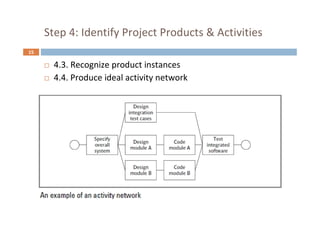
Step 4: Identify Project Products & Activities
 4.3. Recognize product instances
 4.4. Produce ideal activity network
16
Step 4: Identify Project Products & Activities
 4.5. Modify the ideal to take into account need for stages
and checkpoints
 Assumption of ideal activity network:
 an activity will start as soon as the preceding ones upon which it
depends have been completed.
 But we need to divide the project into stages and introducing
checkpoint activities
 to check that products of preceding activities are compatible.
 Milestones represent the completion of important stages of the
project of which managers would want to take particular note.
 Checkpoint activities are often useful milestones.
17
Step 5: Estimate Effort for Each Activity
 5.1. Carry out bottom-up estimates
 Estimates for each activity is produced about
 staff effort required
 probable elapsed time
 non-staff resources
 Elapsed time is different from effort!
 Effort is the amount of work that needs to be done.
 Elapsed time is the time between the start and end of a
task.
 5.2. Revise plan to create controllable activities
18
Step 6: Identify Activity Risks
 6.1. Identify and quantify activity-based risks
 Look at each activity in turn and assess the risks to its successful
outcome.
 The damage that each risk could cause and the likelyhood of its
occurrence must be evaluated.
 6.2. Plan risk reduction and contingency measures where
appropriate
 Contingency plans specify action that is to be taken if a risk
materializes.
 6.3. Adjust overall plans and estimates to take account of
risks
19
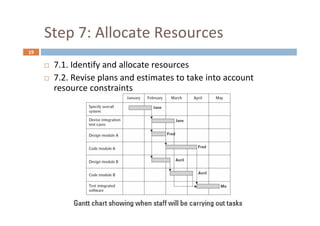
Step 7: Allocate Resources
 7.1. Identify and allocate resources
 7.2. Revise plans and estimates to take into account
resource constraints
20
Step 8: Review/Publicize Plan
 8.1. Review quality aspects of the project plan
 Each task should have quality criteria.
 These quality checks have to be passed before the
activity can be “signed off” as completed.
 8.2. Document plans and obtain agreement
 Plans should be carefully documented.
 All the parties to the project must understand and
agree on the plan.
21
Steps 9/10: Execute Plan/Lower Levels of Planning
 Once the project is under way, plans will need to
be drawn up in greater detail for each activity as it
becomes due.
 Detailed planning of the later stages will need to
be delayed because more information will be
available nearer the start of the stage.
 It is necessary to make provisional plans for the
more distant tasks.
22
Summary
 Any planning approach should have the following elements:
 the establishment of project objectives
 the analysis of the characteristics of the project
 the establishment of an infrastructure consisting of an appropriate
organization and set of standards, methods and tools
 the identification of the products of the project and the activities
needed to generate those products
 the allocation of resources to activities
 the establishment of quality controls
 Project planning is an iterative process
 As the time approaches for particular activities to be carried out they
should be replanned in more detail.

Stepwise planning

  • 1.
    SE403 SOFTWARE PROJECT MANAGEMENT CHAPTER 3 ANOVERVIEW OF PROJECT PLANNING Assist. Prof. Dr. Volkan TUNALI Faculty of Engineering / Maltepe University
  • 2.
    2 Overview  Introduction toStep Wise Project Planning  Select Project  Identify Project Scope and Objectives  Identify Project Infrastructure  Analyze Project Characteristics  Identify Project Products and Activities  Estimate Effort for Each Activity  Identify Activity Risks  Allocate Resources  Review/Publicize Plan  Execute Plan/Lower Levels of Planning
  • 3.
    3 Introduction to ProjectPlanning  Project planning  guides the execution of the project, coordinating the activities.  facilitates better communication between the project stakeholders.  provides a means of tracking and monitoring the progress.  provides a detailed documentation regarding planning decisions.  Project planning is of significant importance for the success of the project.  Careful planning helps prevent costly mistakes.  Good planning is the key to meet the project objectives within defined time and budget.
  • 4.
    4 Introduction to ProjectPlanning  Many different techniques can be used for project planning.  This chapter introduces the Step Wise method.  An example to other methods is the PRINCE2 method.  It is a set of project management standards that were originally sponsored by the Office of Government Commerce (OGC) for use on British governtment ICT and business change projects. The standarts are now also widely used on non-government projects in the UK.  Step Wise method is also compatible with PRINCE2.  Step Wise covers only the planning stages of a project and not monitoring and control.
  • 5.
  • 6.
    6 An Outline ofStep Wise Planning Activities
  • 7.
    7 An Outline ofStep Wise Planning Activities
  • 8.
    8 An Outline ofStep Wise Planning Activities
  • 9.
    9 Step 0: SelectProject  Called Step 0 because it is actually outside the main project planning steps.  While feasibility study suggests that there is a business case for the project, it would still need to be established that it should have priority over other projects.  This evaluation can be part of project portfolio management.
  • 10.
    10 Step 1: IdentifyProject Scope and Objectives  1.1. Identify objectives and practical measures of the effectiveness in meeting those objectives  How do we know we are successful?  1.2: Establish a project authority  Who is the boss?  1.3. Stakeholder analysis – identify all stakeholders in the project and their interests  Who does what?  1.4. Modify objectives in the light of stakeholder analysis  What shall we do for the commitment of stakeholders to the project?  1.5. Establish methods of communication with all parties  How do we stay in touch and informed?
  • 11.
    11 Step 2: IdentifyProject Infrastructure  2.1. Identify relationship between the project and strategic planning  2.2. Identify installation standards and procedures  2.3. Identify project team organization
  • 12.
    12 Step 3: AnalyzeProject Characteristics  3.1. Distinguish the project as either objective- or product-driven  3.2. Analyze other project characteristics (including quality-based ones)  3.3. Identify high-level project risks  3.4. Take into account user requirements concerning implementation  3.5. Select development methodology and life- cycle approach  3.6. Review overall resource estimates
  • 13.
    13 Step 4: IdentifyProject Products & Activities  4.1. Identify and describe project products (or deliverables)
  • 14.
    14 Step 4: IdentifyProject Products & Activities  4.2. Document generic product flows
  • 15.
    15 Step 4: IdentifyProject Products & Activities  4.3. Recognize product instances  4.4. Produce ideal activity network
  • 16.
    16 Step 4: IdentifyProject Products & Activities  4.5. Modify the ideal to take into account need for stages and checkpoints  Assumption of ideal activity network:  an activity will start as soon as the preceding ones upon which it depends have been completed.  But we need to divide the project into stages and introducing checkpoint activities  to check that products of preceding activities are compatible.  Milestones represent the completion of important stages of the project of which managers would want to take particular note.  Checkpoint activities are often useful milestones.
  • 17.
    17 Step 5: EstimateEffort for Each Activity  5.1. Carry out bottom-up estimates  Estimates for each activity is produced about  staff effort required  probable elapsed time  non-staff resources  Elapsed time is different from effort!  Effort is the amount of work that needs to be done.  Elapsed time is the time between the start and end of a task.  5.2. Revise plan to create controllable activities
  • 18.
    18 Step 6: IdentifyActivity Risks  6.1. Identify and quantify activity-based risks  Look at each activity in turn and assess the risks to its successful outcome.  The damage that each risk could cause and the likelyhood of its occurrence must be evaluated.  6.2. Plan risk reduction and contingency measures where appropriate  Contingency plans specify action that is to be taken if a risk materializes.  6.3. Adjust overall plans and estimates to take account of risks
  • 19.
    19 Step 7: AllocateResources  7.1. Identify and allocate resources  7.2. Revise plans and estimates to take into account resource constraints
  • 20.
    20 Step 8: Review/PublicizePlan  8.1. Review quality aspects of the project plan  Each task should have quality criteria.  These quality checks have to be passed before the activity can be “signed off” as completed.  8.2. Document plans and obtain agreement  Plans should be carefully documented.  All the parties to the project must understand and agree on the plan.
  • 21.
    21 Steps 9/10: ExecutePlan/Lower Levels of Planning  Once the project is under way, plans will need to be drawn up in greater detail for each activity as it becomes due.  Detailed planning of the later stages will need to be delayed because more information will be available nearer the start of the stage.  It is necessary to make provisional plans for the more distant tasks.
  • 22.
    22 Summary  Any planningapproach should have the following elements:  the establishment of project objectives  the analysis of the characteristics of the project  the establishment of an infrastructure consisting of an appropriate organization and set of standards, methods and tools  the identification of the products of the project and the activities needed to generate those products  the allocation of resources to activities  the establishment of quality controls  Project planning is an iterative process  As the time approaches for particular activities to be carried out they should be replanned in more detail.