Software Project Management
Lecture # 5
Outline
 Estimation
 Introduction
 Software EffortEstimation and Risk
 Project Planning Activities
 Software Scope and Feasibility
 Resources
 Software Project Estimation
 Decomposition Techniques
 Empirical Estimation Models
Introduction
 Software Project Management begins with
'Project Planning’ activities which include:
 Estimation
 Scheduling
 Risk Analysis
 Quality Management Planning
 Change Management Planning
What is Estimation?
 Estimation is to determine how much…
 Money/cost,
 efforts,
 resources and
 time
will be required to build a specific
software based system or product.
Who does Estimation?
 Estimation is done by software project
managers using information solicited
from
 Stakeholders,
 Software engineers and
 Software metrics data from past projects.
Estimation Steps – Summary
 Description of product scope.
 Decomposition of problem into set of
smaller problems.
 Each sub problem is estimated using
historical data, software metrics and
experience (from past projects) as guides.
 Problem complexity and risks are
considered before final estimate is made.
Estimation and Risk
 Estimation carries inherent risk & risk leads
to uncertainty.
 Estimation risk is measured by the degree of
uncertainty in the quantitative estimates
established for resources, cost, and
schedule.
 Availability of comprehensive historical
information and software metrics (from past
projects) helps establish better estimates
and hence reduces risk factors.
Estimation and Risk (Contd.)
 If project scope is poorly understood or
requirements are subject to change then
uncertainty and estimation risk become
dangerously high.
 Thus variability in software requirements
means instability in cost and schedule.
 However, a project manager should not
become obsessive about estimation as
modern software engineering approaches
are iterative in nature hence making it
possible to revise estimates.
Software Project Planning
Process
 Software project planning provides a
framework that enables the manager
to make reasonable estimates of
resources, cost and schedule.
 Although there is inherent uncertainty,
the team embarks on a project plan.
 But, this plan must be adapted and
updated as the project progresses.
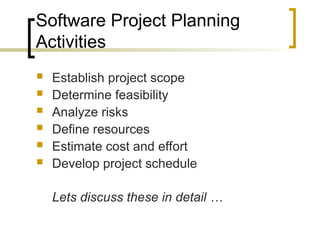
Software Project Planning
Activities
 Establish project scope
 Determine feasibility
 Analyze risks
 Define resources
 Estimate cost and effort
 Develop project schedule
Lets discuss these in detail …
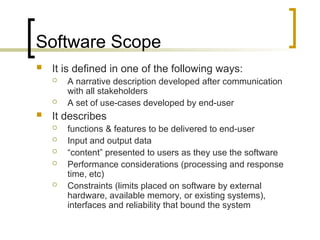
Software Scope
 It is defined in one of the following ways:
 A narrative description developed after communication
with all stakeholders
 A set of use-cases developed by end-user
 It describes
 functions & features to be delivered to end-user
 Input and output data
 “content” presented to users as they use the software
 Performance considerations (processing and response
time, etc)
 Constraints (limits placed on software by external
hardware, available memory, or existing systems),
interfaces and reliability that bound the system
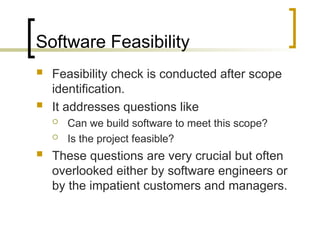
Software Feasibility
 Feasibility check is conducted after scope
identification.
 It addresses questions like
 Can we build software to meet this scope?
 Is the project feasible?
 These questions are very crucial but often
overlooked either by software engineers or
by the impatient customers and managers.
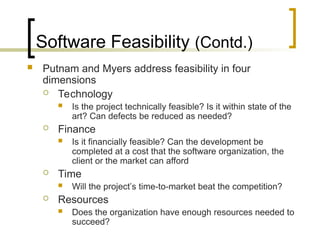
Software Feasibility (Contd.)
 Putnam and Myers address feasibility in four
dimensions
 Technology
 Is the project technically feasible? Is it within state of the
art? Can defects be reduced as needed?
 Finance
 Is it financially feasible? Can the development be
completed at a cost that the software organization, the
client or the market can afford
 Time
 Will the project’s time-to-market beat the competition?
 Resources
 Does the organization have enough resources needed to
succeed?
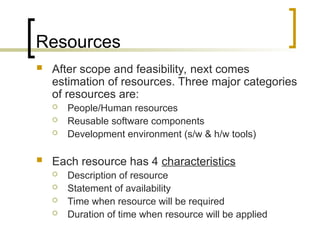
Resources
 After scope and feasibility, next comes
estimation of resources. Three major categories
of resources are:
 People/Human resources
 Reusable software components
 Development environment (s/w & h/w tools)
 Each resource has 4 characteristics
 Description of resource
 Statement of availability
 Time when resource will be required
 Duration of time when resource will be applied
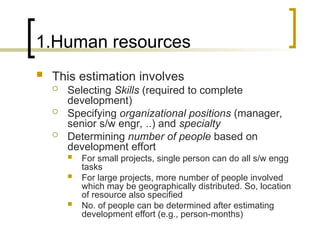
1.Human resources
 This estimation involves
 Selecting Skills (required to complete
development)
 Specifying organizational positions (manager,
senior s/w engr, ..) and specialty
 Determining number of people based on
development effort
 For small projects, single person can do all s/w engg
tasks
 For large projects, more number of people involved
which may be geographically distributed. So, location
of resource also specified
 No. of people can be determined after estimating
development effort (e.g., person-months)
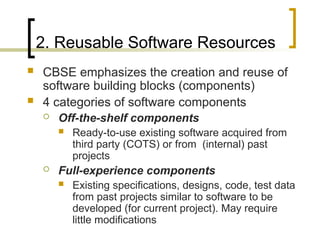
2. Reusable Software Resources
 CBSE emphasizes the creation and reuse of
software building blocks (components)
 4 categories of software components
 Off-the-shelf components
 Ready-to-use existing software acquired from
third party (COTS) or from (internal) past
projects
 Full-experience components
 Existing specifications, designs, code, test data
from past projects similar to software to be
developed (for current project). May require
little modifications
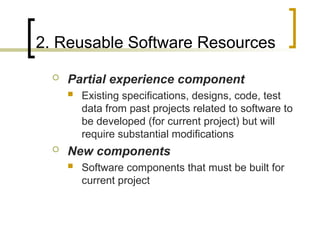
2. Reusable Software Resources
 Partial experience component
 Existing specifications, designs, code, test
data from past projects related to software to
be developed (for current project) but will
require substantial modifications
 New components
 Software components that must be built for
current project
3. (Development) Environment
resources
 Software Engineering Environment (SEE)
includes hardware and software support for
a software project
 Hardware and software elements availability
and time window must be specified
Software Project Estimation
 Options for cost and effort estimates:
 Delay estimation until late in project
 Not a practical approach
 Base estimation on similar past projects
 Reasonable approach but not always successful
 Use simple decomposition techniques to
generate estimates
 Divide and conquer approach. Divide project into major
activities/functions and make estimates
 Use some empirical model for estimation
 Complements decomposition techniques
 Which option is better?
 Each approach can be used as a cross-check for the other
Decomposition Techniques
 Decomposition can be performed in two
aspects
 Decomposition of problem
 Decomposition of process
 Estimation uses one or both forms of
decompositions. But before this, software
size must be estimated.
Software Sizing
 Proper estimation of software size and
mapping of size estimate to human effort,
calendar time and cost are important things
which contribute to accuracy of overall
software project estimation.
 In project planning, size refers to a
quantifiable outcome.
 Direct approach – size is measured as LOC
 Indirect approach – size is measured as
function-points
Software Sizing (Contd.)
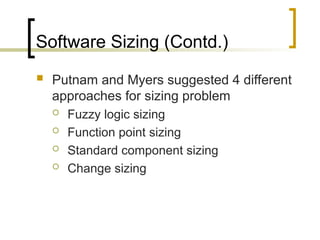
 Putnam and Myers suggested 4 different
approaches for sizing problem
 Fuzzy logic sizing
 Function point sizing
 Standard component sizing
 Change sizing
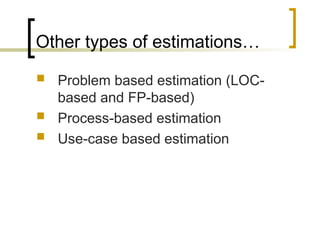
Other types of estimations…
 Problem based estimation (LOC-
based and FP-based)
 Process-based estimation
 Use-case based estimation
References
 Today’s lecture contents were taken
from chapter 23 – “Software
Engineering, A Practitioner's
Approach” by Roger Pressman

Software EffortEstimation and Risk Project Planning Activities Software Scope and Feasibility Resources Software Project Estimation Decomposition Techniques Empirical Estimation Models

  • 1.
  • 2.
    Outline  Estimation  Introduction Software EffortEstimation and Risk  Project Planning Activities  Software Scope and Feasibility  Resources  Software Project Estimation  Decomposition Techniques  Empirical Estimation Models
  • 3.
    Introduction  Software ProjectManagement begins with 'Project Planning’ activities which include:  Estimation  Scheduling  Risk Analysis  Quality Management Planning  Change Management Planning
  • 4.
    What is Estimation? Estimation is to determine how much…  Money/cost,  efforts,  resources and  time will be required to build a specific software based system or product.
  • 5.
    Who does Estimation? Estimation is done by software project managers using information solicited from  Stakeholders,  Software engineers and  Software metrics data from past projects.
  • 6.
    Estimation Steps –Summary  Description of product scope.  Decomposition of problem into set of smaller problems.  Each sub problem is estimated using historical data, software metrics and experience (from past projects) as guides.  Problem complexity and risks are considered before final estimate is made.
  • 7.
    Estimation and Risk Estimation carries inherent risk & risk leads to uncertainty.  Estimation risk is measured by the degree of uncertainty in the quantitative estimates established for resources, cost, and schedule.  Availability of comprehensive historical information and software metrics (from past projects) helps establish better estimates and hence reduces risk factors.
  • 8.
    Estimation and Risk(Contd.)  If project scope is poorly understood or requirements are subject to change then uncertainty and estimation risk become dangerously high.  Thus variability in software requirements means instability in cost and schedule.  However, a project manager should not become obsessive about estimation as modern software engineering approaches are iterative in nature hence making it possible to revise estimates.
  • 9.
    Software Project Planning Process Software project planning provides a framework that enables the manager to make reasonable estimates of resources, cost and schedule.  Although there is inherent uncertainty, the team embarks on a project plan.  But, this plan must be adapted and updated as the project progresses.
  • 10.
    Software Project Planning Activities Establish project scope  Determine feasibility  Analyze risks  Define resources  Estimate cost and effort  Develop project schedule Lets discuss these in detail …
  • 11.
    Software Scope  Itis defined in one of the following ways:  A narrative description developed after communication with all stakeholders  A set of use-cases developed by end-user  It describes  functions & features to be delivered to end-user  Input and output data  “content” presented to users as they use the software  Performance considerations (processing and response time, etc)  Constraints (limits placed on software by external hardware, available memory, or existing systems), interfaces and reliability that bound the system
  • 12.
    Software Feasibility  Feasibilitycheck is conducted after scope identification.  It addresses questions like  Can we build software to meet this scope?  Is the project feasible?  These questions are very crucial but often overlooked either by software engineers or by the impatient customers and managers.
  • 13.
    Software Feasibility (Contd.) Putnam and Myers address feasibility in four dimensions  Technology  Is the project technically feasible? Is it within state of the art? Can defects be reduced as needed?  Finance  Is it financially feasible? Can the development be completed at a cost that the software organization, the client or the market can afford  Time  Will the project’s time-to-market beat the competition?  Resources  Does the organization have enough resources needed to succeed?
  • 14.
    Resources  After scopeand feasibility, next comes estimation of resources. Three major categories of resources are:  People/Human resources  Reusable software components  Development environment (s/w & h/w tools)  Each resource has 4 characteristics  Description of resource  Statement of availability  Time when resource will be required  Duration of time when resource will be applied
  • 15.
    1.Human resources  Thisestimation involves  Selecting Skills (required to complete development)  Specifying organizational positions (manager, senior s/w engr, ..) and specialty  Determining number of people based on development effort  For small projects, single person can do all s/w engg tasks  For large projects, more number of people involved which may be geographically distributed. So, location of resource also specified  No. of people can be determined after estimating development effort (e.g., person-months)
  • 16.
    2. Reusable SoftwareResources  CBSE emphasizes the creation and reuse of software building blocks (components)  4 categories of software components  Off-the-shelf components  Ready-to-use existing software acquired from third party (COTS) or from (internal) past projects  Full-experience components  Existing specifications, designs, code, test data from past projects similar to software to be developed (for current project). May require little modifications
  • 17.
    2. Reusable SoftwareResources  Partial experience component  Existing specifications, designs, code, test data from past projects related to software to be developed (for current project) but will require substantial modifications  New components  Software components that must be built for current project
  • 18.
    3. (Development) Environment resources Software Engineering Environment (SEE) includes hardware and software support for a software project  Hardware and software elements availability and time window must be specified
  • 19.
    Software Project Estimation Options for cost and effort estimates:  Delay estimation until late in project  Not a practical approach  Base estimation on similar past projects  Reasonable approach but not always successful  Use simple decomposition techniques to generate estimates  Divide and conquer approach. Divide project into major activities/functions and make estimates  Use some empirical model for estimation  Complements decomposition techniques  Which option is better?  Each approach can be used as a cross-check for the other
  • 20.
    Decomposition Techniques  Decompositioncan be performed in two aspects  Decomposition of problem  Decomposition of process  Estimation uses one or both forms of decompositions. But before this, software size must be estimated.
  • 21.
    Software Sizing  Properestimation of software size and mapping of size estimate to human effort, calendar time and cost are important things which contribute to accuracy of overall software project estimation.  In project planning, size refers to a quantifiable outcome.  Direct approach – size is measured as LOC  Indirect approach – size is measured as function-points
  • 22.
    Software Sizing (Contd.) Putnam and Myers suggested 4 different approaches for sizing problem  Fuzzy logic sizing  Function point sizing  Standard component sizing  Change sizing
  • 23.
    Other types ofestimations…  Problem based estimation (LOC- based and FP-based)  Process-based estimation  Use-case based estimation
  • 24.
    References  Today’s lecturecontents were taken from chapter 23 – “Software Engineering, A Practitioner's Approach” by Roger Pressman