PROJECT MANAGEMENT
          CONCEPTS
 Effectivesoftware project
 management focuses on the
 four P’s:
 people, product, process, and
 project.
   The “people factor” is so important that the
    Software Engineering Institute has developed a
    people management capability maturity model
    (PM-CMM), “to enhance the readiness of software
    organizations to undertake increasingly complex
    applications by helping to
    attract, grow, motivate, deploy, and retain the
    talent needed to improve their software
    development capability”.
   The people management maturity model defines
    the following key practice areas for software
    people: recruiting, selection, performance
    management, training, compensation, career
    development, organization and work design, and
    team/culture development. Organizations that
   Before a project can be planned, product objectives
    and scope should be established, alternative
    solutions should be considered, and technical and
    management constraints should be identified.
   The software developer and customer must meet to
    define product objectives and scope. In many
    cases, this activity begins as part of the system
    engineering or business process engineering and
    continues as the first step in software requirements
    analysis. Objectives identify the overall goals for
    the product (from the customer’s point of view)
    without considering how these goals will be
    achieved. Scope identifies the primary
    data, functions and behaviors that characterize the
    product, and more important, attempts to bound
   A software process provides the framework from
    which a comprehensive plan for software
    development can be established.
    A small number of framework activities are
    applicable to all software projects, regardless of
    their size or complexity.
   A number of different task sets—
    tasks, milestones, work products, and quality
    assurance points—enable the framework activities
    to be adapted to the characteristics of the software
    project and the requirements of the project team.
   Finally, umbrella activities—such as software
    quality assurance, software configuration
    management, and measurement—overlay the
    process model. Umbrella activities are independent
   We conduct planned and controlled software projects for
    one primary reason—it is the only known way to manage
    complexity. And yet, we still struggle. In 1998, industry
    data indicated that 26 percent of software projects failed
    outright and 46 percent experienced cost and schedule
    overruns. Although the success rate for software projects
    has improved somewhat, our project failure rate remains
    higher than it should be.
   In order to avoid project failure, a software project
    manager and the software engineers who build the
    product must avoid a set of common warning
    signs, understand the critical success factors that lead to
    good project management, and develop a commonsense
    approach for planning, monitoring and controlling the
    project.
  The Players - The software process (and every
   software project) is populated by players who can be
1. Senior managers who define the business issues that
    often have significant influence on the project.
 2. Project (technical) managers who must
   plan, motivate, organize, and control the
   practitioners who do software work.
 3. Practitioners who deliver the technical skills that are
   necessary to engineer a product or application.
 4. Customers who specify the requirements for the
   software to be engineered and other stakeholders
    who have a peripheral interest in the outcome.
5. End-users who interact with the software once it is
  released for production use.
   Project management is a people-intensive
    activity, and for this reason, competent
    practitioners often make poor team leaders.
    They simply don’t have the right mix of
    people skills. And yet, as Edgemon states:
    “Unfortunately and all too frequently it
    seems, individuals just fall into a project
    manager role and become accidental project
    managers.”
   Motivation. The ability to encourage (by “push
    or pull”) technical people to produce to their
    best ability.
   Organization. The ability to mold existing
    processes (or invent new ones) that will
    enable the initial concept to be translated
    into a final product.
   Ideas or innovation. The ability to encourage
    people to create and feel creative even when
    they must work within bounds established for
    a particular software product or application.
   Problem solving. An effective software project manager can diagnose the
    technical and organizational issues that are most relevant, systematically
    structure a solution or properly motivate other practitioners to develop
    the solution, apply lessons learned from past projects to new
    situations, and remain flexible enough to change direction if initial
    attempts at problem solution are fruitless.
   Managerial identity. A good project manager must take charge of the
    project. She must have the confidence to assume control when necessary
    and the assurance to allow good technical people to follow their
    instincts.
   Achievement. To optimize the productivity of a project team, a manager
    must reward initiative and accomplishment and demonstrate through his
    own actions that controlled risk taking will not be punished.
   Influence and team building. An effective project manager must be able
    to “read” people; she must be able to understand verbal and nonverbal
    signals and react to the needs of the people sending these signals. The
    manager must remain under control in high-stress situations.
   There are almost as many human organizational
    structures for software development as there are
    organizations that develop software. For better
    or worse, organizational structure cannot be
    easily modified. Concern with the practical and
    political consequences of organizational change
    are not within the software project manager's
    scope of responsibility. However, the
    organization of the people directly involved in a
    new software project is within the project
    manager's purview.
   Democratic decentralized (DD). This software engineering team
    has no permanent leader. Rather, "task coordinators are
    appointed for short durations and then replaced by others who
    may coordinate different tasks." Decisions on problems and
    approach are made by group consensus. Communication among
    team members is horizontal.
   Controlled decentralized (CD). This software engineering team
    has a defined leader who coordinates specific tasks and
    secondary leaders that have responsibility for subtasks. Problem
    solving remains a group activity, but implementation of solutions
    is partitioned among subgroups by the team leader.
    Communication among subgroups and individuals is horizontal.
    Vertical communication along the control hierarchy also occurs.
   Controlled Centralized (CC). Top-level problem solving and
    internal team coordination are managed by a team leader.
    Communication between the leader and team members is
    vertical.
• The difficulty of the problem to be solved.
• The size of the resultant program(s) in lines of
  code or function points
• The time that the team will stay together (team
  lifetime).
• The degree to which the problem can be
  modularized.
• The required quality and reliability of the system
  to be built.
• The rigidity of the delivery date.
• The degree of sociability (communication)
  required for the project.
   There are many reasons that software projects
    get into trouble.
   The scale of many development efforts is
    large, leading to complexity, confusion, and
    significant difficulties in coordinating team
    members.
   Uncertainty is common, resulting in a continuing
    stream of changes that ratchets the project team.
   Interoperability has become a key characteristic
    of many systems. New software must
    communicate with existing software and conform
    to predefined constraints imposed by the system
    or product.
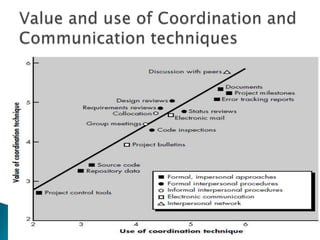
   Formal, impersonal approaches include software engineering
    documents and deliverables (including source code), technical
    memos, project milestones, schedules, and project control tools
    , change requests and related documentation , error tracking
    reports, and repository data
   Formal, interpersonal procedures focus on quality assurance
    activities applied to software engineering work products. These
    include status review meetings and design and code inspections.
   Informal, interpersonal procedures include group meetings for
    information dissemination and problem solving and “collocation
    of requirements and development staff.”
   Electronic communication encompasses electronic
    mail, electronic bulletin boards, and by extension, video-based
    conferencing systems.
   Interpersonal networking includes informal discussions with
    team members and those outside the project who may have
    experience or insight that can assist team members.
   The product and the problem it is intended to
    solve at the very beginning of the project. At
    a minimum, the scope of the product must be
    established and bounded.
   The first software project management activity is the
    determination of software scope.

   Scope is defined by answering the following questions:
   Context. How does the software to be built fit into a larger
    system, product, or business context and what constraints
    are imposed as a result of the context
   Information objectives. What customer-visible data objects
    (Chapter 11) are produced as output from the software?
    What data objects are required for input?
   Function and performance. What function does the
    software perform to transform input data into output? Are
    any special performance characteristics to be addressed?
   It sometimes called partitioning or problem
    elaboration, is an activity that sits at the core
    of software requirements analysis . During
    the scoping activity no attempt is made to
    fully decompose the problem.
    Rather, decomposition is applied in two major
    areas:
    (1) the functionality that must be delivered
    and
     (2) the process that will be used to deliver it.
   The generic phases that characterize the
    software process—
    definition, development, and support—are
    applicable to all software.
   The problem is to select the process model
    that is appropriate for the software to be
    engineered by a project team.
   The project manager must decide which
    process model is most appropriate for
    activities of the people who will do the work

(1) the customers who have requested the
 product an
(2) the characteristics of the product
 itself, and
(3) the project environment in which the
 software team works. When a process model
 has been selected, the team then defines a
 preliminary project plan based on the set of
 common process framework
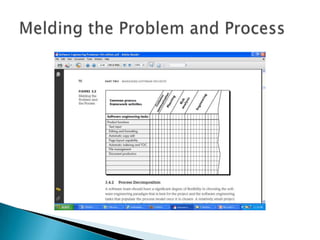
   Project planning begins with the melding of
    the product and the process.
    Each function to be engineered by the
    software team must pass through the set of
    framework activities that have been defined
    for a software organization
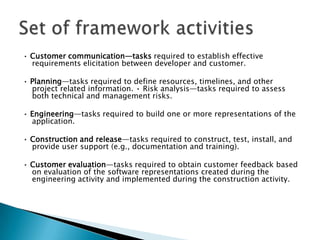
• Customer communication—tasks required to establish effective
  requirements elicitation between developer and customer.

• Planning—tasks required to define resources, timelines, and other
  project related information. • Risk analysis—tasks required to assess
  both technical and management risks.

• Engineering—tasks required to build one or more representations of the
  application.

• Construction and release—tasks required to construct, test, install, and
  provide user support (e.g., documentation and training).

• Customer evaluation—tasks required to obtain customer feedback based
  on evaluation of the software representations created during the
  engineering activity and implemented during the construction activity.
   A software team should have a significant degree
    of flexibility in choosing the software engineering
    paradigm that is best for the project and the
    software engineering tasks that populate the
    process model once it is chosen.
   Once the process model has been chosen, the
    common process framework (CPF) is adapted to
    it. In every case, the CPF discussed earlier in this
    chapter—customer
    communication, planning, risk
    analysis, engineering, construction and
    release, customer evaluation—can be fitted to the
    paradigm.
1. Develop list of clarification issues.
2. Meet with customer to address clarification
 issues.
3. Jointly develop a statement of scope.
4. Review the statement of scope with all
 concerned.
5. Modify the statement of scope as required.
1. Review the customer request.
2. Plan and schedule a formal, facilitated meeting with the
  customer.
3. Conduct research to specify the proposed solution and
  existing approaches.
4. Prepare a “working document” and an agenda for the
  formal meeting.
5. Conduct the meeting.
6. Jointly develop mini-specs that reflect data, function, and
  behavioral features of the software.
7. Review each mini-spec for correctness, consistency, and
  lack of ambiguity.
8. Assemble the mini-specs into a scoping document.
9. Review the scoping document with all concerned.
10. Modify the scoping document as required.
   In order to manage a successful software
    project, we must understand what can go
    wrong (so that problems can be avoided) and
    how to do it right. In an excellent paper on
    software projects
1. Software people don’t understand their customer’s
  needs.
2. The product scope is poorly defined.
3. Changes are managed poorly.
4. The chosen technology changes.
5. Business needs change [or are ill-defined].
6. Deadlines are unrealistic.
7. Users are resistant.
8. Sponsorship is lost [or was never properly obtained].
9. The project team lacks people with appropriate
  skills.
10. Managers [and practitioners] avoid best practices
  and lessons learned.
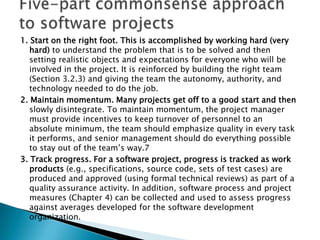
1. Start on the right foot. This is accomplished by working hard (very
   hard) to understand the problem that is to be solved and then
   setting realistic objects and expectations for everyone who will be
   involved in the project. It is reinforced by building the right team
   (Section 3.2.3) and giving the team the autonomy, authority, and
   technology needed to do the job.
2. Maintain momentum. Many projects get off to a good start and then
   slowly disintegrate. To maintain momentum, the project manager
   must provide incentives to keep turnover of personnel to an
   absolute minimum, the team should emphasize quality in every task
   it performs, and senior management should do everything possible
   to stay out of the team’s way.7
3. Track progress. For a software project, progress is tracked as work
   products (e.g., specifications, source code, sets of test cases) are
   produced and approved (using formal technical reviews) as part of a
   quality assurance activity. In addition, software process and project
   measures (Chapter 4) can be collected and used to assess progress
   against averages developed for the software development
   organization.
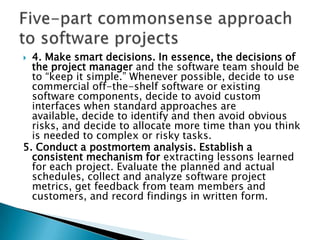
 4. Make smart decisions. In essence, the decisions of
  the project manager and the software team should be
  to “keep it simple.” Whenever possible, decide to use
  commercial off-the-shelf software or existing
  software components, decide to avoid custom
  interfaces when standard approaches are
  available, decide to identify and then avoid obvious
  risks, and decide to allocate more time than you think
  is needed to complex or risky tasks.
5. Conduct a postmortem analysis. Establish a
  consistent mechanism for extracting lessons learned
  for each project. Evaluate the planned and actual
  schedules, collect and analyze software project
  metrics, get feedback from team members and
  customers, and record findings in written form.
   In an excellent paper on software process and
    projects, Barry Boehm [BOE96] states: “you
    need an organizing principle that scales down
    to provide simple [project] plans for simple
    projects.” Boehm suggests an approach that
    addresses project objectives, milestones and
    schedules, responsibilities, management and
    technical approaches, and required resources.
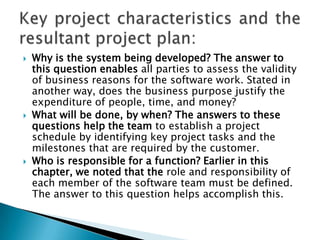
   Why is the system being developed? The answer to
    this question enables all parties to assess the validity
    of business reasons for the software work. Stated in
    another way, does the business purpose justify the
    expenditure of people, time, and money?
   What will be done, by when? The answers to these
    questions help the team to establish a project
    schedule by identifying key project tasks and the
    milestones that are required by the customer.
   Who is responsible for a function? Earlier in this
    chapter, we noted that the role and responsibility of
    each member of the software team must be defined.
    The answer to this question helps accomplish this.
   Where are they organizationally located? Not all
    roles and responsibilities reside within the
    software team itself. The customer, users, and
    other stakeholders also have responsibilities.
   How will the job be done technically and
    managerially? Once product scope is
    established, a management and technical
    strategy for the project must be defined.
   How much of each resource is needed? The
    answer to this question is derived by developing
    estimates based on answers to earlier questions.

Software engineering project management

  • 1.
  • 2.
     Effectivesoftware project management focuses on the four P’s: people, product, process, and project.
  • 3.
    The “people factor” is so important that the Software Engineering Institute has developed a people management capability maturity model (PM-CMM), “to enhance the readiness of software organizations to undertake increasingly complex applications by helping to attract, grow, motivate, deploy, and retain the talent needed to improve their software development capability”.  The people management maturity model defines the following key practice areas for software people: recruiting, selection, performance management, training, compensation, career development, organization and work design, and team/culture development. Organizations that
  • 4.
    Before a project can be planned, product objectives and scope should be established, alternative solutions should be considered, and technical and management constraints should be identified.  The software developer and customer must meet to define product objectives and scope. In many cases, this activity begins as part of the system engineering or business process engineering and continues as the first step in software requirements analysis. Objectives identify the overall goals for the product (from the customer’s point of view) without considering how these goals will be achieved. Scope identifies the primary data, functions and behaviors that characterize the product, and more important, attempts to bound
  • 5.
    A software process provides the framework from which a comprehensive plan for software development can be established.  A small number of framework activities are applicable to all software projects, regardless of their size or complexity.  A number of different task sets— tasks, milestones, work products, and quality assurance points—enable the framework activities to be adapted to the characteristics of the software project and the requirements of the project team.  Finally, umbrella activities—such as software quality assurance, software configuration management, and measurement—overlay the process model. Umbrella activities are independent
  • 6.
    We conduct planned and controlled software projects for one primary reason—it is the only known way to manage complexity. And yet, we still struggle. In 1998, industry data indicated that 26 percent of software projects failed outright and 46 percent experienced cost and schedule overruns. Although the success rate for software projects has improved somewhat, our project failure rate remains higher than it should be.  In order to avoid project failure, a software project manager and the software engineers who build the product must avoid a set of common warning signs, understand the critical success factors that lead to good project management, and develop a commonsense approach for planning, monitoring and controlling the project.
  • 7.
     ThePlayers - The software process (and every software project) is populated by players who can be 1. Senior managers who define the business issues that often have significant influence on the project. 2. Project (technical) managers who must plan, motivate, organize, and control the practitioners who do software work. 3. Practitioners who deliver the technical skills that are necessary to engineer a product or application. 4. Customers who specify the requirements for the software to be engineered and other stakeholders who have a peripheral interest in the outcome. 5. End-users who interact with the software once it is released for production use.
  • 8.
    Project management is a people-intensive activity, and for this reason, competent practitioners often make poor team leaders. They simply don’t have the right mix of people skills. And yet, as Edgemon states: “Unfortunately and all too frequently it seems, individuals just fall into a project manager role and become accidental project managers.”
  • 9.
    Motivation. The ability to encourage (by “push or pull”) technical people to produce to their best ability.  Organization. The ability to mold existing processes (or invent new ones) that will enable the initial concept to be translated into a final product.  Ideas or innovation. The ability to encourage people to create and feel creative even when they must work within bounds established for a particular software product or application.
  • 10.
    Problem solving. An effective software project manager can diagnose the technical and organizational issues that are most relevant, systematically structure a solution or properly motivate other practitioners to develop the solution, apply lessons learned from past projects to new situations, and remain flexible enough to change direction if initial attempts at problem solution are fruitless.  Managerial identity. A good project manager must take charge of the project. She must have the confidence to assume control when necessary and the assurance to allow good technical people to follow their instincts.  Achievement. To optimize the productivity of a project team, a manager must reward initiative and accomplishment and demonstrate through his own actions that controlled risk taking will not be punished.  Influence and team building. An effective project manager must be able to “read” people; she must be able to understand verbal and nonverbal signals and react to the needs of the people sending these signals. The manager must remain under control in high-stress situations.
  • 11.
    There are almost as many human organizational structures for software development as there are organizations that develop software. For better or worse, organizational structure cannot be easily modified. Concern with the practical and political consequences of organizational change are not within the software project manager's scope of responsibility. However, the organization of the people directly involved in a new software project is within the project manager's purview.
  • 12.
    Democratic decentralized (DD). This software engineering team has no permanent leader. Rather, "task coordinators are appointed for short durations and then replaced by others who may coordinate different tasks." Decisions on problems and approach are made by group consensus. Communication among team members is horizontal.  Controlled decentralized (CD). This software engineering team has a defined leader who coordinates specific tasks and secondary leaders that have responsibility for subtasks. Problem solving remains a group activity, but implementation of solutions is partitioned among subgroups by the team leader. Communication among subgroups and individuals is horizontal. Vertical communication along the control hierarchy also occurs.  Controlled Centralized (CC). Top-level problem solving and internal team coordination are managed by a team leader. Communication between the leader and team members is vertical.
  • 13.
    • The difficultyof the problem to be solved. • The size of the resultant program(s) in lines of code or function points • The time that the team will stay together (team lifetime). • The degree to which the problem can be modularized. • The required quality and reliability of the system to be built. • The rigidity of the delivery date. • The degree of sociability (communication) required for the project.
  • 14.
    There are many reasons that software projects get into trouble.  The scale of many development efforts is large, leading to complexity, confusion, and significant difficulties in coordinating team members.  Uncertainty is common, resulting in a continuing stream of changes that ratchets the project team.  Interoperability has become a key characteristic of many systems. New software must communicate with existing software and conform to predefined constraints imposed by the system or product.
  • 15.
    Formal, impersonal approaches include software engineering documents and deliverables (including source code), technical memos, project milestones, schedules, and project control tools , change requests and related documentation , error tracking reports, and repository data  Formal, interpersonal procedures focus on quality assurance activities applied to software engineering work products. These include status review meetings and design and code inspections.  Informal, interpersonal procedures include group meetings for information dissemination and problem solving and “collocation of requirements and development staff.”  Electronic communication encompasses electronic mail, electronic bulletin boards, and by extension, video-based conferencing systems.  Interpersonal networking includes informal discussions with team members and those outside the project who may have experience or insight that can assist team members.
  • 17.
    The product and the problem it is intended to solve at the very beginning of the project. At a minimum, the scope of the product must be established and bounded.
  • 18.
    The first software project management activity is the determination of software scope.  Scope is defined by answering the following questions:  Context. How does the software to be built fit into a larger system, product, or business context and what constraints are imposed as a result of the context  Information objectives. What customer-visible data objects (Chapter 11) are produced as output from the software? What data objects are required for input?  Function and performance. What function does the software perform to transform input data into output? Are any special performance characteristics to be addressed?
  • 19.
    It sometimes called partitioning or problem elaboration, is an activity that sits at the core of software requirements analysis . During the scoping activity no attempt is made to fully decompose the problem. Rather, decomposition is applied in two major areas: (1) the functionality that must be delivered and (2) the process that will be used to deliver it.
  • 20.
    The generic phases that characterize the software process— definition, development, and support—are applicable to all software.  The problem is to select the process model that is appropriate for the software to be engineered by a project team.
  • 21.
    The project manager must decide which process model is most appropriate for activities of the people who will do the work (1) the customers who have requested the product an (2) the characteristics of the product itself, and (3) the project environment in which the software team works. When a process model has been selected, the team then defines a preliminary project plan based on the set of common process framework
  • 22.
    Project planning begins with the melding of the product and the process.  Each function to be engineered by the software team must pass through the set of framework activities that have been defined for a software organization
  • 23.
    • Customer communication—tasksrequired to establish effective requirements elicitation between developer and customer. • Planning—tasks required to define resources, timelines, and other project related information. • Risk analysis—tasks required to assess both technical and management risks. • Engineering—tasks required to build one or more representations of the application. • Construction and release—tasks required to construct, test, install, and provide user support (e.g., documentation and training). • Customer evaluation—tasks required to obtain customer feedback based on evaluation of the software representations created during the engineering activity and implemented during the construction activity.
  • 25.
    A software team should have a significant degree of flexibility in choosing the software engineering paradigm that is best for the project and the software engineering tasks that populate the process model once it is chosen.  Once the process model has been chosen, the common process framework (CPF) is adapted to it. In every case, the CPF discussed earlier in this chapter—customer communication, planning, risk analysis, engineering, construction and release, customer evaluation—can be fitted to the paradigm.
  • 26.
    1. Develop listof clarification issues. 2. Meet with customer to address clarification issues. 3. Jointly develop a statement of scope. 4. Review the statement of scope with all concerned. 5. Modify the statement of scope as required.
  • 27.
    1. Review thecustomer request. 2. Plan and schedule a formal, facilitated meeting with the customer. 3. Conduct research to specify the proposed solution and existing approaches. 4. Prepare a “working document” and an agenda for the formal meeting. 5. Conduct the meeting. 6. Jointly develop mini-specs that reflect data, function, and behavioral features of the software. 7. Review each mini-spec for correctness, consistency, and lack of ambiguity. 8. Assemble the mini-specs into a scoping document. 9. Review the scoping document with all concerned. 10. Modify the scoping document as required.
  • 28.
    In order to manage a successful software project, we must understand what can go wrong (so that problems can be avoided) and how to do it right. In an excellent paper on software projects
  • 29.
    1. Software peopledon’t understand their customer’s needs. 2. The product scope is poorly defined. 3. Changes are managed poorly. 4. The chosen technology changes. 5. Business needs change [or are ill-defined]. 6. Deadlines are unrealistic. 7. Users are resistant. 8. Sponsorship is lost [or was never properly obtained]. 9. The project team lacks people with appropriate skills. 10. Managers [and practitioners] avoid best practices and lessons learned.
  • 30.
    1. Start onthe right foot. This is accomplished by working hard (very hard) to understand the problem that is to be solved and then setting realistic objects and expectations for everyone who will be involved in the project. It is reinforced by building the right team (Section 3.2.3) and giving the team the autonomy, authority, and technology needed to do the job. 2. Maintain momentum. Many projects get off to a good start and then slowly disintegrate. To maintain momentum, the project manager must provide incentives to keep turnover of personnel to an absolute minimum, the team should emphasize quality in every task it performs, and senior management should do everything possible to stay out of the team’s way.7 3. Track progress. For a software project, progress is tracked as work products (e.g., specifications, source code, sets of test cases) are produced and approved (using formal technical reviews) as part of a quality assurance activity. In addition, software process and project measures (Chapter 4) can be collected and used to assess progress against averages developed for the software development organization.
  • 31.
     4. Makesmart decisions. In essence, the decisions of the project manager and the software team should be to “keep it simple.” Whenever possible, decide to use commercial off-the-shelf software or existing software components, decide to avoid custom interfaces when standard approaches are available, decide to identify and then avoid obvious risks, and decide to allocate more time than you think is needed to complex or risky tasks. 5. Conduct a postmortem analysis. Establish a consistent mechanism for extracting lessons learned for each project. Evaluate the planned and actual schedules, collect and analyze software project metrics, get feedback from team members and customers, and record findings in written form.
  • 32.
    In an excellent paper on software process and projects, Barry Boehm [BOE96] states: “you need an organizing principle that scales down to provide simple [project] plans for simple projects.” Boehm suggests an approach that addresses project objectives, milestones and schedules, responsibilities, management and technical approaches, and required resources.
  • 33.
    Why is the system being developed? The answer to this question enables all parties to assess the validity of business reasons for the software work. Stated in another way, does the business purpose justify the expenditure of people, time, and money?  What will be done, by when? The answers to these questions help the team to establish a project schedule by identifying key project tasks and the milestones that are required by the customer.  Who is responsible for a function? Earlier in this chapter, we noted that the role and responsibility of each member of the software team must be defined. The answer to this question helps accomplish this.
  • 34.
    Where are they organizationally located? Not all roles and responsibilities reside within the software team itself. The customer, users, and other stakeholders also have responsibilities.  How will the job be done technically and managerially? Once product scope is established, a management and technical strategy for the project must be defined.  How much of each resource is needed? The answer to this question is derived by developing estimates based on answers to earlier questions.