‫الرحيم‬‫الرحمن‬‫هللا‬‫بسم‬
‫العظيم‬‫هللا‬‫صدق‬
‫ما‬ ‫إال‬ ‫لنا‬ ‫علم‬ ‫ال‬ ‫سبحانك‬ ‫قالوا‬
‫الحكيم‬ ‫العليم‬ ‫أنت‬ ‫إنك‬ ‫علمتنا‬
‫ة‬‫ر‬‫سو‬
‫النساء‬
‫اآلية‬ ‫من‬
:
113
Splenic Abscess
Hamed Rashad
Professor of surgery Banha University - Egypt
Introduction
• Abscesses of the spleen have been reported
periodically since the time of Hippocrates. He
postulated that 1 of 3 courses was followed by a
patient with a splenic abscess:
• (1) the patient might die;
• (2) the abscess might heal; or
• (3) the abscess might become chronic and the
patient may live with the disease. 1
Introduction
Splenic abscess is a rare entity, with a reported
frequency of 0.05-0.7%.2,3
Its reported mortality rate is still high, up to 47%,
and can potentially reach 100% among patients
who do not receive antibiotic treatment.4
Appropriate management can decrease the
mortality to less than 10%.5
Etiology
• The most common is hematogenous spread
originating from an infective focus elsewhere in
the body. Infective endocarditis, a condition
associated with systemic embolization in 22-
50% of cases, has a 10-20% incidence of
associated splenic abscess.8 Other infective
sources include typhoid, paratyphoid, malaria,
urinary tract infection, pneumonias,
osteomyelitis, otitis, mastoiditis, and pelvic
infections.
Etiology
• Pancreatic, other retroperitoneal, and subphrenic
abscesses, as well as diverticulitis, may
contiguously involve the spleen.
• Splenic trauma is another well-recognized etiologic
factor.
• Splenic infarction resulting from systemic
disorders (see the image below), such as
hemoglobinopathies (especially sickle cell disease),
leukemia, polycythemia, or vasculitis, can become
infected and evolve into splenic
abscesses.2,4,9,10,11,12,13
Splenic abscess
Differential diagnosis
Cystic lesions
• With or without cell debris?
• Solitary or multiple?
• With or without enhancement?
• Other associated findings?
• Correlating patient’s data and history
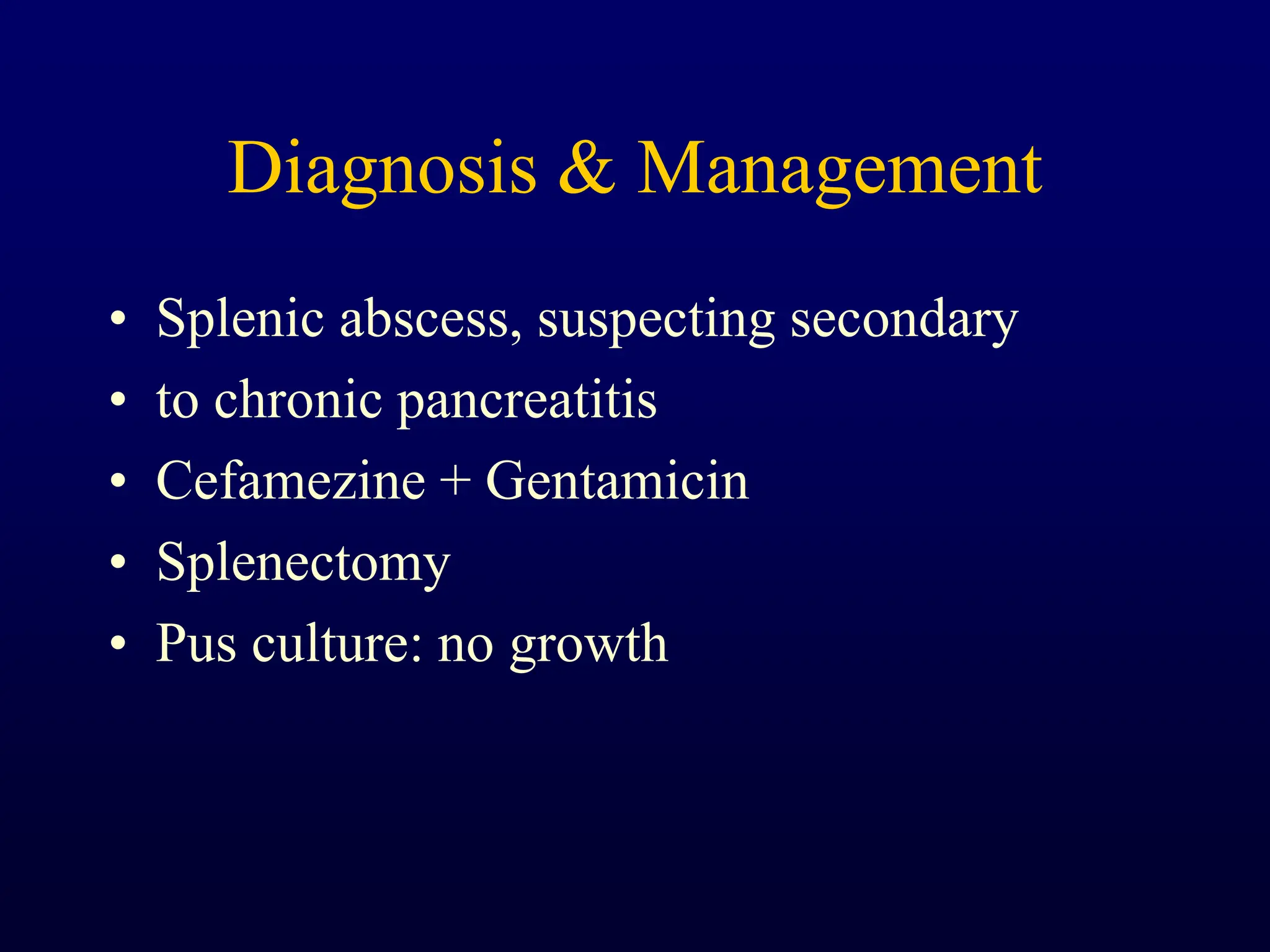
Diagnosis & Management
• Splenic abscess, suspecting secondary
• to chronic pancreatitis
• Cefamezine + Gentamicin
• Splenectomy
• Pus culture: no growth
Clinical Presentation
• Fever: 95%
• Abdominal pain: 60%
• LUQ pain: 38%
• Left chest pain: 17%
• Left shoulder pain:10%
• RUQ pain: 6%
• Weakness: 22%
• Chills: 22%
• Nausea/Vomiting: 16%
• Anorexia: 15%
• Diaphoresis: 12%
• Weight loss: 11%
• Change in bowel habits: 9%
Signs
• Abdominal tenderness: 59%
• Splenomegaly: 54%
• Hepatomegaly: 16%
• Abdominal distention: 13%
• Ascites: 7%
• Costovertebral angle tenderness: 5%
• Friction rub: 3%
Signs
• Dullness at left thoracic base: 33%
• Left basilar rales: 21%
• Elevated left diaphragm: 18%
• Left pleural friction rub: 5%
Complications
• The mortality rate in patients with untreated
splenic abscess approaches 100%.
• The list of complications is long but most
importantly includes free rupture into the
peritoneal cavity with generalized
peritonitis, rupture into the colon, erosion of
the abscess through the diaphragm, or, more
rarely, necessitation through the skin.
Lab Studies
• Leukocytosis: 70%
• Immunocompromised patients with fungal
• abscesses
• Elevated alkaline phosphatase level
• Positive blood culture: 60%
Image Studies
• CXR
-- Abnormal in 80% of patients
-- Elevated left hemidiaphragm: 33%
-- Pleural effusion: 28%
• Abdominal radiograph
-- Abnormal soft tissue density or gas pattern: 35%
• Radioisotope scanning: of little value
Image Studies
• Ultrasound
- Repeatable for interval change
- Nonspecific
- Highly variable and not easy to interpret
• CT
- Test of choice
- Sensitivity: ~100%
- Low-density lesions without enhancement
- CT-guided aspiration
Diagnosis
• Diagnostic procedure
- CT-guided or ultrasound-guided aspiration
- Proper antibiotic treatment
Ultrasound
• Splenic abscess
CT :Splenic abscess
CT Scan
Hypodense
lesion without
enhancement
CT Scan
Multiple
hypodense
lesions with
ill-defined
borders and
heterogenous
contents
Spleen
Stomach
CT Scan
Lesions
without
enhancement
Inflammatory
process
CT scan abdomen demonstrating A single
splenic abscess
Multiple tubercular splenic abscesses
CT Scan
Enlarged
pancreas
with
relatively
decreased
density
Indication
• Once identified, always treated!
Treatment
• Medical treatment
- Interventional treatment involving
antimicrobials
- Primary medical management
controversial
• Surgical treatment
- Percutaneous drainage or splenectomy +
antimicrobial therapy
Surgical Therapy
• The invasive treatment of splenic abscess includes 3 options: percutaneous drainage,
open or laparoscopic surgery (splenectomy), and open drainage.
Percutaneous drainage
• Percutaneous drainage is indicated for easily accessible uniloculated or biloculated
abscesses with otherwise favorable features, as described previously, and also for
surgical patients at very high risk who cannot tolerate general anesthesia or
surgery.21,22
The procedure includes a risk of iatrogenic injury of the spleen, colon (splenic flexure),
stomach, left kidney, and diaphragm.18
Calcified walls of the abscess, the presence of other intra-abdominal cysts with
intraluminal daughter cysts, and an origin from endemic areas (eg, the Mediterranean
basin, Eastern Europe) should raise a suspicion forEchinococcus
granulosus.19 Percutaneous drainage of such suppurative cysts increases the risk of
hydatid seeding and anaphylaxis and is therefore contraindicated.
Other iatrogenic complications resulting from percutaneous drainage include
hemorrhage, pleural empyema, pneumothorax, and enteric fistula.6,23
• Splenectomy
Percutaneous drainage
• Uniloculate solitary abscess
• Not contraindicated
• splenic flexure of the colon and the pleural
spacerisk of injury
• Patients with cavities that have calcified
walls or patients with a history of travel to
endemic areas Echinococcus
Percutaneous drainage
Complications:
• Haemorrhage
• Pleural empyema
• Pneumothorax
• Fistula formation
Contraindications:
• Contiguous process
• A phlegmonous or poorly
differentiated lesion on CT
scan
• Multiloculated or debris-
filled abscess
• Uncontrollable coagulopathy
Treatment
• Splenectomy
• Splenotomy:
Reserved for only the sickest patients who
have contraindications to both splenectomy
and percutaneous drainage
Splenectomy
• Splenectomy has long been considered the standard
treatment of splenic abscess. Depending on the
patient population, open splenectomy has a mortality
rate of 0-17% and a morbidity rate of 28-43%.24
• The method removes the septic source and the
diseased organ. The surgeon can explore and
manage coexisting septic collections.
Laparoscopic splenectomy is safe and effective in
selected patients. It can be performed with no
morbidity or mortality, and patients who have
undergone the procedure reportedly have a shorter
hospital stay.25
Splenectomy
Very infrequently, the perisplenic adhesions are so
severe that safe dissection between the spleen and
the surrounding structures is impossible. The only
choice in this scenario is to perform an open
splenotomy and drain the collection.
Splenectomy
Open drainage
Open drainage is used when the abscess cannot be drained
percutaneously. Depending on the location of the abscess, 1 of 3
access routes can be employed:
• Transpleural - Usually requires resection of the 12th rib in the
posterior axillary line and drainage of the abscess through the
diaphragm
• Abdominal extraperitoneal - Accesses the abscess through the
lateral abdominal wall and between the peritoneum and the flat
abdominal muscles
• Retroperitoneal - Used when the abscess extends to the flank
Complications
• Mortality rate: 100% if left untreated
• Rupture:
- Most commonperitoneal cavity: 6.6%
- Rupture into the bowel, bronchus, or pleural space
• Colon obstruction
• Splenocutaneous fistula
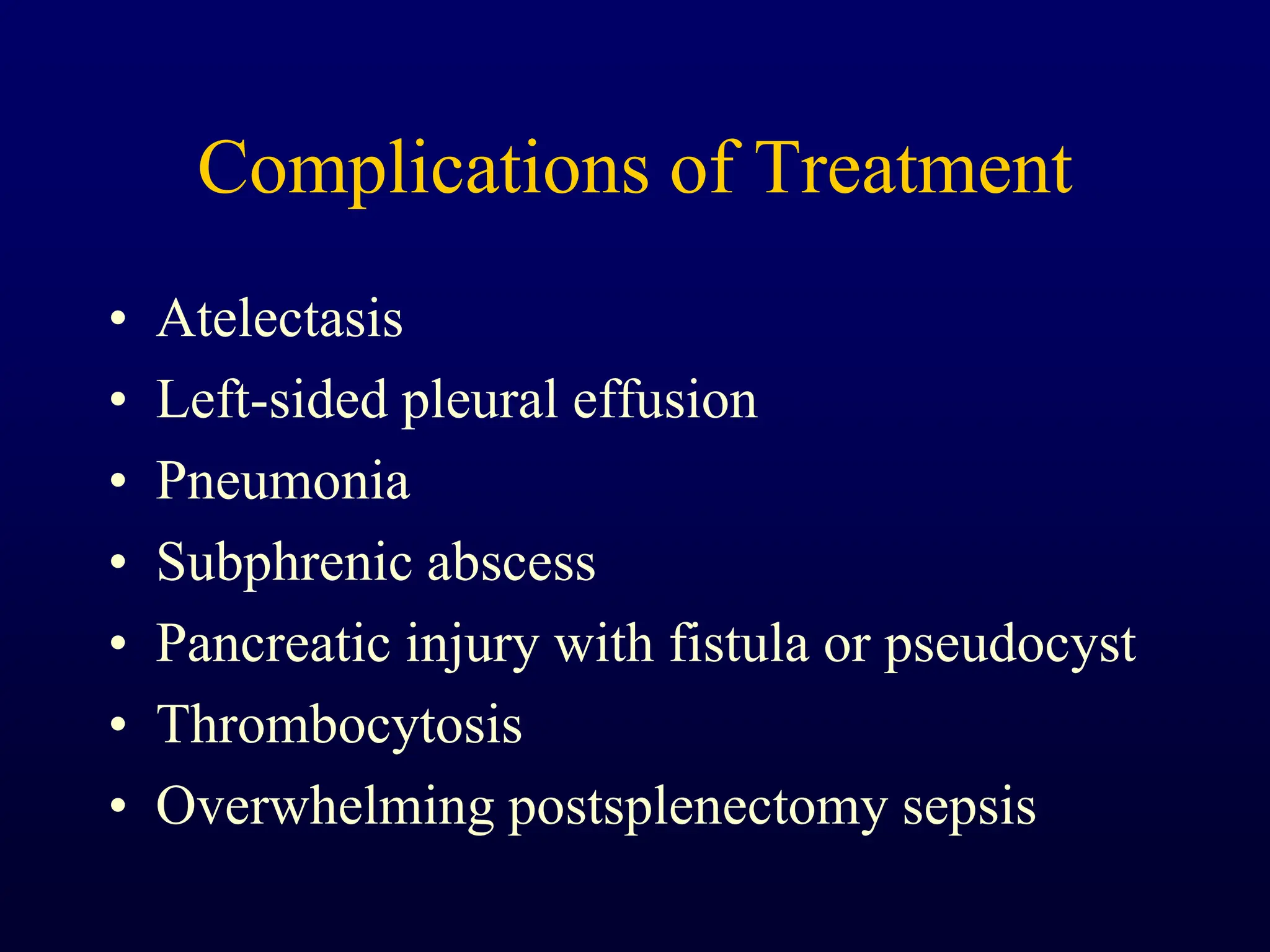
Complications of Treatment
• Atelectasis
• Left-sided pleural effusion
• Pneumonia
• Subphrenic abscess
• Pancreatic injury with fistula or pseudocyst
• Thrombocytosis
• Overwhelming postsplenectomy sepsis
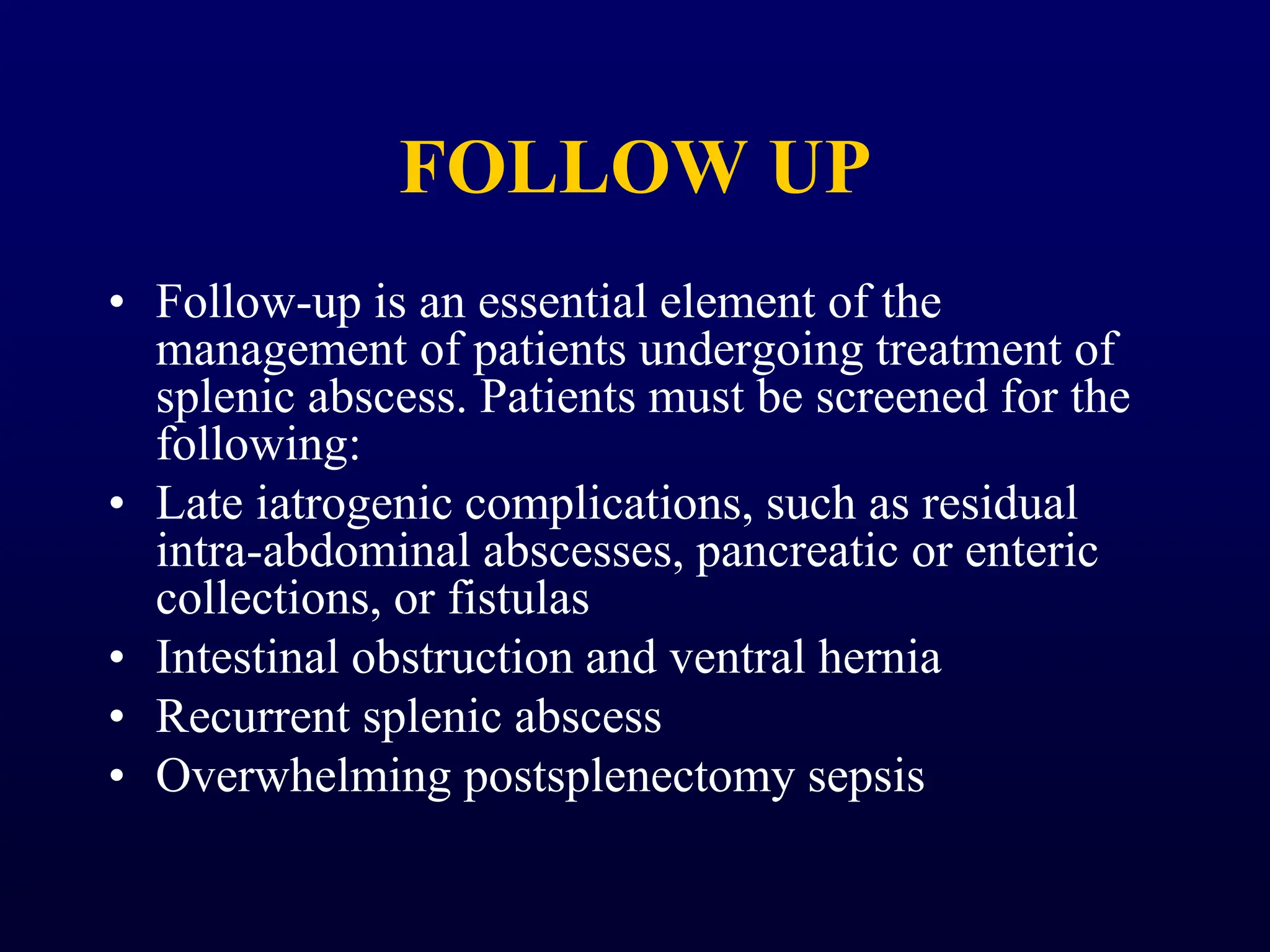
FOLLOW UP
• Follow-up is an essential element of the
management of patients undergoing treatment of
splenic abscess. Patients must be screened for the
following:
• Late iatrogenic complications, such as residual
intra-abdominal abscesses, pancreatic or enteric
collections, or fistulas
• Intestinal obstruction and ventral hernia
• Recurrent splenic abscess
• Overwhelming postsplenectomy sepsis
THANK YOU

Splenic abscess the lect.ppt

  • 1.
    ‫الرحيم‬‫الرحمن‬‫هللا‬‫بسم‬ ‫العظيم‬‫هللا‬‫صدق‬ ‫ما‬ ‫إال‬ ‫لنا‬‫علم‬ ‫ال‬ ‫سبحانك‬ ‫قالوا‬ ‫الحكيم‬ ‫العليم‬ ‫أنت‬ ‫إنك‬ ‫علمتنا‬ ‫ة‬‫ر‬‫سو‬ ‫النساء‬ ‫اآلية‬ ‫من‬ : 113
  • 2.
    Splenic Abscess Hamed Rashad Professorof surgery Banha University - Egypt
  • 3.
    Introduction • Abscesses ofthe spleen have been reported periodically since the time of Hippocrates. He postulated that 1 of 3 courses was followed by a patient with a splenic abscess: • (1) the patient might die; • (2) the abscess might heal; or • (3) the abscess might become chronic and the patient may live with the disease. 1
  • 4.
    Introduction Splenic abscess isa rare entity, with a reported frequency of 0.05-0.7%.2,3 Its reported mortality rate is still high, up to 47%, and can potentially reach 100% among patients who do not receive antibiotic treatment.4 Appropriate management can decrease the mortality to less than 10%.5
  • 5.
    Etiology • The mostcommon is hematogenous spread originating from an infective focus elsewhere in the body. Infective endocarditis, a condition associated with systemic embolization in 22- 50% of cases, has a 10-20% incidence of associated splenic abscess.8 Other infective sources include typhoid, paratyphoid, malaria, urinary tract infection, pneumonias, osteomyelitis, otitis, mastoiditis, and pelvic infections.
  • 6.
    Etiology • Pancreatic, otherretroperitoneal, and subphrenic abscesses, as well as diverticulitis, may contiguously involve the spleen. • Splenic trauma is another well-recognized etiologic factor. • Splenic infarction resulting from systemic disorders (see the image below), such as hemoglobinopathies (especially sickle cell disease), leukemia, polycythemia, or vasculitis, can become infected and evolve into splenic abscesses.2,4,9,10,11,12,13
  • 7.
  • 8.
    Differential diagnosis Cystic lesions •With or without cell debris? • Solitary or multiple? • With or without enhancement? • Other associated findings? • Correlating patient’s data and history
  • 9.
    Diagnosis & Management •Splenic abscess, suspecting secondary • to chronic pancreatitis • Cefamezine + Gentamicin • Splenectomy • Pus culture: no growth
  • 10.
    Clinical Presentation • Fever:95% • Abdominal pain: 60% • LUQ pain: 38% • Left chest pain: 17% • Left shoulder pain:10% • RUQ pain: 6% • Weakness: 22% • Chills: 22% • Nausea/Vomiting: 16% • Anorexia: 15% • Diaphoresis: 12% • Weight loss: 11% • Change in bowel habits: 9%
  • 11.
    Signs • Abdominal tenderness:59% • Splenomegaly: 54% • Hepatomegaly: 16% • Abdominal distention: 13% • Ascites: 7% • Costovertebral angle tenderness: 5% • Friction rub: 3%
  • 12.
    Signs • Dullness atleft thoracic base: 33% • Left basilar rales: 21% • Elevated left diaphragm: 18% • Left pleural friction rub: 5%
  • 13.
    Complications • The mortalityrate in patients with untreated splenic abscess approaches 100%. • The list of complications is long but most importantly includes free rupture into the peritoneal cavity with generalized peritonitis, rupture into the colon, erosion of the abscess through the diaphragm, or, more rarely, necessitation through the skin.
  • 14.
    Lab Studies • Leukocytosis:70% • Immunocompromised patients with fungal • abscesses • Elevated alkaline phosphatase level • Positive blood culture: 60%
  • 15.
    Image Studies • CXR --Abnormal in 80% of patients -- Elevated left hemidiaphragm: 33% -- Pleural effusion: 28% • Abdominal radiograph -- Abnormal soft tissue density or gas pattern: 35% • Radioisotope scanning: of little value
  • 16.
    Image Studies • Ultrasound -Repeatable for interval change - Nonspecific - Highly variable and not easy to interpret • CT - Test of choice - Sensitivity: ~100% - Low-density lesions without enhancement - CT-guided aspiration
  • 17.
    Diagnosis • Diagnostic procedure -CT-guided or ultrasound-guided aspiration - Proper antibiotic treatment
  • 18.
  • 19.
  • 20.
  • 21.
    CT Scan Multiple hypodense lesions with ill-defined bordersand heterogenous contents Spleen Stomach
  • 22.
  • 23.
    CT scan abdomendemonstrating A single splenic abscess
  • 24.
  • 25.
  • 26.
  • 27.
    Treatment • Medical treatment -Interventional treatment involving antimicrobials - Primary medical management controversial • Surgical treatment - Percutaneous drainage or splenectomy + antimicrobial therapy
  • 28.
    Surgical Therapy • Theinvasive treatment of splenic abscess includes 3 options: percutaneous drainage, open or laparoscopic surgery (splenectomy), and open drainage. Percutaneous drainage • Percutaneous drainage is indicated for easily accessible uniloculated or biloculated abscesses with otherwise favorable features, as described previously, and also for surgical patients at very high risk who cannot tolerate general anesthesia or surgery.21,22 The procedure includes a risk of iatrogenic injury of the spleen, colon (splenic flexure), stomach, left kidney, and diaphragm.18 Calcified walls of the abscess, the presence of other intra-abdominal cysts with intraluminal daughter cysts, and an origin from endemic areas (eg, the Mediterranean basin, Eastern Europe) should raise a suspicion forEchinococcus granulosus.19 Percutaneous drainage of such suppurative cysts increases the risk of hydatid seeding and anaphylaxis and is therefore contraindicated. Other iatrogenic complications resulting from percutaneous drainage include hemorrhage, pleural empyema, pneumothorax, and enteric fistula.6,23 • Splenectomy
  • 29.
    Percutaneous drainage • Uniloculatesolitary abscess • Not contraindicated • splenic flexure of the colon and the pleural spacerisk of injury • Patients with cavities that have calcified walls or patients with a history of travel to endemic areas Echinococcus
  • 30.
    Percutaneous drainage Complications: • Haemorrhage •Pleural empyema • Pneumothorax • Fistula formation Contraindications: • Contiguous process • A phlegmonous or poorly differentiated lesion on CT scan • Multiloculated or debris- filled abscess • Uncontrollable coagulopathy
  • 31.
    Treatment • Splenectomy • Splenotomy: Reservedfor only the sickest patients who have contraindications to both splenectomy and percutaneous drainage
  • 32.
    Splenectomy • Splenectomy haslong been considered the standard treatment of splenic abscess. Depending on the patient population, open splenectomy has a mortality rate of 0-17% and a morbidity rate of 28-43%.24 • The method removes the septic source and the diseased organ. The surgeon can explore and manage coexisting septic collections. Laparoscopic splenectomy is safe and effective in selected patients. It can be performed with no morbidity or mortality, and patients who have undergone the procedure reportedly have a shorter hospital stay.25
  • 33.
    Splenectomy Very infrequently, theperisplenic adhesions are so severe that safe dissection between the spleen and the surrounding structures is impossible. The only choice in this scenario is to perform an open splenotomy and drain the collection.
  • 34.
    Splenectomy Open drainage Open drainageis used when the abscess cannot be drained percutaneously. Depending on the location of the abscess, 1 of 3 access routes can be employed: • Transpleural - Usually requires resection of the 12th rib in the posterior axillary line and drainage of the abscess through the diaphragm • Abdominal extraperitoneal - Accesses the abscess through the lateral abdominal wall and between the peritoneum and the flat abdominal muscles • Retroperitoneal - Used when the abscess extends to the flank
  • 35.
    Complications • Mortality rate:100% if left untreated • Rupture: - Most commonperitoneal cavity: 6.6% - Rupture into the bowel, bronchus, or pleural space • Colon obstruction • Splenocutaneous fistula
  • 36.
    Complications of Treatment •Atelectasis • Left-sided pleural effusion • Pneumonia • Subphrenic abscess • Pancreatic injury with fistula or pseudocyst • Thrombocytosis • Overwhelming postsplenectomy sepsis
  • 37.
    FOLLOW UP • Follow-upis an essential element of the management of patients undergoing treatment of splenic abscess. Patients must be screened for the following: • Late iatrogenic complications, such as residual intra-abdominal abscesses, pancreatic or enteric collections, or fistulas • Intestinal obstruction and ventral hernia • Recurrent splenic abscess • Overwhelming postsplenectomy sepsis
  • 38.