LIVER ABSCESS
Dr sujan pandey
Surgery resident
overview
• INTRODUCTION
• CLASSIFICATION
• ETIOLOGY
• PATHOGENESIS
• INVESTIGATIONS
• TRREATMENT
• OUTCOME
Liver abscess
• Occurs when bacteria/protozoa/fungal
destroy hepatic tissue, produces a cavity
which fills up with infective organisms,
liquefied cells & leucocytes. Necrotic tissue
then falls off the cavity from rest of the liver.
CLASSIFICATION
1)Pyogenic liver abscess(-polymicrobial)
2)Amoebic liver abscess(-E .histolytica)
Pyogenic Liver Abscess
• Male preponderance
• Average age – between 43 & 60 years
• More common in Right lobe
• Left lobe receives blood from
-inferior mesentric
-Splenic veins
• Right lobe receives blood from
-superior mesentric
-portal veins
Streaming effect in portal circulation is causative.
ETIOLOGY
• Kupffer cells act as a filter for the clearance of
microorganisms in the liver. These organisms reach the
liver via the bloodstream, the biliary tree, or by direct
extension.
• Abscesses occur when normal hepatic clearance
mechanisms fail or the system is overwhelmed.
• Parenchymal necrosis and hematoma secondary to
trauma, obstructive biliary processes, ischemia, and
malignancy also promote invasion of microorganisms
• In order to appropriately treat the abscess, source control is
required. Six distinct categories have been identified as
potential sources:
(1) Bile ducts,causing ascending cholangitis.
(2) Portal vein, causing pylephlebitis from
appendicitis or diverticulitis
(3) Direct extension from a contiguous disease
(4) Trauma due to blunt or penetrating injuries
(5) Hepatic artery, due to septicemia and
(6) Cryptogenic
Disease of the biliary system
1. Malignancy.
2. Intrahepatic stones and biliary stricture
3.Manipulation of the biliary tree
cholangiography, percutaneous transhepatic
stents, endoscopic stent placement, and biliary-
enteric anastomoses.
Intestinal pathology
Transient bacteremia due to bacterial translocation
or frank gastrointestinal perforation cause
overwhelming numbers of microorganisms to
spread via the portal venous system to the liver.
 Appendicitis
 Diverticulitis
Perforated colon cancers
 Abscesses elsewhere in the abdomen and pelvis
remain common causes of pyogenic liver
abscesses.
Contiguous extension
1. Gangrenous cholecystitis.
2. Perforated ulcers.
3. Subphrenic abscesses.
4. Percutaneous drains
5. Trauma to the liver causes parenchymal
necrosis and clot, which creates an ideal milieu
for the seeding and proliferation of
microorganisms and subsequent abscess
formation.
Arterial embolization of bacteria via
the hepatic artery
1. Intravenous drug abuse
2. hepatic artery chemoembolization
3.umbilical artery catheterization
4. Arterial embolization can also occur from
distant infection in the heart, lungs, kidneys,
bones, ears, and teeth.
Predisposing Factors for Pyogenic Liver
Abscesses
Children
• Chronic granulomatous disease
• Complement deficiencies
• Leukemia
• Malignancy
• Sickle cell anemia
• Inflammatory bowel disease
• Polycystic liver disease
• Congenital hepatic fibrosis
• Post transplant liver failure
• Necrotizing enterocolitis
• Chemotherapy and steroid therapy
• AIDS
Predisposing Factors for Pyogenic Liver
Abscesses
Adults
• Diabetes mellitus
• Cirrhosis
• Chronic pancreatitis
• Peptic ulcer disease
• Inflammatory bowel disease
• Jaundice
• Pyelonephritis
• Malignancy
• Leukemia and lymphoma
• Chemotherapy and steroid therapy
• AIDS
Pathology and bacteriology
• The source of the liver abscess is predictive of the number,
location, and size of the abscess affecting a given patient.
• Portal, traumatic, and cryptogenic hepatic abscesses are
solitary and large, while biliary and arterial abscesses are
multiple and small.
• Fungal abscesses are usually multiple, bilateral, and miliary.
• Gram-Negative Aerobes 50–70 % of Patients Escherichia
coli, Klebsiella species, enterococci, and Pseudomonas
species are the most common.
• In patients with endocarditis and infected
indwelling catheters :staphylococcus and
streptococcus species are common .
Clinical Presentation
• The classic triad of fever, jaundice, and right
upper quadrant tenderness
• SYMPTOMS
Fever (M/C) Weight loss
Pain Nausea and vomiting
Malaise Chills
Anorexia Cough or pleurisy
Pruritus Diarrhea
Clinical Presentation
• SIGN
Right upper quadrant tenderness
Hepatomegaly
Jaundice
Right upper quadrant mass
Ascites
Pleural effusion or rub
Clinical Presentation
• Laboratory Evaluation
 Leukocytosis
 Elevated alkaline phosphatase(M/C)
 An elevated bilirubin and transaminases
 Anemia, hypoalbuminemia, and prolonged
prothrombin time
(Blood cultures are positive in roughly 50% of cases.
Culture of abscess fluid should be the goal in
establishing microbiologic diagnosis.)
Radiology
• X ray chest :
elevated right hemidiaphragm,
a right pleural effusion,
right lower lobe atelectasis.
•Abdominal films may show :
hepatomegaly,
air-fluid levels in the presence of gas-forming
organisms, or portal venous gas if pylephlebitis
is the source
Elevated right hemidiaphragm
Plain film of a barium enema
performed on a patient with
a large gas-filled abscess
located in the right hepatic
lobe. (Reproduced with
permission from Zuidema
GD: Shackleford’s Surgery of
the Alimentary Tract, 4th ed.
Ultrasound
• Ultrasound will distinguish solid from cystic
lesions and is cost effective and portable.
Ultrasound (US) is 80–95% sensitive but has
limited utility in the morbidly obese and in
lesions that are located under the ribs or in an
inhomogeneous liver.
Hypoechoic fluid filled area in liver
Computed tomography
• Computed tomography (CT) is more sensitive (95–100%)
than USG in detecting hepatic abscesses.
• On CT examination, an abscess is of lower attenuation than
the surrounding liver, and the wall of the abscess may
enhance with intravenous contrast administration.
• Hypodense to surrounding parenchyma +/-enchanced rim
sign.
• Lesions are detectable to around 0.5 cm.
• CT and USG may also be used to evaluate and potentially
treat the source of infection by percutaneous drainage.
CT
CT Fluid Collection with surrounding stranding, edema, and
inflammation
low attenuation area in liver (a spot that
appears on a radiographic image as less dense
than the surrounding healthy tissue in that
specific organ of the body)
Treatment
• Treatment of the abscess itself,
• concomitant treatment of the source.
• Steps in management include :
 Antibiotic administration,
 Radiologic confirmation by US or CT,
 Drainage.
Exceptions to this strategy include multiple small
abscesses and miliary fungal abscesses. These abscesses
are treated with intravenous antibiotics and antifungals
respectively, without a drainage procedure.
Antibiotics
• After confirmatory imaging with US or CT, abscesses
are aspirated, blood cultures are drawn, and broad-
spectrum intravenous antibiotics are administered until
sensitivities allow a more selective antibiotic choice.
• Classic antibiotic regimens include an aminoglycoside,
clindamycin, and either ampicillin or vancomycin.
Fluoroquinolones can replace aminoglycosides, and
metronidazole can be used instead of clindamycin,
especially if an amebic source is suspected.
• Carbapenems are recommended when extended
spectrum β-lactamase–producing strains are isolated.
• •Treatment used to be given for 4–6 weeks;
Antibiotics
• Antibiotics alone have an 80% success rate for solitary
abscesses with a diameter <5 cm.
• In a series of 107 patients with unilocular hepatic
abscesses of <3 cm, treatment with antibiotics alone
had a 100% success rate.
• In the setting of multiple abscesses <1.5 cm in size and
no concurrent surgical disease, patients may be treated
with IV antibiotics alone.
• However, multiple small abscesses frequently imply
biliary tract disease and may require biliary drainage
for source control.
• Similarly, fungal abscesses are miliary in nature and not
amenable to percutaneous or surgical drainage.
• Prolonged systemic antifungals are the preferred
treatment for fungal abscesses.
• Higher doses of amphotericin B (2-9 g) are
recommended by most experts because a cumulative
dose of <2 g correlated with residual lesions at autopsy.
• Cases of hepatosplenic candidiasis have been
successfully treated with fluconazole. Symptoms
improved at 3 to 8 weeks, but resolution of the lesions
on CT scan was noted after at least 1 month of
fluconazole.
Needle Aspiration And Percutaneous
Catheter Drainage
• Needle aspiration is less invasive, less expensive,
and avoids all of the complications associated with
catheter care.
• Patients in whom percutaneous drainage is not
appropriate include those patients with
(1) multiple large abscesses;
(2) a known intra-abdominal source that requires
surgery;
(3) an abscess of unknown etiology;
(4) ascites
• <5cm, single abscess- needle aspiration or
catheter
• >5cm- catheter or surgery
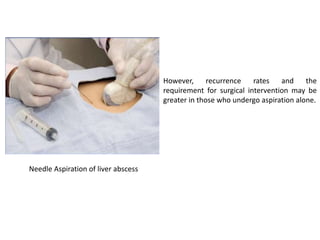
Needle Aspiration of liver abscess
However, recurrence rates and the
requirement for surgical intervention may be
greater in those who undergo aspiration alone.
• USG or CT guided
aspiration and drainage
by using a pigtail
catheter.
Irrigation of abscess
cavity with saline .
Percutaneous Catheter Drainage
Contraindications to catheter drainage
• Coagulopathy
• A difficult access path to the cavity
• Peritonitis
• Complicated ,multiloculated ,thick walled
abscess with viscous pus.
A. CT demonstrating a pyogenic abscess in the right hepatic lobe. B.
Contrast injected into the abscess cavity through a percutaneously placed
drainage catheter. C. Sinogram performed 2 weeks later revealing a
decrease in the size of the abscess cavity. D. CT after 4 weeks
demonstrating complete resolution of the abscess. CT, computed
tomography
Surgical drainage
• Abscesses were drained extraperitoneally via a 12th-rib
resection to avoid contamination of the peritoneal cavity.
• With the advent of systemic antibiotics, transperitoneal
surgical exploration also was considered a safe surgical
approach.
• The transperitoneal approach has the advantages of the
ability to:
(1) Treat the inciting pathology in the remainder of the
abdomen/pelvis;
(2) Gain access and exposure of the entire liver for
evaluation and treatment; and
(3) Access the biliary tree for cholangiography and bile
duct exploration.
Open Surgical drainage
laparoscopic drainage
Complications
• Generalized sepsis
• Pleural effusions
• Empyema
• Pneumonia.
• Abscesses may also rupture intraperitoneally,
which is frequently fatal. Usually, however, the
abscess does not rupture, but develops a
controlled leak resulting in a perihepatic abscess.
• Pyogenic abscesses also can cause hemobilia and
hepatic vein thrombosis.
• Bacteremia is extremely common in K.
pneumoniae liver abscesses as opposed to
other types of pyogenic liver abscesses .
• Disseminated intravascular coagulation, septic
pulmonary emboli, and acute renal failure are
also well-documented complications of K
pneumoniae liver abscess.
• A rare complication specific to Klebsiella
hepatic abscesses is endogenous
endophthalmitis, occurring in approximately
3% of cases.More common in diabetic
patients.
Outcome
Amebic liver abscess
• Amebic liver abscess is caused by the parasitic
protozoan Entamoeba histolytica. The disease
was described in association with blood and
mucus diarrheal stools.
Life cycle E. histolytica
Etiology
 E. histolytica is responsible for all forms of invasive
disease.
 The life cycle involves cysts, invasive trophozoites, and
fecally contaminated food or water to initiate the
infection.
 Fecal-oral transmission occurs; the cyst passes through
the stomach into the intestine unscathed, and then
pancreatic enzymes start to digest the outer cyst wall.
 The trophozoite is then released into the intestine and
multiplies there. Normally, no invasion occurs, and the
patient develops amebic dysentery alone or becomes
an asymptomatic carrier.
Etiology
 In a small number of cases, the trophozoite
invades through the intestinal mucosa, travels
through the mesenteric lymphatics and veins,
and begins to accumulate in the hepatic
parenchyma, forming an abscess cavity.
 Liquefied hepatic parenchyma with blood and
debris gives a characteristic "anchovy paste"
appearance to the abscess.
Pathology
• 90% of people that become infected with E. histolytica are
asymptomatic.
• These cysts are resistant to the effects of gastric acid pH,
but become stimulated to form trophozoites in the alkaline
pH of the bowel.
• Trophozoites are found in the colon and in the feces of
humans and mammals.
• Humans become reservoirs, and transmission occurs by
ingesting food and water contaminated with amebic cysts,
or occasionally through person-to-person contact.
• Incubation takes 1–4 weeks. Left untreated, asymptomatic
individuals may shed cysts for many years.
Pathology
 Invasive amebiasis can include anything from amebic
dysentery to metastatic abscesses.
 The most common form of the invasive disease is colitis.
 The majority (70–80%) of patients experience a gradual
onset of symptoms with worsening diarrhea, abdominal
pain, weight loss, and stools consisting of blood and mucus.
 Trophozoites invade and induce apoptosis in colonic
mucosa resulting in "buttonhole" ulcers with undermined
edges.
 Trophozoites are actually found in the edge of the ulcers.
Pathology
 The most common extraintestinal site of
amebiasis is the liver, occurring in 1–7% of
children and 50% of adults (usually males) with
invasive disease.
Trophozoites reach the liver through the portal
system, causing focal necrosis of hepatocytes and
multiple micro-abscesses that coalesce into a
single abscess.
The central cavity of the lesion contains a
homogenous thick liquid that is typically
red/brown and yellow in color and similar to
anchovy paste in consistency.
Clinical Presentation
• SYMPTOM
 Pain 90%
 Fever 87%
 Nausea and vomiting 85%
 Anorexia 50%
 Weight loss 45%
 Malaise 25%
 Diarrhea 25%
 Cough or pleurisy 25%
 Pruritus 1%
Clinical Presentation
SIGN
 Hepatomegaly 85%
Right upper quadrant tenderness 84%
Pleural effusion or rub 40 %
 Right upper quadrant mass 12%
 Ascites 10 %
 Jaundice 5 %
Clinical Presentation
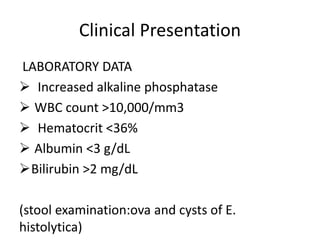
LABORATORY DATA
 Increased alkaline phosphatase
 WBC count >10,000/mm3
 Hematocrit <36%
 Albumin <3 g/dL
Bilirubin >2 mg/dL
(stool examination:ova and cysts of E.
histolytica)
Distinguishing Clinical Characteristics
of Patients with Hepatic Abscesses
Distinguishing Clinical Characteristics
of Patients with Hepatic Abscesses
• Amebic Pyogenic
Age <50 years Age >50 years
Male:female ratio 10:1 Male:female ratio 1:1
Hispanic descent No ethnic predisposition Recent
Travel to endemic area Malignancy
Pulmonary dysfunction High fevers
Abdominal pain Pruritus
Diarrhea Jaundice
Abdominal tenderness Septic shock
Hepatomegaly Palpable mass
Radiology
Chest radiographs frequently show:
• Pleural effusion, infiltrates, or an elevated
hemidiaphragm.
• Single abscess is present and in the right lobe, 10% are
in the left lobe, and the rest are multiple.
• The mean resolution time is 7 months, and 70% have
findings that persist for more than 6 months.
• Eventually, resolution may be complete or result in a
small residual cystic cavity that resembles a simple cyst
of the liver.
• X ray chest:
• Elevated right hemidiaphragm,
• Right pleural effusion,
• Right lower lobe atelectasis.
Amoebic liver abscess burst into the
right pleural cavity.
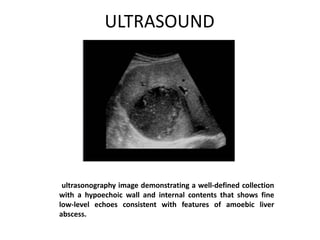
ULTRASOUND
ultrasonography image demonstrating a well-defined collection
with a hypoechoic wall and internal contents that shows fine
low-level echoes consistent with features of amoebic liver
abscess.
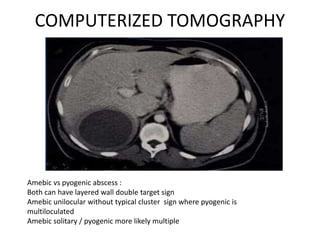
COMPUTERIZED TOMOGRAPHY
Amebic vs pyogenic abscess :
Both can have layered wall double target sign
Amebic unilocular without typical cluster sign where pyogenic is
multiloculated
Amebic solitary / pyogenic more likely multiple
Treatment
Antibiotics :
 Noninvasive infections can be treated with
paromomycin.
 Nitroimidazoles, especially metronidazole 750mg TDS
for 7 to 10 days , are the mainstays of treatment for
invasive amebiasis.
 Metronidazole reaches high concentrations in the liver,
stomach, intestine, and kidney. This antibiotic crosses
the placenta and blood-brain barrier and is
contraindicated in the first trimester of pregnancy.
Treatment
• Antibiotics
 Nitroimidazoles with longer half-life (secnidazole,
tinidazole, and ornidazole) are better tolerated
and can be given for shorter periods of time.
 Parasites persist in the intestine in up to 40–60%
of patients who get a nitroimidazole; thus
nitroimidazole treatment should be followed with
paromomycin 25-30mg/kg/day for 7days or
diloxanide furoate to cure luminal infection or
risk relapse from residual infection in the
intestine.
Therapeutic Aspiration
• Therapeutic aspiration may occasionally be
required as an adjunct to antiparasitic
treatment.
• Drainage should be considered in patients
that have no clinical response to drug therapy
within 5–7 days or those with a high risk of
abscess rupture defined as having a cavity >5
cm in diameter or by the presence of lesions
in the left lobe.
Percutaneous Drainage
• Image-guided percutaneous treatment (aspiration or
catheter drainage) has replaced surgical intervention as
the procedure of choice for decreasing the size of an
abscess.
• Percutaneous drainage remains most useful for treating
pulmonary, peritoneal, and pericardial complications. The
high viscosity of amebic abscess fluid, however, requires a
large diameter catheter for adequate drainage, and this
may cause more discomfort for the patient.
• Secondary infections related to the indwelling catheter
are always a risk of this intervention.
Complications
•Complications from amebic abscesses occur
secondary to rupture of the abscess into the
peritoneum, pleural cavity, or pericardium .
•Extrahepatic sites also have been described in
the lung, brain, skin, and genitourinary tract,
presumably from hematogenous spread.
Outcome
Independent risk factors for mortality include serum bilirubin
>3.5 mg/dL, encephalopathy, hypoalbuminemia defined as
<2.0 g/dL, and the presence of multiple abscess cavities.
FACTORS ASSOCIATED WITH A POOR OUTCOME IN PATIENTS
WITH AMEBIC LIVER ABSCESSES:
• Increased age
• Increased bilirubin level
• Pulmonary involvement
• Rupture or extension
• Late presentation
REFERENCE
• SABISTON 21TH EDITION .
• MAINGOT’S 13TH EDITION
• BAILEY AND LOVE 27TH EDITION
• THANK YOU

LIVER ABSCESS.pptx

  • 1.
    LIVER ABSCESS Dr sujanpandey Surgery resident
  • 2.
    overview • INTRODUCTION • CLASSIFICATION •ETIOLOGY • PATHOGENESIS • INVESTIGATIONS • TRREATMENT • OUTCOME
  • 3.
    Liver abscess • Occurswhen bacteria/protozoa/fungal destroy hepatic tissue, produces a cavity which fills up with infective organisms, liquefied cells & leucocytes. Necrotic tissue then falls off the cavity from rest of the liver.
  • 4.
  • 5.
    Pyogenic Liver Abscess •Male preponderance • Average age – between 43 & 60 years
  • 6.
    • More commonin Right lobe • Left lobe receives blood from -inferior mesentric -Splenic veins • Right lobe receives blood from -superior mesentric -portal veins Streaming effect in portal circulation is causative.
  • 7.
    ETIOLOGY • Kupffer cellsact as a filter for the clearance of microorganisms in the liver. These organisms reach the liver via the bloodstream, the biliary tree, or by direct extension. • Abscesses occur when normal hepatic clearance mechanisms fail or the system is overwhelmed. • Parenchymal necrosis and hematoma secondary to trauma, obstructive biliary processes, ischemia, and malignancy also promote invasion of microorganisms
  • 8.
    • In orderto appropriately treat the abscess, source control is required. Six distinct categories have been identified as potential sources: (1) Bile ducts,causing ascending cholangitis. (2) Portal vein, causing pylephlebitis from appendicitis or diverticulitis (3) Direct extension from a contiguous disease (4) Trauma due to blunt or penetrating injuries (5) Hepatic artery, due to septicemia and (6) Cryptogenic
  • 10.
    Disease of thebiliary system 1. Malignancy. 2. Intrahepatic stones and biliary stricture 3.Manipulation of the biliary tree cholangiography, percutaneous transhepatic stents, endoscopic stent placement, and biliary- enteric anastomoses.
  • 11.
    Intestinal pathology Transient bacteremiadue to bacterial translocation or frank gastrointestinal perforation cause overwhelming numbers of microorganisms to spread via the portal venous system to the liver.  Appendicitis  Diverticulitis Perforated colon cancers  Abscesses elsewhere in the abdomen and pelvis remain common causes of pyogenic liver abscesses.
  • 12.
    Contiguous extension 1. Gangrenouscholecystitis. 2. Perforated ulcers. 3. Subphrenic abscesses. 4. Percutaneous drains 5. Trauma to the liver causes parenchymal necrosis and clot, which creates an ideal milieu for the seeding and proliferation of microorganisms and subsequent abscess formation.
  • 13.
    Arterial embolization ofbacteria via the hepatic artery 1. Intravenous drug abuse 2. hepatic artery chemoembolization 3.umbilical artery catheterization 4. Arterial embolization can also occur from distant infection in the heart, lungs, kidneys, bones, ears, and teeth.
  • 14.
    Predisposing Factors forPyogenic Liver Abscesses Children • Chronic granulomatous disease • Complement deficiencies • Leukemia • Malignancy • Sickle cell anemia • Inflammatory bowel disease • Polycystic liver disease • Congenital hepatic fibrosis • Post transplant liver failure • Necrotizing enterocolitis • Chemotherapy and steroid therapy • AIDS
  • 15.
    Predisposing Factors forPyogenic Liver Abscesses Adults • Diabetes mellitus • Cirrhosis • Chronic pancreatitis • Peptic ulcer disease • Inflammatory bowel disease • Jaundice • Pyelonephritis • Malignancy • Leukemia and lymphoma • Chemotherapy and steroid therapy • AIDS
  • 16.
    Pathology and bacteriology •The source of the liver abscess is predictive of the number, location, and size of the abscess affecting a given patient. • Portal, traumatic, and cryptogenic hepatic abscesses are solitary and large, while biliary and arterial abscesses are multiple and small. • Fungal abscesses are usually multiple, bilateral, and miliary. • Gram-Negative Aerobes 50–70 % of Patients Escherichia coli, Klebsiella species, enterococci, and Pseudomonas species are the most common.
  • 17.
    • In patientswith endocarditis and infected indwelling catheters :staphylococcus and streptococcus species are common .
  • 18.
    Clinical Presentation • Theclassic triad of fever, jaundice, and right upper quadrant tenderness • SYMPTOMS Fever (M/C) Weight loss Pain Nausea and vomiting Malaise Chills Anorexia Cough or pleurisy Pruritus Diarrhea
  • 19.
    Clinical Presentation • SIGN Rightupper quadrant tenderness Hepatomegaly Jaundice Right upper quadrant mass Ascites Pleural effusion or rub
  • 20.
    Clinical Presentation • LaboratoryEvaluation  Leukocytosis  Elevated alkaline phosphatase(M/C)  An elevated bilirubin and transaminases  Anemia, hypoalbuminemia, and prolonged prothrombin time (Blood cultures are positive in roughly 50% of cases. Culture of abscess fluid should be the goal in establishing microbiologic diagnosis.)
  • 21.
    Radiology • X raychest : elevated right hemidiaphragm, a right pleural effusion, right lower lobe atelectasis. •Abdominal films may show : hepatomegaly, air-fluid levels in the presence of gas-forming organisms, or portal venous gas if pylephlebitis is the source
  • 22.
    Elevated right hemidiaphragm Plainfilm of a barium enema performed on a patient with a large gas-filled abscess located in the right hepatic lobe. (Reproduced with permission from Zuidema GD: Shackleford’s Surgery of the Alimentary Tract, 4th ed.
  • 23.
    Ultrasound • Ultrasound willdistinguish solid from cystic lesions and is cost effective and portable. Ultrasound (US) is 80–95% sensitive but has limited utility in the morbidly obese and in lesions that are located under the ribs or in an inhomogeneous liver.
  • 24.
  • 25.
    Computed tomography • Computedtomography (CT) is more sensitive (95–100%) than USG in detecting hepatic abscesses. • On CT examination, an abscess is of lower attenuation than the surrounding liver, and the wall of the abscess may enhance with intravenous contrast administration. • Hypodense to surrounding parenchyma +/-enchanced rim sign. • Lesions are detectable to around 0.5 cm. • CT and USG may also be used to evaluate and potentially treat the source of infection by percutaneous drainage.
  • 26.
    CT CT Fluid Collectionwith surrounding stranding, edema, and inflammation
  • 27.
    low attenuation areain liver (a spot that appears on a radiographic image as less dense than the surrounding healthy tissue in that specific organ of the body)
  • 28.
    Treatment • Treatment ofthe abscess itself, • concomitant treatment of the source. • Steps in management include :  Antibiotic administration,  Radiologic confirmation by US or CT,  Drainage. Exceptions to this strategy include multiple small abscesses and miliary fungal abscesses. These abscesses are treated with intravenous antibiotics and antifungals respectively, without a drainage procedure.
  • 29.
    Antibiotics • After confirmatoryimaging with US or CT, abscesses are aspirated, blood cultures are drawn, and broad- spectrum intravenous antibiotics are administered until sensitivities allow a more selective antibiotic choice. • Classic antibiotic regimens include an aminoglycoside, clindamycin, and either ampicillin or vancomycin. Fluoroquinolones can replace aminoglycosides, and metronidazole can be used instead of clindamycin, especially if an amebic source is suspected. • Carbapenems are recommended when extended spectrum β-lactamase–producing strains are isolated. • •Treatment used to be given for 4–6 weeks;
  • 30.
    Antibiotics • Antibiotics alonehave an 80% success rate for solitary abscesses with a diameter <5 cm. • In a series of 107 patients with unilocular hepatic abscesses of <3 cm, treatment with antibiotics alone had a 100% success rate. • In the setting of multiple abscesses <1.5 cm in size and no concurrent surgical disease, patients may be treated with IV antibiotics alone. • However, multiple small abscesses frequently imply biliary tract disease and may require biliary drainage for source control.
  • 31.
    • Similarly, fungalabscesses are miliary in nature and not amenable to percutaneous or surgical drainage. • Prolonged systemic antifungals are the preferred treatment for fungal abscesses. • Higher doses of amphotericin B (2-9 g) are recommended by most experts because a cumulative dose of <2 g correlated with residual lesions at autopsy. • Cases of hepatosplenic candidiasis have been successfully treated with fluconazole. Symptoms improved at 3 to 8 weeks, but resolution of the lesions on CT scan was noted after at least 1 month of fluconazole.
  • 32.
    Needle Aspiration AndPercutaneous Catheter Drainage • Needle aspiration is less invasive, less expensive, and avoids all of the complications associated with catheter care. • Patients in whom percutaneous drainage is not appropriate include those patients with (1) multiple large abscesses; (2) a known intra-abdominal source that requires surgery; (3) an abscess of unknown etiology; (4) ascites
  • 33.
    • <5cm, singleabscess- needle aspiration or catheter • >5cm- catheter or surgery
  • 34.
    Needle Aspiration ofliver abscess However, recurrence rates and the requirement for surgical intervention may be greater in those who undergo aspiration alone.
  • 35.
    • USG orCT guided aspiration and drainage by using a pigtail catheter. Irrigation of abscess cavity with saline . Percutaneous Catheter Drainage
  • 36.
    Contraindications to catheterdrainage • Coagulopathy • A difficult access path to the cavity • Peritonitis • Complicated ,multiloculated ,thick walled abscess with viscous pus.
  • 37.
    A. CT demonstratinga pyogenic abscess in the right hepatic lobe. B. Contrast injected into the abscess cavity through a percutaneously placed drainage catheter. C. Sinogram performed 2 weeks later revealing a decrease in the size of the abscess cavity. D. CT after 4 weeks demonstrating complete resolution of the abscess. CT, computed tomography
  • 38.
    Surgical drainage • Abscesseswere drained extraperitoneally via a 12th-rib resection to avoid contamination of the peritoneal cavity. • With the advent of systemic antibiotics, transperitoneal surgical exploration also was considered a safe surgical approach. • The transperitoneal approach has the advantages of the ability to: (1) Treat the inciting pathology in the remainder of the abdomen/pelvis; (2) Gain access and exposure of the entire liver for evaluation and treatment; and (3) Access the biliary tree for cholangiography and bile duct exploration.
  • 39.
  • 40.
  • 41.
    Complications • Generalized sepsis •Pleural effusions • Empyema • Pneumonia. • Abscesses may also rupture intraperitoneally, which is frequently fatal. Usually, however, the abscess does not rupture, but develops a controlled leak resulting in a perihepatic abscess. • Pyogenic abscesses also can cause hemobilia and hepatic vein thrombosis.
  • 42.
    • Bacteremia isextremely common in K. pneumoniae liver abscesses as opposed to other types of pyogenic liver abscesses . • Disseminated intravascular coagulation, septic pulmonary emboli, and acute renal failure are also well-documented complications of K pneumoniae liver abscess.
  • 43.
    • A rarecomplication specific to Klebsiella hepatic abscesses is endogenous endophthalmitis, occurring in approximately 3% of cases.More common in diabetic patients.
  • 44.
  • 45.
    Amebic liver abscess •Amebic liver abscess is caused by the parasitic protozoan Entamoeba histolytica. The disease was described in association with blood and mucus diarrheal stools.
  • 46.
    Life cycle E.histolytica
  • 47.
    Etiology  E. histolyticais responsible for all forms of invasive disease.  The life cycle involves cysts, invasive trophozoites, and fecally contaminated food or water to initiate the infection.  Fecal-oral transmission occurs; the cyst passes through the stomach into the intestine unscathed, and then pancreatic enzymes start to digest the outer cyst wall.  The trophozoite is then released into the intestine and multiplies there. Normally, no invasion occurs, and the patient develops amebic dysentery alone or becomes an asymptomatic carrier.
  • 48.
    Etiology  In asmall number of cases, the trophozoite invades through the intestinal mucosa, travels through the mesenteric lymphatics and veins, and begins to accumulate in the hepatic parenchyma, forming an abscess cavity.  Liquefied hepatic parenchyma with blood and debris gives a characteristic "anchovy paste" appearance to the abscess.
  • 49.
    Pathology • 90% ofpeople that become infected with E. histolytica are asymptomatic. • These cysts are resistant to the effects of gastric acid pH, but become stimulated to form trophozoites in the alkaline pH of the bowel. • Trophozoites are found in the colon and in the feces of humans and mammals. • Humans become reservoirs, and transmission occurs by ingesting food and water contaminated with amebic cysts, or occasionally through person-to-person contact. • Incubation takes 1–4 weeks. Left untreated, asymptomatic individuals may shed cysts for many years.
  • 50.
    Pathology  Invasive amebiasiscan include anything from amebic dysentery to metastatic abscesses.  The most common form of the invasive disease is colitis.  The majority (70–80%) of patients experience a gradual onset of symptoms with worsening diarrhea, abdominal pain, weight loss, and stools consisting of blood and mucus.  Trophozoites invade and induce apoptosis in colonic mucosa resulting in "buttonhole" ulcers with undermined edges.  Trophozoites are actually found in the edge of the ulcers.
  • 51.
    Pathology  The mostcommon extraintestinal site of amebiasis is the liver, occurring in 1–7% of children and 50% of adults (usually males) with invasive disease. Trophozoites reach the liver through the portal system, causing focal necrosis of hepatocytes and multiple micro-abscesses that coalesce into a single abscess. The central cavity of the lesion contains a homogenous thick liquid that is typically red/brown and yellow in color and similar to anchovy paste in consistency.
  • 53.
    Clinical Presentation • SYMPTOM Pain 90%  Fever 87%  Nausea and vomiting 85%  Anorexia 50%  Weight loss 45%  Malaise 25%  Diarrhea 25%  Cough or pleurisy 25%  Pruritus 1%
  • 54.
    Clinical Presentation SIGN  Hepatomegaly85% Right upper quadrant tenderness 84% Pleural effusion or rub 40 %  Right upper quadrant mass 12%  Ascites 10 %  Jaundice 5 %
  • 55.
    Clinical Presentation LABORATORY DATA Increased alkaline phosphatase  WBC count >10,000/mm3  Hematocrit <36%  Albumin <3 g/dL Bilirubin >2 mg/dL (stool examination:ova and cysts of E. histolytica)
  • 56.
    Distinguishing Clinical Characteristics ofPatients with Hepatic Abscesses
  • 57.
    Distinguishing Clinical Characteristics ofPatients with Hepatic Abscesses • Amebic Pyogenic Age <50 years Age >50 years Male:female ratio 10:1 Male:female ratio 1:1 Hispanic descent No ethnic predisposition Recent Travel to endemic area Malignancy Pulmonary dysfunction High fevers Abdominal pain Pruritus Diarrhea Jaundice Abdominal tenderness Septic shock Hepatomegaly Palpable mass
  • 58.
    Radiology Chest radiographs frequentlyshow: • Pleural effusion, infiltrates, or an elevated hemidiaphragm. • Single abscess is present and in the right lobe, 10% are in the left lobe, and the rest are multiple. • The mean resolution time is 7 months, and 70% have findings that persist for more than 6 months. • Eventually, resolution may be complete or result in a small residual cystic cavity that resembles a simple cyst of the liver.
  • 59.
    • X raychest: • Elevated right hemidiaphragm, • Right pleural effusion, • Right lower lobe atelectasis.
  • 60.
    Amoebic liver abscessburst into the right pleural cavity.
  • 61.
    ULTRASOUND ultrasonography image demonstratinga well-defined collection with a hypoechoic wall and internal contents that shows fine low-level echoes consistent with features of amoebic liver abscess.
  • 62.
    COMPUTERIZED TOMOGRAPHY Amebic vspyogenic abscess : Both can have layered wall double target sign Amebic unilocular without typical cluster sign where pyogenic is multiloculated Amebic solitary / pyogenic more likely multiple
  • 63.
    Treatment Antibiotics :  Noninvasiveinfections can be treated with paromomycin.  Nitroimidazoles, especially metronidazole 750mg TDS for 7 to 10 days , are the mainstays of treatment for invasive amebiasis.  Metronidazole reaches high concentrations in the liver, stomach, intestine, and kidney. This antibiotic crosses the placenta and blood-brain barrier and is contraindicated in the first trimester of pregnancy.
  • 64.
    Treatment • Antibiotics  Nitroimidazoleswith longer half-life (secnidazole, tinidazole, and ornidazole) are better tolerated and can be given for shorter periods of time.  Parasites persist in the intestine in up to 40–60% of patients who get a nitroimidazole; thus nitroimidazole treatment should be followed with paromomycin 25-30mg/kg/day for 7days or diloxanide furoate to cure luminal infection or risk relapse from residual infection in the intestine.
  • 65.
    Therapeutic Aspiration • Therapeuticaspiration may occasionally be required as an adjunct to antiparasitic treatment. • Drainage should be considered in patients that have no clinical response to drug therapy within 5–7 days or those with a high risk of abscess rupture defined as having a cavity >5 cm in diameter or by the presence of lesions in the left lobe.
  • 66.
    Percutaneous Drainage • Image-guidedpercutaneous treatment (aspiration or catheter drainage) has replaced surgical intervention as the procedure of choice for decreasing the size of an abscess. • Percutaneous drainage remains most useful for treating pulmonary, peritoneal, and pericardial complications. The high viscosity of amebic abscess fluid, however, requires a large diameter catheter for adequate drainage, and this may cause more discomfort for the patient. • Secondary infections related to the indwelling catheter are always a risk of this intervention.
  • 67.
    Complications •Complications from amebicabscesses occur secondary to rupture of the abscess into the peritoneum, pleural cavity, or pericardium . •Extrahepatic sites also have been described in the lung, brain, skin, and genitourinary tract, presumably from hematogenous spread.
  • 69.
    Outcome Independent risk factorsfor mortality include serum bilirubin >3.5 mg/dL, encephalopathy, hypoalbuminemia defined as <2.0 g/dL, and the presence of multiple abscess cavities. FACTORS ASSOCIATED WITH A POOR OUTCOME IN PATIENTS WITH AMEBIC LIVER ABSCESSES: • Increased age • Increased bilirubin level • Pulmonary involvement • Rupture or extension • Late presentation
  • 70.
    REFERENCE • SABISTON 21THEDITION . • MAINGOT’S 13TH EDITION • BAILEY AND LOVE 27TH EDITION
  • 71.